































U.S. officials slam ‘lunatic’ Francesca Albanese, say next U.N. secretary-general must change course
Jeff Bartos, a U.S. representative to the U.N., said the institution is ‘at a crossroads’ and that the coming turnover in leadership is an opportunity to ‘move in a new direction’

Aaron Schwartz/Bloomberg via Getty Images
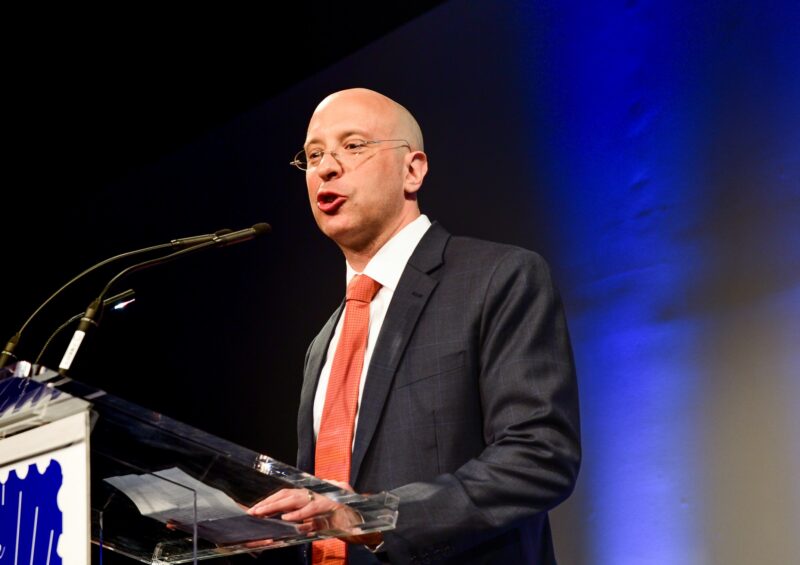
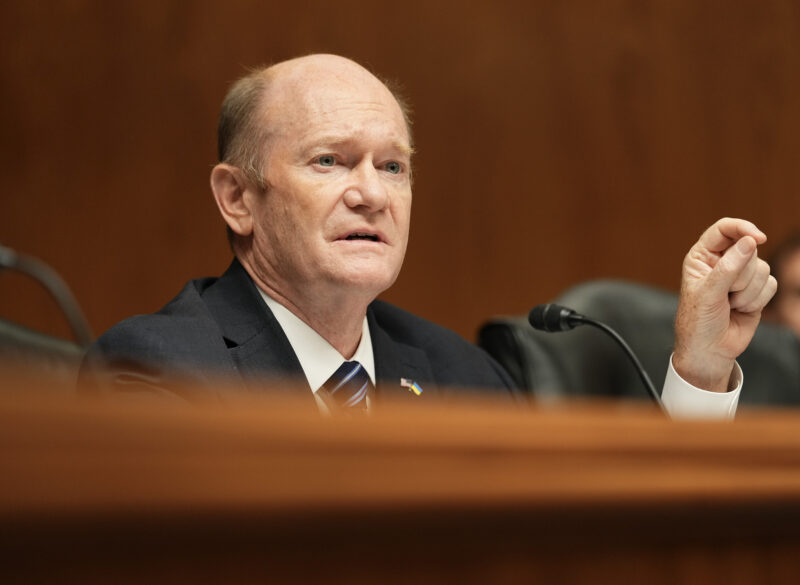
Mike Waltz, U.S. ambassador to the U.N., left, and Jeff Bartos, representative to the U.N. for management and reform, during a House Foreign Affairs Committee hearing in Washington, DC, on July 22, 2026.


 Add JewishInsider on Google
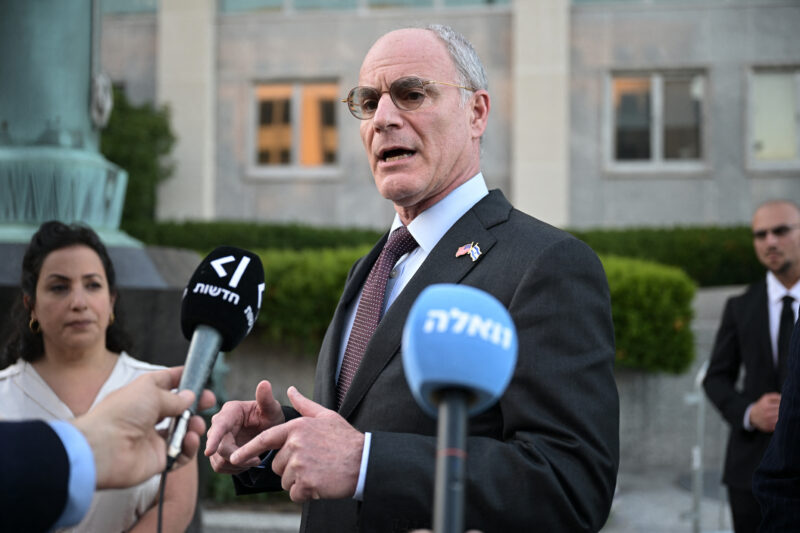
U.S. representatives to the United Nations slammed Francesca Albanese, the U.N. special rapporteur on the Palestinian territories who has faced repeated accusations of antisemitism, and said at a hearing on Wednesday that the next U.N. secretary-general will be faced with a choice of whether to turn the page on the institution’s antisemitic and anti-Israel bias.
Jeff Bartos, the U.S. representative to the U.N. for management and reform, said before the House Foreign Affairs Committee that the U.N. is “really at a crossroads” — saying it does important humanitarian work but also “employs a lunatic like Francesca Albanese, an absolute lunatic.”
“She puts on that U.N. uniform, and it’s such a disservice to the brave humanitarians who are out in the field risking their lives for total strangers,” Bartos said. “It does such a disservice to the brand of the U.N. It is the greatest self-sabotage, as a businessman, I’ve ever seen in my business career, that the U.N. allows its brand to be soiled and spoiled by this bigot.”
He said that the U.S. wants to see the next secretary-general, after Secretary-General António Guterres steps down in December, take a different approach, and that the U.S. is trying to “guide” the U.N. “in the right direction.”
“The U.N. has a decision to make with a new secretary-general coming in,” Bartos said. “Are they going to continue to tolerate this hatred of America and the West and Jews and Israel? Are they going to move in a new direction? We are not only watching it closely, we have a great team that works on it every day, and rest assured that we are going to hold them accountable.”
Jeff Bartos (@AmbUNReform), the U.S. representative to the U.N. for management and reform, said before a House committee that the U.N. is “really at a crossroads” — saying it does important humanitarian work but also “employs a lunatic like Francesca Albanese, an absolute… pic.twitter.com/Ka6DJSlfp1
— Jewish Insider (@jewishinsider) July 23, 2026
He said that the U.N. must pick a secretary-general with “leadership, the moral clarity and the courage to tackle this,” calling it an “existential issue for the organization about whether it wants to be a hotbed of hatred for the one Jewish state and for the West, or whether it wants to get back to basics, its core founding mission of international peace and security and humanitarian aid.”
Both Bartos and U.S. Ambassador to the U.N. Mike Waltz condemned the United Nations Relief and Works Agency and the U.N. system’s response to the Oct. 7, 2023 Hamas attacks on Israel. Bartos said that UNRWA has “no future” in Gaza, highlighting recent comments he made at an UNRWA conference urging other countries not to keep putting money into the agency.
“What was different this year … was the acting director of UNRWA actually agreed to a couple of the points we raised,” Bartos said. “I almost fell over in my chair. Are we making progress? Glacially, but we are making progress.”
Waltz said that the U.S. is working with various partners, including the Palestinian Authority and the Gaza technocratic government under the auspices of the Board of Peace, as well as countries like Morocco and the United Arab Emirates to reform anti-Israel and pro-terrorism curricula promulgated by UNRWA in Gaza and to see that governmental institutions take over responsibilities like education.
Bartos described legislation led by Reps. Mike Lawler (R-NY) and Josh Gottheimer (D-NJ) aimed at dismantling and replacing UNRWA as “terrific” and said that the State Department would support it.
Asked about Turkey’s relationship with Hamas and other activities at odds with U.S. interests, Waltz described Turkey as an ally, if a sometimes “difficult” one, and emphasized that the U.S. is working with the Turkish government to take action against Hamas-supporting charities operating in Turkey.
Waltz also said that the U.S. has stripped taxpayer funding from the U.N. organizations like UNRWA that have been particularly involved in antisemitic and anti-Israel bias, as it works to try to repair and reform them.
Waltz indicated that, in spite of the collapse of the U.S.-Iran ceasefire, U.S. technical negotiators remain engaged in talks with Iran over its nuclear program. He noted that the regime is still trying to reconstitute its nuclear program and maintains its stockpiles of highly enriched uranium.
Waltz also said that the U.S. and other parties are still negotiating what will replace the United Nations Interim Force in Lebanon, which is set to shut down. Some partners and the U.N. have urged replacing it with a similar body, in spite of UNIFIL’s longstanding failures.
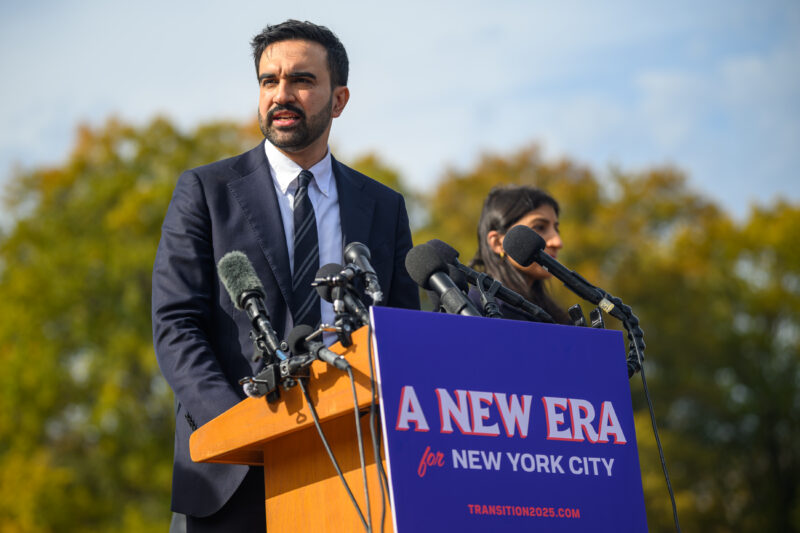
Pushing back on New York City Mayor Zohran Mamdani, Waltz said during the hearing that Mamdani does not have the authority to arrest Israeli Prime Minister Benjamin Netanyahu — as Mamdani acknowledged this week.
He questioned why Mamdani has not threatened action against malign actors like officials from Iran or North Korea and condemned efforts by a Mamdani administration official to meet with Iranian government representatives.
“On the eve of Tisha B’Av, it’s fundamentally offensive that the mayor is spending any of his time on this issue,” Bartos added.
Three senior officials with the board are requesting $200 million from Congress to support the International Stabilization Force in Gaza
Chip Somodevilla/Getty Images
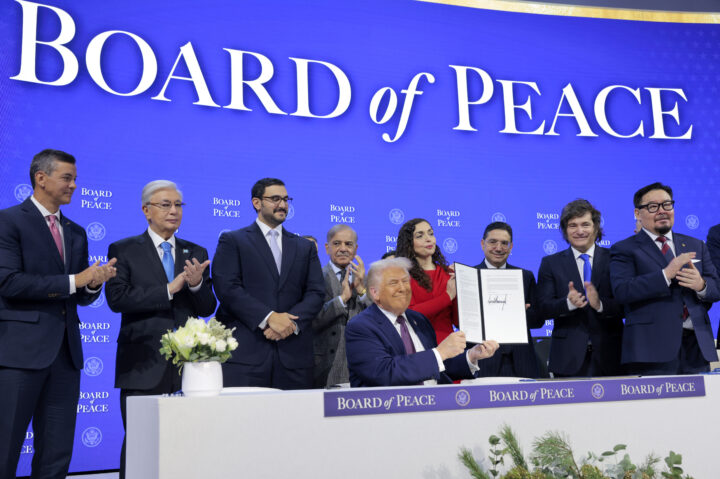
President Donald Trump holds up his signature on the founding charter during a signing ceremony for the “Board of Peace” at the World Economic Forum (WEF) on January 22, 2026 in Davos, Switzerland.
Three senior U.S. officials connected to the Board of Peace, the Trump-led body created to resolve the conflict in Gaza, have been meeting with congressional offices this week to request $200 million for a peacekeeping force, according to two people with knowledge of the meetings. The meetings mark the first time that Board of Peace representatives have approached Congress with a funding request.
Jasper Jeffers, an American military officer serving as commander of the International Stabilization Force, the United Nations-mandated peacekeeping force created in last year’s ceasefire deal between Israel and Hamas; Board of Peace senior advisor Josh Gruenbaum; and retired Gen. Mark Schwartz, a former U.S. security coordinator for Israel and the Palestinian Authority who is now the Board of Peace’s security lead, spoke at the Capitol Hill meetings.
The ISF, which was part of President Donald Trump’s 20-point peace plan announced last September, has struggled to find backers. Indonesia, Morocco, Kazakhstan, Kosovo and Albania pledged troops to the effort, but most have not yet done so. Indonesia paused its plans in March during the Iran war. What was billed as a 20,000-troop force has fewer than 20 initial members, according to a Wall Street Journal report this week. The ISF’s goal is to demilitarize Gaza and keep Hamas out of power, and countries have voiced concerns over whether their troops would be required to militarily confront Hamas.
Gruenbaum, Jeffers and Schwartz have met or plan to meet with staff from the Senate Foreign Relations Committee, the House Foreign Affairs Committee and the national security-focused subcommittees on the House and Senate Appropriations committees. A Board of Peace official called the meetings “extensive and highly constructive.”
“The delegation shared the progress that the Board has made in recent weeks, including movement toward the establishment of a humanitarian pilot [program] in Gaza, ongoing efforts in negotiations to disarm Hamas, preparations for the Palestinian technocratic government to assume authority, the huge improvement in the humanitarian situation, the pending start of training for a civilian police and the recent and ongoing scale-up in manpower and logistics for the International Stabilization Force,” the official told Jewish Insider.
The requested $200 million for peacekeeping operations, or PKO — a specific category in the Foreign Assistance Act — is primarily intended to fund the International Stabilization Force, according to a source with knowledge of the Board of Peace’s activities.
The request is for discretionary funding, rather than a direct congressional appropriation for the Board of Peace. The Board of Peace source said conversations about congressional appropriations for the body may come later.
The Board of Peace official said the congressional meetings marked “the start of an extensive effort to work with Congress” in order to “transform Gaza into a place of peace, prosperity, economic development and reconstruction.”
Earlier in the week, Board of Peace officials met in Brussels with senior Palestinian Authority leaders, and the European Union committed to providing $1 billion toward Gaza recovery efforts.
Trump said that the U.S. must respond to the military provocation
U.S. Navy via Getty Images
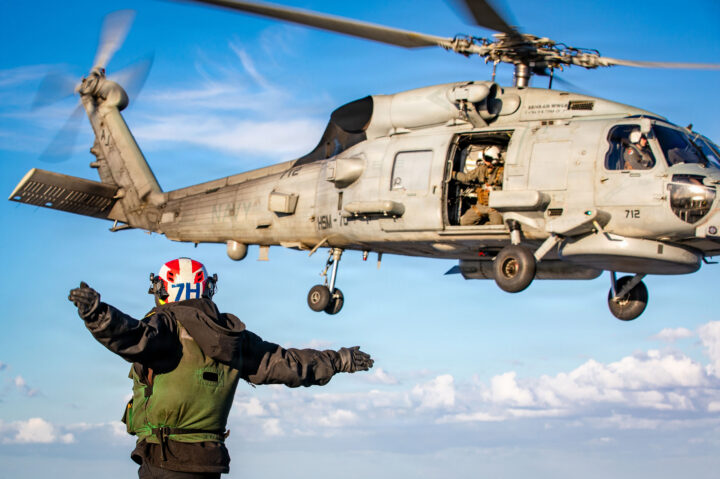
A U.S. Sailor signals the launch of an MH-60R Sea Hawk helicopter, attached to Helicopter Maritime Strike Squadron 70, on the flight deck of the world's largest aircraft carrier, USS Gerald R. Ford (CVN 78), while supporting Operation Epic Fury on February 28, 2026.
President Donald Trump’s declaration that the U.S. “must, of necessity, respond” to Iran’s downing of a U.S. Army Apache helicopter off the coast of Oman on Monday evening received support from GOP lawmakers on Capitol Hill, several of whom called for a powerful military retaliation.
U.S. officials confirmed to CNN that the attack helicopter — whose pilots Trump said were successfully rescued — was brought down by an Iranian one-way attack drone. The high-stakes incident marks the most serious uptick in direct hostilities between Washington and Tehran in weeks, occurring amid diplomatic efforts to end the regional war and begin negotiations to curb Tehran’s nuclear program.
“I agree with the president, there should be significant consequences,” Sen. Ted Cruz (R-TX) told Jewish Insider.
“Enough is enough,” Cruz later wrote on X. “President Trump and our Armed Forces decimated Iran militarily, but the Iranian regime has been trying to rebuild and now they’ve taken down an American Apache. President Trump is absolutely right. There is a pressing necessity for the U.S. to respond to this attack.”
Rep. Mike Rogers (R-AL), who chairs the House Armed Services Committee, also called for a powerful response, urging Trump to look at “meaningful options.”
“We need to vigorously respond,” Rogers said. “We can’t let anybody shoot down one of our helicopters and it not be responded to.”
Sen. Ted Budd (R-NC) similarly pushed for “decisive action” in order to put the looming Iranian threat “behind us.”
“I think America would be in a better place if we had this behind us and clear, decisive action that would bring an absolute end to this so we don’t have to do it again,” Budd told JI. “They [Iran] cannot persist to threaten us and then develop nuclear weapons. … They should never ever have a nuclear weapon.”
While some regional experts agreed that the Iranian attack necessitates a firm U.S. military reaction, they argued that any such response is likely to be limited in scope and is not anticipated to trigger a return to full combat operations, nor is it expected to derail ongoing negotiations given the president’s focus on a diplomatic exit.
“If information is correct, that Iran shot down a U.S. helicopter, then the president is correct, the United States does need to respond,” said former U.S. Ambassador to Israel Dan Shapiro, who later served as deputy assistant secretary of defense in the Biden administration. “That’s a very serious attack, which thankfully did not seem to take the lives of the two aviators, but it needs a response.”
Shapiro noted that while U.S. action is necessary, the retaliation will likely be calibrated to avoid escalation, as Trump remains intensely “motivated” to secure a broader deal that would reopen the Strait of Hormuz.
“U.S. Central Command will be able to give [Trump] options that will include a meaningful response against an Iranian military target, but one that does not necessarily produce a strong Iranian response that leads to an escalatory cycle,” Shapiro explained. “If he wants to succeed in negotiations, say, on the war, he needs to respond, but do it in a way that leads to a de-escalation.”
Alexander Gray, who served as chief of staff on the National Security Council during Trump’s first administration, also anticipates a precise, “proportional blow against key Iranian targets.”
“The president has responsibly maintained considerable American military power in the vicinity of Iran, both conducting the U.S. Navy’s successful blockade, but also being held in reserve should the need arise to continue kinetic military operations,” Gray said. “The president will likely strike a proportional blow against key Iranian targets, while keeping in mind the broader American strategic imperative of concluding this conflict with a diplomatic solution that advances American interests in the region.”
Steven Cook, a senior fellow for Middle East studies at the Council on Foreign Relations, agreed that failing to respond would be a political and strategic impossibility for the White House.
“It would be hard for the president not to respond, though I suspect that this is not a return to combat,” Cook observed. “Trump will likely direct CENTCOM to take out one or several high-value targets.”
Analysts noted that the exchange is unlikely to impact the high-level talks or alter the calculations of either side, as negotiators continue to work out an agreement.
“It doesn’t necessarily push a deal further off the table,” Shapiro said. “It sounds like negotiators are close to a deal. Until there is a deal, though, exchanges in a ceasefire that has seen numerous violations of it are not surprising, but if both sides are motivated to get a deal, this will not prevent it from happening.”
Cook said that a minor strike could solidify Tehran’s perception of American vulnerability.
“I don’t believe that a tit-for-tat exchange will significantly alter Iran’s view that it has time on its hands and that the president is desperate for a deal,” Cook said. “It seems clear that the president does not want anything to upset negotiations and the chances of a negotiated way out of the conflict. The Iranians do not seem willing to give him anything that he could call a victory, however. The result is likely to be a continued stalemate.”
Iran has similarly appeared to prefer a diplomatic exit over renewed escalation. Iranian Foreign Minister Abbas Araghchi on Tuesday said that Iranian leaders “prefer language of diplomacy but speak other languages too.”
“Foreign forces in proximity to our territory are at constant risk on account of their own human errors, plain accidents, or potentially being caught in crossfire,” Araghchi posted on X following the incident. “To reduce risk, best solution is for them to leave.”
Aaron David Miller, a senior fellow at the Carnegie Endowment for International Peace and a former State Department negotiator, said the incident reflects a “manifestation of how emboldened [the Iranians] are and how willing they are to take risks.”
While Miller warned against a heightened response, he noted that even restrained exchanges could lead to eventual escalation if a final diplomatic breakthrough is not reached soon.
“If [Trump] doesn’t [limit the response], then what he’s going to trip into is a very hard response if he goes after directly Iranian targets on the mainland,” Miller warned. “The longer this goes on without having an agreement, it’s inevitable that this is going to escalate.”
The core parameters of a potential deal have been “evident for quite some time,” Miller added, but concluded it will ultimately require a painful political calculation from both Washington and Tehran.
“Both sides must be prepared to accept a situation in which they’re going to perceive to have given something up,” Miller said.
Senior congressional correspondent Marc Rod contributed reporting
Counterterrorism official Seb Gorka said U.S. officials would meet with allies later this week to ask for assistance in combating terrorism abroad
Daniel SLIM / AFP via Getty Images
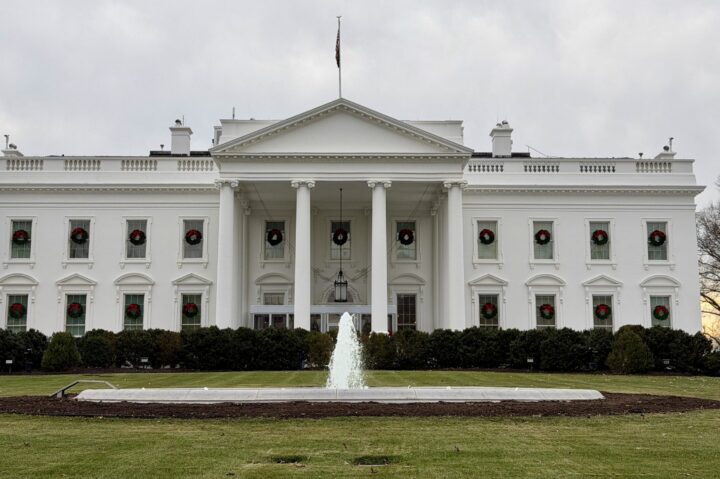
The White House is seen in Washington, DC, on December 17, 2025.
Sebastian Gorka, the National Security Council’s senior director for counterterrorism, announced while unveiling President Donald Trump’s U.S. counterterrorism strategy on Wednesday that U.S. officials will meet with representatives from several foreign governments this week to ask for assistance in combating terrorism emanating from Iran and elsewhere.
Gorka, who also serves as a deputy assistant to the president and oversaw the drafting of the strategy, told reporters that as part of the strategy, the U.S. intends to seek more support on the counterterrorism front from allies who want to be “measured as a serious nation” by the Trump administration.
The strategy covers how the administration will respond to threats from Islamic terrorist organizations at home and abroad, drug cartels in the Western Hemisphere and domestic political groups accused of inciting violence.
On combating threats from Islamist groups, the strategy places a heavy emphasis on Iran, calling the country “the greatest threat to the United States emanating from the Middle East.” It states that “decisive actions by the president … will continue until the regime in Tehran is no longer a threat to the United States.”
The U.S. will use “kinetic, intelligence, and cyber operations against Iranian-backed terror proxies who plot against Americans … Iranian dissidents and Israelis in our country,” it continues.
The strategy further states that the U.S. views the Muslim Brotherhood as “the root of all modern Islamist terrorism,” and says the Trump administration will “continue to designate its branches across the Middle East and beyond as [Foreign Terrorist Organizations] to crush the organization everywhere it operates.”
Gorka detailed to reporters how the U.S. is turning increased attention to Africa amid growing terrorist threats, describing “straggler” ISIS terrorists from Syria and Iran who had migrated to several African countries in search of “ungoverned space” to take over.
The president signed the official document behind closed doors at the White House on Monday alongside senior administration officials.
Gorka announced the strategy’s finalization while speaking at the James W. Foley Freedom awards dinner at the National Press Club on Tuesday evening. Gorka brought a copy of the strategy with him on stage and held it up for the audience of hostage advocates, telling the crowd that Trump had signed the document on Monday and it would be available to the public on Wednesday morning.
Gorka read a brief section of the strategy that referred to the return of U.S. hostages and wrongfully detained Americans abroad as a top priority.
“Countries that wrongfully detain our citizens run the danger of being designated as state sponsors of wrongful detention, with all the attendant consequences that accrue,” Gorka said. “And as the regimes in Iran and Afghanistan know, there are true consequences to that designation.”
The strategy’s signing and release comes as Gorka, who has been one of the most ardent defenders of the U.S. war with Iran in the Trump administration, has been reportedly lobbying the president to consider nominating him as the next director of the National Counterterrorism Center. The role is currently being filled in an acting capacity by Joe Weirsky, a Marine and Army Special Operations Command veteran, following the resignation of former NCTC Director Joe Kent in protest of the war.
The Senate minority leader was pressed by MS NOW’s Joe Scarborough on his view of the U.S. and Israel’s war achievements

Samuel Corum/Getty Images
Senate Minority Leader Chuck Schumer (D-NY) makes a statement alongside House Minority Leader Hakeem Jeffries (D-NY) outside of the West Wing at the White House on January 17, 2024 in Washington, DC.
Senate Minority Leader Chuck Schumer (D-NY) did not directly address whether the degradation of Iran’s military infrastructure should be viewed as a positive outcome, instead emphasizing the war’s potential economic and geopolitical consequences.
Over the course of the past week, U.S. officials have indicated that Iran’s military capabilities have been severely weakened. President Donald Trump has described Iran’s military as “decimated,” and Director of National Intelligence Tulsi Gabbard testified at a congressional hearing this past week that the Iranian regime was “largely degraded.”
When asked by MS NOW’s Joe Scarborough on Monday’s edition of “Morning Joe” whether that degradation was a “good thing,” Schumer called the question “premature.”
“You can’t [answer that question] because it’s a premature question,” Schumer said. “What is going to happen in the next several months? Is it worth it? Will the world economy collapse?”
“I can ask that question,” Scarborough replied. “I’m simply asking on the military side: Is it good — regardless of whether we agree with going in or not — is it good that Iran’s military infrastructure has been seriously degraded?”
Schumer again asserted that it could not be answered without understanding the full implications of the current conflict.
“In all due respect, if you ask the American people, if you have the choice of degrading the military structure in Iran, but having gasoline be $6 a gallon and our economy falling into a deep recession where millions lose their job, what do you think?”
Schumer ultimately signaled agreement with that underlying point, while maintaining his broader concerns.
“The fact that the leader [Ayatollah Ali] Khamenei is gone, no one regrets that. The fact that Iran has less ability to create military trouble [is a good thing], no one disputes that. But you have to look at the consequences.”
Schumer argued that Congress would have had a clearer understanding of the potential economic and geopolitical consequences had lawmakers passed one of several war powers resolutions — an effort that has been voted down by House and Senate Republicans with several Democrats joining them on several instances within the past month.
“If Republicans had voted with us on the War Powers Act, all these questions would have been asked ahead of time instead of Donald Trump’s willy-nilly — one day yes, one day no,” Schumer said.
Trump made the remarks in a Truth Social post, in which he threatened that the U.S. would bomb the South Pars gas field if Iran does not stop attacking Qatar
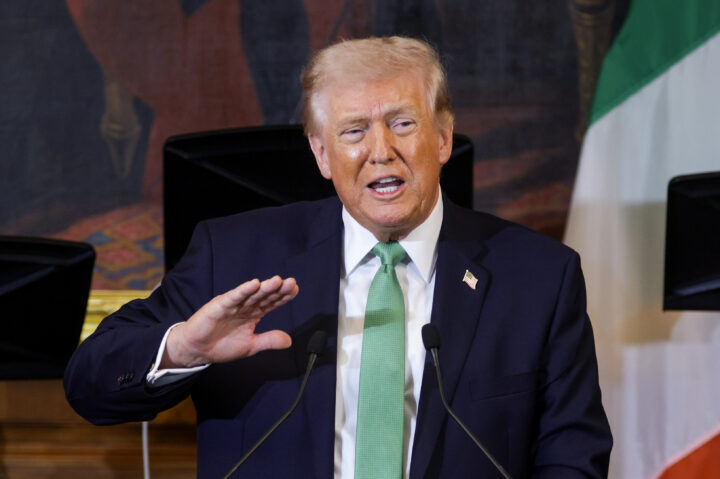
Alex Wong/Getty Images
President Donald Trump speaks during the annual Friends of Ireland Luncheon at the U.S. Capitol on March 17, 2026 in Washington, DC.
Current and former Israeli and U.S. officials suggested that an Israeli strike on an Iranian gas field on Wednesday that prompted the Islamic Republic to strike Qatar was coordinated with the White House, despite President Donald Trump’s claim that the U.S. “knew nothing about this particular attack.”
Trump made the remarks in a Truth Social post, in which he threatened that the U.S. would bomb the South Pars gas field, the Iranian portion of the larger field shared with Qatar, if Iran does not stop attacking Qatar.
“The United States knew nothing about this particular attack, and the country of Qatar was in no way, shape or form involved with it, nor did it have any idea that it was going to happen. Unfortunately, Iran did not know this … and unjustifiably and unfairly attacked a portion of Qatar’s [liquid natural gas] facility,” the president wrote.
If “Iran unwisely decides to attack a very innocent, in this case, Qatar,” he added, the U.S., “with or without the help or consent of Israel, will massively blow up the entirety of the South Pars Gas Field at an amount of strength and power that Iran has never seen or witnessed before.”
An Israeli official told Kan News, Israel’s public broadcaster, that the attack on the South Pars gas field was coordinated with the U.S.
Dan Shapiro, the former U.S. ambassador to Israel and Pentagon official in the Biden administration, wrote on X, “Trump can post whatever he likes. But there is zero, I mean zero, chance the IDF would conduct a strike in that location without giving CENTCOM full visibility.”
“Trump knew (and approved),” Shapiro added. “Now he realizes it caused a major escalation with Iran’s (entirely unjustified) attacks on Gulf energy targets.”
Shapiro later clarified that the Israeli strike “could not have been carried [out] without U.S. knowledge and explicit or implicit approval.”
“It was predictable that strikes on Iranian energy facilities (by US or Israel) would lead to Iranian strikes on Gulf energy facilities,” he wrote. “There is a narrow window following the Israeli and Iranian strikes, and Trump’s Truth Social Post (untrue, but possibly useful in this context), to de-escalate away from further strikes on energy industry targets in either direction. That will still leave a very challenging situation to unwind, but [it] would be the best near-term development.”
Gilad Erdan, a former Israeli ambassador to Washington and a former member of Israel’s Security Cabinet, told Jewish Insider that it was highly likely the U.S. knew about the strike, saying that Trump did not criticize Israel in his post, and “in the same breath” as saying the U.S. was unaware, “[Trump] himself threatened to erase the [gas] field.”
Erdan noted that the South Pars gas field is “used for Iran’s domestic energy needs [and] doesn’t harm the international energy market.”
“Israel took upon itself to be at the front [of the situation] in my estimation because the field is also Qatari,” Erdan, who is also a senior fellow at the Misgav Institute for National Security, said. “Someone had to send the deterrent message about the energy field to the Iranians, that if they continue, then all options are open against them and they will be hurt badly.” (The writer is a senior fellow at the Misgav Institute and cohosts its podcast.)
Yaakov Katz, an Israeli military expert and author of While Israel Slept: How Hamas Surprised the Most Powerful Military in the Middle East, told JI that he agreed with Shapiro’s assessment. “There is no way Israel would attack such a strategic facility [without coordination] because they know it would draw the Iranians to attack the Gulf states,” he said.
Katz pointed to Israeli Prime Minister Benjamin Netanyahu’s behavior since the war with Iran began late last month as further indication that Israel was unlikely to make such a move without coordinating with the U.S.: “Why would Netanyahu who behaved so carefully all throughout the war, coordinating with Trump to not upset him so he keeps the war going … do something that would anger Trump and potentially lead him to do something brash and declare the war is over?”
“It was coordinated, and now Trump is saying what he’s saying to distance himself, but it was done to send a message to the Iranians,” Katz added.
Also Thursday, Saudi Arabia released a statement with the foreign ministers from Azerbaijan, Jordan, the UAE, Bahrain, Pakistan, Turkey, Syria, Qatar, Kuwait, Lebanon and Egypt urging Iran to stop its attacks.
“The participants held Iran fully responsible for the losses and called on Iran to immediately and unconditionally cease its aggression and to comply with UN Security Council resolutions. The meeting also emphasized the dangers of supporting militias and destabilizing security, stressing that Iran must seriously reconsider its miscalculations,” the statement read.
If Iran continues, the foreign ministers stated, there will be “serious consequences for Iran and the security of the region, and will exact a heavy price, casting a shadow over its relations with the countries and peoples of the region, who will not stand idly by in the face of threats to their capabilities.”
Sen. John Fetterman (D-PA): ‘Tree of Life to 10/07 to Bondi Beach: antisemitism is a rising and deadly global scourge’

Saeed KHAN / AFP via Getty Images
A Jewish community member reacts as he stands at the site of a terror attack at Bondi Beach in Sydney on December 14, 2025.
U.S. officials and lawmakers across the political spectrum are condemning the terrorist attack at a Chabad Hanukkah celebration Sunday outside Sydney, Australia, tying the murder of 15 attendees to the rise of antisemitism across the world.
Secretary of State Marco Rubio said in a statement that the United States “strongly condemns” the attack and that “antisemitism has no place in this world.”
U.S. Ambassador to the U.N. Mike Waltz said the “horrific and deadly terrorist attack” is a “sickening reminder that antisemitism remains a global threat. Under President Trump’s leadership, the United States will confront this hatred — at the U.N. and around the world — without apology or hesitation.”
FBI Director Kash Patel said he is “in touch with our counterparts in Australia” regarding the attack and is “providing the requested assistance,” while Attorney General Pam Bondi called it “heartbreaking news.”
U.S. Ambassador to Israel Mike Huckabee noted, as did several others, that Australian Prime Minister Anthony Albanese’s original statement on the attack did not specify its antisemitic nature. “The disgraceful statement from Australia PM never mentioned it was jihadist attack on Jews on first day of Hanukkah. Hope he’s ashamed of antisemitic statements past year,” Huckabee wrote on X.
On the Hill, lawmakers from both parties also expressed their shock and sadness. All 25 Jewish members of the House, on both the Republican and Democratic sides, issued a joint statement remembering the “Jewish families in Australia” who were “grotesquely targeted with hate and murderous intent.”
“Sadly, this attack does not come as a surprise to the Jewish community of Sydney who have been raising a clarion call for local and national authorities to take concrete steps against a rising tide of antisemitism,” the members, organized by Rep. Brad Schneider (D-IL), wrote. “Antisemitism is a cancer that eats at the core of society, whether in Australia, the United States, or anywhere it is allowed to take root and grow. We join leaders around the globe in condemning this evil act and in calling for justice, peace, and unwavering support for those affected. We also call on all leaders to do better standing up to antisemitism, bigotry, and hate.”
House Speaker Mike Johnson (R-LA) said the “tragic news” is “another wake-up call.”
“Jewish people must be free to practice their faith openly and without fear. Antisemitism must be confronted and defeated wherever it appears,” he wrote on X.
House Minority Leader Hakeem Jeffries (D-NY) said in a statement he was “horrified by the attack” and that it is “our collective responsibility to aggressively eradicate the poison of antisemitism whenever and wherever it is found.”
“Today, as the Jewish community throughout America gathers with their loved ones to celebrate Hanukkah, the New York Police Department and law enforcement resources across the country must be vigorously deployed to keep everyone safe. It is my sincere hope that the story of Hanukkah and the candles that will shine on windowsills in homes around the world will bring needed light and resolve that the powerful resilience of the Jewish people that has existed for millennia will continue to endure always and forever,” Jeffries wrote.
Senate Minority Leader Chuck Schumer (D-NY) said the attack “is beyond appalling” and “a shocking reminder that antisemitism and hate is not only toxic and far too present and widespread around the world, it is deadly. It must be vigorously condemned, confronted and overcome.”
Sen. Ted Cruz (R-TX) called it “an act of barbaric, antisemitic terrorism.”
“It was the outrageous, but all-too-predictable result of far too many leaders around the world tolerating and even fomenting hatred of Jews, instead of countering the evil of antisemitism with moral clarity and unrelenting condemnation.”
Sen. John Fetterman (D-PA) connected the attack to other antisemitic acts of violence: “Tree of Life to 10/07 to Bondi Beach: antisemitism is a rising and deadly global scourge,” he wrote. “I stand and grieve with Israel and the Jewish global community.”
Rep. Ritchie Torres (D-NY) said, “Terror and violence against Jews are part of a global surge in antisemitism fueled by an ever-escalating campaign of demonization and dehumanization. Yet the Australian Prime Minister’s initial statement expressed sympathy for ‘every affected person,’ conspicuously omitting any mention of Jews or Jew-hatred: a sin of omission that constitutes a fundamental failure of moral clarity at the very moment it is most urgently needed.”
Rep. Elise Stefanik (R-NY) called it “heinous” and said, “We must root out the rot of this most ancient hatred to bring safety and security for all humanity. Never Again is NOW.”
Rep. Ro Khanna (D-CA) called the “targeted terrorist attack … appalling and sickening,” and Rep. Haley Stevens (D-MI) said she was “horrified by the news of yet another disgusting act of antisemitic violence … Antisemitism has no place in our world.”
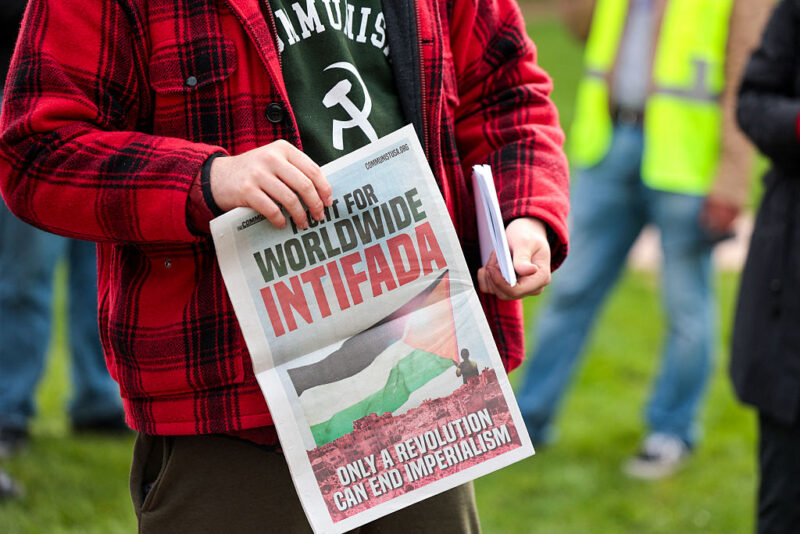
Sen. Rick Scott (R-FL) wrote, “Allowing antisemitism in Australia created the environment for this despicable act. Globalize the antifada [sic] is not a slogan — it’s a promise. A promise we all have to stop.”
Sens. Jacky Rosen (D-NV), Amy Klobuchar (D-MN), Lindsey Graham (R-SC), Mark Warner (D-VA), Tim Scott (R-FL), John Curtis (R-UT), Dave McCormick (R-PA), Katie Britt (R-AL), Ted Budd (R-NC), Jim Banks (R-IN) and Marsha Blackburn (R-TN) and Reps. Mike Lawler (R-NY), Raja Krishnamoorthi (D-IL), Rudy Yakym (R-IN), House Majority Whip Tom Emmer (R-MN), and Shontel Brown (D-OH) also offered their condemnation of the attack and prayers to the victims, among others.
Deborah Lipstadt, former special envoy to monitor and combat antisemitism under the Biden administration, called out New York Mayor-elect Zohran Mamdani for contributing to rhetoric that she said fueled the attack. “Mr. MayorElect, when you refuse to condemn & only ‘discourage’ use of the term ‘Globalize the Intifada, you help facilitate (not cause) the thinking that leads to Bondi Beach,” she wrote of Mamdani.
In a subsequent post, she asked, “Some asked has Mamdani condemned this? Not yet but he will. Strongly. But the time 2speak is before tragedies. The ‘wink & nod’ to Jew-hatred by facilitating language that leads to murdering Jews is unacceptable — and need we say it — so is murdering Jews.”
Mamdani did issue a statement about the attack, which he called “a vile act of antisemitic terror.”
“Another Jewish community plunged into mourning and loss, a holiday of light so painfully reduced to a day of darkness. This attack is merely the latest, most horrifying iteration in a growing pattern of violence targeted at Jewish people across the world. Too many no longer feel safe to be themselves, to express their faith publicly, to worship in their synagogues without armed security stationed outside. What happened at Bondi is what many Jewish people fear will happen in their communities too,” the mayor-elect wrote.
Jewish organizations also came out in force to share their condemnation and pain.
Ted Deutch, CEO of the American Jewish Community, said he was “Horrified. But not surprised.”
“Bondi Beach is one of the most beautiful places in the world. And Jewish kids celebrating the joyous holiday of Hanukkah with their families is likewise one of the most beautiful images of our people. Both have now been ripped to pieces. … This week, we will be reaching out to leaders from around the world to unite around a shared commitment to eradicate the evil scourge of antisemitism. Take our call. Stand with the Jewish community.”
“But don’t wait to speak out,” he continued. “Do it today. Wherever you live. If you are a leader, then lead. Stand with your Jewish community where you are. Yes, reach out privately to your friends in the community to express your support. But speak out as well for all the world to hear. Everyone who looks up to you needs to hear you condemn the antisemitic slaughter in Australia and the ongoing threats to our community everywhere. We are 16 million people in the world. We cannot do this on our own. Stand with us.”
William Daroff and Betsy Berns Korn, respectively the CEO and chair of the Conference of Presidents of Major American Jewish Organizations, recalled their own recent trip to Australia in a statement, including meeting with a Chabad emissary who was killed in the attack: “Just last week, we joined a delegation of Jewish leaders from the seven largest Diaspora Jewish communities in Australia as they confronted a sharp rise in antisemitism. … This past Shabbat, we attended morning services at Chabad of Bondi Beach. We davened in their beautiful new building and saw a community full of warmth, faith, and energy. After services, we had the honor of sharing Shabbat lunch in the home of Rabbi Yehoram and Shternie Ulman with their family, including Rabbi Eli Schlanger and his wife, Chaya. We are devastated to learn that Rabbi Schlanger, z’l, was among those murdered today.”
“Our hearts are with the families of those killed and injured, and with our brothers and sisters in Sydney as they confront this brutal tragedy. The story of Chanukah speaks to Jewish survival and resilience in the face of persecution. This attack on the Bondi Beach community strikes at the heart of the entire Jewish people. We pray for the swift recovery of the injured and mourn those whose lives were taken in this senseless antisemitic act,” Daroff and Korn wrote.
Karen Paikin Barall, chief policy officer at The Louis D. Brandeis Center for Human Rights Under Law, wrote in a post, “In 2008, as Deputy Special Envoy to Monitor and Combat Antisemitism, I traveled to Australia amid rising antisemitic incidents and a troubling lack of response from law enforcement and government leaders. Australia is home to the largest population of Holocaust survivors outside Israel. The Bondi attack is not isolated. It reflects years of inaction and minimization. Antisemitism doesn’t fade when ignored, it grows more violent.”
The Orthodox Union called the attack “a direct assault on Jewish life.”
“Chanukah is the most public of Jewish holidays. We mark the defeat of ancient antisemitic persecution by lighting our menorahs openly and unapologetically. That is precisely why this attack matters. It was meant to intimidate, silence, and drive Jews out of the public square. It will fail. At a time when antisemitism is being normalized, excused, and even justified in public discourse, this attack is no longer shocking. It is the predictable result of unchecked incitement, extremist rhetoric, and repeated failures by leaders to draw red lines,” the organization wrote.
“Calls to ‘globalize the intifada’ are not slogans. They are threats, and they lead directly to violence. … Silence, moral equivocation, and inaction are no longer acceptable. Jews have the right to celebrate their faith openly and safely, without fear, anywhere in the world.”
Democratic Majority for Israel said the attack “makes painfully clear that antisemitic violence remains a grave and growing threat. Jews must be able to gather, pray, and celebrate their religion openly and safely. From the Tree of Life to Poway, from Boulder to Washington, D.C., and now Bondi Beach, the rise of violent antisemitism demands urgent and sustained action from our leaders and communities.”
“At this moment of darkness, as we prepare to begin Hanukkah, we draw strength from the story of the Maccabees, who faced hatred and persecution with courage and resilience. That spirit endures today.”
The Jewish Council for Public Affairs wrote, “Our hearts are shattered for those murdered and injured, all those impacted, and the entire Australian Jewish community. And we are angry: That Jews around the world are now beginning Hanukkah fearful of showing up and celebrating. That after years of us sounding the alarm about the crisis of antisemitism, our leaders and our society have still failed to truly recognize and effectively address this threat. That too many loud voices seek to politicize and exploit our real, legitimate fears — rather than taking the comprehensive, whole-of-society action necessary to keep us safe.”
The Jewish Federations of North America, Anti-Defamation League, Secure Community Network, Community Security Service and Community Security Initiative issued a joint statement with increased security recommendations for “all Jewish organizations that are hosting events in the coming days to undertake.”
Please log in if you already have a subscription, or subscribe to access the latest updates.
 Continue with Google

 Continue with Apple