














The former State Department envoy says EPICA will stay 'laser focused' on policy, tracking whether governments follow through on the global guidelines she helped write

Screenshot
Special Envoy to Monitor and Combat Antisemitism Deborah Lipstadt speaks at the March for Israel on Tuesday, November 14, 2023, in Washington, D.C.


 Add JewishInsider on Google
When Deborah Lipstadt returned to academia last year after nearly three years navigating the State Department as the U.S. special envoy to monitor and combat antisemitism, she had a new mission: to turn what she learned in government into a training ground for the next generation of policymakers confronting antisemitism.
Lipstadt, a longtime Emory University historian, announced last week the launch of the Emory Policy Institute on Countering Antisemitism. The institute will pair undergraduate fellowships with summer internships in Washington; offer seminars for diplomats, journalists and policymakers; and track how governments are implementing the Global Guidelines for Countering Antisemitism that Lipstadt helped develop while serving as special envoy under President Joe Biden.
“In academia, professors think they’re right more often than not. Very often they are right in their assessments. But in diplomacy, you want to be effective. Sometimes you’ve got to compromise, narrow your view and adapt without losing sight of what you want to do,” Lipstadt told Jewish Insider in an interview on Thursday.
Building off that “narrow focus” is what distinguishes EPICA from a crowded field of university antisemitism centers, Lipstadt said.
“I didn’t want to be a kolboinik like some of these other institutions,” she told JI, using the Yiddish word for a jack-of-all-trades. “There are people doing research on antisemitism in the Muslim world in the seventh century. There are people doing research on antisemitism in imperial Russia — all important topics to know. But that was not what I wanted. I wanted to be laser focused on policymaking.”
As special envoy from 2022-2025, Lipstadt frequently argued that antisemitism is not only a threat to Jews and Jewish institutions, but a broader danger that also imperils democracy, the rule of law and international stability.
She said the three focus areas of EPICA aim to address that notion. The student internships will span a wide range of fields in Washington, from Capitol Hill offices to social media companies. The summer internships will be fully funded, covering housing, travel and a stipend, to ensure that students can participate regardless of their financial circumstances.
The institute also plans to hold seminars in the U.S. and Europe for diplomats, journalists and policymakers, working with existing NGOs to educate emerging leaders about antisemitism.
The third focus will be monitoring the implementation of the Global Guidelines, an initiative of Lipstadt’s office during her final year as special envoy, which continue to be utilized by the Trump administration. While numerous countries signed onto the guidelines, Lipstadt said some of the signatories have not followed through in their commitments under the framework, and EPICA will track which governments are adhering to them.
Aaron Keyak, who served as Lipstadt’s deputy special envoy, will serve as the executive director of EPICA. “We’re going to be taking the academically rigorous approach that an Emory University student would take to their research,” Keyak told JI.
Lipstadt said she launched EPICA due to urging from peers, along with the support of Emory.
“When I was finishing up in January 2025, a number of people — some academics, some government officials — said to me that I had a very unique perspective on things,” Lipstadt told JI. “They said now that I’m out of Washington, it can’t just be interesting stories I’m telling at dinner parties or the Shabbos table.”
Kaploun also met with parliamentary leaders to discuss bilateral efforts to counter extremism
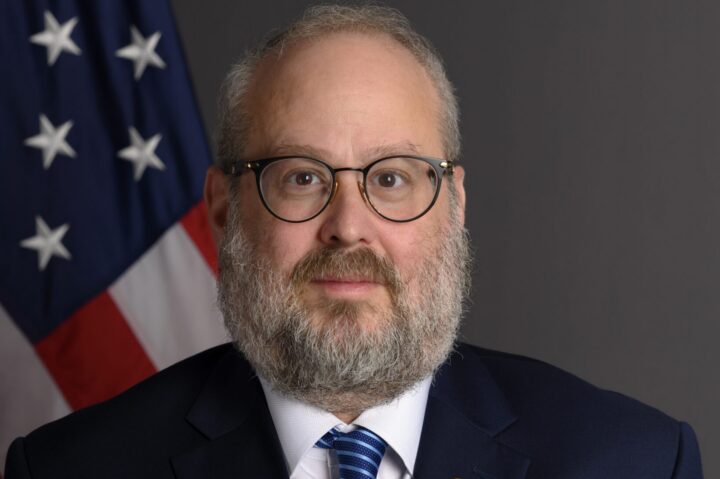
State Department
Special Envoy to Monitor and Combat Antisemitism Yehuda Kaploun
Rabbi Yehuda Kaploun, the Trump administration’s special envoy to monitor and combat antisemitism, visited the United Arab Emirates this week for his first official visit, taking part in high-level meetings that culminated in a Thursday morning discussion with UAE President Sheikh Mohamed bin Zayed Al Nahyan.
During his trip, the envoy also held meetings with senior government officials and rulers, including Ali Rashid Al Nuaimi, chairman of the Defence, Interior and Foreign Affairs Committee at the Federal National Council, the UAE’s parliament.
The meetings focused on bolstering the strategic U.S.-UAE partnership, advancing regional stability and strengthening bilateral efforts to counter extremism, hate speech, and religious intolerance, according to the FNC.
The UAE has long positioned itself as a hub for regional tolerance, having normalized diplomatic ties with Israel through the 2020 Abraham Accords and established the Abrahamic Family House — an interfaith complex in Abu Dhabi featuring a synagogue, church and mosque.
Kaploun previously met with Emirati Foreign Minister Abdullah bin Zayed in Washington in February.
The State Department declined to comment.
The U.S. envoy to Syria’s comments came at odds with Trump’s recognition of Israeli sovereignty over the Golan in 2019
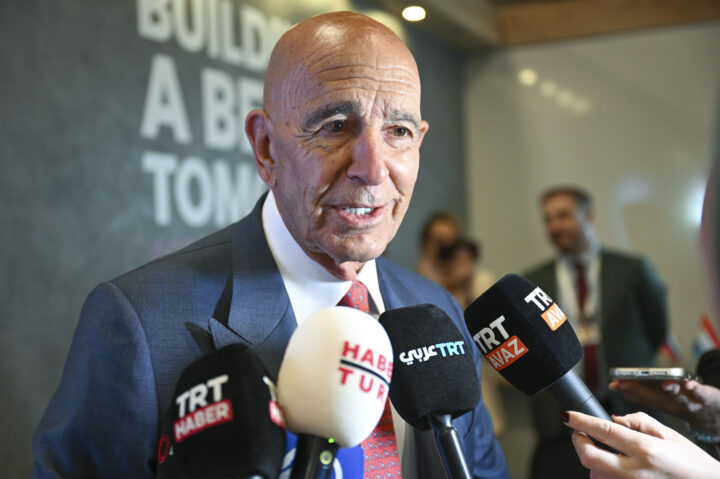
Special Envoy for Syria Tom Barrack speaks during an interview within Antalya Diplomacy Forum, held under the theme of 'Mapping Tomorrow, Managing Uncertainties' in Antalya, Turkiye on April 17, 2026.
U.S. Ambassador to Turkey Tom Barrack, who also serves as the U.S. special envoy for Syria, on Friday described Israel as occupying the Golan Heights, despite the U.S.’ recognition of Israeli sovereignty in the region.
“In the Golan with Syria — they still occupy the Golan against the [United Nations] resolutions, against all of the international order which has said the Golan is Syria’s,” Barrack said during an appearance on commentator Mario Nawfal’s livestreamed show.
Barrack’s comments did not address the U.S.’ 2019 recognition of the Golan Heights as sovereign Israeli territory — a decision made by President Donald Trump during his first term and maintained by the Biden administration.
“My comments were descriptive of a well-known historical record and were made in the course of explaining why I do not anticipate annexation in Lebanon,” Barrack said in a statement on Sunday. “The reference to the United Nations was offered as evidence of the point I was making — that territory taken by force remains contested for generations, in this case for more than fifty years and still unresolved at the UN — which is why I argue that negotiated understandings, not maps, are what endure. It was not an endorsement of the UN’s position. United States policy on the Golan was set by President Trump in 2019 and is unchanged. “
Barrack’s comments came in response to a question about whether Israel seeks to annex Lebanese territory — something Barrack ultimately denied.
The comments had prompted backlash from a range of figures on the right.
“The Senate confirmed [Barrack] to enact the PRESIDENT’S AGENDA, which millions of Americans voted for,” Sen. Rick Scott (R-FL) said on X. “It seems the Ambassador forgot that or failed to do his research, so here’s a refresher for him… President Trump has been CLEAR about Israel’s sovereignty over the Golan Heights for years!”
Far-right influencer Laura Loomer blasted Barrack and demanded that he be forced to resign, calling Barrack “clearly compromised by Arab money.” Bush administration official David Wurmser called the comments a “clear statement” that Barrack “regards the President’s policy and U.S. recognition of the Golan as part of Israel as null and void” and urged him to clarify if he supports U.S. policy, believes he can change U.S. policy on his own or whether U.S. policy has changed.
The U.S. ambassador also dismissed the idea of forced demilitarization of Hezbollah — as required under both U.N. Security Council resolutions and recent Israel-Lebanon diplomatic agreements — as an impossibility.
“We’re asking [the Lebanese Armed Forces], please go shoot your cousins if they don’t give you the AK-47. It’s not going to happen that way. It’s too difficult for it to happen that way,” Barrack said. “So I think what [U.S. Ambassador to Lebanon Michel] Issa is doing in this whole process is saying there’s got to be a better way. How do we get Hezbollah to not utilize those weapons?”
He seemed to rationalize Hezbollah’s continued defiance of demilitarization efforts as resistance to Israeli demolition of Lebanese homes and as the only way for the terror group to financially survive, by receiving monetary support from Iran.
Addressing other comments in the interview, which many saw as a call for negotiating with Hezbollah and Iran over Hezbollah’s demilitarization, Barrack described the Lebanese government as the “sole legitimate authority.”
“My point was that implementation of the June framework requires an honest reckoning with who holds the weapons and who supplies them. I was describing the difficulty of the problem, not proposing a new table,” Barrack said. “Hezbollah is a designated foreign terrorist organization. We do not negotiate with it, and nothing I said suggests otherwise. My remarks should be read in their full context.”
He added that “any honest observer” must determine how to move Iran and Hezbollah.
“How does Hezbollah come to accept disarmament? And who, other than Tehran, sustains the communities of the south, so that the money on which that arsenal’s political cover depends is replaced by something better? Naming those questions is not conferring standing on anyone,” Barrack said. “It is the precondition of answering them — and answering them is precisely what the framework’s designers are working at.”
Barrack praised the defense agreement between Turkey, Pakistan and Saudi Arabia as an accomplishment for the Trump administration, pressing regional powers to take responsibility for their own security — similar to the president’s efforts to pressure European NATO allies to spend more on their own defense.
“It’s not anti-Israel, it’s not pro-Sunni and it’s not anti-America,” Barrack said. “It’s, ‘Guys, we need to band together.’”
He also suggested that others in the region shouldn’t be concerned by Turkey’s apparent growing regional ambitions.
“Turkey’s going into a new, powerful mode, which makes everybody nervous, but it’s a great thing for Turkey,” Barrack said. “They — as a hub, as a non-Arab, really workable, kind, loving, Islamic country with eight countries around it and four seas … it’s threatening in its geographical presentation. So I’m hopeful the calmer heads will be there.”
Barrack is in the midst of a media tour addressing Israel’s decision to strike the runway of a Syrian airbase with the goal of preventing Turkey from deploying troops to the site. Barrack and other U.S. officials have criticized the strikes.
On Friday, Barrack suggested two potential motivations for the strikes: that Israel was “baiting the Turks” or that there had been a “miscommunication” among different elements of the Israeli government that led an Israeli commander to carry out a strike without any intention of sparking further conflict or causing injuries.
Speaking on the incident on “PBS NewsHour” on Friday, Barrack said that Israel believed it had a tacit agreement with Turkey and Syria that the countries would not deploy military equipment that could obstruct an Israeli attack path to Syria, but Barrack said that the other parties did not agree that they had any such accord.
He said that Israel had communicated its concerns about the deployment to Syria, and that Syria had denied any Turkish movement toward the base, with further talks planned the following week. “Something went awry and Israel decided they needed to bomb the craters on two runways. The problem with this is Turkey did not know it was coming,” Barrack continued.
Barrack suggested on both shows that recent tensions between Turkey and Israel are largely a political gambit by both sides ahead of elections in their countries — despite Turkish President Recep Tayyip Erdoğan’s now yearslong threats to invade or attack Israel. And he said on Nawfal’s show that Turkey is “concentrating on restraint” and is “not predatory” and “not interested in attacking or even engaging in any kind of kinetic or adversarial relationship with Israel.”
He said that the U.S. saw no malign intent or aggressive action by Syria or Turkey.
However, in the same interview, Barrack expressed an understanding of Israel’s concerns about the new Syrian government, particularly when it first took power, and insisted that Israel’s incursion into Syria was designed as a protective measure, not as an effort to expand its territory, as some in anti-Israel circles have claimed.
Nawfal’s show, on which Barrack appeared, has also featured a range of anti-Israel figures and conspiratorial anti-Israel narratives. Other recent guests have included Anthony Aguilar, the former U.S. Marine turned anti-Israel activist who claimed to have seen Gaza Humanitarian Foundation contractors kill a child in Gaza only for that child to be found alive and well; former Trump administration official Joe Kent; and anti-Israel commentator and retired Gen. Douglas Macgregor.
Kaploun said his office’s remit had been expanded under the Trump administration; ‘Every agency in Washington was told to work with me to combat the scourge of antisemitism,’ he said
Marc Rod
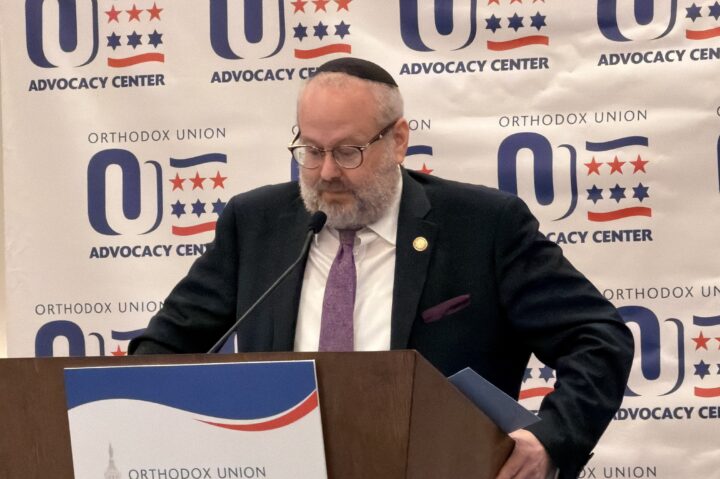
Ambassador Yehuda Kaploun, the Trump administration’s special envoy to monitor and combat antisemitism, speaks at an Orthodox Union conference, June 22, 2026
Ambassador Yehuda Kaploun, the Trump administration’s special envoy to monitor and combat antisemitism, said on Monday that his office, under President Donald Trump, had been given a broader remit across the federal government, including assisting in the recent arrest and indictment of an alleged mastermind of attacks on Jewish communities in Europe and the U.S.
Kaploun said at an Orthodox Union conference that his office had worked with the Department of Justice, FBI, intelligence community and the White House to help bring to justice Mohammed Al-Saadi, an Iranian Iraqi Kata-ib Hizballah operative allegedly involved in more than two dozen attacks and attempted attacks across Europe and the U.S.
“That is not the role of the previous ambassadors that had this role, but the president made certain that when I took the job, that every agency in Washington was told to work with me to combat the scourge of antisemitism,” Kaploun said. “Antisemitism has to have consequences.”
Kaploun emphasized that the threat of antisemitism is global — describing an attack in a Jewish neighborhood in Montreal on Monday as an antisemitic terrorist incident — and comes from international organizations, foreign terrorist organizations, “unchecked mass migration,” online radicalization and “hateful rhetoric from all sides.”
Montreal police said on Monday they were still investigating the shooting suspect’s motive and had not yet deemed it a terrorist attack.
Kaploun said that a new approach to antisemitism is needed, because the old “script” — more conferences, more groups, more “empty commitments from different governments around the world” — has clearly failed.
“America’s response to antisemitism has to be a collective response and a united response. Let’s face this moment and realize that it’s not slogans that are going to make a difference,” Kaploun said. “It’s real action, it’s real education, and we have to go back to Jewish unity, about teaching our children to be proud of being Jewish, to understand our Jewish history, to understand what makes our Jewish nation unique and to restore the pride that people have in being Jewish.”
He said the Trump administration is “leading by example and taking very decisive actions to protect Jewish communities worldwide.” He pointed to the administration’s moves against universities, hate crimes prosecutions by the Department of Justice, an “extremely tight visa vetting program,” the U.S. withdrawal from various international bodies that have demonstrated antisemitism and its push for other countries to adopt the International Holocaust Remembrance Alliance’s working definition of antisemitism.
“These are benchmarks that every country should really be doing the exact same thing,” Kaploun said.
He also touted his work on a trip to Belgium after a synagogue had been firebombed. He said that he began the visit by meeting with members of the Jewish community, who expressed their fear, only to go next to a meeting with Belgium’s foreign minister, who insisted that the country did not have an antisemitism problem.
He said he left the meeting having secured a commitment for Belgium’s military to protect the Jewish community — an effort that just two days later caught a group of Iranians trying to set fire to a Jewish grocery story in Antwerp.
“Because that happened, the Belgian government had to designate the Iranian terrorist group as a terrorist group. Little things matter,” Kaploun said.
With Holocaust affairs envoy Ellen Germain expected to retire, Jewish organizations are split over whether the two diplomatic posts should be consolidated

Courtesy
Ellen Germain speaking at the Rumbach synagogue in Budapest, Hungary, in November 2022.
Jewish communal groups are at loggerheads over the possibility of merging two related but distinct State Department offices: the special envoy to monitor and combat antisemitism and special envoy for Holocaust issues.
Some Jewish groups recently sent a letter to Secretary of State Marco Rubio in support of the concept of merging the two offices, while others have sent letters in recent months opposing such a move.
Proponents of combining the two offices say that doing so consolidates linked issues under the authority of one envoy with ambassador-rank status, while maintaining the work of both offices. Opponents say that combining the two teams would undermine and diminish the work of the Holocaust affairs envoy and risk politicizing critical work on Holocaust restitution.
The reexamination of the two roles comes ahead of the expected retirement of Ellen Germain, who has served as special envoy for Holocaust issues since 2021. Advocates on both sides of the debate said they understand the State Department is considering whether to merge the two offices, though no final decision has yet been made. Multiple communal letters reference rumors about the possibility of a merger of the two offices.
The antisemitism envoy office focuses on combating antisemitism globally, and is led by a political appointee chosen by the president and confirmed by the Senate, who has typically changed with each administration. The Holocaust affairs envoy office focuses on Holocaust restitution and education issues, as well as combating Holocaust denial and distortion, and is led by an apolitical career Foreign Service Officer, often maintaining their role across multiple administrations.
The Department of State did not provide comment.
In a June 10 letter, groups and leaders including the Combat Antisemitism Movement, American Association of Jewish Lawyers and Jurists, Chabad-Lubavitch World Headquarters, Coalition for Jewish Values, Institute for the Study of Global Antisemitism and Policy, Orthodox Union, World Jewish Congress, Zionist Organization of America, former U.S. Ambassador to Israel David Friedman, former antisemitism envoy Elan Carr, former deputy antisemitism envoy Ellie Cohanim and former deputy antisemitism envoy Karen Barall, wrote to Rubio urging him to merge the two positions.
“The historical realities of global antisemitism and the preservation of Holocaust memory are inextricably linked. Today, we are witnessing an unprecedented and sophisticated surge in global anti-Jewish hostility, which frequently weaponizes Holocaust denial, historical revisionism, and the distortion of Nazi-era atrocities to fuel modern hatred,” the groups wrote. “Fragmenting our diplomatic response across two distinct offices dilutes administrative efficiency, risks duplicative efforts, and underutilizes vital Department resources at a time when maximum strategic impact is required.”
The groups said that combining the two offices “will streamline U.S. foreign policy implementation and provide foreign governments and international bodies with a singular, high- level point of contact in the form of [current antisemitism envoy] Ambassador [Yehuda] Kaploun, elevating the visibility and diplomatic weight of the SEHI portfolio” and help facilitate the adoption of the International Holocaust Remembrance Alliance’s working definition of antisemitism worldwide.
The Holocaust issues office currently falls within the State Department’s Europe portfolio, while the antisemitism office has a global mandate.
Groups including the American Jewish Committee, American Joint Distribution Committee, Agudath Israel of America, Anti-Defamation League, B’nai B’rith International, Conference on Jewish Material Claims Against Germany, The National Coalition Supporting Eurasian Jewry and the World Jewish Restitution Organization — many of which deal directly with post-Holocaust and restitution issues — are opposing the move.
The Holocaust issues office “serves as a critical statement to the world of American values and moral leadership and of the singular significance that the United States attributes to commemoration, research and remembrance of the Holocaust, as well as the commitment of the United States in seeking justice for Holocaust survivors,” they said in a joint letter to Rubio in late April, a draft of which was obtained by JI.
The groups described the office as a critical resource for the Jewish community, which has received strong support from Congress. “In a world where there is less and less knowledge of the horrors of the Holocaust, and there are fewer and fewer Holocaust survivors, it is imperative that this office which is dedicated solely to these goals, continue to stand as a beacon showing the special commitment of the United States government to education about the Holocaust and the United States’ role in leading the quest for justice for the victims and their families internationally.”
The groups urged Rubio to appoint a “senior diplomat” to fill Germain’s role upon her retirement.
Numerous Jewish organizations have also weighed in individually, on each side of the issue.
In favor of a merger, Rabbi Abraham Cooper, the associate dean of the Simon Wiesenthal Center, also wrote to Rubio this month in favor of combining the two offices. He said that combining the offices under a Senate-confirmed ambassador will “elevate the issue set; strengthen U.S. representation on key international fora like the International Holocaust Remembrance Alliance; and send a clear signal to foreign counterparts that the United States remains committed to these issues.”
“Ambassador Kaploun has made clear that the status quo must be broken if we are to finally achieve a small measure of justice. This means strengthening accountability, working with Jewish communities, and seeking results, not conferences and photo-ops,” Cooper said. “I look forward to supporting him in those efforts.”
The World Jewish Congress also expressed support for merging the two offices, arguing in a May letter to Rubio that the “Holocaust issues today differ from those of the postwar and restitution eras.”
“The central challenges now concern Holocaust denial and distortion, the erosion of historical memory, and the exploitation of Holocaust revisionism in service of contemporary antisemitism and extremism,” the WJC letter reads, adding that the issues are now far larger than Europe.
But that’s far from a consensus view within the Jewish community.
Opposing a merger, AJC CEO Ted Deutch separately wrote to Rubio in March to “respectfully underscore the critical importance of maintaining the U.S. Department of State’s Office of the Special Envoy for Holocaust Issues as a separate, prominent, and fully empowered office within the Department, and to urge that the process of selecting a qualified Special Envoy be set in motion without delay.”
“Maintaining a dedicated and empowered Special Envoy ensures that the United States can continue to press governments to meet their commitments, resolve outstanding restitution matters, combat Holocaust distortion and antisemitism, and uphold justice for survivors and their families while it is still possible to do so,” Deutch said, particularly at a time of rising Holocaust denial, distortion and inversion, including by public figures and leaders, and when many Holocaust restitution claims remain unresolved.
Robert Williams, the USC Shoah Foundation’s chair and CEO, also urged Rubio, in a letter in late May, to keep the two positions separate.
“Merging these offices risks diluting their effectiveness. This is something we can ill afford in our trans-Atlantic relations or in our work in North America,” Williams said, particularly after Canada eliminated its own antisemitism envoy. “Respecting the relevance of the Holocaust and justice for the survivors, while simultaneously focusing the fight against antisemitism is only possible if State maintain[s] both offices with their complementary yet different strengths and areas of expertise.”
A source familiar with the situation said that some in the Jewish community feel that having a senior FSO in the Holocaust affairs envoy role has historically served the office well, insulating the position and the issues from politics.
The source said that some in the community see the move to combine the offices as driven by Kaploun, and believe it to be an effort by the antisemitism envoy to expand his influence over various issues relating to the Jewish community.
At the same time, the source acknowledged that there could be value in placing the Holocaust affairs envoy’s responsibilities in the hands of someone such as Kaploun, who has the ear of President Donald Trump, in addition to other senior officials.
Barall, who serves as the chief policy officer for the Louis D. Brandeis Center for Human Rights Under Law, said that discussions about combining the two offices are longstanding, dating back to the Bush administration, when the antisemitism office was first established.
“We’re at a time where resources are limited, and combining expertise and budgets under a unified strategy can create greater impact without sacrificing the mission,” Barall said. “When you have two different offices working independently and in parallel of each other, it doesn’t benefit anybody.”
She said that it’s not helpful for the Jewish community and is confusing to foreign interlocutors to have two separate offices, which sometimes are undertaking duplicative or contradictory efforts.
Alyza Lewin, the president of U.S. affairs at CAM, echoed that argument, calling the current separation “awkward and inefficient” for interlocutors with the offices.
“It makes sense for the two offices to be combined, so that the issues are addressed together with one voice, with consistency, and it also, quite frankly, elevates the Holocaust issues today” under the supervision of a Senate-confirmed official reporting directly to the secretary of state, Lewin said.
She said that her understanding is that there would be no reduction in staff or resources to either office, and that the Holocaust affairs envoy’s staff would move to the antisemitism envoy’s team, ensuring no loss of expertise or capacity to work on Holocaust issues.
Lewin also argued that, with the shrinking number of Holocaust survivors, the work of the Holocaust affairs envoy is shifting toward a greater emphasis on issues like Holocaust memory, Holocaust denial and Holocaust education, which she said are a “key part” of modern antisemitism.
Opponents of a merger say that the extent of that shift is overstated, and that the issues of the Holocaust affairs envoy remain critical, and distinct, from those of the antisemitism envoy.
“I worry … that a merger brings with it a risk that these offices’ individual tasks will be harder to accomplish, and at least in the short term, and that could inhibit our ability to, A, push back against the world’s oldest hatred, and B, as the head of a Holocaust institution, ensure that we have a future that remembers, learns from, and respects the history of the Holocaust and its contemporary relevance over the long term,” Williams, the USC Shoah Foundation CEO, said.
He also argued that Holocaust restitution issues remain a critical and ongoing task and will not disappear in the near future — pointing to Congress’ recent passage of a new law relating to restitution issues and some countries that continue to resist restitution efforts.
Williams further argued that Holocaust education and antisemitism are related but ultimately distinct issues. And, he said, the U.S. should not necessarily model its own approach on other countries’ decisions to combine antisemitism and Holocaust issues into a singular role, though he said he did not doubt Kaploun’s personal capabilities and effectiveness.
“None of these countries have been as effective as morally clear and as useful in ensuring a future for the fight against antisemitism and a future that remembers and respects the Holocaust, as has the United States, and I think a major factor in that has been because we have divided labor effectively,” Williams said. He warned that consolidating the positions could ultimately open the door to antisemitism and Holocaust work being subsumed into a broader portfolio in some future administration.
Menachem Rosensaft, a Cornell University adjunct law professor involved for years in post-Holocaust issues and fighting antisemitism who has worked with multiple envoys in both offices, said that combining the two teams “risks undermining the effectiveness and the professionalism of the Holocaust-era office.”
“I think both are important offices, both are important areas, but they’re also different,” Rosensaft said. “One of them is a politically oriented office looking at contemporary manifestations of antisemitism abroad, and the other is an office whose purpose… is to effectively assist in Holocaust-era restitution, mostly benefiting Holocaust survivors and their heirs, and those are two very different functions.”
He emphasized that the Holocaust affairs envoy position is in some ways “much more sensitive and delicate” because it requires navigating complex bureaucracies in Europe, a task which he said is best left to an apolitical career official rather than a political appointee — even as he praised Kaploun’s credibility on the issue of antisemitism.
Trump, Mamdani, Witkoff, Kraft, Lutnick and more watched the game
Al Bello/Getty Images
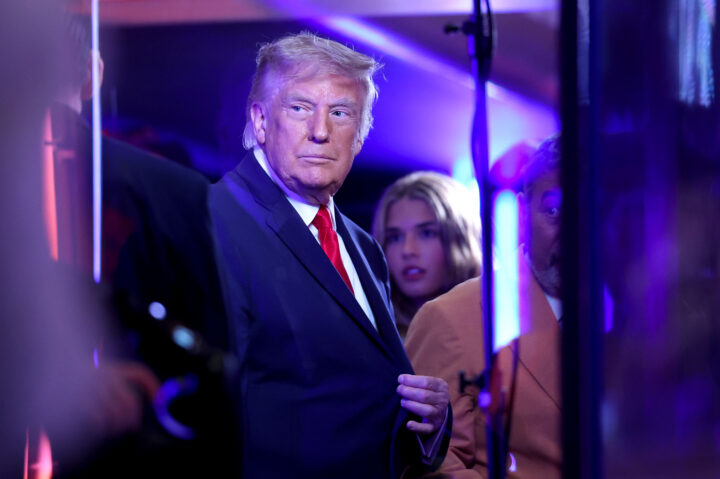
U.S. President Donald Trump looks on prior to a game between the San Antonio Spurs and the New York Knicks in Game Three of the 2026 NBA Finals at Madison Square Garden on June 08, 2026 in New York City.
White House Special Envoy Steve Witkoff, EPA Administrator Lee Zeldin and Boris Epshteyn, the personal attorney to President Donald Trump, joined the president in a luxury suite at Madison Square Garden on Monday night for Game 3 of the NBA Finals, where the Knicks lost to the San Antonio Spurs on home turf, 115-111.
Also in the suite were MSG Network CEO Jim Dolan, White House Deputy Chief of Staff Dan Scavino, Interior Secretary Doug Burgum and Transportation Secretary Sean Duffy, White House Communications Director Steven Cheung and Michael Boulos, who is married to Trump’s daughter Tiffany and is the son of White House senior advisor Massad Boulos.
New York City Mayor Zohran Mamdani also attended the game, the first time the Knicks’ played the Spurs at home in the Finals. The mayor’s office said Mamdani paid $1,000 for a standing room only ticket to the game, where he was photographed with New York state lawmakers.
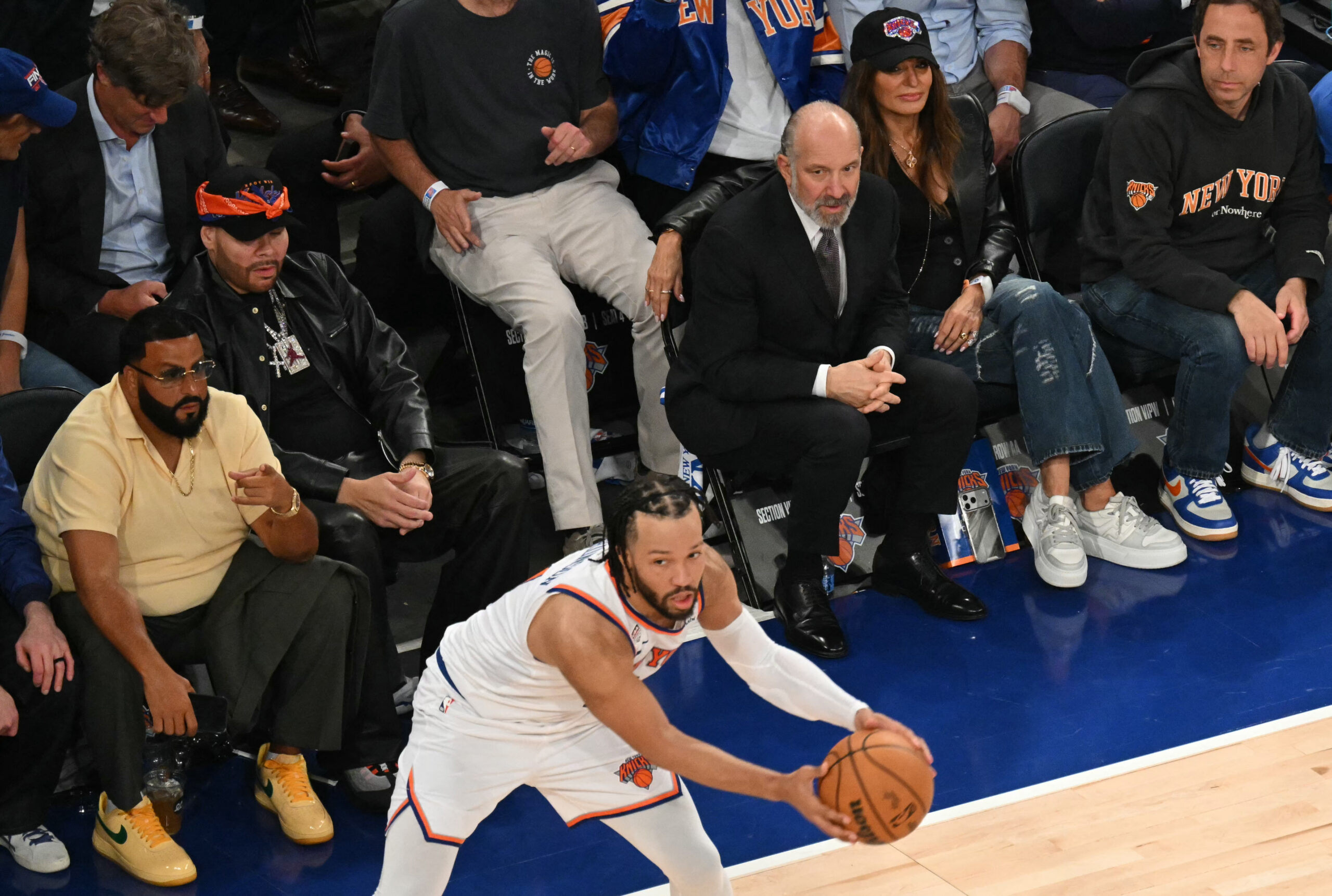
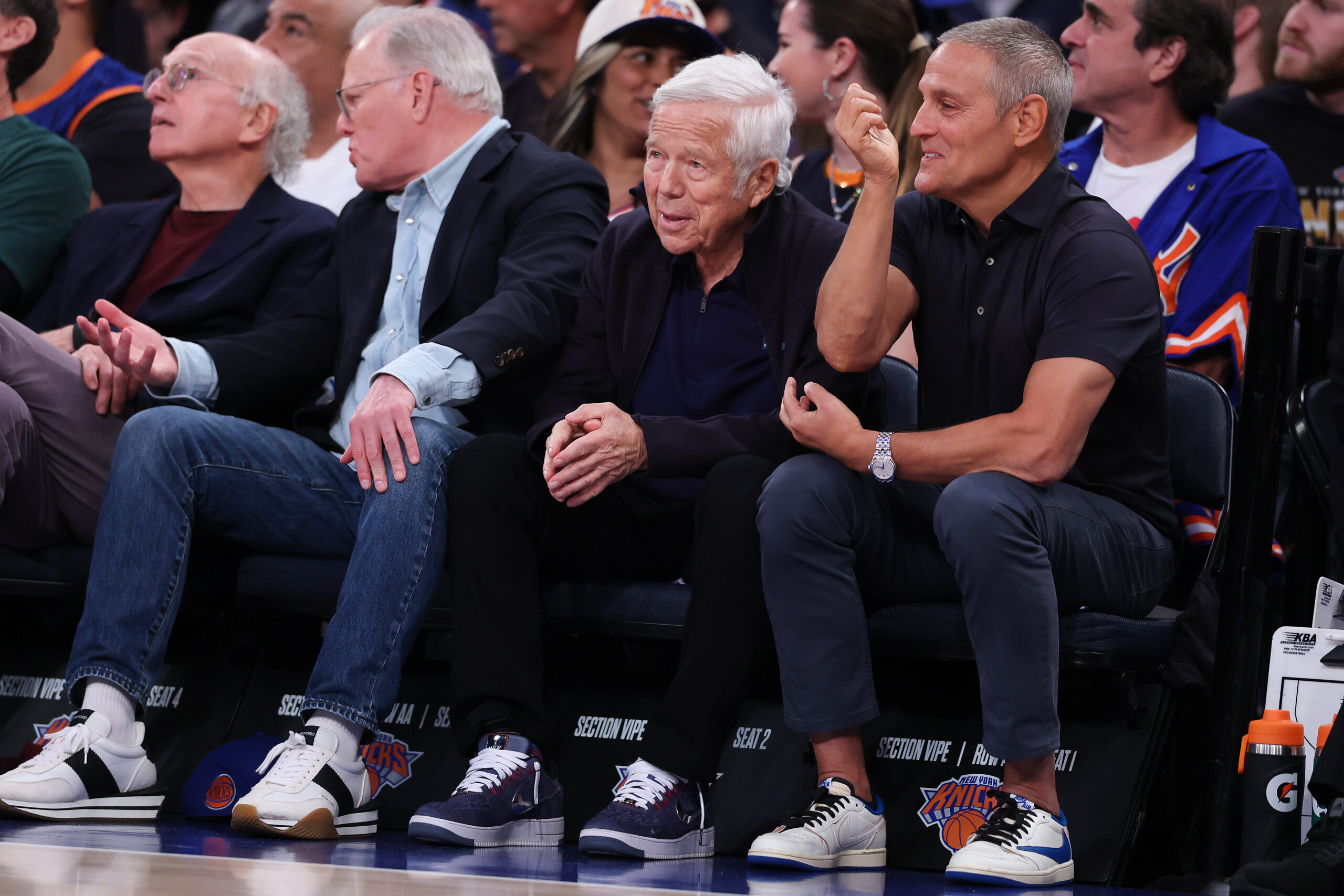
Courtside, Commerce Secretary Howard Lutnick sat with his wife, Allison, across the aisle from rappers Fat Joe and DJ Khaled. Elsewhere at MSG, former U.S. Ambassador to Japan Rahm Emanuel, TKO Group CEO Ari Emanuel, Mark Shapiro, Larry David, David Zaslav and Robert Kraft were seated courtside for the game. Former New York City Mayor Michael Bloomberg also sat courtside — and found himself face-to-face with Jose Alvarado as the Knicks guard crashed into spectators while trying to save the ball from going out of bounds.
The Knicks will face the Spurs again on Wednesday at MSG.
Dozens of GOP lawmakers sent a letter last year urging the president to fill the position created in 2023
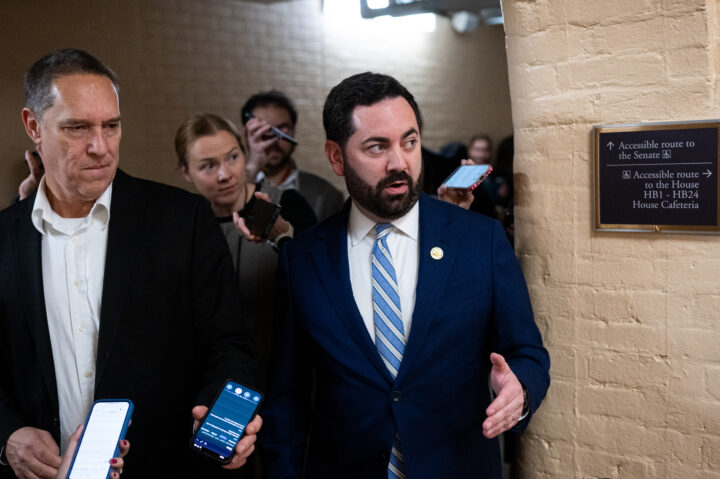
Bill Clark/CQ-Roll Call, Inc via Getty Images
Rep. Mike Lawler (R-NY) speaks to reporters as he leaves the House Republican Conference meeting in the U.S. Capitol on December 10, 2025.
Rep. Mike Lawler (R-NY) expects Congress to make another “big push” to urge President Donald Trump to fill the role of special envoy for the Abraham Accords once the Iran conflict subsides.
The role was created in 2023, when Lawler and Rep. Ritchie Torres (D-NY) introduced a bill to establish a Senate-confirmed, ambassador-level special envoy position dedicated to expanding the Abraham Accords and Middle East normalization. The measure was ultimately signed into law as part of the FY2024 National Defense Authorization Act (NDAA).
Tasked with strengthening and expanding regional normalization, the special envoy would be responsible for coordinating U.S. strategy across regional embassies, nongovernmental organizations, and international stakeholders.
But despite the legal mandate, the position has remained open. The vacancy has drawn frustration from congressional Republicans, with 47 House GOP members sending a letter in January 2025 urging Trump to immediately fill the post while condemning former President Joe Biden’s failure to do so during his term.
Lawler told Jewish Insider that he would “like to see it filled,” noting that the evolving situation in the region has increased the need for the position. He said it is something he will “continue to advocate for.”
“Obviously there’s been a lot happening in the Middle East over the last year and a half. As we see the situation in Iran get resolved, I do think the Abraham Accords is going to critical moving forward,” Lawler said. “I would like to see somebody fill that position and be entirely dedicated to that work, which I think is going to be a key part of keeping stability in the region.”
Asked whether he expects House Republicans to make another push similar to the January 2025 letter urging Trump to fill the position, Lawler replied: “I do. I think we will.”
“As you see the situation in the Middle East, from the standpoint of Iran, resolve, there will be a big push again on the special envoy.”
“Look, obviously a lot of the focus has been on the role of Steve Witkoff, the [White House] special envoy, and he has been hyper-focused on a lot of these issues that are covered in the Abraham Accords. So I think in some capacity they have been doing this work,” Lawler added. “But I think long term, this was a position we created to accentuate one of the president’s biggest achievements of his first term.”
The appointment of Deek, the country's first Christian ambassador, comes following several controversies in Israel relating to Christians
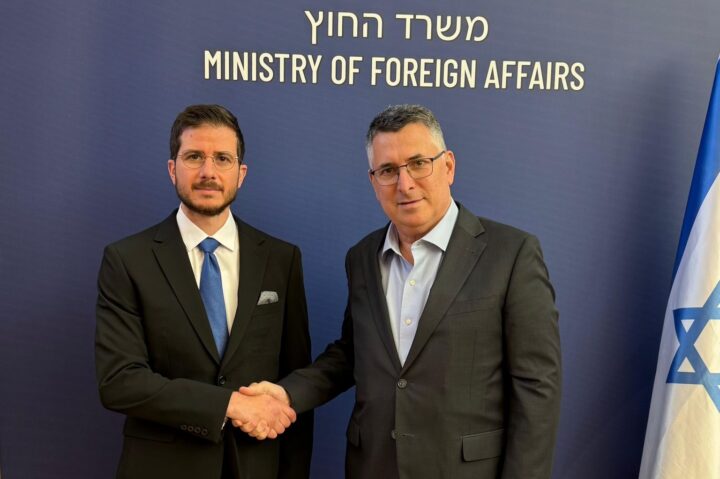
Courtesy
Former Israeli Ambassador to Azerbaijan George Deek (left) and Israeli Foreign Minister Gideon Sa'ar
Israel’s first Christian ambassador, George Deek, has a new job after his return to Israel from his most recent posting as Israeli ambassador to Azerbaijan: special envoy to the Christian world.
Israeli Foreign Minister Gideon Sa’ar named Deek to the role on Thursday, with the ministry saying that the move was “intended to deepen Israel’s ties with Christian communities around the world.”
Deek, who joined the Foreign Ministry in 2008 and has been posted to Norway and Nigeria, received the Foreign Ministry Director General’s Award for Excellence in 2021. He is part of the Arab Orthodox Christian community in Jaffa, and his father, Youssef Deek, was chairman of the community for many years.
Deek came to international prominence as Israel’s chargé d’affaires in Oslo after giving a speech about his family’s background and his decision to represent Israel around the world. In the speech, video of which has gone viral, he spoke about his grandparents’ departure from Jaffa during Israel’s War of Independence and choice to return and build their lives in the fledgling Jewish state.
Sa’ar said that “the State of Israel attaches great importance to its relations with the Christian world and with its Christian friends around the world. I am confident that George, a respected and experienced diplomat, will greatly contribute to the friendship and strengthening of the ties between the State of Israel and the Christian world.”
Deek’s appointment was announced soon after several controversies in Israel relating to Christians. Most recently, an IDF soldier who broke a statue of Jesus in a southern Lebanese Christian town was removed from combat duty and given 30 days in prison.
On Palm Sunday, with the war in Iran still raging, police officers barred Cardinal Pierbatista Pizzaballa from accessing the Church of the Holy Sepulcher because it did not have proper protection from missiles. After Prime Minister Benjamin Netanyahu intervened, Pizzaballa was given more access to the church.
Speaking at the FII Priority summit, the special envoy also said the current ceasefire proposal with Iran would address the regime’s nuclear enrichment and existing stockpiles
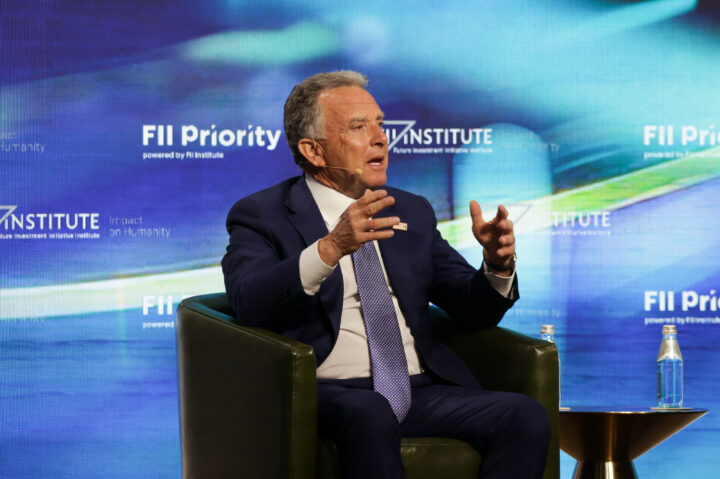
Zak Bennett/Bloomberg via Getty Images
White House Special Envoy Steve Witkoff during the Future Investment Initiative (FII) Priority Summit conference in Miami, Florida, on March 27, 2026.
White House Special Envoy Steve Witkoff compared the release of Israeli hostages kidnapped by Hamas to the release of Palestinians from Israeli prisons, stating that both experiences “feels like we’re changing lives.”
“People ask me: ‘Why do I like doing it?’ And I say because it feels worthy, it feels like we’re changing lives,” Witkoff said on Friday at the FII Priority summit in Miami. “I remember when we met those families of the Israeli hostages and they were ecstatic because they didn’t think their children were coming home.”
“But I was also in Gaza,” Witkoff continued. “I met Gazan families whose children were released from Israeli prisons in exchange, and they were just as grateful as the Israeli parents.”
“People ask me: ‘Why do I like doing it?’ And I say because it feels worthy, it feels like we’re changing lives,” Witkoff said on Friday at the FII Priority summit in Miami. “I remember when we met those families of the Israeli hostages and they were ecstatic because they didn’t… pic.twitter.com/CBpwY4bQHi
— Jewish Insider (@J_Insider) March 29, 2026
Israel released around 2,000 Palestinian security prisoners in exchange for 20 living and several deceased hostages under the U.S.-backed ceasefire and hostage-release deal with Hamas. At least 250 of the released prisoners were serving life sentences for carrying out deadly terror attacks.
During the summit, Witkoff also discussed the current conflict in Iran, as President Donald Trump continues to herald the success of ongoing diplomatic negotiations with the regime. Iran initially denied that negotiations were taking place but then formally rejected the U.S.’ 15-point ceasefire proposal, sending a five-point counteroffer that would recognize Tehran’s authority over the Strait of Hormuz.
“There are some people who have denied that we are negotiating,” Witkoff said. “We may have a different definition of negotiating than they do, or there may be people within their system today who just don’t have the ability to admit it, but we’re talking to them.”
“We have a 15-point deal on the table that the Iranians have had for a bit of time,” Witkoff added. “We expect an answer from them, and it would solve it all. It would solve the enrichment question, which is, we can’t have enrichment there today.”
Witkoff said the deal on the table would also solve Iran’s “enriched material stockpile, which they have to give up.”
“There are red lines for us, but we’re not looking to see the dissolution of the Iranian people,” Witkoff said. “They are very good people. We want them to thrive and survive and the country to join the league of nations and to be prosperous and do a lot of business. We just don’t want the destabilizing forces that they’ve generated out there.”
Witkoff said a deal could generate “collateral benefits,” such as diplomatic normalization between Saudi Arabia and Israel, a goal that has thus far been elusive for the administration. He also noted that there will be “meetings this week,” and that “ships are passing” in the Strait of Hormuz, where Iran has effectively blocked one of the world’s most critical oil passageways.
“I think the president wants a peace deal, but he also believes in — and I believe in it too — peace through strength. Without pressure, you never get anybody to the table,” Witkoff said. “We’re employing a lot of strength, we have a big fleet there, and yet we’re prepared to solve it with a diplomatic solution.”
The backchannel diplomacy led Trump to postpone potential strikes against Iran’s energy infrastructure
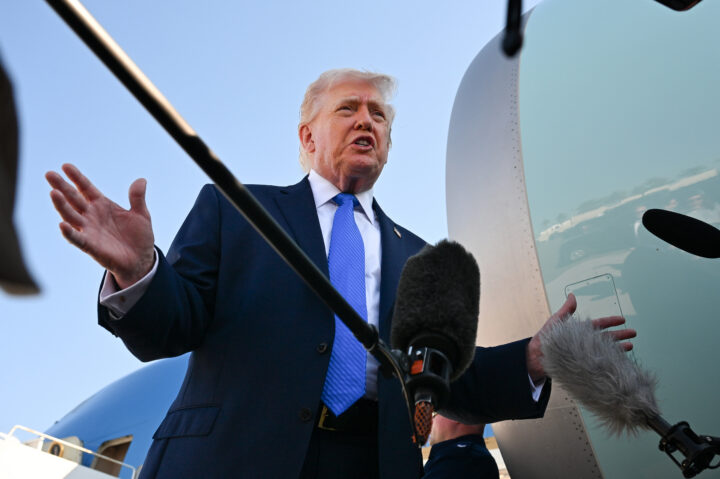
Roberto Schmidt/Getty Images
President Donald Trump speaks to reporters before boarding Air Force One at Palm Beach International Airport on March 23, 2026 in West Palm Beach, Florida.
President Donald Trump revealed on Monday that White House Special Envoy Steve Witkoff and advisor Jared Kushner have been negotiating with Iran amid the ongoing war, which played a role in Trump’s decision to delay by five days potential strikes on Iranian energy infrastructure in response to Iran’s threat to fully close the Strait of Hormuz.
“We have had very, very strong talks. We’ll see where they lead. We have major points of agreement, I would say almost all points of agreement. Perhaps that hasn’t been conveyed. The communication, as you know, has been blown to pieces. They were unable to talk to each other,” Trump told reporters from Palm Beach International Airport before boarding Air Force One.
“But we have had very strong talks,” Trump added. “Mr. Witkoff and Mr. Kushner had them. They went, I would say, perfectly. If they carry through with that, it’ll end that problem, that conflict, and I think it’ll end it very, very substantially.”
“We’re going to get together today, by probably phone because it’s very hard to find a country, it’s very hard for them to get out. But we’ll at some point very soon meet. We’re doing a five-day period. We’ll see how that goes,” Trump continued.
But the president kept the option of continued military action open: “If it goes well, we’re going to end up with settling this. Otherwise, we’ll just keep bombing our little hearts out,” he said.
Trump’s comments came hours after he announced that he was delaying his planned attacks on Iranian energy targets by five days based on the parties’ “very good and productive conversations regarding a complete and total resolution of our hostilities in the Middle East,” which he said will continue over the course of the week. The president announced the pivot about 12 hours before his 48-hour deadline to the Islamic Republic was set to expire.
Any future military action, Trump wrote, will be determined “subject to the success of the ongoing meetings and discussions.”
Axios reported on Monday morning that Turkey, Egypt and Pakistan had been “passing messages between the U.S. and Iran over the past two days in an effort to de-escalate” tensions and pause the fighting.
Officials from the three countries had separate conversations over the weekend with Witkoff and with Iranian Foreign Minister Abbas Araghchi, the outlet reported, while sources said Witkoff and Kushner were negotiating directly with Mohammad Bagher Ghalibaf, speaker of the Iranian parliament.
The envoy is set to hold discussions with Iranian Foreign Minister Abbas Araghchi in Geneva on Thursday
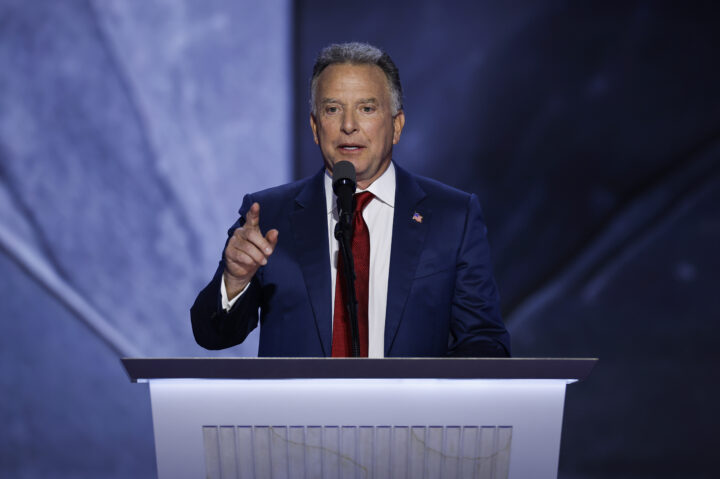
Chip Somodevilla/Getty Images
Steve Witkoff speaks on stage on the fourth day of the Republican National Convention at the Fiserv Forum on July 18, 2024 in Milwaukee, Wisconsin.
White House Special Envoy Steve Witkoff addressed the AIPAC Congressional Summit taking place in Washington on Tuesday, two sources with knowledge of the event told Jewish Insider, as he prepares for the third round of negotiations with Iran later this week.
AIPAC led lobbying efforts against the 2015 Joint Comprehensive Plan of Action (JCPOA) nuclear deal with Iran, including creating a new lobbying group called Citizens for a Nuclear Free Iran that spent upwards of $20 million opposing the agreement. Witkoff has led the Trump administration’s negotiations with Tehran during the president’s second term, alongside Jared Kushner, and is set to hold discussions with Iranian Foreign Minister Abbas Araghchi in Geneva on Thursday.
The summit, which ran from Sunday to Tuesday and brought together more than 1,000 of the group’s top donors, featured virtual addresses from Israeli Prime Minister Benjamin Netanyahu and Opposition Leader Yair Lapid. Others expected to address the event included House Speaker Mike Johnson (R‑LA), Senate Minority Leader Chuck Schumer (D‑NY) and Sens. Tom Cotton (R‑AR) and Ted Cruz (R‑TX).
U.S. Ambassador to the U.N. Mike Waltz also addressed the summit on Monday about “the absurd nature of the U.N. and its institutions and how they are horribly anti-Israel,” one attendee told JI, while wearing a hat that read “Make the U.N. Great Again.”
On Monday evening, former Israeli hostage and pianist Alon Ohel performed on the main stage alongside John Ondrasik, the singer-songwriter known as “Five for Fighting” who has been deeply involved in Israel advocacy during the Israel-Hamas war. Ondrasik rereleased his song “Superman” in April 2025 dedicated to the Israeli hostages and Ohel in particular.
The conference’s speakers were “well balanced” with bipartisan members of Congress and senior level administration officials, the attendee told JI.
Barrack, the U.S. ambassador to Turkey, plays an outsized role in setting foreign policy in the region, lawmakers and experts say
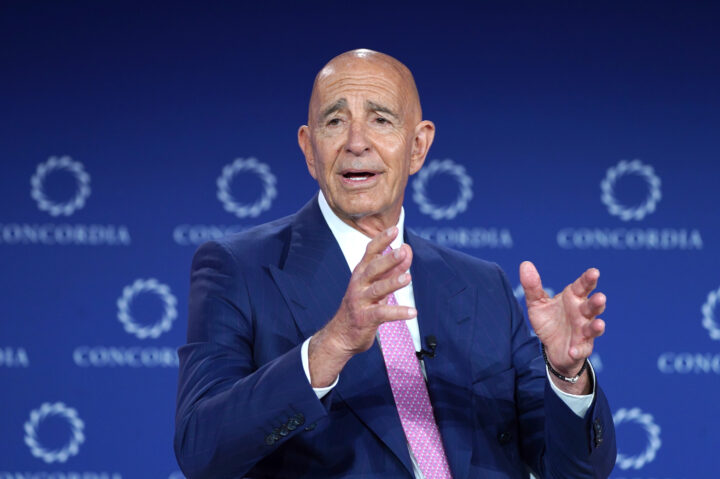
Leigh Vogel/Getty Images for Concordia Annual Summit
U.S. Ambassador to Turkey Tom Barrack speaks during the 2025 Concordia Annual Summit on September 24, 2025 in New York City.
Simmering frustrations among lawmakers with U.S. Ambassador to Turkey Tom Barrack — who also serves as special envoy to Syria and manages a wide remit in America’s Middle East policy — have recently emerged with force, as multiple lawmakers tell Jewish Insider they have concerns about the U.S. envoy’s expansive role.
Barrack’s critics see the envoy pushing U.S. policy in concerning directions, toward an overly close relationship with Turkey despite the country’s overt anti-Israel posture and regional ambitions and, most recently, as a key enabler of the Turkish-backed Syrian government’s offensive against U.S.’ longtime Kurdish allies in the Syrian Democratic Forces.
Over the course of months, the envoy has also made comments that have concerned lawmakers, including questioning Israel’s status as a democracy, downplaying the threat from Hezbollah and supporting a Turkish role in the International Stabilization Force in Gaza, despite Turkey’s long record of hostility to Israel.
A Republican senator, granted anonymity to speak candidly, told JI last week that Barrack’s role in U.S. policy in the region makes them “nervous.”
“He’s running a Turkish line, and there are very legit[imate] concerns” about his role and influence, the senator said.
A senior Senate Democrat involved in foreign policy issues also said he had concerns about Barrack, suggesting the envoy was pursuing personal business interests through his post.
“Barrack is clearly knowledgeable about the region, he’s clearly energetic and engaged. But that’s the only good I can say. I have real concerns about his motives and the consequences of his actions,” the Democratic senator said.
“That’s something I really worry about. When the president himself is among the most corrupt in American history, we can’t be surprised when the people he puts in positions of power conduct themselves in the same way, but it’s really dangerous,” the lawmaker added. “We’re losing our reputation as a good partner, a reliable ally and a country committed to supporting anti-corruption efforts.”
Asked about Barrack’s role in the administration, Sen. Richard Blumenthal (D-CT) told JI, “I’m hopeful that the interests of the Kurds will be protected. America needs to stand up to the Turks where necessary and insist that those rights be adequately represented.”
Lawmakers’ concerns have become public at a series of hearings on the Hill in recent weeks.
At a House Foreign Affairs Committee hearing on Syria last week, Rep. Josh Brecheen (R-OK), a leading skeptic among House Republicans of repealing U.S. sanctions on Syria, said he feels that Barrack’s dual role as ambassador to Turkey and Syria special envoy is hampering the U.S.’ ability to take a tougher stance with Syria.
“[Barrack] has to maintain a good relationship with Turkey. Would we not be well-served for someone to be specific to Syria, whether it be an envoy specific to Syria or an ambassador — how would that not help us to make sure that Tom Barrack can maintain a good relationship with Turkey but we’d have somebody to play hardball with Syria?” Brecheen said.
Brecheen said he’s worried that Turkish President Recep Tayyip Erdoğan seeks to reestablish the Ottoman Empire and that Syrian President Ahmed al-Sharaa is deceiving the U.S. and still maintains a jihadist ideology. He said current U.S. policy appears to be facilitating Turkish and Russian interests.
Nadine Maenza, the former chair of the U.S. Commission on International Religious Freedom, who testified before the committee, responded that she shares Brecheen’s concerns.
“It’s been very difficult to have him have both hats on, and I think we’ve seen that with the State Department not having a role to play in Syria policy and waiting for Barrack to make decisions,” Maenza said. “I don’t think that serves the president well, if his goal is peace and stability in the Middle East.”
At another House Foreign Affairs Committee hearing earlier this month, Rep. Brad Sherman (D-CA) highlighted Barrack’s past comments on Hezbollah, which he said “have often sent the wrong signals.” David Schenker, a senior fellow at The Washington Institute for Near East Policy who served in the first Trump administration, also repudiated Barrack’s comments.
Barrack has faced criticism off the Hill in conservative circles as well: a Wall Street Journal editorial last month blasted his “not-so-excellent Syrian adventure,” characterizing the ambassador as overly close with Turkey and pushing an anti-SDF policy in the administration.
Responding to the editorial, former Sen. Rick Santorum (R-PA) blasted Barrack for having “betrayed [the Kurds], Christians in Syria and our country for Turkey.” “His behavior is a disgrace. He should be recalled,” Santorum added.
Former National Security Advisor John Bolton — who has since come under fire by President Donald Trump — said last year that Barrack has been “publicly making excuses for al-Sharaa’s reluctance to open full diplomatic relations with Israel. It is not generally a U.S. ambassador’s job to justify another country’s actions. He should be warned about the symptoms he is displaying.”
Conservative commentator Mark Levin similarly criticized Barrack last summer for rebuking Israel’s attacks on Syrian government-aligned forces carrying out massacres of Druze and other minority groups.
His concerns were echoed by right-wing influencer Laura Loomer, who said that Barrack’s “delusions that he can play nice with [al-Sharaa], who is literally ISIS, is going to continue to destabilize the Middle East and get more innocent non-Muslims killed,” describing Barrack’s approach to Syria as completely wrong-headed.
“I have heard from different sources that [the Turks] perceive Tom Barrack to be their man, and this is the first time in a long time they feel that they have a U.S. envoy that’s essentially on their side, if you want to use that terminology, and is basically positioning Ankara to really realize a lot of their policy goals, their geostrategic goals,” Sinan Ciddi, the director of the Turkey program at the Foundation for Defense of Democracies, told JI.
Barrack, while being “a problematic actor,” is also “deeply influential,” Ciddi said, characterizing him as one of the two most influential figures in the U.S.’ regional policy alongside White House Special Envoy Steve Witkoff. Like Witkoff, Barrack is a longtime friend and business associate of Trump.
“He is making moves, he’s implementing policies as special envoy and as ambassador that I think present deep risks and and could have potentially detrimental consequences, because it’s going to alienate the United States at the least, but at worst, they could really inflame a considerable number of situations that we’re active looking at,” Ciddi said.
He raised concerns about three particular policies that Barrack has appeared to promote: providing Turkey with advanced F-35 fighter jets despite U.S. sanctions, bringing Turkey into the International Stabilization Force in Gaza and pushing for an influential role for Turkey in Syria and a favorable stance toward the new Syrian government.
He said that Barrack and the Trump administration more broadly appear to view Turkey as a partner that they can cooperate with on goals including stabilizing Syria and Gaza.
Israeli officials, however, view the situation in a very different light, and “feel that through Barrack’s adventurism, what we are seeing are dangerous moves to position Turkey in the Levant and the Middle East as an aggressive actor,” Ciddi said. “They feel that Turkey is, through Barrack, finding a means and opportunity to weaken Israel.”
Ciddi warned that Turkey having any role in the stabilization force in Gaza would be “fundamentally very, very dangerous” given Turkey’s friendliness with Hamas and hostility toward Israel. And he said that providing Turkey with the advanced F-35 jets would be “deeply problematic” given its close relationship with Russia, along with various other issues, a dynamic that has troubled lawmakers and European allies.
Ciddi also said that Barrack’s public comments, or lack thereof, about Turkey’s closeness with Hamas and Iran, about Hezbollah and about Israel’s status as a democracy should be concerning for “all the countries that have signed up to the Abraham Accords, or any country in the region that’s taking a position against jihadist movements and Salafist movements.”
Michael Makovsky, the CEO of the Jewish Institute for National Security of America, told JI that, “half the things the guy says I can’t understand, and the other half I don’t agree with.” Makovsky said he’s been particularly troubled by Barrack’s influence on Syria policy, seemingly pushing the U.S. toward support for al-Sharaa.
“I think that’s been a big mistake,” Makovsky said, criticizing the “betrayal of the Syrian Kurds, which I found rather obscene” and emphasizing that the Kurds had been a critical ally of the U.S. in the fight against ISIS. He noted that al-Sharaa remains aligned with jihadists who have carried out massacres of Syrian minority groups.
“We’re all in on [al-]Sharaa, and I think that’s partly because Trump met him and likes him, but even before that, it’s because this is what Barrack wants,” Makovsky continued. “He seems to often reflect exactly the Turkish view, and I don’t think the Turkish view on Syria aligns with our own interests at all.”
He said that he was also troubled by Barrack’s claim that Israel is not a democracy, saying that it was a poor message from a U.S. official and suggested that he does not properly understand the region.
Congressional correspondent Emily Jacobs contributed reporting.
Yehuda Kaploun’s strategy differs from the Trump administration’s stance against censorship
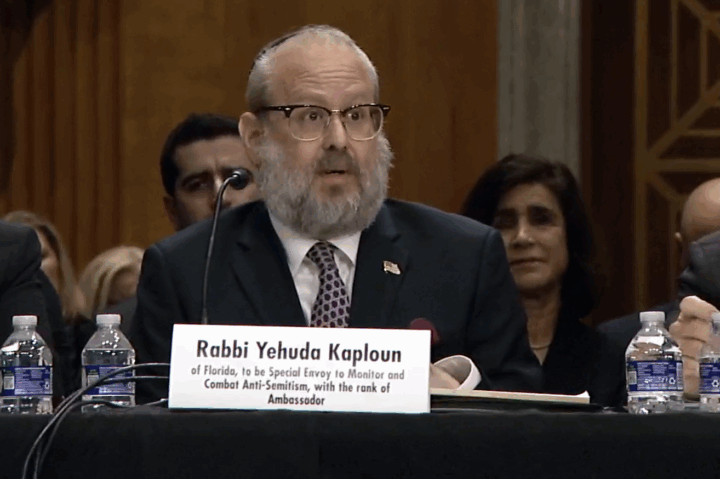
Screenshot
Rabbi Yehuda Kaploun, the Trump administration's nominee to be special envoy to monitor and combat antisemitism
Rabbi Yehuda Kaploun, President Donald Trump’s nominee to serve as U.S. antisemitism special envoy, warned in an interview with Jewish Insider that inaccurate, inflammatory content is being allowed to spread on social media, and pledged to work with social networks to curb the spread of antisemitic falsehoods online.
“The ideal outcome is, I want to continue America’s tradition of free speech and allowing free speech anywhere and everywhere, freedom of expression,” Kaploun said. “But I would like the platforms — because of the advent of AI and those technologies, you have the ability to recognize when something is not factually correct and it should be labeled as such. I think that’s something that we’d like to target.”
Kaploun spoke to JI on Wednesday, with his Senate confirmation vote for the State Department role expected this month before the holiday recess. His comments about working with social media platforms to label misinformation contradict the approach of the Trump administration, which has urged the major platforms not to “censor” information. Earlier this year, after Trump took office, Meta announced the end of its fact-checking program, and YouTube eased many of its content moderation policies.
“There’s many other areas of working with the companies — the algorithms and things that have been now proven, that bots are busy promoting antisemitic rhetoric on the internet, how we get to some of that and preventing some of that. These are very tall tasks. These are not things that occur overnight,” said Kaploun, a Chabad-trained rabbi and businessman from Miami. “But I truly believe there is a true willingness of many people within the administration to tackle these problems and confront them head on, globally.”
As an example of the kind of content he would seek to flag as false, Kaploun referred to a July New York Times article about the hunger that many civilians in Gaza were experiencing during Israel’s war against Hamas. The Times published a correction regarding the article several days after it was published, once it was revealed that a child who was featured prominently in the article as an example of malnutrition had preexisting health conditions.
The misrepresentation in the photo could contribute to antisemitism, according to Kaploun, who suggested that the article had been viewed hundreds of times more than the correction.
“I’m not exactly 100% sure of the actual number, but in that realm, a total disbalance and disproportionate view of people saw something that could be creating antisemitic behavior,” said Kaploun. “All those people that saw it have incorrect information.”
He declined to say whether he believes social networks should have removed posts that included that article.
“I’m not going to get into the specifics or the semantics of what that’s going to look like. We are going to work collectively and together with these companies and try and come up with productive solutions that will lower the disinformation and lower the hatred,” Kaploun said. “That’s what I’d like to work with these social media platforms to do a better job with, recognizing that and making sure that we can do a better job of getting accurate facts out.”
Discussing strategy, Kaploun laid out a vision for his tenure as special envoy to monitor and combat antisemitism, stating that his first priority would be to fight antisemitism with “pro-Semitism” — teaching about Jewish history and culture, and convincing countries and groups that are experiencing antisemitism that Jews are productive members of society and contribute a great deal to the countries in which they live.
“What I mean by pro-Semitism is to explain to countries the benefits of what it is the Jewish nation provides, and our historical perspective of what the Jewish communities have always done for communities, in terms of growth in countries,” said Kaploun. “The countries that have literally attacked the Jews and expelled the Jews don’t always have success, and there’s a reason for that. And when countries are welcoming and when Jews are in countries, usually the benefits far exceed any type of whatever detriments [there] are. There really aren’t detriments.”
“It’s not all about Israel,” Kaploun added. “It’s about the Jewish culture, the Jewish religion, the Jewish sciences.”
Still, he recognizes that separating Israel from discussions of antisemitism is not possible — like if he encounters people who insist that they have no problem with Jews, and that their only issue is with the Jewish state.
“Understand the battle that Israel has to fight here,” said Kaploun. “You’re fighting a culture that was teaching children to kill themselves, that the benefit to get to heaven is to kill a Jewish person. So we have to get to the root causes. You want to condemn Israel, ‘Oh, I love the Jews, but I hate Israel.’ Why is Israel in existence? Because there was a period of time when Jews were being slaughtered throughout Europe and the world was silent and there wasn’t a country for the Jews to go to.”
Here, too, he said it all comes down to education.
“The importance of Israel may need to be explained, but at the same time, people’s facts are incorrect,” Kaploun said. “If they’re factually accurate, then you’re able to have a conversation with someone. They will see the folly of what they’re saying.”
Kaploun has a plan, he told JI, for where to kick off his work once he is confirmed by the Senate and moves into Foggy Bottom.
“The president and the secretary [of state] are firmly behind the efforts that I am doing,” Kaploun said. “They’ve made it very, very clear that the administration is fully behind the efforts that we’re going to do to combat antisemitism.”
Kaploun’s nomination was advanced out of committee on Wednesday, with bipartisan backing

Joe Raedle/Getty Images
President Donald Trump and Rabbi Yehuda Kaploun light a candle during an Oct. 7th remembrance event at the Trump National Doral Golf Club on Oct. 7, 2024 in Doral, Florida.
Rabbi Yehuda Kaploun, the Trump administration’s nominee to be the State Department’s special envoy to monitor and combat antisemitism, is expected to come before the full Senate for a confirmation vote before the end of the year, two sources familiar with the situation confirmed.
Kaploun’s nomination was advanced out of the Senate Foreign Relations Committee on Wednesday with the support of all committee Republicans and two Democrats, Sens. Jeanne Shaheen (D-NH) and Jacky Rosen (D-NV). Shaheen is the committee’s ranking member.
Kaploun’s nomination is included in a package of nearly 100 mid-level nominees for a variety of different federal agencies and posts.
Senators will not have the opportunity to vote on Kaploun’s nomination individually, but the nomination package as a whole is likely to be approved. Only a simple majority vote of the Senate will be required to approve the nominations.
The exact timing of the vote will depend on various procedural factors, but Kaploun is likely to be confirmed before the Senate leaves for its winter recess in two weeks, a source familiar with the situation said.
Kaploun wasn’t included in a previous version of this nomination package, which was filed before he cleared the Foreign Relations Committee. That version of the package was defeated on the Senate floor earlier Thursday because a nominee who did not meet the qualifications for inclusion had been part of the package. As they refiled a new version, Republicans added several additional nominees, including Kaploun.
Facing procedural obstacles from Democrats that were slowing confirmation proceedings on the Senate floor to a crawl, Republicans changed the chamber’s rules earlier this year to allow themselves to approve some lower-level nominees in such groups by a simple majority vote, rather than the previous 60-vote threshold.
Jewish Insider’s senior national correspondent Gabby Deutch and congressional correspondent Emily Jacobs contributed reporting.
Rabbi Yehuda Kaploun, at hearing: ‘We must learn from the past to protect and educate the living’
Screenshot
Rabbi Yehuda Kaploun, the Trump administration's nominee to be special envoy to monitor and combat antisemitism
Rabbi Yehuda Kaploun, the Trump administration’s nominee to be the State Department’s special envoy to monitor and combat antisemitism, emphasized the importance of education as the critical tool to combat antisemitism during his confirmation hearing before the Senate Foreign Relations Committee on Wednesday.
“Together with bipartisan support, we must educate the world to respect one another. Lofty goals, perhaps, but a lesson that I learned from the Grand Rabbi of Lubavitch, as well as from my grandparents and my parents, is to do my best to impact and make the world a better place,” Kaploun said. “We do this by building bridges through education and friendships and dialogue. We must learn from the past to protect and educate the living.”
“We must, educate, educate, educate about the history of the Jewish community in America and the Judeo-Christian values our country was founded on,” he continued. “I pledge to all of you here, I will not waver and I will not rest. I will commit to you to do my very best, if confirmed, to fight antisemitism everywhere and to make this world a better arena for God to dwell and spread his blessings upon us all.”
Kaploun also emphasized the importance of understanding the history of the Holocaust, describing the U.S. veterans who liberated Nazi death camps as men who “saw the worst of humanity” and became “the best advocates in the world” against antisemitism. He also said he urges people to visit the U.S. Holocaust Memorial Museum.
“People don’t know the history, people don’t understand that we have to respect one another,” Kaploun said. “The problem is that people don’t want to listen to [WWII veterans] and hear their stories. … In America, we believe in freedom of expression and freedom of speech, but at the same time, we have to educate people as to what the facts truly are. … We’re missing that boat.”
Asked by Sen. Chris Van Hollen (D-MD) about President Donald Trump’s response to Tucker Carlson hosting neo-Nazi influencer Nick Fuentes on his podcast — Trump said that Carlson has “said good things about me over the years” and that “people have to decide” how they feel about Fuentes — Kaploun emphasized freedom of speech, as well as the administration’s work to combat antisemitism.
“I think the president and the secretary of state have made it perfectly clear that any type of antisemitism [does not have] a place in America. … That’s something that guides the administration’s policy,” Kaploun said, adding that the administration’s policy is that “antisemitism is to be condemned everywhere.”
He said that antisemitism is a “global problem” that stems from “ignorance” and a lack of education.
“But freedom of speech is something that’s a right, and freedom of expression globally is an important part of what the administration’s policy is,” he continued.“You have a right to hate, but we have a right to explain and stand up and abhor everything that you say. I believe very strongly that we can condemn remarks whenever they need to be condemned and educate people.”
The friendly interview between Carlson and Fuentes has touched off a reckoning in conservative circles about antisemitism on the right, though the administration has largely stayed out of the fray on the issue.
Pressed on the line between criticism of Israel and antisemitism, Kaploun pointed to the International Holocaust Remembrance Alliance’s working definition of antisemitism, which has been used by the State Department for years.
He said that anyone has a right to criticize Israel, but that when individuals single out Israel without offering criticisms of any other countries, that can cross the line into antisemitism.
In his opening statement, Kaploun detailed the ways that antisemitism has impacted him throughout his life: he heard shouts of “dirty Jew” while walking to synagogue as a child; he grew up during the Crown Heights riots, hearing cries of “kill the Jews” in the streets; and his sister died of 9/11 related cancer and his cousin was killed on Oct. 7 protecting her children who are now orphans.
He said he also had the opportunity to sit with former hostage Yarden Bibas, whose family was killed by terrorists in Gaza after being taken captive, the night before the funeral of Bibas’ wife and children.
“Yes, I have seen the worst that humanity can do. When asked to serve my country by our president in a role that I truly wished did not need to exist there was no hesitation,” Kaploun said. “I sit before you humbled by the opportunity to serve my country. It is a daunting task.”
Kaploun also emphasized that antisemitism is a “symbol of a larger hatred” and that “when a country starts allowing antisemitism, the results are not kind to that country.”
“That is why President Trump and Secretary Rubio have stated there can be no compromise with antisemitism,” he said. “Antisemitism is anti-American. Those who chant ‘death to the Jews’ all too often chant ‘death to America.’ We cannot allow anyone to teach children from infancy to kill and to be a martyr.”
Sen. Jacky Rosen (D-NV), co-chair of the Senate antisemitism task force and a member of the committee, told Jewish Insider in a statement, “I’ve worked closely with Special Envoys under both Republican and Democratic Administrations. Maintaining this bipartisan tradition will be critical to the success of this role. If confirmed, I look forward to working with Rabbi Kaploun to achieve our shared priorities.”
In a letter to the committee, the Orthodox Union Advocacy Center’s Nathan Diament and Isaac Pretter — while not directly endorsing Kaploun — emphasized the importance of filling the role quickly and noted Kaploun’s qualifications.
“As an easily identifiable member of the Jewish community, and longtime activist, Rabbi Kaploun is familiar with the issues facing Jews around the world,” the OU Advocacy leaders wrote. “As a member of the Orthodox community, we are familiar with Rabbi Kaploun and his commitment to combatting antisemitism.”
The also noted that he had “shown a willingness to cross the partisan divide” to issue a joint op-ed with predecessors Ambassador Deborah Lipstadt and Elan Carr in response to the Capital Jewish Museum shooting.
“In short, Rabbi Kaploun has proven an eager and capable ally in the fight against antisemitism,” Diament and Pretter said.
Ted Deutch, the CEO of the American Jewish Committee, urged the “swift confirmation of Rabbi Kaploun to help the United States continue to lead the fight against antisemitism across the globe,” in a post on X.
Rep. Jerry Nadler (D-NY), a co-chair of the House Jewish Caucus, and 17 other House Democrats wrote to committee leaders in opposition to Kaploun’s nomination, calling it “partisan and controversial.”
They criticized him for past comments accusing Democrats of failing to condemn the Oct. 7 attackers as terrorists or call out antisemitism, saying that the comments raise concerns about his “judgement, temperament” and capacity to work with Democrats, and that a vote to support him would be an endorsement of those sentiments and an insult to committee Democrats.
They also condemned him for failing to condemn antisemitic comments by Trump and members of his administration, and highlighted past reporting on a lawsuit relating to an alleged extramarital affair.
“Ultimately, Mr. Kaploun, when confronted by antisemitic rhetoric, did not speak out against it and himself engaged in speech that was deeply damaging to the Jewish community at a time of peak antisemitism,” the letter reads. “We must demand better.”
Other signatories to the letter included Jewish Reps. Jamie Raskin (D-MD), Jan Schakowsky (D-IL), Becca Balint (D-VT) and Steve Cohen (D-TN), as well as Reps. Adam Smith (D-WA), Jim McGovern (D-MA), Andre Carson (D-IN), Joaquin Castro (D-TX), Rosa DeLauro (D-CT), Sylvia Garcia (D-TX), Cleo Fields (D-LA), Mark Takano (D-CA), Madeleine Dean (D-PA), Betty McCollum (D-MN), Troy Carter (D-LA), Emily Randall (D-WA) and Joe Courtney (D-CT).
State Department spokesperson Tammy Bruce, nominated to be deputy U.S. representative to the United Nations, testified alongside Kaploun. She affirmed that the administration is committed to preventing the U.N. Relief and Works Agency from having any role in the future of Gaza.
“Other nations, other entities, NGOs know that this is something now, it is a new way forward, it is something they can work forward with,” she said, praising the Trump administration’s Gaza peace plan, recently approved by the U.N. Security Council. “The World Food Program, other entities associated with the U.N. and other nations and their assistance will make the difference. We will pick up the difference of whatever UNRWA claimed that they were doing.”
She also highlighted concerns about UNRWA’s educational programs radicalizing young generations of Palestinians through antisemitic and anti-Israel school curricula and said these issues must end.
Bruce also committed to pursuing “bold reform” at the U.N. and pursuing an end to its anti-Israel bias.
The White House envoy spoke at an event at the U.S. Holocaust Memorial Museum in Washington, D.C, commemorating two years since the Oct. 7 Hamas attacks on Israel
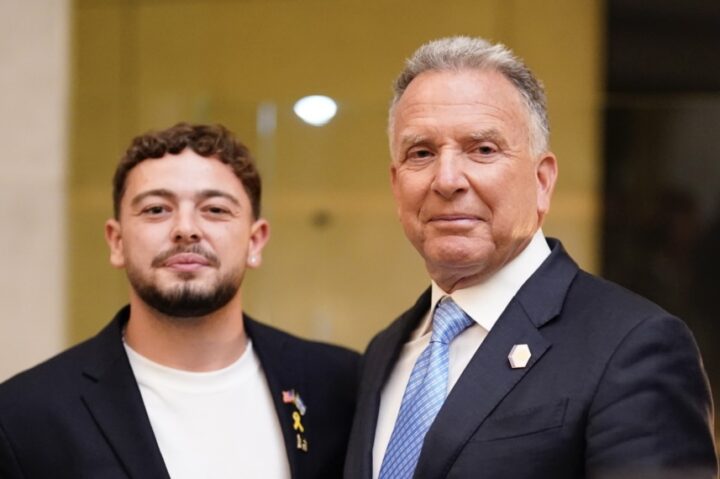
United States Holocaust Memorial Museum
White House Special Envoy Steve Witkoff and Almog Meir Jan
White House Special Envoy Steve Witkoff predicted on Thursday that the Abraham Accords will “seriously expand” in response to the end of fighting in Gaza. Witkoff was addressing attendees at an event commemorating the second anniversary of the Oct. 7, 2023, Hamas terror attacks.
“No leader has done more for the Jewish people or the State of Israel than President Trump,” Witkoff, speaking at an event at the U.S. Holocaust Memorial Museum in Washington, said. “He moved our embassy to Jerusalem, he recognized Israel’s sovereignty over Judea and Samaria [the West Bank] and the Golan Heights. He forged the Abraham peace Accords, which will seriously expand now,” Witkoff said.
The White House envoy, who returned from the region earlier this week after the implementation of the first phase of the ceasefire, posited that Trump winning a second term last November was “the major breakthrough of this conflict.”
“The moment that result was declared, the world changed, and so did the negotiations. Hamas and every party in the region understood that President Trump, his return to office, meant strength, accountability and action,” Witkoff explained. “Even before taking office, President Trump made it clear he wanted progress by the day he stepped into the Oval Office, and shortly thereof, we struck a ceasefire and hostage release deal that began to turn the tide.”
“The success of that first hostage release was made possible by President Trump’s 20-point plan, a strategy that united the Arab world behind this effort. Nations like Egypt, Turkey, Qatar, Saudi Arabia, the UAE, Jordan and many others came aboard because peace and civility are in everybody’s interests,” he added.
Witkoff went on to commend the Arab state negotiators and Jared Kushner, Trump’s son-in-law and former senior advisor, arguing that they collectively pressured Hamas to release the remaining hostages. All 20 living hostages were freed on Monday, while the terror group has slow-walked the repatriation of the bodies of deceased hostages
“In the final phase, at President Trump’s directive, Jared Kushner, a great American, and I flew to Sharm el-Sheikh, Egypt, for the last round of negotiations, led by Qatari, Egyptian and Turkey’s mediators. They were incredible and without them we would not be where we are today,” Witkoff said. “Jared was tremendous. Together, we convinced Hamas that keeping the remaining 20 hostages was no longer an asset, it was a liability, and they began to believe it.”
Witkoff acknowledged that Israel has yet to receive the remains of the deceased hostages still being held by Hamas in Gaza, but said the administration was working toward their release.
“We didn’t get everybody back. We’ve gotten [nine deceased hostages] back and we will pursue the return of the … deceased until they all go home, and I’m confident that they will,” Witkoff said.
Witkoff also referenced his several recent visits to Gaza during his remarks, pointing out that Gazans he’s engaged with “want peace too. They want stability, opportunity, a better life for their children. A future for Gazans must include jobs, education, hope, aspirations, not just guns and violence. Israel should never have to live under the threat of rockets flying at its people or the fear of terrorist attacks, but Gaza’s people must be able to live a decent life as well.”
“We have to be clear, Hamas must unequivocally disarm. They have no future in Gaza,” he continued. “Only when extremism ends does prosperity begin.”
Rabbi Yehuda Kaploun, Trump’s nominee to serve as antisemitism envoy; Ben Ladany, a former IDF sergeant in the elite Oketz K-9 Unit who was shot seven times in November 2023 while fighting Hamas in Gaza; and Almog Meir Jan, an Israeli hostage held by a Palestinian journalist after being taken from the Nova music festival, also spoke at the event.
Nat Shaffir, a Holocaust survivor and USHMM volunteer, and 18 other Holocaust survivors, were among those in attendance, in addition to Rep. Randy Fine (R-FL); Andrew Giuliani, the son of former New York City Mayor Rudy Giuliani and the executive director of the White House task force overseeing the 2026 FIFA World Cup whom Trump appointed in his first term to sit on the U.S. Holocaust Memorial Council; Alex Witkoff, the son of Steve Witkoff and CEO of the Witkoff Group who also sits on the council; Rabbi Levi Shemtov, executive vice president of American Friends of Lubavitch (Chabad); and Alina Habba, the acting U.S. attorney for New Jersey and the president’s former personal attorney.
Mentions of President Donald Trump drew raucous applause, while the crowd booed Witkoff’s mentions of Prime Minister Benjamin Netanyahu
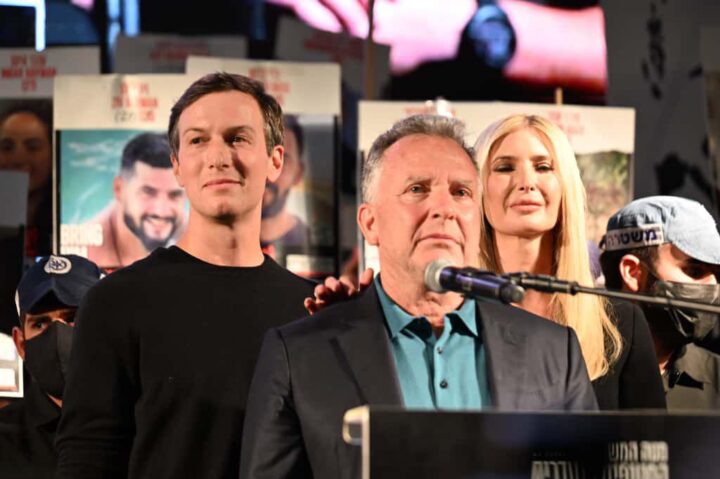
Paulina Patimer
Jared Kushner, Steve Witkoff and Ivanka Trump speak in Hostages Square in Tel Aviv, Israel, on Oct. 11, 2025.
Days before the remaining living hostages are expected to be released from more than two years of captivity in Gaza, White House Special Envoy Steve Witkoff, Jared Kushner and Ivanka Trump addressed a receptive crowd of hundreds of thousands on Saturday night in Tel Aviv’s Hostages Square.
Witkoff and Kushner had been in Sharm el-Sheikh, Egypt, earlier in the week for high-level talks that secured an agreement, which went into effect on Friday, to end the two-year war between Israel and Hamas. They arrived in Israel on Thursday ahead of President Donald Trump’s planned visit to the country on Monday, the day that most living hostages are expected to be released.
“To the hostages themselves,” Witkoff said, “our brothers and sisters, you are coming home.” The White House special envoy praised Trump, who, Witkoff said, “once again proved that bold leadership and moral clarity can reshape history and change the world.”
“We all owe a debt of deep gratitude to President Trump,” the White House special envoy continued, to cheers and chants thanking Trump, Witkoff and Kushner. Numerous mentions of Trump’s name throughout the evening drew cheers and applause from the crowd.
Witkoff paused his speech and appeared flustered after his mentions of Israeli Prime Minister Benjamin Netanyahu drew widespread jeers from the crowd. “I was in the trenches with the prime minister,” Witkoff said as he tried to mollify the crowd. “Believe me, he was a very important part here.” Netanyahu and Israeli Strategic Affairs Minister Ron Dermer, Witkoff added, “have both sacrificed so much for this country and devoted their lives to the service of Israel.”
Witkoff noted the “tireless dedication of leaders who would not rest until the world saw what could be achieved,” naming the president, Kushner and Arab leaders including Qatari Prime Minister Sheikh Mohammed bin Abdulrahman Al Thani, Qatari Emir Tamim bin Hamad Al Thani, Turkish President Recep Tayyip Erdoğan and Egyptian President Abdel Fattah el-Sissi.
Calling Oct. 7, 2023, a “shattering day,” Kushner said the attacks “shocked me to my core in a way I’ll never be the same. Since then, my heart has not been complete.”
Kushner, who has in recent months been increasingly involved in the White House’s efforts to reach a comprehensive deal to end the Israel-Hamas war, described the “tremendous burden that I felt to see these hostages come home, to see their families get the closure they deserve and to end this nightmare — and also to see the suffering end for the people in Gaza, who, for most of them, were experiencing this through no fault of their own, other than being born into a situation that was horrific.”
In brief remarks, Ivanka Trump said that “the return of each hostage is not only a moment of homecoming and relief, it’s a triumph of faith, of courage and of our shared humanity.”
Addressing the hostage families, Trump said, “The president wanted me to share, as he has with so many of you personally, that he sees you, he hears you, he stands with you — always. Always.”
A video that played as Kushner, Witkoff and Trump exited the stage praised the U.S. president as “Israel’s great friend.”
Ruby Chen, the father of slain Israeli American hostage Itay Chen, who spoke following Trump, said that Israel Police estimated that 400,000 people were in attendance at Saturday’s rally, a weekly solidarity event since the Oct. 7 attacks.
Yehuda Kaploun and former Rep. Mark Walker have not yet had committee hearings scheduled
Joe Raedle/Getty Images
President Donald Trump and Rabbi Yehuda Kaploun light a candle during an Oct. 7th remembrance event at the Trump National Doral Golf Club on Oct. 7, 2024 in Doral, Florida.
Several major Jewish organizations are expected to call on the Senate to “swiftly” confirm President Donald Trump’s nominees for special envoy to monitor and combat antisemitism and international religious freedom ambassador.
The groups, led by the Jewish Federations of North America, are writing in a letter to Senate Majority Leader John Thune (R-SD) and Senate Minority Leader Chuck Schumer (D-NY) that filling the roles is “of utmost importance in fighting growing antisemitism and ensuring freedom of religion or belief worldwide,” according to a draft obtained by Jewish Insider. The letter is set to be sent on Tuesday, according to a source with knowledge of the draft.
“We dare not delay in filling these critical positions that protect human rights around the world,” the letter states. “To that end we strongly urge you to prioritize filling these positions, sending a powerful signal to governments around the world that the United States upholds our constitutionally guaranteed rights to life and liberty, to freedom of religion and belief, and calls on them to do the same.”
In April, Trump tapped Rabbi Yehuda Kaploun, an Orthodox businessman and Chabad rabbi who served as a campaign surrogate, to serve as the next U.S. special envoy to monitor and combat antisemitism. In the Biden administration, that role was filled by Deborah Lipstadt, a Holocaust historian at Emory University. In May, the two authored a joint op-ed, with former antisemitism envoy Elan Carr, calling for action after two Israeli Embassy staffers were killed outside the Capital Jewish Museum in Washington.
Trump named former Rep. Mark Walker (R-NC) as the U.S. ambassador-at-large for international religious freedom. Both positions require Senate confirmation, and neither has had a confirmation hearing yet.
“We believe that these ambassador-at-large positions are crucial to protecting vital human rights, promoting religious freedom and vigorously confronting the global surge in antisemitism,” the Jewish organizations wrote.
JFNA CEO Eric Fingerhut told JI on Tuesday that the positions must be filled to help Jewish organizations combat rising antisemitism.
“The 141 Jewish Federations across our system are on the front lines of responding to and combatting antisemitism, and every single day we hear from them about the elevated levels of antisemitism our communities are facing,” Fingerhut said. “The government is a critical partner in our fight against antisemitism, both at home and around the world, so we must make sure that these roles do not remain vacant.”
A spokesperson for Thune did not respond to a request for comment.
A spokesperson for Schumer referred to the hold the Senate minority leader currently has on dozens of Trump nominees, and Trump’s recent message to Schumer to “go to hell” after bipartisan negotiations broke down. The spokesperson declined to comment specifically on Kaploun or Walker.
“President Trump has focused on promoting religious freedom and fighting antisemitism in a historic way,” White House deputy press secretary Anna Kelly told JI in a statement. “He wants all of his nominees confirmed as quickly as possible, including Yehuda Kaploun and Mark Walker, whose roles will be critically important to protecting Americans of faith.”
Current signatories to the letter include the Conference of Presidents of Major American Jewish Organizations, the Anti-Defamation League, the Orthodox Union, the Israeli-American Council, the Zionist Organization of America, Hadassah, American Jewish Committee, Agudath Israel, B’nai Brith International, the Louis D. Brandeis Center for Human Rights Under Law, NORPAC, Combat Antisemitism Movement, Religious Zionists of America and the American Association of Jewish Lawyers and Jurists.
A White House spokesperson did not respond to a request for comment.
This story was updated at 9:35 a.m. ET on Aug. 27, 2025.
The U.S. envoy to Syria has proposed a roadmap to the Lebanese government to disarm the terrorist group as part of a comprehensive regional plan
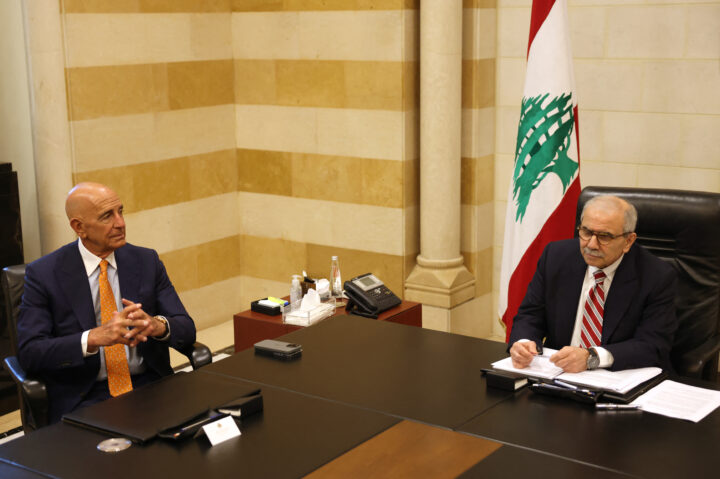
IBRAHIM AMRO/AFP via Getty Images
Lebanese Prime Minister Nawaf Salam (R) meets with U.S. envoy Thomas Barrack in Beirut on July 7, 2025.
U.S. Ambassador to Turkey Thomas Barrack, who is serving as special envoy to Syria, said on Monday that Hezbollah could have a future in Lebanese politics, despite the organization’s designation by the U.S. State Department as a Foreign Terrorist Organization.
“Hezbollah is a political party. It also has a militant aspect to it,” Barrack said at a press conference on Monday morning in Beirut, following a meeting with Lebanese President Joseph Aoun. “Hezbollah needs to see that there is a future for them, that the road is not not harnessed just solely against them, and that there’s an intersection of peace and prosperity for them also.”
Barrack said he was “unbelievably satisfied” with the Lebanese government’s response to the U.S.-proposed peace plan for the country, which includes the complete disarmament of Hezbollah and Israel ceasing airstrikes within the country.
Looking forward, Barrack emphasized that Hezbollah’s role within a new governing structure would be decided by the Lebanese government alone, with the U.S. playing a supporting role.
“Nobody is better than the Lebanese in choosing opportunities,” Barrack said. “The region is changing, everything is moving at warp speed. All of the countries around us are changing, are morphing. You have a president of the United States who has committed to saying he has great respect for Lebanon, that he is behind it, and he wants to help in peace and prosperity.”
In May, Lebanese Prime Minister Nawaf Salam said 80 percent of the government’s objectives in disarming Hezbollah were met, reportedly with assistance from Israel, including intelligence and military support.
A State Department directory lists Ortagus as a senior policy advisor at the mission to the U.N., according to a screenshot obtained by JI

John Lamparski/Getty Images for Concordia Summit
Morgan Ortagus speaks onstage during 2024 Concordia Annual Summit at Sheraton New York Times Square on September 25, 2024 in New York City.
Morgan Ortagus, who joined the Trump administration as Steve Witkoff’s deputy Middle East special envoy, has now moved to a position at the U.S. mission to the United Nations, a State Department source told Jewish Insider.
A State Department directory lists Ortagus as a senior policy advisor at the mission to the U.N., according to a screenshot obtained by JI.
Ortagus left Witkoff’s office after a widespread purge of Israel and Iran officials at the National Security Council. Ortagus is close with Mike Waltz, President Donald Trump’s former national security advisor who is now his pick to serve as ambassador to the UN.
Ortagus served as the State Department spokesperson during Trump’s first term, becoming a familiar face advocating for the president’s foreign policy priorities.
With its parent office being eliminated, the special envoy to monitor and combat antisemitism will be moved to State’s new foreign and humanitarian affairs office

AP Photo/Luis M. Alvarez
State Department in Washington
A new organizational chart released by the State Department on Tuesday shows major changes to the department’s structure, including the elimination of the office where the special envoy to monitor and combat antisemitism’s team is located. Despite this, internal department communications affirmed that the office of the special envoy is still a department priority and will continue to exist.
Secretary of State Marco Rubio announced the major shake-up of the department’s organizational structure as seeking to counter what he described as left-wing orthodoxy in the department and “drain[ing] the bloated, bureaucratic swamp.”
The changes include the elimination of the office of the under secretary for civilian security, democracy and human rights, where the office of the antisemitism envoy was previously placed.
A fact sheet sent to State Department employees that was obtained by Jewish Insider makes clear that the antisemitism envoy’s office will now fall under the State Department’s new foreign and humanitarian affairs office, along with the office of international religious freedom. Many other offices were not afforded the same clarity in Rubio’s fact sheet. Layoffs are expected across the department, but senior officials declined to share with employees who might lose their job.
“President [Donald] Trump and Secretary Rubio are focused on realigning U.S. foreign policy to reflect America’s core national interests and deliver better results for Americans,” the fact sheet stated.
Trump nominated businessman Rabbi Yehuda Kaploun to serve as antisemitism envoy, an ambassador-level position that requires Senate confirmation. The office is still staffed by several civil servants even in the absence of a confirmed envoy.
The U.S. special envoy to monitor and combat antisemitism also spoke about her hopes for the Trump administration’s efforts to fight antisemitism during a roundtable with reporters

Noam Galai/Getty Images
Ambassador Deborah Lipstadt, U.S. special envoy to monitor and combat antisemitism, speaks during 'March For Israel' at the National Mall on November 14, 2023 in Washington, D.C.
The U.S. special envoy to monitor and combat antisemitism, Ambassador Deborah Lipstadt, told reporters at a roundtable on Tuesday — her last before departing her role — that U.N. Secretary-General António Guterres had condemned Francesca Albanese, the special rapporteur on the situation on human rights in the Palestinian territories, who the U.S. has repeatedly criticized for antisemitic comments, in a one-on-one conversation with her.
Lipstadt also spoke about her hopes for the Trump administration’s efforts to fight antisemitism, internal issues among some State Department staff relating to her office’s mission, China’s role as a driver of global antisemitism and her most important accomplishments in office.
The outgoing envoy said that, during an event at a synagogue during the Munich Security Conference, she had spoken to Guterres about the U.S. government’s concerns with Albanese. In Lipstadt’s retelling, Guterres responded, twice, “She’s a horrible person.”
U.S. lawmakers have repeatedly pressed Guterres and the U.N. to dismiss Albanese, whose position is unpaid, but those calls have gone unanswered.
Lipstadt declined to comment on some of the controversial names, such as Shmuley Boteach, Alan Dershowitz and Dov Hikind, who’ve been floated to replace her, but said that she hopes President-elect Donald Trump will nominate “someone who will be a barn-builder, not a barn-burner,” and can build on the progress she has made.
“I would hope it would be someone who would command the respect and the attention of the foreign governments with which they’ll be dealing,” she continued. Lipstadt said she “certainly hope[s]” that the incoming administration is up to the task of combating the global surge in antisemitism.
She said that, based on conversations with Secretary of State-designate Marco Rubio during her confirmation process, she is confident that the Florida senator “takes this issue very seriously” and “gets it 100%, just as Secretary [Tony] Blinken got it, so that gives me direct hope on this issue.”
Lipstadt said she’d be willing to offer advice to the Trump team or her eventual replacement if they ask, explaining that refusing to do so “would be a dereliction of duty and everything I’ve said.”
Since the Oct. 7 attacks, several mid-level State Department staffers have publicly resigned in protest of the U.S.’ support for Israel. While Lipstadt said that the issue had not impacted the senior policy-making levels of the State Department, some individual mid-level staff had expressed issues with her office’s work because they did not understand that combating antisemitism and support for Israel are separate issues.
“For some of them, I think it spilled over into thinking, ‘Well, if they fight antisemitism, they must support Israel 120%,’ or something like that,” she said. “It wasn’t resistance to the work that we’re doing but I think there were some people, misinformed people, who thought [they knew] what our particular views were without ever asking us.”
Lipstadt said that State Department officials also still had yet to identify who scrawled a swastika inside an elevator in the State Department headquarters several years ago.
She also noted that China has been a significant driver of global antisemitism in recent years, which she described as a form of “utilitarian” antisemitism, employed for political gain, rather than ideological reasons.
“It seems to have been … a way of signaling that ‘We are with the global south. We’re with you and not with them,’” Lipstadt said.
She said that such discussions have made a particularly strong impression on foreign officials with whom she has met, and helped some better understand the nature and importance of combating antisemitism.
U.S. intelligence and security agencies are “very aware” of the Chinese government’s amplification of antisemitism and the “global implications” of that, she added.
Reflecting on the rise of antisemitism since Oct. 7, Lipstadt said she believes that the organized Jewish community overlooked and underestimated the extent to which anti-Israel and pro-Hamas groups had built up support on college campuses. She said she’s “glad the organizations are re-assessing” and are adapting to the new landscape.
She also emphasized that antisemitism is now impacting individual Jews’ “personal lives in a way that we haven’t seen since the ‘50s and early ‘60s.”
The spike, she said, has brought antisemitism issues “into sharper focus than I ever imagined,” and the global landscape has “changed tremendously,” with antisemites becoming more emboldened and brazen.
She noted that it’s been “frustrating at times” to be restricted, because of her international remit, in her ability to address domestic antisemitism on college campuses, where she spent most of her career before the State Department.
Lipstadt did say she was struck by how “heated and extreme” rhetoric on college campuses became, including overt support for terrorism and denial of Hamas’s atrocities, “in a way that I had never seen before in relation to other kinds of tragedies.” She said that “struck me as something really significant.”
Lipstadt said that one of her early goals in office was making progress on fighting antisemitism in Gulf states, and convincing them to separate the issue from geopolitical issues with Israel. Her first foreign trip in her role was to Saudi Arabia to pursue this goal.
She said those efforts were stalled as a result of the Oct. 7 attack, but said she hopes that the next administration is able to advance them.
“I think that could have a very big impact in terms of the power of those countries, the importance of those countries, but also in terms of antisemitism within the Muslim world, the Arab world,” Lipstadt said.
Lipstadt said she believes she has helped raise the prominence of antisemitism as a foreign policy concern issue both within the State Department and with partner governments abroad, even in countries without substantial Jewish populations.
One key signal of this, she said, is that the State Department distributed the global guidelines for combating antisemitism, which the U.S. and other partners developed, as a démarche to a range of U.S. partners, formally asking other nations to sign express their support for the guidelines and making them a formal part of the State Department’s global human rights agenda.
Lipstadt said another major success was overhauling the structure of the office, which had just two full time and one part-time permanent staff members when the Trump administration left office and effectively shut down in the transition period between presidential administrations.
Now, the office will have approximately 20 full-time non-political staff who will continue on into the Trump administration and will be able to keep the office’s work moving ahead even before a new special envoy is nominated or a deputy special envoy is appointed.
Those staff, she said, will continue to work on recruiting additional countries to sign the global guidelines, participate in international conferences and continue to advise other State Department personnel and policymakers on antisemitism.
Lipstadt, who was a frequent social media user in her pre-government life — a fact that caused issues with some Republicans during her confirmation process — said she’s still deciding how best to speak out in her post-government life.
She said that she’s also found, in government life, that not speaking out, or acting quietly, can be more effective in the long-run than public condemnations.
“I’ll have to decide,” she said. “Also, if you speak too much on everything, at some point you’ll just be dismissed as a partisan hack.”
Please log in if you already have a subscription, or subscribe to access the latest updates.
 Continue with Google
 Continue with Apple