


























The book imparts the lesson of teaching children there are consequences for taking things that don’t belong to them
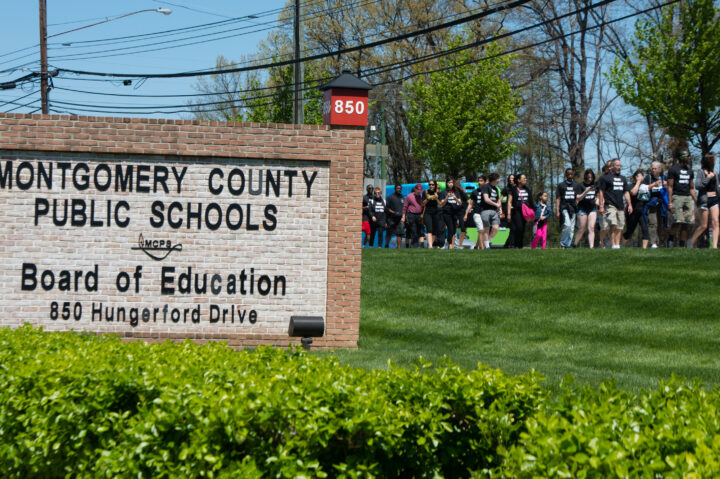
Sarah L. Voisin/The Washington Post via Getty Images
Montgomery County Public Schools building on April 27, 2014.


 Add JewishInsider on Google
A book that centers on Palestinian identity is drawing controversy from some Jewish parents in the Montgomery County, Md., public school system after it was assigned to first grade students as required classroom reading, Jewish Insider has learned.
The book,“Tunjur! Tunjur! Tunjur! A Palestinian Folktale,” written by Margaret Read MacDonald, aims to convey a message to children that there are consequences for taking things that don’t belong to them. It tells the story of a woman who “prayed to Allah” for a child and received a pot as her child. The pot, too young to know right from wrong, had a tendency to steal honey from the marketplace and jewels from the king — until she got caught. As punishment, she was filled with muck. “I hope you’ve learned your lesson,” the pot’s mother tells her. “You cannot take things that do not belong to you.”
While the book does not mention Israel, local Jewish leaders and parents voiced concern that the required book’s subtext sends an anti-Israel message to elementary schoolers and that the reference to “Allah” does not belong in a public school setting.
A syllabus notes that students can receive supplemental reading materials if “any instructional material conflicts with your family’s sincerely held religious beliefs.”
The book’s lesson that “‘you cannot take things that do not belong to you’ echoes activist rhetoric that falsely casts Israel as an oppressor and the Jewish people as imperialist rather than indigenous,” Dana Stangel-Plowe, chief program officer at the North American Values Institute, a nonprofit that monitors antisemitism in K-12 schools, told JI.
“It reinforces a false narrative that erases the historic Jewish connection to Israel. It sends a troubling message to Jewish families during a time of rising antisemitism,” Stangel-Plowe told JI.
Not all Jewish communal leaders agreed that the book was problematic. Guila Franklin Siegel, chief operating officer of the Jewish Community Relations Council of Greater Washington, argued that Jewish families should embrace the book.
“If the only complaint about this book is that it’s sharing a Palestinian folktale that teaches children not to take things that don’t belong to them, I can’t see what the problem with the book is,” Franklin Siegel told JI. “It will be a shame if Jewish people wind up objecting to books only because they have protagonists who happen to be Palestinian.”
“There may well be books and materials that do misinform students about the Israeli-Palestinian conflict, and we always monitor that work,” said Franklin Siegel. “If we turn this into a back and forth where parents are requesting opt-outs for any material that they don’t see eye-to-eye with, we’ll wind up in a situation where we’re seeing a significant number of students whose parents are requesting opt-outs for things like Holocaust speakers.”
Meanwhile, Margery Smelkinson, a parent of four MCPS students, told JI that she would have preferred the district find a children’s book that teaches not to steal “without causing controversy.”
“The real problem is that MCPS chose a book that even requires an opt-out form — why not just pick another book?”
Smelkinson called on the school district to prioritize helping students get up to speed in reading, math and science instead of “creating more barriers to learning.”
“I’m concerned and curious if my child was introduced to [similar rhetoric] last year,” Diana Tung, the parent of an MCPS second grader and kindergartener, told JI. “I assume in a public school setting there’s going to be pretty diverse spiritual beliefs [but] the context of the tale itself [concerns me]. The themes should be taught using a different folktale, I’m pretty confident there are plenty.”
“Books and materials approved to be available for use in classrooms, beyond being in alignment with curriculum standards, are selected to be representative of our very diverse community,” Christopher Cram, a spokesperson for the suburban Washington school system, which is the 15th-largest school district in the country and educates a significant number of Jewish students, told JI. “Students and families expect to be able to see themselves in the materials we use.”
The school system has faced several antisemitic incidents since Hamas’ Oct. 7, 2023, terrorist attacks, leading to the school board president, Karla Silvestre, being subpoenaed to testify at a congressional hearing in May 2024. Weeks after the hearing, at least six MCPS school buildings — including three elementary schools — were vandalized with antisemitic graffiti.
The assignment of the Palestinian folktale as required reading comes two months after the Supreme Court ruled in Mahmoud v. Taylor that MCPS must allow parents to opt their children out of lessons and books that feature LGBTQ+ themes if the material conflicts with their religious beliefs.
Please log in if you already have a subscription, or subscribe to access the latest updates.
 Continue with Google
 Continue with Apple