





































‘Prioritizing politics over antisemitism signals that Jewish safety is negotiable,’ the rabbis wrote, after JI reporting found Murphy and other Democratic leaders were worried about electoral backlash

AP Photo/Eduardo Munoz Alvarez
New Jersey Gov. Phil Murphy speaks during a press conference to announce that George Helmy will take the U.S. Senate seat that will soon be vacated by Senator Bob Menendez, in Newark, New Jersey, Friday, Aug. 16, 2024.


 Add JewishInsider on Google
Nearly 100 New Jersey rabbis wrote to now-former Gov. Phil Murphy and members of the New Jersey Assembly this week expressing concerns about reporting from Jewish Insider that Murphy and other Democratic leaders had blocked passage of legislation to adopt the International Holocaust Remembrance Alliance’s working definition of antisemitism.
A source had told JI that Democratic leaders in the state were concerned that lawmakers who supported the legislation would be vulnerable to progressive primary challengers.
“This is a deeply troubling failure of leadership that places political calculations above the safety of the Jewish population,” the 95 rabbis wrote, highlighting a string of violent antisemitic incidents in the state and a report indicating that New Jersey was the state with the highest number of antisemitic incidents per capita in 2024.
“Prioritizing politics over antisemitism signals that Jewish safety is negotiable and subjects our community to further cases of harassment and violence,” the letter reads. “Therefore, we call on our political leaders in New Jersey to immediately revisit and pass legislation that adopts the IHRA definition of antisemitism, and applies that definition to training, education, and hate-crime response systems.”
The letter was first reported by NJ.com and organized by The Jewish Majority.
“Already in 2026 demonstrators have gathered outside Jewish institutions to support Hamas’ murder of Jews, and a synagogue has been burned,” the letter continued. “Now is not the time to play politics with our safety.”
The rabbis also said that the recent mass shooting at a Hanukkah event in Sydney, Australia, shows the “lethal consequences of ignoring such hate” and the necessity to provide “clarity around what constitutes Jew-hatred.”
“We spent a lot of time working on this issue in the legislation, and then when Gov. Murphy killed it very late in his term, [it] was really deflating and hurtful and frustrating,” one signatory, Rabbi David-Seth Kirshner of Temple Emanu-El in Closter, N.J., told JI.
He emphasized that the “worst event to happen in our modern era since the Holocaust [the Oct. 7 attacks] … was met in the diaspora, outside of Israel, with increased hatred towards Jews, and vilification and threatening of Jews” and that “what made it even worse is that when we started to wag a finger in the face of those who were threatening and hurting and intimidating the Jewish people, they were claiming it’s not antisemitic.”
New Jersey lawmakers are likely to pursue efforts to pass the IHRA bill again this year.
Kirshner said that the path forward is clear: “We did all the work, all the legislation. It was all put in front of us. Just put the bill out, and let’s pass it. New Jersey has the largest population of Jewish people outside of New York City. It’s the second largest out of our 50 states. We need to act like it.”
He emphasized that nothing about the bill would silence criticism of the Israeli government, as some critics have claimed.
“It will give us guardrails, and it will give us a sense of protection that we are desperately seeking for the last 24-plus months since the worst day since the Holocaust,” Kirshner said.
He said that an executive order implementing the IHRA definition, “especially if it has all the nuts and bolts of the IHRA legislation” would be a “good stopgap measure” and would “engender some good will” for the new governor, Democrat Mikie Sherill, but said that it cannot be a replacement for the state legislature passing the bill.
A source told JI that such an executive order had been drafted and presented to Murphy’s office before the end of his term, amid outcry over the failure of the IHRA legislation, but it was not signed.
Murphy and other Democrats were reportedly concerned that support for the legislation would fuel primary campaigns against incumbents
AP Photo/Eduardo Munoz Alvarez
New Jersey Gov. Phil Murphy speaks during a press conference to announce that George Helmy will take the U.S. Senate seat that will soon be vacated by Senator Bob Menendez, in Newark, New Jersey, Friday, Aug. 16, 2024.
A high-profile New Jersey bill adopting the International Holocaust Remembrance Alliance’s working definition of antisemitism is not expected to pass in the current New Jersey Assembly session, four sources familiar with the situation told Jewish Insider.
Two sources familiar with the legislation said that Gov. Phil Murphy opposed the legislation and was a key obstacle to its passage.
Assemblyman Gary Schaer, the Democratic lead sponsor of the legislation, told Politico on Thursday that he had been told by the assembly speaker that the legislation would not be on the docket for the assembly’s final session next week because it did not have “the necessary votes to get where we wanted to.”
“Leadership in the assembly, in the Senate and in the governor’s office have tried significantly to get it done, but they have not been able to get it done,” Schaer told JI. “My office worked closely with any number of agencies and organizations, but the effort was just — cannot get it done. Do I think the bill can pass at some point? The answer is yes, but it requires a political will which does not seem to be evident.”
The legislation was cosponsored by a significant majority of the assembly, but — assuming any Democrats not cosponsoring the bill would have voted against it — it would not have been able to pass with Democratic votes alone.
The bill would have instructed law enforcement to take the IHRA definition into account when determining if violations of state or federal anti-bias law have occurred or whether criminal acts were motivated by antisemitism, and to use it for training public officials and responding to antisemitic incidents.
The legislation, which has been a priority for Jewish state leaders, became a flashpoint among Democratic gubernatorial candidates and in Democratic politics last year. After much debate, it moved through committee in the state Assembly, but hasn’t received a full-chamber vote in either the Assembly or the state Senate. The legislature’s session ends on Monday, and Gov.-elect Mikie Sherrill will be sworn in the following week.
Two sources familiar with the legislation blamed Murphy, the outgoing governor, for its failure, alleging that he did not want to be forced to make a decision whether to sign it.
One source familiar with the situation emphasized that the legislation had the support to pass, but that Democratic leaders were reluctant to move the bill forward to a full vote — concerned that support for the bill would place some Democratic members in danger of progressive primary challenges in the future. Concerns about such primary challenges are already widespread, and leaders were concerned that the IHRA bill could give challengers additional ammunition against Democratic incumbents.
The legislation has been attacked by progressive Democrats as an attempt to silence free speech and criticism of Israel, despite provisions in the legislation protecting free speech and its narrow application in criminal matters.
The Murphy administration declined to comment on pending legislation, but emphasized that Murphy “unequivocally condemns all forms of violence and discrimination based on religious belief” and pointed to past statements and initiatives he has supported to combat rising antisemitism in the Garden State.
Rep. Josh Gottheimer (D-NJ) told Politico that Murphy would have signed the bill had it passed the legislature.
Another source familiar with the situation said that there had been significant finger-pointing between Murphy, Senate President Nicholas Scutari and Assembly Speaker Craig Coughlin, with each blaming the others for the legislation’s failure to pass. Scutari and Coughlin did not respond to requests for comment.
Assemblyman Mike Inganamort, the lead Republican sponsor of the legislation, told JI he’s “disappointed” the legislation has not made it into law.
“This has been going on for a long time now, preceding even my time in the legislature,” he said. “I think advocates are tired of getting jerked around. Frankly, what I’m hearing from them is they’re tired of the lip service … all we’re asking for is a simple up-or-down vote.”
He emphasized that the legislation is co-sponsored by approximately three-quarters of the Assembly but votes have repeatedly been postponed — “so does the majority rule or not?”
He said that he’s not involved in internal discussions among Democrats about the bill, but said, “the reality is, it’s highly likely that there is a very vocal fringe that is opposed to this legislation. And I sure hope they’re not the ones calling the shots.”
Inganamort said that he’ll work with his fellow sponsors to “fight again in the new term,” though he said that he’s not “terribly optimistic that we’re going to achieve more success in a new term under a new governor,” saying he had been “cautioned to re-read” Gov.-elect Mikie Sherrill’s “exact words” on the subject.
Gov.-elect Mikie Sherrill told JI in February 2025 that she “supported the IHRA definition in the U.S. House, and would support the current state Senate bill to combat the alarming rise of antisemitism in New Jersey.” Some Jewish leaders told JI that she made comments later in the campaign that included caveats about free speech concerns — which is protected in the existing legislation — but ultimately clarified and strengthened her position.
The GOP nominee said one key to victory is winning over independents and moderate Dems in Rep. Josh Gottheimer’s home base of Bergen County
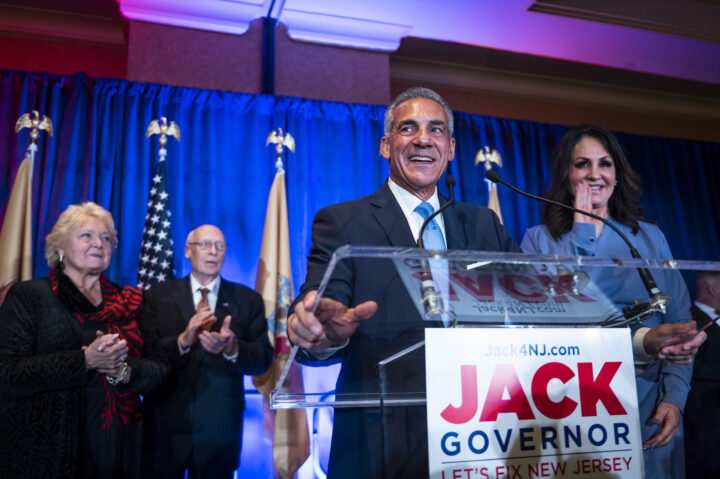
Mark Kauzlarich/Bloomberg via Getty Images
Jack Ciattarelli, Republican candidate for governor of New Jersey, speaks during an election night event in Bridgewater Township, N.J. on Wednesday, Nov. 3, 2021.
Ever since President Donald Trump ran surprisingly close to Vice President Kamala Harris in New Jersey during last year’s presidential race, Republicans have been looking at the state’s gubernatorial race as a chance to capitalize on the party’s momentum in the blue state.
Jack Ciattarelli, the GOP’s nominee for governor, also came tantalizingly close to defeating Gov. Phil Murphy in the state’s last gubernatorial race. He’s running again, and hoping to get over the finish line against Rep. Mikie Sherrill (D-NJ), in part by courting the state’s sizable Jewish community, which has swung to the right in recent elections.
“People now know, because of the closeness of my race, that we can win. There’s just an attitude change because they feel like the Democrats have really failed them on a number of issues, and antisemitism is one of them,” Ciattarelli told Jewish Insider in an interview ahead of his visit to Israel this week.
Ciattarelli, 63, who built two medical publishing companies in New Jersey while serving as a state lawmaker, said, “I see myself not so much as a politician, but a successful CEO who is looking to be the CEO hands-on governor that we need.”
As part of his Jewish communal outreach, Ciattarelli traveled to Israel on Sunday for a five-day visit, which he organized in a show of solidarity. He also spent time on his visit pursuing opportunities for economic investment from leading Israeli companies in the technology and medical sectors.
“Any students in violation of university policy, I think, should be expelled. Any student that’s broken the law should be arrested, and any student here on an academic visa from another country should be sent back to where they came from if they’re going to engage in that kind of behavior,” Ciattarelli said. “I will pressure our college and university presidents to be working in partnership with me to make sure that kind of behavior isn’t tolerated.”
He told JI that one of his goals with the visit was to boost the state’s economy “by forging a closer economic relationship with a number of nations” that are close U.S. allies. “Israel is first and foremost on the list, but as governor, I will certainly look to Canada, Mexico and India as well to increase our bilateral trade,” Ciattarelli said.
Fighting antisemitism, Ciattarelli said, will be a priority of his if he’s elected. Ciattarelli said he has “made very, very clear” that he supports codifying the International Holocaust Remembrance Alliance’s working definition of antisemitism into state law, will “appoint an attorney general and a superintendent of state police that are both sensitive to the needs and worries of New Jersey’s Jewish community” and will establish an Advisory Council on Jewish Relations to guide him on ways to the best support the community.
“Any students in violation of university policy, I think, should be expelled. Any student that’s broken the law should be arrested, and any student here on an academic visa from another country should be sent back to where they came from if they’re going to engage in that kind of behavior,” Ciattarelli said. “I will pressure our college and university presidents to be working in partnership with me to make sure that kind of behavior isn’t tolerated.”
Ciattarelli described the December 2023 House Education and Workforce Committee hearing, where the presidents of Harvard University, University of Pennsylvania and the Massachusetts Institute of Technology declined to say that calling for the genocide of Jews qualified as bullying and harrassment, as a “watershed moment” that brought the issue of antisemitism to the forefront of Jewish voters’ minds.
“I will do what others have done, including Democratic leaders, and that’s condemning Mamdani, condemning his candidacy, and doing all they can to make sure that a threat to communities such as this is not elected,” Ciattarelli told JI. “There is no space for someone like this in the public sphere, let alone in public office, and I’m going to do everything in my power to protect all 9.3 million citizens here in New Jersey, and particularly members of the Jewish community who feel threatened by a person such as this.”
“They want to see a governor who’s going to demonstrate zero tolerance for antisemitism and call it out for what it is when we see it and hear it,” Ciattarelli said of Jewish voters in the Garden State.
The New Jersey Republican has also sought to tie Sherrill to Zohran Mamdani, the far-left Democratic nominee in New York City’s mayoral race who has resisted condemning “globalize the intifada” rhetoric. Ciattarelli’s campaign cut a digital ad highlighting Sherrill’s nationally televised indecision on whether she would support Mamdani’s mayoral campaign.
“I will do what others have done, including Democratic leaders, and that’s condemning Mamdani, condemning his candidacy, and doing all they can to make sure that a threat to communities such as this is not elected,” Ciattarelli told JI. “There is no space for someone like this in the public sphere, let alone in public office, and I’m going to do everything in my power to protect all 9.3 million citizens here in New Jersey, and particularly members of the Jewish community who feel threatened by a person such as this.”
The race is competitive, with Jewish voters (who make up about 6% of the state’s population) potentially emerging as a swing voting bloc.
“This race is shaping up to be fairly tight, with both candidates making notable outreach efforts to the Jewish community. Jack’s visit to Israel and his strong support for IHRA have had a particularly positive impact,” one Jewish leader in the state told JI.
“Mikie has also engaged significantly, and that effort has been noticed, but concerns remain based on her support of Mamdani in the city and the way she recently framed the call for a ceasefire in Gaza. She still retains goodwill within the Jewish community, but has a long way to go in strengthening trust and confidence,” the leader explained.
A Jewish community leader in Central Jersey, also granted anonymity to speak freely, offered a similar take.
“It’s definitely a race that’s very closely watched in the Jewish community, more than any time in the past, I would say. I think seeing Jack going to Israel, out of all places, just three months before the general election, I think that shows you how important the Jewish vote is going to be this time around, and Jack is losing no time and trying to get the Jewish vote on his side,” the source said.
“I often say that in New Jersey, you have to run for governor as though you’re running for mayor,” Ciattarelli said, adding of his outreach to Democratic and unaffiliated voters, “The biggest compliment I get is when I can come down off a platform or stage, if somebody comes up to me and says, ‘Are you Republican? Are you Democrat?’”
Ciattarelli told JI that he views Bergen County, the state’s most populous county, as a must-win area for his campaign, making the support of Democratic and independent voters necessary in his path to victory. The area, which is represented by Gottheimer in Congress, is also home to around 100,000 Jewish residents, a majority of whom are registered Democrats or independents.
“Bergen County has a greater population than eight states and it’s the key to winning a statewide election. I did very well, just coming a little short in ‘21, but I do sense a change amongst a great number of people who may not have considered me last time, may not have voted last time that are looking to make a change here in New Jersey,” Ciattarelli said.
“I often say that in New Jersey, you have to run for governor as though you’re running for mayor,” he continued, adding of his outreach to Democratic and unaffiliated voters, “The biggest compliment I get is when I can come down off a platform or stage, if somebody comes up to me and says, ‘Are you Republican? Are you Democrat?’”
Since narrowly losing his first campaign for governor, Ciattarelli worked hard to unify the party around his repeat bid, making particular effort to secure support from the MAGA wing of the Republican Party. His efforts paid off in the primary, which he won without much serious GOP opposition.
For her part, Sherrill handily defeated five other Democrats, including Gottheimer, Newark Mayor Ras Baraka,and Jersey City Mayor Steve Fulop, in the Democratic primary.
With that backdrop, both parties are watching the November gubernatorial contest closely to see if the rightward shift in the Garden State has held since Trump took office in January. For his part, Ciattarelli says that while the issues animating New Jersey voters have not changed since his 2021 race, he believes “what is different is the political landscape.”
“The issues I was talking about in ‘21, including antisemitism, have now come to a complete boil. They were simmering back then,” Ciattarelli told JI. “I’m not competing with a pandemic this time around. It’s not easy to campaign when there’s a shelter-in-place order. I’m not running against an incumbent. There’s a lot less indifference.”
As part of his strategy to encourage voters to hit the polls in November, he said he was focusing his messaging around “four issues across the state that are raging that apply to all people”: the affordability crisis, affecting housing and energy costs; public education; public safety; and the overdevelopment of the interior of the state, where suburbs without the infrastructure to become a city are being overinvested in at the expense of New Jersey’s cities.
Regardless of which community he’s engaging with, the New Jersey Republican says the voters he’s spoken to have been more concerned with “how it is I go about solving issues” than national political matters.
“People get excited by ideas. They don’t want to hear the use of polarizing rhetoric. I think they find it a breath of fresh air when somebody stands up and is speaking to the issues and how they’re going to solve them,” Ciattarelli explained, describing this approach as “the secret to the sauce for me in the seven elections I won prior to November ‘21.”
Both parties are also investing heavily as the race emerges as one of the most competitive statewide elections of 2025.
The Democratic National Committee said earlier this month that it would provide more than $1.5 million for Sherrill’s campaign to devote to field staffing and ground game efforts. Greater Garden State, a super PAC connected to the Democratic Governors Association, announced plans in July to spend $20 million on ads for Sherrill. That dollar amount is greater than Murphy and outside groups supporting him spent on ad buys during the entire 2021 general election.
Georgia Gov. Brian Kemp, the chairman of the Republican Governors Association, visited North Jersey earlier this month for a series of fundraising events for Ciattarelli that brought in $1 million.
Please log in if you already have a subscription, or subscribe to access the latest updates.
 Continue with Google
 Continue with Apple