



























































The chair of the Jewish caucus said the 2026 convention was ‘night and day’ compared to last year's, when Jewish delegates reported being harassed on the floor

Getty Images
Notebook with a pen on a table in a classroom at a school


 Add JewishInsider on Google
Major Jewish organizations expressed “reason for optimism” that the National Education Association, the nation’s largest teachers union, is taking meaningful steps to address rising antisemitism following its annual Representative Assembly, which concluded in Denver on Tuesday.
The organizations credited NEA’s Jewish Affairs Caucus (JAC) with pushing through three amendments to the NEA Constitution and a resolution on Jewish education at this year’s RA.
The Jewish Council for Public Affairs said in a statement that it “welcomed the implementation of new rules and policies that better protected the safety and First Amendment rights of Jewish and all members during the National Education Association’s annual meeting.” JCPA said it worked with the JAC to lobby the NEA for the rule changes.
The Jewish groups noted a safer and more inclusive environment for Jewish members at this year’s gathering, marking a stark contrast from last year, when delegates voted to boycott Anti-Defamation League materials in a measure Jewish groups condemned as antisemitic, among other disruptive events. The changes also come following the Equal Employment Opportunity Commission opening an investigation into NEA in June over alleged failure to address antisemitism.
“We commend the important steps the NEA took to foster a more inclusive Representative Assembly this year. Those efforts reflect the union’s stated commitment to the core values of solidarity and belonging for all,” the ADL, American Jewish Committee, Conference of Presidents of Major American Jewish Organizations, Hadassah and StandWithUs said Wednesday in a joint statement.
Ahead of the gathering, aiming to avoid the misconduct seen at the 2025 RA, the NEA adopted several new rules, including stricter conduct enforcement for delegates, electronic voting to prevent shouting on the floor, de-escalation training for staff and regular public reminders of assembly rules.
The 2026 RA — attended by some 6,000 educators — was “night and day” compared to last year’s, the chair of the JAC, Alyson Brauning, told Jewish Insider, recalling that she called security at last year’s convention when some Jewish delegates were allegedly being harassed by other attendees.
After last year’s controversies, Brauning said she spent “six months working with NEA [leadership] on delegate safety and participation protections.”
“The reality was that NEA came through. Building relationships is, to me, the absolute key to making sure we as Jewish delegates can, and did, participate fully at RAs … and I believe our relationships we were able to build with Jewish organizations and the support that they were able to give us is also extremely important,” she continued.
Out of 88 business items for the convention, Brauning viewed two as potentially concerning to Jewish educators, but said this marked an improvement over years past.
“Did they write some things that I as a Jewish person know their intent was probably antisemitic? Sure. Does the body understand that? Probably not. They didn’t outright say [anything antisemitic] which is a win because in the past they would literally say it,” she said.
One of those items mentioned war and genocide — “I’m sure that was about the genocide that they think was in [Gaza], but that’s up to the interpretation of all 6,000 delegates. That one was completely defeated on the floor,” she said.
A second business item called for NEA to add resources on its website including some from Jewish Voice for Peace. “[The majority] of the delegates had no idea who JVP is,” said Brauning. “It was referred to the executive committee because NEA has a policy that they must vet any curriculum before they can use it or recommend it as a resource. That gives us the opportunity to write to NEA and explain why it might be harmful or anti-Jewish hate.
The convention was held one month before a leadership change at JAC, a caucus established five decades ago as a social group that began taking on advocacy work following Oct. 7. Naomi Rodriguez, a Pennsylvania math teacher and first-time delegate who helped organize this year’s RA, will succeed Brauning as the caucus’ chair.
“Going into it, I was intimidated,” Rodriguez told JI of the convention. “I didn’t know how I would be received. Many issues are important to me but I came to this RA with an agenda, to protect Jewish students and teachers. I found myself speaking up about that a lot. It was the most amazing and heartwarming experience. I received so much support from my own state caucus. I felt so loved.
“Our union is simply a reflection of society. Whatever problems we’re having in society, you’re going to see in our union, too, because there are so many members and our union is a place where people exchange ideas,” she continued.
Among the most helpful new policies, Rodriguez said, was the implementation of clickers to vote. “One of the problems last year was voting was done standing up and down or holding a card in the air so everyone in your caucus could see how you vote, so sometimes you could get pushback from the people you’re working with. We could vote more confidentially with the clickers — that made a huge difference,” she said.
Although Rodriguez declined to share the specifics of the three new amendments JAC helped pass, she said the purpose of each “was to ensure that the values of our union are accurately reflected in NEA’s governing documents. The amendments included language to address discrimination and ensure equal participation access for all member communities.”
Jay Goldfischer, a teacher in Los Angeles County who has been an NEA member for 26 years, told JI that it was “overall a very positive and effective RA for Jewish teachers,” where “allies from across America stood up with the Jewish community on the floor of the RA when it counted.”
Though Goldfischer applauded the new guidelines, he noted that the improvements could have also stemmed from the majority of delegates growing “tired of the divisive and distracting issues related to Israel and things unrelated to education.”
Alongside JAC, several Jewish leaders pushed for NEA to adopt new guidelines after last year’s RA.
“Everything we’ve heard from Jewish delegates and educators has been reflective of them feeling that this was a safer and more inclusive convention and that these rules had an impact,” said JCPA CEO Amy Spitalnick, who led a presentation titled “How Educators Can Confront Antisemitism & Hate and Defend Democracy” at the convening.
“There is obviously a lot more to do,” she told JI. “We’ll continue to work with NEA on workshops, programs and trainings to address antisemitism and ensure the union and our schools are as inclusive and safe as possible. But this is definitely an important step in the right direction.”
To support JAC, the ADL and Conference of Presidents also deployed representatives to be on the ground at this year’s convention.
“I was so proud to see Naomi [Rodriguez] use her voice and play such a critical role in shaping a very different narrative at this year’s RA,” Sara Colb, ADL’s director of advocacy, told JI. “Empowering Naomi and teachers like her was ADL’s very purpose for doing this work. Watching these teachers advocate for themselves, their students and the Jewish community is truly inspiring.”
“We started working with JAC after last year to help make [the RA] better for the year ahead,” Stephanie Hausner, chief operating officer of the Conference of Presidents, who attended for the first time on behalf of the organization, told JI.
“Some of that included rules changes, multiple organizations talking to the NEA about helping the tenor of the conference. For sure there was more security [this year]. The overall vibe of the conference was much calmer than we heard from last year. Jewish delegates weren’t afraid to be present and speak, which was also an improvement. They were able to get a lot done.”
Hausner continued, “Some of the resolutions that were put forward that would have done harm to the Jewish community didn’t pass, which says a lot about the body as a whole.”
The focus this year, said Hausner, was “on education and issues of importance for teachers.”
Some Jewish Affairs Caucus leaders say they weren’t consulted about the changes, which are meant to prevent issues around antisemitism that occurred at last year’s assembly

Robyn Stevens Brody/Sipa USA via AP Images
Protesters rally against proposed resolutions at the National Education Association meets in Philadelphia in August 2024.
Following last year’s contentious assembly mired in allegations of antisemitism, the National Education Association — the nation’s largest teachers’ union — adopted new policies for its upcoming Denver convention aimed at preventing the same chaos, the NEA confirmed to Jewish Insider.
“Leading up to this year’s Representative Assembly, we are taking significant steps to ensure all of our members are respected and supported at the event based on extensive feedback and consultation with the Jewish Affairs Caucus, Jewish members, and partners in the Jewish community,” an NEA spokesperson told JI.
“We have strengthened policies for addressing discriminatory or harassing conduct, streamlined the complaint process, and are empowering event staff and leaders to remove those who violate NEA’s standards. There will also be an expanded security presence at the Representative Assembly and we will continue rigorous outreach and engagement with caucuses, including the Jewish Affairs Caucus, and external partners.”
The new rules for the July 3-7 Representative Assembly include stricter conduct enforcement for delegates, electronic voting to prevent shouting on the floor, de-escalation training for staff and regular public reminders of assembly rules, according to the Jewish Council for Public Affairs, which said it worked with the union’s Jewish Affairs Caucus to lobby the NEA for the changes.
At last year’s conference in Portland, thousands of delegates passed a measure that would have barred the union from using, endorsing or publicizing any materials from the Anti-Defamation League, though the decision was later overturned by NEA’s Board of Directors.
Several Jewish teachers who spoke out against the resolution at the RA told JI they were “harassed and shouted down during the proceedings.” Other delegates from the JAC said they were surrounded in what appeared to be coordinated disruptions, and one member who referenced the victim of an antisemitic firebombing in Colorado said other attendees then laughed and applauded.
The episode was widely criticized by Jewish educators and their allies as antisemitic, exacerbating concerns about the growing marginalization of Jews within the teachers’ union following the Oct. 7, 2023, Hamas terrorist attacks and the subsequent impacts in K-12 classrooms.
JCPA CEO Amy Spitalnick, who will lead a presentation titled “How Educators Can Confront Antisemitism & Hate and Defend Democracy” at the weekend convening, said that “as extreme voices on both ends of the political spectrum pit Jewish safety against democratic norms and values, it’s vital that we carve a different path forward.”
JAC Chair Alyson Brauning celebrated the NEA’s adoption of “clear standards for speech and conduct in all union spaces and promoting a greater understanding of the needs and concerns of Jewish members.
“We want to express our gratitude to NEA leadership for their work with the JAC on these new rules, and are expressing our hopes that these will be enforced as fully and fairly as possible,” she said.
Some NEA members, including incoming JAC leadership who say they were excluded from drafting the new policies, are reserving their judgment as to their efficacy.
Naomi Rodriguez, a math teacher in Pennsylvania and the incoming chair of JAC who will start her term on Aug. 1, told JI that despite being a “proud union member,” she believes the “NEA has significant work to do.”
“Unfortunately, I was not consulted about the agreement reached with JCPA,” said Rodriguez. “Our members should never have to choose between supporting our union and protecting themselves. The real test will be on the Representative Assembly floor: whether the experience of Jewish delegates is tainted by dehumanizing rhetoric and identity-based attacks, and how our NEA leadership responds.”
Josh Hirsch, an English teacher in Colorado and incoming vice chair of the JAC, told JI he was also not included in the discussions with JCPA and NEA.
“NEA has appropriately spoken up for racial justice and immigration issues, like George Floyd and ICE raids, but when a man firebombed a peaceful Jewish gathering in Boulder just up the road from this convention, and when gunmen opened fire on Jews celebrating Hanukkah at Bondi Beach in Sydney killing 15 people, NEA stayed silent. That silence is a failure of our values, and NEA must step up publicly and stop sitting on the fence.”
The ADL, which was targeted by the union, also criticized the manner in which the policies came about.
“We are extremely frustrated about a so-called ‘agreement’ with JCPA that was reached without all NEA JAC leadership and delegates at the table,” the ADL told JI. “Crafting commitments that affect Jewish educators without including their incoming representatives sends a troubling message. It risks reinforcing the very sense of exclusion that the changes are presumably meant to address.”
“NEA has a considerable amount of work to do to earn back the trust of Jewish educators after last year’s Representative Assembly, and in light of the unchecked rise of antisemitism within NEA and many state and local affiliates,” the antisemitism watchdog group continued. “NEA’s inconsistent enforcement of its own protections has sent an unmistakable message: Jewish educators are not a priority. That must change now.”
Spitalnick and the NEA disputed these accounts and insisted that JAC leadership was consulted. “Our team was keeping ADL and other Jewish organizations closely in the loop,” Spitalnick told JI. “[We’ve] been in close touch with the incoming [JAC] leaders.”
“Leadership represents the caucus in conversations like this,” she said.
Jay Goldfischer, a teacher in Los Angeles County who has been an NEA member for 26 years, told JI that “on paper, the changes are in the right direction.”
He added, “Actions will speak louder than words once we’re on the floor at the convention.”
Goldfischer said he is going into the RA prepared for “antisemitic and exclusionary policies [being] considered — and that continues to send the message that Jewish educators aren’t a priority.”
“What transpired at the Representative Assembly last year was really upsetting and I have serious concerns about what could happen this year,” he continued. “Last year was not a safe environment for Jewish delegates. I think it’s premature to claim that these new policies are going to ensure the safety of Jewish members and educators when already NEA’s enforcement has not been consistent in the past.”
“I’m still stuck on the fact that they shouldn’t have to make new rules to make an education convention safe for Jewish delegates,” he continued.
The leading Jewish legal group alleges that the country’s largest teachers’ union has repeatedly discriminated against its Jewish members
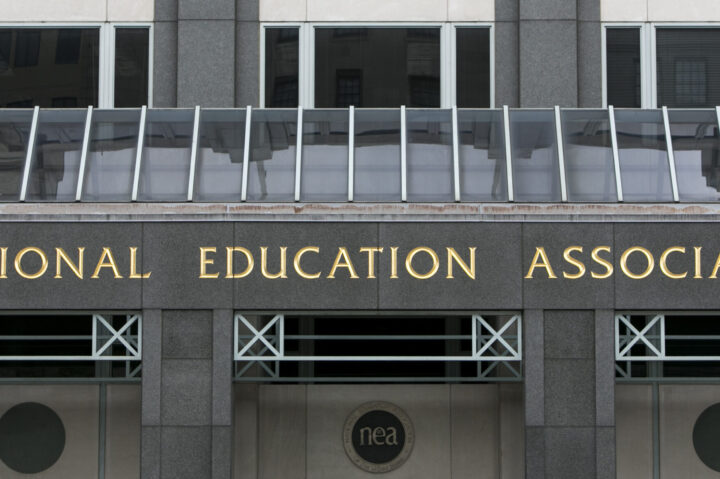
Kristoffer Tripplaar/Sipa via AP Images
A logo sign outside of the headquarters of the National Education Association (NEA) labor union in Washington, D.C. on July 11, 2015.
A leading Jewish legal group has filed a bias complaint with the U.S. Equal Employment Opportunity Commission against the National Education Association, alleging the country’s largest teachers’ union violated civil rights law by discriminating against its Jewish members, Jewish Insider has learned.
The complaint, filed Monday by the Louis D. Brandeis Center for Human Rights Under Law, highlights several incidents in which the NEA — which represents over 3 million educators — allegedly breached Title VII of the Civil Rights Act of 1964, which protects employees, resulting in the spread of antisemitism in K-12 public schools.
“Students are arriving to college much of the time already having antisemitic views,” Marci Miller, Brandeis Center’s director of legal investigations, told JI. “We needed to look at the K-12 space to see where this was originating, and we saw that a lot of the false narratives and antisemitic tropes were originating from local teachers’ unions — and in a lot of cases it came from the top, the NEA, which is the umbrella union.”
Last summer, the NEA’s Representative Assembly passed a resolution to boycott the Anti-Defamation League’s Holocaust education materials after union delegates complained the ADL’s definition of antisemitism was too strong. While NEA’s board of directors unanimously voted to reject the measure that would’ve ceased relations with the ADL, Jewish educators and parents continue to remain uneasy about rising antisemitism within the union.
The 297-page complaint highlights several concerns in the NEA’s 2025 handbook, a 434-page report outlining the organization’s “visionary goals” and “strategic objectives.”
Among these examples is official handbook language for International Holocaust Remembrance Day that removed Jews as the primary targeted victims of the Holocaust, reframing the genocide as a generalized tragedy, the Brandeis Center said.
The handbook stated that the “NEA shall promote the celebration of International Holocaust Remembrance Day on January 27 annually on its website and through other appropriate media to recognize the more than 12 million victims of the Holocaust from different faiths, ethnicities, races, political beliefs, genders, and gender identification, abilities/disabilities, and other targeted characteristics.”
Although the language was later revised following public backlash, the NEA did not issue an apology for the erasure of Jewish history from its handbook materials and provided no corrective guidance to members or affiliates.
On Oct. 8, 2025, one day after the two-year anniversary of Hamas’ Oct. 7, 2023, terrorist attacks, the NEA sent a mass email to its membership celebrating Indigenous lands and distributing a “Native Land Digital” map that erased Israel entirely, labeling the territory solely as Palestine and linking to materials associated with organizations that have expressed support for Hamas’ attacks.
After public backlash, the NEA removed the resource and issued a statement that the external resource did not meet its standards, but it did not advise members to stop using the materials or issue an apology to Jewish members.
According to the complaint, Jewish members reported facing harassment at the NEA’s 2025 Representative Assembly, a convening of the organization’s top leaders from around the country — the same group that voted to censure the ADL.
Allegations included Jewish delegates being physically surrounded and shouted at by anti-Israel advocates; delegates laughing after a Jewish delegate referred to the murder of an 82-year-old Holocaust survivor in the Boulder, Colo., antisemitic firebombing attack; and delegates physically intimidating and disrupting the Jewish Affairs Caucus when the executive chair tried to speak.
The complaint also alleges that the NEA engages in systematic discrimination by utilizing discriminatory racial quotas and preferences, a practice that harms Jewish members who are excluded from preferred racial groups, denying them equal access to opportunities and full participation in union governance.
“NEA is not taking enough steps to make Jewish teachers, Jewish members feel comfortable in the NEA,” said Miller. “They may have taken some minimal steps but haven’t really responded to complaints from members.”
The complaint comes as NEA is under investigation by the House Committee on Education and Workforce, as well as the Senate Health, Education, Labor, and Pensions Committee, following allegations that its policies and materials have fostered an environment conducive to antisemitism in K-12 schools.
A series of contradictory and confusing measures paint a picture of an organization struggling to stake out a position on the controversial issues that have divided its members
Kristoffer Tripplaar/Sipa via AP Images
A logo sign outside of the headquarters of the National Education Association (NEA) labor union in Washington, D.C. on July 11, 2015.
With a unanimous vote last week rejecting a measure that would’ve cut ties with the Anti-Defamation League, the board of directors of the National Education Association extended an olive branch to frustrated Jewish educators and parents who are concerned about creeping antisemitism within the union’s ranks.
ADL CEO Jonathan Greenblatt told Jewish Insider earlier this week that he was “pleased” to see the NEA reject the anti-ADL measure. But, he added, the union still has a “long way to go” toward making clear that it respects the Jewish community.
Greenblatt’s lingering concern is a sign that the NEA — the largest teachers’ union in the country, with more than 3 million members — has not entirely placated Jewish communal stakeholders. In fact, additional questions have continued to emerge in light of an NEA document that encourages teaching the “Nakba” and that erases antisemitism from the history of the Holocaust.
The Washington Free Beacon reported this week on the NEA’s 2025 handbook, a 434-page report outlining the organization’s “visionary goals” and “strategic objectives.” Among the items included in the dense document are dozens of measures that passed at last year’s “representative assembly,” a convening of the organization’s top leaders from around the country — the same group that, this year, voted to censure the ADL. Several of them have raised eyebrows in the Jewish community.
For instance, the NEA pledged to “celebrate” International Holocaust Remembrance Day with educational materials on the union’s website that “recognize the more than 12 million victims of the Holocaust from different faiths, ethnicities, races, political beliefs, genders, and gender identification, abilities/disabilities, and other targeted characteristics” — with no mention of antisemitism or the Jewish victims of the Nazis. (Another item said that in January, to mark the remembrance day, the NEA’s website will feature a graphic that says “Stand up Against Antisemitism” around a Jewish star.)
One measure said the NEA will use digital communications “to educate members about the difference between anti-Zionism and antisemitism.” Another section promised to “educate members and the general public about the history of the Palestinian Nakba,” or catastrophe, the word Palestinians use to describe the founding of the State of Israel and affiliated displacement of Palestinians.
These contradictory and confusing measures paint a picture of an organization struggling to stake out a position on the controversial issues that have divided its members.
One measure pledges to adopt an antisemitism education plan; meanwhile, another measure seeks to “defend educators’ and students’ academic freedom and free speech in defense of Palestine at K-12 schools, colleges and universities.” It is not clear how any of these goals will be achieved — or what position the NEA will take if the objectives ever come into conflict with each other.
The NEA and its statewide affiliates have faced scrutiny in the two years since the Oct. 7, 2023, Hamas attacks over the politicization of education about Israel and Gaza in classrooms. A report last year found that Massachusetts educators were introducing anti-Israel material into schools. In California, the statewide NEA affiliate began a lobbying push this month against a bipartisan antisemitism bill.
Reversing the anti-ADL measure looked like a step forward for the NEA, but it also came with a step backward. An ADL spokesperson said the “problems identified” in the NEA handbook “underscore how much work it has to do to earn the trust of the Jewish community, Jewish educators and families.”
Some of the measures in the handbook are considered offensive by some Jewish community leaders, but other measures are explicitly focused on countering antisemitism and earned the blessing of Jewish communal leaders. While the contradictory language regarding Jewish issues can create whiplash, it might also open an avenue for dialogue with the union.
An NEA spokesperson declined to comment on any specific measures.
“This document is not a handbook for use in the classroom, but a compilation of the more than 100 resolutions adopted by NEA last year,” NEA President Becky Pringle told JI in a statement. “The NEA has opposed antisemitism throughout its history and is deeply committed to ensuring the safety and inclusion of Jewish educators and students. The NEA regularly shares resources and supports educator workshops on Holocaust education, antisemitism, and ways to promote understanding of Jewish culture, heritage and history.”
The STUDENT Act also expands the NEA charter to prohibit the ‘promotion of antisemitic beliefs’ and Holocaust denial

Kayla Bartkowski/Getty Images
U.S. Sen. Cynthia Lummis (R-WY) speaks with press after voting on the nomination of Tulsi Gabbard as President Donald Trump’s director of national intelligence at the Senate Chambers on February 12, 2025 in Washington, DC.
Sen. Cynthia Lummis (R-WY) will introduce legislation on Thursday requiring the National Education Association to expand its federal charter to prohibit the nation’s largest teachers’ union from “engaging in electoral politics or lobbying” in response to the group’s proposal to cut ties with the Anti-Defamation League, Jewish Insider has learned.
Lummis began working on the STUDENT Act in response to the NEA’s representative assembly, the union’s governing body, voting earlier this month at an annual leadership conference to adopt a measure barring teachers from using, endorsing or publicizing any materials from the ADL. The NEA’s board of directors announced on Friday it would not implement the contentious resolution after determining that it “would not further NEA’s commitment to academic freedom, our membership or our goals.”
In addition to the moratorium on involvement in political causes, the bill would add language to the NEA charter banning the “promotion of antisemitic beliefs, including harmful stereotypes about Jewish people, Holocaust denial or minimization, and hatred based on Jewish identity or connection to Israel,” according to a readout from Lummis’ office. It would also bar the organization from “promoting or requiring adherence to critical race theory concepts,” eliminate the union’s tax-exempt status in Washington, prevent them from “calling strikes or work stoppages” and require “all NEA officers to be U.S. citizens.”
Lummis said in a statement on the bill that the NEA had “exploited its federal charter to advance a radical political agenda that puts ideology before education.”
“Federal charters should be reserved for organizations that serve patriotic, charitable, historical, or educational purposes — not for unions that push divisive and antisemitic ideologies,” Lumis said.
Lummis told JI she found the NEA’s original decision on the ADL “to be completely ridiculous and misguided.”
“The fact that such a resolution passed the representative assembly — made up of thousands of NEA members — was reason enough for me to be concerned. Our educational institutions should be strengthening their partnerships with organizations committed to protecting Jewish Americans and combating hatred, not severing these important ties,” Lummis explained, referencing the more than 6,000 union delegates who took part in the three voice votes that were ultimately called in favor of the measure.
The Wyoming senator said the developments prompted her “to examine the NEA’s charter more closely, which revealed how significantly the organization has deviated from its original mission and misused its federally granted charter privileges.”
“It’s evident that the NEA lacks the leadership and vision necessary for self-correction, which is why I’m proposing this legislation. We cannot allow the NEA and other federally chartered organizations to slide toward antisemitic positions,” she told JI.
Sens. Jim Risch (R-ID), Pete Ricketts (R-NE), Ted Cruz (R-TX) and Tim Sheehy (R-MT) cosponsored the bill. Rep. Scott Fitzgerald (R-WI) is working on companion legislation on the House side.
“The NEA long ago transformed from an educational association into a political machine, pushing a progressive agenda that puts activists ahead of students’ needs. The STUDENT Act reins in NEA’s federal charter, restores accountability, and demands a return to its original purpose: educating, not indoctrinating, American children,” Fitzgerald said in a statement.
Greenblatt told JI: ‘We've got a long way to go to make sure that the ADL and our community is respected for who we are’

Jemal Countess/Getty Images for Anti-Defamation League
Jonathan Greenblatt speaks onstage during the 2024 ADL “In Concert Against Hate” at the Kennedy Center Concert Hall on November 18, 2024 in Washington, DC.
Days after the National Education Association walked back a decision by its members to cut ties with the Anti-Defamation League, ADL CEO Jonathan Greenblatt praised the move but cautioned that the union still has a “long way to go” toward making clear that it respects the Jewish community, he said in an interview on Monday.
“I am glad that they recognize what’s wrong about calling out the most consequential organization fighting antisemitism at a time of rising antisemitism,” Greenblatt told Jewish Insider. “Yet at the same time, there are elements of even the statement that lead me to believe that we’re still in this fight. We’ve got a long way to go to make sure that the ADL and our community is respected for who we are.”
While the board of directors of the NEA — the largest teachers union in the country — condemned antisemitism in the statement released last week, the board also stated that the organization’s rejection of the anti-ADL measure was “in no way an endorsement of the ADL’s full body of work.”
Further, the NEA called on the ADL “to support the free speech and association rights of all students and educators.”
“We strongly condemn abhorrent and unacceptable attacks on our members who dedicate their lives to helping their students thrive,” the NEA’s board of directors continued. “Our commitment to freedom of speech fully extends to freedom of protest and dissent whether in the public square or on college campuses.”
That rhetoric surprised Greenblatt, who said he was “pleased” to see the NEA shoot down the anti-ADL measure but concerned and confused about the inclusion of language that he viewed as a swipe at the ADL.
“The idea that the ADL — which, of course, all of our work is predicated on protecting the First Amendment — that we are ‘not supporting the free speech of all students and educators?’ Give me a break. Find the evidence to even support this assertion,” Greenblatt said. “We don’t have a problem with freedom of assembly. We have a problem with those people who use that speech to slander Jews or other minorities. We have a problem with those who use the right to associate to attack Jews and other marginalized communities.”
The NEA and the ADL have never had a formal partnership, Greenblatt confirmed. The ADL would be “amenable” to working more formally with the NEA, but he said their relationship was “not quite that far along.”
The union’s board of directors said the proposal ‘would not further NEA’s commitment to academic freedom’
Kristoffer Tripplaar/Sipa via AP Images
A logo sign outside of the headquarters of the National Education Association (NEA) labor union in Washington, D.C. on July 11, 2015.
The National Education Association, the largest teachers’ union in the country, announced on Friday that it would not cut ties with the Anti-Defamation League, declining to implement a contentious resolution approved by its governing body earlier this month that sought to target the Jewish civil rights organization.
“After consideration, it was determined that this proposal would not further NEA’s commitment to academic freedom, our membership or our goals,” the union’s board of directors said in a statement.
The decision came nearly two weeks after the measure was adopted by the NEA’s representative assembly, its annual leadership gathering that drew more than 6,000 union delegates.
“There is no doubt that antisemitism is on the rise. Without equivocation, NEA stands strongly against antisemitism. We always have and we always will,” the NEA’s board wrote. “In this time of division, fighting antisemitism, anti-Arab racism, and other forms of discrimination will take more resources, not fewer. We are ready.”
ADL CEO Jonathan Greenblatt cheered the union’s decision to distance itself from the “misguided” measure.
“We are committed to working with the NEA and all teachers’ unions to join the Jewish community in making clear these hateful campaigns cannot succeed. They must redouble efforts to ensure that Jewish educators are not isolated and subjected to antisemitism in their unions and that students are not subjected to it in the classroom,” Greenblatt said in a statement.
The measure faced fierce backlash from the Jewish world. A letter authored by the ADL expressing opposition to the proposal — which would have discouraged educators from using teaching materials from the ADL — garnered the support of roughly 400 Jewish organizations across the country, including the leadership of the Reform, Conservative and Orthodox movements.
Other outside Jewish groups, including the Conference of Presidents of Major American Jewish Organizations, the American Jewish Committee and Jewish Federations of North America, released a statement welcoming the NEA’s rejection of the anti-ADL resolution.
The groups signed a letter to NEA President Rebecca Pringle calling out the hostile climate for Jews at the nation’s largest teachers’ union

Dominick Sokotoff/SOPA Images/LightRocket via Getty Images
National Education Association President Rebecca Pringle speaks during the Get Out the Vote Rally in Detroit ahead of the 2022 midterm elections.
Around 400 Jewish organizations and synagogues signed onto an Anti-Defamation League backed letter Monday expressing concern over the “growing level of antisemitic activity” within teachers’ unions, which recently escalated with the National Education Association’s adoption of a measure targeting the leading Jewish civil rights organization, Jewish Insider has learned.
Signatories include the American Jewish Committee, Jewish Federations of North America, Conference of Presidents of Major American Jewish Organizations, National Council of Jewish Women, Orthodox Union, Rabbinical Assembly and Union for Reform Judaism.
The letter, addressed to Rebecca Pringle, president of the NEA — the largest teachers’ union in the U.S. — comes on the heels of a measure passed last week by the association that bars the union from using any teaching materials from the ADL.
The letter urges Pringle to reject the measure, referred to as New Business Item 39, as well as to issue a condemnation of and plan of action to address antisemitism and anti-Israel rhetoric in the NEA.
“The ADL has been a national leader in anti-hate education in K-12 schools for decades and is widely recognized as one of the country’s foremost experts on antisemitism,” the letter states, raising concern that, “although NBI 39 does not explicitly say so, we understand that much of the underlying concern prompting this resolution is directed at ADL’s Holocaust education materials.”
“That reality makes this proposal especially disturbing,” the letter continues. “This is precisely the kind of education that is vital not only to combat antisemitism, but also to fighting hatred and intolerance of all kinds. The effort to exclude ADL’s voice from educational spaces at a time of skyrocketing antisemitism — including in K-12 classrooms — speaks volumes about the climate within NEA that allowed this measure to pass, and the lack of understanding, if not outright hostility, behind it.”
The letter also references several Jewish teachers who spoke out against the resolution at the Representative Assembly, claiming that they were “harassed and shouted down during the proceedings.”
“It is our belief that the goal of those who introduced NBI 39 is to marginalize mainstream Jewish voices within this country’s public school systems and to limit the ability of educators to address the growing threat of antisemitism with their students,” the letter states.
The ADL has criticized the vote, calling it “profoundly disturbing that a group of NEA activists would brazenly attempt to further isolate their Jewish colleagues and push a radical, antisemitic agenda on students.”
“Excluding ADL’s gold-standard educational resources is not just an attack on our organization – it’s a dangerous attack on the entire Jewish community,” Jonathan Greenblatt, the group’s CEO, said in a statement. “We urge the NEA Executive Committee to reverse this biased, fringe effort, and reaffirm its commitment to supporting all Jewish students and educators.”
Even outside of the recent measure, antisemitism and anti-Israel activism in teachers’ unions has been increasing since the Oct. 7, 2023, Hamas terror attacks in Israel. At their conventions last year, both the NEA and the American Federation of Teachers, the second largest teachers’ union in the U.S. — which together represent 4.7 million members — made anti-Israel resolutions a notable part of both gatherings. In July 2024, the NEA signed a joint letter calling on President Joe Biden to halt all military aid to Israel amid its war against Hamas.
Also in July of last year, at the AFT convention, members voted on a total of seven resolutions regarding Israel, including one against the “weaponization of antisemitism” to defend Israel. One of the seven proposed resolutions critical of Israel at the AFT convention passed.
Plus, NEA nixes collaboration with the ADL

Andrew Harnik/Getty Images
President Donald Trump hosts Israeli Prime Minister Benjamin Netanyahu for a dinner in the Blue Room of the White House on July 7, 2025, in Washington, DC. Trump is hosting Netanyahu to discuss a potential ceasefire agreement to end the fighting in Gaza.
Good Tuesday morning.
In today’s Daily Kickoff, we report on last night’s meeting between Israeli Prime Minister Benjamin Netanyahu and President Donald Trump, and cover the National Education Association’s recent passage of a measure banning coordination with the Anti-Defamation League. We look at concerns from Jewish community security groups and congressional Democrats over plans to shrink the Department of Homeland Security’s Office of Intelligence and Analysis, and spotlight Pepperdine University’s new Middle East policy graduate program, which is being launched in partnership with The Washington Institute for Near East Policy. Also in today’s Daily Kickoff: Sam Altman, Effie Phillips-Staley and Amb. Tom Barrack.
What We’re Watching
- Israeli Prime Minister Benjamin Netanyahu’s Washington trip continues today. He’s slated to meet with Vice President JD Vance, and will head to Capitol Hill later this morning for meetings with House and Senate leadership, including Senate Majority Leader John Thune (R-SD), Senate Minority Leader Chuck Schumer (D-NY) and House Speaker Mike Johnson (R-LA).
- Elsewhere on the Hill, the Senate Armed Services Committee’s subcommittees continue their markups of the NDAA.
- In Sun Valley, Idaho, the annual Allen & Co. gathering formally kicks off today. Look out for the paparazzi photos of vest- and fleece-wearing tech and media moguls arriving at the Sun Valley Lodge.
What You Should Know
A QUICK WORD WITH JI’S MARC ROD
Israeli Prime Minister Benjamin Netanyahu’s third visit to Washington since the start of the Trump presidency kicked off Monday with closed-door meetings with President Donald Trump, Secretary of State Marco Rubio and Middle East envoy Steve Witkoff.
Trump and Netanyahu were on warm terms during remarks to the press ahead of their dinner. Netanyahu offered effusive praise for Trump for the U.S. strikes on Iran’s nuclear facilities and said he nominated Trump for a Nobel Peace Prize, as well as following Trump’s lead in expressing openness to the new Syrian government.
Trump, for his part, deferred to Netanyahu on a question about a two-state solution. “We’ll work out a peace with our Palestinian neighbors, those who don’t want to destroy us,” Netanyahu said. “I think the Palestinians should have all the powers to govern themselves, but none of the powers to threaten us. That means that certain powers like overall security will always remain in our hands. Now that is a fact and no one in Israel will agree to anything else because we don’t commit suicide.”
White House Press Secretary Karoline Leavitt told reporters earlier in the day that Trump’s “utmost priority … is to end the war in Gaza and return all of the hostages” and that Trump and Netanyahu would discuss “peace in Gaza and ending that conflict.”
But that agenda item saw little discussion in Trump and Netanyahu’s public remarks. Asked about talks with Hamas, Trump instead spoke about Iran.
A senior Israeli official in Netanyahu’s delegation told reporters following the Trump-Netanyahu meeting that a deal to end the Gaza war is not on the table because “Hamas is not responsive to the conditions that would allow a comprehensive agreement,” such as demilitarization for Gaza and exile for remaining Hamas leaders, the senior official explained. Without those conditions, “Hamas could do [the Oct. 7, 2023, attacks] again.” More on this from JI’s Lahav Harkov here.
At the same time, the differences between the two leaders’ comments on potential further strikes on Iran indicated a possible point of friction in the future.
Asked about further strikes, Trump said he “can’t imagine wanting to do that” and maintained that Iran’s nuclear program had been “knocked out completely.” Trump added, “I think they want to make peace and I’m all for it,” while also suggesting that there is no need for negotiations or a deal, saying “What’s the purpose of talking?” He said that the U.S. is “ready, willing and able” if further strikes are necessary, “but I don’t think we’re going to have to be.”
SPECIAL RELATIONSHIP
Trump-Netanyahu bromance returns with Nobel Peace Prize nomination

Israeli Prime Minister Benjamin Netanyahu greeted President Donald Trump in the White House Monday evening with effusive warmth, expressing the “appreciation and admiration” of Israel, the Jewish people and “the leadership of the free world” for the U.S.’ recent bombing campaign against Iran’s nuclear facilities. He also offered Trump an avenue toward his elusive goal: receiving a Nobel Peace Prize, Jewish Insider’s Gabby Deutch reports.
Prize goals: “He is forging peace as we speak, in one country and one region after the other. So I want to present you, Mr. President, the letter I sent to the Nobel Prize Committee,” Netanyahu announced, saying it would be a “well-deserved” honor for Trump. “Coming from you in particular, this is very meaningful,” Trump said. “It’s a great honor.”
Notable quotable: U.S. Ambassador to Turkey Thomas Barrack, who is serving as special envoy to Syria, said on Monday that Hezbollah could have a future in Lebanese politics, despite the organization’s designation by the U.S. State Department as a Foreign Terrorist Organization, Jewish Insider’s Jake Schlanger reports. “Hezbollah is a political party. It also has a militant aspect to it,” Barrack said at a press conference on Monday morning in Beirut, following a meeting with Lebanese President Joseph Aoun. “Hezbollah needs to see that there is a future for them, that the road is not not harnessed just solely against them, and that there’s an intersection of peace and prosperity for them also.”
EDUCATION CONSTERNATION
As teachers unions target ADL and oppose antisemitism bill, Jewish educators sound the alarm
A grassroots campaign urging educators to stop using teaching materials from the Anti-Defamation League reached the highest levels of K-12 education over the weekend. Inside a packed conference hall in Portland, Ore., the thousands of delegates who make up the governing body of the National Education Association — the largest teachers union in the country — passed a measure that bars the union from using, endorsing or publicizing any materials from the ADL, Jewish Insider’s Gabby Deutch reports.
School ties: The NEA’s adoption of a measure targeting the leading Jewish civil rights organization may be an escalation, but it is only the most recent example of antisemitism — and divisive politics surrounding the war in Gaza — spilling into K-12 education, and teachers unions in particular. Just this week, the largest teachers union in California, a 300,000-person NEA affiliate, published a letter urging state senators to vote against a bill focused on fighting and preventing antisemitism. In May, the state assembly voted unanimously to approve the bill. But the bill’s fate is now in jeopardy as senators face pressure from one of the state’s most powerful unions to reject it.
Case closed: Barnard College reached a settlement on Monday in a lawsuit brought by Jewish students which claimed that the school violated Title VI of the Civil Rights Act of 1964 by failing to address antisemitism, Jewish Insider’s Haley Cohen reports.
campus competition
Pepperdine, Washington Institute launch Middle East policy graduate program

As the federal government continues its battles with dozens of colleges over campus antisemitism, the field of Middle East studies has been particularly scrutinized for advancing a one-sided, anti-Israel curriculum contributing to a rise of hostility towards the Jewish state in the classroom and beyond. Aiming to address that bias, Pepperdine University’s School of Public Policy will launch a new Middle East Policy Studies master’s program this fall. The tuition-free, fully accredited, two-year master’s program on Pepperdine’s D.C. campus is a partnership with The Washington Institute for Near East Policy. It will be funded solely by American citizens — unlike many similar university programs that take foreign funds, Jewish Insider’s Haley Cohen reports.
Seeking balance: The program comes as critics of the field have long alleged that it imparts to students a one-sided history of the Middle East in which Israel is a perpetual villain, particularly since the Oct. 7, 2023, Hamas terrorist attacks. “We wouldn’t be in these conversations had it not been revealed what’s been happening on college campuses since Oct. 7,” Pete Peterson, dean of Pepperdine’s public policy school, told JI.
WORKFORCE WORRIES
Jewish groups, congressional Democrats raise concerns about DHS intelligence cuts

Jewish community security groups and congressional Democrats are raising concerns about the Department of Homeland Security’s plans to slash 75% of the staff for the department’s Office of Intelligence and Analysis (I&A), Jewish Insider’s Marc Rod reports.
What they’re saying: I&A plays a role in collecting and disseminating to local law enforcement and private partners intelligence to counter threats including terrorism and foreign adversaries. But the office has also faced criticism from various fronts in recent years. “Hollowing out the office risks leaving the homeland dangerously exposed to these threats, especially at a time when the FBI’s budget is being substantially reduced,” top congressional Democrats said. A coalition of Jewish groups said, “We are deeply concerned that any wholesale changes to the operations of I&A will have an adverse effect on countering antisemitism and ensuring the safety of the Jewish community in the United States.”
HUDSON VALLEY SHOWDOWN
Effie Phillips-Staley plays to progressive base as she targets Rep. Mike Lawler

Effie Phillips-Staley, running on a progressive platform in the crowded Democratic field looking to unseat Rep. Mike Lawler (R-NY) in a swing congressional district, is taking a firm stance against the U.S. and Israeli strikes on Iran’s nuclear program, even as she has expressed concern about Iran’s nuclear ambitions, Jewish Insider’s Marc Rod reports.
Positioning: “For the leader of the free world to decide to strike Iran based on Fox News coverage and without deliberation or the approval of Congress is alarming and unprecedented,” she said in a statement to JI on Monday, a position shared by many congressional Democrats. “We cannot have a nuclear armed Iran under any circumstances and Congress must hold this President accountable by upholding the War Powers Act and requiring a full diplomatic process.” Despite her criticisms of the Iran strikes, Phillips-Staley has otherwise not embraced elements of the left-wing policy agenda that have alienated Jewish voters.
Blast from the past: Former Rep. Sean Patrick Maloney (D-NY) is mulling entering the crowded Democratic primary in New York’s 17th Congressional District after falling short in his 2022 matchup against Lawler.
legal case
New legal report by Israeli NGO finds systematic use of sexual violence by Hamas on Oct. 7

A report released by The Dinah Project on Tuesday that seeks to “set the record straight” on the sexual assaults that occurred during the Oct. 7, 2023, Hamas attacks on southern Israel found that the terror group systematically used sexual violence as a tactical weapon of war, acts that the report argues constitute crimes against humanity. The study, which was led by legal and feminist experts and has been compiled into a book, offers a new evidentiary and legal framework to prosecute such crimes as its authors call on international bodies to hold the perpetrators accountable, Jewish Insider’s Tamara Zieve reports for eJewishPhilanthropy.
The painful truth: The 80-page report, “A Quest for Justice: October 7 and Beyond,” is described by its authors as the most comprehensive legal analysis to date of the sexual and gender-based crimes committed during the-Hamas led attacks, and afterwards against hostages in captivity. It argues that the acts of sexual violence committed constitute crimes against humanity and that the acts were not isolated, but deliberate, widespread and systematic. The authors call for the development of a new legal protocol to handle cases of sexual violence in armed conflicts. The report was presented on Tuesday to Israeli First Lady Michal Herzog at a press event at the President’s Residence in Jerusalem. “The report presents the truth as it is — shocking, painful, but necessary. On behalf of all those who were affected, we are committed to continuing to fight until their cry is heard everywhere and until justice is done,” Herzog said.
Read the full story here and sign up for eJewishPhilanthropy’s Your Daily Phil newsletter here.
Worthy Reads
Bringing Harvard to Heel: The New York Times’ Stephanie Saul and Steven Rich look at how Harvard’s fiscal ties to China, which boosted its giving to the school following the 2008 recession that significantly impacted Harvard’s financial stability, have contributed to the Trump administration’s legal battles targeting the Ivy League school. “Now Harvard’s ties with China are coming back to haunt the university. Those connections were forged when Harvard was more financially vulnerable and when much of the foreign policy establishment believed that higher education could play a part in pushing America’s democratic ideals to China and the rest of the world. But American foreign policy has turned sharply hawkish against China, and even though Harvard has steadily reduced its ties there, the Trump administration has made the relationship another line of attack in its broader effort to bring the university to heel.” [NYTimes]
What Mamdani Means: The Wall Street Journal’s Gerard Baker considers how New York City Democratic mayoral nominee Zohran Mamdani’s primary success underscores the present political climate that allows more extreme positions and views to take hold. “But while we may mock the radicalism of Mr. Mamdani and his fellow socialists seemingly on the rise in the Democratic Party, I see in the man’s appeal, his evident popularity among a certain type of young voter especially, more signs of the continuing crack-up of American politics. Many Republicans like to think that the extremism represented by the likes of Mr. Mamdani and Rep. Alexandria Ocasio-Cortez is a signal of the Democrats’ growing irrelevance and unelectability. But his ascent — provisional though it may still be — is more likely a reflection of the fissures that continue to stretch our national cohesion than some proof of the marginalized nature of Donald Trump’s opponents.” [WSJ]
Alarmed in Algeria: The Financial Times’ Heba Saleh and Leila Abboud report on how the shifting dynamics and power structures across the Middle East and North Africa — including Israel’s warming ties with Morocco — have affected Algeria. “Algerian leaders feel surrounded by hostile forces, with Morocco, Israel and the United Arab Emirates all increasing their influence in the region, analysts say. Algiers has also fallen out with France, the former colonial power and a key partner. … Staunchly pro-Palestinian Algiers has been particularly riled by the Moroccan normalisation deal with Israel, which was the price Rabat paid for US recognition of its sovereignty over Western Sahara. It is also wary of Israeli-Moroccan military co-operation.” [FT]
Word on the Street
President Donald Trump overruled Pentagon policy chief Elbridge Colby in calling for a restoration of weapons to Ukraine, one week after the Defense Department announced a holdup of arms earmarked for the country; “We have to, they have to be able to defend themselves,” Trump said in his Monday meeting with Netanyahu…
The Senate Foreign Relations Committee will hold a confirmation hearing next week for former National Security Advisor Mike Waltz, the Trump administration’s nominee to be U.S. ambassador to the U.N.…
The U.S. revoked the Foreign Terrorist Organization designation of Hay’at Tahrir al-Sham, the militant group led by Syrian President Ahmed al-Sharaa that overthrew the Assad regime last year…
Syrian media reports that Syrian President Ahmed al‑Sharaa met an Israeli official on Monday in Abu Dhabi during his official visit to the United Arab Emirates; the reports named Israeli National Security Advisor Tzachi Hanegbi as the official, but Hanegbi is said to be in Washington as part of Israeli Prime Minister Benjamin Netanyahu‘s delegation…
The IRS, in a new court filing, said it will allow places of worship to endorse political candidates, exempting them from a law prohibiting tax-exempt organizations from engaging in political activity…
eJewishPhilanthropy’s Nira Dayanim looks at how Jewish organizations in central Texas are mobilizing to assist in relief and recovery efforts following storms and flash floods that have killed more than 100 people across the region…
A federal court in Massachusetts heard opening arguments on Monday in a lawsuit brought against the Trump administration by two faculty associations over the government’s targeting of noncitizen U.S. residents who have espoused or engaged in anti-Israel activity that could be seen as supporting Hamas…
The Wall Street Journal reports on the support that New York City Mayor Eric Adams is receiving from city real estate executives following Democratic mayoral nominee Zohran Mamdani’s victory over former Gov. Andrew Cuomo last month…
OpenAI CEO Sam Altman described himself in a recent social media post as “politically homeless”; addressing Mamdani’s recent suggestion that billionaires shouldn’t exist, Altman said he would “rather hear from candidates about how they are going to make everyone have the stuff billionaires have instead of how they are going to eliminate billionaires”…
Mubadala Capital, a subsidiary of Abu Dhabi-based sovereign wealth fund Mubadala Investment Company, hired Ophir Shmuel as its new head of business development, The Circuit reports…
U.K.-based American stand-up comic Reginald Hunter appeared in a London court to face charges for sending offensive, antisemitic messages on multiple occasions to an organizer of the city’s hostage-awareness events…
Five IDF soldiers were killed and more than a dozen injured when an explosive detonated in the northern Gaza city of Beit Hanoun; four of the soldiers killed were members of the army’s Haredi “Netzah Yehuda” battalion…
Iran has expelled more than 800,000 Afghans since March, the majority of whom were forced to leave the country in the last five weeks amid a crackdown on undocumented individuals in the Islamic Republic…
Two people were injured and two others are missing following a Houthi attack on a Liberian-flagged ship transiting through the Red Sea; the attack came a day after the crew of a second Liberian-flagged vessel was forced to abandon ship following an attack believed to have been conducted by the Houthis…
Psychoanalyst Dr. Anna Ornstein, who as a teenager survived the Holocaust and would go on to pioneer a school of thought in her field that prioritized empathy, died at 98…
Playwright Ronald Ribman died at 82…
Pic of the Day

Imams and Muslim community leaders from France, Belgium, the Netherlands, Italy and the U.K. visited Israel’s Yad Vashem Holocaust Memorial Museum in Jerusalem on Tuesday as part of a trip focused on coexistence that also included a meeting with Israeli President Isaac Herzog.
Birthdays

Israeli film director, producer and researcher, Eyal Boers turns 50…
Retired in 2016 after 26 years as executive director of the Baltimore Jewish Council, Arthur “Art” Abramson turns 77… Democratic candidate for president of the U.S. in 2020 and 2024, Marianne Deborah Williamson turns 73… Mayor of Farmington Hills, Mich., until 2023, she is a former member of the Michigan House of Representatives, Vicki Barnett turns 71… Attorney and Democratic politician from Texas, Barbara Ann Radnofsky turns 69… Attorney and a former U.S. ambassador to Belgium in the Obama administration, Howard Gutman turns 69… Partner of the global law firm Dentons, when he was elected attorney general of Georgia in 2010 (and reelected in 2014) he became the first Jewish person to win statewide office in Georgia, Samuel Scott Olens turns 68… Former member of Knesset who had served as Israel’s foreign minister, justice minister, agriculture minister and housing minister, Tziporah Malka “Tzipi” Livni turns 67… Retired rabbi at Temple Emanuel in Beaumont, Texas, Rabbi Joshua Samuel Taub… Co-president of Rochester, N.Y.-based Hahn Automotive Warehouse, he is on the board of governors of the Jewish Federation of Greater Rochester, Eli N. Futerman… SVP and COO of New York’s Jewish Communal Fund, Marina W. Lewin… Former Washington bureau chief of the Jewish Telegraphic Agency, Ron Kampeas turns 65… Consultant strategist, policy advisor and writer, he served as corporate counsel to Allstate Insurance for 28 years, Steven Richard Sheffey turns 65… Writer, television producer, ventriloquist and puppeteer, Mallory Hurwitz Tarcher Lewis turns 63… Managing partner at DGA’s Albright Stonebridge Group, Dan K. Rosenthal turns 59… Former ice hockey player, her three sons were seventh, first and fourth picks overall, respectively, in the 2018, 2019 and 2021 NHL Drafts, Ellen Weinberg-Hughes turns 57… Higher education reporter for The Wall Street Journal, Douglas Belkin… New York City comptroller, Brad Lander turns 56… Managing director of investor relations for Harbor Group International, Meir Raskas… EVP of the Atlantic Council, Jenna H. Ben-Yehuda… Atlanta-based educator, activist and writer, Robbie Medwed… Sports journalist, known for his coverage of mixed martial arts and professional wrestling, Ariel Jacob Helwani turns 43… Senior legal counsel at Horizons Law and Consulting, Alon Sachar… Policy and communications consultant, Stefanie Feldman… Diplomatic correspondent at the Jerusalem Post and i24NEWS, Amichai Stein…
The ADL accused the nation’s largest teachers union of pushing a ‘radical, antisemitic agenda on students’
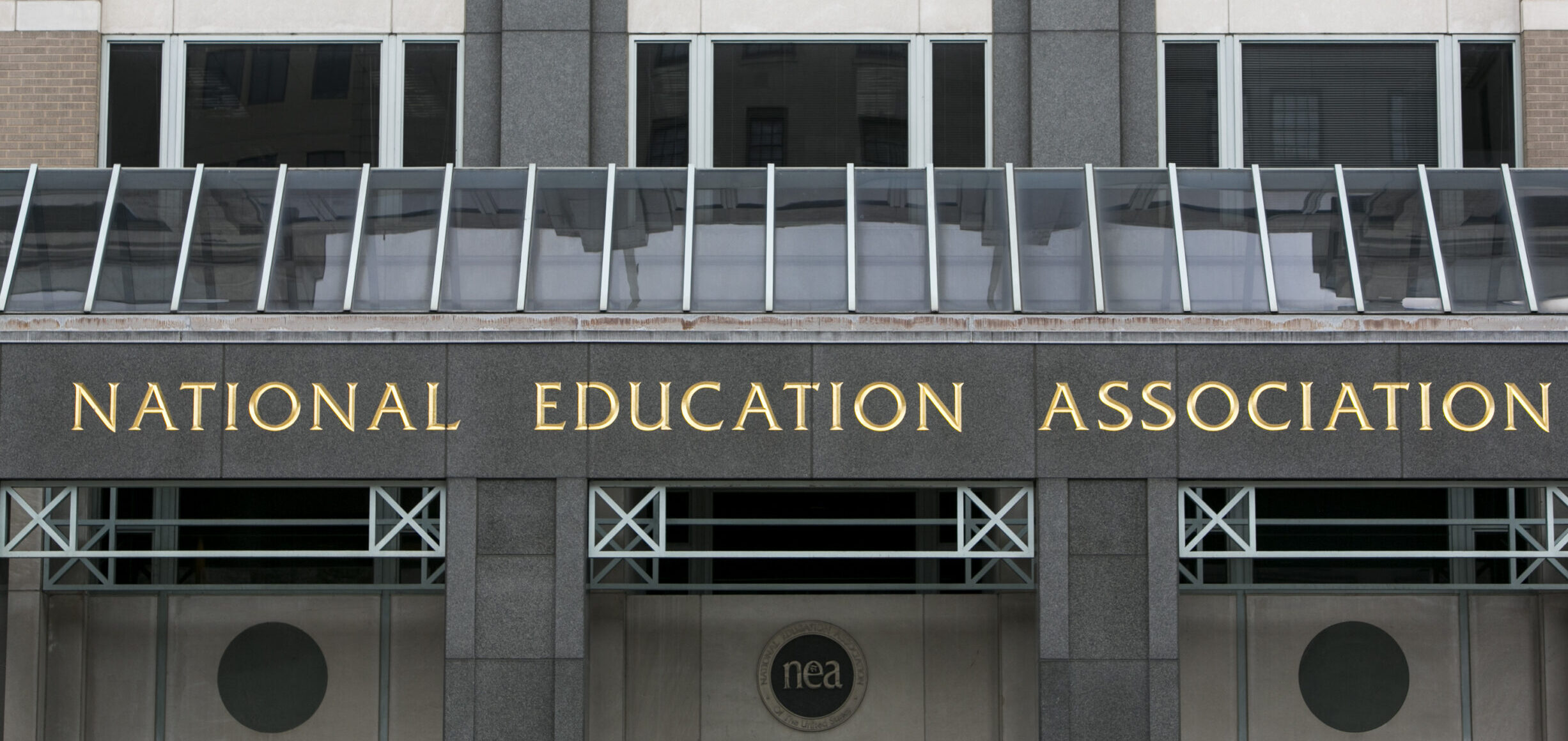
Kristoffer Tripplaar/Sipa via AP Images
A logo sign outside of the headquarters of the National Education Association (NEA) labor union in Washington, D.C. on July 11, 2015.
A grassroots campaign urging educators to stop using teaching materials from the Anti-Defamation League reached the highest levels of K-12 education over the weekend.
Inside a packed conference hall in Portland, Ore., the thousands of delegates who make up the governing body of the National Education Association — the largest teachers union in the country — passed a measure that bars the union from using, endorsing or publicizing any materials from the ADL.
In the moments before the vote, several Jewish delegates spoke passionately in opposition of the measure.
“I stand here and ask you to oppose [the measure] to show that all are truly welcome here,” a teacher from New Jersey said, according to audio of the closed-door meeting obtained by Jewish Insider.
Another Jewish teacher quoted NEA Executive Director Kim Anderson from her keynote address earlier in the weekend. “This union has your back,” Anderson told the more than 6,000 assembled delegates.
“Does that include stopping Jewish hate, antisemitism? Some of our members don’t feel they are safe,” the Jewish teacher said during Sunday’s debate.
The vote occurred by voice. The margin was so close that delegates had to vote three times as the chair considered whether the loudest cheers were in support of the measure or in opposition, but, ultimately, it still received the backing of more than half the delegates. It now heads to the NEA’s nine-member executive committee, which gets the final word on whether the measure will be put into effect. (The passage of the anti-ADL measure was first reported by the North American Values Institute.)
The episode garnered criticism from Jewish teachers and allies. NEA’s national leadership has not yet weighed in on the measure.
“At a time when incidents of hate and bias are on the rise across the country, this action sends a troubling message of exclusion and undermines our shared goal of ensuring every student feels safe and supported,” a spokesperson for the NEA’s Jewish affairs caucus said in a statement to JI. The caucus said its members plan to continue using ADL materials in their classrooms.
The ADL slammed the vote, calling it “profoundly disturbing that a group of NEA activists would brazenly attempt to further isolate their Jewish colleagues and push a radical, antisemitic agenda on students,” according to an ADL spokesperson.
Staci Maiers, an NEA spokesperson, declined to comment on the specific measure. “NEA members will continue to educate and organize against antisemitism, anti-Muslim bigotry and all forms of hate and discrimination,” Maiers told JI in a statement. “We will not shy away from difficult or controversial issues that affect our members, our students or our schools.” (The NEA assembly also adopted a measure pledging to highlight Jewish American Heritage Month each May.)
The NEA’s adoption of a measure targeting the leading Jewish civil rights organization may be an escalation, but it is only the most recent example of antisemitism — and divisive politics surrounding the war in Gaza — spilling into K-12 education, and teachers unions in particular.
Since the 2023 Hamas attacks, Jewish parents have raised concerns about discrimination against Jewish students and about the increasingly frequent use of anti-Israel materials in classrooms. Last week, for instance, the parents of an 11-year-old sued their child’s Virginia private school, alleging school administrators ignored antisemitic harassment directed against her for months.
The NEA’s vote on the anti-ADL measure grew out of a campaign called #DropTheADLFromSchools, which began with an online open letter and gradually garnered the support of some of the country’s most powerful local unions, including United Teachers Los Angeles, which represents 35,000 LA teachers.
In March, UTLA president Cecily Myart-Cruz wrote a letter asking the superintendent of the LA Unified School District and the LAUSD school board to stop using ADL materials and “refuse to contract or partner” with the ADL, because of its “focus on indoctrination rather than education.” (An LAUSD spokesperson said no action had been taken in reference to the letter.)
Last year, the NEA joined a campaign to pressure then-President Joe Biden to halt all U.S. military aid to Israel. The Massachusetts Teachers Association, an NEA affiliate, has encouraged members to introduce anti-Israel materials into classrooms.
Last week, the largest teachers union in California published a letter urging state senators to vote against a bill focused on fighting and preventing antisemitism.
“While we share the same overarching goal of the AB 715 author and sponsors of combating antisemitism, we have serious reservations about the proposed methods for achieving it,” wrote Seth Bramble, legislative relations manager of the California Teachers Association, a 300,000-member affiliate of the NEA. “We are also concerned with academic freedom and the ability of educators to ensure that instruction include perspectives and materials that reflect the cultural and ethnic diversity of all of California’s students.”
In May, the state assembly voted unanimously to approve the bill, which was co-sponsored by the Jewish, Black, Latino, Native American and Asian American and Pacific Islander legislative caucuses. The legislation would create a statewide antisemitism coordinator in the state’s Education Department and strengthen anti-discrimination protections, while providing additional guidelines to keep antisemitism out of teaching materials.
But the bill’s fate is now in jeopardy as senators face pressure from one of the state’s most powerful unions to reject it. The California Senate’s education committee is set to vote on the bill on Wednesday. State Sen. Sasha Renée Pérez, the Los Angeles-area Democrat who chairs the committee, did not respond to a request for comment about whether she plans to vote for the bill.
State Sen. Scott Wiener, a Democrat from San Francisco and the co-chair of the legislative Jewish caucus, said it is “frustrating” seeing the CTA oppose the bill instead of collaborating with its authors.
“We need, as a matter of state policy, to be very, very clear that antisemitism will not be tolerated in California public schools,” Wiener told JI. “I was really disappointed to see CTA’s letter which basically says, ‘Oh, we hate antisemitism, but we can’t possibly do anything meaningful about it.’” (A CTA spokesperson did not respond to a request for comment.)
More than two dozen California Jewish groups released a statement on Monday slamming the CTA, saying that advocates for the bill have already put its passage on hold for more than a year to try to negotiate with the union. The sponsors pivoted from an earlier version of the bill — which was intended to root out antisemitism in the state’s ethnic studies curriculum — at the urging of the CTA.
“We call on the legislature to stand firmly in support of California’s Jewish students and move the bill forward,” wrote the Jewish organizations, including the ADL, StandWithUs, American Jewish Committee and the Jewish federations in Los Angeles, San Diego, San Francisco and several other communities.
Jewish community activists plan to spend the next two days lobbying for passage of the bill. Jay Goldfischer, a teacher in Los Angeles County, is traveling to Sacramento to urge lawmakers to vote for it.
“Jewish students across California are being silenced. Many are afraid to walk into their schools, unsure if they’ll be targeted for who they are,” Goldfischer told JI. “As a CTA member, I am personally disappointed that CTA doesn’t feel Jewish students are worth protecting.”
Please log in if you already have a subscription, or subscribe to access the latest updates.
 Continue with Google
 Continue with Apple