














































































Because of Trump’s low job approval rating, widespread economic anxiety and opposition to the Iran war, Democrats are well-positioned to ride the political backlash into a House majority
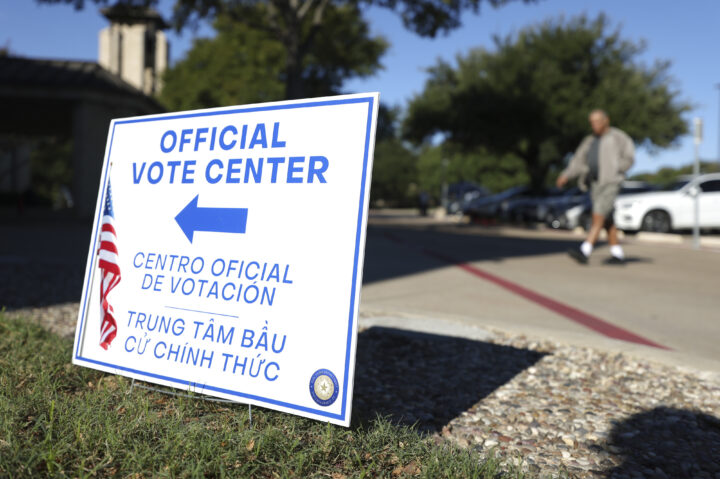
(Chitose Suzuki/The Dallas Morning News via Getty Images)
A voter walks to the polling location at Northway Christian Church during the first day of early voting for the Nov. 3 midterm elections, Monday, Oct. 19, 2026 in Dallas.


 Add JewishInsider on Google
The battle for the Senate majority is going down to the wire, and the outcome will be determined by two major questions.
How successful will Democrats be in picking off GOP-held seats in deeply red states, including several (such as Kansas and Texas), which haven’t elected a Democrat in a Senate race in decades?
And will Republicans be able to score a surprise in Maine, Michigan or Minnesota, where left-wing Democratic nominees are badly underperforming but are being bolstered by the very favorable national Democratic environment?
Because of President Donald Trump’s low job approval rating, widespread economic anxiety and opposition to the Iran war, Democrats are well-positioned to ride the political backlash into a House majority. If polls are to be believed, the Senate is looking increasingly winnable, as well.
But for Democrats to win the Senate, they’ll need to win at least two red states that Trump won by double digits in the 2024 presidential election. The roster of possible pickup opportunities is expanding, with Kansas and South Carolina now looking highly competitive, joining the expected battlegrounds of Ohio, Alaska, Iowa and Texas.
While all those races look potentially winnable, Trump’s margin of victory in those states in the 2024 presidential election was formidable. Democrats lost Ohio by 11 points — the closest race of the red-state bunch — and are facing an even bigger deficit in the other battlegrounds. In our hyperpartisan times, it will require a critical mass of Republicans to cross over to support the Democratic nominee.
Typically in wave elections, most of the tossup races all fall in one direction. But given how hard it’s been for Democrats to win on red-state turf, we may see a different dynamic in 2026.
The math for a Democratic Senate majority gets even tougher if Republicans manage to hang on in Maine, where Sen. Susan Collins (R-ME) has a long record of winning in tough environments and outrunning the polls, and in Michigan, where Abdul El-Sayed’s unapologetically far-left campaign is alienating moderates, and putting a seat in play that should’ve been a Democratic lock.
(Michele Tafoya’s GOP Senate campaign against left-wing Lt. Gov. Peggy Flanagan is also unexpectedly close; the Cook Political Report changed its rating of the race this week to Lean Democrat from Likely Democrat.)
Even if just one of those purple and blue state races ends up in GOP hands, it would increase the number of seats Democrats would need to win on much more conservative turf.
Conventional wisdom suggests that Democrats are now favored to win back the Senate majority. But to do so, they’ll have to defy history — both in winning red states they haven’t won in many years while winning swing states with unusually weak nominees. If they accomplish both, it would truly be a historic accomplishment — and a sign of a massive political wave.
Given the dominant Democratic outcomes from the off-year elections, there’s been renewed attention to the possibility of some red-state upsets in 2026
Adobe Stock
A panoramic view United States Capitol Building at Washington, DC, USA with American flag
Given the GOP’s sturdy 53-seat majority in the Senate, combined with the increasing rarity of split-ticket voters, the Republican Party’s hold on the upper chamber looked nearly guaranteed, with a map featuring very few true swing-state pickup opportunities for the Democrats.
Indeed, the unlikely pathway for Democrats to win back control of the Senate in 2026 runs through states that have been reliably Republican in recent years — Ohio, Iowa, Texas, Florida and Alaska. To win back a majority, the party would need to win at least two of these red-state races, reversing the yearslong Democratic drought in many of these states — along with winning GOP-held seats in battleground Maine and North Carolina, which is far from assured.
But given the dominant Democratic outcomes from the off-year elections, there’s been renewed attention to the possibility of some red-state upsets in 2026. Already, political strategists from both parties are mulling over which seats are the most likely to get competitive, in preparation for an unpredictable midterm election.
On paper, Ohio looks like it’s the best opportunity for Democrats to play offense. Former Sen. Sherrod Brown, a populist, battle-tested Democrat won three statewide elections in Ohio even as the state trended in a more conservative direction. He eventually lost in 2024 to Sen. Bernie Moreno (R-OH) by five points, but ran well ahead of Vice President Kamala Harris’ double-digit defeat in the state.
With the national environment tilting back in the Democrats’ favor, Brown is seeking a comeback against appointed Sen. Jon Husted (R-OH), Ohio’s former lieutenant governor. A recently released September poll of the race conducted by the respected Democratic firm Hart Research found Brown narrowly ahead over Husted, 48-45%. Among independents, Brown held a substantial 25-point lead (56-31%).
Of all the five “reach” states for Democrats, Ohio was the closest in the presidential race, with President Donald Trump winning by 11 points. That should make it the best opportunity for Democrats to win a third seat — even as it underscores how many Trump voters Democrats will need to convert in order to win.
Sen. Joni Ernst’s (R-IA) sudden retirement is turning Iowa into a possible opportunity for Democrats. The state was once reliably competitive, but has been a solidly Republican state in the age of Trump. But the state’s farming economy has taken a hit, in part because of the aftereffects from the president’s tariffs. That’s given Democrats a narrow opportunity to capitalize on growing voter dissatisfaction, especially with an open Senate seat in play.
Republicans have coalesced behind Rep. Ashley Hinson (R-IA), a well-liked lawmaker and former TV anchor from the northeastern corner of the state. Democrats, meanwhile, are dealing with a crowded primary, with Iowa state Rep. Josh Turek appearing to be the party favorite. The contested primary could push the eventual nominee to the left, which would be a major handicap in a state that’s now reliably conservative.
Texas hasn’t elected a Democrat to the Senate since 1988, making the Lone Star State an unlikely pickup opportunity. Democrats’ hopes center on scandal-plagued Texas Attorney General Ken Paxton winning the GOP nomination over Sen. John Cornyn (R-TX) and Rep. Wesley Hunt (R-TX), and that Democrats nominate a moderate candidate who can win back the Hispanic voters who swung towards the Republicans in the last election.
Complicating the Democrats’ path: They’re dealing with a competitive primary themselves between former Rep. Colin Allred, who lost his Senate race in 2024, and state Rep. James Talarico, who has won attention for speaking to conservative audiences about his Christian faith.
If there’s a true sleeper race on the board, it’s in Alaska, a state whose Republican voting record belies its independent nature. Sen. Dan Sullivan (R-AK) doesn’t have any obvious vulnerabilities, but respected Alaska pollster Ivan Moore found former Democratic Rep. Mary Peltola leading Sullivan, 48-46%, in his October survey. But Peltola, who held the state’s at-large House seat from 2022-2024, is probably the only Democrat with the political standing who could put the Senate seat in play.
Finally, Florida used to be a perennial swing state but it’s gotten so Republican in recent years that Democrats don’t even look to be seriously challenging appointed Sen. Ashley Moody (R-FL). In a sign of how times have changed: Moody’s leading Democratic challenger appears to be a former Brevard County School Board member without much statewide name recognition.
Please log in if you already have a subscription, or subscribe to access the latest updates.
 Continue with Google

 Continue with Apple