




























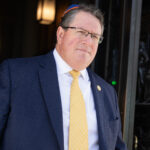

Andrew Gross told JI he’s willing to explore giving the mayor ‘a second chance’ — if Mamdani is willing 'to repent'
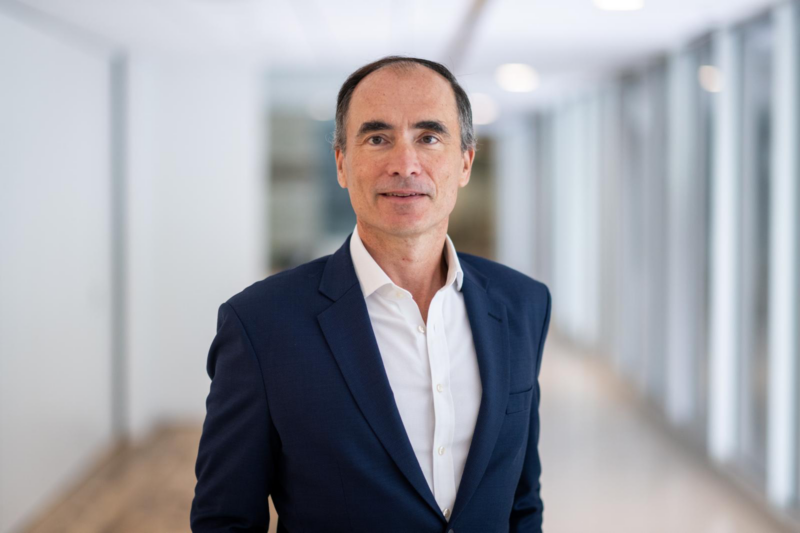
Andrew Gross/LinkedIn
Andrew Gross


 Add JewishInsider on Google
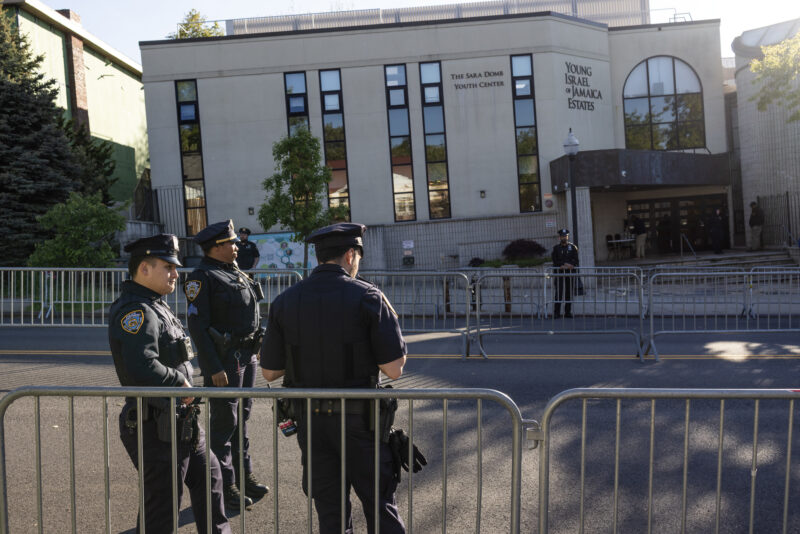
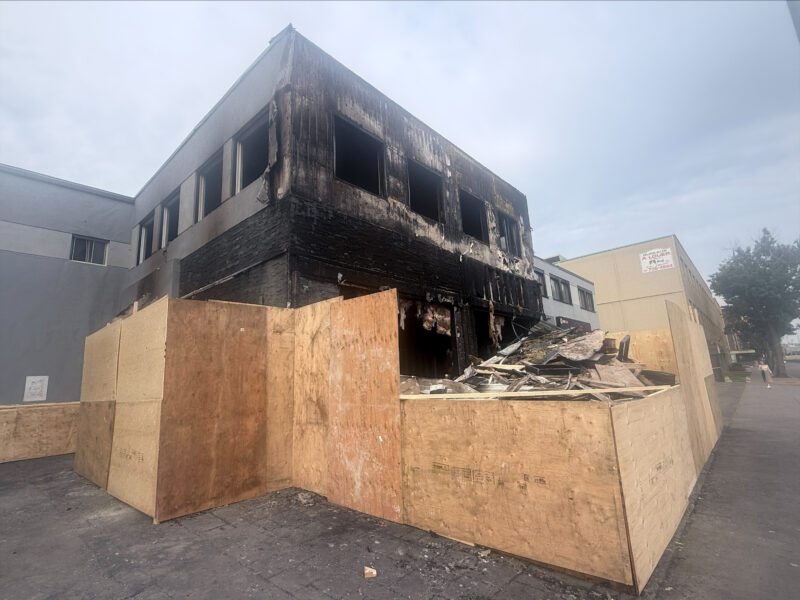
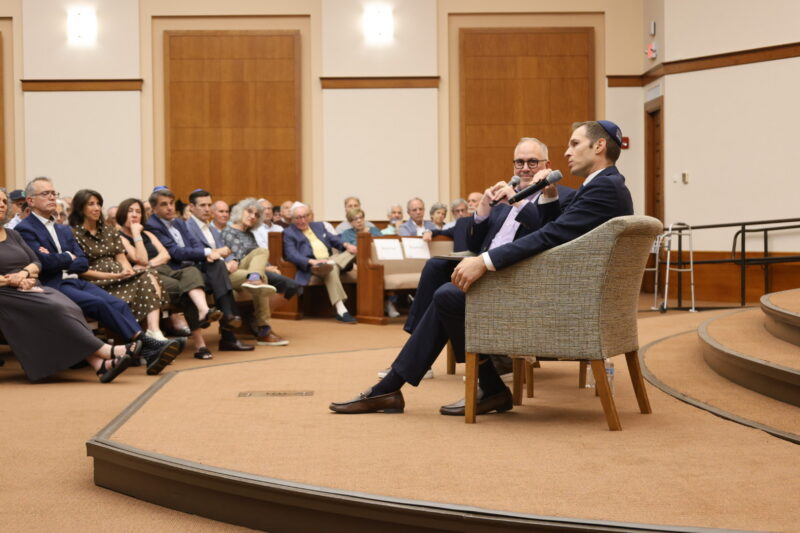
Andrew Gross arrived in his new role as the American Jewish Committee’s New York regional director on Monday with memories from the other side of the Hudson River — memories of the shattered JC Kosher Supermarket in Jersey City, where in December 2019 antisemitic gunmen killed three people before themselves dying in a firefight with police.
“I remember seeing the bullet casings and glass fragments on the ground,” recalled Gross, who had become executive director of the New Jersey-Israel Commission under then-Gov. Phil Murphy just a few months before. “As I do my job here at the AJC, I’m going to work with everyone to make sure that exact type of scenario does not happen again.”
“Everyone,” as he described it in a wide-ranging interview with Jewish Insider, extends from the NYPD to New York City Council Speaker Julie Menin to AJC’s long-standing network of Jewish and non-Jewish civic allies, and even friendly interests out of the Persian Gulf. Gross said he also plans to draw on another set of experiences from Murphy’s administration: his time at the New Jersey Economic Development Authority, as he looks now to forge stronger ties with Big Apple business leaders.
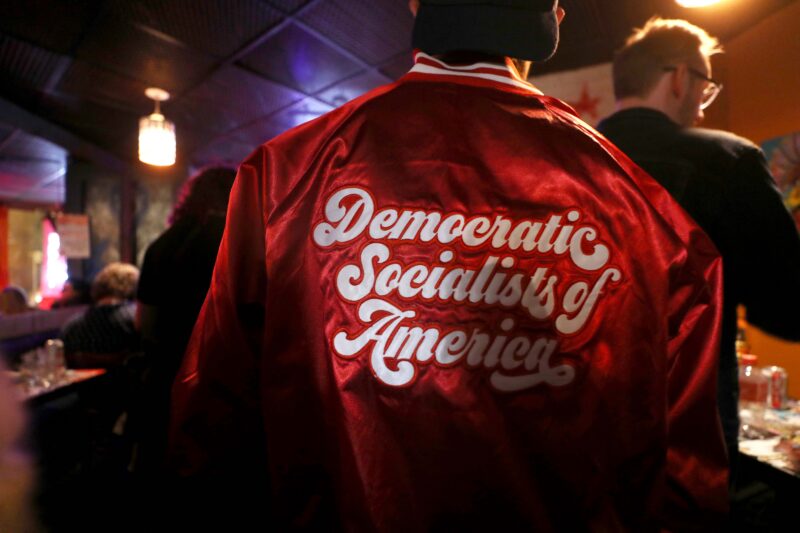
The Jewish and business communities overlap and, he argued, share an interest in opposing the rhetoric of the city’s branch of the Democratic Socialists of America.
“They seem to have a serious issue with capitalism, and they seem to have a serious issue with the West and how the West has developed its economy, and they seem to be very against a lot of the pillars of free markets,” said Gross, recalling the persecution of Soviet Jewry. “Historically, Jewish people have not fared very well when that’s the theme. When you attack free markets, and you attack capitalism, and you attack the ability of business owners to succeed, that usually comes with very troubled waters for Jewish people.”
Gross’ remarks echoed those of another veteran of New Jersey Democratic — and Jewish — politics who arrived in New York City this year with plans to counter Mayor Zohran Mamdani: former Jersey City Mayor Steve Fulop, who assumed leadership of the Partnership for New York City, a business advocacy organization with numerous Jewish board members. Fulop has highlighted combating antisemitism as a key priority for the Partnership, which has in the past confined itself to promoting policy favorable to private enterprise.
Gross lauded Fulop’s focus, though he added they had not yet coordinated their efforts.
“There are a lot of parallels. And I can tell you that AJC has a very, very strong history and a strong board that’s deep in the New York City business community,” he said. “And one of the areas, especially with my background working with Gov. Murphy over the years, is going to be to deeply, deeply strengthen how AJC works with the business community in the city, and we’ll be looking for ways to build up that portfolio and strengthen relations.”
Yet despite declaring his intention to “push back” on Mamdani and his DSA allies for what Gross described as their “unreasonably hostile” posture toward Israel, he stressed he was open to warmer relations with City Hall — if the mayor is willing to “tone down” his rhetoric around the Jewish state.
“Jewish values tell us that people deserve to be given a second chance,” Gross said. “They deserve to be able to redeem themselves and to repent and to be better. I have absolutely no interest in having an endless battle with him or his administration.”
Gross told JI that he would not have attended a meeting like the one Mamdani’s Office to Combat Antisemitism held earlier this week with several liberal-leaning rabbis at City Hall because of the way the mayor has “singled out” Israel for criticism. Having served at the Israeli consulate himself, Gross also expressed horror that Mamdani’s international affairs commissioner had agreed to a meeting with Iran’s representative to the United Nations.
The mayor has said he was unaware of the planned rendezvous, which the State Department blocked, and called his commissioners actions “an error.”
“When you try to meet with a regime that is currently in kinetic combat with the United States, and a regime that has supported terrorism not just against Israel and Jewish people around the world, but against Americans, killed Americans, I think that is deeply, deeply disturbing,” Gross said, highlighting that the mayor has used his official platforms to excoriate Israeli leadership exclusively. “They seem to just be singularly ideologically focused on attacking Israel. There was no speech about Ukraine. There is no speech about what Russia has been doing. No speech about China or how they have damaged American interests. No speech about Taiwan. Right? There seems to be no other engagement globally.”
Gross pointed to a rise in antisemitic hate crimes during Mamdani’s tenure, as well as recent AJC data finding a majority of Jewish Americans nationally have changed their behavior for fear of being victims of a bias incident, and argued both are linked to the kind of rhetoric the mayor and his allies in the DSA use.
“It’s causing strife and concern, and the Jewish community to retreat from their own identity,” Gross said, arguing that the anti-Zionist Jewish figures Mamdani has elevated in his administration are not representative of the community writ large. “AJC has a unique and urgent role to work with our partners to educate, speak out and call out each instance where Jewish New Yorkers are being discriminated against, and to push back against this tide where the identity of Jewish New Yorkers is being chipped away.”
As the new head of NYC’s leading business advocacy group, Fulop said he’s preparing for ‘this experiment of what it means to be an executive in a DSA world’
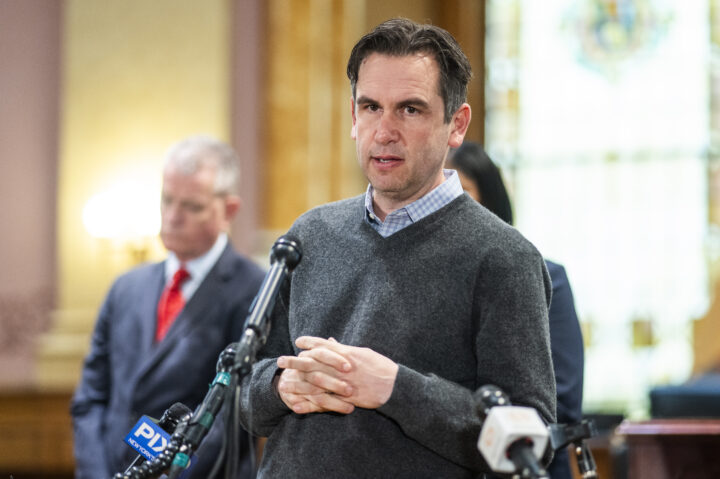
Eduardo Munoz Alvarez/Getty Images
Jersey City Mayor Steven Fulop speaks during a press conference on April 11, 2025 in Jersey City, New Jersey.
As he settles into his role leading the Partnership for New York City, a prominent business advocacy group, Steve Fulop, the former longtime mayor of Jersey City, N.J., has a few major issues on his mind, chief among them countering the rise of antisemitism.
For Fulop, a Jewish Democrat who assumed his new job last month, just five days after he left office on Jan. 15, such efforts are not only personal as a former yeshiva student who was also the grandson of Holocaust survivors. They are directly connected, he explained to Jewish Insider, to promoting a friendlier climate where businesses can feel safe and welcome in the city.
Many of the Partnership’s Jewish board members, representing some of the city’s most powerful firms in finance, real estate and other leading sectors, also share his sense of urgency, Fulop said, as do many of the 800,000 employees who make up his group’s core constituency.
“They often say of the tax conversation that we could talk about whether people stay or go, if they migrate elsewhere,” Fulop said of his conversations with members in an interview with JI on Tuesday at his fifth-floor office in the Financial District, which looks out on Jersey City. “But if you continue on a trend where it feels like antisemitism is increasing and quality of life is decreasing, that is a trigger for people to leave very, very fast.”
Citing statistics from January that showed a sharp, year-on-year uptick in antisemitic incidents in New York City, Fulop emphasized that the city now finds itself on an “alarming” track. “Those are things that will push people to leave immediately,” he warned.
“Obviously you have a fringe far left that often says antisemitic things and has normalized it, and that’s not OK,” he said. “If it continues on a trajectory, we will be vocal on it.”
Fulop said that he has met with New York City Mayor Zohran Mamdani “multiple times,” and described their discussions as “very positive and pleasant,” despite clear differences on hot-button topics ranging from support for Israel to proposed tax hikes on wealthy New Yorkers.
“To be honest with you, I don’t think we’re going to agree on everything,” he told JI, “but we do try to find places where we agree,” including such shared affordability issues as “housing growth” and child care.
Speaking from his own experience as a former Democratic “outsider” who also rose to mayor in his 30s, Fulop, who turns 49 next week, acknowledged that Mamdani has a “tough job” as he faces pressure from his far-left base in the Democratic Socialists of America, which has aggressively pushed boycotts of Israel. “There is clearly antisemitic rhetoric coming from that base,” Fulop said.
“Even if he’s not sympathetic to some of them, his base is very vocal,” Fulop said. “That’s going to be something that we pay attention to, when you start talking about some of the rhetoric around the BDS language, where the left pushes, and how [Mamdani] stands up to them,” he elaborated, referring to the Boycott, Divestment and Sanctions movement targeting Israel. “It’s early days at this point.”
Fulop’s assessment underscores how the business community, in conjunction with Jewish leaders and others concerned about Mamdani’s policies, is now formalizing an approach to act as a bulwark against the mayor while navigating a new political landscape it views as largely inhospitable to its goals.
Even as he expressed a desire to be “helpful” to Mamdani, Fulop has also indicated that he will not hesitate to stake out more adversarial positions on key areas where they are not aligned. In November, for instance, he described Mamdani’s proposal for a corporate tax hike as “absolute suicide” for the city.
“The goal is to be more aggressive on tenor, not necessarily adversarial all the time,” he said. “To be clear that we think that a fragile city environment is at risk.”
Regarding the administration’s track record on Israel and antisemitism a month and a half into Mamdani’s tenure, Fulop voiced reservations in particular about the mayor’s skepticism of the partnership between Cornell University and Israel’s Technion on Roosevelt Island, which Mamdani’s team had suggested during the campaign he would review.
“We think that would be shortsighted and a double standard to Israel,” Fulop, who said he held a call “with some people affiliated with the partnership” to discuss the situation last week, told JI. “Singling out one country that happens to be the Jewish state is, I don’t think, OK with anybody.”
In his final days as mayor, Fulop signed executive orders banning Jersey City from engaging in BDS and regulating the kinds of protests outside houses of worship that Mamdani has struggled to condemn decisively as mayor.
“The guy following me wants to be like Mamdani, but he’s less charismatic,” Fulop said of his mayoral successor, James Solomon, a progressive Democrat. “I thought that there was risk, and better off putting guardrails in place — because you don’t know where things go.”
During an unsuccessful Democratic primary campaign for governor of New Jersey last year, Fulop had criticized efforts to legally codify the International Holocaust Remembrance Alliance’s working definition of antisemitism. But he said he believed that Mamdani had made a strategic error when, on his first day as mayor, he swiftly revoked — as part of a blanket repeal of all of former Mayor Eric Adams’ executive orders following his September 2024 indictment on federal corruption charges — an executive order that had adopted the definition in the city, along with an order prohibiting BDS in city agencies.
“It obviously elevated the idea that the incoming administration is anti-Judaism,” he told JI, saying he is closely monitoring Mamdani’s next steps amid rising rates of antisemitism the mayor has vowed to confront.
Fulop said that the Partnership’s board members, who met with Mamdani during the campaign as he drew criticism over his refusal to condemn calls to “globalize the intifada” and rejection of Israel’s right to exist as a Jewish state, remain worried about his hostile views on Israel and commitment to fighting antisemitism. “Very, very very, very” worried, Fulop said.
Mamdani’s office did not respond to a request for comment from JI.
Eric Goldstein, the CEO of UJA-Federation of New York, which was among the first groups that Fulop met with when he took over the Partnership, said he looked “forward to working with” the former mayor.
“Steve brings a strong record of public service, principled leadership and a commitment to civic responsibility,” he told JI. “We also support and appreciate Steve’s deep support of Israel’s existence as a Jewish homeland and commitment to fighting antisemitism and the delegitimization of Israel.”
Now that he is no longer a politician, Fulop, a former Goldman Sachs banker and Marine veteran who recently relocated to Hell’s Kitchen across the river from Jersey City, is appreciating his time away from elected office, he said.
“It’s a little bit of a different world not being on the elected side, which I’m thankful for, to be honest,” he told JI. “We’re in a very polarized environment here for people in elected office. So, for me, I think this is kind of a sweet spot of advocacy and impact without some of the headaches of being in elected office.”
Fulop praised his predecessor, Kathy Wylde, the former longtime Partnership leader who reportedly faced internal backlash from members who felt that she was too deferential to Mamdani. But the group finds itself in a moment “where we need to be more assertive with both our actions and voice,” he said, noting that he is seeking to focus on a “very narrow subset” of advocacy issues, including antisemitism.
To that end, he says he is expanding the group’s political advocacy arm, hiring an executive director to help steer its current $10 million in reserves, on top of lobbying, research and a venture capital fund.
“I think we have a reasonable, centrist message that most people agree with — whether it’s antisemitism or homeless encampments,” he explained. “I think we’re in a place where most people would say, ‘You know what? What they’re saying kind of makes a lot of sense.’”
New York City is now “in a unique time and space,” Fulop told JI. “We haven’t seen a socialist mayor of prominence anywhere in this country for decades.”
“The Partnership has a significant voice in that,” he said. The city is “going to be front and center in this experiment of what it means to be an executive in a DSA world.”
‘I stand alone in the sense that I've been an advocate for the Jewish community and Israel with no support financially or politically from that community,’ Fulop said comparing himself to Gottheimer and Sherrill

Kyle Mazza / SOPA Images/Sipa USA via AP Images
Jersey City Mayor Steve Fulop during a press conference in Jersey City.
Facing scrutiny and increasing criticism from some in the New Jersey Jewish community, Jersey City Mayor Steve Fulop is suggesting that his top opponents in the state’s Democratic gubernatorial primary aren’t reliable allies against antisemitism and in support of Israel — and is also taking aim at the state’s current governor, accusing him of failing to adequately address the issue.
“When people try to portray me as anything other than a person that understands and supports the Jewish community here, it’s like a laughable accusation, considering my family’s background and my personal trajectory and personal backgrounds,” Fulop told Jewish Insider. “I stand alone in the sense that I’ve been an advocate for the Jewish community and Israel with no support financially or politically from that community. I do it solely because I believe that what I say is on the right side of the issues. That’s not the same place that the congressional candidates are.”
Fulop is facing growing skepticism and frustration over his rejection of legislation to codify the International Holocaust Remembrance Alliance’s working definition of antisemitism and his ties to prominent anti-Israel figures in the state, among other concerns.
Reps. Josh Gottheimer (D-NJ) and Mikie Sherrill (D-NJ) are both running in the race to succeed Gov. Phil Murphy, a Democrat.
“This attack reeks of desperation from a candidate who has failed to gain any traction after more than two years running for governor. But far worse, it politicizes efforts to fight antisemitism and support our ally, Israel,” Sherrill spokesperson Sean Higgins said. “The mayor often misses the mark as he fabricates attacks in an attempt to benefit his political self-interest; this one is particularly craven.”
Gottheimer’s campaign declined to comment.
Gottheimer, who is Jewish, has been among the most active and outspoken lawmakers on antisemitism and Israel, including when it put him at odds with former President Joe Biden. Sherrill has often backed key pro-Israel legislation and other efforts to combat antisemitism.
Though he does not support the IHRA legislation, arguing that it chills criticism of Israel and will actually exacerbate antisemitism, Fulop told Jewish Insider last week he does see room for the state to act in other ways.
He said the state could expand antisemitism and hate education — which he said should start at early ages — and more forcefully enforce the law at institutions of higher education.
“I don’t think Phil Murphy has done a particularly great job around that,” Fulop said.
Fulop asserted that Murphy should have intervened sooner in response to campus antisemitism in New Jersey, saying that the governor had allowed the issue to “fester” and should have had “no tolerance for that sort of stuff.”
Fulop added that Murphy should have been “more assertive” against antisemitism at Rutgers, adding that the state school system should not have made a deal with and concessions to student demonstrators to break up an anti-Israel encampment.
“The reality of the situation is that you had a lot of Jewish students there that felt that they were at risk with physical harm, and no student should feel that way when they attend a university,” Fulop said. “Getting to a place where you are negotiating with a group of students that ultimately made other students feel uncomfortable, I don’t think it’s a productive course of conversation. I don’t think it’s the right approach.”
Murphy did not respond to a request for comment.
Fulop said it would be “hard to argue that these were peaceful protests,” especially at Columbia University in neighboring New York City.
Fulop also highlighted his father’s service in the Golani Brigade during the Six-Day War, his Jewish upbringing and the Tanach quotes in his inauguration speech.
He said he’s supportive of the work of the New Jersey-Israel Commission, and said he’d work to highlight and grow that work, finding new partnership and investment opportunities. He said he’d worked in a similar way in Jersey City, on a smaller scale.
He said he sees opportunities to further connect technology companies and educational institutions in New Jersey and Israel.
Mayor blames rise in antisemitic attacks on right-wing antisemitism

Michael Appleton/Mayoral Photography Office
Mayor Bill de Blasio, Police Commissioner Dermot Shea and Executive Director of the Office for the Prevention of Hate Crimes Deborah Lauter meet with Jewish community leaders in Williamsburg to discuss the City's response to the attack in Jersey City, on Thursday, December 12, 2019.
New York City Mayor Bill de Blasio pledged on Thursday to increase efforts to root out hate speech and antisemitism in the aftermath of a terror attack at a Jersey City, N.J., kosher supermarket on Tuesday, the deadliest targeted attack against members of the tri-state Jewish community in history.
Calling it out and acting: “This is a moment to be really, profoundly concerned but history is not a teacher only of the negative, history teaches us something else. Which is these horrible trends, these horrible gathering storms can be stopped if people stand up and refuse to accept the reality,” de Blasio said during a press conference with Orthodox Jewish community leaders in the Williamsburg neighborhood of Brooklyn. “We need to be in the vanguard of stopping this hatred, turning the tide. And that is what we will do.”
High alert: De Blasio and Police Commissioner Dermot Shea told JI they were committed to increasing police presence around synagogues and Jewish establishments for as long as necessary. “Until this investigation is absolutely concluded, we are going to be in a state of high alert,” de Blasio told Jewish Insider. “and we’re going to assess the broader backdrop with this new unit focused on racially and ethnically motivated extremism of what kind of threats may be emerging over the horizon. This presence will be ongoing as we make that assessment.”
Shifting blame: The mayor maintained that the growing threat of antisemitism comes from the political right. “Where has the worst antisemitic attacks — before two days ago — happened in the United States of America in recent memory? Pittsburgh, Poway, and other parts of the country. And who were the perpetrators? White supremacists. We know this,” de Blasio explained to JI. “If folks on the right want to play this game with people’s lives, I would say you should be concerned about that. The historic danger to the Jewish people has come from right-wing extremists. That is a fact that is proven so deeply. I will debate anyone, anywhere on that one. De Blasio blamed the rise of violent antisemitic attacks on “a tragic global phenomenon” that has orginiated in Europe with the rise of political movements who are a “direct descendant of Nazism.”
De Blasio also pushed back against criticism that antisemitism has been rising under his watch, attributing it to the dramatic rise of hate speech on the right. “Why is there so much hate speech in America? Why is it different today that it was 4-5 years ago? I think you can fill in the blank. You can love [President Donald Trump], that is your choice, but you can’t miss the fact that the dialogue changed with the election in 2016.” He further insisted that there is an “extraordinary difference” between the rise of antisemitic incidents in New York City and the attacks in Jersey City, Poway and Pittsburgh. “And I will tell you just very clearly, we are going to go at all of it. I don’t care who the perpetrators are.”
De Blasio on the White House’s executive order to combat antisemitism on campus: “I have, honestly, mixed feelings about it. I have not read the exact proper document, but I have mixed feelings. Anything that confronts antisemitism, I support. But I worry, at the same time — as an American — about the balance we always strike in terms of freedom of speech and freedom of expression, particularly on college campuses. So this one leads me to real questions about whether that balance has been struck properly. Someone who disagrees with the Israeli government on a given policy, I don’t consider that antisemitic. If someone bears hatred in their heart towards the Jewish people, that’s antisemitism. So we have to understand where that line is.”
Please log in if you already have a subscription, or subscribe to access the latest updates.
 Continue with Google
 Continue with Apple