




































































The Senate minority leader was pressed by MS NOW’s Joe Scarborough on his view of the U.S. and Israel’s war achievements

Samuel Corum/Getty Images
Senate Minority Leader Chuck Schumer (D-NY) makes a statement alongside House Minority Leader Hakeem Jeffries (D-NY) outside of the West Wing at the White House on January 17, 2024 in Washington, DC.


 Add JewishInsider on Google
Senate Minority Leader Chuck Schumer (D-NY) did not directly address whether the degradation of Iran’s military infrastructure should be viewed as a positive outcome, instead emphasizing the war’s potential economic and geopolitical consequences.
Over the course of the past week, U.S. officials have indicated that Iran’s military capabilities have been severely weakened. President Donald Trump has described Iran’s military as “decimated,” and Director of National Intelligence Tulsi Gabbard testified at a congressional hearing this past week that the Iranian regime was “largely degraded.”
When asked by MS NOW’s Joe Scarborough on Monday’s edition of “Morning Joe” whether that degradation was a “good thing,” Schumer called the question “premature.”
“You can’t [answer that question] because it’s a premature question,” Schumer said. “What is going to happen in the next several months? Is it worth it? Will the world economy collapse?”
“I can ask that question,” Scarborough replied. “I’m simply asking on the military side: Is it good — regardless of whether we agree with going in or not — is it good that Iran’s military infrastructure has been seriously degraded?”
Schumer again asserted that it could not be answered without understanding the full implications of the current conflict.
“In all due respect, if you ask the American people, if you have the choice of degrading the military structure in Iran, but having gasoline be $6 a gallon and our economy falling into a deep recession where millions lose their job, what do you think?”
Schumer ultimately signaled agreement with that underlying point, while maintaining his broader concerns.
“The fact that the leader [Ayatollah Ali] Khamenei is gone, no one regrets that. The fact that Iran has less ability to create military trouble [is a good thing], no one disputes that. But you have to look at the consequences.”
Schumer argued that Congress would have had a clearer understanding of the potential economic and geopolitical consequences had lawmakers passed one of several war powers resolutions — an effort that has been voted down by House and Senate Republicans with several Democrats joining them on several instances within the past month.
“If Republicans had voted with us on the War Powers Act, all these questions would have been asked ahead of time instead of Donald Trump’s willy-nilly — one day yes, one day no,” Schumer said.
Netanyahu and his team are preparing to brief Trump on Israel's concerns that Iran is expanding its ballistic missile program
Jim Lo Scalzo/EPA/Bloomberg via Getty Images
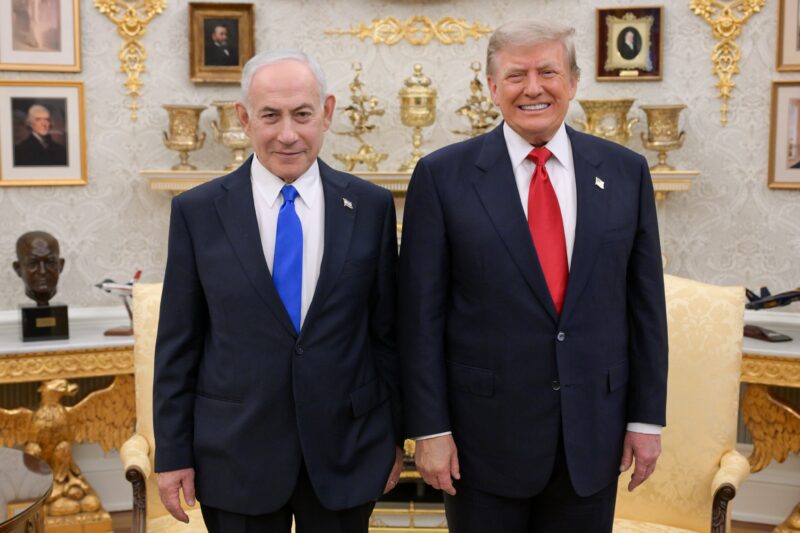
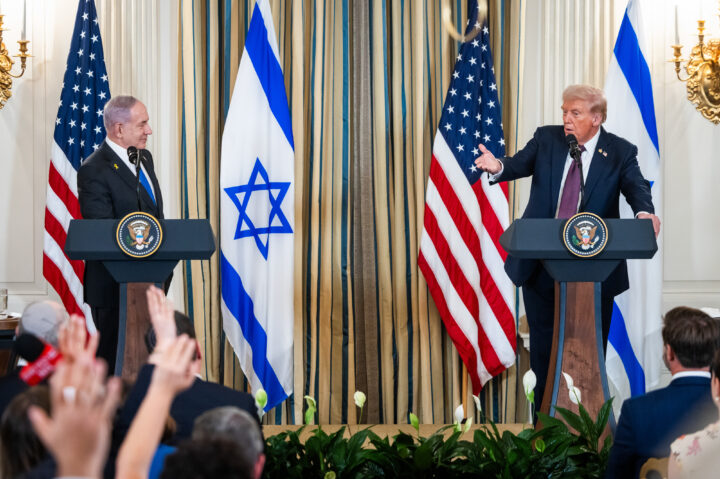
President Donald Trump, right, and Benjamin Netanyahu, Israel's prime minister, during a news conference in the State Dining Room of the White House in Washington, DC, US, on Monday, Sept. 29, 2025.
When Israeli Prime Minister Benjamin Netanyahu meets with President Donald Trump next week, the Iranian threat will be at the top of the agenda. That’s a sentence that could have been written countless times in the past – but this time, after the degradation of Iran’s nuclear program, was supposed to be different.
We’re six months out from Operation Midnight Hammer, when the U.S. and Israel worked together to bomb Iranian nuclear facilities, and the 11 days of Israeli airstrikes on Iran that preceded it.
But much of the public conversation following that 12-day war focused on the damage done to Iran’s nuclear program – which is likely significant, but still hard to measure precisely – and less on the Islamic Republic’s ballistic missiles and air defenses.
Israel destroyed hundreds of missiles, launchers and production sites, and boasted about its control of the airspace over Tehran a day into the war as testament to its military prowess. But Jerusalem is now deeply concerned that Tehran has managed to recoup, with help from China, much of its losses.
In that vein, Netanyahu and his team are preparing to brief Trump on Israel’s concerns that Iran is expanding its ballistic missile program.
IDF Chief of Staff Eyal Zamir called the head of U.S. Central Command, Adm. Brad Cooper, to warn that an Iranian Revolutionary Guard Corps exercise that began last week is likely part of preparations to attack Israel, Axios reported.
NBC News reported over the weekend that Netanyahu plans to tell Trump that Israel may strike Iran if the ballistic missile program reaches a point where it is an immediate threat. The prime minister is reportedly expected to present Trump with options for the U.S. to take part in such a military operation or to assist in the effort.
Meanwhile, Iranian Foreign Ministry spokesman Esmaeil Baqaei ruled out any negotiations to dismantle the country’s ballistic missile program. At a weekly press conference on Monday, Baqaei said, “Iran’s missile program was developed to defend Iran’s territory, not for negotiation. Therefore, Iran’s defense capabilities, designed to deter aggressors from any thought of attacking Iran, are not a matter that could be talked about.”
The Iranian missile attacks in June effectively shut down Israel’s economy. Israel’s defense establishment was prepared for a scenario in which 1,000 Israelis were killed by missiles, though ultimately, the IDF’s Arrow 2 and 3 defense systems shot down 86% of Iran’s deadly ballistic missiles, meaning only 36 out of 550 missiles launched reached their targets, 32 people were killed, over 3,000 wounded and 13,000 homes destroyed by missiles landing in Tel Aviv, Beersheba and other cities.
Israel is concerned that Iran could produce as many as 3,000 ballistic missiles per year if it is not stopped. With the same success rate, and assuming Iran uses 3,000 missiles, that would mean 420 missiles exploding in Israel and nearly 12 times as much damage in life, limb and property.
Please log in if you already have a subscription, or subscribe to access the latest updates.
 Continue with Google
 Continue with Apple