


















































The vice president’s visit to Israel marks a pivot point in the Trump administration’s efforts for a post-Hamas Gaza

Nathan Howard-Pool/Getty Images
U.S. Vice President JD Vance boards Air Force Two en route to Israel on October 20, 2025 at Joint Base Andrews, Maryland.


 Add JewishInsider on Google
Vice President JD Vance landed in Israel on Tuesday with the charge to lead efforts to stabilize the fragile ceasefire in Gaza and assist in the implementation of the second phase of President Donald Trump’s peace deal.
Following the release of the remaining 20 living Israeli hostages from Gaza in exchange for Palestinian prisoners, there was little indication that Hamas would abide by the other elements of Trump’s 20-point plan, which calls on the terrorist group to disarm and cede governance to a technocratic group of Palestinian leaders. In the last week, Hamas began executing Palestinians, clashing with rival groups and reasserting itself as the security and governing force in the Gaza Strip.
Over the weekend, Hamas terrorists shot an anti-tank missile at IDF machinery and killed two soldiers and Israel retaliated with airstrikes in Rafah, further jeopardizing the status of the ceasefire. Israeli Prime Minister Benjamin Netanyahu briefly halted the delivery of humanitarian aid into Gaza, but reversed course following pressure from the Trump administration.
The vice president will now step into the conflict, visiting Israel at an important juncture as the Trump administration looks to avoid another breakdown into renewed hostilities and ensure full compliance with the deal.
“Hamas is going to fire on Israel. Israel’s going to have to respond, of course. There are going to be moments where you have people within Gaza that you’re [not] quite sure what they’re actually doing. But we think it has the best chance for sustainable peace,” Vance told reporters on Sunday, referring to the peace proposal.
The decision to dispatch Vance to Israel is a sign of the Trump administration’s continued engagement in the Middle East after securing the hostage-release deal, according to experts.
“We are in a moment of really intense American engagement and influence that have got us to a stage one that no analyst a month ago would have told you was possible, and so there is a moment of opportunity here,” said John Hannah, a senior fellow at the Jewish Institute for National Security of America. “In order to be sustained, it’s a ceasefire and peace process that is going to require intense and continuous U.S. engagement at the most senior levels.”
While Vance’s foreign policy experience was limited during his time in the Senate, the vice president has remained deeply engaged on issues regarding Israel during the second Trump administration. Hannah said this continued high level involvement will be key to sustaining any peace deal.
David May, a senior research analyst at the Foundation for Defense of Democracies, said deploying Vance shows the significance of this issue to the Trump administration.
“This is a huge legacy item for President Trump, and so trying to make sure that the ceasefire holds is a highly important item for him. They had to send someone of a high profile, and sending the vice president shows that you are serious,” said May.
May said it would be a “huge accomplishment” if Vance is able to keep the ceasefire from collapsing — and secure progress toward other elements of Trump’s peace plan.
“This is now an opportunity for Vance to build on his portfolio and show his vice presidential experience,” said May. “There’s very often vice presidents that sit in the background and don’t do much and don’t have much to show for it. This is an opportunity for him to get in the foreground.”
The key, May says, will be for Vance to leverage the U.S. relationship with Israel and convince Netanyahu’s government to show restraint in responding to Hamas’ provocations.
“In order for the ceasefire not to collapse, the exchanges of fire have to stop. It’s very difficult to get Hamas to stop firing, but if you can get the Israelis to stop responding, or at least to respond less forcefully, then maybe that can lower the temperature a little bit and allow for some of the benefits of the ceasefire to start kicking in,” said May.
But beyond keeping the pause in hostilities afloat, the administration still faces a significant challenge in completely disarming Hamas and removing them from Gaza, a hurdle May says could require further confrontation with the terrorist group.
“I don’t think any power besides maybe the United States or Israel can be trusted and would have the commitment to actually disarming Hamas,” said May. “Unless Hamas is able, or willing, to resume its previous role as being a more religious and cultural and social organization without the same political power or weapons, I don’t foresee a way of implementing the ceasefire without maybe another round of fighting with Israel actually taking out Hamas.”
Vance is slated to stay in Israel until Thursday, according to reports. The vice president will join White House Special Envoy Steve Witkoff and Jared Kushner, both of whom played vital roles in securing the first phase of the deal, who are already in Israel and met on Monday with Netanyahu.
Sen. Bernie Sanders didn’t mention the Israeli hostages in a comment expressing hope the war in Gaza would soon end
Chip Somodevilla/Getty Images
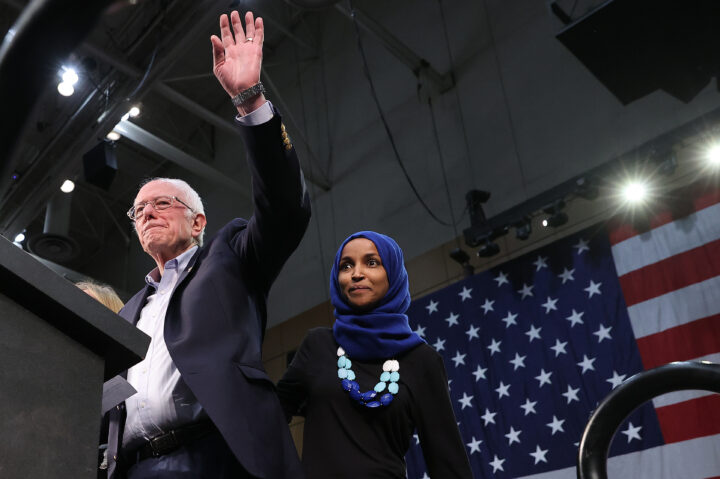
Rep. Ilhan Omar (D-MN) (R) introduces Democratic presidential candidate Sen. Bernie Sanders (I-VT) during a campaign rally at the Roy Wilkins Auditorium March 2, 2020.
Democratic lawmakers who have been stridently critical of Israel and its operations in Gaza offered tepid support for the ceasefire and hostage-release deal, the first phase of which was signed on Thursday, while reiterating their criticisms of Israel and the U.S.’ support for the Jewish state. Few offered any words of support for the Israeli hostages who have been held by Hamas for over two years.
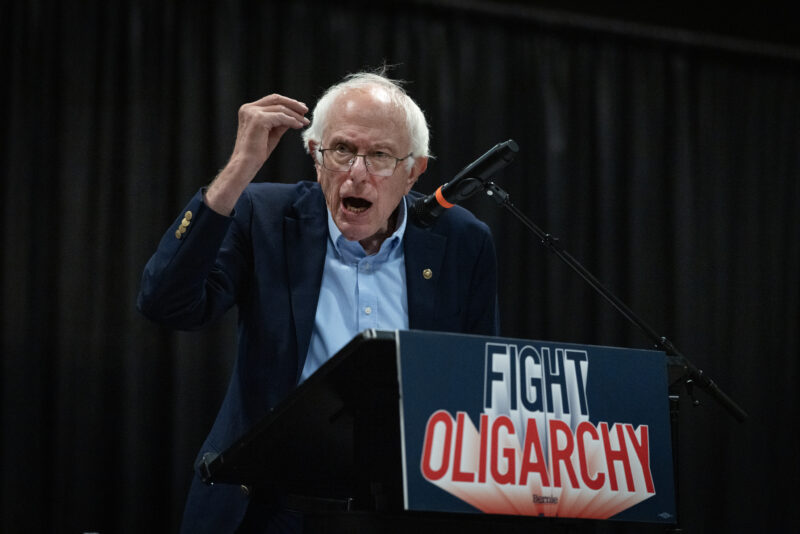
Sen. Bernie Sanders (I-VT), who has led a series of efforts to block arms transfers to Israel, didn’t explicitly praise the deal negotiated by President Donald Trump, but said he hopes the deal would lead to the end of a “horrific war.” He made no mention of the Israeli hostages set to be released, but asserted one-tenth of the Gazan population was killed or injured during the war.
“As of today something like 10% of the Palestinian people in Gaza have been killed or wounded, mostly women, children and the elderly. The United States has put tens of billions of dollars into an effort which has led to mass destruction,” Sanders told Jewish Insider. “So I hope — and I’m sure everybody else does — that this horrific war can end as soon as possible.”
Rep. Ilhan Omar (D-MN) said on X that the ceasefire is a “hopeful step” but quickly pivoted to expressing unvarnished opposition to Israel. She also made no mention of the Israeli hostages expected to be freed from their Hamas captors.
“For the sake of humanity, let’s hope this will be a lasting and permanent ceasefire,” Omar said. “While this is a hopeful step, we must demand accountability for every war crime committed during this genocide and continue to call for an end to the occupation.”
Rep. Delia Ramirez (D-IL), the lead sponsor of legislation that aims to place strict conditions on critical arms sales to Israel, said on X she plans to continue to pursue that legislation.
“Immediately after October 7, I called for a ceasefire and for a path that honors our shared humanity. It is unfortunate that it took this long. However, I am hopeful that today’s ceasefire agreement will bring the hostages and prisoners home and end the bombing and starvation of the Palestinian people,” Ramirez said. “We must save Palestinian lives and pursue an end to U.S. complicity in Israel’s war crimes, atrocities, and genocide. I will continue to work to Block the Bombs, as we pursue a future of self-determination for the Palestinian people and a just and lasting peace for all residents of the region.”
Rep. Joaquin Castro (D-TX), tamping down on enthusiasm for the deal, reposted an X post suggesting that Israel may violate the deal.
“There is certainly some hope that the Gaza deal will hold but it’s important to remember that the last ceasefire agreement collapsed in March before ever reaching phase 2 when Israel reimposed a blockade on Gaza and bombings on the strip resumed,” the post, from an NBC News correspondent, reads.
Other prominent critics, particularly on the far-left, have remained unusually mum about the deal.
Squad members Reps. Rashida Tlaib (D-MI) and Alexandria Ocasio-Cortez (D-NY), Rep. Summer Lee (D-PA) and Progressive Caucus Chair Rep. Greg Casar (D-TX) did not respond to requests for comment and did not comment publicly.
Some other lawmakers who have been vocally critical of Israel’s operations in Gaza offered more fulsome praise for the deal.
Sen. Chris Van Hollen (D-MD) said in a statement that the deal is “the first hopeful moment in a long time,” noting both the release of hostages and the surge of aid into Gaza. He credited U.S. pressure on Israel, however, rather than the reported increased pressure from Qatar, Turkey and Egypt on Hamas, for the breakthrough.
“Pressure from the U.S. and others has always been necessary to reach this moment — something that could have been achieved much earlier and prevented the staggering loss of civilian life, starvation, and devastation in Gaza,” Van Hollen said. “U.S. leadership will be essential to enforce this plan and convert this moment into real progress toward lasting peace — which can only be achieved by sidelining the extremists on all sides and committing to security, dignity, human rights, and justice for all.”
Rep. Ro Khanna (D-CA), who led an effort calling for the U.S. to unilaterally recognize a Palestinian state, also praised the deal and led with the return of the Israeli hostages in his comments.
“It’s obviously very welcome news. Finally, the hostages are going to come home. The bombing hopefully is going to stop. Israel is going to withdraw,” Khanna said on Fox Business. “Everything I have read seems that this is a welcome development. And I’m really glad that after two years of a war, this seems to be finally coming to a resolution.”
“Now, we need to work for 2 states & ensure the bombing does not resume later in the year,” he added on X.
Rep. Ayanna Pressley (D-MA) told JI, “For the sake of humanity, I pray this holds. It is so far past time to end this genocide, free the hostages, and surge food, water, and baby formula to starving families in Gaza.”
Sen. Elizabeth Warren (D-MA) declined to comment, saying she had not reviewed the deal.
Please log in if you already have a subscription, or subscribe to access the latest updates.
 Continue with Google
 Continue with Apple