














































































Sen. Chris Coons (D-DE) and Rep. Greg Meeks (D-NY), who are both expected to hold powerful committee leadership roles if Democrats win both chambers, have recently made legislative moves that signal a harsher stance on Israel
Eric Lee/Getty Images
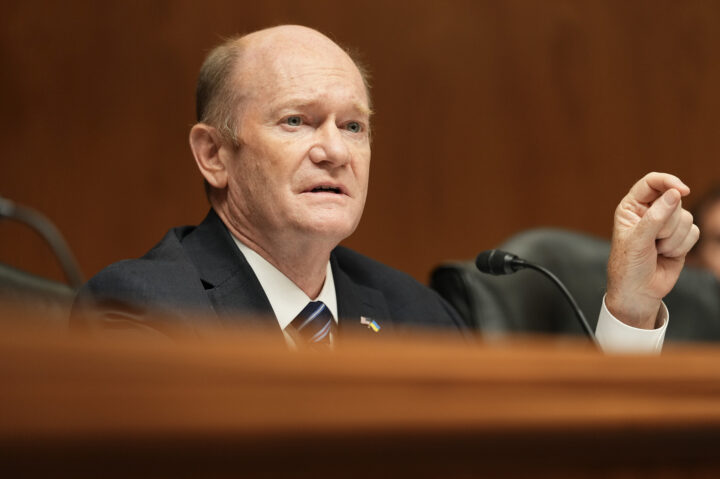
Sen. Chris Coons (D-DE) speaks at the Senate Appropriations Committee on Capitol Hill on July 14, 2026 in Washington, DC.


 Add JewishInsider on Google
If Democrats take control of Congress next year — or even if they win back a majority in only the House of Representatives — expect a legislative agenda that’s a lot tougher on Israel than it has been in a long time.
With growing support among House Democrats for legislation restricting U.S. aid and arms sales to Israel, bills such as the Block the Bombs Act, the Ceasefire Compliance Act or measures similar to this summer’s vote on cutting aid to Israel could come to the House floor, and continued fights over the U.S.-Israel relationship in funding bills and other legislation seem likely.
But the top target for senior Democrats at the moment is targeting settlement activity and settler violence in the West Bank. Asked by Jewish Insider at a press conference on Wednesday what Israel-related legislation Democrats might bring forward for a vote, House Minority Leader Hakeem Jeffries (D-NY) — who has generally been a reliable supporter of the U.S.-Israel relationship — pointed to a bill imposing sanctions related to West Bank violence.
“That now has broad support across the House Democratic Caucus family [and] is certainly a legislative step that should be considered in order to push back aggressively against the out of control settler violence in the West Bank,” Jeffries told Jewish Insider. “That cannot continue.”
Responding to JI's @marcrod97, Hakeem Jeffries suggested the West Bank Violence Prevention Act — which seeks to curb settler violence by imposing sanctions on perpetrators and potentially Israeli officials — could be up for a vote next year should Democrats take back the House. pic.twitter.com/2S8upRRz37
— Jewish Insider (@jewishinsider) September 23, 2026
The West Bank Violence Prevention Act would reimplement the West Bank sanctions regime established by the Biden administration and repealed by the Trump administration, which sought to penalize Israeli settlers who commit acts of violence. But the legislation also clearly targets members of the Israeli government connected to or who have permitted settler violence, as well as others who have provided support for such activities, a step the Biden administration never took.
The bill has 173 total co-sponsors — more than any other Israel-related Democratic bill introduced this Congress. Its supporters include all top House Democratic leaders, as well as the leaders of several key committees and even several moderate pro-Israel lawmakers.
There’s similar movement on West Bank issues on the Senate side. Sen. Chris Coons (D-DE), generally a strong ally of Israel who is in line to chair the Senate Foreign Relations Committee if Democrats take the upper chamber, introduced a bill on Wednesday with nearly 20 colleagues to sanction companies, financial institutions and Israeli officials involved in settlement construction in the controversial E1 area of the West Bank, which critics say would sever the West Bank from east Jerusalem.
And a separate Senate measure demanding a report on violence in the West Bank and the killings of U.S. citizens by Israeli settlers and security forces — which could trigger the cut-off of U.S. aid to Israel — picked up more than 20 co-sponsors, including Sen. Richard Blumenthal (D-CT), generally a strong supporter of the Jewish state.
Also among those expected to hold positions of power Rep. Greg Meeks (D-NY), who is in line to chair the House Foreign Affairs Committee, recently announced a hold on a $2.8 billion sale of bombs to Israel, financed by U.S. foreign military funding.
From their anticipated committee leadership posts, Coons and Meeks would hold significant sway over the direction of Democratic policy on Israel and have particular power to guide hearings on and investigations into the U.S.-Israel relationship, the West Bank and more.
At the same time, Coons is one of the few Senate Democrats who have consistently opposed resolutions led by Sen. Bernie Sanders (I-VT) to halt various arms sales to Israel, and Meeks opposed the amendment led by Rep. Thomas Massie (R-KY) to cut off U.S. aid to Israel.
A Democratic-led Congress would also likely bring more of those efforts to restrict or cut off both aid and arms sales to Israel. More than 100 House Democrats, nearly half of the caucus, supported efforts to cut off U.S. aid to Israel earlier this year. In the Senate, 40 Democrats have voted for at least one of Sanders’ resolutions to halt specific arms sales to Israel, and several Democratic candidates have said they would have voted the same way.
In the House, two bills pushing for stringent conditions on U.S. arms sales to Israel have been gaining steam.
The most prominent — and most punitive — of the bills is the Block the Bombs Act, on which Congressional Progressive Caucus Chair Rep. Greg Casar (D-TX) has said his caucus would push for a floor vote in the next term.
The bill would impose unprecedented restrictions on U.S. arms sales to Israel not applied to any other U.S. ally, preventing the transfer or sale of bombs, bomb-guidance kits and tank and artillery ammunition to Israel unless Congress passes a specific law authorizing each individual sale or transfer.
Congress would be required to delineate what specific purposes for which those weapons could be used, and Israel would be asked to provide written assurances that it would comply with those restrictions. Given the gridlock on Capitol Hill and the months it would take to approve any arms sales to Israel — if they could be moved past objections from anti-Israel members at all — critics say the bill would effectively place an arms embargo on Israel for those systems.
Though the Block the Bombs Act started with just 22 co-sponsors in 2025, it has grown to 82, including a handful of more moderate Democrats, a number that is likely to grow further after the midterms, with numerous expected Democratic freshmen pledging on the campaign trail to support the bill.
Alternative measures have been introduced to condition U.S. arms sales to the Jewish state, including the Ceasefire Compliance Act, led by Rep. Sean Casten (D-IL), with 53 co-sponsors. That bill would cut off any arms transfers or sales to Israel if it conducts any strikes inside Gaza, which could only be restored subject to a specific agreement by Israel that it will not use any U.S.-origin weapons inside Gaza or the West Bank.
The legislation would also impose various other conditions on arms sales to Israel related to compliance with the 20-point peace plan for Gaza, the establishment of Palestinian Authority governance in Gaza and steps to prevent West Bank violence or annexation.
Casten’s bill is backed by J Street, the progressive Israel advocacy group that Democratic leaders have increasingly leaned on as a validator on Israel policy issues, such as during the debate in the caucus over the Massie amendment (which J Street opposed).
Speaking broadly, Jeffries told JI that Democrats’ policy should be “anchored in two different principles”: supporting “Israel’s right to exist as a Jewish and democratic state” alongside a peaceful and prosperous Palestinian state to provide “the Palestinian people … the dignity and self-determination that they long deserved.”
Also worth watching: the next U.S.-Israel memorandum of understanding on military aid is set to be finalized during the next Congress. Expect real fights on the Hill, under Democratic leadership, over whether to continue appropriating funding for military aid to Israel and even over the future of U.S.-Israel cooperative military programs in legislation like the National Defense Authorization Act.
Whether negotiators believe that further aid to Israel would actually be passed by a hostile Congress could also be a factor that shapes the MOU itself.
Democratic control of either chamber is also likely to further fuel fights over the future of the U.S. relationship with the United Nations Relief and Works Agency, which were a repeated battle in the divided Congress in 2024.
This term, 79 House Democrats introduced legislation to restore funding to the scandal-plagued agency, including Rep. Rosa DeLauro (D-CT), who is likely to chair the House Appropriations Committee in the upcoming term if the Democrats win back the House.
The morning after his congressional victories, the mayor hinted at how he’ll wield his new democratic socialist bloc
Michael M. Santiago/Getty Images
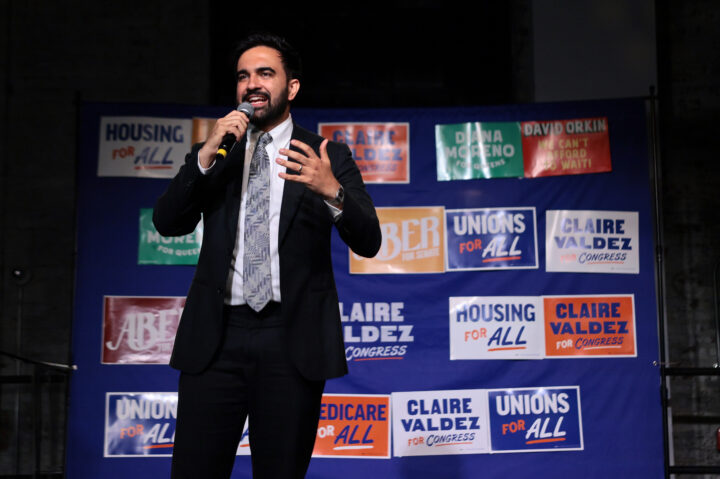
New York City Mayor Zohran Mamdani speaks during a primary-night watch party for NYC congressional candidate Claire Valdez on June 23, 2026.
Having conquered New York City with a stunning primary night sweep on Tuesday, Mayor Zohran Mamdani is wasting no time in moving on Capitol Hill.
In an uncharacteristically long question-and-answer session at an unrelated announcement on Wednesday, the mayor — having deposed two congressional incumbents in Reps. Dan Goldman (D-NY) and Adriano Espaillat (D-NY) and installed his favored candidate in the seat of retiring Rep. Nydia Velazquez (D-NY) — announced he would sit down later in the day with House Minority Leader Hakeem Jeffries (D-NY).
Jeffries is a longtime critic of Mamdani’s Democratic Socialists of America, and attempted unsuccessfully to rally last-minute support for Espaillat.
The mayor nonetheless kept his comments civil and conciliatory for the potential future speaker of the House. Despite endorsing challengers against two Democratic lawmakers, Mamdani blocked a DSA ally from running against Jeffries in this year’s primary.
“I’ll be speaking with Congressman Jeffries later today, and I’m looking forward to working with Congressman Jeffries on delivering for the people of our city,” the mayor told reporters. “What we saw last night was a hunger for leaders who will be there on the front lines.”
Mamdani stuck mostly to his usual rhetoric about affordability, but noted former City Comptroller Brad Lander — who defeated Goldman — had committed to supporting the Block the Bombs Act cutting off military aid to Israel.
Jeffries, for his part, had less favorable remarks for Mamdani, alluding to the distrust his endorsements engendered with himself and the rest of the delegation.
“He’s got work to do in terms of the conversations that he’s going to have with members of Congress moving forward,” the Democratic leader told reporters, saying he and the mayor “agree to strongly disagree about some of his endorsements.”
Lander has committed to backing Jeffries for speaker, as has another candidate who triumphed last night: Assemblymember Micah Lasher, the establishment-backed successor to Rep. Jerry Nadler (D-NY). Mamdani stayed aloof from the contentious and costly race for the Manhattan district, which boasts a large and progressive Jewish population, but Lasher enlisted the skills of Morris Katz, the mayor’s closest political advisor.
Pressed by Jewish Insider at his election party Tuesday night as to whether he would look to the mayor or to Jeffries for leadership, Lasher answered: “I expect Hakeem Jeffries will be the leader of the House caucus.”
JCRC of Greater Washington CEO Ron Halber: ‘It’s difficult when two-thirds of our community is voting for a political party whose base is hostile to Israel’
Jemal Countess/Getty Images for Court Accountability
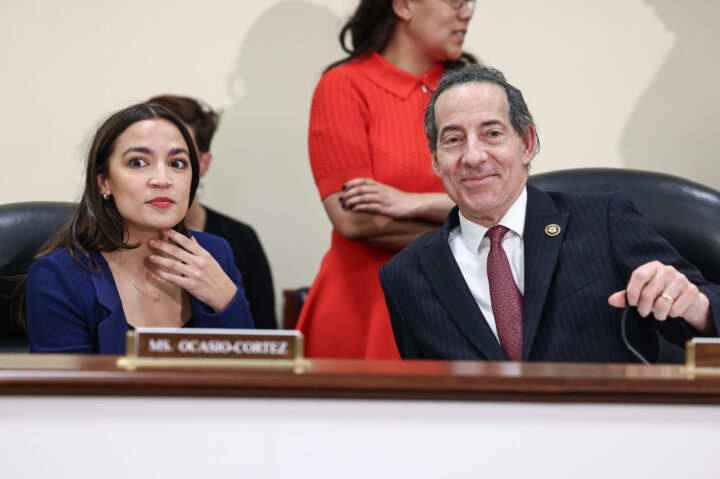
Rep. Jamie Raskin (D-MD) chats before a roundtable discussion on Supreme Court Ethics conducted by Democrats of the House Oversight and Accountability Committee at the Rayburn House Office Building on June 11, 2024 in Washington, DC.
Ron Halber, the CEO of the Jewish Community Relations Council of Greater Washington, strongly criticized Rep. Jamie Raskin (D-MD) over his recent decision to support legislation that seeks to severely restrict U.S. aid to Israel, casting the congressman’s move as part of a troubling pattern that has sparked concern among pro-Israel activists in his Maryland district.
“Jamie’s signing on that legislation was extremely disappointing,” Halber said in an interview with Jewish Insider on Tuesday, referring to the Block the Bombs Act, a bill led by far-left lawmakers that would place unprecedented new conditions on U.S. weapons transfers to Israel.
Raskin, who became a co-sponsor of the bill earlier this month, has not issued any statement regarding his decision.
“It unfortunately follows his signing on to other similar letters and a vote against additional arms to Israel last year, which really raised a lot of people’s eyebrows,” Halber, who said he considers Raskin a friend, told JI.
Halber said that he had spoken with Raskin, one of the most prominent progressive Jewish lawmakers in Congress, three times over the last two days, asking him to withdraw his name from the bill and instead issue a statement expressing the concerns about the war in Gaza that had motivated him to back the controversial legislation.
Raskin said he would be considering the request and indicated he was “not opposed to Israel using arms in other theaters” outside of Gaza, according to Halber, who described “a very honest and frank conversation” about the bill, which was introduced in May in response to the worsening humanitarian crisis in the war-torn enclave.
While he acknowledged that Raskin is “pulled by both being a leader of the Progressive Caucus and by his own progressive Zionism,” Halber said that the legislation represents “a bridge too far” for the pro-Israel community. The bill effectively amounts to an arms embargo on Israel, he said, arguing that it “seeks to unilaterally disarm one of our closest allies” as Israel defends itself on multiple fronts.
“I’m hoping that Jamie will take his name off the bill and use a statement to express his concerns,” Halber told JI, noting that the congressman has also fielded messages from several Jewish leaders leaders in his Montgomery County district who have aired objections. “If he doesn’t, we will be disappointed, but that’s his decision to make and he has to live with the ramifications of his decision,” Halber added. “I don’t see how that helps him.”
Natalie Krute, a spokesperson for Raskin, declined multiple requests for comment about his decision to back the bill, and did not immediately respond to JI on Tuesday regarding his recent conversations with Halber.
Halber’s private engagement with Raskin, who joined 32 other lawmakers in supporting the bill, underscores the challenges that mainstream Jewish groups are now facing as even some of the most reliable defenders of Israel in the Democratic Party shift away from reflexively backing the Jewish state, amid growing outrage over the crisis in Gaza.
“It’s difficult when two-thirds of our community is voting for a political party whose base is hostile to Israel,” Halber said of the waning support for Israel among Democrats. “I think a lot of my colleagues are also finding this a very difficult era,” he added.
Halber said he had also recently spoken with Sen. Angela Alsobrooks (D-MD) after she faced scrutiny from Jewish leaders this month for voting in favor of Sen. Bernie Sanders’ (I-VT) resolutions to block some U.S. arms sales to Israel, despite vowing to oppose such efforts during her Senate campaign last year.
“I’m convinced that her vote was more about sending a message of moral outrage to the Israeli government about the number of children who are malnourished in Gaza,” he said of their discussion, adding he was “a little more forgiving” in assessing her decision because it had coincided with a surge of media coverage about the humanitarian crisis in Gaza.
Alsobrooks was among 27 Senate Democrats, the majority of the caucus, who voted earlier this month to block shipments of U.S. aid to Israel — marking a dramatic turn against the Jewish state for the party. “While I didn’t like that Democratic senators voted” for the resolutions, “it was understandable, and they knew it wasn’t going to pass,” Halber said on Tuesday. “The question is, if it was going to pass would they have supported it — and I hope not.”
Even as the Block the Bombs bill is also not expected to pass, Halber indicated that he viewed Raskin’s move as a more egregious offense, calling it a “safe way” to register discontent with Israel’s conduct in Gaza that nevertheless “went too far” for his heavily Jewish district.
“Obviously, he’s trying to maintain a leadership position within the House Progressive Caucus,” Halber said of the congressman’s thinking. But on his home turf, “there are a lot of” constituents who do not support imposing sweeping new conditions on Israel, he told JI.
Still, Halber suggested that his lobbying to convince Raskin to withdraw his name from the bill is part of a broader effort to “push back against” the growing influence of what he called the “radical left,” whose views on Middle East policy he described as a “huge danger” to Israel’s continued security in the region.
“Once the war comes to an end, the whole Jewish community is going to have to re-strategize,” Halber said of the challenges ahead as his organization and others like it reckon with their traditional approach to engaging on such issues. “We have a lot of work to do with young people and with Democrats and independents.”
The war in Gaza “is going to impact Israel’s image for years to come,” Halber predicted. “Hopefully, once the media isn’t covering it every day, we can provide more context about what happened” and help “rebuild” Israel’s reputation among skeptical voters.
One of the most visible and well-known progressive Jewish lawmakers in Congress became a cosponsor of the ‘Block the Bombs Act’
Annabelle Gordon/Bloomberg via Getty Images
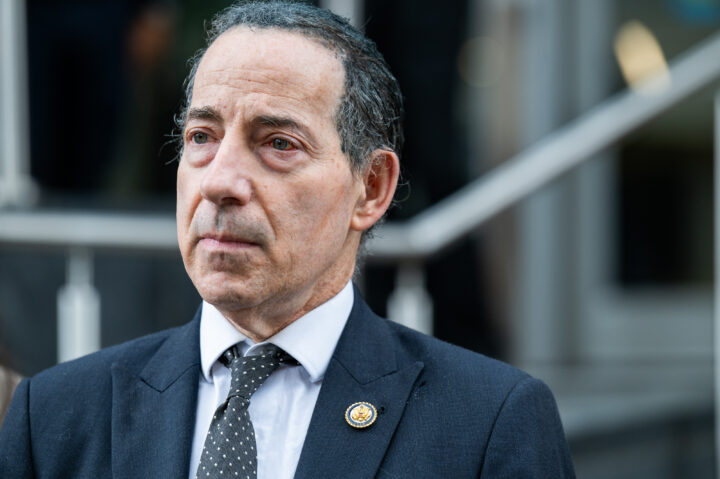
Rep. Jamie Raskin (D-MD) during a news conference in Washington, D.C., on Thursday, May 22, 2025.
Rep. Jamie Raskin (D-MD), one of the most visible and well-known progressive Jewish lawmakers in Congress, last week became a cosponsor of the “Block the Bombs Act,” a bill led by far-left lawmakers that aims to severely restrict U.S. aid to Israel.
The bill would impose unprecedented new conditions on weapons sales or transfers to Israel, requiring specific congressional authorization for each individual transfer of various weapons systems, and would require Congress to identify specific purposes for which those weapons would be used.
Critics say that it would effectively constitute an arms embargo for the key weapons in question.
Raskin has not issued any statement on his support for the bill, which aligns him with some of the most anti-Israel members of the House. Currently, 32 other lawmakers are cosponsoring the legislation, but Raskin, the ranking member of the House Judiciary Committee, is among the most recognizable sponsors.
Three other progressive Jewish House members, Reps. Sara Jacobs (D-CA), Becca Balint (D-VT) and Jan Schakowsky (D-IL) are also backing the bill.
Raskin’s suburban Maryland district has a sizable Jewish population.
Raskin’s support for the bill adds to a growing record of similar positions since the Oct. 7, 2023 Hamas attack on Israel, including voting against supplemental aid to Israel last year and signing onto a letter calling for the U.S. to withhold offensive arms transfers to Israel after a 2024 strike that killed World Central Kitchen aid workers.
He also joined a letter accusing Israel of violating U.S. arms sales law, which would require the U.S. to cut off aid, and another one arguing that Israeli operations in Rafah would violate U.S. arms sales policy.
In addition, Raskin led an effort to restore U.S. funding to the United Nations Relief and Works Agency.
The Maryland Congressman called for a ceasefire between Israel and Hamas on Nov. 17, 2023.
Raskin also flipped earlier this year against the Antisemitism Awareness Act, after supporting it last year, calling it part of “Trump’s transparent moves to undermine American democracy under the banner of opposing antisemitism.” The legislation predates Trump’s time in office.
He was a vocal defender of Columbia University protest leader Mahmoud Khalil, co-leading a letter which made no mention of Khalil’s alleged involvement with antisemitic and pro-Hamas activity.
At the same time, Raskin has continued to speak out against antisemitism and for the release of the hostages in Gaza.
Please log in if you already have a subscription, or subscribe to access the latest updates.
 Continue with Google

 Continue with Apple