












A new exhibition at the Upper East Side synagogue uses paintings of everyday Jewish life to explore nostalgia and identity as Jewish artists increasingly feel unwelcome in cultural spaces
Haley Cohen
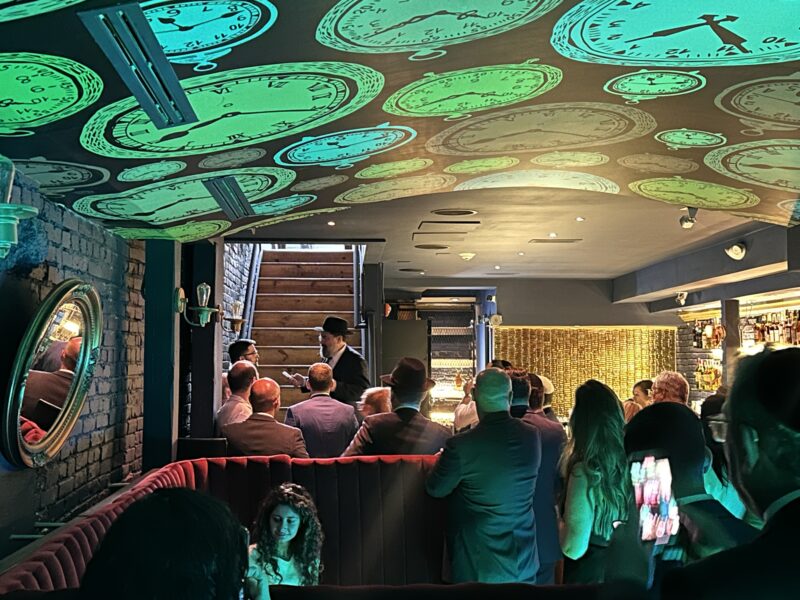
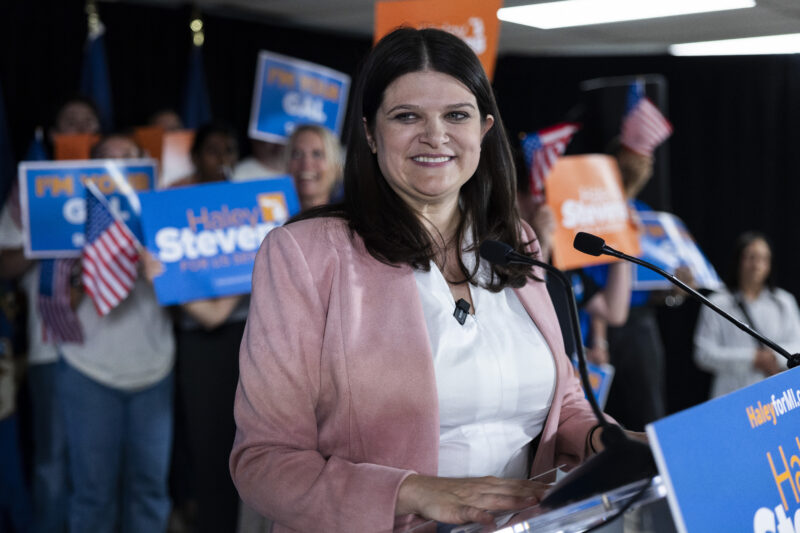
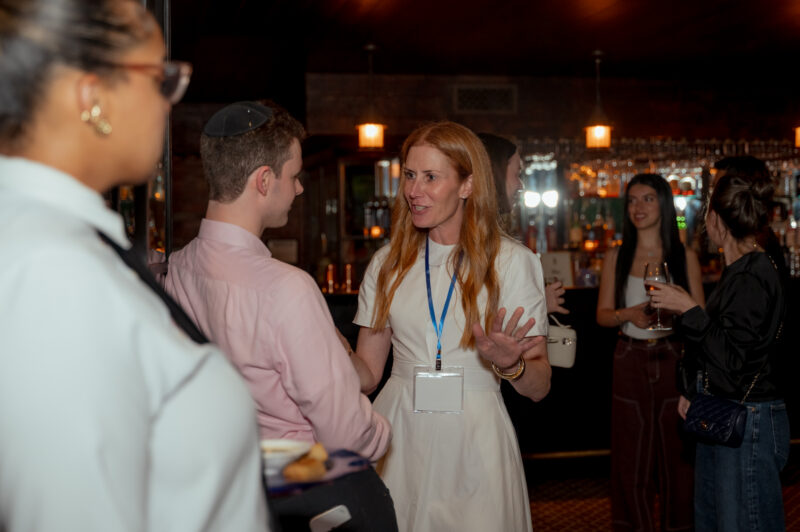
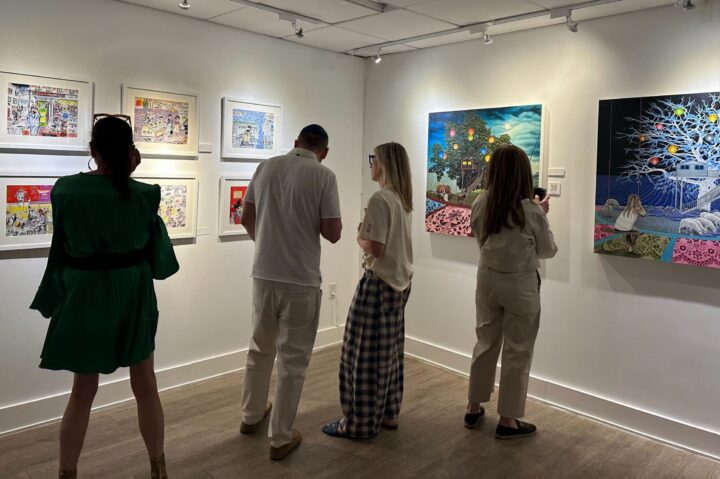
Opening night of "Golden Age: Nostalgia for the American Jewish Century" at Altneu in Manhattan.


 Add JewishInsider on Google
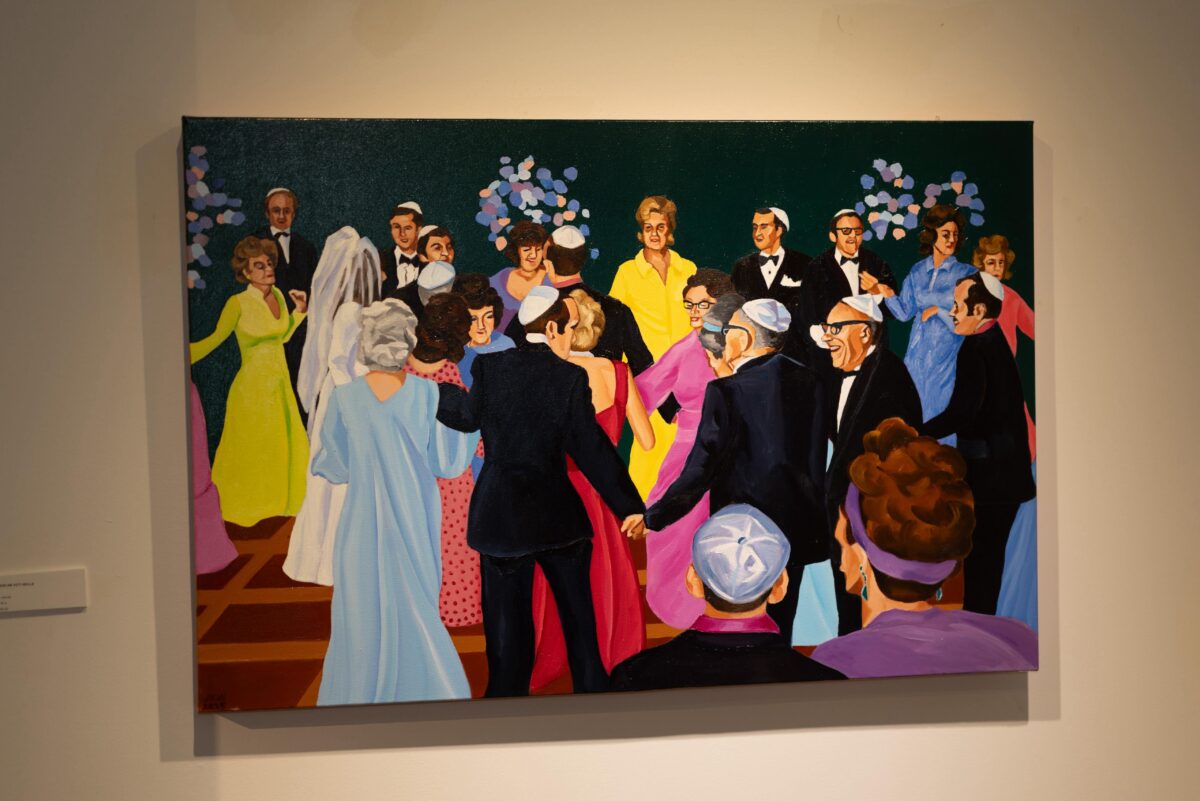
Four friends gather around a table as a waiter serves a tray of pastrami sandwiches; a Torah scroll is passed from grandfather to father and son, marking a bar mitzvah; three grandmothers sit on lawn chairs outside of a brownstone, watching passersby on a summer night.
These candid glimpses of ordinary American Jewish life, part of a new art exhibition, “Golden Age: Nostalgia for the American Jewish Century” — currently on display at the Altneu, an Upper East Side Orthodox synagogue — evoke a bygone era, before today’s historic rise in antisemitism.
“I grew up in the golden age [of North American Jewry], the ’70s, ’80s and ’90s. It was an easy time,” Jacqueline Kott-Wolle, one of the seven artists whose work is highlighted in the exhibit, told Jewish Insider on Wednesday at an event to mark the gallery’s opening. “My memories of growing up Jewish [in Toronto] were very positive. Everybody was Jewish — even the people at my high school who weren’t Jewish were Jewish. It was a good time to be alive. [Today,] antisemitism slammed into us so hard. It shocked us.”
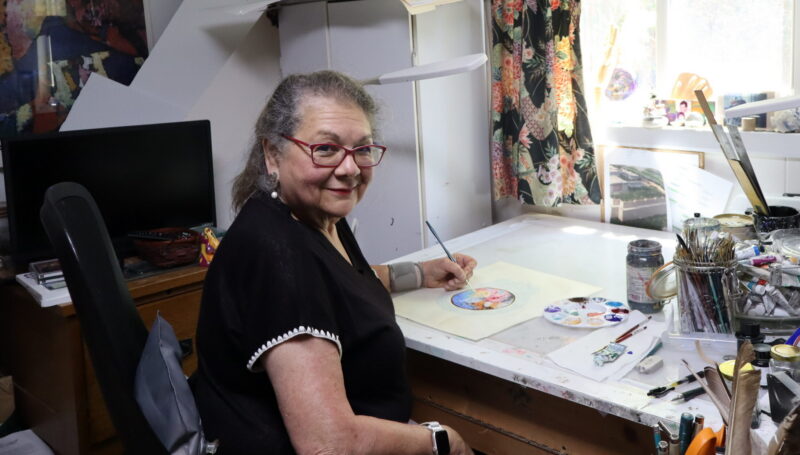
Kott-Wolle, who is based in Highland Park, Ill., and is the daughter of Holocaust survivors, said her oil paintings “represent the height of that time period, when we were very comfortable being Jewish.” The artwork, she said, evokes memories of the “Golden Age of American Jews,” which a 2024 piece in The Atlantic claimed is ending due to antisemitism stemming from both the left and right.
In addition to her six paintings displayed in the exhibit, Kott-Wolle has a larger exhibit called “Growing Up Jewish – Art and Storytelling.” The series of 40 paintings illustrates five generations of her family photos, which have been exhibited in the Maltz Museum in Cleveland and Houston Holocaust Museum.
“[The paintings] are playful and fun, and they make us feel a little more nostalgic for something that we think or worry might be lost,” she told JI, noting that displaying her work in a synagogue is a unique experience.
“The paintings resonate everywhere, but differently,” she said. “I find Jewish audiences recognize it immediately. I can’t tell you how many times someone will come up to me and say, ‘I love this painting and how come my mom is in it?’”
In more mainstream settings, her art has also been widely embraced, she said. “It’s like our Jewish faces have been beaming into people’s TV screens forever. Our faces are familiar, so non-Jewish audiences also respond, but in a different way. Still in a very loving and receptive way.”
But amid the highest levels of antisemitism seen in generations following the Oct. 7, 2023, terrorist attacks in Israel and the ensuing war in Gaza, many Jewish and Israeli artists no longer feel their work is welcome in non-Jewish spaces. Located in the basement of the Altneu synagogue — a Tudor Revival townhouse on East 70th Street — the new exhibit directly responds to that exclusion, according to curator Anne-Marie Helwaser and co-chairs Diana Gordon and Avital Chizhik-Goldschmidt, who is also Altneu’s rebbetzin.
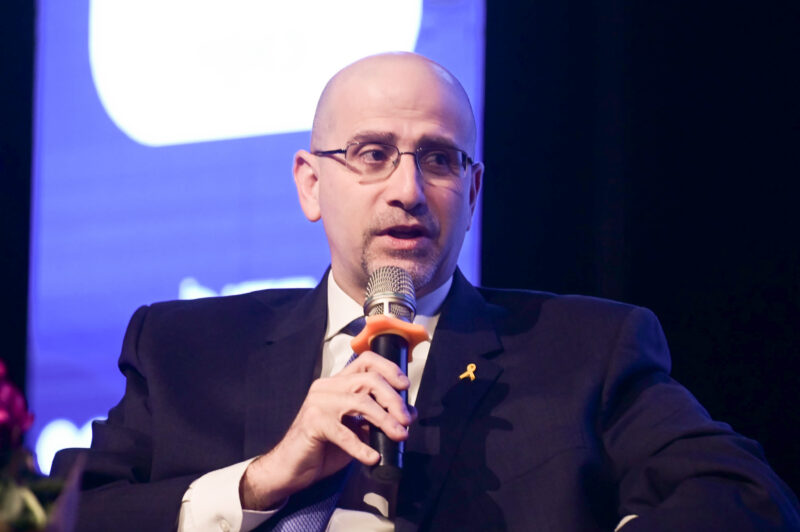
“At a moment when openly Jewish artists are facing growing barriers in cultural spaces, we are doubling down on Jewish creativity by giving space and visibility to strongly Jewish [and] Israeli emerging art, in the heart of the Upper East Side,” said Chizhik-Goldschmidt who founded Altneu in 2022 together with her husband, Rabbi Benjamin Goldschmidt.
“On a deeper level, there is a spiritual component too. Visual arts is a powerful connection point for people; in the words of Rav Kook, ‘Literature and art are positioned to express the deepest of secrets hidden within the soul.’ We believe it’s an important part of our spiritual experience, to be moved, to feel a stirring in the soul when seeing a particularly evocative piece of work,” she told JI.
“As the Altneu grew, I dreamt of people coming to an Orthodox synagogue for a contemporary art show, and for those two pieces to feel utterly organic together,” said Chizhik-Goldschmidt, who recalled growing up in the halls of New York’s museums, the granddaughter of a passionate art historian and tour guide.
“It was a major part of my upbringing, as a child of Soviet Jewish immigrants,” she told JI. “The arts were the only kind of spirituality that Jews had access to in the USSR. Now, we are blessed to be able to combine this with a sanctuary space.”
This is the fourth art exhibit the Altneu has hosted. Until now, the synagogue has focused on Israeli artists. However, the conflict with Iran made the logistics of securing their artwork nearly impossible in time for this exhibit.
The idea first came about “at a fragile moment,” said Helwaser, director of the Helwaser Gallery on Madison Avenue.
On a trip to Israel soon after Oct. 7, she recalled being moved by an exhibition by one artist who was an IDF soldier.
“He came back [from war] and started painting,” she said. “I talked to my friend, [Altneu community leader] Diana [Gordon], and thought we should show the images. We created — very improvised — an exhibition here. People responded really well.”
Once the organizers realized the Iran war would make it a challenge to bring Israeli art, they issued an open call for American Jewish artists, and the resulting meetings sparked the idea to highlight this different political moment.
“Hundreds of artists responded. I selected maybe 20 and we met with them and chose seven.
In different ways, all the selected artists were asking the same question: what does it mean to be Jewish today in America? It’s something we are concerned about,” Helwaser continued.
Asked why she displayed the art at Altneu instead of her own gallery, Helwaser admitted she never expected to curate for a synagogue. She explained that unlike gallery visitors, this audience comes for the story and to connect with the artists rather than just the art.
“We don’t need Altneu for art, we have the best galleries in the world in New York,” she continued. “[Visitors] want to talk about what it is to be Jewish. Art is a nice way to do that.”
“It’s not easy [to show Israeli artwork] in New York City galleries now,” said Helwaser. “I would do it but I’d be worried. In London, you wouldn’t be able to do it. Israeli artists here [are afraid] to be shown as Israeli.”
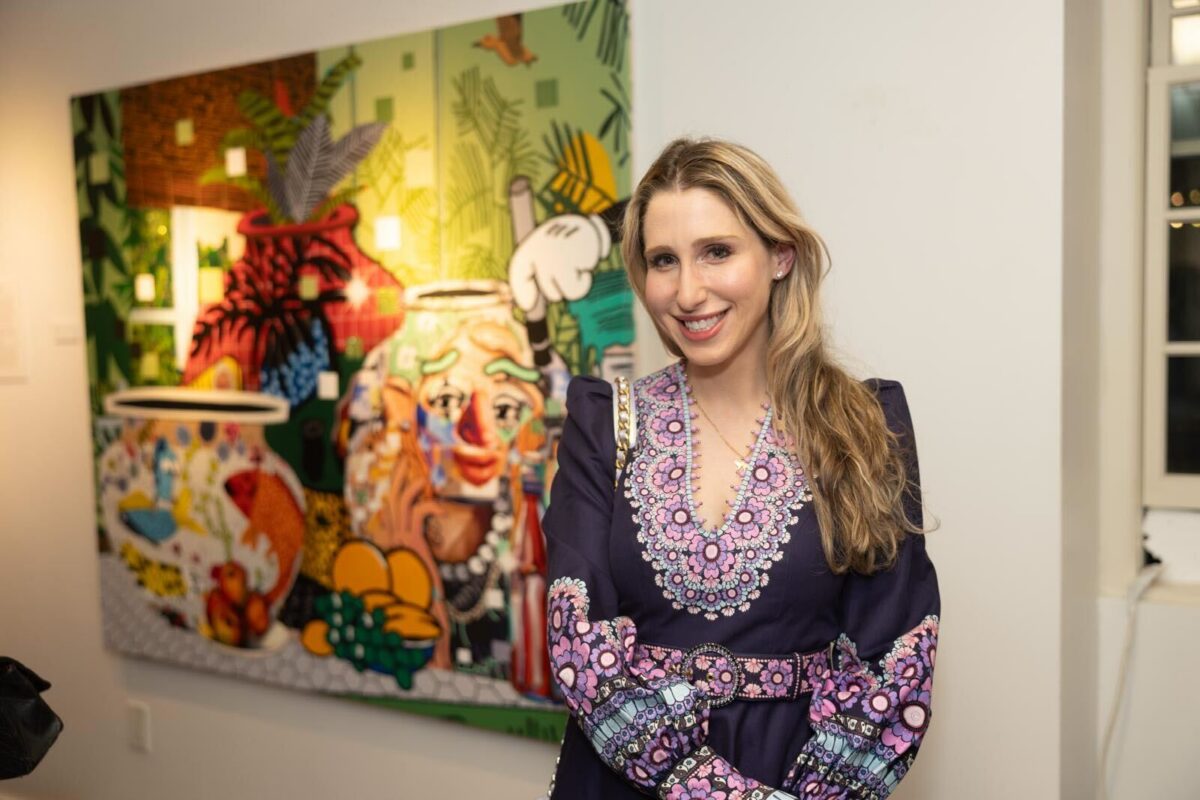
In addition to Kott-Wolle, participating artists are: Rotem Amizur, Nicole Gordon, Noa Ironic, Alan Richards, Ephraim Wuensch and Allison Zuckerman.
Paintings are priced between $600- $52,000. Many of the buyers are not Jewish, according to Helwaser. The exhibit is scheduled to run until July 6.
The opening night brought a diverse crowd of Jews together, including many newcomers to the synagogue — from those wearing black yarmulkes and sheitels to others sporting piercings and tattoos. “That’s the beauty of Manhattan, and of the Altneu as a gathering point. It goes beyond denomination,” said Chizhik-Goldschmidt.
The artwork appears to be resonating. At the debut, one guest was overheard gesturing toward a painting and remarking to a friend, “This is nostalgia for me. This is exactly how American grandmothers looked when I was growing up.”
'Please do not think about us only as a headline,' father pleads

Maya Alleruzzo/AP Photo
Relatives of U.S. citizens that are missing since Saturday's surprise attack by Hamas militants near the Gaza border, in Tel Aviv, Israel attend a news conference on Tuesday, Oct. 10, 2023 in Tel Aviv, Israel. Seated from left: Jonathan Dekel-Chen, father of Sagui Dekel-Chen (35) from Nahal Oz; Ruby Chen, father of Itay Chen, 19, a soldier in the armored corps; Ayala Neta, daughter, and Nahal Neta, son of Adrienne Neta, 66, a nurse living in Kibbitz Be'eri; Rachel Goldberg, mother of Hersh Goldberg-Polin, 23, who was attending the music festival, and Jonathan Polin, Hersh's father.
A nurse and midwife who has delivered more than 1,000 babies. A soldier who swapped weekend shifts so that he could attend his brother’s bar mitzvah. A young man attending an outdoor rave with friends. A father awaiting the birth of his third child.
The families of four American citizens who believe their loved ones are being held by Hamas in Gaza gathered in Tel Aviv on Tuesday afternoon to deliver a public, emotion-laden plea to both the Israeli and American governments, neither of which, relatives say, have provided adequate support or information about their family members.
On Tuesday afternoon, National Security Advisor Jake Sullivan said that 20 or more Americans remain unaccounted for. A National Security Council spokesperson confirmed on Monday that at least 11 American citizens have been killed in the attacks.
On Tuesday afternoon, following a phone call with Israeli Prime Minister Benjamin Netanyahu and Vice President Kamala Harris, President Joe Biden said he had “directed my team to share intelligence and deploy experts from across the United States Government to consult with and advise Israeli counterparts and hostage recovery efforts. Because as president, I have no higher priority than the safety of Americans being held hostage around the world.”
Rachel Goldberg, who grew up in Chicago and now lives in Jerusalem, last heard from her son, Hersh Goldberg-Polin, on Saturday morning. Goldberghad turned her phone off on Friday evening as the sunset ushered in Shabbat and Simchat Torah. After a siren alerted her to a rocket attack near Jerusalem on Saturday morning, she turned on her phone, concerned about Hersh, who was attending the Tribe of Nova music festival near Kibbutz Re’im.
“I turned my phone on, I believe, at 8:23 in the morning,” Goldberg said. “And when I turned it on, there were two texts in a row from Hersh at 8:11. The first one said, ‘I love you’ and immediately at 8:11 also it said, ‘I’m sorry.’ And so I knew immediately wherever he was, it was a terrible situation.”
Goldberg identified her son, whom she has not heard from since, in a photo taken inside a bomb shelter. In collecting eyewitness accounts, she said, she learned that Hersh had been injured in a firefight.
“They were fish in a barrel sitting in this bomb shelter,” Goldberg explained. “Terrorists came to the door, they were throwing grenades in, shooting machine guns, and we know that Hirsch’s arm from the elbow down was severed, was blown off, and that he tied a tourniquet around with his shirt.” She has not received any further information about her son’s whereabouts.
Goldberg was joined by the families of Itay Chen, Sagui Dekel-Chen (who is not related to Itay) and Adrienne Neta, whose son, Nahar Neta, issued a plea to President Joe Biden and Secretary of State Tony Blinken. The administration, Neta said, is “responsible to bring the U.S. citizens back home safe and sound. We expect nothing less from the U.S. administration and from President Biden and Secretary of State Blinken.”
Adrienne Neta is a California-born nurse and midwife who moved to Israel in 1981. She lived for decades on Kibbutz Be’eri, one of the deadliest sites of Saturday’s attack. When Hamas terrorists invaded the kibbutz, her children said, she was sitting on her patio on the phone. It was roughly 9:30 a.m. “Both my brother and my sister were on the call with her as the terrorist barged into her home, and we heard a little bit of screaming and that was our last contact with her,” her son Nahar Neta said. “There was no shooting on the call.”
His mother, Neta added, tried to use the limited Arabic she had picked up as a longtime nurse at Soroka Hospital to communicate with her captors.
A half-hour’s drive from Neta’s Kibbutz Be’eri sits Kibbutz Nahal Oz, which is where 35-year-old Sagui Dekel-Chen was taken hostage as he and other men on the kibbutz attempted to overpower the terrorists who had infiltrated the property. Dekel-Chen’s wife is pregnant with the couple’s third daughter.
Of the roughly 400 residents of the kibbutz, Sagui’s father, Jonathan Dekel-Chen, said, more than half have been killed or taken hostage. The roughly 160 survivors, the elder Dekel-Chen said, “call this a pogrom.”
“What happened to us, it’s not a war,” he said. “It’s not a fair fight. It is a pogrom. Hundreds of heavily armed, well-organized terrorists walked, rode, ran over the border with one object in mind: and that was to kill, maim, to destroy civilian life along the border.”
“As such,” he continued, “it seems to me that the United States, my original home, and still a very beloved place for me, always wants to be and must be on the side of good.” He called on the “United States government, to the Congress, to do what they can on the side of good here. We’re waiting for Sagui to come home.”
Rubi Chen, whose son Itay was captured while on duty, said he has connected with about 10 other families who are missing a relative with American citizenship following Saturday’s ambush.
Itay Chen had not been scheduled to be on duty the weekend of the attack. His younger brother’s bar mitzvah was the following weekend, when he had been originally scheduled to report for duty. Itay had traded weekend shifts so that he could be a part of his family’s celebrations.
Rubi Chen said the IDF had informed the family that Itay was listed as missing in action.
“You would think it would be a good assumption to say that after 70 hours, if he’s not in the State of Israel, he might be some other place. If that is the case, then he is by definition a POW.” Chen called for his son to be treated as a POW according to international law.
Chen said he had been in contact with the State Department and the U.S. Embassy in Jerusalem, but that he has received few answers as to his son’s whereabouts and any plans to rescue the hostages. There has “been no formal or concentrated attempt to talk to us as a group and update us about what they are doing in this matter,” Chen said on Tuesday.
“Please do not think of us only as a headline,” Rubi Chen pleaded. “We are more than that.”
Please log in if you already have a subscription, or subscribe to access the latest updates.
 Continue with Google
 Continue with Apple