












































































David Axelrod downplays DSA ascendance within Democratic Party
The former Obama advisor argued at the Jewish Federations of North America that Democrats won on affordability rather than focusing on Israel issues
Jewish Federations of North America
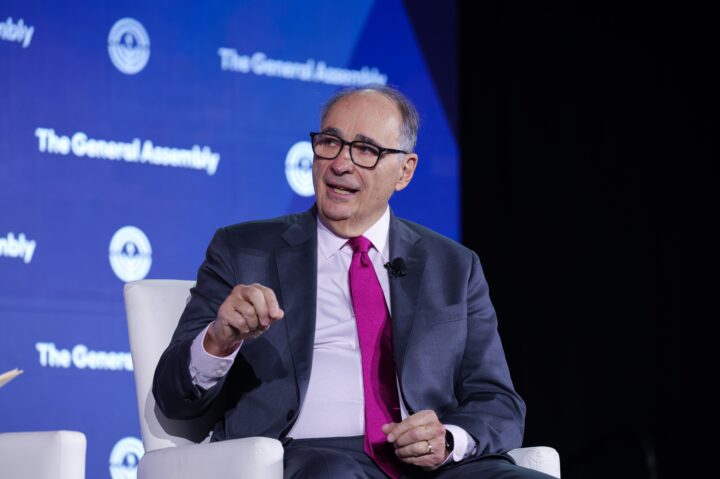
David Axelrod speaks at the Jewish Federations of North America's General Assembly on Nov. 10, 2026.


 Add JewishInsider on Google
David Axelrod, the longtime Democratic strategist and former senior advisor to President Barack Obama, downplayed concerns on Tuesday that the Democratic Socialists of America could take over the Democratic Party, arguing that progressive candidates such as New York City Mayor Zohran Mamdani won primarily on economic issues rather than opposition to Israel.
Speaking at the Jewish Federations of North America’s annual General Assembly in Washington, Axelrod said the newly elected Democratic congressional caucus would give House Minority Leader Hakeem Jeffries (D-NY) sufficient room to prevent the party’s progressive wing from dominating its agenda.
“I want to quell some of these concerns because I don’t think that’s where the Democratic Party is going,” Axelrod said. “I don’t think that we’re on the verge of a kind of DSA takeover of the Democratic Party.”
Axelrod argued that Mamdani and other progressive candidates had seen success due to their focus on affordability and economic concerns rather than campaigning primarily on their positions toward Israel. “They ran around their views on Israel, and they got elected,” he said, adding that the incoming Democratic caucus would be geographically and ideologically diverse.
Eliana Johnson, editor-in-chief of The Washington Free Beacon, speaking alongside Axelrod, challenged his assessment, pointing to Mamdani’s role in helping elect three far-left New York City congressional candidates — Brad Lander, Darializa Avila Chevalier and Claire Valdez — two of whom are members of the DSA.
“If David’s going to tamp down the concerns, I’ll amp them up a little bit,” Johnson said. She argued that opposition to Israel had become a prerequisite for candidates seeking support from the party’s progressive wing, saying that “the ticket to entry” to DSA politics appeared to be “a loathing of the State of Israel.”
Johnson also pointed to the election of Abdul El-Sayed to the Senate in Michigan, arguing that he and Mamdani had not moderated their views on Israel to win office. She warned that the growing number of anti-Israel lawmakers could influence the Democratic Party’s direction even without constituting a majority of its congressional caucus.
Axelrod acknowledged concerns about the relationship between anti-Zionism and antisemitism, calling their convergence “deeply, deeply troubling,” but maintained that hostility toward Israel was a problem confronting both political parties rather than Democrats alone.
He also argued that declining support for Israel among younger Americans was partly rooted in criticism of how Israel conducted the war in Gaza. “As a Jew, I don’t say Israel right or wrong,” Axelrod said. “Israel certainly had a right to defend itself. How it did it, I think, is a fair discussion to have.”
More Stories
MAJORITY RULES
Democratic sweep raises questions for U.S.-Israel ties and Iran war
analysis
Vance’s post-election political dance underscores his 2028 vulnerabilities

PENTAGON SHOWDOWN
Hegseth accuses Massie of carrying out personal vendetta in impeachment effort

LEADING THE PACK
Rebeca Grynspan gains ground in latest U.N. secretary-general straw poll
ROCKY START
Rep.-elect Chris Rabb’s silence on antisemitic protest frustrates Philly’s Jewish community

wolverine wave
Abdul El-Sayed wins Michigan Senate seat
Please log in if you already have a subscription, or subscribe to access the latest updates.
 Continue with Google

 Continue with Apple