






































































The package would face steep hurdles in the Senate, where lawmakers have already balked at the Pentagon's initial $1.5 trillion funding request

SAUL LOEB / AFP via Getty Images
Chairman of the Joint Chiefs of Staff Gen. Dan Caine speaks as a map of the Strait of Hormuz is displayed during a press briefing at the Pentagon in Washington, DC, on April 16, 2026.


 Add JewishInsider on Google
The Trump administration is planning to ask Congress to approve an $80 billion request for additional funding to replenish stockpiles and otherwise pay for the war in Iran, according to several reports.
That request comes on top of a push for a $1.15 trillion regular defense budget for 2027 as well as another $350 billion for the Pentagon that the administration wants Congress to pass through a partisan reconciliation process — a $1.5 trillion request in total that Republican lawmakers have criticized and some key Senate Republicans have described as unrealistic.
The supplemental request, too, could prove difficult to pass, requiring 60 votes in the Senate. Many Democrats declared at the outset of the war that they would refuse to pass any supplemental funding for the effort, and have further balked at the initial $1.5 trillion defense budget request.
Secretary of Defense Pete Hegseth is set to brief some House Republicans on Wednesday about the administration’s defense funding requests and the war in Iran.
Sen. Thom Tillis (R-NC) indicated he’s generally supportive of the anticipated $80 billion request, and argued that many of his colleagues could be convinced to support it if it’s primarily focused on restocking expended U.S. munitions supplies.
“It doesn’t surprise me. I think a part of what we need to do is figure out how much of that is for replenishment, that’s basically to get us the base load pre-conflict,” Tillis told Jewish Insider. “So I think the more that people spend on describing at that level, the more likely it is you’ll get support for it, and particularly if they only focus on what’s critical to get back to pre-conflict baselines. I think most members would say we got to do that.”
Sen. Mark Kelly (D-AZ), a military veteran who has generally been more moderate on defense issues than some of his more progressive colleagues, indicated he’s more skeptical of the proposal.
“I always want to make sure that the troops have what they need to do a really hard job and defend themselves especially,” Kelly said.
But, he continued, when he joined the Senate in 2022, the total defense budget was $650 billion, and the $1.5 trillion the administration is now seeking is higher than much of the rest of the world’s defense budgets combined.
He said that some of the systems the administration is asking for, such as space-based missile defense, are impractical or unneeded, “so I want to see the munitions be replaced, but let’s do it within a responsible top line of the defense bill, not this crazy, overly inflated number.”
Sen. Josh Hawley (R-MO), who had called for a prompt end to the war and has been supportive of talks with the Iranian regime, said he was withholding judgement on the supplemental request until the administration actually submits it.
Initial reports indicated the Pentagon intended to request as much as $200 billion for the war, but Pentagon officials testified last month that the costs of the war — excluding anticipated rebuilding costs of U.S. facilities in the region, came in between $20 and $30 billion.
“I don’t want to get out ahead of what the Pentagon will propose here,” Hawley said. “There’s been multiple iterations, so next week it may be something different. Let’s let them come up with something.”
The vote ended in a 212-212 tie, with two new House Republicans voting to force an end to the war

Kevin Carter/Getty Images
The U.S. Capitol Building is seen at sunset on May 31, 2025 in Washington, DC.
The House voted by the narrowest possible margin to reject Democrats’ latest effort to force an end to the war in Iran, with a final tied vote of 212-212.
Reps. Tom Barrett (R-MI) and Brian Fitzpatrick (R-PA) both voted with Democrats and Rep. Thomas Massie (R-KY) for the war powers resolution, while Rep. Jared Golden (D-ME) again voted against it.
Following the vote, an angry shout about Golden could be heard from a lawmaker on the Democratic side of the chamber. Golden said in a statement on Wednesday that he would vote for a “‘clean’ war powers resolution to remove the United States from hostilities against Iran,” pointing to a potential upcoming vote next week on a resolution by Rep. Greg Meeks (D-NY), but said that the resolution that came up for a vote on Thursday was flawed.
Wednesday’s resolution, of which Golden was an original co-sponsor, set a 30-day timeline for the war operations in Iran, a deadline which has long since passed.
“I supported this resolution when it was introduced, but unfortunately its proposed 30-day deadline lacks any real meaning now that we are more than 70 days into this conflict,” Golden said. “It no longer passes the straight-face test. I look forward to voting for a clean, relevant resolution as soon as possible.”
But, Golden continued, the “law is clear” and the administration’s “window for unilateral military engagement has closed. Hostilities, including the use of the U.S. fleet to impose a blockade of Iranian ports, cannot legally continue unless the president seeks, and wins, Congressional approval.”
Barrett and Fitzpatrick both represent swing districts, and Barrett recently introduced an Authorization for Use of Military Force to limit the U.S. operations in Iran. Should Barrett and Fitzpatrick maintain their positions and attendance otherwise remain the same, a war powers resolution could pass as early as next week.
Barrett, when he introduced the AUMF, said that he believes operations in Iran are ongoing in spite of claims to the contrary by the administration and that Congress needs to reclaim its constitutional authority over war powers.
Rep. Warren Davidson (R-OH), who voted for the first Democratic war powers resolution earlier this year and “present” on a second one in April, flipped his vote to “no” on this third effort. Davidson said he wanted to allow President Donald Trump space to negotiate and that any vote before the 90-day mark of the war would be “political.”
House progressives have gradually introduced a barrage of war powers resolutions, with the goal of potentially forcing votes as frequently as every day, meaning many more such votes are on the horizon.
The measure garnered 47 votes in the Senate, with GOP Sen. Susan Collins joining with Democrats for the first time
Kevin Carter/Getty Images
The U.S. Capitol Building is seen at sunset on May 31, 2025 in Washington, DC.
The Senate rejected for the sixth time an effort from Democrats to force the Trump administration to halt the war in Iran — with the vote once again falling largely along party lines.
The vote was the last before the conflict approaches the 60-day mark outlined in the War Powers Resolution of 1973, which requires the executive to seek congressional approval for continuing hostilities or draw down U.S. forces.
“After 60 days of war, it is long past time for Republicans to hold Donald Trump accountable,” Sen. Adam Schiff (D-CA) said in a statement released prior to the vote. “Some of my colleagues have indicated that the War Powers Act’s 60-day mark is the moment they may join our efforts to bring this war to its conclusion. That time has come.”
The latest resolution, sponsored by Schiff and Senate Minority Leader Chuck Schumer (D-NY), failed by a measure of 50-47. Sens. Jerry Moran (R-KS), Patty Murray (D-WA) and Tommy Tuberville (R-AL) did not vote.
Sens. John Fetterman (D-PA), Rand Paul (R-KY) and Susan Collins (R-ME) voted with the opposition party. This was the first time in which Collins sided with the Democrats on the war powers votes.
“As I have said since these hostilities with Iran began, the President’s authority as Commander-in-Chief is not without limits,” Collins said in a statement following the vote. “Further military action against Iran must have a clear mission, achievable goals, and a defined strategy for bringing the conflict to a close. I voted to end the continuation of these military hostilities at this time until such a case is made.”
Collins added that the 60-day war powers deadline is “not a suggestion; it is a requirement.”
Sen. Josh Hawley (R-MO) said he was not surprised by Collins, noting that “she has been saying the 60-day clock is significant for her.”
He added that for him: “We haven’t reached the 60 days. That’s why I voted the way I voted.” However, Hawley said that he wants “to see an end to the war.”
Senate Republicans have told Jewish Insider they expect the White House to abide by the law and provide notification of a 30-day extension to Congress, which is permitted to ensure a safe withdrawal. However, the administration has not yet indicated publicly whether it will seek that extension or continue offensive operations, and Defense Secretary Pete Hegseth claimed at a Senate Armed Services Committee hearing on Thursday that the 60-day clock was “paused” during the ongoing ceasefire.
As the deadline approaches, a growing rift is emerging among Senate Republicans over whether to support an Authorization of Use of Military Force.
“I would hope it wouldn’t come to that,” Hawley said of the White House potentially extending the conflict past the 60-day mark. “I think the administration has tried to remain within the statute.” Hawley has said that should the conflict extend past the deadline with no further action from the White House that he would debate an AUMF, but said he would prefer not to support authorizing a war he wants to see “wind down.”
Hawley said he would “welcome further communication from the White House.”
Sen. Todd Young (R-IN) also said he expects that the White House will “communicate” and “make a very strong legal argument.” He also noted that he believes the administration has “followed the War Powers Act provision so far in a very careful way.”
Young said that should an AUMF be necessary, he could see himself voting for a “properly structured authorization.”
“That’s been my position throughout this exercise,” Young said, referring to the recent slate of war powers votes. “My hope would be that if we went down that road, we’d work with the administration to draft a properly scoped authorization for the use of military force.”
Meanwhile, Sen. Mike Rounds (R-SD) said he is “not ready to commit to anything.”
“I want to make sure that we continue to get classified information on a timely basis from the Pentagon,” Rounds said. “I think today we had a very good classified setting with a lot of good information being provided. I think they [the White House] did a good job of sharing their point of view on it. So we’re moving in a good direction.”
Asked whether he believes anything would change at the 60-day deadline, Rounds replied: “I have no reason to believe that’s the case right now.”
Rounds said he believes a path forward between the U.S. and Iran will be “extremely difficult without regime change.”
“But that doesn’t mean that there isn’t hope for an agreement with this particular regime under very strict observations by outside forces to make sure that they adhere to any agreements we make,” Rounds added.
Sen. Tim Kaine (D-VA) said that while he thinks the current war is “unwise” and “illegal,” he said that if Congress “were to pass an AUMF in both houses it would stop being illegal.”
“I would stop critiquing it as an illegal war if they [Congress] passed an AUMF,” Kaine said.
Kaine said he expects that another war powers vote “will come up right after [Congress adjourns for] recess.”
“I think the testimony this morning shows they [the White House] know they got a 60-day problem,” Kaine said, referring to Hegseth’s remarks at the hearing.
Rounds, who serves on the Senate Armed Services committee, said that he would need to “go back and do a good review of that particular” remark.
“We’re in the middle of it,” Rounds said. “Once I have a chance to actually go through it myself then I’ll have a comfort level. I’m not going to disagree with him [Hegseth] at this stage.”
The results remained unchanged from previous iterations of the vote

Graeme Sloan/Bloomberg via Getty Images
The U.S. Capitol in Washington, DC, US, on Wednesday, April 1, 2026.
For the fifth time, the Senate rejected an effort by Democrats to force the administration to end the war in Iran, with the partisan battle lines on the issue remaining firmly unchanged from previous iterations of the vote.
“Democrats will continue to force votes on war powers resolutions every week until Republicans decide to put the American people over Donald Trump and end this war,” Senate Minority Leader Chuck Schumer (D-NY) said ahead of the vote.
The vote failed 51-46, with Sens. Mark Warner (D-VA), Chuck Grassley (R-IA) and David McCormick (R-PA) not voting, and Sens. John Fetterman (D-PA) and Rand Paul (R-KY) voting with the opposing party.
Democrats have already introduced eight other similar resolutions that will be eligible for votes in the coming days and weeks, giving them plenty of runway to continue such efforts for the foreseeable future.
In the House, Reps. Greg Meeks (D-NY) and Ro Khanna (D-CA) also introduced new war powers resolutions on Iran, after previous efforts narrowly failed. The Congressional Progressive Caucus reportedly plans to force votes on such resolutions frequently next month.
Though they haven’t broken openly with the president, dynamics for at least some Senate Republicans could begin to shift toward the end of the month; under the War Powers Act, the administration can only carry on military operations without congressional approval for 60 days, with an additional 30-day drawdown period.
Though some Republicans have said Congress and the administration should disregard that deadline, others say that some form of action will be necessary at that point, and some hope that the war will be over before then.
Sen. Lisa Murkowski (R-AK) who has been working with other senators on crafting an Authorization for Use of Military Force on the war, told Jewish Insider on Wednesday, “we’ve been having some good conversations, and we’re going to continue them.” She said the goal of the AUMF is to have “greater disclosure, greater transparency” about the war.
Sen. Josh Hawley (R-MO) said earlier this week, ahead of the U.S. extension of the ceasefire, that he believed the president was “trending in a direction of ‘let’s end this without further involvement, including even further strikes’” and said that he hopes the war is over before the 60-day mark.
He told JI that he hasn’t been working with Murkowski on her AUMF, but said that the effort “makes sense since we’re approaching the 60-day deadline.”
Sen. Mike Rounds (R-SD) told JI he would “give the administration the benefit of the doubt that they will respond accordingly, in compliance with that” 60-day deadline “and if not, then we’ll have to have some discussions” around further congressional involvement through an AUMF or other avenue.
Still, other Republicans seem comfortable overlooking the 60-day deadline.
“I think the president has the authority to protect us, so we should let the president protect us,” Sen. Pete Ricketts (R-NE) said.
All but one of the four Democrats who had opposed the previous war powers effort flipped their votes in support

Graeme Sloan/Sipa via AP
The U.S. Capitol Building at sunset in Washington, D.C., on Saturday, March 6, 2021.
The House narrowly voted to block a Democratic resolution to force an end to the war in Iran by a vote of 214-213-1, with all but one of the four Democrats who opposed a similar effort in March changing their votes to support it on Thursday.
Rep. Greg Meeks (D-NY), the top Democrat on the House Foreign Affairs Committee, had held off on calling a vote on the resolution in hopes that he would be able to win over enough Democratic holdouts and Republican defectors to pass the legislation.
Reps. Greg Landsman (D-OH), Juan Vargas (D-CA) and Henry Cuellar (D-TX), who voted last month against a similar resolution, flipped their votes to support the war powers effort. But Rep. Jared Golden (D-ME), who is retiring at the end of his term, voted no again.
On the Republican side, Rep. Warren Davidson (R-OH), who voted for the war powers resolution last time, switched his vote to “present.” Rep. Thomas Massie (R-KY) was the only Republican who voted for the resolution.
A small number of Republicans who have expressed skepticism about the war effort and could have been potential swing votes, including Reps. Lauren Boebert (R-CO) and Nancy Mace (R-SC), did not vote.
Golden said in a statement that the war powers resolution would “weaken our hand” in negotiations with Iran.
“I believe we must maintain a strong negotiation position over Iran’s nuclear program, freedom of movement in the international waters at the Strait of Hormuz, and how to achieve a durable peace between our two nations,” Golden said in a statement.
Even after their fourth failed attempt, Democrats say they intend to continue forcing such votes weekly
Kevin Carter/Getty Images
The U.S. Capitol Building is seen at sunset on May 31, 2025 in Washington, DC.
An effort by Senate Democrats to force an end to the war in Iran was again blocked by Republicans on Wednesday, the fourth such failed attempt mounted by Senate Democrats since the war began in late February.
The measure failed by a vote of 52-47, with all Democrats except Sen. John Fetterman (D-PA) voting for a procedural motion on the war powers resolution, and all Republicans except Sen. Rand Paul (R-KY) voting against it. Sen. Jim Justice (R-WV) was not present for the vote.
Nevertheless, Democrats intend to continue their efforts. They have nine such resolutions that have been filed, and top Senate Democrats said this week they intend to continue forcing such votes weekly, in the hopes that more Republicans will change their votes as the war drags on.
Some Republicans have begun to express hesitation about the war, and top members of the caucus have said they hope it comes to an end soon. But thus far most have not been willing to openly break with President Donald Trump on the effort.
Separately, Sen. Bernie Sanders (I-VT) plans to call up a vote later on Wednesday on a pair of measures to block sales of bombs and bulldozers to Israel, which Sanders has also framed as referenda on the war in Iran. Twenty-seven Democrats have previously voted for such resolutions, and supporters of the effort expect that number to increase this time.
But at least one lawmaker, Sen. Kirsten Gillibrand (D-NY), who introduced a war powers resolution on Iran this week, for future consideration, said that she views the two issues differently.
“I think of them very differently,” Gillibrand told Jewish Insider during a virtual press conference on Wednesday. “I oppose the war in Iran, but I do not believe we should leave an ally who is being attacked without support,” she said, referring to Israel.
Sen. Lisa Murkowski said she’s concerned Trump will deploy ground troops while the Senate is on recess

Heather Diehl/Getty Images
Sen. Lisa Murkowski (R-AK) walks through the Capitol on March 23, 2026 in Washington, DC.
Thursday brought a series of new signals that at least a small number of ideologically varied Republican lawmakers are growing frustrated with the war in Iran and with the administration’s frequently shifting rhetoric about it — including from some otherwise-hawkish lawmakers.
Sen. Lisa Murkowski (R-AK), who previously called for an end to the war, told Bloomberg on Thursday that she’s working on a potential authorization for use of military force in Iran, to limit the scope of the U.S. operation and prevent the deployment of ground troops.
“I don’t know what else to do,” Murkowski told the outlet. “I’m worried we get out of town and the president goes in with ground troops aiming for a full takeover.” The Senate is scheduled to be in recess for the next two weeks.
After Murkowski’s comments, The Wall Street Journal reported that President Donald Trump was considering deploying an additional 10,000 troops to the Middle East.
Rep. Don Bacon (R-NE), who has generally been supportive of the war effort, told NOTUS on Thursday after a House Armed Services Committee briefing the day prior that he was unclear on the U.S.’ plans and goals in the war.
“I don’t know the plan,” Bacon said. “What is the end-state goal? What is the mission? I think clarity there would be helpful.”
Rep. Rob Wittmann (R-VA) also told the outlet that he’s seeking “more granularity, more specificity on what specifically is happening on the ground, and then how is that leading to achieving the military objectives.”
Rep. Mike Rogers (R-AL), the Armed Services Committee chairman, emerged from the briefing Wednesday frustrated with what he said was a lack of information from the administration, warning officials that their reticence could have “consequences.”
Meanwhile, Rep. Nancy Mace (R-SC), who’s been more critical of the war in general, indicated to Axios she’s now inclined to vote for an upcoming war powers resolution to end the war, bringing it closer to the threshold for passage. She added, “War with Iran needs to end. President Trump has won the war, time to exit.”
House Democrats were initially expected to call a vote on that legislation this week, but have delayed their plans until after the congressional recess, saying they still don’t think they have the votes to pass it.
Regardless of whether the resolution passes the House, it remains unlikely to pass the Senate and could be vetoed by Trump. But passage of the resolution in the closely divided House would be a rebuke of Trump and his strategy.
The Senate Budget Committee chair said he’d prefer to pass the supplemental through normal legislative procedures, rather than folding it into a reconciliation process

Photo by Kevin Dietsch/Getty Images
Sen. Lindsey Graham (R-SC) speaks during a news conference at the U.S. Capitol on July 30, 2021 in Washington, DC.
Sen. Lindsey Graham (R-SC) said Wednesday that he still hopes to pass supplemental military funding to support the war in Iran through regular legislative procedures, rather than incorporating it into an anticipated party-line budget reconciliation bill.
Graham, who chairs the Senate Budget Committee, which oversees reconciliation, announced on Wednesday that the committee would be pursuing a new reconciliation bill, to include funding for both the military and homeland security.
But asked by Jewish Insider whether he expects Iran war funding — the Pentagon has proposed an ask of more than $200 billion for the war — to be included in the reconciliation bill, as some Republicans have been discussing, Graham said he would still like to pass it through normal procedures.
“That might be difficult — hopefully we can do it through normal order,” Graham said.
Sen. Susan Collins (R-ME), who chairs the Senate Appropriations Committee, also previously expressed a preference for approving the funding through regular order, rather than reconciliation.
Both paths come with significant hurdles: With nearly all Senate Democrats opposed to the war and many opposed to additional funding, trying to pass the Iran war supplemental through normal procedures may run up against a Democratic filibuster.
But the reconciliation process, which only needs a 50-vote majority, would require near-unanimous support from House Republicans, something that may be difficult to rally on any reconciliation bill — regardless of the policy issues — but especially so when a handful of House Republicans have expressed opposition to or skepticism of the war effort.
Graham said Wednesday morning on X that the Budget Committee would “expeditiously move toward creating a second budget reconciliation bill.”
“The purpose of the second reconciliation bill is to make sure there is adequate funding to secure our homeland and to support our men and women in the military who are fighting so bravely,” Graham said. “President Trump and Leader [John] Thune [R-SD] are right to push for a second reconciliation bill to address the threats we face and keep our elections secure and fair.”
Even outside of the war-related funding, President Donald Trump is seeking a $1.5 trillion budget for the Pentagon for 2027, an increase of more than 50%. Some reporting around the ongoing talks to reopen the Department of Homeland Security has suggested that funding for immigration enforcement could be separated from the current funding debate and passed through reconciliation.
Democrats rejected the figure, while Republicans were open to a supplemental funding request but noncommittal on the $200 billion proposal

Fatemeh Bahrami/Anadolu via Getty Images
Smoke rises after airstrikes in Tehran, Iran on March 13, 2026.
The Pentagon’s reported intention to ask Congress for $200 billion for an emergency supplemental to fund the U.S. military amid war in Iran is being met with prompt rejection from a number of congressional Democrats, raising questions about whether the funding will pass through normal procedures or if supporters will have to resort to partisan budget reconciliation measures.
“As far as $200 billion, I think that number could move, obviously. It takes money to kill bad guys,” Secretary of Defense Pete Hegseth said of the reported proposal on Thursday. “We’re going back to Congress and our folks there to ensure that we’re properly funded for what’s been done, for what we may have to do in the future, ensure that our ammunition is — everything’s refilled, and not just refilled, but above and beyond.”
The Pentagon request will still need to be approved by the White House before being submitted to Congress.
Sen. Ruben Gallego (D-AZ) said that the size of the request suggests that the administration is planning for a much larger war than initially envisioned.
“At the height of combat the Iraq War cost around $140 Billion per year. If the Pentagon is asking for $200 billion they are asking for a long war. The answer is a simple no,” Gallego said on X.
The request seems likely, however, to include funding to expand U.S. defense production beyond the specific costs of the current Iran war. President Donald Trump has requested $1.5 trillion for the Pentagon’s overall budget in 2027, expanding the military budget by more than one-third.
“We’re asking for a lot of reasons beyond even what we’re talking about in Iran. This is a very volatile world,” Trump said Thursday.
Sen. Richard Blumenthal (D-CT) told reporters that a $200 billion request for a war without congressional authorization and for which the costs have not been clearly articulated would be a “nonstarter.” He also raised concerns — as have other Democrats — that any authorization of funding for the war could be legally considered an authorization for use of military force.
“Trump is asking Congress for $200 billion more for his war in Iran, but he cut your health care, drove costs up, and slashed Medicaid,” Sen. Kirsten Gillibrand (D-NY) said. “He wants money for his war first while Americans are paying for it.”
At the same time, some Republicans have expressed that they would likely support the request, arguing that it is necessary to provide funding in time of war if it makes sense, though some haven’t treated the $200 billion figure as final.
“We’ve been in a shooting war … we need to see it through and make sure our men and women have what they need,” said Sen. Lindsey Graham (R-SC), arguably the leading advocate for the war on Capitol Hill. “So I’d hate to be the senator that denied the request if it made sense.”
House Speaker Mike Johnson (R-LA) predicted that the request would be carefully considered and matched to U.S. needs.
“It will be detailed and specified. I’m sure it’s not a random number, so we’ll look at that,” Johnson said. “But obviously, it’s a dangerous time in the world, and we have to adequately fund defense, and we have a commitment to do that.”
Meanwhile, House Majority Whip Steve Scalise (R-LA) is withholding comment until the funding request is finalized and submitted.
Other Republicans have expressed more skepticism, with some calling for a clear plan from the White House before any decision is made. Rep. Lauren Boebert (R-CO) said she is a “no” in an interview with CNN, arguing instead that funds should be allocated domestically.
“I have already told [House] leadership: I am a ‘no’ on any war supplemental. I am so tired of spending money over there [in the Middle East],” Boebert said. “I have folks in Colorado who can’t afford to live. We need America First policies right now.”
Since the war started, some on Capitol Hill have discussed potentially attaching funding for the war to a reconciliation package, which could pass the Senate by a party-line vote rather than needing to receive a filibuster-proof 60 vote majority.
But Sen. Susan Collins (R-AK), the chair of the Senate Appropriations Committee, rejected that idea on Thursday.
“That would not be my preference,” Collins said. “I understand the need to get this through, but it seems to me that it would be best to go through the appropriations process.”
It is also not clear, with narrow margins in the House and a small number of Republicans opposed to the war, that any reconciliation package — particularly one including funding for the conflict — could pass the lower chamber, either.
After resigning from the National Counterterrorism Center over the Iran conflict, Kent used an appearance on Tucker Carlson’s show to level accusations about Israeli influence on U.S. policy

Screenshot
Joe Kent, who resigned earlier this week from his role as director of the National Counterterrorism Center over his opposition to the war in Iran, offered a litany of baseless accusations about Israel while defending the Iranian regime in an appearance on Tucker Carlson’s program on Wednesday.
Kent doubled down in the interview on an allegation made in his resignation statement that Israel coerced the U.S. into the war for its own benefit. As evidence, Kent and Carlson — a friend of Kent’s and a leading critic of the Trump administration’s approach to Iran in the conservative movement — pointed to Secretary of State Marco Rubio saying earlier this month that the “imminent threat” that prompted the U.S. to take action was the foreknowledge that Israel was going to strike, likely resulting in retaliation against American targets by the Iranian regime.
“So, the imminent threat that the secretary of state is describing is not from Iran,” Carlson mused. “It’s from Israel.”
“Exactly,” Kent replied. “And I think this speaks to the broader issue, who is in charge of our policy in the Middle East? Who’s in charge of when we decide to go to war or not?”
Kent argued that the Israelis “felt emboldened that no matter what they did, no matter what situation they put us in, they could go ahead and take this action and we just have to react.”
He suggested that the U.S. could have threatened to cut off Israel’s military aid, including defensive weapons, in order to prevent them from attacking Iran.
“We could have said to the Israelis: ‘No, you will not and if you do, we will take something away from you,'” Kent told Carlson. “It’s fine that we offer defense to Israel but when we’re providing the means for their defense, we get to dictate the terms of when they go on the offensive.”
Kent also raised questions during the interview about possible foreign ties to the assassination of conservative influencer Charlie Kirk last fall. He told Carlson he tried to investigate Kirk’s killing, at a Turning Point USA event at a Utah college, last fall because of the pressure Kirk was facing over backsliding GOP support for Israel, but was blocked by the Justice Department and FBI. Kent said that the last time he saw Kirk was last summer at the White House, and claimed that the final message Kirk gave him was to “stop us from getting into a war with Iran.”
“One of President [Donald] Trump’s closest advisors was vocally advocating for us to not go to war with Iran and for us to rethink, at least, our relationship with the Israelis. And then he’s suddenly publicly assassinated and we’re not allowed to ask any questions about that?” Kent said. “The investigation that I was a part of [with] the National Counterterrorism Center, we were stopped from continuing to investigate. And the FBI will say that they stopped it because they wanted to have everything turned over to the Utah state authorities. Everything is going to trial, it’s very sensitive. But there was still a lot for us to look into that I can’t really get into. There were still linkages for us to investigate that we needed to run down.”
Kent said that while he was “not making any conclusions … Charlie was under a lot of pressure from a lot of pro-Israel donors. And again, we know, because of the text messages that have been made public, that Charlie was advocating to President Trump against this war with Iran.”
On Iran, Kent alleged that the regime and assassinated Supreme Leader Ayatollah Ali Khamenei were not interested in acquiring a nuclear weapon, while acknowledging that Iran’s strategy had been “to not completely abandon the nuclear program.”
He cited Khamenei’s 2003 fatwa on the production or use of nuclear weapons, arguing that there is “zero U.S. intelligence suggesting it’s been lifted or ignored in a way that changes the posture. Iran knows what happens when you openly pursue or acquire nukes or even give them up.”
Kent went on to claim, despite reports to the contrary, that Khamenei was working to keep the regime from becoming a nuclear power.
“I’m no fan of the former supreme leader, Ali Khamenei, however, he was moderating their nuclear program. He was preventing them from getting a nuclear weapon,” Kent said. “If you take him out, if you kill him aggressively, people are going to rally around that regime.”
The former Trump administration official later told Carlson that “a good deal of key decision-makers were not allowed to come and express their opinion” to Trump prior to the start of joint U.S. and Israeli military operations targeting Iran.
“In the lead-up to this last iteration, a good deal of key decision-makers were not allowed to come and express their opinion to the president,” Kent said, arguing that this was a contrast from the “robust debate” that took place ahead of Trump’s decision to strike Iranian nuclear sites last June.
Kent said that efforts by the intelligence community to offer the president a “sanity check” during briefings “were largely stifled in this second iteration.”
“They had that discussion behind closed doors, and there wasn’t a chance for any dissenting voices to come,” Kent said.
Asked about his resignation, Kent told Carlson that he spoke to Trump prior to announcing his decision publicly and said he believes they “departed personally on good terms.”
“I spoke with him before I departed the administration,” Kent said. “It went great. I mean, not the best conversation ever. I told him why I was leaving. He heard me out.”
Kent’s appearance on Carlson’s show came as sources told Semafor that the FBI began investigating Kent weeks ago for allegedly leaking classified information.
The WH and FBI declined to comment when reached by Jewish Insider. The Office of the Director of National Intelligence did not respond to a request for comment on the matter.
In his resignation letter, Kent baselessly claimed Israel tricked President Trump into war with Iran and said U.S. operations in Syria were also 'manufactured by Israel'

AP Photo/Jenny Kane
Former congressional candidate and counterterrorism official Joe Kent speaks during a debate at KATU studios on Monday, Oct. 7, 2024, in Portland, Ore.
Joe Kent, director of the National Counterterrorism Center, resigned from his role on Tuesday over opposition to the war in Iran, baselessly alleging that Israel had coerced the United States into what he characterized as a misguided military conflict.
In a letter to President Donald Trump shared on social media, Kent, a former Green Beret who had reported to Director of National Intelligence Tulsi Gabbard, wrote that he “cannot in good conscience support the ongoing war in Iran,” claiming that the Islamic Republic “posed no imminent threat to our nation, and it is clear that we started this war due to pressure from Israel and its powerful American lobby.”
Kent, a hard-right former congressional candidate in Washington State who has pushed an isolationist foreign policy vision, has previously drawn scrutiny for promoting conspiracy theories, echoing pro-Russia messaging and associating with white supremacists and neo-Nazis, among other controversies.
During a failed House bid in 2022, Kent also said that accepting donations from pro-Israel lobbying groups like AIPAC puts Israel’s “interests ahead of ours” — invoking an antisemitic trope about foreign influence over American politics that is increasingly common on the far right.
Kent’s wife, Heather Kaiser, is a military veteran who has written for The Grayzone, an extremist outlet, authoring articles with its founder Max Blumenthal, a prominent conspiracy theorist who has published sympathetic coverage of Iran and spread misinformation about the Hamas terror attacks of Oct. 7, 2023.
In his letter, Kent claimed that Trump had been tricked into striking Iran by “high-ranking Israeli officials and influential members of the American media” who “deployed a misinformation campaign that wholly undermined” the president’s “America First platform and sowed pro-war sentiments to encourage war with Iran.”
“This echo chamber was used to deceive you into believing that Iran posed an imminent threat to the United States, and that should you strike now, there was a clear path to a swift victory,” Kent wrote to the president. “This was a lie and is the same tactic the Israelis used to draw us into the disastrous Iraq war that cost our nation the lives of thousands of our best men and women. We cannot make this mistake again.”
Kent, who served in Iraq, also claimed his first wife, Shannon Kent, a military cryptologist who died in an ISIS suicide bombing in Syria in 2019, had been killed “in a war manufactured by Israel.” Israel was not a member of the U.S.-led coalition combating ISIS at the time.
“I pray that you will reflect upon what we are doing in Iran, and who we are doing it for,” he concluded, telling the president that he can “reverse course and chart a new path for our nation” or “allow us to slip further toward decline and chaos.”
Karoline Leavitt, the White House press secretary, rejected Kent’s account. “As President Trump has clearly and explicitly stated, he had strong and compelling evidence that Iran was going to attack the United States first,” she wrote in a lengthy social media post.
She called Kent’s claim that Israel had duped Trump into joining the war “an absurd allegation” that “is both insulting and laughable,” arguing that “Trump has been remarkably consistent and has said for DECADES that Iran can NEVER possess a nuclear weapon.”
Speaking to reporters from the Oval Office on Tuesday, Trump said it was a “good thing” that Kent had resigned, calling him “very weak on security.”
“He said that Iran was not a threat. Iran was a threat. Every country realized what a threat Iran was. The question is whether or not they wanted to do something about it,” Trump added. “So when somebody is working with us that says they didn’t think Iran was the threat, we don’t want those people.”
Kent’s comments, which underscored deepening divisions in Trump’s MAGA coalition over the war, also drew criticism from Republican lawmakers.
Rep. Don Bacon (R-NE), a leading moderate voice in the House, accused Kent of fueling antisemitism. “Good riddance,” he said of Kent’s departure on social media. “Iran has murdered more than a thousand Americans. Their EFP land mines were the deadliest in Iraq. Anti-Semitism is an evil I detest, and we surely don’t want it in our government.”
House Speaker Mike Johnson (R-LA) said Kent’s claims about Israeli influence were “clearly wrong” and that “there was clearly an imminent threat” to the United States.
Sen. Lindsey Graham (R-SC) and Rep. Mike Lawler (R-NY) also criticized Kent’s letter and said they were glad to see him leave the administration — Lawler called him “a leaker who spent more time undermining our foreign policy than doing his job,” while Graham said, based on his claims, Kent “clearly … did not go to work enough.”
On the other side of the aisle, Sen. Mark Warner (D-VA), vice chairman of the Senate Intelligence Committee, said in a statement that Kent had been “right” to point out “there was no credible evidence of an imminent threat from Iran that would justify” an attack — even as he called Kent’s “record deeply troubling” and believed he “never should have been confirmed” to lead the counterterrorism office.
Meanwhile, Tucker Carlson, a close ally of Kent, praised his decision to resign. “Joe is the bravest man I know, and he can’t be dismissed as a nut,” Carlson told The New York Times on Tuesday.
But with Iran maintaining various capabilities and continuing its attacks, other leading GOP senators say it would be premature to end the war now
Al Drago/Getty Images
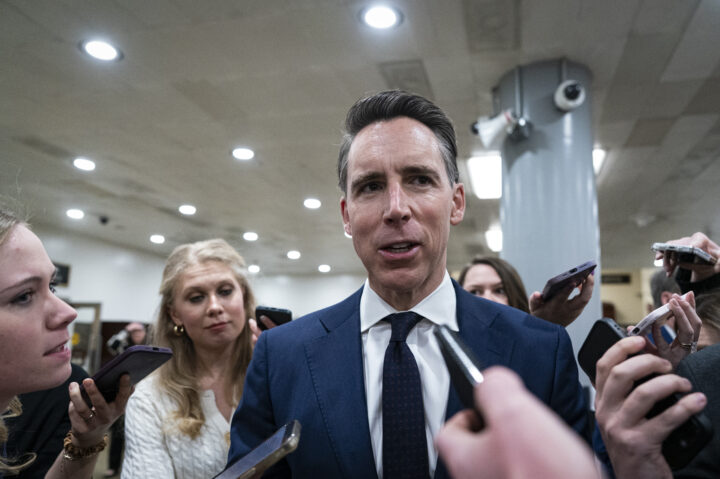
Sen. Josh Hawley (R-MO) speaks to reporters prior to the Senate Republicans weekly policy luncheon, in the US Capitol on March 25, 2025 in Washington, DC.
Both of Missouri’s Republican senators, Josh Hawley and Eric Schmitt, argued that the administration seems to have largely achieved its key objectives for the war in Iran — a posture that distinguishes him from most GOP colleagues and highlights subtle but emerging divisions among Republicans on the proper scope and duration of the war.
Pointing to comments by President Donald Trump saying that the war was substantially complete and that the U.S. had achieved its objectives, Hawley said on Fox News earlier this week, “I agree with what the president said last night. You look at all the success that we’ve had in the last 10 days. I mean, this thing is a victory. I think we should be hailing our military. We ought to be saying we’ve achieved our objectives here. … If this isn’t success, I don’t know what would be. … Now it’s time to declare victory.”
He also posited that Iran has nothing remaining with which to reconstitute its nuclear program — though the regime maintains a stockpile of enriched nuclear material which many experts argue cannot be fully secured without some form of on-the-ground presence.
Continuing a trend of making contradictory comments on the war’s timeline, Trump had said the same day that the U.S. could and would go much further in Iran, and that the U.S.’ aims could expand significantly.
Asked by Jewish Insider on Thursday about the metrics by which he was judging the success of the war, Hawley — who is one of the more prominent senators from the populist wing of the GOP — said he was referring to Trump’s own comments on the subject.
“I assume our overriding national security objective when it comes to Iran is to prevent them from getting nukes. And between our bombing last June and in the last … 12 days, I don’t know how they’re going to reconstitute their nuclear program anytime in, maybe, our lifetimes,” Hawley said.
“Our military has done an amazing job. I think it’s been an overwhelming display of force,” Hawley continued. “I know my Democrat colleagues, a bunch of them are saying, ‘This has accomplished nothing, nothing’s happened.’ It seems to me a lot has happened. And I think we should say that’s a good thing.”
Pressed on whether the war can be ended while Iran continues to fire missiles and drones at countries throughout the Middle East and is dropping mines in the Strait of Hormuz, Hawley said he would defer to Trump’s judgement on when to end the war.
“My point is just that I think the military has achieved a tremendous amount. It has ended [Iran’s] nuclear program for all intents and purposes. It has destroyed their navy. It has eliminated most of their ballistic missiles — those are good things,” he continued. “I’d be glad to take that [win].”
“Seems pretty good to me,” Hawley added.
Schmitt, who is also aligned with the populist wing of the party, likewise emphasized the progress the U.S. has made and pushed for a quick conclusion to the war.
“I know they’re way ahead of schedule. I’d look for a swift end to it,” Schmitt told JI. “I’m not interested in forever war in the Middle East, I don’t think the president is either. And I think that, again, they’ve laid out clear objectives and [are] making a lot of progress.”
Other Republicans are taking a distinctly different approach. Sen. Kevin Cramer (R-ND) told reporters on Thursday that “victory isn’t determined by declaration, it’s determined by the outcome.” He argued that the U.S. can’t and shouldn’t end the war prematurely.
“If you pull 90% of the weeds of our garden and you leave 10%, you’re going to have a weedy garden,” Cramer continued. “The last 10% are the hardest, in many cases.”
The North Dakota senator, who sits on the Senate Armed Services Committee, expressed surprise that the U.S. had not been better prepared to secure the Strait of Hormuz, calling it a potential “miscalculation” and saying that the attacks on ships in the critical waterway “could have been avoided.”
Sen. Lindsey Graham (R-SC), one of the most vocal supporters of the Iran war on Capitol Hill, said that he thinks there are “weeks more of this coming.”
“I don’t see this conflict ending today. I think the mission is to make sure they cannot regenerate, that they’re going to be beyond capable of building missiles to hit us, and they’ll never go back to the nuclear business,” Graham continued.
Also on Thursday, in a rare Senate floor speech, Sen. Mitch McConnell (R-KY), emphasized that the war against Iran cannot be decoupled from the global axis, including Russia and China, with which Iran is aligned.
Russia, McConnell emphasized, has reportedly been providing Iran with targeting intelligence. He criticized Special Envoy Steve Witkoff, who said earlier this week that he takes Russia at its word that it has not been doing that.
“I’ve warned successive presidents to take the Russian-Iranian axis, actually, more seriously,” McConnell said. He emphasized the supportive role that Ukraine has taken in helping to protect the U.S.’ allies in the Gulf, and criticized administration officials for not moving more quickly in pre-war discussions to acquire Ukrainian anti-drone technology.
He also urged lawmakers who oppose the war to nonetheless support an expected request for supplemental military funding as “an overdue opportunity to invest in urgent and strategic defense priorities.”
President threatens further attacks if Iran blocks Strait of Hormuz; teases nation-building effort
The White House via X Account/Anadolu via Getty Images
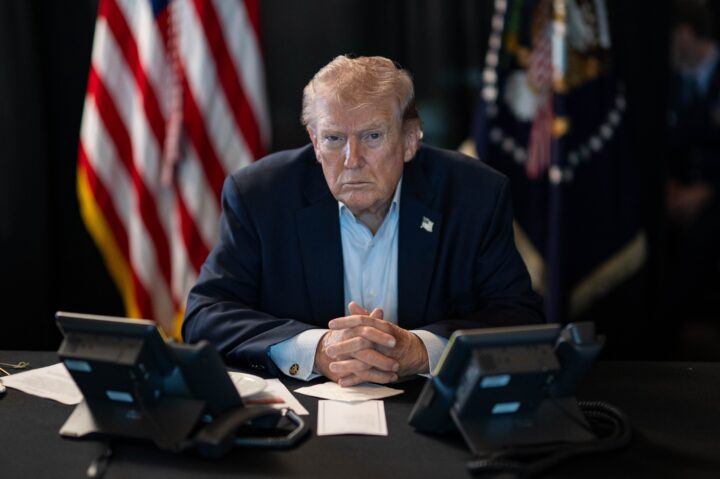
U.S. President Donald J. Trump sits at a table monitoring military operations during Operation Epic Fury against Iran, with U.S. flags visible behind him, in Washington, United States, on March 02, 2026.
President Donald Trump drew two contradictory timelines for the ongoing war in Iran in remarks on Monday, saying that the conflict was both drawing to a close and in its early stages.
In a call with CBS News, Trump said, “The war is very complete, pretty much. [Iran has] no navy, no communications; they’ve got no air force. Their missiles are down to a scatter. Their drones are being blown up all over the place, including the manufacturing of drones. … There’s nothing left in a military sense.”
The war has progressed faster than initially expected, the president added: “We’re very far ahead of schedule.”
Also Monday, the Department of Defense posted on X that “we have only just begun to fight, with a graphic of a missile interceptor and the text: “No Mercy.”
At a news conference after his CBS News interview, Trump was asked whether the war is “very complete” or “just beginning.”
“I think you could say both,” the president responded. “It’s the beginning of building a new country. We could call it a tremendous success right now, or we could go further.”
“And we’re going to go further,” Trump added.
In his interview with CBS, Trump considered further steps, saying that he is “thinking about taking … over” the Strait of Hormuz.
The president later posted on Truth Social: “If Iran does anything that stops the flow of Oil within the Strait of Hormuz, they will be hit by the United States of America TWENTY TIMES HARDER than they have been hit thus far.”
The Strait of Hormuz is the only passage by sea from the Gulf to the open ocean and a critical chokepoint in the global energy market.
Israeli Prime Minister Benjamin Netanyahu, meanwhile, said during a visit to Israel’s National Health Command Center on Monday that “our aspiration is to enable the Iranian people to cast off the yoke of tyranny; ultimately, it is up to them.”
“If we succeed together with the Iranian people, we will bring about a permanent end to the extent that such things exist in the lives of nations,” Netanyahu added. “We will bring about change, and we are already bringing about a massive shift in Israel’s international standing.”
The IDF Home Front Command reported only six missile launches from Iran to Israel in the past 24 hours, a significant slowdown from previous days of the war.
The IDF continued to strike targets in Iran, including a missile launcher, 10 minutes after it fired at Israel.
On Monday night, the IAF completed a wave of strikes against six major Iranian military airfields, destroying Islamic Revolutionary Guard Corps aircraft, including combat helicopters.
Lebanese President Joseph Aoun reached out to the U.S. to start direct talks with Israel on “permanent arrangements for security and stability on [its] borders.” He called for a “complete truce” ending Israeli military activity, and lamented that Hezbollah — which Beirut had agreed to disarm as one of the terms of its 2024 ceasefire with Israel — “wanted to achieve the fall of the State of Lebanon, under aggression and chaos.”
Israeli strikes on Hezbollah in Lebanon continued, with overnight attacks on command centers and the facilities of the Al-Quard Al-Hassan Association, which funds the Iran-backed terrorist group and works with cash, as well as a cell of Hezbollah terrorists approaching IDF soldiers and a structure in which commanders of the elite Radwan Force were said to be gathering.
Israeli Foreign Minister Gideon Sa’ar met with U.N. Special Coordinator for Lebanon Jeanine Hennis in Jerusalem on Monday. In his readout of the meeting, he noted that Hezbollah joined the war on Iran’s side “against the interest of Lebanon.”
“Over the past week there have been more attacks against Israel from Lebanese territory than from Iran,” Sa’ar said. “Weakening Hezbollah is a mutual interest of both Israel and Lebanon. I also said that Hezbollah initiated an attack against us and no member of the international community is acting to stop it besides us.”
Sa’ar and Hennis also discussed Israel’s decision not to evacuate residents from its northern border towns, in contrast with October 2023, and said that “the deployment of IDF troops in the border area is critical for preventing an invasion of Hezbollah’s ground forces and attacks against Israeli citizens and communities.”
The IDF estimated in recent days that over half a million Lebanese residents evacuated southern Lebanon.
Magen David Adom emergency services reported treating 76 people as a result of Monday’s missile attacks, two of whom were killed and 18 injured by missile debris.
Since the start of Operation Lion’s Roar, there have been 14 fatalities. MDA reported treating 667 people for injuries resulting from missile attacks, 511 of whom were injured making their way to shelter or in traffic accidents when stopping for a missile alert.
‘Each individual senator has a tremendous amount of power to disrupt the normal functionings of the Senate,’ Sen. Cory Booker said

Marc Rod
Sens. Cory Booker (D-NJ), Tim Kaine (D-VA), Tammy Duckworth (D-IL), Chris Murphy (D-CT), Tammy Baldwin (D-WI) and Adam Schiff (D-CA) hold a press briefing on Iran war powers resolutions on March 9, 2026.
A group of six Senate Democrats is threatening to immediately begin obstructing proceedings on the Senate floor in order to force public hearings in the Senate Armed Services Committee and Foreign Relations Committee and debate on the chamber floor on the war in Iran.
Jewish Insider first reported that several of those lawmakers — including Sens. Cory Booker (D-NJ), Tim Kaine (D-VA), Tammy Duckworth (D-IL), Chris Murphy (D-CT), Tammy Baldwin (D-WI) and Adam Schiff (D-CA) — introduced a series of five new war powers resolutions late last week.
The senators indicated in a meeting with reporters on Monday that they plan to force votes on those, and possibly additional, war powers resolutions when they become eligible for votes next week, but that those resolutions are just part of a broader strategy to disrupt normal Senate business in an attempt to force greater public discussion about the war in Iran.
“We’ve had no oversight whatsoever over what the executive is doing, as they’re spending a billion dollars a day. And we have failed to have any real substantive debate or discussion,” Booker said. “We are not going to let business as usual go on in the Senate … we are demanding that the Republican leadership of the Senate hold the adequate hearings and oversight, as well as to allow a debate that brings transparency to this onto the Senate floor.”
Booker declined to discuss their specific plans, but said that the senators would “use the levers that we have,” citing efforts over the years by Republican colleagues to block or slow down Senate procedure to compel votes on various issues.
“Each individual senator has a tremendous amount of power to disrupt the normal functionings of the Senate, as well as certain privileges that we can exercise,” Booker said. “And what we have agreed on right now is that we are not going to let the Senate continue its business as usual.”
Though the war powers resolutions won’t be eligible for Senate floor votes until next week, Booker indicated that the senators plan to begin other obstructionist tactics immediately, unless hearings are announced.
Murphy highlighted that the lawmakers have the ability, should they choose to do so, to “force a vote and debate every single day in the Senate” on the war powers resolutions. But Baldwin indicated that the lawmakers might not force the war powers votes if Republicans do schedule the hearings they request.
Booker said that the group is not necessarily speaking for the entire Senate Democratic caucus.
Murphy asserted that public hearings with administration officials, tasked with defending and explaining the war effort to the public, would only make the operation less popular with the American public. The Democrats also highlighted other costs, including increasing gas prices, associated with the war.
Kaine argued that the question for the Senate and the American people is not whether “Iran [is] a bad actor” or whether “in the abstract, [they have] done terrible things,” it is whether the war is worth risking American lives. Seven U.S. servicemembers have died in the course of the campaign so far.
Murphy and other Senate Democrats had also been pushing for a Senate vote on an authorization for use of military force regarding Iran. But on Monday, the six Democrats involved in this effort said they had ruled out the idea of a Democratic-led AUMF, arguing that the burden is on Republicans and the administration to put forward such a proposal and define its scope.
“They have to tell us and bring evidence to us that this war is worth an AUMF,” Duckworth said. “I personally don’t even want to have the discussion about an AUMF, because they haven’t even gone to the first step yet” of proving the need for the war.
Kaine said that the lawmakers, including Murphy, had “explored the procedural option” of an AUMF, but said that the “burden” to write such a bill should not be on the Democrats “who think this war is a bad idea.”
“It would be too unusual for the opponents to file the AUMF,” he continued. “The proponents are the ones that carry the burden of proof with the American public. They need to file it.”
The six Democrats did not appear to be entirely in agreement about how they would handle a potential request by the administration for supplemental funding to support the war effort or replenish U.S. armaments expended in it.
Kaine said he would withhold judgement on the issue until such a request was presented, explaining, “I want to end the war, I want to protect our troops.”
Schiff argued that the military has “plenty of money” from last year’s reconciliation bill, and also said that a congressional appropriation for a military effort could, legally, be considered an authorization for use of military force.
Should they secure the hearings they seek, the senators said they want to press administration officials on the goals and timeline for the war, the rules of engagement and restrictions imposed on U.S. forces, the circumstances that led to a deadly strike — which some have attributed to the U.S., though the administration disputes this — on a girls’ school, potential plans to support separatist movements inside Iran and the administration’s plans to support and protect Iranian demonstrators should another mass uprising occur.
“My goal is to end this war, to stop wasting millions of dollars and to protect further servicemembers from dying, and I think the way that you do that is by exposing to the public the fact that this is a war of choice, the fact that this president has ignored the law and the Constitution and the people through us, hold him to account,” Baldwin said.
The Arizona senator’s outspoken commentary has repeatedly placed blame for the military operation on Israel, leading one Jewish Democrat to pull her support

Tom Williams/CQ-Roll Call, Inc via Getty Images
Then-Rep. Ruben Gallego (D-AZ) in Rayburn Building on Capitol Hill on June 9, 2022.
With a series of pugnacious tweets and media appearances, Sen. Ruben Gallego (D-AZ) has made himself a face of the Democratic opposition to the war in Iran, issuing one of the first comments from a U.S. lawmaker opposing the effort in the early hours of Saturday morning.
Gallego’s outspoken commentary, which has repeatedly pinned blame for the operation on Israel — a notion that colleagues on both sides of the aisle have disputed — also coincide with Gallego’s endorsement of Graham Platner, the progressive Maine Senate candidate who has faced a series of scandals related to antisemitism.
The high-profile moves come as Gallego, who claimed victory in Arizona in 2024 even as President Donald Trump won the state, is seen by political observers as positioning himself for a 2028 presidential campaign — and as anti-Israel policies have become a litmus test for the progressive left.
“So Netanyahu now decides when we go to war? So much for America First,” Gallego said earlier this week, in response to comments by Secretary of State Marco Rubio that seemed to suggest that the timing of the war was dictated by Israel.
“What the f*** happened to America First?” Gallego wrote in another post, adding that the U.S. should have left Israel to go ahead with the operation alone.
Though some lawmakers emerged from a Monday briefing echoing that line, Rubio has since said his comments were misrepresented, and others on both sides of the aisle have denied that Israel forced the U.S. into the conflict.
“They’re following Netanyahu, who has literally told us … that he’s been trying to do this for 47 years. I know — I suffered the first attempt at this in 2005, and now America is suffering again because of it,” Gallego said on MS NOW this week, referencing his service in Iraq. “There’s a lot of ways that we can be supportive of Israel. There’s a lot of ways that we could defend Israel’s existence, its sovereignty. I’m 100% for that. We don’t need to go to war for them, especially when it’s a dumb war.”
He said that the U.S. should have threatened to withhold intelligence, support and munitions from Israel if it went ahead with an attack on Iran.
And he said on “Pod Save America” that the U.S. should have tried “calling Iran, saying ‘This is not us, we’re going to be staying out of this.’ No, we just decided that we’re going to let Netanyahu choose our wars. This is very disturbing to me.”
The Arizona senator also said he would not support funding to replenish U.S. munitions expended in the war, saying that Middle Eastern partners should be responsible.
“When the bill comes to pay for the replenishment of interceptors and munitions, the Middle Eastern countries that we have been protecting need to pay for it,” Gallego said on X. “We aren’t cutting more Medicaid, food stamps for protecting these countries in a war of choice and not in our interest.”
In a podcast appearance on The Bulwark this week, he also urged fellow Democrats to reject the war forcefully and wholeheartedly, without caveats or appeals to constitutional authority as other lawmakers have used to justify their opposition.
“Why are we spending all this money? All these countries in the Middle East have a lot of money. Why are we spending all this money?” Gallego continued, explaining questions he’s hearing from constituents. “These are the things that are very simple for people to understand. I think we should not be afraid to communicate that.”
Endorsing Platner, Gallego called him “the kind of fighter Maine hasn’t seen in a long time, someone who tells you exactly what he thinks, doesn’t owe anything to the special interests, and wakes up every day thinking about working families,” also referencing their shared history as veterans.
Platner most recently faced scrutiny for appearing on a podcast in January with an antisemitic conspiracy theorist of whom Platner said he was a “longtime fan.” Just before that podcast appearance came to light, Platner came under fire for retweeting a prominent neo-Nazi influencer. Platner also, for decades, had a tattoo that closely mirrored a Nazi emblem on his chest.
While Platner has claimed not to have been aware of the significance of the symbol, both Jewish Insider and CNN reported that Platner described the tattoo as a Totenkopf, a symbol used by an SS unit.
Gallego and Platner are both represented by the same consulting firm, Fight Agency, which has signed on a number of far-left candidates who have made opposition to Israel a central focus of their campaigns. Another one of the Fight Agency’s clients is New York City Mayor Zohran Mamdani, who the senator defended during his polarizing mayoral campaign.
Gallego, who has a Jewish child with his ex-wife, has spoken in the past about his concerns about antisemitism and its impacts on his own family. But pressed this week on Platner’s antisemitic ties, a Gallego spokesperson referred JI to an interview Gallego conducted on “Pod Save America” about the endorsement.
Asked about Platner’s appearance on and praise for the antisemitic podcaster, Gallego downplayed the situation, noting that many Democrats have appeared on Joe Rogan’s podcast, which has also spread antisemitic conspiracy theories.
“A working class man goes and has a conversation on a platform that is very similar to what Joe Rogan talks about … but everyone freaks out on this guy,” Gallego said. “Why? Because the establishment doesn’t want him. This is very simple … so they’re going to make sure that he looks bad.”
Gallego also said that Platner was “young and stupid” when he got the tattoo but argued that it was not clearly identifiable as a Nazi symbol, and that subsequent security checks and physicals did not identify the tattoo as a problem.
And he argued that Democrats are too focused on finding “perfect” candidates who are ultimately unable to appeal to voters.
The Arizona senator separately said on a Bulwark podcast this week, “I also endorsed Haley Stevens and Angie Craig, right? And, I was accused by the left of being in the pocket of Israel.” He said that he’s supporting people he believes can win general elections.
Arizona state Rep. Alma Hernandez, a Jewish Democrat and outspoken supporter of Israel, said she was surprised and disappointed by Gallego’s endorsement of Platner.
“It is a really hard one to justify. I, quite frankly, do not care if they are both veterans. There are plenty of veterans who are not complete bigots and jerks who you could endorse,” Hernandez told JI. “There is a woman who’s running, who is the governor, who has not had any history of being a bigot like this individual. I mean, for God’s sake, he has a Nazi tattoo.”
She added, “you can’t excuse and pretend that there is no pattern of bigotry and, quite frankly, just a real disregard for Democratic values” from Platner, pointing to offensive comments about people of color and women that the Maine candidate has made.
“I’m disappointed as an Arizonan, as a woman and as a Jewish woman,” Hernandez continued. “I think it says a lot about a person who’s willing to put their name behind someone like him.”
Hernandez said that, in response to Gallego’s support for Platner and his shifting stance and recent comments on Israel, she’s heard from other Jewish Democrats in Arizona who say they won’t support Gallego going forward.
In the House, Gallego was generally a supporter of Israel — and voted against the 2015 Iran nuclear deal — within what was at the time the mainstream of the Democratic Party, but was not particularly active on the issue.
The then-congressman appeared to take a more hawkish position during and immediately after his Senate race in 2024, leading an effort to expand U.S.-Israel counter-tunneling cooperation, supporting efforts to sanction the International Criminal Court, backing the redesignation of the Houthis as a foreign terrorist organization, strongly condemning Rep. Rashida Tlaib (D-MI) for including the phrase “from the river to the sea” in a video she posted and quickly urging the administration to freeze Iranian assets shortly after the Oct. 7, 2023 attacks, when other Democrats were slower to endorse that position.
He also said, through a spokesperson, that he would have opposed efforts earlier this year to block certain U.S. aid shipments to Israel that were supported by a majority of Senate Democrats. Gallego himself was absent for the vote, citing family duties as a new father.
But Gallego’s recent statements, particularly since the start of the Iran war, indicate a sharp tack in the opposite direction as he eyes a potential national campaign. Other potential 2028 Democratic candidates, like California Gov. Gavin Newsom, appear to be making a similar calculation.
Please log in if you already have a subscription, or subscribe to access the latest updates.
 Continue with Google
 Continue with Apple