



































The suspension ends a key commercial lifeline, though analysts said Iran's sanctions-evasion networks and enforcement uncertainty limit how decisive a blow it will be
Stringer/Anadolu via Getty Images
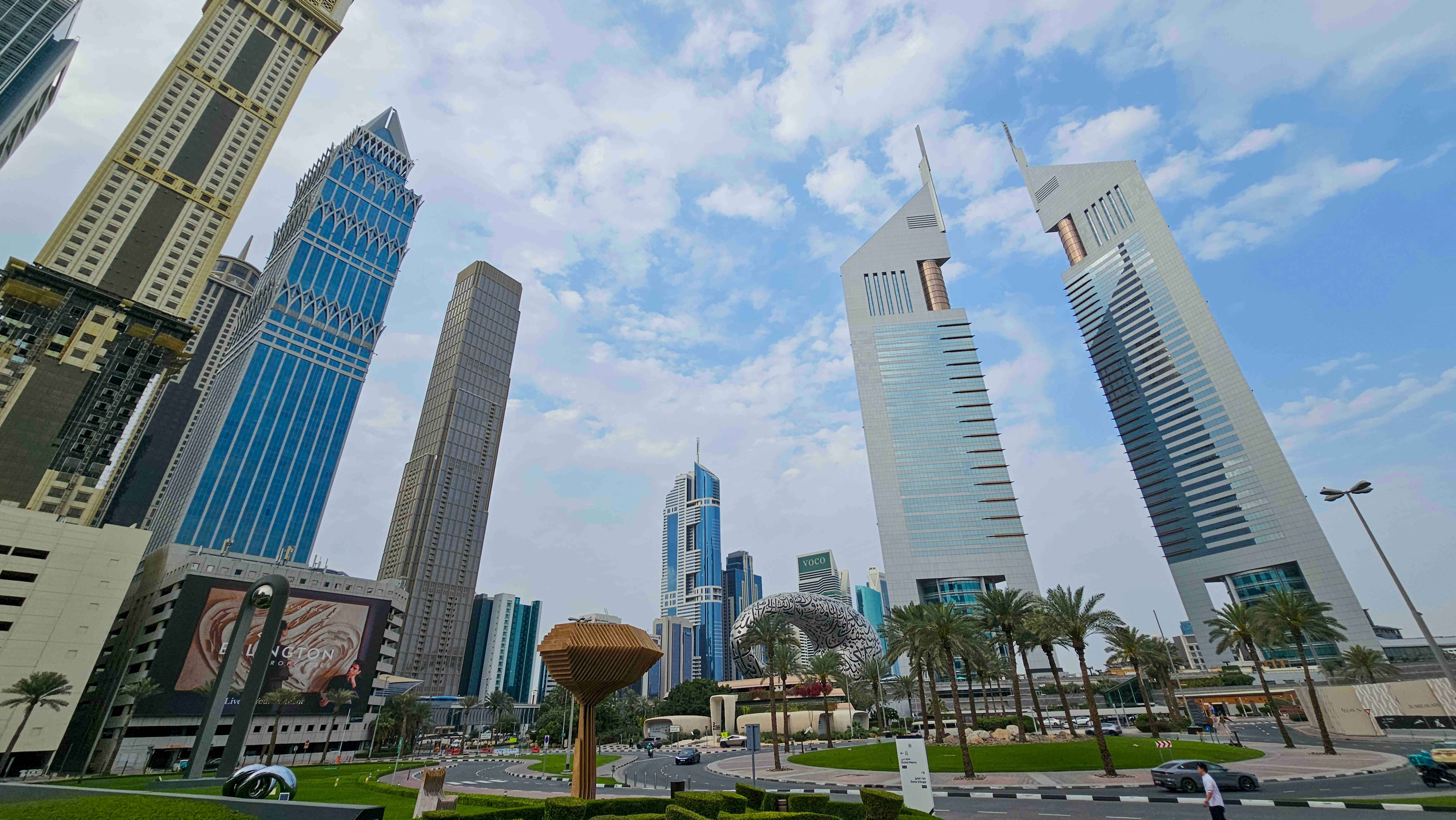
A view from the Dubai International Financial Centre (DIFC) on March 03, 2026 in Dubai, United Arab Emirates.


 Add JewishInsider on Google
The United Arab Emirates’ decision to sever trade and financial ties with Iran could deliver a major blow to Tehran’s economy, regional analysts said, disrupting a commercial lifeline that Iran has relied on for years. But experts cautioned that Tehran is likely to turn to existing workarounds to keep money flowing and that the UAE’s full implementation of the move is not completed.
In a statement released on Tuesday, Afra Al-Hameli, a spokesperson for the UAE Ministry of Foreign Affairs, announced that Abu Dhabi had suspended all trade activity, commercial exchanges and financial transactions with Iran “until further notice.” The UAE — which serves as Tehran’s second-largest commercial partner — issued the declaration after its Defense Ministry reported detecting two Iranian ballistic missiles that were “targeting maritime navigation” before falling into the sea. Iran’s Foreign Ministry denied launching the missiles.
Since the Iran war began in late February, the UAE has been the country most heavily targeted by Tehran’s missile and drone attacks, with strikes damaging airports, ports, energy facilities, financial centers and other critical infrastructure.
Regional experts told Jewish Insider that given the UAE’s history as a vital commercial conduit and financial hub for Iran, cutting those links would deal a heavy blow to Tehran’s already fragile economy.
“Dubai in particular has been a key hub for Iranian finance, and if that role ends, Iran’s economy will be hurt,” Elliott Abrams, who served as special envoy for Iran during the first Trump administration, told JI. “And while Iran will scramble to find alternatives, that will be difficult and take time — and meanwhile their weak economy will suffer even more.”
Abrams added that ensuring the UAE acts as “a full ally” rather than a neutral observer is essential to President Donald Trump’s strategy of exerting maximum economic pressure against Tehran.
Anne Dreazen, vice president of the American Jewish Committee’s Center for a New Middle East, similarly described the UAE’s declaration as “significant,” emphasizing that sustained enforcement would restrict Iran’s commercial access and financial liquidity.
“This move by the UAE sends an important message to Iran that it can’t continue to attack Gulf commerce with impunity while continuing to rely on the Gulf as one of its principal economic lifelines,” Dreazen said. “If this suspension is sustained and enforced, it will make it more difficult for Iran to conduct commerce and move money.”
However, Dreazen pointed out that Tehran’s economic resilience and pre-existing sanctions evasion networks mean the move will not act as a “silver bullet.”
“Iran is resilient, and a lot of Iran-UAE trade has already been disrupted due to the war. I therefore don’t expect this move to be a silver bullet — Iran will devise workarounds and can probably withstand this move,” Dreazen continued. “However, it will cause significant additional economic pain for Iran at a time when Iran cannot really afford more economic pressure.”
Jason Greenblatt, who served as White House Middle East envoy during the first Trump administration, voiced strong support for the decision, framing it as a necessary measure against Iranian aggression.
“It also strengthens President Trump’s effort to choke the Iranian regime economically and stop its threats to the region and the United States,” Greenblatt told JI. “The more nations that join, the greater the pressure on Tehran and the better the chance of changing its behavior.”
Conversely, Kristin Diwan, a senior resident scholar at the Arab Gulf States Institute in Washington, expressed skepticism over whether Abu Dhabi will follow through with full execution or that neighboring Gulf nations will replicate the move.
“Dubai is the safety valve for the Iranian economy. Losing that outlet would unquestionably be punishing, but it will hurt Dubai as well,” Diwan said. “I’m skeptical that this will be fully executed or that other Gulf states will follow the UAE on this path. While the U.S. is now focusing on punishing Iran economically, many Gulf partners are looking for ways to deescalate, and those tools may also be economic.”
The India-Middle East-Europe Corridor, originally viewed as an alternative to China’s Belt and Road Initiative, is being considered as another passage for trade
JULIEN DE ROSA / AFP via Getty Images
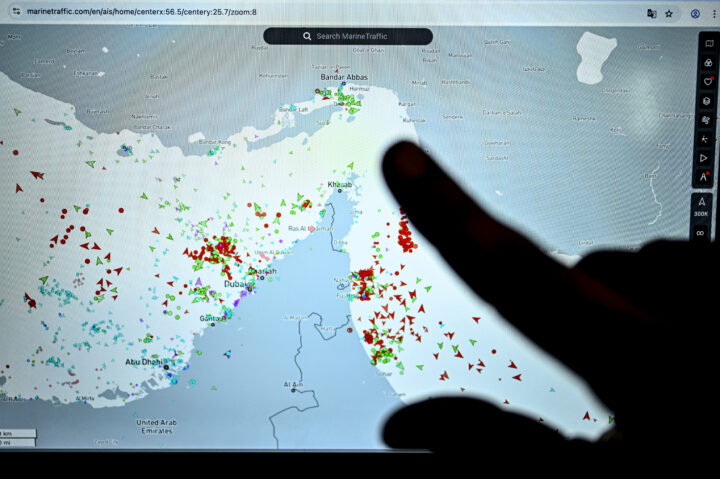
A person points at a page on the Marinetraffic website that shows commercial boats traffic on the edge of the Strait of Hormuz near the Iranian coast, in Paris on March 4, 2026.
With Iran’s closure of the Strait of Hormuz roiling energy markets, other countries in the region may begin to pursue alternative routes to transport energy and other goods, but they are far from ready to be put into use, experts told Jewish Insider this week.
One of the highest-profile routes is the India-Middle East-Europe Corridor (IMEC), proposed by the Biden administration in September 2023 as a route for trade, energy and more; it would go from India, through Saudi Arabia, the UAE, Jordan and Israel, then across the Mediterranean to Europe through Greece.
While Iran has threatened to block the Strait of Hormuz and obstruct oil shipping for decades, the Islamic Republic was not the main reason for considering another route of transportation — it was initially conceived as an alternative to China’s Belt and Road Initiative.
But now that the Iranian threat has been realized, IMEC and other alternative routes to ship oil and gas from the Gulf are back in focus.
Gabriel Mitchell, an expert on energy security and a visiting fellow at the German Marshall Fund, told JI that “the threat and challenge posed with the Strait of Hormuz has raised questions about East-West shipping, traffic and global energy trade to the maximum.”
”If you look at it from the perspective of India on one end, Europe on the other and anywhere in between, they are thinking they need to create as much redundancy as possible for commercial shipping for their own economic security,” Mitchell said. “It doesn’t make a difference whether you’re Emirati or Qatari or just an international shipping company with a base of operations in [the UAE’s Port of] Fuajirah, you’re asking the same questions.”
Mitchell said the idea of redundant shipping routes initially came from a desire to lower costs and increase speed of delivery, and grew more popular due to challenges with the Suez Canal during the COVID-19 pandemic. Now, in light of Iran’s obstruction of the Strait of Hormuz, “the argument in favor of IMEC [and] creation of redundancy has increased significantly.”
Increased regional connectivity can “take away Iran’s lever of closing the Strait of Hormuz,” Joseph Rozen, a senior fellow at the Misgav Institute for National Security and the former director for Asia-Pacific in Israel’s National Security Council, told JI. (The writer is a senior fellow at the Misgav Institute.)
Rozen said that “IMEC is a buzzword; the focus needs to be on inter-regional connectivity,” and noted that the Trump administration may be hesitant to adopt a Biden-era initiative, though it seemingly supports increasing connectivity more broadly through the Board of Peace.
Regional connectivity can increase stability and growth, Rozen said, and more countries can be brought in than those initially on board, such as Oman, Iraq, Syria, Egypt and even Gaza.
“The Iran war increased American involvement and its push for connectivity initiatives,” Rozen said. “Before the war [President Donald] Trump expressed interest, but now, the U.S. is more invested, and that encourages countries in the region to invest in regional connectivity if they know there’s an American security umbrella … over their investments and development.”
Rozen argued that existing infrastructure should be improved in the short term. The Saudi and Emirati pipelines combined can only transfer about 8.5 million barrels’ worth of oil per day, 42% of what passed through the Strait of Hormuz each day before the current war with Iran, he said. Another short-term move Rozen proposed is to continue to grant countries waivers to buy Russian gas, though this effort has seen resistance from members of Congress.
Mitchell said that IMEC faced a lot of skepticism when it was proposed, and none of its challenges have been resolved.
The commercial viability of alternative pipelines and routes is in question, Mitchell said: “Who is going to pay? Who is going to secure it? Which available ports will be able to manage that intake?”
Companies may prefer to try to find quick fixes rather than make multibillion-dollar investments that take a decade or more to bring returns, Mitchell argued, and the private sector and states will have to work together to make them viable. “I believe that will tip the scales in favor of these kinds of projects, but which end up getting green lit is yet to be determined.”
Some of the geopolitical challenges have grown more difficult since the Oct. 7, 2023, Hamas attacks on Israel, weeks after IMEC was announced. In addition, Mitchell pointed out that Turkey has obstructed joint energy projects between Israel, Greece and Cyprus in the past decade, demanding to be involved, and would likely do the same with IMEC.
”It’s hard to get everyone involved in one project … It’s hard to say how we are going to set aside our differences for these sets of initiatives … [and] what combination of carrots and sticks will convince people to pursue diversification. … I think in the end the answer will be yes, but it will take time to get there,” Mitchell said.
When Indian Prime Minister Narendra Modi visited Israel earlier this year, IMEC was part of the public conversation, but diplomats from both countries told JI on condition of anonymity that Saudi Arabia was hesitant to proceed because of Israel’s involvement — even though both countries were part of the plan from its inception.
Rozen said that Riyadh and Jerusalem can be part of the same project as long as the focus is on practical steps that serve the Saudis’ interests and not summits and bombastic statements that would “do more harm than good.”
”I understand their interest to maintain a certain kind of rhetoric, but there are other interests,” he said. “The more we advance through channels that are not political and are lower profile … I think the Saudis would be willing to do it. It can happen at any level of IMEC or other connectivity plans, in energy, trade and digital services. Cooperation led by the business sector would not carry the same political baggage … and under the current political circumstances it may be better for it not to be government-led.”
Mitchell also said that disputes between Saudi Arabia and the UAE that surfaced late last year could get in the way of developing IMEC, though in “a situation like now, when everyone is economically bleeding, there should be room for creative solutions.”
Israeli officials have made many positive statements about IMEC and Israeli Foreign Minister Gideon Sa’ar took part in a summit last year with his counterparts from involved countries, but no progress has been made on the ground.
Rozen said that Israel will likely wait to develop the necessary infrastructure “as long as there is no commitment from Arab States, such as Jordan, to invest on their side.” However, he added that, in the interim, Israel can “focus on the technological aspects” of regional connectivity at a lower cost.
Mitchell said the big challenge for Israel is that other countries will be competing to be involved in connectivity projects. Egypt, he said, has been pushing to be the gateway to the Mediterranean, with support from France.
”The argument in Israel’s favor is the security-related coordination [with Arab states] that is happening informally in a lot of ways. We need to concretize that,” he said. “One would assume that Israeli companies would have the opportunity to present their offerings for cybersecurity infrastructure.”
”The real thorn in Israel’s side since Oct. 7 is the diplomatic element. Can Israel manifest any kind of diplomatic initiative or momentum to patch together meaningful cooperation?” Mitchell questioned. “It seems that as of right now, nobody is willing to meet in the middle, which is challenging if you’re Israel, but it’s also challenging for the U.S., which is trying to work with everybody in parallel and has struggled to bring them around the table [together].”
Some disagree on who should claim ultimate responsibility for the strait — the U.S. or other countries in the region
Tom Williams/CQ-Roll Call, Inc via Getty Images
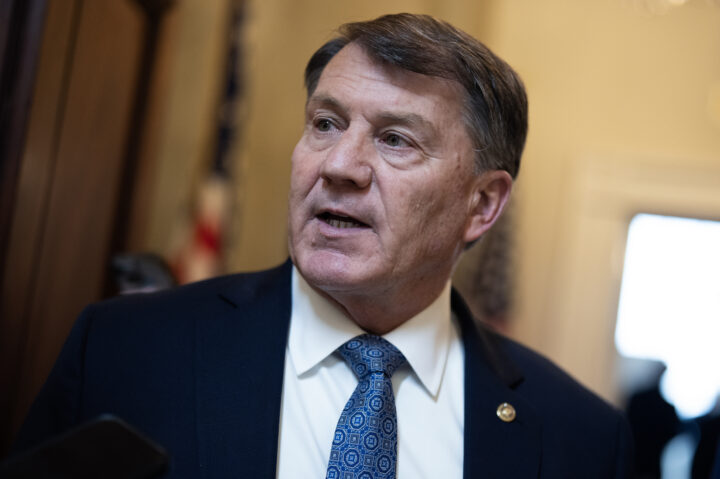
Sen. Mike Rounds (R-SD) talks with reporters in the U.S. Capitol on Tuesday, March 3, 2026.
Multiple Senate Republicans said Tuesday that they haven’t heard from the administration specific plans for restoring free trade through the Strait of Hormuz, though most emphasized that doing so is a critical goal.
Sen. Mike Rounds (R-SD) said that the Pentagon has been planning for this contingency for years.
“I can just tell you, the Pentagon has, for years, been playing out their plans,” Rounds told Jewish Insider. “The question is which plan is next, and that’s based on conditions — the same thing with Kharg Island,” he said, referring to potential U.S. military operations against the Iranian regime’s primary petroleum export hub. “I’m sure that when the time comes, we’ll all know.”
Rounds said he’s confident the administration has “multiple plans” for Kharg Island as well. The administration has reportedly been considering invading or blockading the island to force the regime to lift its blockade of the Strait of Hormuz. President Donald Trump previously threatened to destroy the energy facilities on Kharg Island if the blockade continues.
The Strait of Hormuz “has to” be reopened, “but no, I have not heard from them on the ‘how’ and the ‘what’ — how they’re trying to be able to accomplish that,” Sen. James Lankford (R-OK) said. “This has been Iran’s trick for decades, right? When they get mad, they close the Strait of Hormuz. They just hang that over everybody’s head all the time.”
He suggested that any solution to the current blockade should also aim to prevent similar occurrences in the future.
“[However] this is resolved, you can’t have a future of terrorism in the region,” Lankford said. “You can’t have this constant on-and-off of the Strait of Hormuz, and you can’t have a nuclear weapon.”
Sen. John Cornyn (R-TX) said of the U.S. military, “they’re certainly sending a lot of assets there to do that, so I hope they’re successful.”
Cornyn also characterized the waiver of some U.S. sanctions on Iranian and Russian oil as “temporary disruptions,” which he hopes will be restored once the strait is reopened.
One Republican senator, however, argued that the onus is not on the United States to reopen the strait, despite the closure’s impact on global oil prices.
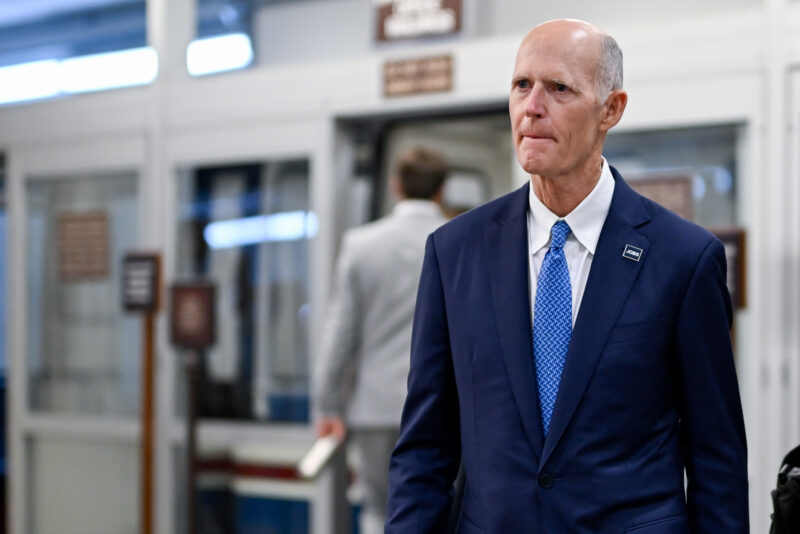
“The way I look at it, the countries that need to get it open — they’re the ones who should do it,” Sen. Rick Scott (R-FL) said. “We’re energy independent. So the countries that need [to get] product out of there — they ought to figure out how to get it open. I don’t think it’s our responsibility.” Trump has made similar comments about leaving responsibility over the strait to countries that utilize it most, which are primarily Gulf states.
Lankford and Cornyn both said they disagreed with the idea that the U.S. should leave others to handle obstacles to commerce in the strait.
Lankford said he has a “very different view” on the issue, emphasizing that there are hundreds of thousands of Americans living and working in the region.
“America stands with Americans, wherever they stand, so we’ve got to be able to fix that,” Lankford said. “Iran, for 47 years, has performed acts of terrorism on Americans that live in the area. They’ve got to stop that. And the Strait of Hormuz — they can constantly adjust oil prices … based on them opening and closing it. You can’t do that. We don’t let Somali pirates take our ships, we don’t let the Houthis stop international traffic and we don’t let the Iranians shut off the Strait of Hormuz.”
Cornyn highlighted the global economic impacts of the strait’s closure.
“It impacts, obviously, worldwide commodity prices, but it affects our country as well, given the impact on the gas prices,” Cornyn said.
Democrats, meanwhile, have accused the administration of failing to properly plan for the likelihood that Iran would close the strait in advance of the war.
“We’ve known for 80 years that that was a vulnerability to the entire [world],” Sen. Tim Kaine (D-VA) said. “Did you think about it? Did you not think about it? If you thought about it, did you just assume Iran wouldn’t do it? I mean, it’s amateur hour.”
The Oklahoma senator said, ‘The United States needs to make a clearer statement to the world that, if you join the Abraham Accords … it's different for this group, so wouldn't you like to join this club?’
AJC/Martin H. Simon
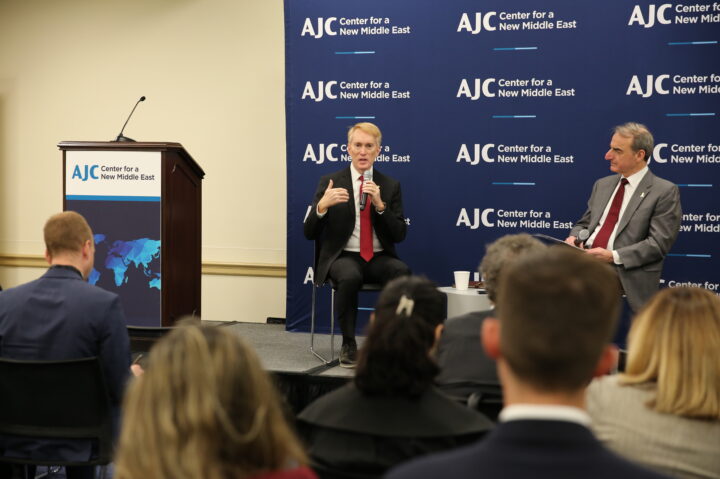
Sen. James Lankford (R-OK) speaks at AJC's Abraham Accords 5th Anniversary Commemoration on Capitol Hill in Washington on Sept. 10, 2025.
Sen. James Lankford (R-OK) urged the Trump administration to offer clearer incentives, including favorable trade and tariff treatment, to countries that normalize relations with Israel.
“The United States needs to make a clearer statement to the world that, ‘If you join the Abraham Accords, this is what happens to trade. We change the rules on what we do, on trade, on tariff, on relationships — it’s different for this group, so wouldn’t you like to join this club?’” Lankford said at an American Jewish Committee event in Washington marking the five-year anniversary of the Abraham Accords. “I think that’s something that we’ve yet to define clearly as an American government and as a State Department and our Commerce [Department], and I think it’s an area that is unfinished business.”
He also urged other countries in the region not to give Hamas the result it sought, through the Oct. 7, 2023, attacks, in scuttling regional normalization efforts and isolating Israel globally.
“I think one of the biggest challenges right now is communicating to other nations, ‘Don’t show Hamas they were successful based on what your behavior changes now, and your relationship with Israel in the future. Don’t allow that terrorist extremist group to be the one that speaks for you and your nation,’” Lankford said. “If you say you oppose extremism, then don’t support their methods.”
He said that’s “a hard conversation to have among friends. I think it’s also difficult because we have broken relationships with multiple nations. That means sitting down with people you don’t normally sit down with and saying, ‘How do we get past this?’ And those are not simple conversations.”
Lankford said that offering favorable trade terms and offering a “package of what it means to be a part of this club” would help “smooth some of that.”
Asked by Jewish Insider about the Israeli attack on Hamas leaders in Qatar, Lankford said that Israel has been “very, very clear. It has been for decades. If you kill us and … [in] an act of terrorism, we don’t care where you are anywhere in the world, we’re going to come after you.”
“Their statement is pretty clear: ‘We had an opportunity, we’re going to take the opportunity,’” Lankford said. “An air strike may not be the most elegant way to be able to do that. And so I think there’s some disagreement on that. There’s not disagreements on, if someone is trying to kill you — it’s been American policy as well — we’re going to find you.”
He added that Qatar is an ally of the United States, but also of Iran.
On the issue of recent Israeli strikes on Syria, Lankford largely defended Israel, saying that Israel had been clear that it not allow Turkey to take over Syria and that it would protect the Druze population. He said that Israel’s focus on the atrocities against the Druze had raised that issue to global attention.
“Syria and its disjointed government at this point, as they’re trying to be able to form, has either allowed or encouraged the attack on the Druze in the south, that can’t be allowed,” Lankford said. “The leadership in Syria needs to control its own military and militant factions to be able to make sure they’re not slaughtering the Alawites, as it was allowed just a few weeks before that, or the Druze.”
Lankford, who recently visited Lebanon, said he remains encouraged by the progress that it has made toward eliminating Hezbollah, particularly setting an end-of-year deadline to disarm the terrorist group and moving to secure its banking system to prevent Hezbollah’s financing.
Lankford said he believes Lebanon is on track to meet the deadline the country set to disarm Hezbollah.
“I think that’s one of the greatest opportunities for peaceful connections between two neighbors that say they don’t want war with each other,” Lankford said, referring to potential relations and a stable, established border between Israel and Lebanon. “Good fences make good neighbors at times, and this is a good spot to be able to do that.”
Please log in if you already have a subscription, or subscribe to access the latest updates.
 Continue with Google
 Continue with Apple