



























Yael Nativ’s application to return as a dance professor was rejected after the department chair told her ‘things are very hot’ at the university since the Oct. 7, 2023, attacks and Gaza war

GETTY IMAGES
This photo was taken from the top of Sather Tower on UC Berkeley campus.


 Add JewishInsider on Google
As part of a settlement reached on Wednesday, the University of California, Berkeley acknowledged it discriminated against an Israeli former professor, and offered remedies for the situation, two years after the school disinvited her from teaching a course on Israeli dance, Jewish Insider has learned.
Dance professor Yael Nativ filed a lawsuit against the UC Board of Regents in August, claiming that she was the victim of discrimination under California law. Nativ, a visiting professor who taught a course on contemporary Israeli dance in 2022 and reapplied for the 2024-25 school year, alleged that her application to return was denied due to her Israeli nationality and the climate on campus following the Oct. 7, 2023, terrorist attacks in Israel and ensuing war between Israel and Hamas. Nativ was represented in the suit by the Louis D. Brandeis Center for Human Rights Under Law.
Under the agreement, UC Berkeley Chancellor Rich Lyons issued a personal apology to Nativ. She was also granted $60,000 in monetary damages and was invited by the university to teach the course she “successfully” taught during a previous semester at UC Berkeley — during a semester of her choosing. According to a joint statement from UC Berkeley and the Brandeis Center, “UC Berkeley publicly acknowledges the violation of [its] policy against discrimination with regard to Dr. Nativ and commits to rigorously enforce this policy to prevent recurrence.”
The UC Berkeley Office for the Prevention of Harassment and Discrimination opened an investigation into Nativ’s case last year following her complaint. After a probe that lasted several months, OPHD concluded that she had faced discrimination based on national origin. The recent settlement, however, is the first time the university offered steps to address the mistreatment.
The lawsuit alleges that months after Nativ sent in her application, she received a WhatsApp message from the chair of the department of theater, dance and performance studies, SanSan Kwan, saying she was under pressure from faculty not to bring anybody from Israel or hold courses related to Israel.
“[M]y dept cannot host you for a class next fall. … Things are very hot here right now and many of our grad students are angry. I would be putting the dept and you in a terrible position if you taught here,” Kwan wrote, according to the lawsuit.
“It’s a shame that this [incident] required us to file a lawsuit, because it was a pretty straightforward case of discrimination,” Paul Eckles, senior litigation counsel at the Brandeis Center, told JI. Even though OPHD already ruled in Nativ’s favor, Eckles said there was still a need to “get [the university] to take some action.”
A separate lawsuit against UC Berkeley, also filed by the Brandeis Center on behalf of Jewish groups in November 2023, remains under litigation. That lawsuit alleges that the university violated its own policies and federal civil rights laws by allowing discrimination, harassment and physical violence against Jewish students and faculty. Incidents cited include an attack against a Jewish student draped in an Israeli flag by protesters who struck him with a metal water bottle and the distribution of e-mails to Jewish students calling for their gassing and murder. The complaint, filed in San Francisco federal court, was among the first against a major university after the Oct. 7 attacks and ensuing Israel-Hamas war, with similar discrimination lawsuits following at universities nationwide.
Plus, Steve Israel's new spy thriller
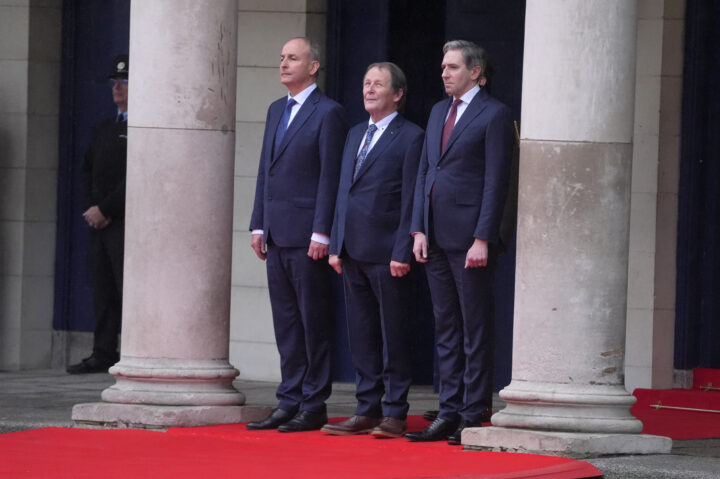
(Brian Lawless/PA Images via Getty Images)
(left to right) Taoiseach Micheal Martin, Brian McEnery and Tanaiste Simon Harris after President Catherine Connolly was inaugurated as Ireland's 10th president at Dublin Castle. Tuesday November 11, 2025.
Good Monday morning.
In today’s Daily Kickoff, we interview former Rep. Steve Israel about his new spy thriller and report on Northwestern University’s $75 million settlement with the Trump administration. We talk to the parents of Yaron Lischinsky about the slain Israeli Embassy staffer’s life and legacy, and cover recent victories for Irish Jews and Israel supporters in the face of an effort to remove the name of Chaim Herzog from a Dublin park, as well as the shelving of a bill to boycott Israeli products made in the West Bank. Also in today’s Daily Kickoff: Sen. Cory Booker, Segev Kalfon and Rabbi Brent Chaim Spodek.
Today’s Daily Kickoff was curated by Jewish Insider Executive Editor Melissa Weiss and Israel Editor Tamara Zieve. Have a tip? Email us here.
What We’re Watching
- White House Special Envoy Steve Witkoff and Jared Kushner are traveling to Moscow today ahead of their meeting tomorrow with Russian President Vladimir Putin. Witkoff and Kushner, joined by Secretary of State Marco Rubio, met yesterday in Miami with senior aides to Ukrainian President Volodymyr Zelensky.
- Pope Leo XIV is in Lebanon this week as part of his first international trip since becoming pontiff. He first traveled to Turkey last week, where he met with President Recep Tayyip Erdogan as well as the head of the country’s Jewish community.
- Israel Defense Tech Week kicked off this morning at Tel Aviv University. Senior Pentagon official Mike Dodd; Adm. (ret.) Mike Rogers, a former director of the National Security Agency; and Sequoia Capital’s Shaun Maguire are among the two-day conference’s featured speakers.
What You Should Know
A QUICK WORD WITH JI’S LAHAV HARKOV
Ireland has long been competing for the title of most anti-Israel country in the West, and in recent years, the local Jewish community has expressed fears that the country has become systemically antisemitic. Calls to boycott Israel have permeated the political mainstream; the Emerald Isle’s under 3,000 Jews face hostility in schools and workplaces, and physical harassment has increased in recent years. Pleas to the former president not to politicize International Holocaust Memorial Day by making it another occasion to accuse Israel of war crimes fell on deaf ears; Ireland has since elected a president who is even more stridently opposed to the Jewish state.
Yet, Irish Jews and supporters of Israel notched two victories on Sunday.
Ireland is pulling its “Occupied Territories Bill” to boycott Israeli products from the West Bank in light of a “changed political climate” as a result of the ceasefire in Gaza, the Irish Mail on Sunday reported. The legislation faced legal challenges due to its violation of European Union trade rules, and, as several members of Congress pointed out, could run afoul of U.S. states’ laws penalizing those who boycott Israel and damage relations between Washington and Dublin.
In addition, following an uproar started by the local Jewish community that went global, leading Israel’s leadership and Sen. Lindsey Graham (R-SC) to sound the alarm, pressuring Ireland’s government, a proposal to remove sixth Israeli President Chaim Herzog’s name from a public park and replace it with a name related to Palestinians was taken off of Dublin City Council’s agenda.
Herzog, father of current Israeli President Isaac Herzog, was born in Belfast and grew up in Dublin. He was Israeli ambassador to the U.N. — famously tearing up its “Zionism is racism” resolution — before serving as president in 1983-1993. The park in Dublin was named after Herzog in 1995, to coincide with the 3,000th anniversary of Jerusalem’s establishment. It is adjacent to Ireland’s only Jewish school and close to major Orthodox and Progressive synagogues.
The current President Herzog, his brother, former Israeli Ambassador to the U.S. Michael Herzog, Israeli Foreign Minister Gideon Sa’ar, Graham and others spoke out, saying “Ireland, once home to a proud, thriving Jewish community, has become the scene of raging antisemitism.”
Ireland’s Prime Minister Micheál Martin chimed in soon after, expressing concern that the name change would be seen as antisemitic, and hours later, it was no longer on Dublin City Council’s agenda.
PARDON PLEA

Israeli Prime Minister Benjamin Netanyahu on Sunday asked President Isaac Herzog to pardon him, six years after Netanyahu was indicted for fraud, breach of trust and bribery and as his yearslong trial continues to play out in Israeli court, Jewish Insider’s Lahav Harkov reports. Among the reasons Netanyahu cited for requesting the pardon, in a concurrent video statement, was “the requests from President Trump to the president of Israel, so I can work together with him as quickly as possible to promote the necessary shared interests between the U.S. and Israel in a window of opportunity that I doubt will return.”
Next steps: Netanyahu’s attorney, Amit Hadad, sent Herzog’s office a 111-page file of details of the trial, including a letter from the prime minister. Herzog’s office passed Netanyahu’s request to the Justice Ministry’s Pardons Department, which will send its opinions to the legal advisor of the Office of the President, who will then add her opinion before sending them to Herzog. A source in Herzog’s office told JI that the process may take weeks and the president will rely heavily on the opinions he receives.
BLESSED ARE THE PEACEMAKERS
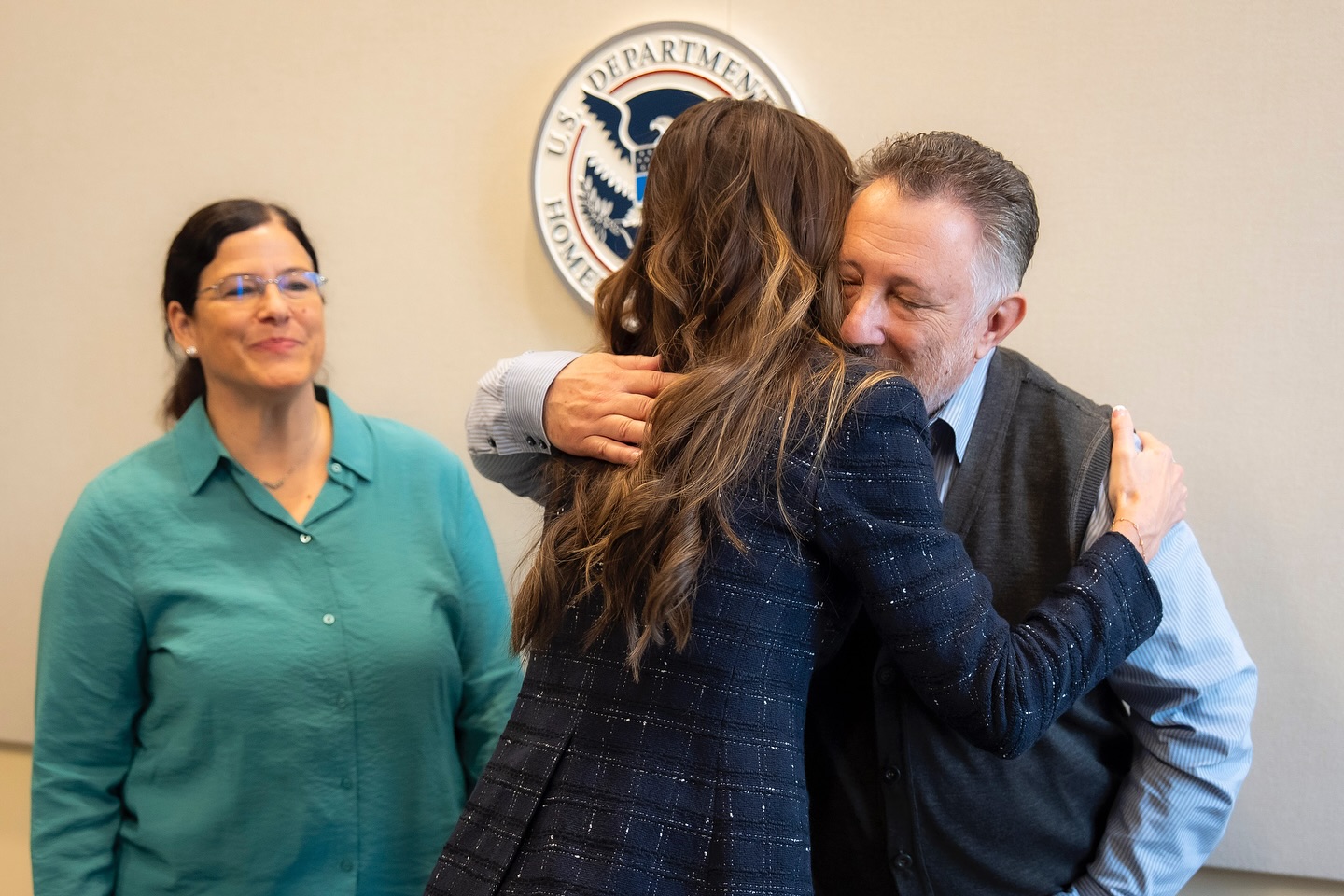
Six months after the death of their son, Yaron Lischinsky, and his girlfriend, Sarah Milgrim — both Israeli Embassy employees — in a shooting outside the Capital Jewish Museum, Daniel and Ruth Lischinsky visited Washington last week, meeting with senior administration officials and visiting the sites where their son lived, worked and, ultimately, died. Speaking to Jewish Insider’s Marc Rod during their time in the U.S. capital, the pair reflected on their son’s life and legacy.
A son’s legacy: “He was a peacemaker. He tried [to make] people understand one [another], talking with the other and not fighting. He was a big fan of the Abraham Accords and he was a peacemaker. He knew that through diplomacy he can reach and he can make achievements,” Daniel Lischinsky said. Ruth Lischinsky said she’s been struck by the number of people that knew her son in Washington.
CAMPUS BEAT

Jewish leaders with ties to Northwestern University are cautiously celebrating a $75 million settlement reached on Friday with the Trump administration to restore federal funding that was frozen earlier this year over allegations that administrators failed to address campus antisemitism, Jewish Insider’s Haley Cohen reports.
What it means: Under the agreement — which will restore at least $790 million in funding that was frozen in April — the Illinois private university agreed to end its commitment to the Deering Meadow agreement, a controversial pact made with anti-Israel encampment participants in the spring of 2024. The agreement allowed students to protest the war in Gaza until the end of the school year so long as tents were removed and encouraged employers not to rescind job offers for student protesters. The document also allowed students to weigh in on university investments — a major concession for students who had demanded the university divest from Israel. The school’s settlement with the Department of Justice also stipulates that Northwestern commit to “clear policies and procedures” around demonstrations, protests and other “expressive activities” and implement mandatory antisemitism training for all students, faculty and staff.
BOOKSHELF
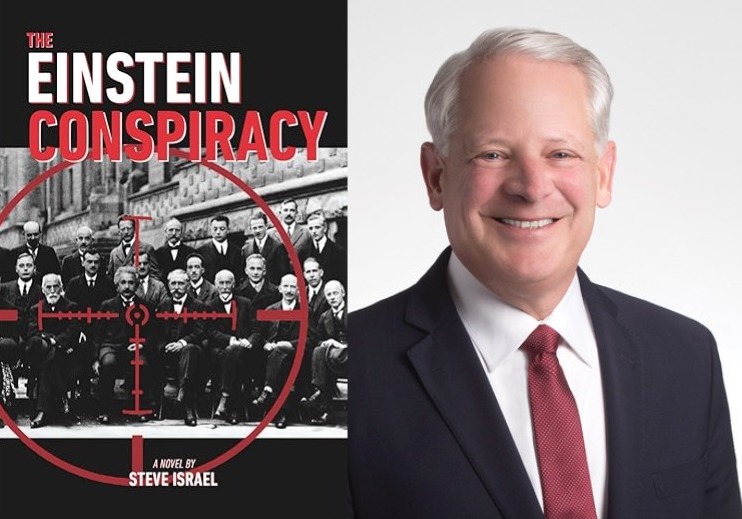
In his latest novel, former Rep. Steve Israel (D-NY) takes readers through a tense spy thriller, with famed physicist Albert Einstein at its center, set against the backdrop of the pro-Nazi movement in America in 1939, Jewish Insider’s Marc Rod reports.
Political moment: Published last week, The Einstein Conspiracy is a fictionalized account of true events, in which the Nazis targeted Albert Einstein to prevent him from helping the United States build an atomic bomb. “The backdrop is the chilling and widespread pro-Nazi movement across America in 1939,” Israel explained to JI. “There was a [Nazi] rally at Madison Square Garden in February 1939 that attracted 20,000 people. On Long Island is a community that used to be known as Camp Siegfried, where the streets were named after Adolf Hitler, Goebbels and Goering. So I’m trying in the book to remind Americans of how close we could have come to staying out of World War II.”
Worthy Reads
Penny Wise: In The Washington Post, philanthropist and Kind founder Daniel Lubetzky considers the overlap in Jewish and American values as he reflects on the rise in global antisemitism. “My maternal grandfather — who fled pogroms in Lithuania and landed on the shores of northern Mexico, where he became a successful cattle rancher — taught his grandchildren about humility and resourcefulness. He used to say, in Spanish, ‘A man who is too arrogant to pick up a penny is not worth a penny.’ The idea harbored by some that picking up a penny is beneath them, and is disgusting in others, isn’t just bad for Jews. Its manifestation today seems to reflect a cultural crisis marked by economic anxiety, frustration and a growing rejection of the very values that have long been the foundation of the American Dream. The crisis has been marked by the emergence of a victim-oppressor mindset; those who feel left behind often believe that they have no agency, and it is all too easy to deflect responsibility onto convenient scapegoats — including those perennial targets, the Jews.” [WashPost]
Qatar Ready For Its Close-up: Variety’s Nick Vivarelli looks at the effort by Qatar to break into Hollywood amid the backdrop of last week’s Doha Film Festival, which kicked off featuring “The Voice of Hind Rajab,” about a Palestinian girl killed in Gaza. “‘We are building the foundations of a world class [film and TV] ecosystem with new infrastructure, production facilities and post-production capabilities supported by vast technology, and data analytics,’ said Hassan Al Thawadi, the Qatari lawyer who oversaw the 2022 World Cup. He is now leading The Qatar Film Committee, an official body that is part of the Media City Qatar hub tasked with driving growth of the country’s entertainment industry. But Al Thawadi made it clear that Hollywood should not be expecting any handouts from Qatar. ‘This agreement is about more than financing films,’ he said, after announcing the relatively modest pact with Neon that involves six to 10 feature films and shorts over a four-year period that Neon will co-finance and distribute. ‘It’s about creating a new platform for Arabic and regional storytelling, ensuring that stories from Qatar and the wider Arab world are seen, celebrated, and shared globally.’” [Variety]
Beyond Denominations: In Tablet, Rabbi Nolan Lebovitz argues that the post-Oct. 7 landscape provides an opportunity for the American Jewish community to find new ways of collaboration and partnership relating to Israel that go beyond the confines of denominations. “We should drop the focus on denominational labels and instead be willing to partner with anyone — Orthodox, Conservative, Reform, and everything in-between — who is a Zionist. Now that the crisis of war is behind us, how do we together foster a new, inspiring Jewish identity of Oct. 8? We can invite rabbis from other regions and other denominations into our communities to speak and to teach to build bonds. We can also work together and pool resources in programming efforts. More communities can work together to share the messages of Zionist thinkers and authors, artists and musicians. Pooling our resources and ideas can help bridge the American Jewish connection with our Israeli brothers and sisters.” [Tablet]
Word on the Street
Rep. Don Davis (D-NC), a pro-Israel stalwart among House Democrats, will run for reelection in his redrawn 1st Congressional District, which under the new state congressional map was won by President Donald Trump by 11 points…
A federal judge ordered the University of Florida’s law school to reinstate a student who had authored a paper arguing that “Jews must be abolished by any means necessary”…
The New York Times interviews former Israeli hostage Segev Kalfon about the more than two years he spent in Hamas captivity in Gaza…
Actor Guy Pearce apologized for sharing antisemitic social media posts, including content that blamed Israel for the Sept. 11 attacks as well as the murder of conservative activist Charlie Kirk…
A tribunal affiliated with the U.K.’s National Health Service suspended for 15 months a British-Palestinian doctor who defended Hamas terrorists as “oppressed resistance fighters” and called Israelis “worse than Nazis”…
U.K. police arrested a man in connection with the deadly attack on a Manchester synagogue on Yom Kippur in which two congregants were killed…
A Nazi soldier photographed executing a Jewish man in the Ukrainian town of Vinnitsa was identified using artificial intelligence decades after the image, whose subjects were unknown, gained notoriety during the trial of Adolf Eichmann…
Wizz Air CEO Jozsef Varadi said the low-cost European carrier plans to open a hub in Israel in early 2026…
Israeli drone manufacturer Heven AeroTech raised $100 million in a round of funding, led by IonQ, that values the company at more than $1 billion…
Iran said it would boycott the 2026 World Cup draw this week in Washington after the U.S. denied visas to members of the soccer team’s delegation…
Iranian Foreign Minister Abbas Araghchi, who met with his Turkish counterpart in Tehran over the weekend, announced a $1.6 billion joint project with Ankara to build a rail link connecting Asia and Europe…
Iran’s Islamic Revolutionary Guard Corps seized an Eswatini-flagged ship carrying oil and more than a dozen crew members as it transited through the Persian Gulf; the incident occurred less than a month after the IRGC seized a Marshall Islands-flagged vessel that originated in the United Arab Emirates…
The Wall Street Journal reports on Iran’s efforts to funnel money to Hezbollah through Dubai-based companies…
In The New York Times’ “Modern Love” column, Rabbi Brent Chaim Spodek reflects on his own marriage and the vows and promises made in his ketubah…
Sen. Cory Booker (D-NJ) and Alexis Lewis, who is Jewish, married in a ceremony co-officiated by Rabbi Matthew Gewirtz, a longtime friend of Booker, in Washington over the weekend…
Tony Award-winning playwright Tom Stoppard, whose “Leopoldstadt” reflected his own life as an assimilated Englishman who did not learn of his family ties to the Holocaust until adulthood, died at 88… Israeli Maj. Gen. (res.) Dan Tolkowsky, who led the Israeli Air Force from 1953-1958 before going on to found the country’s first VC, died at 104… Tekserve co-founder David Lerner died at 72… Architect Robert A.M. Stern, who gained global acclaim for Manhattan’s 15 Central Park West, died at 86… Psychologist Paul Ekman, whose pioneering work on facial recognition was used by Hollywood animators and the FBI alike, died at 91…
Pic of the Day
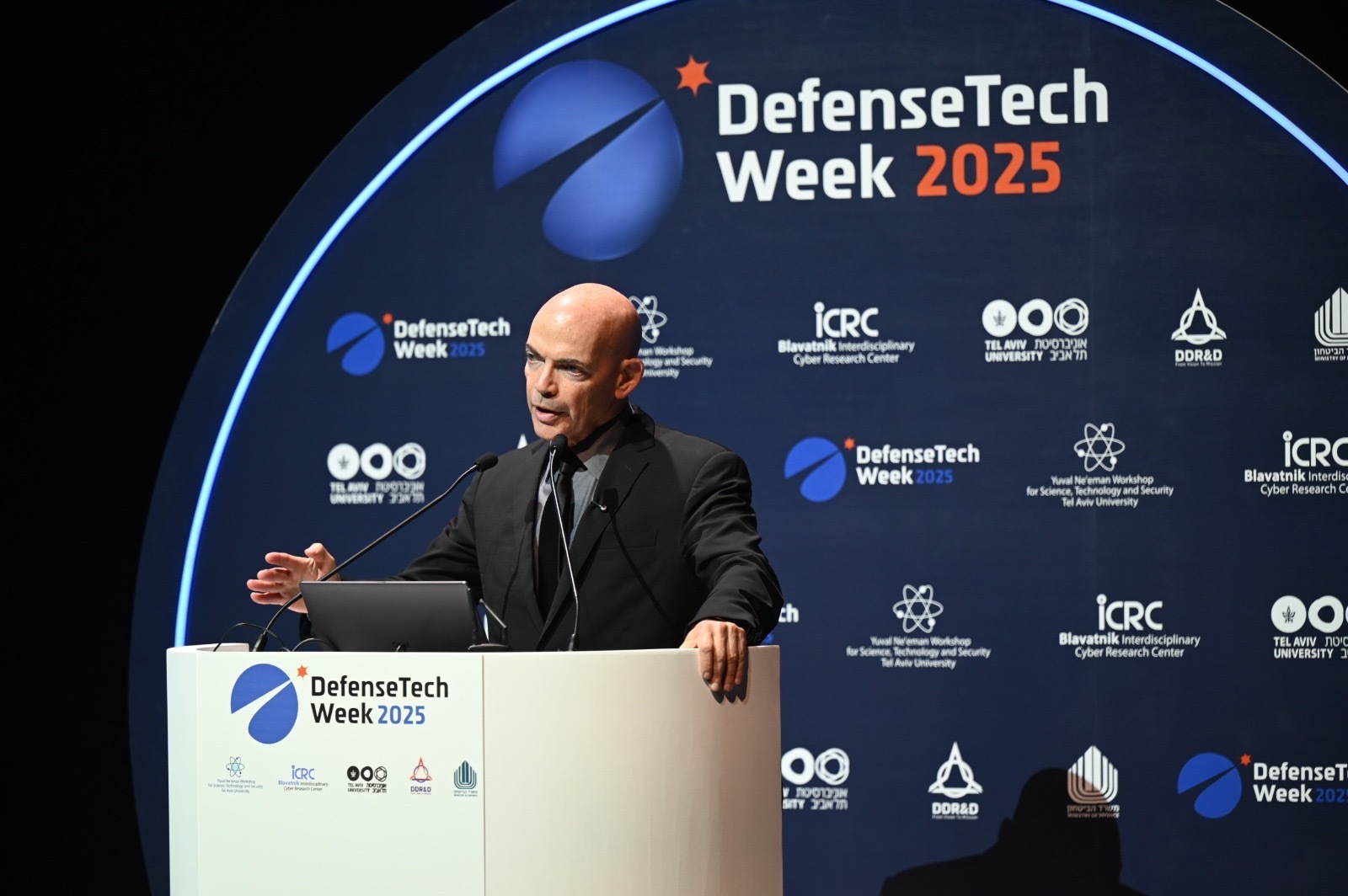
Brig. Gen. (res.) Dr. Daniel Gold, head of the Israel Ministry of Defense Directorate of Defense Research & Development, spoke this morning at the International DefenseTech Summit at Tel Aviv University.
Birthdays
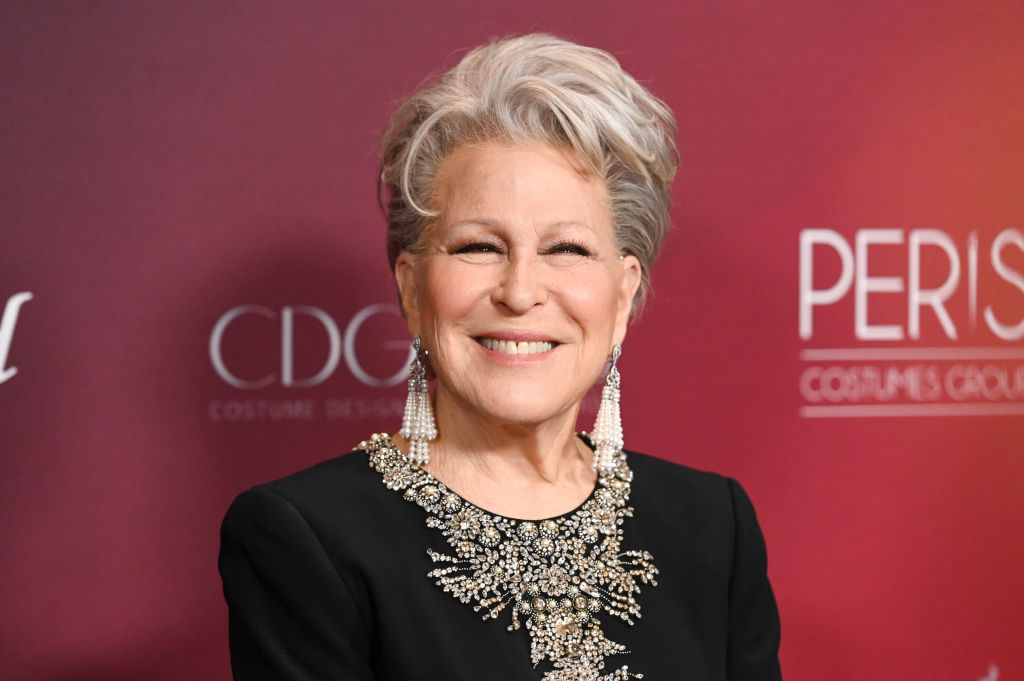
Singer, actress, comedian and author, Bette Midler turns 80…
Former CEO of Marvel Comics and chairman until 2023 of Disney’s Marvel Entertainment, Isaac “Ike” Perlmutter turns 83… Former EVP of Stuart Weitzman, Jane Weitzman… NYC-based real estate mogul, he owned the New York Post, served as chair of NYC’s MTA and is a noted car collector, Peter Kalikow turns 83… Executive producer of over 200 shows with more than 15,000 hours of television over a lengthy career, David E. Salzman turns 82… Comedian, actor and voice actor best known for his starring role in the animated sitcom “Dr. Katz, Professional Therapist,” Jonathan Katz turns 79… Former director of Pardes Institute of Jewish Studies, he is now the director of Yashrut, Rabbi Daniel Landes turns 75… Former president of the American Jewish Committee and a board member at Israel Policy Forum, John M. Shapiro… British playwright, director and scriptwriter who has won many awards for his work on the stage, film and television, Stephen Poliakoff turns 73… U.S. senator (R-FL), Rick Scott turns 73… Newly appointed rabbi at Congregation Beth El of Windsor, Ontario, Rabbi Gordon Fuller… Former chair of the board of the Greater Miami Jewish Federation, Isaac “Ike” Fisher turns 69… U.S. District Court judge in Oregon, Judge Michael H. Simon turns 69… U.S. senator (D-MI), Gary Peters turns 67… CEO of Oracle Corporation until a few months ago, now vice chair of the board, she also joined the board of the recently merged Paramount Skydance, Safra A. Catz turns 64… Professor in the Department of Mathematics and Physics at the University of Cambridge, Raymond E. Goldstein turns 64… Pittsburgh-based entrepreneur, David Seldin… CEO at My Pest Pros in Fairfax County (Virginia), Brett Lieberman… Emmy Award-winning stand-up comedian, actress, producer and writer, Sarah Silverman turns 55… Rabbi of Shaarei Tefillah Congregation in Toronto, Rafi Lipner turns 52… Editorial lead in policy communications on the global affairs team at OpenAI, he is the author of a book on military suicides, Yochi J. Dreazen turns 49… Emmy and Peabody Award-winning director, comedian, producer, writer and actor, Akiva Schaffer turns 48… Marketing and communications executive, Natalie Ravitz… Editor-in-chief at Jewish Insider, Josh Kraushaar… Writer and television producer, including for NBC’s primetime series “Brooklyn Nine-Nine,” Evan Daniel Susser turns 40… English teacher at Jerusalem’s Inbar School, the first secular, girls-only middle-high school in Israel, Shira Sacks… Senior advisor to U.S. Ambassador to Israel Mike Huckabee, David Milstein… Mexican musician influenced by Sephardic brass and klezmer styles, known by his mononym “Sotelúm,” Jorge Sotelo turns 36… Becky Weissman…
The deal reached last week ends the agreement made between the university and anti-Israel student protesters in the spring of 2024

Vincent Alban for The Washington Post via Getty Images
Northwestern University in Evanston, Ill. on Saturday, October 5, 2024.
Jewish leaders with ties to Northwestern University are cautiously celebrating a $75 million settlement reached on Friday with the Trump administration to restore federal funding that was frozen earlier this year over allegations that administrators failed to address campus antisemitism.
Under the agreement — which will restore at least $790 million in funding that was frozen in April — the Illinois private university agreed to end its commitment to the Deering Meadow agreement, a controversial pact made with anti-Israel encampment participants in the spring of 2024. The agreement allowed students to protest the war in Gaza until the end of the school year so long as tents were removed and encouraged employers not to rescind job offers for student protesters. The document also allowed students to weigh in on university investments — a major concession for students who had demanded the university divest from Israel.
The school’s settlement with the Department of Justice also stipulates that Northwestern commit to “clear policies and procedures” around demonstrations, protests and other “expressive activities” and implement mandatory antisemitism training for all students, faculty and staff.
“This is a major victory in the administration’s efforts to root out institutionalized antisemitism on college campuses,” Rich Goldberg, a senior advisor at the Foundation for Defense of Democracies who holds bachelor’s and master’s degrees from Northwestern, told Jewish Insider. “The White House won a complete termination of the deal Northwestern had cut with its pro-Hamas encampment along with an important ban on disrupting the campus while wearing masks. Now comes implementation and enforcement to ensure life improves for Jewish students and the university’s antisemitic DEI infrastructure gets fully dismantled.”
Goldberg said he’d also like to see Northwestern “welcome Chabad on to campus as a recognized Jewish organization, which would send a strong next signal of the university changing direction.”
“The agreement contains important commitments, but Northwestern has an extensive record of failing to enforce its own policies,” the Coalition Against Antisemitism at Northwestern said in a statement to JI. “The real test is whether the university finally delivers safety and equal treatment for Jewish students. We intend to monitor every step of implementation.”
“This agreement reflects progress, but Northwestern’s leadership still has a long way to go,” said CAAN, a coalition of Northwestern students, parents, alumni, faculty and trustees. “Jewish students have endured two years of escalating hostility, and trust will only be rebuilt through real enforcement.”
Michael Simon, executive director of Northwestern Hillel, told JI that in light of the deal, “We reiterate Northwestern Hillel’s unwavering commitment to working with University administrators, faculty and community partners to build on efforts underway to combat antisemitism and promote a campus climate that is safe and conducive to learning and exploration for everyone at Northwestern. The entire campus community has a critical role to play in countering antisemitism and all forms of hate.”
The settlement comes two months after Michael Schill, Northwestern’s former president, announced his resignation amid a series of controversies during his brief tenure. When anti-Israel encampments emerged on college campuses across the country in spring 2024, Schill, who is Jewish, became the first university president to strike a deal with demonstrators. The deal allowed the students to avoid disciplinary action taken and acceded to several demands of the protesters, which drew strong condemnation from many Jewish leaders at the time. In an August interview with the House Committee on Education and Workforce, Schill appeared unfazed to hear that a Palestinian professor he hired as part of the deal with encampment protesters had once met with slain Hamas leader Yahya Sinwar.
At the time of Schill’s resignation, Jewish alumni expressed optimism that his departure, and the House interview being made public, would lead Northwestern leaders to make reforms. Henry Bienen, who served as Northwestern president from 1995-2009, assumed the role of interim university president in September. Bienen previously established Northwestern’s Qatar campus, which has faced scrutiny for faculty ties to Hamas.
Bienen said in a video statement that under the settlement, the school would retain its academic freedom and autonomy from the federal government.
“There were several red lines that I, the board of trustees and university leadership refused to cross. I would not have signed anything that would have given the federal government any say in who we hire, what they teach, who we admit or what they study,” Bienen said. “Put simply, Northwestern runs Northwestern.”
Northwestern is required to pay $75 million to the federal government through 2028 without the use of donor funds. The figure is the second-highest fine any university has agreed to pay to the Trump administration so far, following Columbia University’s settlement of more than $200 million to the government in July. Several other elite institutions have reached deals with the Trump administration in recent months, including Columbia, Cornell University, Brown University, the University of Virginia and the University of Pennsylvania. Some of the settlements, such as Brown’s, have focused primarily on money, rather than campus reforms.
“Today’s settlement marks another victory in the Trump Administration’s fight to ensure that American educational institutions protect Jewish students and put merit first,” Attorney General Pam Bondi said in a statement. “Institutions that accept federal funds are obligated to follow civil rights law — we are grateful to Northwestern for negotiating this historic deal.”
Nysmith School for the Gifted will adopt the IHRA definition of antisemitism and will provide students and staff with antisemitism education

Lexey Swall/GRAIN for The Washington Post via Getty Images
Nysmith School for the Gifted opened in 1983 with 55 children, they now teach more than 600 students ranging from Pre-K to eighth grade.
A private K-8 school in Northern Virginia reached a settlement on Tuesday with the parents of an 11-year-old Jewish student who say their daughter faced months of antisemitic harassment that went unaddressed by school officials.
According to the complaint, filed in July with the Office for Civil Rights in the Virginia Attorney General’s Office by the Louis D. Brandeis Center for Human Rights under Law and Washington-based firm Dillon PLLC, the student faced several antisemitic incidents while a student at Nysmith School for the Gifted in Herndon, Va., including a history class where students were asked to work together to create a large drawing featuring the attributes of “strong historical leaders.”
The students collaborated on a large artistic rendering featuring Adolf Hitler’s face. The parents learned of the project only after Nysmith School posted a photo of the children holding up their project, which is reproduced in the complaint. The student was also told that Jews are “baby killers” and that they deserved to die because of the Israel-Hamas war.
Kenneth Nysmith, the headmaster and owner of Nysmith, told the parents to tell their daughter to “toughen up” when they asked the school to take steps to address the bullying, according to the complaint.
Two days later, on March 13, the headmaster sent the parents an email stating all three of their children — a son in the second grade and two daughters in the sixth grade — were expelled effective that same day. The complaint does not address any reason that Nysmith provided for the expulsions but noted that the children had no disciplinary record.
In addition to the harassment, the complaint notes that Nysmith canceled an event featuring a Holocaust survivor due to concerns that the event might exacerbate tensions within the school community related to the Israel-Hamas war.
Under the terms of the settlement, in addition to monetary relief to the family, Nysmith School agreed to establish a committee to review and investigate discrimination complaints — with an independent monitor evaluating the committee’s work. It also agreed to adopt the International Holocaust Remembrance Alliance’s working definition of antisemitism and to provide staff with annual antisemitism training and students with annual education on antisemitism and the Holocaust for the next five years.
The training will be led by the Jewish Community Relations Council of Greater Washington. Nysmith, headmaster of Nysmith School, agreed to issue a public statement apologizing for expelling the children and making them feel unwelcome based on religious identity.
Kenneth Marcus, chairman of the Brandeis Center, said that the settlement sends “a clear message, one that demonstrates accountability and willingness to improve. It is our hope that other schools and universities around the country will follow suit.”
The Association of Legal Aid Attorneys agreed to pay $315,000 and acknowledge misconduct after pushing an anti-Israel resolution shortly after Oct. 7, 2023
Alex Wong/Getty Images
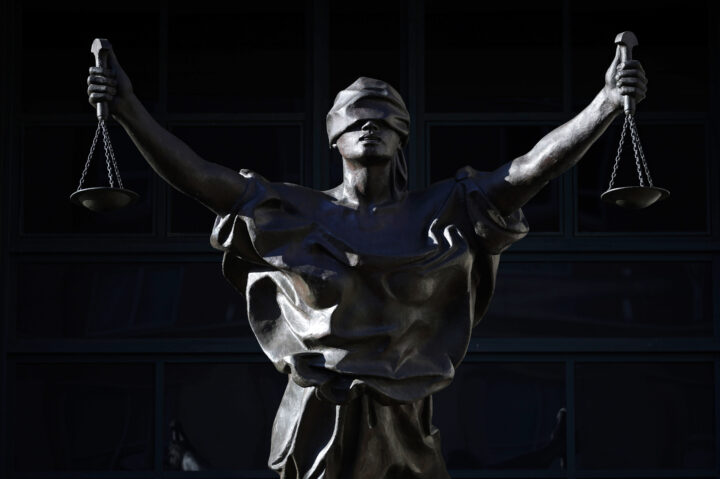
The statue titled "Justice Delayed, Justice Denied" stands on the front of the Albert V. Bryan United States Courthouse in Alexandria, Va.
The Association of Legal Aid Attorneys, a union representing over 3,000 legal workers, has acknowledged “inappropriate” communication around Israel and antisemitism as part of a settlement reached on Thursday brought on behalf of three union members who sued to block an anti-Israel resolution proposed weeks after the Oct. 7, 2023, terrorist attacks.
Under the agreement, ALAA, part of Local 2325 of the United Auto Workers, will pay the plaintiffs $315,000 in monetary damages and will refer all disciplinary charges brought against members to the union’s outside counsel for review. The union also agreed to implement mandatory training for its executive board to understand its obligation to ensure its members rights are being protected.
“The training is not on antisemitism per se, but the expectation is that there will be discussions about how discriminatory animus could motivate violations of union members’ bill of rights,” Rory Lancman, director of corporate initiatives and senior counsel at the Louis D. Brandeis Center for Human Rights Under Law, told Jewish Insider.
The lawsuit was filed in September 2024 by the Brandeis Center. In their federal court complaint, plaintiffs described being targeted as “snitches,” “losers,” “disgusting,” “dictators in training” and “Zionist ghouls” in the ALAA’s internal discussion boards.
The resolution, which was passed by a majority of ALAA members in November 2023, called for an immediate ceasefire in the Israel-Hamas war, denounced Israel’s “colonial apartheid occupation” of Gaza, opposed “any future military aid” to Israel and called for the U.S. to cut ties with the Jewish state.
Plaintiffs said they were accused of “spreading lies and misinformation” by talking about “Jewish babies being murdered, and women being raped” on Oct. 7.
This settlement comes following a U.S. district court ruling in July that federal labor law claims brought by union members against the ALAA could proceed, rejecting the ALAA’s motion to dismiss.
The case is part of a larger trend of rising antisemitism and opposition to Israel in labor unions, many of which historically had been supportive of Israel, dating back nearly a century, when many American unions donated money to the Hisdarut, Israel’s national labor union.
In February 2024, the AFL-CIO, which represents more than 12 million workers, called for a ceasefire in Gaza.
Kenneth Marcus, chairman of the Brandeis Center, called the reversal of Israel support in labor unions a “bitter irony.”
“Labor unions are supposed to be advocates for social justice and workplace equality,” Marcus said in a statement. “To find the oldest hatred in such places is deeply antithetical to their mission. This settlement is a landmark in the fight against antisemitism in this sector. I am gratified by this outcome and resolved to support Jewish workers at any union around the country that is seeing this problem arise. Based on what we are hearing around the country, there will be more of these cases coming.”
The Ivy League school will pay $60 million and agree to comply with civil rights laws against antisemitism

Matt Burkhartt/Getty Images
A man walks through the Cornell University campus on November 3, 2023 in Ithaca, New York.
Cornell University agreed to conduct “annual surveys to evaluate the campus climate for students, including the climate for students with shared Jewish ancestry” as part of an agreement it reached with the Trump administration on Friday.
The settlement will restore more than $250 million in federal funding that was cut from the Ivy League school earlier this year, over allegations that it failed to address campus antisemitism. The annual surveys will “ask students whether they feel welcome at Cornell; whether they feel safe reporting antisemitism at Cornell; and whether they believe the changes Cornell has made since October 2023 have benefited the Cornell community.”
The federal government concluded that Cornell is not in violation of Title VI of the Civil Rights Act of 1964 and has closed the relevant investigations.
“I am pleased that our good faith discussions with the White House, Department of Justice, and Department of Education have concluded with an agreement that acknowledges the government’s commitment to enforce existing anti-discrimination law, while protecting our academic freedom and institutional independence,” Cornell President Michael Kotlikoff told Jewish Insider on Friday. “These discussions have now yielded a result that will enable us to return to our teaching and research in restored partnership with federal agencies.”
Under the terms of the settlement, in which Cornell agreed to pay $60 million — half to the government and the other $30 million toward research that will support U.S. farmers — the university must also ensure it is in compliance with government civil rights laws and provide admissions data to the government to ensure race is not considered a factor in admissions.
The settlement includes a provision stating that the university and government both “affirm the importance of and their support for academic freedom.” It also said that no part of the settlement could be “construed as giving the United States authority to dictate the content of academic speech or curricula.”
Menachem Rosensaft, an adjunct professor of law at Cornell Law School who teaches about antisemitism in the courts, called the settlement a “significant victory for Cornell.”
“It is proof that the Cornell administration under President Kotlikoff has in fact been doing — and is doing — everything in its power, and everything that is appropriate within the restraints posed by academic freedom, to protect its Jewish students, faculty and staff against any type of antisemitic discrimination, just as it is protecting all members of the Cornell community from Title VI or Title IX based discrimination,” Rosensaft told JI.
“Of course there remains work to be done to fight against antisemitic manifestations at Cornell, just as there is at virtually every university and college in this country. But the settlement is proof that Kotlikoff and his administration are fully invested and engaged in this fight.”
The six-page agreement comes weeks after a similar one was signed by the University of Virginia; however, the Charlottesville campus’ settlement did not explicitly address Jewish students. Columbia University, Brown University and the University of Pennsylvania also cut deals with the government earlier this year. The Trump administration is still reportedly in talks to reach agreements with Harvard University and the University of California.
The move from Cornell comes as its graduate student union is considering a BDS resolution that accuses Jewish students of “weaponizing antisemitism” and blames labor disputes on “Zionist interests” — where, unlike many other unions, dues are mandatory.
In the immediate aftermath of the Oct. 7, 2023 attacks in Israel, Cornell made headlines for several high-profile incidents. Those included a student’s online threats to shoot Jewish students at the kosher dining hall — and, following a leave of absence, the return to campus earlier this year of Russell Rickford, an associate professor of history who called Oct. 7 “exhilarating” and “energizing.”
Cornell’s former president, Martha Pollack, issued a set of recommendations aimed at countering antisemitism in May 2024. Pollack resigned in July 2024, citing “enormous, unexpected challenges” on campus amid the Israel-Hamas war.
McMahon said Harvard has already started to make changes requested by the federal government ‘and that is the ultimate goal of our investigation’
Zach Miller Photography
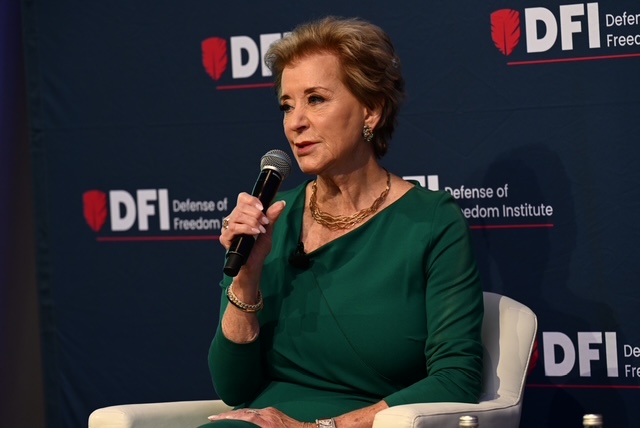
Education Secretary Linda McMahon speaks at the Federalist Society and the Defense of Freedom Institute’s annual Education Law & Policy Conference on Sept. 17, 2025.
Education Secretary Linda McMahon said on Wednesday that the Trump administration’s goal is not to engage in a prolonged legal battle with Harvard University and expressed hope that the federal government would be able to reach a settlement that delivers meaningful reforms to the elite campus.
McMahon made the comments while appearing at the Federalist Society and the Defense of Freedom Institute’s annual Education Law & Policy Conference on Wednesday morning, after being asked during a moderated conversation with Washington Examiner news editor Marisa Schultz where negotiations between Harvard and the administration stand.
“I’m certainly hopeful on the settlement. I have spoken to Alan Garber, their very good president, at the very beginning of this. I haven’t spoken to him since, but I do think that with the idea that Harvard has already started to take certain measures to change what they were doing, I certainly hope that there will be an agreement,” McMahon said. “It’s not our goal to have to go to court to make people abide by the law, to make universities abide by the law.”
Getting specific, the education secretary explained that, “Harvard has already started to put in place some of the things we wanted them to do. They reassessed their Middle East policies. They actually fired a couple of their professors. They are looking at having safe measures on campus, and so without even admitting any guilt in any way, they have started to change their policies, and that is the ultimate goal of our investigation, of making sure that things are proper on campus.”
Asked by Schultz about the ongoing negotiations with the University of California, Los Angeles and other schools, and how the settlements fit into the Trump administration’s “big picture mission for elite universities and colleges in America,” McMahon said that their “goal is really not to be punitive necessarily, but to have universities, I think, return to what we all believe that universities started out to be.”
“It’s not to be punitive. That’s really not the goal. The goal is to make them change their policies and practices, and if they are not in compliance with the law, then surely we’re going to insist they are, or they won’t receive federal funding,” she said.
The education secretary said she believed it was in the best interest of all parties to reach settlements rather than risk upending the more than $2 billion in research grants that Harvard receives from the federal government. “The federal funding for Harvard, not only for students who attend, for their tuition, but also the amazing amount of research funding — they get over $2 billion, almost $3 billion — is very significant to those scientists and professors who were there, who have grants and who are working on their own projects,” McMahon said.
“They can take that grant money and go somewhere else, if it’s a grant directly to them, so I think it’s in Harvard’s interest to continue to negotiate. I think it’s in all of our interests for Harvard and for all of the other universities that we are sending letters to, that we are investigating, and there are others. Hopefully there will be these settlements with all of them, because basically, we just want them to do right,” she explained.
McMahon made a similar remark about the importance of protecting research grants while discussing the administration’s settlement with Columbia University reached over the summer, which followed a protracted legal battle.
“We eventually reached an agreement with Columbia,” McMahon said. “They will pay a fine back to the United States government. Their funding will be released again, and it’s primarily research funding. I believe our universities do some of the most incredible research in the country. We want them to be able to do that, but they have to abide by the law. They have to abide by Title VI, they have to abide by Title IX. They have to be worthy to receive the funds that they are receiving from the United States government.”
The comments mark the first time McMahon has publicly shared her thoughts on what outcome she would like to see from the federal government’s negotiations with Harvard University amid an ongoing dispute between different factions within the Trump administration over the effectiveness of the ongoing negotiations and settlements with universities.
While some officials are focused on any deal that would secure strong reforms to address antisemitism and other civil rights issues, others are looking for securing large payouts to appease President Donald Trump.
“There’s growing dissatisfaction with the White House letting universities buy their way out of accountability with no meaningful change. It’s clear they’ve been totally out-negotiated,” one source familiar with the negotiations told JI earlier this month of the situation.
Trump said late last month that he expected Harvard to pay at least $500 million to restore its more than $2 billion in federal funding. “We want nothing less than $500 million from Harvard. Don’t negotiate, Linda. They’ve been very bad. Don’t negotiate,” Trump said while addressing McMahon at a Cabinet meeting. (McMahon acknowledged Trump’s remarks in the moment but did not respond further.)
Pressed on Wednesday about Trump’s comments and the fact that a federal judge in Boston blocked the administration’s freeze on Harvard’s research grants earlier this month, McMahon noted that they plan to appeal the ruling and said the government was in a strong position in its fight against the university.
“We’re still in the throes of negotiating with Harvard. They filed a lawsuit, they won the first round, and one of the things they were claiming was that the steps that we were asking of them would violate First Amendment rights, and that’s just not true. I think that we have a really good case against Harvard,” McMahon said.
SJP filed the First Amendment suit when UMD revoked its permit for an anti-Israel protest on the Oct. 7 anniversary

Loop Images/Universal Images Group via Getty Images
The McKeldin Library at the University of Maryland
The University of Maryland, College Park and Maryland’s attorney general have asked the state to approve their joint request to settle a First Amendment lawsuit brought by the school’s Students for Justice in Palestine chapter.
The request to settle the case, which was not previously publicly available information, was revealed in a memo detailing the agenda for an impending meeting of the Maryland Board of Public Works, which oversees matters impacting the state university system. The university’s settlement, according to the agenda posted to BPW’s website ahead of a Wednesday board meeting, would provide $100,000 to defendants through the CAIR Legal Defense Fund, an arm of the Council on American-Islamic Relations.
“The University of Maryland College Park and the Office of the Attorney General recommend paying $100,000 to settle all claims, including attorneys’ fees, as in the best interest of the State,” the memo reads.
The University of Maryland declined to comment to Jewish Insider about its request to settle and Maryland Attorney General Anthony Brown did not respond to JI’s request for comment.
On behalf of UMD SJP, CAIR and Palestine Legal filed a lawsuit against the university’s College Park campus last September alleging a violation of the students’ free speech after UMD President Darryll Pines announced that the school had canceled an SJP-sponsored anti-Israel rally slated for the first anniversary of the Oct. 7 terrorist attacks.
UMD initially granted SJP a permit last August to hold the Oct. 7 demonstration on the campus’ central McKeldin Mall, prompting swift backlash and calls from campus groups including Hillel and the Jewish Student Union — and from former Maryland Gov. Larry Hogan, who was running for the Senate at the time — for the school to reverse course.
After the university canceled the protest, SJP filed a lawsuit stating that its First Amendment rights had been violated and a federal judge wrote in an opinion that the group “has demonstrated a substantial likelihood that it will prevail [in its lawsuit] on the merits of its freedom of speech claim.” The university then backtracked a second time and ultimately allowed the demonstration to take place, but the lawsuit moved forward.
Pines said at the time that the initial decision to cancel the event — and all events scheduled for Oct. 7, other than university sponsored ones — was made following a “safety assessment,” which, he added, did not identify any threats to the campus.
Einav Tsach, a rising senior studying journalism and business, told JI that amid turmoil around the SJP demonstration, Jewish students still “came together as a strong, vibrant Jewish campus community to mark the one-year anniversary of the horrors perpetrated by Hamas.”
As the second anniversary of the Oct. 7 attacks approaches this fall, Tsach, the former leader of Mishelanu, an on-campus Israeli-American cultural association, said that Jewish UMD students “remain focused on marking this solemn day in the most meaningful way possible.”
Other than the controversy around last year’s demonstration, UMD, which has one of the largest Jewish student populations in the country — nearly 20% of the College Park undergraduate student body of more than 30,000 is Jewish — has largely avoided egregious incidents of antisemitism that have occurred on other college campuses.
Jewish students said their ‘support is contingent on enforcement’ and called the deal ‘not the end of the story’ but ‘an important start’
CHARLY TRIBALLEAU/AFP via Getty Images
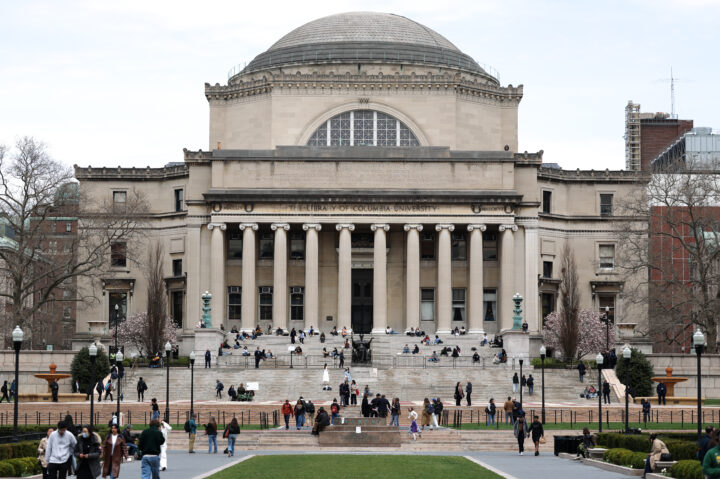
Students are seen on the campus of Columbia University on April 14, 2025, in New York City.
Jewish leaders on and off Columbia University’s campus praised the settlement reached last week between the university and the Trump administration to restore some $400 million in federal funding that was slashed in March due to the Ivy League’s record dealing with antisemitism.
While some Jewish leaders, students and alumni are taking a wait-and-see-approach, others expressed cautious optimism that the deal could lead to a safer environment for Jewish students following nearly two years of antisemitic protests and disruptions on campus in the aftermath of the Oct. 7, 2023, Hamas terror attacks in Israel.
“I am heartened to see the resolution agreement for several reasons,” Adam Lehman, president and CEO of Hillel International, told Jewish Insider last week. “It recognizes both the clear, egregious violations of the civil rights of Jewish students and staff at Columbia and Barnard [an affiliate of Columbia] during the past two academic years, and the concrete steps Columbia has recently pursued to address these issues.”
Those steps, publicized last week, included further incorporating the International Holocaust Remembrance Alliance’s working definition of antisemitism by requiring its Office of Institutional Equity to embrace the definition; appointing a Title VI coordinator to review alleged violations of the Civil Rights Act; requiring antisemitism training for all students, faculty and staff; and refusing to recognize or meet with Columbia University Apartheid Divest, a coalition of over 80 university student groups that Instagram banned earlier this year for promoting violence.
The school also announced last week that disciplinary action and rules surrounding student protests would be moved out of the purview of the faculty-run University Senate and into the provost’s office, a move called for by pro-Israel students. Columbia also agreed to pay a $200 million settlement over three years to the federal government.
“Importantly, it also restores the university’s ability to pursue essential medical and scientific research with access to federal funding support,” Lehman said. “I hope and trust that the university will use this important resolution to see through its recent commitments to foster a campus environment that will be safer and more welcoming for Jewish students, and all students, moving forward.”
Still, some said that key reforms are missing from the deal, which falls short of several demands initially made by the Trump administration. Among the demands were putting the Middle Eastern, South Asian and African studies department and the Center for Palestine Studies under the purview of a senior vice provost, who would be appointed by the university to supervise course material and non-tenure faculty hiring, as well as the formation of a presidential search committee to replace acting President Claire Shipman.
In addition to the fine, the university has agreed to settle investigations brought by the U.S. Equal Employment Opportunity Commission for $21 million. A number of open Title VI investigations into the university alleging harassment of Jewish students will also be settled and the university will abide by laws banning the consideration of race in admissions and hiring. Columbia, which did not admit to wrongdoing in the deal, said it will continue to have “autonomy and authority over faculty hiring, admissions, and academic decision-making.”
“I’m on board [with the settlement] but my support is contingent on enforcement,” said Shoshana Aufzien, an incoming sophomore in the dual program between Barnard College and the Jewish Theological Seminary. At the same time, Aufzien said that “the scope of the settlement is unclear” and “many of the reforms mentioned are existing legal obligations” for recipients of federal funding, such as the appointment of a Title VI coordinator.
Lishi Baker, a rising Columbia senior studying Middle East history, called the settlement “an important moment for the Jewish community, Columbia, higher education and the United States more broadly. Getting federal funding back and committing to the work of positive reform within the university is a good thing,” Baker told JI.
“This deal is not the end of the story. It is an important start. Reforming Columbia for the better is a long-term endeavor that could never be covered in one deal, and need not be overly intertwined with the government.”
Eden Yadegar, a former president of the Columbia chapter of Students Supporting Israel who graduated in the spring with Middle East studies and modern Jewish studies degrees, told JI she is “grateful to the federal government for prioritizing the fight against antisemitism in higher education, and hope this deal is the beginning of what will be sustained change at Columbia.”
“I’m holding my breath to see if and how things will change for Jewish and Israeli students in September. There is undoubtedly plenty more work to do and the Jewish community is not going to back down from doing it and holding Columbia accountable,” Yadegar said.
The Anti-Defamation League called the settlement “an important next step in fighting antisemitism and hate on their campus, along with restoring federal funding needed for critical research.”
But others raised concerns that the settlement does not include the structural reforms initially demanded in the Trump administration’s letter to Columbia in March.
“The deal stops short of necessary internal reforms, such as discipline and review of faculty leadership for those who participated in encampments or violated other campus policies,” Inbar Brand, who graduated in the spring from Columbia’s dual-degree program with Tel Aviv University, told JI. “Worst to me is that this deal is a closing of the Title VI investigation without any admission of guilt by Columbia.”
A source familiar with the negotiations told JI that “while the [Trump] administration spins the deal as a win, the reality is it caved and let Columbia pay a fine and continue business as usual under a toothless monitor with no meaningful reforms.”
The settlement “lets Columbia off the hook in advance of presidential selection, meaning [that there’s] no incentive to pick a president committed to reform,” the source said, referring to the ongoing search for a permanent president.
The Trump administration is in talks with several other universities that have faced similar funding cutoffs, including Harvard, Cornell and Northwestern.
Among other actions, Barnard College agreed to hire a coordinator to review allegations of Title VI violations and refuse to meet with anti-Israel campus groups

Lishi Baker
Milbank Hall on Barnard College campus on February 26, 2025 as the building was occupied by anti-Israel protesters for six hours.
Barnard College reached a settlement on Monday in a lawsuit brought by Jewish students which claimed that the school violated Title VI of the Civil Rights Act of 1964 by failing to address antisemitism.
Under the agreement reached, Barnard will adopt an anti-masking policy at demonstrations; refuse to meet with anti-Israel campus groups, including Columbia University Apartheid Divest; “consider” adoption of the International Holocaust Remembrance Alliance’s working definition of antisemitism; require students, faculty and staff to complete antisemitism training; and expand its discipline policy to include harassment that occurs off campus or online.
Barnard will also hire a coordinator to review new allegations of Title VI violations and agreed not to divest from companies that have ties to Israel.
The complaint, Students Against Antisemitism, Inc. et al v. The Trustees of Columbia University in the City of New York, filed in district court in New York in February 2024 against Columbia University and Barnard, detailed several instances of antisemitism, including physical assaults of Jewish students. The complaint alleges that faculty members and students routinely referred to Hamas’ Oct.7, 2023 attacks as “awesome” and a “great feat.”
Barnard also recently expanded its partnership with the Jewish Theological Seminary. Jewish studies courses at JTS — located near Barnard’s Morningside Heights campus — will now count toward Barnard degree requirements, with students able to participate with no additional tuition costs.
Laura Ann Rosenbury, president of Barnard, said in a statement that the settlement “reflects our ongoing commitment to maintaining a campus that is safe, welcoming, and inclusive for all members of our community.”
Monday’s settlement comes as Barnard — which is closely affiliated with Columbia but has independent administration and affiliation — remains under investigation by the Trump administration for violating Title VI.
Barnard faced several major incidents of antisemitism on its campus during the last academic year. A staff member was assaulted and sent to the hospital in February by anti-Israel demonstrators who stormed the college’s main administrative building and remained there for several hours, chanting “resistance is justified when people are occupied” and “intifada revolution.”
The demonstration was a response to the school’s decision just days earlier — in its most forceful response to anti-Israel activity on campus to date — to expel two second-semester seniors who disrupted a “History of Modern Israel” class on Columbia’s campus by storming in, banging on drums and distributing posters to students that read “CRUSH ZIONISM.”
Marc Kasowitz of Kasowitz LLP, counsel for the plaintiffs, praised Barnard’s “commitment to take meaningful actions to combat antisemitism demonstrates its leadership in the fight against antisemitism and upholding the rights of Jewish and Israeli students.”
Kasowitz continued, “These commitments are not only the right thing to do, but are essential to creating a welcome and inclusive campus for all members of the Barnard community. I encourage other colleges and universities to do the right thing and follow Barnard’s lead.”
Please log in if you already have a subscription, or subscribe to access the latest updates.
 Continue with Google
 Continue with Apple