































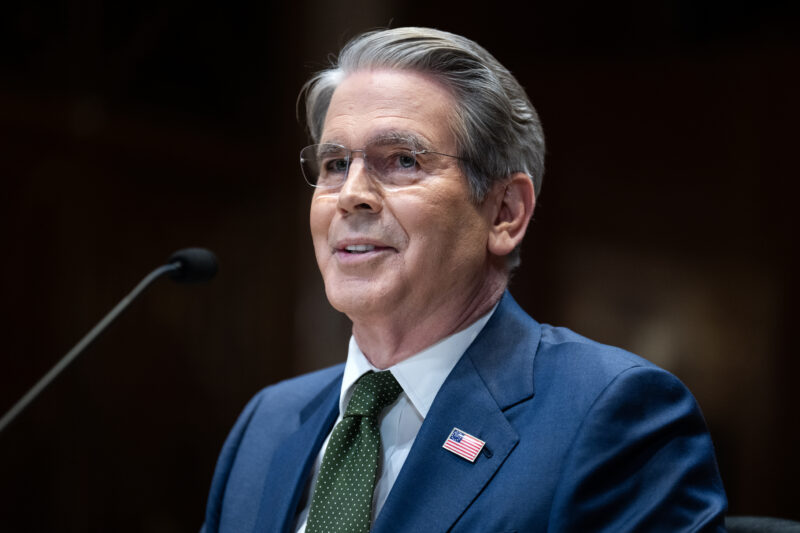








‘An overriding goal that has been one of my most profound concerns since coming to the United States Senate is to preserve bipartisan support for Israel,’ Blumenthal told JI
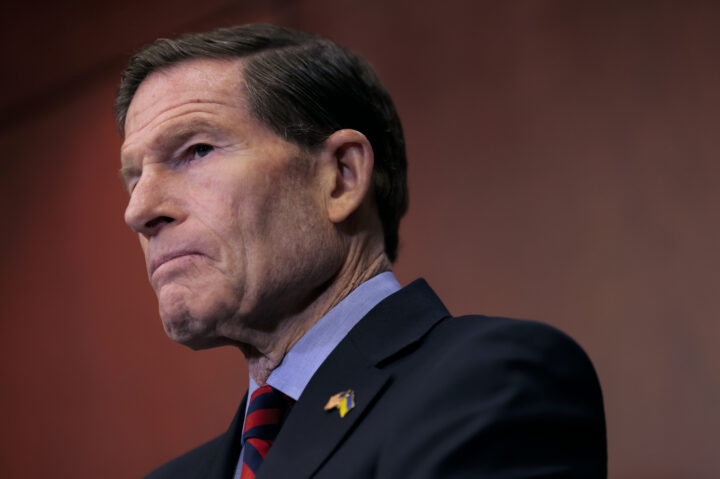
Heather Diehl/Getty Images
Sen. Richard Blumenthal (D-CT) holds a press conference at the U.S. Capitol on March 03, 2026 in Washington, DC.


 Add JewishInsider on Google
Sen. Richard Blumenthal (D-CT), one of just seven Senate Democrats to vote last week against resolutions to block U.S. arms sales to Israel, said that he wants to maintain and restore bipartisan support for Israel.
“An overriding goal that has been one of my most profound concerns since coming to the United States Senate is to preserve bipartisan support for Israel,” Blumenthal told Jewish Insider in a brief interview on Wednesday. “I partnered with [former Sen.] John McCain (R-AZ) on traveling to the Middle East and to Israel a number of times. He believed powerfully, as I do, that the cause of Israel’s security has to be bipartisan, and I will adhere to that goal as long as I’m in this body.”
Asked how that support on the Democratic side can be restored, he said that he doesn’t have a silver bullet, but he’s “going to work at it every day,” reaching out to colleagues on both sides of the aisle, even those who disagree with him, to work on the issue and travel to the region.
“I will take advantage of every opportunity to make sure that we are as bipartisan as possible, and I resent and oppose anyone who tries to use Israel as a wedge issue politically,” he said. “We need to make decisions on the merits of our own national interests and security.”
He said that he has family in Israel and in the IDF, but his support for Israel comes from it being one of the U.S.’ closest allies and the U.S.-Israel relationship being “vital to our own national security” through military cooperation, intelligence sharing and technological, academic and educational cooperation.
“My argument to my colleagues is that Israel is an ally in a dangerous world,” he continued.
He said he’s also working “fervently” toward normalizing relations between Israel and Saudi Arabia and other Gulf states, a goal he said was “very close” prior to the Oct. 7, 2023, Hamas attacks.
“But it’s a very powerful, long-range dynamic that serves everyone’s interests, including our own,” Blumenthal said, describing normalization as an issue that “could bring us together again, to more robust bipartisan support.”
Asked during a Tuesday press conference about the anti-Israel shift in the Democratic Party, Senate Minority Leader Chuck Schumer (D-NY), another one of the seven Democrats who opposed the effort to block weapons sales, pivoted to discussing the war in Iran.
“Our caucus is united and focused on ending the war in Iran,” Schumer responded.
Sen. Tommy Tuberville, who also sits on the Armed Services Committee, which was briefed Tuesday morning, strongly denied that ground troops would be necessary

Jemal Countess/Getty Images for Fair Share America
Sen. Richard Blumenthal speaks at a rally at the Capitol on April 10, 2025 in Washington, DC.
Sen. Richard Blumenthal (D-CT), following a classified briefing for the Senate Armed Services Committee on the war in Iran on Tuesday morning, said he’s concerned that the U.S. is headed toward putting troops in Iran — echoing and elevating concerns he voiced following a classified briefing last week.
But other colleagues have, at this point, not affirmed Blumenthal’s view.
“If you look at the administration’s objectives, most especially regime change, there’s no way to accomplish it from 30,000 feet,” Blumenthal told Jewish Insider. “Every military expert seems to agree that it requires troops in Iran, and likely, as well, destruction of the nuclear material that Iran has right now will require some presence of personnel.”
He said that comments by President Donald Trump and administration officials about the future of the campaign and about loosening rules of engagement have further fed into his concerns.
“There is an air of recklessness that leads me to be very fearful — not to mention what I’ve heard in the classified briefings,” Blumenthal said.
Other colleagues on the Armed Services Committee aren’t backing up Blumenthal’s concerns at this point.
“I don’t know,” Sen. Gary Peters (D-MI) said, when asked if he agrees with Blumenthal that ground troops are likely to be deployed.
Sen. Tommy Tuberville (R-AL) forcefully denied to JI the idea that the U.S. would put troops on the ground in Iran.
“That’s interesting,” Sen. Mike Rounds (R-SD) said, when asked about Blumenthal’s comments.
Sen. John Kennedy (R-LA), who is not on the Armed Services Committee, said that Blumenthal “is my friend” but he “needs to back off the crank. That’s not going to happen.”
A ground operation would likely be a red-line for at least some lawmakers — on both sides of the aisle — currently supporting the war effort.
Sen. John Fetterman (D-PA), the most vocal Democratic supporter of the war effort, told JI he would not support a ground operation, a position he said he believes most Americans agree with.
“I’m not supporting a boots on the ground thing — the vast, vast, vast [majority of] Americans are there — but I support what’s happened” so far, Fetterman said. “I’ll be the first guy to say, ‘Look, I’m not aware of any single person that would support boots on the ground.’ I just watched [Defense Secretary Pete] Hegseth’s interview where he says they’re never going to make it about nation-building or anything.”
The Pennsylvania senator also said he plans to support any request from the administration for supplemental funding relating to the ongoing operation, adding that he took umbrage with the notion of lawmakers on either side of the aisle voting down aid for U.S. forces in an ongoing combat mission.
“If it comes up, I will vote for it,” Fetterman told JI of a supplemental package. “And I would dare anyone to vote against providing our military what’s required at this point.”
A growing number of Democrats are coming out against such supplemental funding.
“They’re saying they have more than ample resources and munitions right now. I have no idea why they would need a supplemental, so I’m certainly not writing a blank check, and they’ve given us no specificity as to why a supplemental is required,” Blumenthal told JI.
“What’s more, Trump is saying he’s not going to sign any legislation anyway until there’s the SAVE AMERICA Act, which is a preposterous position, but why should we consider a supplemental when he’s going to veto it anyway?” he continued.
Also on Tuesday, Senate Minority Leader Chuck Schumer (D-NY) and Sens. Jack Reed (D-RI) and Jeanne Shaheen (D-NH) wrote to Trump calling on him to send Secretary of State Marco Rubio and Hegseth to immediately testify publicly on the war effort.
They need to “come and answer for their failures and explain to the American people what the hell is going on,” Schumer said at a press conference. “That’s what people are asking in drug stores and bowling alleys and office buildings: What is going on? No one can understand it from what the Trump administration and Trump himself are saying.”
Blumenthal: ‘I hope that this indication of a change in course is just a short-term flip’
Jemal Countess/Getty Images for Fair Share America
Sen. Richard Blumenthal speaks at a rally at the Capitol on April 10, 2025 in Washington, DC.
Sen. Richard Blumenthal (D-CT) warned on Thursday that the U.S. would need to reevaluate its relationship with Saudi Arabia if Riyadh makes a long-term pivot against efforts to normalize relations with Israel.
Israeli Prime Minister Benjamin Netanyahu suggested this week that Saudi Arabia’s increasing rapprochement with Turkey and Qatar would be a nonstarter for continued normalization efforts. Leading Saudi figures and media have also recently taken a strongly anti-Israel and antisemitic tone, which Netanyahu said provides aid to anti-Israel forces.
“If they’re reversing course on normalization, all bets are off for almost everything, including a defense treaty and other kinds of agreements,” Blumenthal told Jewish Insider. “I would very much regret it, and I think they would too in the long run, because it goes against all of the long-term goals of the kingdom to turn a leaf on terrorism and restore or reimagine their economy with less dependence on oil.”
He added that he “would be very surprised” if Riyadh actually makes such a pivot “and I hope that this indication of a change in course is just a short-term flip.”
Pressed on signals that Riyadh’s long-term vision may be shifting — given Saudi Arabia’s deepening ties to Turkey and Qatar and its recent plans to scale back some of the landmark megaprojects that were part of its Vision 2030 push — Blumenthal said he believes that Crown Prince Mohammed Bin Salman’s plan remains the same.
“I think there continues to be a long-term strategy in MBS’ mind, but there’s no question we need to be very clear-eyed that there are reactionary forces, and frankly antisemitic elements, in the regime,” Blumenthal said. “And we’re going to see those elements bubble up and potentially resist progress — and hopefully not prevent it. But we need to be very mindful of the mantra ‘trust but verify’ when dealing with Saudi.”
Two Republican senators offered a more optimistic view on the future of the U.S.-Saudi relationship.
Sen. Markwayne Mullin (R-OK) said that “every conversation I’ve had with Saudi Arabia is that they’re interested in normalization,” and that he would have to hear from Riyadh directly before judging the consequences of any potential change in direction.
Sen. James Lankford (R-OK) said that he didn’t have a strong read on Saudi Arabia’s current stance on normalization, but that he continues to believe that it is in the U.S.’ and the world’s interest.
“That brings long-term stability to the region,” Lankford said. “It’s been one of the main dividing points in the region is this absurd belief that Israel’s not even a country should be recognized. We don’t break through that until everybody just acknowledges everybody’s sovereignty.”
The Senate Democrats said the Iranian moves were indicative of Iran’s broader continued malign activity
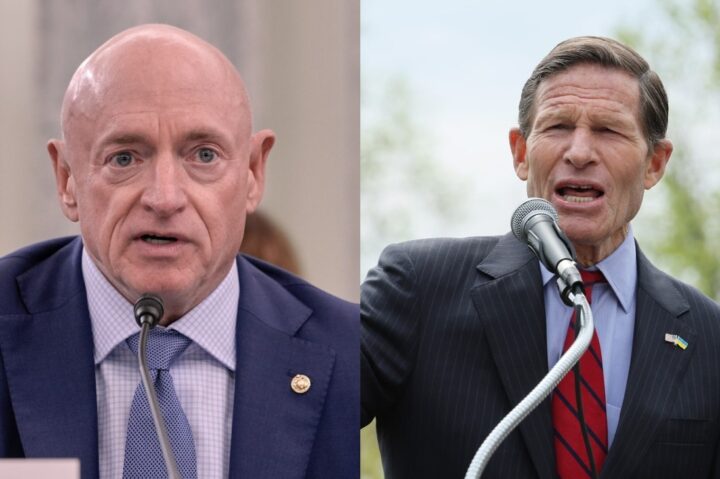
Mariam Zuhaib/AP Photo//Jemal Countess/Getty Images for Fair Share America
Sens. Mark Kelly (D-AZ) and Richard Blumenthal (D-CT)
Two Democratic senators expressed concern on Tuesday about the Islamic Revolutionary Guard Corps’ seizure of an commercial oil tanker in the Strait of Hormuz, a critical international shipping route.
The IRGC took credit on Friday for the seizure of the Talara, a Marshall Islands-flagged tanker, for what state media described as alleged cargo violations. The tanker, which began its journey in the United Arab Emirates, was carrying petrochemicals through the Strait of Hormuz to Singapore when it was diverted by the IRGC into Iranian territorial waters.
“It’s like the 1980s all over again,” Sen. Mark Kelly (D-AZ), a former fighter pilot, said. “The first time I was there was 1989, in the Strait of Hormuz, with the Iranians doing that same old shit, where they would harass shipping. A couple times, I felt like we were on the edge of getting in the conflict.”
“This was 40 years ago. It’s the same playbook with them, over and over and over again, harassing shipping, our planes, our naval vessels,” Kelly continued. “So what’s the solution? Hopefully, I think the solution is: The Iranian people get fed up with this at some point and just force out the ayatollah and his lackeys around there, because it has destroyed their economy.”
Asked if the development should impact the U.S. posture toward Iran, Kelly said it was too soon to determine that.
“We’ve got to stand on the side of the rule of law. The oil that comes through that Strait is critical to our economy, and we can’t let this become a major problem, but it’s one tanker,” Kelly said.
Sen. Richard Blumenthal (D-CT) said that the U.S. needs to remain vigilant against Iran’s other malign activities in spite of the setbacks to its nuclear program.
“Iran is Iran. They are the toxic element in the Middle East. We have no reason for complacency. Just because we set them back in their nuclear program, they remain a malevolent force, and the seizure of that tanker is just one indication of that,” Blumenthal said.
Asked if this latest development should be viewed as escalatory given that Tehran targeted commercial shipping, the Connecticut senator replied: “I’m troubled by the lack of an aggressive reaction to it. Maybe it’s just, with the press of everything else that’s going on.”
Sen. Richard Blumenthal (D-CT): ‘There are very serious, potential negative impacts on our national security and they include changing the qualitative edge for Israel’

Tsafrir Abayov/AP Photo
An Israeli F-35 lands at Ovda airbase during the bi-annual multi-national aerial exercise known as the Blue Flag, at Ovda airbase near Eilat, southern Israel, Sunday, Oct. 24, 2021.
Senate Democrats echoed their House counterparts on Tuesday in expressing concern about President Donald Trump’s announcement of a deal to sell advanced F-35 fighter jets to Saudi Arabia.
Sen. Richard Blumenthal (D-CT), who serves on the Armed Services Committee, told Jewish Insider, “I think there are very serious, potential negative impacts on our national security and they include changing the qualitative edge for Israel, the possibility of a hostile use of them [the jets], the absence of any normalization agreement, which should be part of it, so I think there ought to be very close, critical scrutiny.”
The prospect of advanced weapons sales to Saudi Arabia — along with several other deals announced by Trump on Tuesday with Saudi Crown Prince Mohammed bin Salman — had previously been linked to Saudi Arabia joining the Abraham Accords, something the kingdom is unwilling to do without a “clear path to a two-state solution,” MBS said.
Blumenthal said he was unsure if he would meet with the crown prince during his visit to Washington this week, citing scheduling conflicts. The Connecticut senator said that he’d like to ask MBS about the path forward toward normalization with Israel and the kingdom’s role in the future of Gaza.
“What’s the path to normalization? Realistically how can we get there as quickly as possible? Because it’s so important to peace and stability in the region,” Blumenthal told JI. “What are the Saudis willing to commit to do for the international security force and for reconstruction of Gaza and financial peace?”
Sen. Mark Kelly (D-AZ) described the jets as an “incredibly capable airplane” and noted that “Israel has F-35s, [as do] some of our other allies.” The Arizona senator said that while he supports the U.S. engaging with the Saudis, he had reservations about selling them the jets.
“Is this the step to some kind of bigger security arrangement in the Middle East? We’ll have to see. I think there’s some benefits for Israel and for Saudi Arabia and for the United States if that’s the case,” Kelly told JI. “I am always concerned about our best technology winding up in the proximity of any of our adversaries. The Chinese have been attempting to build a port there in the UAE, that’s pretty close. So I do worry about these things.”
Some in the Defense Department have reportedly expressed concerns that a sale of the jets to Saudi Arabia would provide China with an opportunity to take or compromise sensitive American technologies.
“I have concerns about it, and also about how the Saudis are going to use these planes,” he added.
Kelly said that if he were a member of the Foreign Relations Committee he would want assurances that China would not have access to U.S. technology before approving the sales.
“If I was on SFRC and had the ability to approve this, I’d want a lot of assurances that the Saudis are going to protect that technology,” Kelly said. “The Chinese would love to get close to these airplanes, to get the radar signatures, if they’re not stealing it from us already.”
Sen. Jeanne Shaheen (D-NH), the ranking member of the Senate Foreign Relations Committee who will have some ability to obstruct or slow the deal, was deeply critical of multiple announcements made by Trump during his White House summit with MBS.
Shaheen said in a statement that the F-35 deal “raises major concerns about protecting U.S. military technology and the military edge America shares with our allies” and demanded the administration “fully explain to the Senate Foreign Relations Committee why this sale is in the vital national interest of the United States.”
The senior Democrat also said that any security agreement made with Saudi Arabia without Senate approval “is very troubling” and would be non-binding and “easily reversed” by a future administration.
“Bypassing Congress on commitments of this scale sets a dangerous precedent, especially after a similar agreement with Qatar without Senate approval,” Shaheen said.
She also said that any nuclear deal with Riyadh, which Trump said on Tuesday he is pursuing, must ensure that it cannot enrich or reprocess nuclear material and include stringent inspections, and warned that “Saudi Arabia’s stated intention to acquire nuclear weapons if Iran does demands extreme caution.”
Shaheen also warned that any deal to provide advanced computer chips to Saudi Arabia must be made in consultation with Congress to protect America’s AI and technological edge over China.
Republican Sen. Markwayne Mullin (R-OK), an Armed Services Committee member, indicated support for the deal, saying, “we have strategic partners around the region and this has been a discussion going on for a long time. … It’s, I think, a [move] in the right direction.”
Other Republicans have also backed the president on the issue.
Mullin said he’d also like to see the United Arab Emirates acquire F-35s. During his first term, Trump sealed a deal to sell the jets to the UAE — in connection with the signing of the Abraham Accords — but the Biden administration suspended the deal due to concerns about the UAE’s relationship with China.
The UAE has since expressed it is no longer interested in reopening the deal.
Mullin said he’s planning to meet with the Saudi crown prince on Wednesday if their schedules allow, to “continue [the] conversation” from past meetings.
Many prominent Senate Democrats have criticized the strike
Jemal Countess/Getty Images for Fair Share America
Sen. Richard Blumenthal speaks at a rally at the Capitol on April 10, 2025 in Washington, DC.
Breaking with many of his Senate Democratic colleagues, Sen. Richard Blumenthal (D-CT) sounded a supportive note on the Israeli strike on Hamas leaders in Qatar on Tuesday.
“I strongly support Israel’s right to defend itself against Hamas,” Blumenthal told Jewish Insider. “I want to know more about the details of this particular strike — I’m learning about it in real time and anything done to destroy Hamas’ leadership or its terrorist capability or military capacity is a step in the right direction.”
Many prominent Senate Democrats have criticized the strike, saying it undermines negotiations for a ceasefire and that it should not have been carried out in Qatari territory. The White House expressed a similar view, breaking with top Senate Republicans who have been supportive of the Israeli attack.
Sen. John Fetterman (D-PA) was the only other Senate Democrat who has publicly been supportive of the Israeli action.
Schumer condemns the phrase and ‘believes it should not be used because it has such dangerous implications’

HANNA LEKA/Middle East Images/AFP via Getty Images
Protesters hold a banner reading "Globalize the Student Intifada" during a demonstration outside the ICE building in Washington, DC, on March 15, 2025.
Several Senate Democrats told Jewish Insider on Monday that calls to “globalize the intifada” are unacceptable and must be condemned, amid concerns from Jewish leaders and organizations over presumptive New York City Democratic mayoral nominee Zohran Mamdani’s defense of the slogan.
Senate Minority Leader Chuck Schumer (D-NY), who has thus far not endorsed Mamdani, told JI he plans to meet with Mamdani in a few weeks, when asked about Mamdani’s refusal to condemn the slogan.
“Sen. Schumer condemns the phrase ‘Globalize the Intifada’ and believes it should not be used because it has such dangerous implications. As Senator Schumer said after the death of Karen Diamond, the attack in Boulder continues to serve as a grave reminder of the deadly consequences of the rise in antisemitism,” a spokesperson for Schumer told JI.
“I don’t know what [Mamdani’s] position is on it, but I certainly think that the call to spread the intifada is the kind of incitement that can lead to extremist violence,” Sen. Richard Blumenthal (D-CT) told JI.
Blumenthal added that he is “an advocate of increasing the Nonprofit Security Grant Program, which protects against terrorist hate crimes to synagogues, mosques, churches and similar community institutions, and so I’m deeply concerned about incitement and hate speech that can lead to hate crimes.”
Sen. Jacky Rosen (D-NV) said calls to globalize the intifada must be condemned.
“At a time when antisemitism is rising at alarming rates in the U.S., leaders of both parties have an obligation to stand up, speak clearly, and unequivocally condemn hatred and bigotry in every form,” Rosen said in a statement to JI. “The intifadas were periods marked by unspeakable violence and terror against innocent Israelis, and it should not be a difficult decision for anyone to condemn the antisemitic call to globalize these violent attacks. Our words matter — and in moments like this, silence is not an option.”
“I’m not a member of the Jewish community or a NYC voter. Personally, I would never use or defend this deeply troubling phrase,” Sen. John Fetterman (D-PA) said in a statement to JI.
Some other Senate Democrats declined to comment or said they hadn’t been following Mamdani’s remarks.
Sen. Kirsten Gillibrand (D-NY), who thus far has declined to endorse Mamdani, said in response to a listener call on WNYC last week that constituents she has spoken to are “alarmed” by Mamdani’s past comments.
“They are alarmed by past public statements. They are alarmed by past positions, particularly references to global jihad,” Gillibrand said. “This is a very serious issue because people that glorify the slaughter of Jews create fear in our communities. The global intifada is a statement that means ‘destroy Israel and kill all the Jews.’”
She emphasized that Mamdani needs to understand and accept that “globalize the intifada” is viewed by the Jewish community as, inherently, a call for violence against Jews.
“It doesn’t matter what meaning you have in your brain,” Gillibrand said, when pressed on Mamdani’s claims that he does not view the statement as a call for violence. “It is not how the word is received. When you use a word like ‘intifada’ to many Jewish Americans and Jewish New Yorkers, that means you are permissive for violence against Jews.”
“It is a harmful, hurtful, inappropriate word for anyone who wants to represent a city as diverse as New York City with 8 million people, and I would be very specific in these words, and I would say, ‘You may not use them again if you expect to represent everyone ever again because they are received as hateful and divisive and harmful, and that’s it,’” she continued.
She said that Mamdani, if elected, will “need to assure all New Yorkers that he will protect all Jews and protect houses of worship and protect funding for not-for-profits that meet the needs of these communities.”
She said she had spoken to Mamdani about Jewish community security issues last week, and said that he “agreed to work with me on this and to protect all residents. … I will work with him when he gets elected, if he gets elected, to make sure everyone is protected.”
Speaking on CNN on Monday, Rep. Ritchie Torres (D-NY) called the intifada slogan “deeply offensive” and said that “every elected official, without exception, should condemn it.”
Torres said that condemning the language was not the same as criminalizing it, responding to Mamdani’s own comments saying he did not believe he should “police” speech: “No one‘s advocating for imprisonment. I mean, every elected official has an obligation to condemn hatred, whether it‘s antisemitism or Islamophobia,” the New York congressman said.
Blumenthal: ‘Our bipartisan effort seeks to strengthen measures to bring long overdue justice to families whose cherished art was brazenly stolen by the Nazis’

J. Scott Applewhite/AP Photo
Sen. John Cornyn, R-Texas, center, is flanked by Senate Judiciary Committee Chairman Dick Durbin, D-Ill., left, and Sen. Richard Blumenthal, D-Conn., at the Capitol in Washington, Thursday, Nov. 14, 2024.
Sens. John Cornyn (R-TX) and Richard Blumenthal (D-CT) introduced bipartisan legislation last week aimed at eliminating loopholes used by museums and other stakeholders to continue possessing Nazi-looted artwork that Jewish families have been trying to recover.
Introduced on Thursday, the Holocaust Expropriated Art Recovery (HEAR) Act would expand on Cornyn’s 2016 legislation of the same name, which was passed at the time by unanimous consent, by ending the Dec. 31, 2026, sunset date on the original bill and strengthen the existing procedural protections to ensure that victims’ claims are not dismissed due to non-merit-based factors such as time constraints.
“The artwork wrongfully ripped from Jewish hands during the Holocaust bears witness to a chapter in history when evil persisted and the worst of humanity was on full display. I’m proud to introduce this legislation to support the Jewish people and Holocaust survivors by helping them recover art confiscated by the Nazis that they are rightfully owed and give them the justice and restitution they deserve,” Cornyn said in a statement.
“The theft of art by the Nazi regime was more than a pilfering of property — it was an act of inhumanity. Our bipartisan effort seeks to strengthen measures to bring long overdue justice to families whose cherished art was brazenly stolen by the Nazis,” Blumenthal said.
Many families of Holocaust victims in the U.S. who have located artwork from deceased relatives and sued to recover those items face the deadline at the end of next year before the statute of limitations sets in. Thousands of stolen works of art remain unreturned to their rightful owners from the Nazi plunder, and there are scores of ongoing cases to resolve disputes over ownership of those items.
“Unfortunately, many museums, governments, and institutions have contradicted Congress’ intent and obstructed justice by stonewalling legitimate claims, obscuring provenance, and employing aggressive legal tactics designed to exhaust and outlast Survivors and their families. Rather than embracing transparency and reconciliation, too many have chosen to entrench and litigate, effectively preserving possession of stolen works rather than returning them to their rightful owners,” a press release for the bill states.
Sens. Thom Tillis (R-NC), Cory Booker (D-NJ), Marsha Blackburn (R-TN), John Fetterman (D-PA), Eric Schmitt (R-MO) and Katie Britt (R-AL) co-sponsored the bill, which was endorsed by a number of Jewish organizations including Agudath Israel of America, the American Jewish Committee, Anti-Defamation League, Jewish Federations of North America, StandWithUs and World Jewish Congress, among others.
“This legislation helps to right a historic wrong committed during one of the darkest chapters in history. By eliminating unnecessary legal obstacles, the HEAR Act establishes a clear path to restitution for Holocaust survivors and their families, ensuring that art and cultural property stolen by the Nazis can finally be returned to their rightful owners,” Tillis said.
Fetterman said in a statement, “Eighty years after the Holocaust, we have a moral responsibility to do right by the victims of these atrocities and their families. I’m grateful to join my colleagues from both sides of the aisle in introducing the HEAR Act to help return artwork stolen by the Nazis to its rightful owners.”
The lawmakers said Trump is ‘using what is a real crisis as a pretext to attack people and institutions who do not agree with [him]’

Kevin Dietsch/Getty Images
Senate Minority Leader Charles Schumer (D-NY) leaves a Senate briefing on China on February 15, 2023 in Washington, DC.
A group of Jewish Senate Democrats accused President Donald Trump of weaponizing antisemitism as a pretext to withhold funding from and punish colleges and universities, moves they said in a letter on Thursday “undermine the work of combating antisemitism” and ultimately make Jewish students “less safe.”
“We are extremely troubled and disturbed by your broad and extra-legal attacks against universities and higher education institutions as well as members of their communities, which seem to go far beyond combatting antisemitism, using what is a real crisis as a pretext to attack people and institutions who do not agree with you,” the lawmakers, including Senate Minority Leader Chuck Schumer (D-NY), antisemitism task force co-chair Sen. Jacky Rosen (D-NV) and Sens. Richard Blumenthal (D-CT), Adam Schiff (D-CA) and Brian Schatz (D-HI) wrote to the president.
“It has become abundantly clear that for this administration, the stated goal of fighting antisemitism — which is needed now more than ever, and for which we stand ready to work in a bipartisan way on real solution — is simply a means to an end to attack our nation’s universities and public schools and their ability to function as multifaceted and vital institutions of higher learning and to protect free speech and the civil liberties of their students and employees,” they continued.
The letter points to Trump’s attacks on Harvard University, including the freezing of billions of dollars in funding and threats to revoke its tax-exempt status, as the most prominent examples of the administration’s efforts, which they say “go far beyond constructive and necessary efforts” to support Jewish students.
They said the administration instead appears to be trying to change “the way the university functions” and impose significant penalties “in ways wholly unrelated to combating antisemitism.” The lawmakers instead accused Trump of trying to undermine or destroy these colleges under the “guise” of antisemitism.
“We strongly support efforts to ensure universities uphold their duty to protect students from unlawful discrimination and harassment, but we reject your administration’s policies of defunding and punishing universities out of spite, as they actually undermine the work of combating antisemitism,” the letter continues, “ultimately only making Jews less safe by pitting Jewish safety against other communities and undermining the freedoms and democratic norms that have allowed Jewish communities, and so many others, to thrive in the United States.”
The letter poses a series of questions to the administration, requesting answers by the end of April, including how the administration has chosen the institutions it has targeted, the specific charges made against Harvard, how the “totally disproportionate” penalties are being assessed, how the administration is deciding what funding to cut and what its legal basis is for threatening Harvard’s tax-exempt status.
The lawmakers particularly raised concerns about the impact of cuts to medical research funding, which they say will affect all students, including Jewish students, and why Harvard’s medical school has been targeted.
They also asked why the administration has significantly cut funding and resources for the Department of Education’s Office for Civil rights and how it plans to work with schools to implement reforms and protections for Jewish students going forward, in light of those cuts.
The letter further asks whether the administration has consulted “a broad range” of Jewish students and organizations on remedies for antisemitism and how it will ensure that funding cuts don’t hurt Jewish students or those uninvolved in or victimized by antisemitic activity.
They additionally inquired about the revocation of visas of foreign students and deportation proceedings and whether such actions are being taken based “solely on their expressed views and speech, which the administration has identified as antisemitic.” They asked whether the administration believes that the First Amendment applies to non-citizens and whether any deported or detained students have been charged with any crimes.
Please log in if you already have a subscription, or subscribe to access the latest updates.
 Continue with Google
 Continue with Apple