








































The anti-BDS Protect Economic and Academic Freedom Act garnered the most bipartisan support of any of the three bills

Michael A. McCoy/Getty Images
Rep. Virginia Foxx (R-NC) speaks at a hearing called "Calling for Accountability: Stopping Antisemitic College Chaos" before the House Committee on Education and the Workforce on Capitol Hill on May 23, 2024 in Washington, DC.


 Add JewishInsider on Google
The House Education & Workforce Committee advanced three bills to combat antisemitism on college campuses, with little support from Democrats, at a markup on Thursday.
The committee approved the Protect Economic and Academic Freedom Act, which would make schools engaged in a “nonexpressive commercial boycott of Israel” ineligible for federal student aid funding; the Student Protection and University Accountability Act, which would overhaul how discrimination complaints are handled on campuses, with schools that fail to comply facing a loss of federal funding; and the No Antisemitism in Education Act, which would require schools to treat antisemitic discrimination, as defined by the International Holocaust Remembrance Alliance’s working definition of antisemitism, in the same manner as racist discrimination.
The anti-BDS Protect Economic and Academic Freedom Act garnered the most bipartisan support of any of the three bills, picking up votes from Democratic Reps. Bobby Scott (D-VA), Joe Courtney (D-CT), Donald Norcross (D-NJ), Jahana Hayes (D-CT), Haley Stevens (D-MI) and John Mannion (D-NY), with nine other committee Democrats voting against the bill.
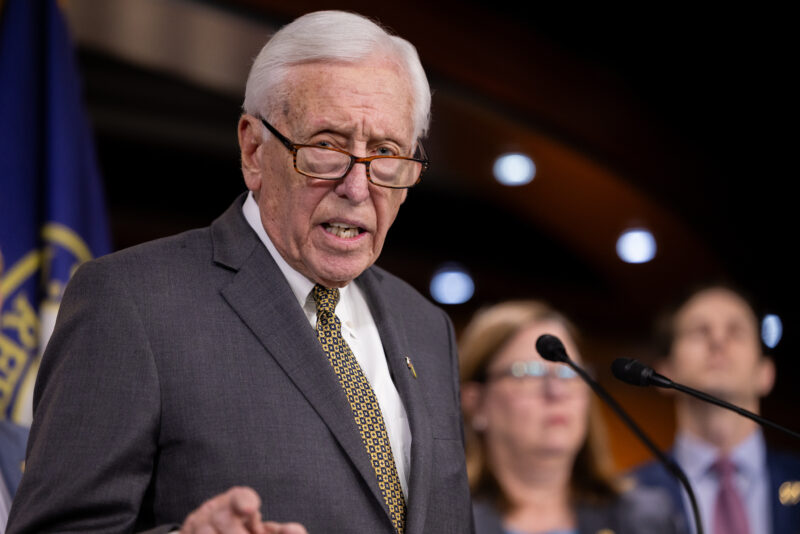
Rep. Virginia Foxx (R-NC), a lead sponsor of the bill, emphasized the important results that have come from the U.S.-Israel partnership and said that anti-Israel boycott efforts “have been weaponized to isolate Jewish students, silence Jewish faculty and cut American universities off from invaluable intellectual and research partnerships with Israeli academic institutions.”
She emphasized that institutions supported by federal funding, which aims in part to support research and training overseas, have made moves toward such boycotts.
“This legislation does not dictate viewpoints, does not prohibit anyone from expressing their opinions. Individuals remain free to advocate, protest or engage in political speech protected by the First Amendment,” Foxx said. “Students can still choose to abstain from products made in Israel, but what Congress cannot and should not tolerate is taxpayer money being used to marginalize Jewish people and undermine Israel’s major strategic partner status enshrined in law.”
Scott, the ranking member on the committee, expressed opposition to the BDS movement but called the bill “a solution in search of a problem,” pointing to the fact that no institution of higher education has actually joined the BDS movement, and that efforts to force boycotts by student or faculty governance bodies have been consistently rejected by administrators.
But he said that the bill does not appear to run afoul of constitutional concerns at play in other anti-BDS legislation, and ultimately supported the bill.
Votes on the Student Protection and University Accountability Act split entirely along party lines, with all Democrats voting against the legislation, despite bipartisan support outside of the committee.
Rep. Randy Fine (R-FL) said that the bill aims to address the “confusing reporting processes” and lack of transparency around investigations that Jewish students and families have faced when filing Title VI complaints.
Current statute allows universities to set their own policies and procedures for handling complaints, leaving students “navigating inconsistent procedures and uncertain outcomes,” Fine said.
He said the bill would increase “transparency, accountability and oversight” for both schools and the federal government, ensure that complainants are kept informed and understand the decisions made, ensure that students know how to report discrimination, provide Congress with greater oversight of the Office for Civil Rights’ work and ensure that OCR investigates cases.
Scott argued that the bill has some similar provisions to legislation he supports, but said that it “is hard to consider these bills from the majority that put affirmative responsibilities on the Department of Education when the department is illegally being dismantled.”
He and other Democrats argued against providing additional responsibilities to OCR at a time when the administration is cutting its staff and is attempting to reassign its responsibilities to the Department of Justice.
Scott also criticized provisions in the legislation preventing OCR from dismissing complaints in instances where there are pending cases with other agencies or courts relating to the same incidents, arguing that this change would only exacerbate the OCR backlog.
Along party lines, the committee blocked two amendments proposed by Scott. One aimed to stymie the administration’s efforts to reassign elements of the Department of Education to other agencies — including moving OCR to the Department of Justice. The other sought to authorize increased funding for OCR.
Two Democrats, Norcross and Hayes, voted with Republicans for the No Antisemitism in Education Act, with all other Democrats on the committee opposing it.
Fine, the bill’s lead sponsor, argued that the legislation only requires schools to treat antisemitism as they would any other form of discrimination under Title VI, making the case that such incidents have not been handled with the same seriousness as other forms of discrimination.
“It simply says that we cannot discriminate in how we deal with discrimination. And to object to that view means that you think that we should,” Fine said. “It means that you think some minority groups deserve superior protection to others.”
He said that the bill mirrors legislation he passed as a legislator in Florida, which he credited for decreasing the prevalence of antisemitic incidents in the state.
“With that seven years of experience, we have largely eradicated the problem. It’s time to take this experiment from our laboratory of democracy and make it nationwide,” Fine said.
Scott said that the bill aims to “rewrite civil rights law in a manner that is grossly inequitable and probably unconstitutional.” Title VI does not include religious discrimination, he noted, even as it has been interpreted to include discrimination based on shared ancestry or identity, including discrimination against Jews and other religious groups.
“His bill would elevate the treatment of antisemitism above any other form of racial or religious discrimination. Rather than amend Title VI directly, the bill attempts to piggyback on the provisions of Title VI, asking those provisions apply to religious discrimination as well, but only for antisemitic discrimination,” Scott said, though he said he did not believe that was Fine’s intent. “This bill would position Jewish victims of discrimination differently than Christian, Muslim, Sikh or other religions who are victims of discrimination.”
He also decried the bill’s use of the IHRA definition, saying it would silence constitutionally protected speech — even though the definition has already been utilized by the Department of Education for years.
The Protect Economic and Academic Freedom Act would require schools to certify annually that they are not engaged in a ‘nonexpressive commercial boycott’ of Israel

Vincent Ricci/SOPA Images/LightRocket via Getty Images
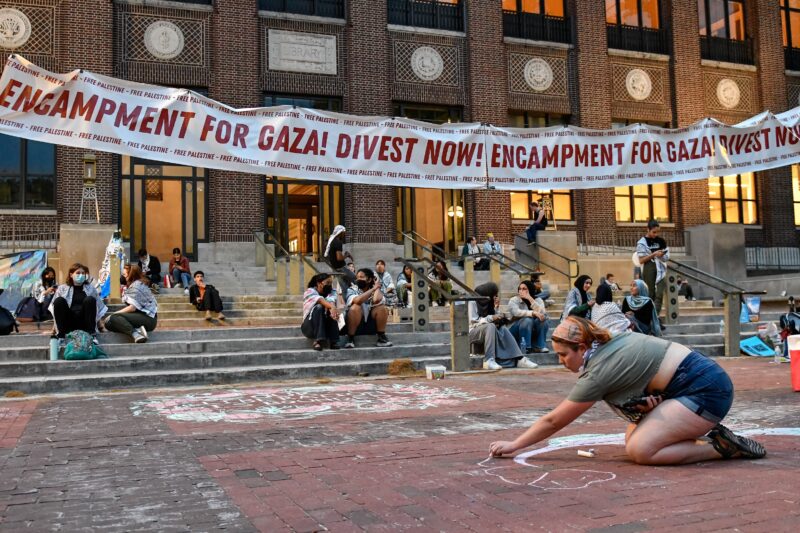
Students sit and stand around the edges of the encampment with a banner declaring their demands.
Reps. Virginia Foxx (R-NC) and Josh Gottheimer (D-NJ) introduced legislation on Tuesday that would make colleges that engage in a “nonexpressive commercial boycott” of Israel ineligible to receive federal student aid funding.
The legislation, the Protect Economic and Academic Freedom Act, would require schools to certify annually that they are not engaged in such boycotts, and would instruct the Department of Education to annually publish a list of schools that fail to submit such certification.
The legislation would apply both to boycotts of Israel as a country or companies and other entities operating under Israeli law.
Schools would be required to certify to the Department of Education that they allow students to participate in programs including conferences, study abroad, research and collaborative activities in Israel under the same terms as such programs in other countries, and to allow Israeli students to participate in programs on their campuses as applicable.
The bill defines a “nonexpressive commercial boycott” as “commercial action (including engaging in refusals to deal and terminating business activities) … intended to limit commercial relations with a major strategic partner” and “not based on a valid business reason.”
“The antisemitic rot that has corroded college campuses must be eradicated — enough is enough. The safety and security of Jewish students, faculty, and staff should never be threatened under any circumstances,” Foxx said in a statement. “If an institution of higher education chooses to capitulate to the caustic BDS movement, there will be consequences — starting with this bipartisan legislation.”
Gottheimer said in a statement that the Boycott, Divestment and Sanctions movement seeks to destroy Israel and that it has no place on college campuses or in the United States.
“At a time when our Jewish students are facing death threats, being physically assaulted, and blocked from going to class simply for who they are, we must do everything possible to ensure they can learn safely, speak freely, and get the education they deserve,” Gottheimer continued.
“That’s why I’m proud to help introduce the bipartisan Protect Economic and Academic Freedom Act to give the Department of Education a critical new tool to combat the dangerous, hate-fueled, antisemitic BDS movement on college campuses,” he said. “We cannot allow antisemitism to run rampant and endanger Jewish students, staff, and faculty. Now more than ever, we must stand up and protect our Jewish community.”
The legislation also includes language stating that, “limitations on cooperative efforts by institutions of higher education, consortia of such institutions, or partnerships between non-profit educational organizations and institutions of higher education with [Israel] do not serve the security, stability, and economic vitality of the United States.’’
Please log in if you already have a subscription, or subscribe to access the latest updates.
 Continue with Google
 Continue with Apple