










































































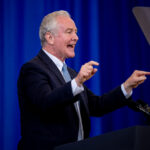



Top contributors to Florida gubernatorial candidate James Fishback are also bankrolling Rashida Tlaib, Ilhan Omar, Abdul El-Sayed and Andre Carson
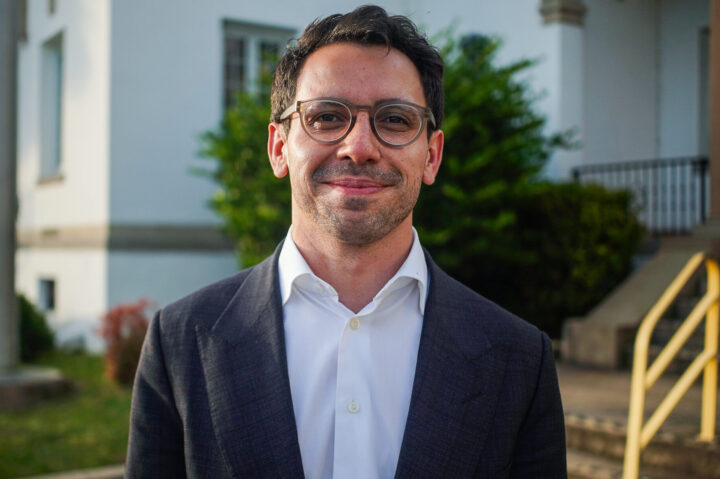
Campaign website
James Fishback


 Add JewishInsider on Google
James Fishback, the GOP candidate for Florida governor whom critics call “openly racist” and “openly antisemitic,” ostensibly sits at the opposite end of the political spectrum from the likes of Rep. Rashida Tlaib (D-MI) and Democratic Senate candidate Abdul El-Sayed in Michigan.
But the far-right and far-left politicians share more than just an aversion to Israel — they also overlap in donors, Jewish Insider has found.
As a candidate, Fishback has embraced and celebrated neo-Nazi podcaster Nick Fuentes’ “groyper” movement, propagated the “white genocide” and “great replacement” conspiracy theories, told a Black Floridian they should be lynched and repeatedly taunted Rep. Byron Donalds (R-FL) — his rival to replace Gov. Ron DeSantis — over his race. The radical right candidate has also called the Western Wall “stupid,” referred to fast food as “goyslop,” promised Tucker Carlson he would dump the Sunshine State’s holdings in Israeli bonds, blamed the Iran war on AIPAC and released an ad vowing that no one would be “convicted of antisemitism” for criticizing the Jewish state under his leadership.
But his campaign has proven a magnet for donors to progressive candidates, who have poured tens of thousands of dollars into a PAC supporting his election.
Among the 27 donors to give the maximum $3,000 contribution to Fishback’s bid for Tallahassee is New York-based philanthropist and financier Amed Khan. A longtime associate of the Clinton family and contributor to former Presidents Barack Obama and Joe Biden, as well as to the Democratic National Committee, Khan’s public commentary and political giving has pivoted leftward since the Oct. 7, 2023, Hamas attacks on Israel.
Besides maxing out to Fishback, this cycle the investment banker and Quincy Institute board member has kicked $7,000 to former Maine Senate nominee Graham Platner, the progressive Democrat whose tirades against “oligarchs” and “the establishment” — not to mention his rhetoric on Israel — made him a favorite of the online left before a rape allegation derailed his campaign. In March, Khan donated the maximum $5,000 to Peace, Accountability, and Leadership PAC, an arm of the Institute for Middle East Understanding Policy Project, a dark money nonprofit dedicated to advancing pro-Palestinian narratives and candidates.
And just weeks before contributing to the Republican Fishback in February, Khan gave $3,500 to Gaza flotilla activist Greg Stoker, who is running against Rep. John Carter (R-TX) and Democratic candidate Justin Early on the Green Party line. On the same day he cut a check to the far-right Floridian, Khan donated $3,500 to another Green House hopeful: former Gaza Humanitarian Foundation contractor Anthony Aguilar, who has accused his former employer and the IDF of war crimes.
Khan also gave $3,500 in January to Rep. Ro Khanna (D-CA), part of a pattern of support for the increasingly anti-Israel lawmaker that stretches back to 2019.
In the 2024 cycle, Khan gave $5,000 to Justice Democrats, and donated smaller amounts to Rep. Summer Lee (D-PA), Rep. Ilhan Omar (D-MN), and then-Rep. Jamaal Bowman (D-NY), all figures linked to the Democratic Socialists of America and the left-wing “Squad” in Congress.
But Khan has also maintained support for more mainstream liberal figures, donating $7,000 in June 2025 to former U.S. Ambassador to Ukraine Bridget Brink’s bid for Congress in Michigan, and $14,000 that March to committees affiliated with Sen. Jon Ossoff (D-GA), a Jewish Democrat who has lately clashed with AIPAC and opposed military aid to Israel.
Another of Fishback’s max-out donors is similarly a historic backer of Democrats who lately has ventured into supporting figures on the fringes of both parties: Parviz Tayebati, a Port Biscayne-based tech investor.
Tayebati has donated a total of $19,000 to committees linked to Rep. Thomas Massie (R-KY) and $6,600 to former Rep. Marjorie Taylor Greene (R-GA), both hard-right figures who have increasingly leaned into an anti-Israel identity toward the end of their tenure. He has also donated $3,500 to a PAC supporting one of Greene’s unsuccessful replacements, former state lawmaker Colton Moore, who once was a firm supporter of Israel but more recently became the lone Republican in the state Senate to oppose adopting the International Holocaust Remembrance Alliance’s working definition of antisemitism.
In May, Tayebati gave $2,000 to Platner and another $1,000 to Effie Phillips-Staley, a left-wing Democrat who picked up an anti-Israel drumbeat in her failed bid to become the Democratic nominee against Rep. Mike Lawler (R-NY).
One of the few donors to comment for this story, Tayebati told JI he donated to Fishback after seeing a social media video of him criticizing Israel’s military campaign in the Gaza Strip. However, he called his decision to give money to the candidate “short sighted,” and pleaded ignorance of Fishback’s full views at the time of the donation in January.
“After I found out how extreme and actually antisemitic he is I regretted my support,” Tayebati wrote in a text message, adding that he has changed parties several times in the years since he arrived in the U.S. from Iran. “I am an American citizen and believe anyone who becomes a citizen [in] this country must have their loyalty only to America first and view anyone who is a U.S. citizen but uses their rights and freedom to promote another country as traitors and should be deported.”
Tayebati has also supported a few less extreme candidates, including Dr. Annie Andrews, a Democratic challenger to Sen. Lindsey Graham (R-SC) and Rep. Nancy Mace (R-SC).
Fitting a similar pattern is physician Mohamad Naem of Tampa, Fla., who has given the maximum to Fishback while also donating $7,450 to El-Sayed’s campaign in Michigan, blowing past the $7,000 campaign contribution ceiling. The Senate candidate’s team told JI they would refund the over-the-limit funds, but declined to comment for this piece beyond vowing they had never shared any donor list or had other contact with Fishback.
A longtime supporter of Tlaib, in late 2023 Naem began also sending cash to her Squad colleagues Lee, Bowman, Rep. Ilhan Omar (D-MN) and former Rep. Cori Bush (D-MO). Also in the 2024 cycle, he donated $2,000 to Pervez Agwan and $1,000 to Preston Nouri, both left-wing upstarts who made criticism of Israel and AIPAC a central theme in their campaigns.
Last year, he contributed $3,333.34 to the committees of Rep. Andre Carson (D-IN) and $1,500 to Rep. Delia Ramirez (D-IL), both key backers of legislation that would sever military aid to the Jewish state and of resolutions condemning its actions, while keeping up his support for Omar and Tlaib.
In recent months, along with donations to El-Sayed, Naem has given smaller amounts to Phillips-Staley and to Eric Yonce, another unsuccessful Israel critic who ran for Congress in Florida.
As with Khan and Tayebati, Naem has made a few donations to candidates supportive of Israel, including Sen. Jim Risch (R-ID), Rep. Abe Hamadeh (R-AZ) and Rep. Cory Mills (R-FL). He also gave $1,000 in 2025 to Rep. Marlin Stutzman (R-IN), who in June proposed winding down U.S. aid to Israel, although the congressman has aligned his position with that of Israeli Prime Minister Benjamin Netanyahu.
But Fishback’s other underwriters have shunned centrists in favor of candidates on the party’s margins. Another of his contributors is Hassan Shibly, who left his position as the head of the Florida chapter of the Council on American-Islamic Relations in 2021 following domestic abuse allegations from his wife.
On the federal level, Shibly has given this cycle to Aaron Baker, running as a right-wing, anti-Israel alternative to Rep. Randy Fine (R-FL) and to Mussab Ali, who challenged Rep. Rob Menendez (D-NJ) as an AIPAC-bashing left-wing insurgent. And beginning in November 2023, Shibly has donated $200 each month to Omar in Minnesota.
In an email to JI, Shibly fiercely disavowed all of Fishback’s controversial stances — save one.
“One of the most significant reasons for my support is his stated position that American taxpayer dollars should be prioritized for the needs of Americans rather than funding foreign governments,” Shibly wrote. “I have been outspoken in opposing continued U.S. funding for the Israeli government’s military campaign in Gaza because I believe Israel has committed genocide against the Palestinian people. Ending or substantially reducing U.S. taxpayer funding for that campaign is an issue of profound moral importance to me.”
Current CAIR-Florida director and attorney Mohammad Mubarak gave $1,000 to Fishback, but at the federal level has given thousands more to El-Sayed, Tlaib, Omar and Carson. Radiologist Nabeel Hamoui gave the GOP gubernatorial contender the full $3,000 allowed under law in May, three months after maxing out to El-Sayed’s Senate campaign. In recent cycles, he’s given to Carson, Omar, Bowman, Lee, Bush and Tlaib.
Tampa investor Ramsy Dahla gave the maximum to Fishback, but has never donated to a federal official other than Tlaib. Another longtime Tlaib backer from Tampa, Ymad Elabed, appears to have given double the largest legally permitted contribution to Fishback by donating from two separate addresses.
Meanwhile, another Tampa businessman, Yasin Saad, gave $3,000 to Fishback but has favored Tlaib and recurring Palestinian American congressional candidate Ammar Campa-Najjar at the federal level.
Texas supermarket magnate Salah Nafal is also a member of Fishback’s $3,000 club, even as he’s given strictly to left-wing Israel critics for national offices, including El-Sayed, Platner, Omar and Tlaib, as well as Rep. Analilia Mejia (D-NJ), Michigan democratic socialist Aisha Farooqi and failed Texas congressional candidates Zeeshan Hafeez and Tanya Lloyd.
Meanwhile, Florida First PAC — a state committee dedicated to backing Fishback for governor — picked up a $35,000 contribution in June from Jacksonville law office Farah & Farah. The firm’s founding partner, Eddie Farah, has given $6,000 this cycle to Tlaib while also kicking $2,000 to the committees of Georgia’s Greene. In 2024, he backed Cornel West for president, while also donating to the PAC Counter Coalition, which subsequently ran a small independent expenditure for New York City Mayor Zohran Mamdani.
Oil distributor Basem Ali gave Florida First $5,000 in May, nearly a year after he gave to the Tlaib campaign. Ali has given tens of thousands to the Michigan congresswoman over the course of her career, and also supported Omar and Campa-Najjar, though he has also donated to Rep. Gus Bilirakis (R-FL), a strong Israel supporter.
In conversation with The Atlantic’s Jeffrey Goldberg, Kurtzer said the Jewish community is caught between the illiberalism of the left and the illiberalism of the right
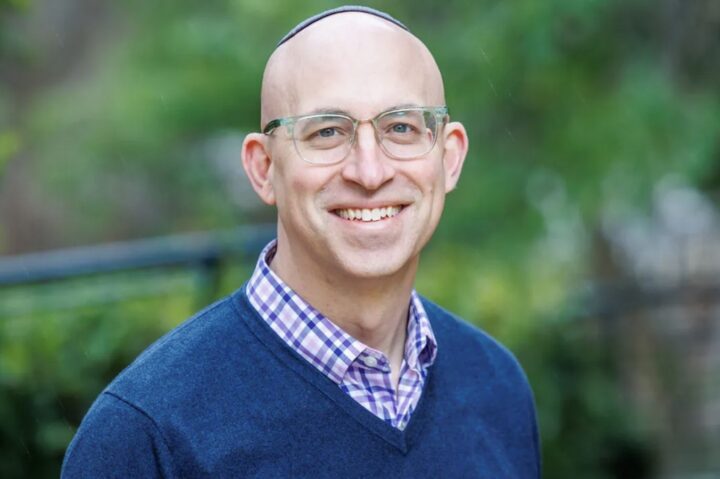
Shalom Hartman Institute
Yehuda Kurtzer
Amid a surge in antisemitism across the political spectrum, many American Jews have described feeling a growing sense of isolation. But for Yehuda Kurtzer, president of the Shalom Hartman Institute, being “politically homeless” is not a crisis to be solved, but rather a position to be embraced.
“I don’t think some measure of political homelessness is a fundamentally bad thing,” Kurtzer said on Thursday while speaking alongside Jeffrey Goldberg, editor-in-chief of The Atlantic, at the Capital Jewish Museum in Washington. “I think Americans have become hyper-partisan in ways that reflect that partisan political identity has become part of our identities in ways that are not healthy for Americans.”
Kurtzer and Goldberg sat in conversation at an event focused on American Jewry ahead of the upcoming 250th anniversary of the founding of the United States.
Kurtzer argued that hyper-partisanship is particularly dangerous for the Jewish community, noting that Jews “believe in the notion that we are tethered to other people regardless of what they believe.” He said American Jews “should take that same ethos and apply it to what it means to be an American as well.”
“Choosing a side has never worked for Jews because when you get out of the hall to power, you will be identified as the exemplar of that political attitude that can now be destroyed,” Kurtzer said.
“Now we’re stuck as an American Jewish community between an illiberal argument on the right, which is currently in power, and an illiberalism of the left,” Kurtzer continued. “We don’t have a choice as American Jews but to fight for the very liberal framework that resists the authoritarianism of the right and resists the authoritarianism of the left and insists that this is the only way we can make it work for ourselves.”
This tension is especially acute on university campuses, Kurtzer said, where he believes “progressivism” has played “a major role in shutting down the pluralistic discourse that a university campus is supposed to inhabit.”
“I think there’s an immense amount of shame that travels for American Jews, especially for young people, about association with Israel,” Kurtzer said. “At a moment like this, it’s very hard to get past that shame with even rational arguments.”
However, Kurtzer suggested that young Jews may be uniquely positioned to model a “healthy political alternative” by demonstrating how to navigate complex discourse. He noted that since the Oct. 7, 2023, Hamas attacks, many Jews feel “a greater sense of attachment to the Jewish community and Jewish lives and even the State of Israel.”
He argued that American Jews must “find a way to articulate the thickness of our relationship to Israel and the Jewish people that is not perpetually under the test of what the Israeli government does today and tomorrow.”
Kurtzer also warned that the American Jewish community has grown too “comfortable” being part of the daily fabric of American life.
“Jews wrote the soundtrack to American patriotism. We engaged in that project,” he said. “The thing that I think the American Jewish community has let go of is that we became comfortable saying, ‘We’re now insiders to that project. We no longer need to be active creators of the American story.’ We just get to kind of sit on our laurels.”
While Kurtzer called for further engagement from the Jewish community in American life and political processes, he explained that the strength of the community also lies in its willingness to remain distinct.
“It’s OK and probably important for Judaism to maintain some dimension of counter-culturalism,” Kurtzer said. “Some dimension of insisting that in a radical technological world, anti-technological behaviors like turning off your phone for 25 hours a week are actually good.”
Antisemitic views were highest among those who rely on social media for their news
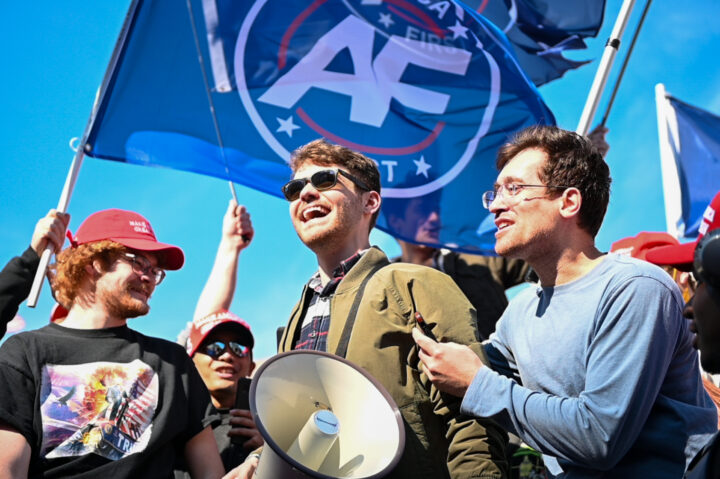
Zach D Roberts/NurPhoto via Getty Images
Nick Fuentes, the leader of a Christian based extremist white nationalist group speaks to his followers in Washington D.C. on November 14, 2020
Younger voters are significantly more likely to hold antisemitic beliefs and critical views of Israel compared to older generations, according to a new survey.
The Yale Youth Poll, an undergraduate-led research group based at Yale University, polled over 3,400 American voters, more than half of whom were under 35, between March 9-23.
Respondents were presented with paraphrased statements on Israel from several prominent figures across the political spectrum: neo-Nazi podcaster Nick Fuentes, anti-Israel Rep. Rashida Tlaib (D-MI), Sen. Ted Cruz (R-TX), former U.S. Ambassador to the U.N. Ambassador Nikki Haley, Rep. Ritchie Torres (D-NY) and Senate Minority Leader Chuck Schumer (D-NY).
Among all voters, 35% agreed with the statement “America should end the slavish surrender to Israel, its wars, and its demands for foreign aid,” which is paraphrased from comments Fuentes made in a video. But among the youngest respondents, agreement rose to 55% of voters ages 18-22 and to 52% among those 23-29 years old.
Similarly, 34% of voters agree with Tlaib’s characterization of Israel as an “apartheid state” engaged in “racist oppression” of Palestinians. This agreement spikes sharply among younger voters, rising to 55% for those 18-22 and 54% for those 23-29.
With 59% support, Schumer’s statement — that “Israel is a democracy and the safe haven of the Jewish people, but they have a moral obligation to ensure humanitarian treatment of Palestinian civilians,” — was the only one to garner majority approval. It was the most popular position across the political spectrum, agreed upon by 66% of Democrats and, notably, 55% of Republicans.
Most respondents said they disagreed with several antisemitic conspiracies and statements of Holocaust distortion. However, 25% of voters agreed that “Jews have an extremely organized international community that puts their own interests before those of their home countries.” Furthermore, roughly 3 in 10 voters said they support Christian nationalism (27%), believing the U.S. should be declared a Christian nation, and 31% said that being Christian is key to being “truly American.”
Two-thirds of voters rejected all three antisemitic statements presented to them in the survey, which were “Jews in the United States are more loyal to Israel than to America”; “It’s appropriate to boycott Jewish American-owned businesses to protest the war in Gaza”; and “Jews in the United States have too much power.”
Agreement was higher, however, among young, non-white and male voters, as well as those who rely on social media for news. Ten percent of voters ages 18-34 agreed with all three statements, compared to just 2% of voters 65 and above. Black voters were most likely to agree with at least one statement (46%), followed by Asian (39%), Hispanic (37%) and white (29%) voters.
Please log in if you already have a subscription, or subscribe to access the latest updates.
 Continue with Google

 Continue with Apple