




































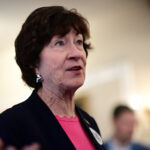



The executives, philanthropists and politicians who attended the gathering took note of the increasingly populist moment while discussing how to remedy some of the legitimate concerns of Americans

Patrick T. Fallon / AFP via Getty Images
US musician and tech entrepreneur Will.i.am shakes hands with Editorial Director of Bloomberg, Erik Schatzker, during the 29th annual Milken Institute Global Conference at the Beverly Hilton in Beverly Hills, California on May 5, 2026.


 Add JewishInsider on Google
The country’s consummate insiders gathered at the Milken Institute Global Conference in Beverly Hills this week. But far away from the five-star hotels where attendees closed business deals and mingled over salmon bento boxes, there is concern over an anti-elite sentiment that is dominating American politics.
The executives, philanthropists and politicians who attended the gathering took note of this increasingly populist moment while discussing how to remedy some of the legitimate concerns of Americans.
There were sessions focused on protecting the workforce in the face of disruption from AI, and on retirement planning for gig economy workers who cannot contribute to a typical 401(k). Behind the scenes, Trump Accounts — tax-advantaged savings accounts for American children, with $1,000 kicked in from Uncle Sam — were a big topic of conversation.
As some of America’s most important decision-makers discussed the turbulent downstream impacts of the AI boom, and the sense that many people are feeling left behind, a related topic that animated the many Jewish executives and investors who attended the conference.
They worry that the intermingling of populism and antisemitism, already heightened following the Oct. 7 Hamas attacks on Israel two and a half years ago, represents a dangerous combination.
“Antisemitism is a manifestation of extremism and populism,” TD Bank Vice Chair Jeffrey Solomon told Jewish Insider. “Extremism on the left and extremism on the right, neither one of those is good for us as Jews, but it’s not good for a lot of people.”
Solomon, a major Jewish philanthropist who chairs the board of the Foundation for Jewish Camp, spoke on a panel at Milken about macroeconomic trends. He said that fighting antisemitism requires also understanding that the problems in society run deeper than just anti-Jewish hate.
“Our job isn’t necessarily to just cure antisemitism. The job is to get at the root cause of what’s causing there to be stress in society. We have to acknowledge that the policies that have gotten us to this place have not been inclusive enough for enough people,” said Solomon, which requires “enabling [people] to be able to find their own path and be successful. The people that can make that happen are at this conference, and if we do that, antisemitism will take care of itself, because there will be no need for it.”
Sara Eisen, a CNBC reporter who was at the conference to moderate several conversations with big-name principals like Citadel CEO Ken Griffin, told JI she heard concerns about antisemitism, and the broader political environment, raised in conversation with other high-profile attendees.
“They see what’s happening in the political world. They see what’s happening in geopolitics,” she said. “This is the sideline conversation.”
At a Tuesday panel about antisemitism, Steven Weitzman, director of the Center of Advanced Judaic Studies at the University of Pennsylvania, made the case that antisemitism is itself anathema to the ideals espoused by Milken attendees.
“Not only is antisemitism the hatred of the Jews,” said Weitzman, “it’s also opposition to globalization, it’s opposition to what this very conference represents, which is peaceful cooperation across national borders.”
The four-day convening is billed as a way for global leaders to address some of the world’s biggest challenges
Taylor Hill/FilmMagic
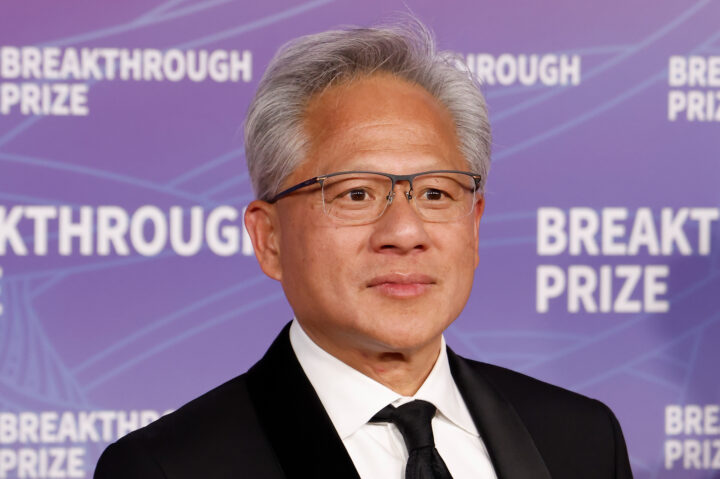
Jensen Huang attends the 12th Breakthrough Prize Ceremony at Barker Hangar on April 18, 2026 in Santa Monica, California.
A who’s who of global decision-makers is gathering today at the iconic Beverly Hilton hotel in Los Angeles for this year’s annual Milken Institute Global Conference. Investors, philanthropists and business executives from around the world will hobnob with pro athletes, movie stars and politicians.
The four-day convening is billed as a way for global leaders to address some of the world’s biggest challenges. According to event organizers, this year’s conference is focused on building “a more sustainable, equitable and resilient future” in the face of “recent disruption and innovation.” In other words: What are the most powerful innovators in the world going to do about artificial intelligence?
AI is shaping up to be the buzzword at Milken, just like it is everywhere else right now. Govs. Ron DeSantis of Florida and Gretchen Whitmer of Michigan will each be talking on Monday about developing a competitive workforce. Sens. Bill Hagerty (R-TN) and Mark Warner (D-VA) will speak on a panel with Alphabet President Ruth Porat and Meta President Dina Powell McCormick about disruptions to the American workforce. Perhaps the most anticipated speaker of the day is Nvidia CEO Jensen Huang.
The events at Milken are a mix of utilitarian, educational and enlightening. Practical panel discussions about investing take place next to addresses from world leaders and politicians; conversations about philosophy occur alongside sessions about medical breakthroughs. (Rabbi David Wolpe and the actor Kelsey Grammer are speaking about the meaning of faith today.)
Milken attendees will have the opportunity on Monday to hear from Nobel Peace Prize-winner Maria Corina Machado, the Venezuelan opposition leader, as well as U.S. Ambassador to the United Nations Mike Waltz and Rafael Grossi, director-general of the International Atomic Energy Agency.
Many Israelis who work in tech are attending amid a period of relative calm in Israel during a ceasefire with Iran. A closed-door session today about ties between Silicon Valley, Washington and the Middle East features UAE Ambassador to the U.S. Yousef Al Otaiba, Israeli-born Silicon Valley investor Elad Gil, Abu Dhabi department of health chair Mansoor Ibrahim Al Mansoori and Jacob Helberg, the U.S. under secretary of state for economic affairs.
At a moment of geopolitical tumult and economic uncertainty, the Milken conference presents an opportunity to listen in on some of the conversations that could drive policy and shape economic outcomes. We’ll be paying close attention.
Philanthropists Laura and Gary Lauder hope to boost in-depth investigative journalism in Israel

Moran Barak/Shomrim
The home page of the Shomrim website.
A group of journalists, activists and philanthropists have joined together to support the creation of investigative reporting projects in Israel. The new organization, called Shomrim: The Center for Media and Democracy, has published an open call for proposals for reporting and documentary projects that will be granted financial and professional support. Shomrim co-founder Ethan Bronner and CEO Alona Vinograd explained the organization’s vision to Jewish Insider.
Sorely missing: “I do believe that this kind of reporting is sorely missing in Israel, where media are in financial crisis as they are in much of the world,” Bronner told JI. He said the organization is modeling itself partly on the U.S.-based ProPublica — whose president, Richard Tofel, serves on its advisory committee — and on the Center for Investigative Reporting — whose former executive director, Robert Rosenthal, also sits on the committee. According to The Marker, the initiative intends to spend $3 million over a period of three years.
A-team: Shomrim was co-founded by Bronner, a senior editor at Bloomberg, along with philanthropists Laura and Gary Lauder; venture capitalist and social activist Oded Hermoni; Prof. Moshe Zviran; photojournalist Vardi Kahana; Calcalist publisher Yoel Esteron and editor and journalist Tamar Prizan-Litani. In addition to Tofel and Rosenthal, its advisory committee includes leading journalists in both Israel and the U.S.: Channel 12’s Ilana Dayan; Channel 13’s Raviv Drucker; Times of Israel editor-in-chief David Horovitz; Haaretz‘s Amos Harel; KAN 11’s Guy Zohar; Bokra’s Ghada Zoabi; New York Times columnist Bret Stephens; former NPR president Vivian Schiller, former CBS legal advisor Richard Altabef; E. W. Scripps vice president Ellen Weiss; and film producer Isaac Lee.
Untold tales: Vinograd, who previously led the Center for Democratic Values and Institutions at the Israel Democracy Institute, said Shomrim is looking to support projects “that put a light on important issues in Israeli democracy,” citing gender, the environment and healthcare, as well as the marginalized voices “of those less heard in Israeli media — Arabs, Haredim, immigrants [and] disadvantaged communities.” Bronner said he wants the organization to focus on societal challenges, “because these tend to be undercovered in Israel, where politics and national security take up most of the space of serious journalism.”
Free press: Bronner, a former Jerusalem bureau chief for The New York Times, Reuters and The Boston Globe, has also worked as a journalist in London, Madrid and Brussels. “Media freedom is pretty strong in Israel,” Bronner noted, “which is one reason we believe this project can work and make a difference.”
Wide net: While the current open call for projects has a deadline of March 31st, Vinograd said the center intends to accept proposals three to four times a year. “We will support a large number of projects,” she said, “not only of the written word. We hope to work also on audio (podcasts) or video (documentary) stories, and photojournalism as well.”
Please log in if you already have a subscription, or subscribe to access the latest updates.
 Continue with Google
 Continue with Apple