































The Senate majority leader also said the deal triggers requirements for the administration to provide Congress with the opportunity to review the agreement under INARA

Kayla Bartkowski/Getty Images
Sen. Majority Leader John Thune (R-SD) calls on reporters following the weekly Senate Republican caucus policy luncheon at the U.S. Capitol on January 14, 2025 in Washington, DC. Senators spoke about the Laken Riley Act which was named after a nursing student who was murdered in February 2024 by Jose Ibarra, a migrant from Venezuela who crossed the border in September 2022, that could give state attorney generals far-reaching veto power over federal immigration policy.


 Add JewishInsider on Google
With scant details provided by the Trump administration about the contours of the peace deal with Iran, Senate Majority Leader John Thune (R-SD) said on Monday afternoon that he doesn’t yet know enough about the administration’s deal with Iran to determine whether it is a good deal that will prevent Iran from acquiring a nuclear weapon.
“I don’t know enough about it to say,” Thune told reporters. “I think the issues are going to be compliance, and how you can enforce that, and what are the financial incentives that the Iranians have from our country, and what are they conditioned upon.”
The South Dakota Republican said that a positive deal would include financial incentives that are conditioned upon Iran winding down its nuclear program, the disposal of Iran’s enriched uranium and Tehran giving up its capacity to have a nuclear program in the future.
Thune also indicated that he believes the deal should be submitted to Congress for review under the Iran Nuclear Agreement Review Act.
“There are some requirements that are triggered because of the nuclear components of the deal, in terms of notification or informing Congress,” Thune said. “I know there is probably some expectation that there may be a vote at some point, whether that’s on a resolution of disapproval or something. We’ll see. I just don’t know enough about it yet. And I don’t think even the people who follow this stuff closely up here know that much.”
The administration hasn’t publicly commented on the issue of INARA yet, and has offered varying timelines for when it might release the text of the agreement. In media appearances, Vice President JD Vance has been framing specific nuclear issues as part of the next round of talks, rather than the current MOU, which could give the administration an avenue to attempt to dodge INARA review.
Thune said that “somebody” from the administration, whether that be Vance or other officials, “will need to” come to the Hill to brief members.
“For sure, our members are going to have a lot of questions about it,” Thune said.
Sen. John Barrasso (R-WY), the No. 2 Senate Republican, indicated he was similarly in the dark about the agreement.
“I haven’t seen anything from the president in terms of what’s in it. I’ve seen some press reports,” Barrasso told reporters. “I want to see what’s actually in it and I congratulate the president for his continued efforts.”
But asked whether he was concerned that the deal would be an effective surrender to Iran in providing sanctions relief, Barrasso rejected the idea out of hand.
“President Trump is never, ever going to do what you just suggested,” Barrasso said. “He’s not going to accept a deal that doesn’t eliminate nuclear weapons, isn’t enforceable, isn’t verifiable and doesn’t take Iran completely out of what they’ve been doing to try to undermine and attack us for the last 47 years.”
Makovsky said Trump’s reported deal with Tehran ‘wouldn’t be worth the paper it’s written on’
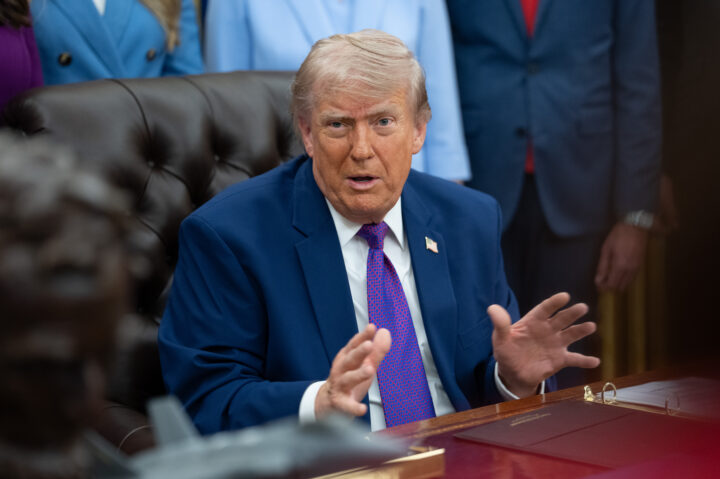
Aaron Schwartz/Sipa/Bloomberg via Getty Images
President Donald Trump speaks during a maternal healthcare event in the Oval Office of the White House in Washington, DC, US, on Monday, May 11, 2026.
Michael Makovsky, the president and CEO of the hawkish Jewish Institute for National Security of America, criticized the Trump administration’s recent handling of the U.S. war in Iran, expressing concern about the possibility of a broader peace deal that does not address key issues.
“The U.S. has lost the plot on Iran,” Makovsky told Jewish Insider on Friday. “After significant military achievements, declaring the ceasefire was a huge mistake, and there was too much hype about what pressure a blockade alone would achieve. The net result has reduced U.S. leverage, and the perception that America is vulnerable if gasoline nears $5 per gallon.”
Makovsky said that the U.S. “should not pursue a deal” with Iran, arguing that such an agreement “wouldn’t be worth the paper it’s written on.” He said that a deal “will only enrich and strengthen the regime and demoralize the Iranian people.”
“Instead, the U.S. should resume military operations for a couple weeks, weaken the regime and its nuclear and conventional capabilities further, cease the military campaign while maintaining the blockade and support the Iranian people in every way possible,” he said.
Makovsky spoke to JI in response after President Donald Trump’s announcement on Friday that he was nearing a decision on the agreement reportedly reached by U.S. and Iranian negotiators to extend the ongoing ceasefire by 60 days, reopen the Strait of Hormuz and continue nuclear talks. Makovsky made the comments prior to this weekend’s fighting between the two countries, with the U.S. striking Iranian air defenses and drone sites after Iran downed an American MQ-1 drone and shot missiles at U.S. forces based in Kuwait.
“Based on what appears to being negotiated, the Strait of Hormuz will be opened in return for certain Iranian pledges about what will be worked out in further negotiations,” Makovsky said. “There are even reports about a possible international investment fund in Iran, which would be preposterous with this regime.”
After holding a Situation Room meeting on Friday, Trump reportedly requested several amendments to the negotiated deal, including firmer commitments around Iran’s stockpile of enriched uranium, leading to another round of negotiations. Iranian state media reported on Monday that its delegation was suspending talks with the U.S. over Israel’s continued strikes against Hezbollah in Lebanon.
The vice president’s comments echo a warning from President Donald Trump that the terror group would face ‘elimination’ if it doesn’t abide by the terms of the ceasefire agreement
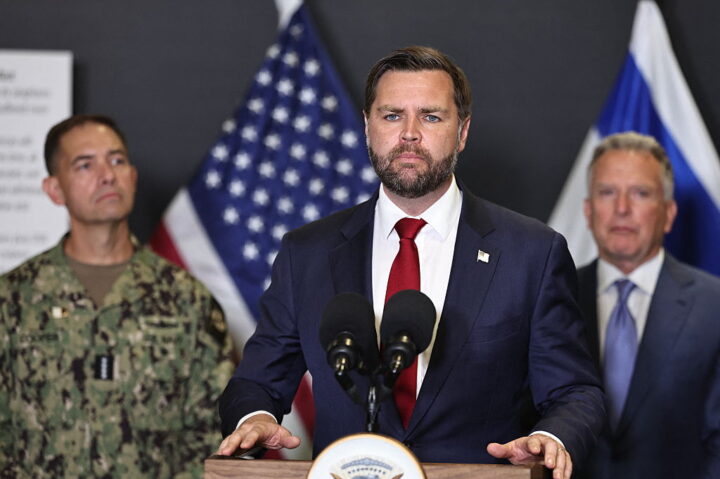
FADEL SENNA/AFP via Getty Images
Vice President JD Vance listens to a question during a press conference following a military briefing at the Civilian Military Coordination Center in southern Israel on October 21, 2025.
Visiting the new U.S.-run Civilian Military Cooperation Center in southern Israel, Vice President JD Vance said on Tuesday that he is “very optimistic” about the advancement of the peace plan, but warned that Hamas must disarm and cooperate with international interlocutors, or else it would be “obliterated.”
The vice president’s comments came shortly after President Donald Trump, in a post on his Truth Social site, threatened Hamas with “elimination” should the terror group continue to carry out violence in Gaza and violate the terms of the peace deal.
“Numerous of our NOW GREAT ALLIES in the Middle East … have explicitly and strongly, with great enthusiasm, informed me that they would welcome the opportunity, at my request, to go into GAZA with a heavy force and ‘straighten out Hamas’ if Hamas continues to act badly, in violation of their agreement with us,” Trump wrote. “There is still hope that Hamas will do what is right. If they do not, an end to Hamas will be FAST, FURIOUS, & BRUTAL!”
The president’s statement, which came hours after Vance touched down in Israel in part to keep the deal on track, underscored his growing impatience and frustration with the terrorist group.
“Hamas has to disarm,” Vance said. “They’re not going to be able to kill their fellow Palestinians. … If Hamas doesn’t cooperate, as the president of the United States said, Hamas will be obliterated.”
“But I’m not going to do what the president of the United States has thus far refused to do, which is put an explicit deadline on it,” the vice president continued, “because a lot of this stuff is difficult … In order for us to give it a chance to succeed, we’ve got to be a little bit flexible.”
Asked about Turkish troops entering Gaza despite the country’s hostility to Israel, Vance said that Israel will have to agree to any foreign troops on the ground. “We’re not going to force anything on our Israeli friends when it comes to foreign troops on their soil, but I think there’s a constructive role for the Turks to play,” he said. “They already played a constructive role.”
As for reconstruction of Gaza, Jared Kushner, who has played a central role in negotiating the end of the war, said that “no reconstruction funds will be going to areas Hamas still controls. … There are considerations in the area the IDF controls to start reconstruction of a new Gaza, in order to give the Palestinians in Gaza a place to go, a place to get jobs, a place to live.”
Vance said that the eventual governing structure of Gaza is still undetermined, as the plan focuses on getting “to a point where both Gazans and our Israeli friends have some measure of security.” After that, he added, “we’ll worry about long term governance.”
“Let’s worry about security, give people food and medicine,” he said.
Vance said that the CMCC’s focus is on repatriating the bodies of the 15 remaining Israeli hostages, but that “it’s not going to happen overnight.”
The administration’s push for Hamas’ disarmament is expected to face hurdles. “On the one hand, Hamas wants to avoid losing the sympathy of Turkey and Qatar and wants to avoid wasting Egypt’s desire for a political settlement that creates Palestinian unity with Hamas support,” said Rob Satloff, executive director at The Washington Institute for Near East Policy. “On the other hand, it is clear that Hamas has no intention of voluntarily giving up the battle against Israel, let alone voluntarily disarming.”
But while Trump threatened that “many countries” will get involved, other nations have been reluctant to send in reinforcements, despite talks of forming an International Stabilization Force, as laid out in the unfinalized second phase of the peace deal.
At the CMCC facility on Tuesday, the vice president noted that the force is still in the process of being formed, but said no American troops will be on the ground in the enclave. There are about 200 U.S. servicemembers at the CMCC in Kiryat Gat, Israel, tasked with coordinating the effort.
Trump himself emphasized that the U.S. will not send troops into Gaza, telling reporters at the White House on Monday that “Israel would go in in two minutes if I asked them to go in … But right now we haven’t said that.”
“Many countries are hesitant to send troops to serve as peacekeepers,” said David May, a senior research analyst at the Foundation for Defense of Democracies. “So, it will be very difficult to find a country able and willing to strike Hamas as punishment.”
Even if Trump is able to get other countries on board to take a more involved role in defanging Hamas in Gaza, May said more firepower does not always mean better results.
“There’s a certain value in threats and provocative language, especially from an unpredictable president,” said May. “But striking Hamas and not killing civilians requires surgical precision — something the Israelis excel in — not the overwhelming force that the United States alone possesses. [At the same time,] Hamas’ violations are mounting, and the terrorist group cannot be allowed to retake Gaza and execute its potential replacements.”
May said a return to fighting would sink any possibility of the current deal developing into full-fledged peace. The Trump administration has sought to avoid a return to hostilities and build on the momentum from phase one. Experts warned the administration is in a precarious position, balancing between keeping the president’s deal stable and preventing Hamas from reasserting power.
“The Trump administration is trying to navigate between these poles,” said Satloff. “Taking advantage of political pressure while avoiding a showdown with Hamas without the Arab, Muslim or international troops to back it up, all the while trying to avoid a collapse of relapse into full-scale Hamas-Israel war that would undermine the president’s great diplomatic achievement.”
The vice president also spoke of the significance of Israel to him as a Christian, sharing plans to visit the Church of the Holy Sepulcher. “I pray that the Prince of Peace,” he said, using a name for Jesus,” can continue to work a miracle in this part of the world.”
The vice president’s visit to Israel marks a pivot point in the Trump administration’s efforts for a post-Hamas Gaza

Nathan Howard-Pool/Getty Images
U.S. Vice President JD Vance boards Air Force Two en route to Israel on October 20, 2025 at Joint Base Andrews, Maryland.
Vice President JD Vance landed in Israel on Tuesday with the charge to lead efforts to stabilize the fragile ceasefire in Gaza and assist in the implementation of the second phase of President Donald Trump’s peace deal.
Following the release of the remaining 20 living Israeli hostages from Gaza in exchange for Palestinian prisoners, there was little indication that Hamas would abide by the other elements of Trump’s 20-point plan, which calls on the terrorist group to disarm and cede governance to a technocratic group of Palestinian leaders. In the last week, Hamas began executing Palestinians, clashing with rival groups and reasserting itself as the security and governing force in the Gaza Strip.
Over the weekend, Hamas terrorists shot an anti-tank missile at IDF machinery and killed two soldiers and Israel retaliated with airstrikes in Rafah, further jeopardizing the status of the ceasefire. Israeli Prime Minister Benjamin Netanyahu briefly halted the delivery of humanitarian aid into Gaza, but reversed course following pressure from the Trump administration.
The vice president will now step into the conflict, visiting Israel at an important juncture as the Trump administration looks to avoid another breakdown into renewed hostilities and ensure full compliance with the deal.
“Hamas is going to fire on Israel. Israel’s going to have to respond, of course. There are going to be moments where you have people within Gaza that you’re [not] quite sure what they’re actually doing. But we think it has the best chance for sustainable peace,” Vance told reporters on Sunday, referring to the peace proposal.
The decision to dispatch Vance to Israel is a sign of the Trump administration’s continued engagement in the Middle East after securing the hostage-release deal, according to experts.
“We are in a moment of really intense American engagement and influence that have got us to a stage one that no analyst a month ago would have told you was possible, and so there is a moment of opportunity here,” said John Hannah, a senior fellow at the Jewish Institute for National Security of America. “In order to be sustained, it’s a ceasefire and peace process that is going to require intense and continuous U.S. engagement at the most senior levels.”
While Vance’s foreign policy experience was limited during his time in the Senate, the vice president has remained deeply engaged on issues regarding Israel during the second Trump administration. Hannah said this continued high level involvement will be key to sustaining any peace deal.
David May, a senior research analyst at the Foundation for Defense of Democracies, said deploying Vance shows the significance of this issue to the Trump administration.
“This is a huge legacy item for President Trump, and so trying to make sure that the ceasefire holds is a highly important item for him. They had to send someone of a high profile, and sending the vice president shows that you are serious,” said May.
May said it would be a “huge accomplishment” if Vance is able to keep the ceasefire from collapsing — and secure progress toward other elements of Trump’s peace plan.
“This is now an opportunity for Vance to build on his portfolio and show his vice presidential experience,” said May. “There’s very often vice presidents that sit in the background and don’t do much and don’t have much to show for it. This is an opportunity for him to get in the foreground.”
The key, May says, will be for Vance to leverage the U.S. relationship with Israel and convince Netanyahu’s government to show restraint in responding to Hamas’ provocations.
“In order for the ceasefire not to collapse, the exchanges of fire have to stop. It’s very difficult to get Hamas to stop firing, but if you can get the Israelis to stop responding, or at least to respond less forcefully, then maybe that can lower the temperature a little bit and allow for some of the benefits of the ceasefire to start kicking in,” said May.
But beyond keeping the pause in hostilities afloat, the administration still faces a significant challenge in completely disarming Hamas and removing them from Gaza, a hurdle May says could require further confrontation with the terrorist group.
“I don’t think any power besides maybe the United States or Israel can be trusted and would have the commitment to actually disarming Hamas,” said May. “Unless Hamas is able, or willing, to resume its previous role as being a more religious and cultural and social organization without the same political power or weapons, I don’t foresee a way of implementing the ceasefire without maybe another round of fighting with Israel actually taking out Hamas.”
Vance is slated to stay in Israel until Thursday, according to reports. The vice president will join White House Special Envoy Steve Witkoff and Jared Kushner, both of whom played vital roles in securing the first phase of the deal, who are already in Israel and met on Monday with Netanyahu.
Please log in if you already have a subscription, or subscribe to access the latest updates.
 Continue with Google
 Continue with Apple