














































One Jewish community leader said that the debate had ‘reinforced’ Jewish community members’ ‘deep concern’ about El-Sayed and his political ideology
Paul Sancya, Pool/AP
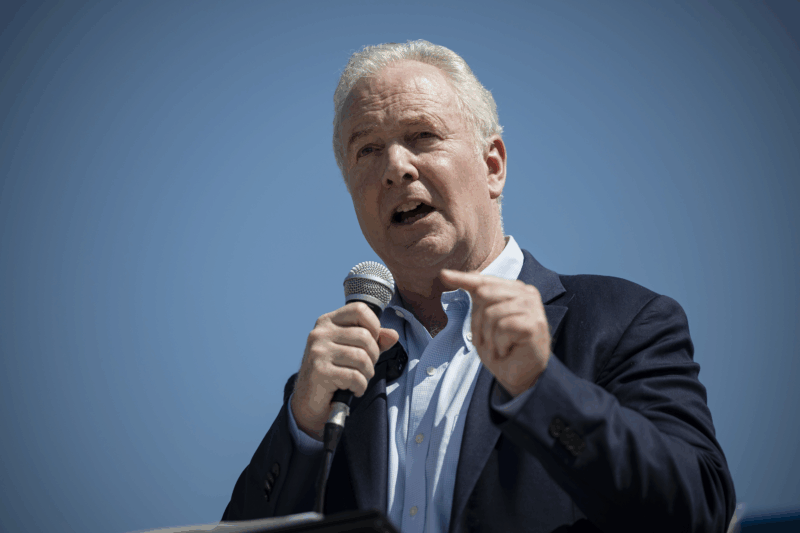
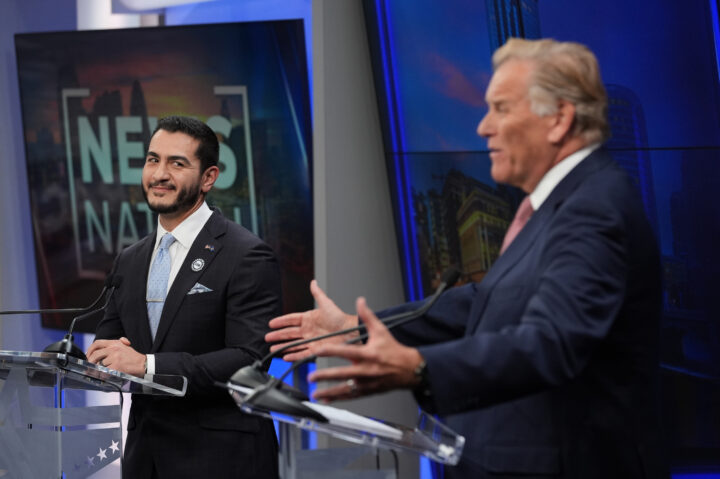
Republican nominee for U.S. Senate Mike Rogers, right, speaks during a televised debate with Democratic nominee for U.S. Senate Abdul El-Sayed on Oct. 8, 2026, in Grand Rapids, Mich.


 Add JewishInsider on Google
Last Thursday’s Michigan Senate debate, where Democratic nominee Abdul El-Sayed framed Israel as a threat to the United States comparable to Iran and said he would not vote to send defensive aid to Israel even if it were under fire, proved to be a breaking point for some Jewish Democrats who were holding out hope that the Democratic nominee would moderate his views in the general election.
Community leaders said that they’re hearing from some previously undecided Jewish Democrats that, after they debate, they now plan to back Republican Mike Rogers.
“I think for a lot of pro-Israel Jewish Democrats, Abdul has made it easy. He’s not really made any accommodations whatsoever, and the debate was just the latest example,” said David Kramer, a prominent Michigan Democratic fundraiser and vice chair of the Michigan Democratic Jewish Caucus.
He told Jewish Insider he’s heard from members of his community that they felt the debate demonstrated that El-Sayed is “not giving an inch and he’s absolutely showing who he is.”
Kramer had previously said he wasn’t willing to vote for El-Sayed without changes to his rhetoric and platform.
“I’ve talked to a couple of people who were wrestling with the same choice as I am, who have said that based on the debate, that was kind of a final straw, and they are going to vote for Rogers,” Kramer told JI.
Another Michigan Jewish Democrat told JI that they are hearing similar feedback in their network.
El-Sayed’s campaign did not respond to a request for comment.
Kramer said, “I think there were well-intentioned voters and community leaders, and even elected officials, who were hoping we’d get him to a better place, and he’ll need us, and he’ll want to embrace us, and it’s quite evident, at this point, that he’s not doing anything.”
Joan Lowenstein, a member of the Michigan Democratic Party Central Committee and president of the Jewish Federation of Ann Arbor, said she’s also heard from people in her community that the debate was a turning point. “I think people who did watch the whole thing really didn’t get anything new about what El-Sayed thinks, or what he was willing to do for Jewish safety — not at all.”
Lowenstein said the debate had “confirmed what I think about El-Sayed,” describing him as evasive and lacking in substantive policy proposals. On Israel, she said that his responses show a “lack of understanding that you would expect a senator to have” about foreign policy issues.
Kramer and Lowenstein are members of the Nonnegotiable Michigan campaign that has sought to pressure El-Sayed to make commitments to supporting Israel’s right to exist as a Jewish state and to Jewish safety in the United States.
Dennis Bernard, the national chair of government relations at the Jewish Federations of North America, who supported both Rep. Haley Stevens (D-MI) and Rogers in their respective primaries, said that El-Sayed’s response on whether Israel or Iran is more dangerous to the United States was “the defining moment for our community. … It’s an astounding comment.”
“At this point, if you still haven’t decided that there is enough out there as a Democrat not to vote for him, nothing’s going to convince you,” he said. “There were still a lot holding out. … After that debate, those who will go for Rogers have made their decision. El-Sayed did not help himself in our community. It was not a good performance. He had to have a better answer.”
Anecdotally, Bernard said that there’s intense discussion in the Jewish community about the race, with his social circle unanimously questioning how any Jewish voter at this point could support El-Sayed. Bernard said that he’d spoken to six lifelong Democrats on Saturday who were all planning to vote for Rogers. Bernard also said he’s never heard so much discussion in the Jewish community about ticket splitting.
Rabbi Aaron Starr, of Congregation Shaarey Zedek in Southfield, Mich., speaking in his personal capacity, said the debate left him “frustrated and sad” with both candidates spending more time “criticizing each other with personal attacks than helping us understand how they will help us work toward a better tomorrow for our children.”
“Dr. El-Sayed’s inability to affirm my basic needs has led me, and many others in my community, to confidently decide we simply cannot vote for him,” Starr continued, referring to the Nonnegotiable campaign’s core principles. Starr is a leading organizer of the Nonnegotiable petition.
He said that El-Sayed’s comments during the debate “reinforced” Jewish community members’ “deep concern about his candidacy, and reminded us that if Dr. El-Sayed’s position takes hold in the Democratic Party, Israel’s enemies will be emboldened, American Jews will be even more vulnerable, and America will be pulled into even more war –– not less, as Dr. El-Sayed claims to want.”
Starr said that he was “horrified, though not surprised” at El-Sayed’s hostility toward Israel and “refusal to condemn the Iranian regime and its proxies.” He added that “Dr. El-Sayed gave voice to centuries-old libels against the Jewish people by suggesting Israelis somehow manipulated an otherwise innocent America into a war. In this way, he denies America’s agency in choosing to defend itself and its allies against nuclear threats and belligerency.”
Zach Nessel, the secretary of the Michigan Democratic Jewish Caucus, who spoke to JI in his personal capacity, said that he thought El-Sayed’s answer to the question about Israel and Iran showed he is “not really taking our national security seriously” and “doesn’t want to upset people who don’t have America’s national security interests top of mind.”
Nessel, the son of Michigan Attorney General Dana Nessel, who is supporting El-Sayed, said he’s still undecided and doesn’t believe in sitting out elections, but feels “unenthusiastic” about both candidates.
He said he also found El-Sayed’s frequent attacks on AIPAC and its donors to be hypocritical when he has refused to address his own donors’ and associates’ support for groups including Hamas and Hezbollah, something that Rogers repeatedly hammered him on during the debate.
El-Sayed denied Sunday that any of his family have ties to the Muslim Brotherhood, and asserted that Rogers had only raised the issue to stoke Islamophobia.
“Now, I don’t think one man is perfectly represented by his donors, but it seems to be certainly very problematic,” Nessel said.
Decky Alexander, the chair of the Michigan Democratic Jewish Caucus, who plans to vote for El-Sayed, said she was broadly disappointed by the debate, calling it “a lot of theater” rather than a substantive exchange of ideas.
She acknowledged that many in the Jewish community did not think the “rhetoric around Israel and Iran in particular was helpful in this moment, particularly for Jews that are on the fence.” She said she was also “uncomfortable” with what she heard at the debate but said that the debate does not tell the “whole story.”
She added she thinks that El-Sayed’s joint event with Sen. Elissa Slotkin (D-MI) the previous weekend was ultimately more impactful for Jewish Democratic voters than the debate. “They want to hear from somebody … that affirms their own perspectives and values,” she said, describing Slotkin as a strong “ambassador” for El-Sayed.
Alexander said she and others in the community feel that the current political moment is existential in two respects: both for the pro-Israel Jewish community and for other elements of American society.
Lowenstein also said that she had received the anti-El-Sayed mailer that AIPAC’s United Democracy Project began circulating to Michigan Jews at the end of last week, describing it as an effective and targeted message, particularly coming in tandem with the debate.
But others take a different view, and said they haven’t heard much movement — in either direction — following the debate.
“From the people that I’ve spoken to, they all said that Rogers didn’t say anything new,” said Rabbi Asher Lopatin, who said previously that he’s voting for Rogers but is no longer discussing his personal views on the race, given his nonpartisan role as director of community relations at the Jewish Federation of Greater Ann Arbor. “On the other hand, the people that have reservations about Abdul El-Sayed, they also feel he avoided questions … he didn’t change his opinion at all. So there wasn’t any real movement on either side and it really hadn’t changed anything.”
He said that people who were struggling with their votes prior to the debate are still struggling, and some are still holding out hope for a change from El-Sayed.
Several Jewish Democrats also said that El-Sayed’s explanation that he didn’t issue a statement honoring the third anniversary of the Oct. 7, 2023, Hamas attacks on Israel to avoid turning the event into “political theater” was unsatisfactory.
“It was a sorry excuse not to stand up for our community three years after the Oct. 7 attack,” Nessel said, adding that El-Sayed’s failure to speak up cast doubt on other comments asserting that he wants to protect and stand up for the Jewish community. “It’s a really simple ask, just to remember the tragedy of Oct.7 and condemn Hamas for killing 1,200 Jews and kidnapping 200 more.”
He said he thinks that El-Sayed stayed silent because “I don’t think anything he would say would have been true to his values and probably would have been inflammatory.”
Starr offered a somewhat different view.
“While at first I felt resentment at his lack of communication on Oct. 7, I actually appreciate Dr. El-Sayed’s explanation about why he chose not to address the Jewish community,” Starr said. “He recognized that because he couldn’t say anything that spoke to the anguish in Jewish hearts, he was better off not saying anything at all. That said, his inability to speak genuinely with sympathy to us on that heartbreaking day does reinforce why so many Jewish Michiganders are unable to vote for him.”
Alexander said that she called El-Sayed’s campaign to ask about the lack of a statement on Oct. 7 and said she hoped for a “recognition of the impact of this day on his Jewish constituents” but also said that it was likely a “no-win situation for him” politically.
“Is it the thing that is going to deter me from not voting for him?” she continued. “No, because I also understand he’s in this really complicated, political space that I am just not in.”
Lowenstein told reporters before the debate that she had been looking for Rogers to make commitments on civil rights and other issues she sees as tied to her Jewish values, and emerged somewhat encouraged by his responses, including his willingness to reform Immigration and Customs Enforcement and to separate from the Trump administration’s stance on tariffs.
Nessel said he was disappointed in the performance of both candidates, saying that neither had done a good job of arguing their points or explaining their policy positions. He said that the debate could have been a “productive conversation and it just simply didn’t happen,” though he credited Rogers as being more willing and able to discuss policy specifics than El-Sayed.
“I might not agree with his ultimate conclusions when it comes to certain policies, but the fact that he expresses working knowledge and being able to at least understand the issues and explain it to the public is helpful,” Nessel said.
Bernard said he felt that El-Sayed appeared off balance and unwilling to address specifics, though he said that he “also would have liked to see Mike a little more senatorial.”
Lopatin said that hearing Rogers make a clearer declaration that he will not be a “rubber stamp for Donald Trump,” particularly when it comes to defending democracy and the Supreme Court, could be helpful to Rogers in reassuring Jewish Democrats still hesitant to pull the lever for him.
The Democratic Senate nominee also said he regrets his comments about the Temple Israel attack: ‘I regret anytime if I step on somebody's grief’
Chip Somodevilla/Getty Images
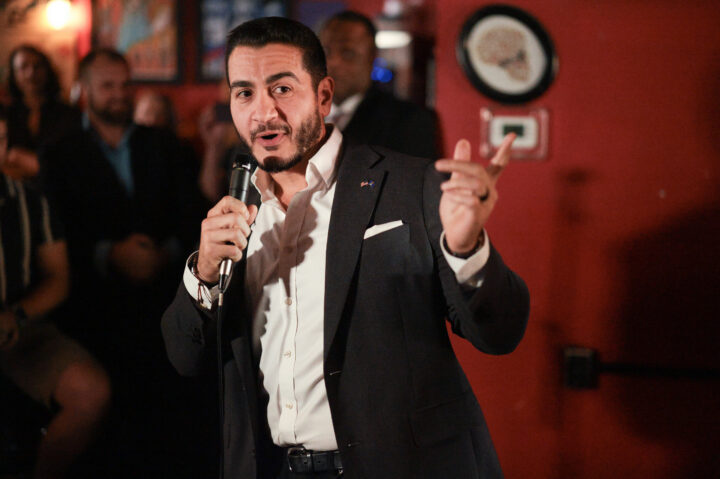
Michigan Democratic Senate candidate Abdul El-Sayed campaigns at The Meanwhile Bar on October 8, 2026 in Grand Rapids, Michigan.
Democratic Michigan Senate nominee Abdul El-Sayed on Sunday denied that he or any of his family members have ties to the Muslim Brotherhood — accusations his opponent, former Rep. Mike Rogers (R-MI), raised last week during the first Michigan Senate debate.
Asked by Kristen Welker on “Meet the Press” to respond to Rogers’ claims, El-Sayed first answered, “You know Kristen, the only reason he said those things is because he really wanted to repeat the word Muslim.”
Pressed to answer directly if he or his family have ties to the Muslim Brotherhood, El-Sayed said, “No.”
Rogers had claimed that El-Sayed received donations from groups in support of the Muslim Brotherhood and from individuals who “openly support Hamas, Hezbollah [and] al-Qaida.” El-Sayed’s mother also worked for the Islamic American Relief Agency, which was designated as a terrorist organization for supporting al-Qaida, and his sister-in-law sued to be removed from a federal terrorism watchlist, according to recent reports.
“Let me ask you though, why this is even a subject of debate,” El-Sayed said to Welker. “Because his only strategy is to point to me and my name and my faith and to say that we’re different. And that you should suspect people simply because they are different than you in how they pray.” He went on to accuse Rogers of being beholden to President Donald Trump and seeking office in order to enrich himself.
El-Sayed also reiterated in the interview that his “commitment to Jewish safety is the same as my commitment to my own kids,” a common refrain of his on the campaign trail, and said of his relationship with the Jewish community that he has “had really important conversations.”
Abdul El-Sayed denied on NBC’s “Meet the Press" that he or any of his family members has ties to the Muslim Brotherhood — accusations his opponent Mike Rogers made during the first Michigan Senate debate last week. Read @marcrod97’s full coverage: https://t.co/8I0EFZd5w9 https://t.co/Vi7gMuHy3x
— Jewish Insider (@jewishinsider) October 11, 2026
“I’ve learned a lot from the conversations I’ve had, some conversations with folks who will be colleagues, somebody like Sen. Elissa Slotkin (D-MI). And, you know, I remember sitting down with her and her sharing how she felt when she heard that ‘hurt people hurt people’ comment. And it was really important to me to hear, to understand that I had been stepping on somebody’s pain. That’s not my goal here,” El-Sayeed said, referring to his comments in the aftermath of the terror attack on Temple Israel earlier this year that critics said attempted to justify the actions of the perpetrator, a Hezbollah sympathizer.
Asked if he regretted the comment, El-Sayed said, “I regret anytime, you know, if I step on somebody’s grief, of course I regret that. And I really wish I’d thought about how somebody would have felt hearing that, and thought twice about making those comments.”
Plus, Jewish preschool teachers' Italy trip nixed over Israel litmus test
Paul Sancya, Pool/AP
Republican nominee for U.S. Senate Mike Rogers, right, speaks during a televised debate with Democratic nominee for U.S. Senate Abdul El-Sayed on Oct. 8, 2026, in Grand Rapids, Mich.
Good Friday morning.
In today’s Daily Kickoff, we cover last night’s contentiousMichigan Senate debate between Mike Rogers and Abdul El-Sayed, report on the cancellation of a program for Israeli and American Jewish preschool educators in Italy after organizers asked them to condemn Israel, and spotlight conversations and addresses at the National Conservatism Conference in Jerusalem in which speakers criticized Jews for raising concerns about antisemitism. Also in today’s Daily Kickoff: Hakeem Jeffries, Asaf Rajuan and Nechumi Yaffe.
Today’s Daily Kickoff was curated by JI Executive Editor Melissa Weiss, with assists from Tamara Zieve and Danielle Cohen-Kanik.
For less-distracted reading over the weekend, browse this week’s edition of The Weekly Print, featuring stories from Jewish Insider and eJewishPhilanthropy, including: Three years after Oct. 7, Israel’s security is ‘much better,’ but risks loom; Michigan Hillel’s break with Israel advocacy groups raises questions about where it stands; and The Siegels lost their home and community on Oct. 7. Now they’re finding their way forward. Print the latest edition here.
Today’s Agenda
With weeks to go before the midterms, President Donald Trump ruled out a resumption of strikes on Iran before Election Day, saying on Truth Social that the U.S. is having “productive discussions” with the Islamic Republic.
The president’s comments could be taken with a grain of salt: In June 2025, he suggested that the U.S. was pursuing diplomacy a day before joining Israel’s attacks on the Islamic Republic, and earlier this year, he said he had not decided on whether to attack Iran, hours before the U.S. and Israel launched coordinated military strikes that took out the top echelon of Iranian leadership.
The Norwegian Nobel Committee announced Navi Pillay, a former U.N. high commissioner for human rights and International Criminal Court judge, as the winner of this year’s peace prize. Pillay, a South African jurist and sharp critic of Israel, served as the head of the U.N.’s Commission of Inquiry targeting Israel, which has been condemned by members of the international body over its anti-Israel bias.
We’re keeping an eye on the political situation in the U.K., where Green Party leader Zack Polanski lost his House of Commons by-election bid overnight, days after his party passed a resolution declaring Zionism to be racism. Polanski has said he will stay on as party leader following his defeat, despite questions over his ability to lead the Greens going forward. The Campaign Against Antisemitism, meanwhile, has reported Polanski’s party to the U.K.’s Equality and Human Rights Commission over the Zionism motion passed earlier this week, saying that such a move has “real potential to embolden expressions of antisemitism.”
One Thing To Know
DEBATE DEBACLE
By Marc Rod
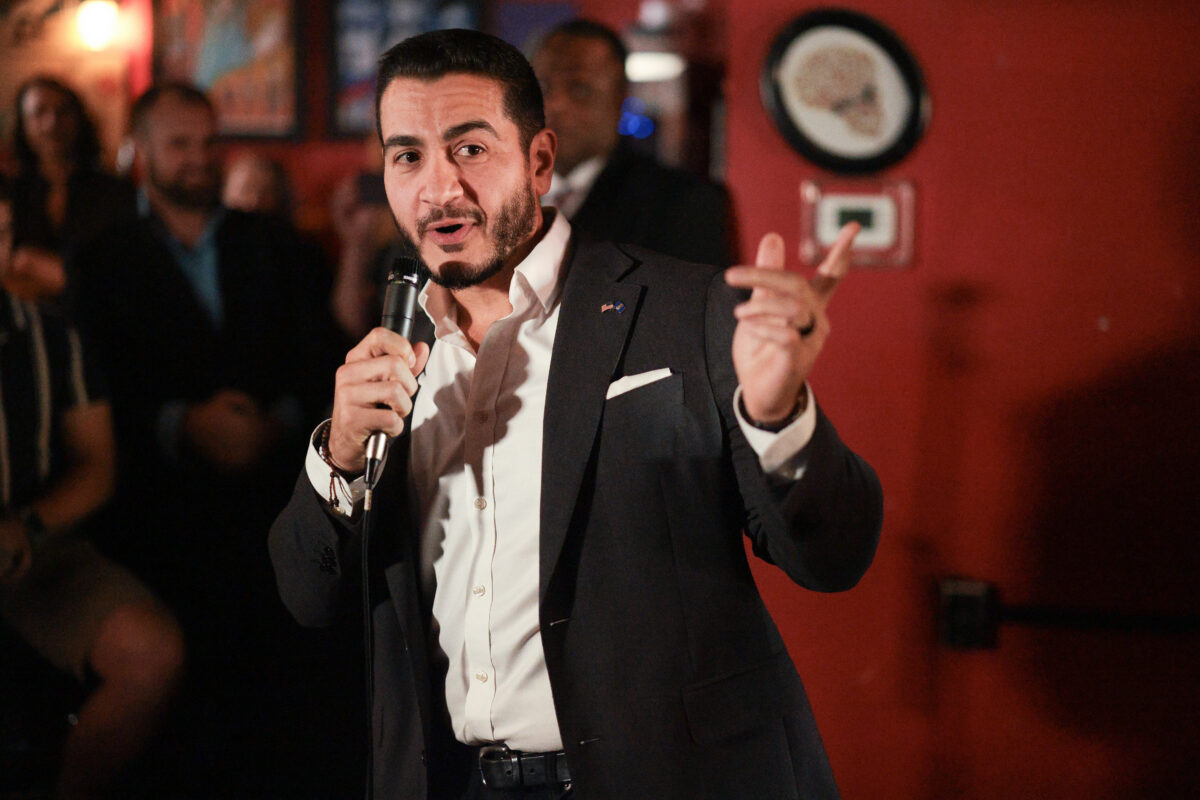
In the first debate of the general election for Senate in Michigan, former Rep. Mike Rogers (R-MI) repeatedly hit Democratic nominee Abdul El-Sayed over his supporters’ ties to and support for terrorist groups and El-Sayed’s comments on the Temple Israel terrorist attack — accusations that El-Sayed largely did not respond to during the deeply acrimonious exchange.
El-Sayed, for his part, said he would not support defensive aid to Israel even if it was under attack, framed Israel as a threat to the United States comparable to Iran, defended his decision not to issue a statement honoring the anniversary of Hamas’ Oct. 7, 2023, attacks on Israel and continued to sidestep questions on Iran’s persecution of its own civilians.
“He has taken money from groups in support of the Muslim Brotherhood. He has taken money from individuals on his campaign who openly support Hamas, Hezbollah, al-Qaida,” Rogers said several times throughout the debate, and accused El-Sayed of failing to condemn terrorist groups and attacks.
The Big Reads
Arrivederci, Reggio
A planned study trip to Italy for some 100 Jewish early childhood educators from the U.S. and Israel was canceled after participants were required to sign a statement condemning Israel’s actions in Gaza, prompting organizers to conclude that the trip’s political litmus test made such a trip untenable, Jewish Insider’s Haley Cohen reports. The educators — members of the U.S.-based Paradigm Project — were scheduled to travel to Reggio Emilia, Italy, from Oct. 11–16. Their goal was to study the Reggio Emilia Approach to early childhood education, a method long embraced by Jewish preschools, and bring those insights back to their classrooms. But ahead of the trip, participants were asked to sign a statement declaring, “I distance myself from the occupation of Gaza and the violation of children’s and human beings’ rights in the occupied territories as well as in every places [sic] in the world,” according to a screenshot obtained by JI.
mayor unmoved
New York City Mayor Zohran Mamdani on Thursday shrugged off the protest — which featured jeers of “traitor” at the democratic socialist leader, and chants of “long live Hamas” — that sought to drown out an event he attended the night prior memorializing the victims of the Oct. 7, 2023, Hamas attacks, Jewish Insider’s Will Bredderman reports. “I was proud to attend last night’s vigil, as I did last year, to listen to testimonies from family members of those who were killed on Oct. 7, and those who’ve been killed in the three years since, and all of whom united in a vision for peace and an end to the genocide in Gaza,” Mamdani told journalists after an unrelated event in Brooklyn. “As for those protesting me, I am the mayor of New York City, and this is what I signed up for.”
Buddy backlash: Politico spotlights concerns from Jewish allies of Mamdani who were dismayed over his Oct. 7 statement, among them T’ruah’s Rabbi Jill Jacobs, a backer of the mayor’s recently announced antisemitism plan who said Mamdani’s comments “missed the mark.”
conference quotables
Several speakers at the right-wing National Conservatism Conference in Jerusalem said on Wednesday that Jews complain too much about antisemitism — on the third anniversary of the Oct. 7 Hamas attacks on Israel, which were followed by a sharp increase in hate crimes against Jews around the world, Jewish Insider’s Lahav Harkov reports. NatCon, as the conference spearheaded by right-wing Israeli American intellectual Yoram Hazony is known, was held in Israel for the first time this week. In a plenary on Wednesday titled “American Right: The Next Generation,” multiple speakers berated Jews for speaking out against antisemitism, accused Israel of drawing the U.S. into wars and mocked evangelical Christians’ beliefs about Israel. They also blamed liberal and neoconservative Jews for mass immigration to the U.S.
The Rundown
exclusive
back from the gulf
cross-party call
TORAH AND TAXES
On Our Radar
● The Live Briefing. Word on the street, clips, podcasts and quick updates — the items we’re tracking all day in our Live Briefing on the app (on Apple and Android) and website.
The Treasury Department announced sanctions on 17 new vessels tied to the Islamic Revolutionary Guard Corps’ “shadow fleet” used to clandestinely move oil and gas out of Iran…
OpenAI said on Thursday that Iranian operatives used ChatGPT to help place nearly 100 articles criticizing the Iran war under fake journalist bylines in roughly a dozen online outlets around the world…
House Minority Leader Hakeem Jeffries (D-NY) said he “strongly” backs the creation of an Oct. 7 memorial in Brooklyn; any future memorial, the funds for which are being privately raised, would require the approval of the mayor’s office to move forward…
The Denver school board voted to censure its vice president, Monica Hunter, over allegations she had made antisemitic comments to a Jewish member of the board; an independent investigation was inconclusive, finding that the allegations amounted to a “he said, she said” situation…
The former head of the Middle Eastern studies department at the University of Arkansas — who called for Israel to be “dismantled” and shared a social media post calling for someone to “thrust the dagger from Doha into the throats of the Zionists, so that all of them howl” — is seeking for a court to strike down the state’s recently adopted antisemitism law, saying it was used for her dismissal from the university…
A district court judge in California ruled that German singer-songwriter Alice Merton’s copyright lawsuit against Kanye West, now known as Ye, can proceed with references to the Holocaust and West’s documented history of antisemitism; West had sought permission to sample one of Merton’s songs for his 2024 track “Gun to My Head,” and chose to use it after Merton, who is a descendant of Holocaust survivors, refused…
Germany’s Left Party, which won a plurality of votes in last month’s state elections in Berlin, agreed to measures to address antisemitism within the party as part of coalition talks with the Social Democrats and Greens…
The Royal College of Pharmacy ended its relationship with the U.K. arm of Teva Pharmaceuticals, becoming the second British institution after the Royal College of Nursing to do so; the college cited the Israeli pharmaceutical company’s unspecified “activities” as the reason for its cutting of ties, which came amid pressure from anti-Israel activists…
British counterterrorism police arrested two Latvian men after they were found inside RAF Molesworth, an air base used by the U.S. military and NATO for intelligence operations. Police said there is no evidence at this stage linking the incident to the suspected Iran-related plot at RAF Fairford…
The Israeli Defense Ministry opened a national pavilion and led a delegation of defense firms — including Elbit Systems, Israel Aerospace Industries and Rafael — at the Marrakech Airshow in Morocco this week, marking Israel’s first official participation in a Moroccan defense exhibition since signing the Abraham Accords…
The Gaza Children’s Village network, a U.S. nonprofit providing food, medical care and education to Palestinian children in Gaza, is planning to use AI to monitor classroom lessons for “hateful” speech and ensure teachers adhere to a peace-focused curriculum…
Three Saudi citizens were killed in Houthi attacks on Riyadh’s King Khalid International Airport and a Saudia Airlines aircraft…
Canadian philanthropist and investor Stephen Jarislowsky died at 101…
Worthy Reads
Hatred on the March: In Fox News, Jeff Miller and Stuart Eizenstat, respectively the current and former chairs of the United States Holocaust Memorial Council, raise concerns about the rise of antisemitism, aided by malign actors. “Furthermore, state actors like Iran, Qatar, China and Russia spread antisemitic and anti-Israel conspiracy theories and Holocaust denial to stir hatred of Jews and sow chaos in democracies. They are succeeding. Antisemitism is no longer lurking at society’s fringes. It is marching openly through its institutions. Violent antisemitism is at levels not seen since the Holocaust.” [FoxNews]
Facing the Palestinian Question: In The New York Times, Shira Efron, a senior fellow at RAND, posits that Israel’s next government must address questions around the Palestinians in order to improve the country’s global social standing. “No amount of walking is going to make the Palestinian question go away. The current government tried to settle the matter for good, seeking to bury the idea of the Palestinian question once and for all. Instead, this government may have exhumed it, turning it into a domestic issue in nations around the world and leaving whichever government comes next no choice but to finally reckon with it.” [NYTimes]
The Meaning of Mourning: In The Wall Street Journal, Kenneth Brander, the president and rosh yeshiva of Ohr Torah Stone, reflects on Jewish mourning practices. “We need the dead to take on an enduring role in the lives of the living. That takes time, and the shaping of time spent mourning is one of the purposes of ritual. In Jewish practice, when one says the name of a deceased person, one adds the phrase “may his memory be a blessing.” The goal of mourning is to make that phrase true: The memory of the dead actually improves our physical lives and our moral selves.” [WSJ]
Find more Worthy Reads in our Live Briefing via our app (on Apple and Android) and website.
Picture of the Day
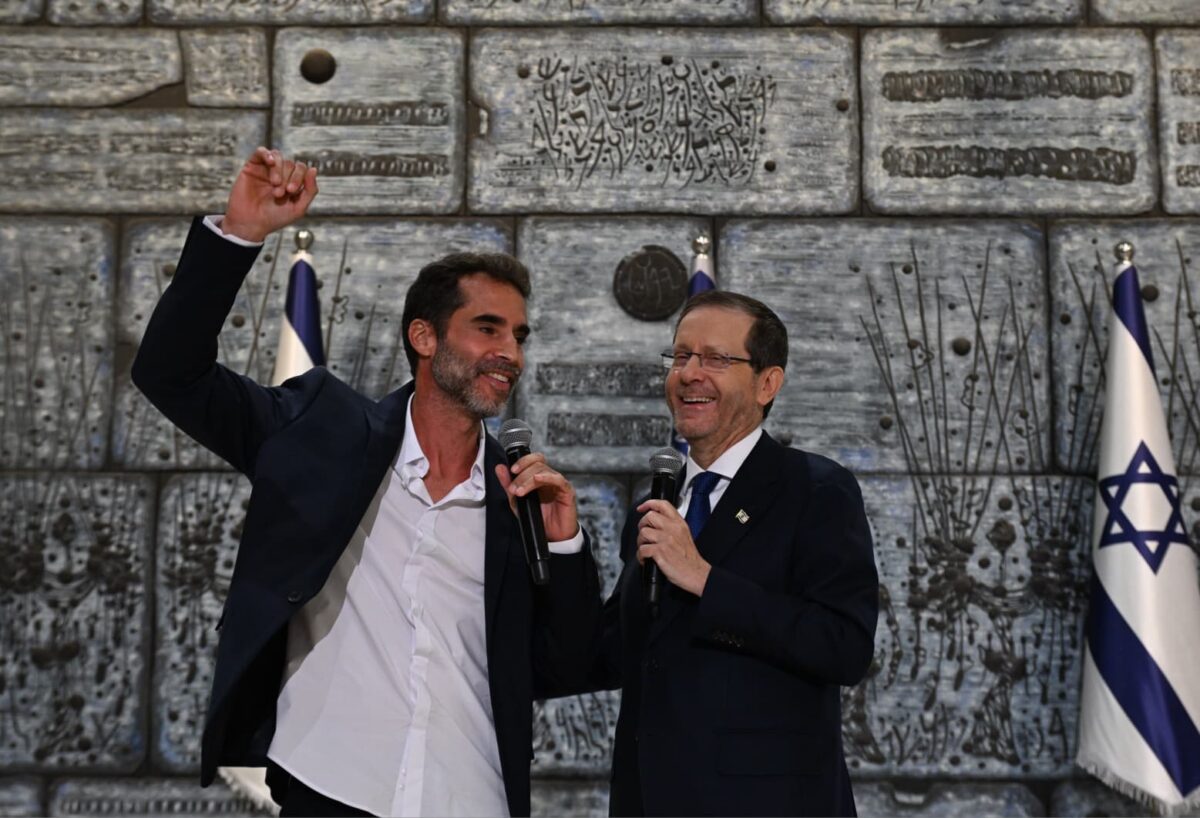
Israeli President Isaac Herzog presented FlyDubai 1073 passenger Asaf Rajuan with the Presidential Award for Civilian Heroism during a ceremony yesterday at the President’s Residence in Jerusalem. Herzog and his wife, First Lady Michal Herzog, honored Rajuan and five other Israelis for their successful efforts for their efforts to thwart an attempted hijacking by the plane’s co-pilot, who had attacked his Indian captain and attempted to crash the plane with 174 people, most of whom were Israelis, on board. Haim Zach/GPO
Wine of the Week
Tzora Vineyards Shoresh Blanc 2025
Shoresh is the Hebrew word for root, and this week I was shown what grows from it. I was at Tzora Vineyards, in the Judean Hills, in the company of my dear friend Yoram, tasting the 2025 Shoresh Blanc, arguably one of the three finest white wines produced in Israel today, when the winery manager insisted on opening the same wine from the 2016 vintage. With nearly a decade in the bottle, the older wine was significantly better than the 2025, and the pairing of the two made for a wine tasting made in heaven.
A blend of predominantly sauvignon blanc, chardonnay, and semillon, the wine holds a subtle sweetness and a bright acidity in graceful balance. The front palate is overwhelmingly citrus; the mid-palate carries a whisper of vanilla, in the elegant, restrained manner of French chardonnay; and the finish is still sitting on my tongue three days later. This is a wine that will hold for a very long time. Serve it with the best cheese in your refrigerator. Buy the 2025 now, and give the roots time.
Birthdays

Evgeny Kissin, concert pianist and composer, turns 55 on Saturday
FRIDAY
Brian Lamb, founder and retired executive chairman and CEO of C-SPAN, known for his unique interview style, turns 85
Charles Miller, retired federal government manager and analyst
Bernard Dov Cooperman, associate professor of Jewish history at the University of Maryland, turns 80
Richard Marpet, Burbank, Calif., resident
David Jacobson, U.S. ambassador to Canada during the Obama administration, then vice-chair of BMO from 2013 to 2024, turns 75
Don Garber, commissioner of Major League Soccer since 1999, turns 69
David Gerstman, research analyst at the Committee for Accuracy in Middle East Reporting and Analysis
Eric S. Kassoff, president of Wilkes Artis, he is active in AIPAC, the Washington JCC and the Jewish Federation of Greater Washington, turns 66
Debby Arzt-Mor, retired director of Jewish learning at the Brandeis School of San Francisco
Todd Richman, managing director and financial advisor at Morgan Stanley Private Wealth Management and chair emeritus of Democratic Majority For Israel
Simon Sinek, best-selling author and motivational speaker, his 2010 TED Talk about leadership is one of the most popular talks of all time, turns 53
Rabbi Shmuel Herzfeld, rosh yeshiva at Yeshivas Elimelech following 17 years as rabbi at Ohev Shalom Synagogue in Washington, D.C., turns 52
Neshama Carlebach, musician and singer, the protégé of her late father, singer-songwriter Rabbi Shlomo Carlebach, turns 52
Karin Elharar Hartstein, member of the Knesset for Yesh Atid., turns 49
Benjamin Berger, SVP for Jewish education, community and culture at Hillel International
Justin Barasky, partner at TKO Political
Ben Lusher, CEO at Denver-based energy firm Nexus Energy Partners, he was the national board chair of Moishe House (now known as Mem Global) until 2022
David Meyerson, executive director of international initiatives at the U.S. Chamber of Commerce Institute for Legal Reform
Ian Karmel, stand-up comedian and Emmy Award-winning television writer, turns 42
Lily Goldstein, VP of portfolio management for LEO Impact Capital
David Cohen, counsel in O’Melveny’s NYC office, he was an executive assistant and advance associate in the Obama White House
Chaya Notik, physical therapist in Montreal
Jason Kaplan, VP at L’Oréal, turns 36
Julia Schechter, senior manager of policy communications at Snap
Daniel Rubin, Israel-based VP at JP Morgan
Kayla Levinson Segal, manager of in-stock management at Amazon in NYC
Inbal Rabin-Lieberman, security coordinator of Kibbutz Nir Am on Oct. 7, 2023, where her team killed 25 terrorists and the kibbutz suffered no casualties, turns 28
Nick Itkin, foil fencer, he won a team bronze medal at the 2020 Olympics (Tokyo) and an individual bronze medal at the 2024 Olympics (Paris), turns 27
SATURDAY
Laurence Tribe, professor emeritus of constitutional law at Harvard Law School, he has argued 36 cases at the U.S. Supreme Court, turns 85
Bruce Karatz, past chairman and CEO of KB Home, a nationwide home builder, turns 81
Miriam Adelson, physician, philanthropist and the majority owner of the Las Vegas Sands Corporation and the NBA’s Dallas Mavericks, turns 81
Ronald Maurice “Ronny” Naftaniel, former director of the Center for Information and Documentation Israel in The Hague, promoting a positive view of Israel within Dutch society, turns 78
Meir Sheetrit, former member of the Knesset for 30 years on behalf of three political parties, he has served in seven ministerial roles, turns 78
Yedidya Atlas, longtime IDF chaplain
Diane Schmidt, award-winning writer and photographer based in Albuquerque, N.M.
David Lee Roth, vocalist and songwriter best known as the lead singer of Van Halen, he is an inductee of the Rock & Roll Hall of Fame, turns 72
Bruce Karsh, co-chairman and chief investment officer of Oaktree Capital Management, turns 71
John M. Grunsfeld, former NASA astronaut who flew on five space shuttle missions, he has held many positions at NASA including chief scientist, turns 68
Neil Gurvitch, senior counsel at the Bethesda, Md., law firm of Selzer Gurvitch
John C. P. Goldberg, dean of Harvard Law School, turns 65
Rodney Freeman, founder and principal of Los Angeles-based real estate firm, Freeman Group
Sam Lauter, governmental relations and strategic communications principal at BMWL Public Affairs
Mark H. Shpall, head of school at de Toledo High School, a Jewish school in northern Los Angeles County
Gavin Newsom, governor of California since 2019, turns 59
Asi Cohen, Israeli comedian and actor, twice voted as the funniest Israeli, turns 52
Rabbi Schlomo Elieser Hofmeister, community rabbi of Vienna and chief rabbi of the Austrian Armed Forces, turns 51
Matti Friedman, columnist for The Free Press, he is the author of five acclaimed books, turns 49
Chanan Weissman, Jewish liaison during the first two years of the Biden administration, now the director of emerging technologies at the Maimonides Fund
Ian Sugar, president of Ian Sugar Strategies
Seth Levey, head of U.S. government relations and corporate affairs at Glencore
Avi Davidoff, VP in the Chicago office of Goldman Sachs
Rabbi Elliot Schrier, rabbi of Congregation Bnai Yeshurun in Teaneck, N.J., turns 37
Hali Haber Spiegel, director of education at CAMERA
Avner Netanyahu, winner of Israel’s National Bible Quiz as a teen and then a soldier in the IDF’s Combat Intelligence Collection Corps, he is a son of PM Benjamin Netanyahu, turns 32
Or Shaked, U.S. correspondent at Israel Hayom and deputy director at Jewish Virtual Library
SUNDAY
Saul Friedländer, professor emeritus of history at UCLA, winner of both a Pulitzer Prize and the Israel Prize, he won a MacArthur Genius fellowship in 1999, Saul Friedländer, turns 94
Ronald S. Liebman, former assistant U.S. attorney who prosecuted then-VPOTUS Spiro T. Agnew in 1973, he is the author of four novels, turns 83
Amos Gitai, Israeli filmmaker and artist, turns 76
Patty Murray, U.S. senator (D-WA), turns 76
Barry G. Silverman, senior judge of the U.S. Court of Appeals for the 9th Circuit, turns 75
Helane Goldstein, past president and then board chair of Congregation B’nai Tzedek in Potomac, Md., turns 73
Ron Prosor, Israeli ambassador to Germany, he has also been Israel’s ambassador to both the U.K. and the U.N., turns 68
Shari Aronson, NYC-based philanthropist
Mark Gurvis, former EVP at JFNA, now CEO at the Vancouver, British Columbia-based Ronald S. Roadburg Foundation, turns 67
Sharon Rockman, owner of Sababa Travel
Peter Turman, Los Angeles-based real estate agent
Rob Speyer, president and CEO of NYC-based real estate firm Tishman Speyer, turns 57
Asher Epstein, CEO of Focus at 50, helping Israeli companies break into the U.S. market
Joshua London, head of philanthropy at the University of Haifa UK, also an advisor at the Yad Vashem UK Foundation, turns 51
Michael Dickson, executive director of the StandWithUs Israel office in Jerusalem, turns 49
Brianne Nadeau, member of the Council of the District of Columbia since 2015, turns 46
Jamie Weinstein, political journalist, opinion commentator and satirist, he is the host of “The Dispatch” podcast, turns 43
Please log in if you already have a subscription, or subscribe to access the latest updates.
 Continue with Google

 Continue with Apple