










































In an interview with ‘The Bulwark,’ the former national security advisor argued that the argument in favor of restricting military aid is ‘much stronger’ than it was a year ago
Andrew Harnik/Getty Images
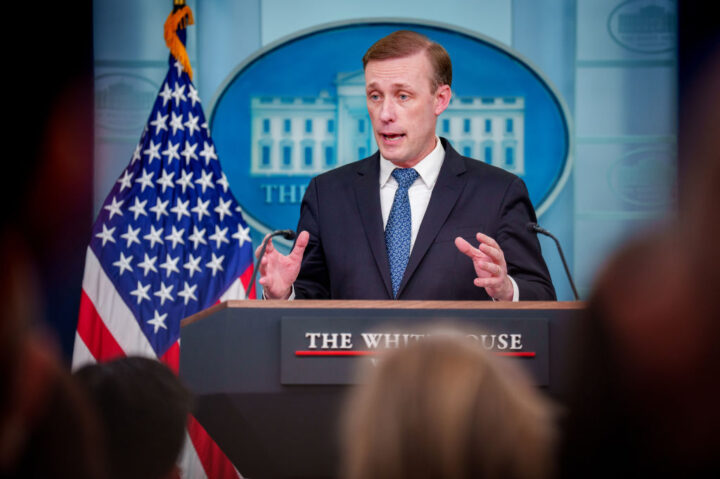
National Security Advisor Jake Sullivan speaks during a news conference in the Brady Press Briefing Room at the White House on January 13, 2025 in Washington, DC.


 Add JewishInsider on Google
Former National Security Advisor Jake Sullivan said on Wednesday that the “case for withholding weapons from Israel today is much stronger than it was one year ago,” adding that he now backs such efforts.
“The thing that we were grappling with throughout all of 2024, which is not the case today, is that Israel was under attack from multiple fronts,” Sullivan, who served under President Joe Biden, told The Bulwark’s Tim Miller. “It was under attack from Hezbollah, from the Houthis, from Syria, from Iraq, obviously from Hamas and from Iran itself. So the idea of saying, ‘Israel, we’re not going to give you a whole set of military tools’ in that context was challenging.”
“The case for withholding weapons from Israel today is much stronger than it was one year ago,” Sullivan added. “One, they don’t face the same regional threats. Two, there was a ceasefire hostage deal in place and the ability to have negotiations, and it was Israel who just walked away from it without negotiating seriously. Three, there is a full-blown famine in Gaza. And four, there are no more serious military objectives to achieve. It’s just bombing the rubble into rubble.”
Sullivan, who was tapped as the inaugural Kissinger Professor of the Practice of Statecraft and World Order at the Harvard Kennedy School, suggested that the political makeup of the Israeli government could affect the future of the U.S.-Israel relationship.
“If nothing changes in their government — if it continues to be a far-right government that pursues the same policies — then it won’t be the Israel we’ve known,” Sullivan said. “I think a lot of Israelis would say they wouldn’t recognize that Israel. And obviously, that should have an impact on the relationship.”
‘A weak and vulnerable Iran was susceptible to a very good deal that would lock Iran's program in a box for decades, not just set it back for a couple of years,’ Sullivan said

Drew Angerer/Getty Images
Former National Security Advisor Jake Sullivan speaks during the daily press briefing after U.S. President Joe Biden gave remarks on the terrorist attacks in Israel at the White House October 10, 2023 in Washington, DC.
ASPEN, Colo. — Former National Security Advisor Jake Sullivan suggested at the Aspen Security Forum on Friday that the U.S. strikes on Iran had not been necessary and didn’t accomplish the fundamental goal of permanently stopping Iran’s nuclear program.
Asked whether he wished that President Joe Biden had carried through with plans to strike Iran before he left office, Sullivan argued that the situation at the time had been ripe for a diplomatic solution.
“During the transition, we handed off to the Trump administration. The situation in which Iran was at its weakest point since 1979,” Sullivan said. “Hezbollah had been functionally defeated. Assad had fallen. Its air defenses had been destroyed, and twice, Iran had tried to hit Israel with large salvos and missiles, and twice, with American help ordered by President Biden, Israel defeated those attacks. So Iran was weak and vulnerable.”
“In my view, a weak and vulnerable Iran was susceptible to a very good deal that would lock Iran’s program in a box for decades, not just set it back for a couple of years,” Sullivan continued.
He said that, after the strikes, a very similar deal remains necessary, “which is what I think President Trump will pursue, because the only way to permanently end Iran’s nuclear threat, I think, is through diplomacy.”
Sullivan’s perspective separates him from some Senate Democrats who spoke earlier in the day at Aspen, who described the strikes as successful even as they criticized the administration’s failure to coordinate with Congress and also emphasized that negotiations must follow.
Biden’s former national security advisor said, ‘on this, unlike on many other issues, on foreign policy, I seem to be on the same page as Donald Trump’

White House National Security Advisor Jake Sullivan
Former National Security Advisor Jake Sullivan praised President Donald Trump for his strategy of engagement with Iran on their nuclear weapons program and predicted that the Trump administration would reach a deal that “is going to look and feel pretty similar to the” 2015 nuclear deal reached by former President Barack Obama.
Sullivan made the comments on the Unholy Podcast, hosted by Channel 12 anchor Yonit Levi and The Guardian columnist Jonathan Freedland, when asked how he views Trump’s embrace of diplomacy with Iran after withdrawing from the Obama-era deal in his first term. Sullivan, who helped negotiate the 2015 agreement before serving as former President Joe Biden’s national security advisor, noted that Trump referred to the Joint Comprehensive Plan of Action as “the worst deal in human history.”
“The irony is not lost on me that now they are negotiating something that, in its broad elements, is going to look and feel pretty similar to the JCPOA. I’m not talking to anyone in the Trump administration about this. I don’t know of them engaging with other of the architects or negotiators from the Obama era, in part because, while they’re following some of the blueprint of the JCPOA, I think from a marketing perspective, they want to distance themselves and say [that] whatever the Trump deal is is going to be so much better than the Obama deal. I will find it very interesting to watch them make that case,” Sullivan said.
The former national security adviser said he was monitoring public developments with regard to how the uranium enrichment issue was addressed in the ongoing negotiations. Sullivan noted that the issue “has both hung up the negotiations and created this big fight, frankly, within the Republican party.”
Citing the risk of the “potential for retaliation by Iran against both Israel and the United States in the region,” Sullivan said that, “I’ve always thought that a diplomatic resolution that puts Iran’s nuclear program in a box is the right way to proceed. And on this, unlike on many other issues, on foreign policy, I seem to be on the same page as Donald Trump.”
Asked about Trump’s decision to not stop in Israel during his recent Middle East visit and if his overall approach to extracting concessions from Israeli Prime Minister Benjamin Netanyahu served as evidence that the Biden administration should have taken a firmer stance with the Israelis, Sullivan argued there were commonalities between Trump and Biden’s approach to the Gulf states.
“Donald Trump likes peace and he likes deals. That’s his basic approach to the region. And he looks at Bibi and he says, ‘Is Bibi going to give me peace or deals? No. Is MBS [Saudi Crown Prince Mohammed bin Salman]? Yes. Is MBZ [UAE President Mohamed bin Zayed Al Nahyan]? Yes. Even, are the Iranians? Maybe. So are the Houthis, maybe they’ll give me a deal.’ So really I think what he’s doing is saying, ‘Can Bibi be a partner in the things I’m trying to accomplish here, deescalation and deals?’ And since he’s kind of concluded the answer is no, he’s just going to go off and largely do that himself,” Sullivan explained.
“That means cutting a deal with the Houthis that essentially still leaves the Houthis in a position where they’re attacking Israel and saying they’re going to hold Israeli link shipping at risk. It has him potentially doing a deal with Iran, despite misgivings from Israel. And of course, it has him pursuing these massive economic deals with Saudi and the UAE,” he continued.
Sullivan argued that the Biden administration “worked to pave the way for a lot of the strengthened relations with countries in the Gulf,” pointing to partnerships they made with the Saudis and Emiratis.
“We had a different approach on some of this AI and tech stuff, particularly limitations around numbers of chips that would go there. But in substance, the idea that there would be a technology partnership between the UAE and the United States, between the U.S. and Saudi Arabia, that was a hallmark of the Biden approach as well. And so I don’t see a huge divergence there,” he said.
Asked about the ramifications of Israel potentially striking Iran’s nuclear program without Trump’s approval, Sullivan dismissed the notion that Netanyahu would defy the current president.
“I’m pretty skeptical that Prime Minister Netanyahu would act contrary to Trump’s wishes on this front. I think it is highly unlikely that you would see an Israeli prime minister order an attack against the express urging of an American president, particularly this American president in this time, particularly given that the U.S. is engaged in diplomacy with Iran to try to get to some kind of deal,” Sullivan said.
Addressing the war in Gaza, the outgoing White House national security advisor said, ‘just having Israel say: OK, we accept the cease-fire. We have to just stop — at a time when all of these hostages are being held — that doesn’t wash.’
White House National Security Advisor Jake Sullivan
White House National Security Advisor Jake Sullivan, in his final days in office, said on Tuesday that China, Russia and Iran are “demonstrably weaker” after President Joe Biden’s time in office, during a wide-ranging conversation on “The Ezra Klein Show” podcast.
Questioned by Klein about whether President-elect Donald Trump is better suited to bring back international order as “a strongman” leader, Sullivan responded, “I believe we are in a plastic moment in the world, a time when our competitors are trying to challenge the system in a profound way. It’s true of China, it’s true of Russia, it’s true of Iran. And they’re doing so trying to push the boundaries of what they can — for lack of a better term — get away with. And I believe that, in a period like this, there is no way to prevent all crises, all turbulence. I don’t think that is a viable endgame for American foreign policy.”
Sullivan continued, “I think the endgame for American foreign policy should be: Can we manage that period without our getting dragged into a major conflict? We have done that. Can we manage that period with our alliances stronger than we found them? I think it is indisputable that we have done that. And can we manage that period where our adversaries are weaker than we found them? In all three cases — China, Russia, Iran — I think the record is clear that they are demonstrably weaker.”
Addressing the Biden administration’s approach to Israel and the Middle East conflict, Sullivan said, “What we have tried to do is adopt a policy that says: We are going to continue to support Israel in its attempt to defeat terrorist enemies and to deter Iran. We are going to do so, including through the provision of military assistance. At the same time, we are also going to be unflinching in our critique of Israel, where we believe they have gone too far. And we are going to push them to a better place on things like humanitarian assistance.”
The war in Gaza, Sullivan said, “continues to be a daily struggle, in part because we are trying to deliver this cease-fire and hostage deal. And just having Israel say: OK, we accept the cease-fire. We have to just stop — at a time when all of these hostages are being held — that doesn’t wash.”
At the end of the interview, Sullivan gave listeners a book recommendation: Nexus: A Brief History of Information Networks from the Stone Age to A.I., by Israeli writer Yuval Noah Harari, which was published in September, 2024. Sullivan said he thinks “everyone should read this book.”
Please log in if you already have a subscription, or subscribe to access the latest updates.
 Continue with Google
 Continue with Apple