


















The president made the comments on Fox News after the IRGC attempted a surprise ballistic missile attack on U.S. forces in the region
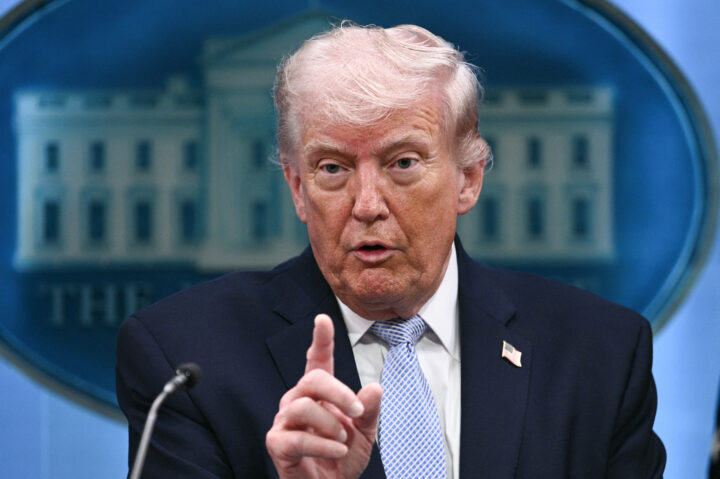
Brendan SMIALOWSKI / AFP via Getty Images
US President Donald Trump speaks about the conflict in Iran in the James S. Brady Press Briefing Room of the White House on April 6, 2026, in Washington, DC.


 Add JewishInsider on Google
President Donald Trump warned on Wednesday that the U.S. would “beat the f**king sh*t out of” Iran following an attempted surprise ballistic missile attack by the Islamic Revolutionary Guard Corps on American forces in the region, even as he signaled a willingness to keep diplomatic channels open.
“We’ll be hitting them hard,” Trump told Fox News’ Trey Yingst. “They’re going to get a beating.”
But Trump added that he’s “going to let them keep talking,” referring to ongoing indirect U.S.-Iran negotiations.
The president’s comments followed a spate of attacks on Tuesday evening into Wednesday morning by Iran and its proxies. In addition to the IRGC surprise attack, Iran also directed more than 30 drone attacks by its proxies in Iraq over several days on “U.S. forces and Saudi energy infrastructure,” CENTCOM said, leading the U.S. and Saudi Arabia to conduct joint strikes on logistics and weapons sites in eastern Iraq early Wednesday. The Jordanian military also announced that it had intercepted five missiles launched from Iran on Tuesday night.
The attacks ended a pause in hostilities between the parties, which began last Friday, and came after Trump’s disclosure on Monday that the U.S. remains engaged in “very deep talks” with Iran. But the president has repeatedly threatened to reengage in military action if diplomacy collapses.
On Sunday afternoon, the U.S. and Iran agreed to cease their strikes and meet later in the week in Doha, Axios reported
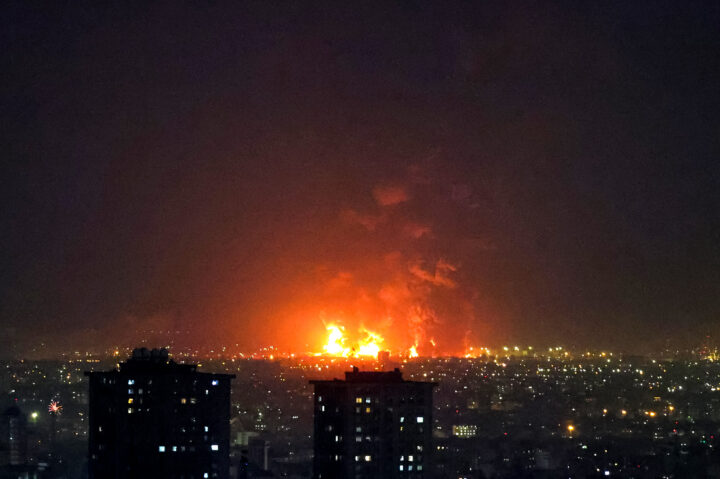
ATTA KENARE / AFP via Getty Images
Explosions erupt following strikes at Tehran Oil Refinery in Tehran on March 7, 2026.
The U.S. and Iran traded strikes over the weekend, testing the fragile memorandum of understanding signed between the countries earlier this month.
The U.S. first accused Iran of violating the ceasefire after it launched drone attacks on a Singapore-flagged oil tanker in the Strait of Hormuz on Thursday. The Islamic Revolutionary Guard Corps had earlier issued a warning to commercial vessels “to strictly refrain from any movement outside the designated routes,” which are in parts of the waterway that it controls.
In a “powerful response” to Iran’s “unwarranted aggression,” CENTCOM said, the U.S. struck Iranian missile and drone storage locations and coastal radar sites on Friday.
On Saturday, CENTCOM said Iran was “given [another] chance to honor the ceasefire agreement but elected not to” when it launched another one-way attack drone on a Panama-flagged oil tanker earlier that morning. In retaliation, the U.S. targeted Iranian military surveillance infrastructure, communication systems, air-defense sites, drone storage facilities and minelayer capabilities, CENTCOM said.
President Donald Trump sounded his frustration in a post on Truth Social on Saturday, writing, “There may come a point when we are no longer able to be reasonable, and will be forced to militarily complete the job that we very successfully started” in Iran. “If that happens, the Islamic Republic of Iran will no longer exist!”
After the U.S. strikes, the governments of Bahrain and Kuwait said they were targeted by Iranian drone and missile attacks, which the IRGC said were attempted strikes on U.S. military bases in the country.
The IRGC added in its statement that vessels violating Iran’s instruction in the Strait of Hormuz “will be dealt with even more forcefully” and that U.S. bases in the region will be “experiencing hell” in the coming days.
By Sunday afternoon, the U.S. and Iran had agreed to cease their strikes and meet on Tuesday in Qatar to discuss the dispute over the Strait of Hormuz, Axios reported.
Trump designated the Islamic Revolutionary Guard Corps as a terrorist organization during his first term; the group has been tied to plots to assassinate him and other U.S. officials
Nathan Howard-Pool/Getty Images
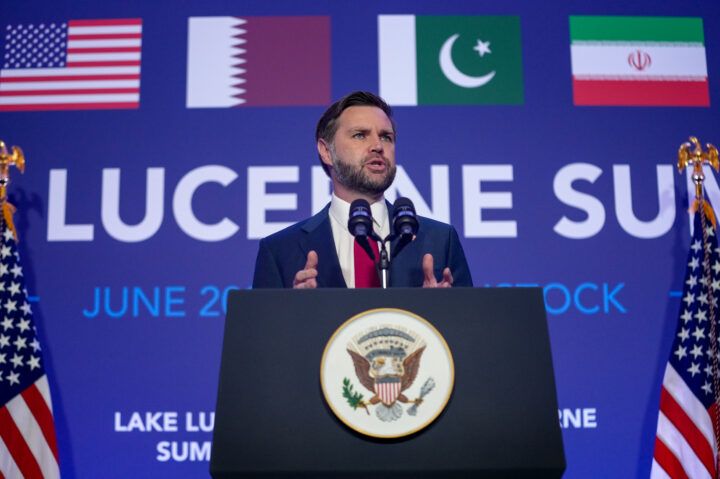
Vice President JD Vance speaks to members of the media at the Buergenstock Resort Lake Lucerne, after the U.S. and Iran held high-level talks at the Lake Lucerne Summit on June 22, 2026 near Stansstad, Switzerland.
Vice President JD Vance said this week that U.S. military officials are working directly with Iran’s Islamic Revolutionary Guard Corps, a U.S.-designated Foreign Terrorist Organization. The vice president made the comments after departing Switzerland following the conclusion of talks with Iran that lasted until Monday.
“One of the things we wanted to come out [of the negotiations]” was a “channel on the Iranian side” to seek conflict resolution, Vance told the outlet UnHerd aboard Air Force Two. “Which we did. They were like, ‘OK, fine, we’ll send somebody from the IRGC to go hang out in Doha with somebody from CENTCOM,’ and that’s how we’re going to settle a lot of these disputes,” he said.
President Donald Trump designated the IRGC an FTO during his first term in 2019 and ordered the strike that killed IRGC Quds Force head Qasem Soleimani in 2020. Announcing the designation, the State Department said the group “has been directly involved in terrorist plotting; its support for terrorism is foundational and institutional, and it has killed U.S. citizens.” The IRGC also “continues to provide financial and other material support” for terror groups including Hezbollah, Kataib Hezbollah, Hamas and Palestinian Islamic Jihad, the statement added.
The group played a central role in Iran’s attacks around the region during the U.S.-Iran war, including an attack on the U.S. Fifth Fleet headquarters in Bahrain earlier this month, and is linked to dozens of recent plots and attacks in Europe. U.S. authorities have also repeatedly alleged IRGC involvement in assassination schemes targeting current and former American officials, including Trump.
Vance said that the Emiratis — “by far the most hawkish, by far the most pro-Israel country in the [Gulf Cooperation Council]” — are also “having conversations with the Iranians that have never happened before, including with the IRGC,” namely about economic incentives to urge Iran to cooperate.
Regarding criticism of the memorandum of understanding reached with Iran, Vance said, “There are many things I don’t like about the comparison to the [2015 Joint Comprehensive Plan of Action], but one of them is that the MOU is a much more generic document than the JCPOA.”
“It really is a foundational document,” he said of the MOU. “Let’s open the strait, let’s stop shooting at each other, and let’s see if we can make a nuclear deal. And from their perspective, it’s, ‘Let’s lift the blockade, let’s stop shooting at each other, and let’s see if there’s a sanctions deal.’ That’s fundamentally where it’s coming from.”
Vance claimed the Iranians are now offering “things radically different from the JCPOA” and “want a fundamentally transformed relationship with the United States and the world.”
A spokesperson for Murphy said the senator's social media post was 'sarcasm'

Jemal Countess/Getty Images for Fair Share America
Sen. Chris Murphy (D-CT) speaks at the U.S. Capitol on April 10, 2025 in Washington, DC.
Sen. Chris Murphy (D-CT) on Monday appeared to cheer on the reported evasion by more than two dozen Iranian ships of the U.S. maritime blockade of the Strait of Hormuz.
The Connecticut Democrat, one of the most vocal critics of Israel in the Senate, responded on X with a one-word comment — “awesome” — to an unconfirmed report that at least 26 vessels belonging to the shadow fleet, which is overseen by the Islamic Revolutionary Guard Corps, had bypassed the blockade.
A spokesperson for Murphy clarified to Jewish Insider, “The tweet was sarcasm. Chris obviously thinks it’s terrible that Donald Trump continues to mishandle every aspect of a war he started but clearly has no strategy to end.”
Over the weekend, Murphy appeared at the Alex Soros-backed Global Progressive Summit in Barcelona, where he claimed that the U.S. was “in the middle of” a “totalitarian takeover.”
This post was updated at 9:25 a.m. ET on 4/21/2026 to add comment from Murphy’s office.
The unanimous decision came after several countries including France and Italy removed their objections due to Iran’s violent crackdown on protesters
Siavosh Hosseini/SOPA Images/LightRocket via Getty Images
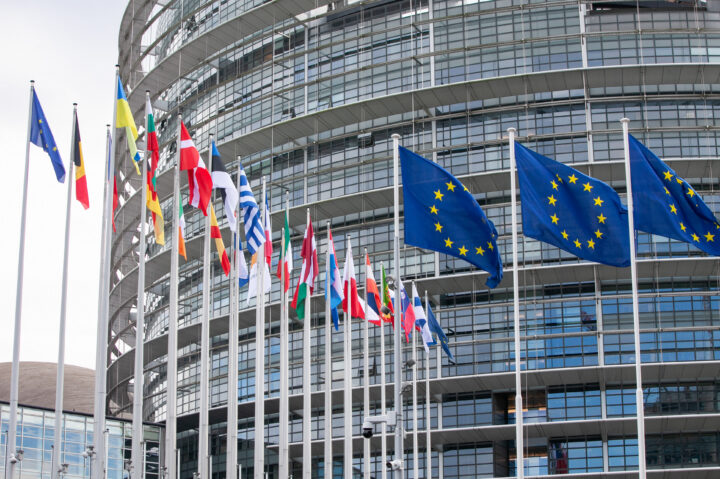
EU Flag and 27 members of European countries at the European Parliament building.
The European Union designated Iran’s Islamic Revolutionary Guard Corps as a terrorist organization on Thursday, marking a significant shift in policy for European countries that had long been wary of irreparably harming ties with Tehran.
The 27 European Union foreign ministers convened in Brussels, Belgium where they voted unanimously to make the designation as a response to Iran’s violent suppression of nationwide protests. The decision puts the IRGC among the likes of al-Qaida, Hamas and the Islamic State on the EU terror list. The bloc also imposed new sanctions on 15 Iranian officials, including top commanders of the Revolutionary Guard, in addition to existing stringent sanctions.
“Repression cannot go unanswered,” Kaja Kallas, the EU’s high representative for foreign affairs and security policy, wrote on X on Thursday following the decision. “EU Foreign Ministers just took the decisive step of designating Iran’s Revolutionary Guard as a terrorist organisation. Any regime that kills thousands of its own people is working toward its own demise.”
Anne-Sophie Sebban-Bécache, vice president of Europe at the American Jewish Committee, told Jewish Insider the declaration was a “historical political decision.”
“It’s a very key political decision that will also have concrete consequences, because as soon as it is considered a terrorist organization, it will have legal implications,” said Sebban-Bécache. “It means that all the counter-terrorist authorities and organizations in Europe … will now be in charge of also tackling IRGC networks in Europe.”
The United States has long regarded the IRGC, an elite military force separate from the country’s regular army, as a terrorist organization; The State Department proscribed the group, along with its Quds Force, in April 2019 during President Donald Trump’s first term. Canada and Australia have also recognized the IRGC as a terrorist group, among other countries.
However, the issue had remained stalled in the EU for years, as designation requires unanimous consent of all member states. Germany and the Netherlands are among the countries that have repeatedly urged for the EU to follow suit of the U.S. Others, such as France, Italy and Spain, remained opposed, citing concerns over diplomatic ties, negotiations over European nationals being held in Iran, lack of a legal basis and ability for the bloc to reach unanimity on the issue.
“It’s a question that was on the table for many, many years,” said Sebban-Bécache. “Some countries were in favor of it, some were reluctant to do it, and because there is a need for unanimity, the discussion never really took place at the EU Council level.”
In January 2023, the European Parliament, one of two legislative bodies of the EU, voted overwhelmingly — 598 to 9 — to call for the union to make such a designation, but the issue remained unresolved.
It was not until Iran’s violent crackdown on protesters earlier this month that the conversation was reignited, sparking holdout countries to reverse course and signal newfound support for such a move. The U.S.-based Human Rights Activists News Agency (HRANA) said it had confirmed at least 6,126 deaths since the start of the protests earlier this month, adding it was investigating over 17,000 more potential deaths.
“The dramatic events that we’ve witnessed in Iran in the past month have shifted many countries’ positions, and there was some political pressure also mounting,” said Sebban-Bécache, who noted that the designation is the “best tool” for Europe to “isolate” the regime. “I think Europeans also came to the conclusion that that regime can fall and that we all have a role to play to isolate it and to make it accountable.”
On Monday, Italian Foreign Minister Antonio Tajani announced that Italy would be withdrawing its objections, stating that it is his country’s “highest priority” to protect Iranian citizens. On Wednesday, France followed suit.
Sebban-Bécache noted that the new decision is a way for Europe to further take a stand “against terror” and finally recognize an organization that poses a threat “not just for the Iranian people and the Middle East, but also for international and European security itself.” She noted that the IRGC has tried to develop financial networks in Europe.
“We’ve had proof now for many years that the IRGC has developed an international network … and also has already tried to conduct terrorist attacks around the world and especially in Europe,” said Sebban-Bécache. “We know that IRGC is the organ that is orchestrating all the terror and oppression of the Iranian population inside Iran, but it’s also the organ that is coordinating the financing and support of Iran’s proxies and conducting terrorist activities across the Middle East.”
Gideon Sa’ar, Israel’s minister of foreign affairs, welcomed the decision, calling it “important and historic.”
“The number one actor in spreading terror and undermining regional stability has now been called by its name,” Sa’ar wrote on X. “Designating the IRGC as a terrorist organization will thwart and criminalize their activities in Europe. It will deal a significant economic blow to an organization that controls a vast share of the Iranian regime’s economy, and it sends an important message to the brave men and women of Iran who are fighting for their freedom.”
The House Foreign Affairs Committee Majority also lauded the move, stating that Europe is “waking up to the truth.”
“The IRGC must not be given a free pass to export terror and brutality throughout the globe on behalf of the Ayatollah,” the post read.
The Senate Democrats said the Iranian moves were indicative of Iran’s broader continued malign activity
Mariam Zuhaib/AP Photo//Jemal Countess/Getty Images for Fair Share America
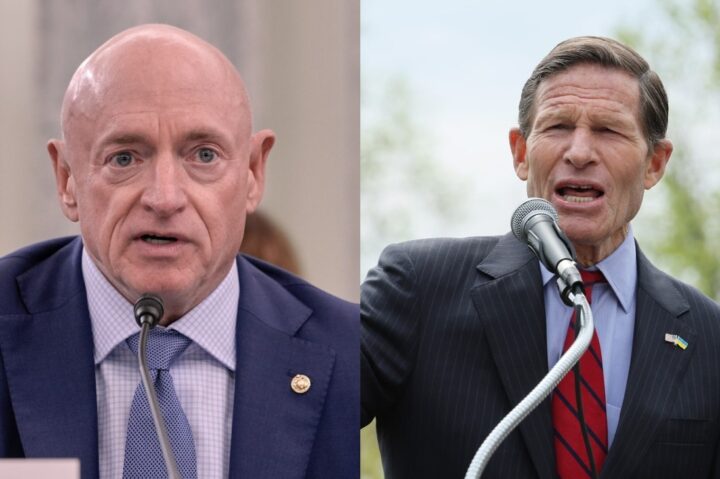
Sens. Mark Kelly (D-AZ) and Richard Blumenthal (D-CT)
Two Democratic senators expressed concern on Tuesday about the Islamic Revolutionary Guard Corps’ seizure of an commercial oil tanker in the Strait of Hormuz, a critical international shipping route.
The IRGC took credit on Friday for the seizure of the Talara, a Marshall Islands-flagged tanker, for what state media described as alleged cargo violations. The tanker, which began its journey in the United Arab Emirates, was carrying petrochemicals through the Strait of Hormuz to Singapore when it was diverted by the IRGC into Iranian territorial waters.
“It’s like the 1980s all over again,” Sen. Mark Kelly (D-AZ), a former fighter pilot, said. “The first time I was there was 1989, in the Strait of Hormuz, with the Iranians doing that same old shit, where they would harass shipping. A couple times, I felt like we were on the edge of getting in the conflict.”
“This was 40 years ago. It’s the same playbook with them, over and over and over again, harassing shipping, our planes, our naval vessels,” Kelly continued. “So what’s the solution? Hopefully, I think the solution is: The Iranian people get fed up with this at some point and just force out the ayatollah and his lackeys around there, because it has destroyed their economy.”
Asked if the development should impact the U.S. posture toward Iran, Kelly said it was too soon to determine that.
“We’ve got to stand on the side of the rule of law. The oil that comes through that Strait is critical to our economy, and we can’t let this become a major problem, but it’s one tanker,” Kelly said.
Sen. Richard Blumenthal (D-CT) said that the U.S. needs to remain vigilant against Iran’s other malign activities in spite of the setbacks to its nuclear program.
“Iran is Iran. They are the toxic element in the Middle East. We have no reason for complacency. Just because we set them back in their nuclear program, they remain a malevolent force, and the seizure of that tanker is just one indication of that,” Blumenthal said.
Asked if this latest development should be viewed as escalatory given that Tehran targeted commercial shipping, the Connecticut senator replied: “I’m troubled by the lack of an aggressive reaction to it. Maybe it’s just, with the press of everything else that’s going on.”
After Australia revealed the IRGC was behind two attacks on a synagogue and kosher restaurant, observers call for ‘increased awareness’ in the U.S.
Asanka Ratnayake/Getty Images
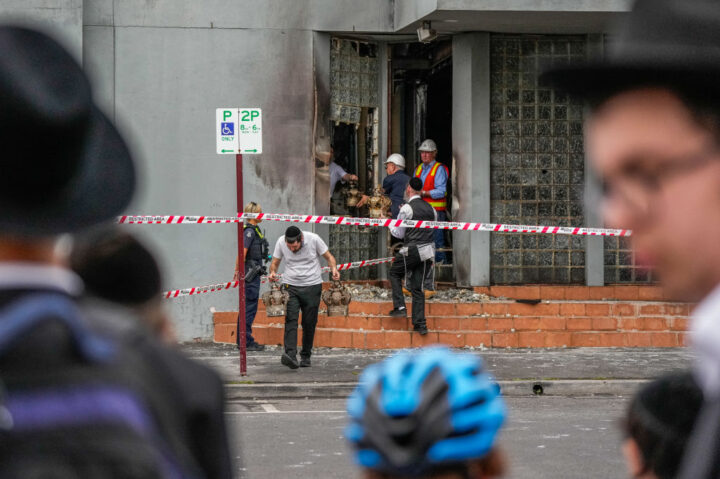
Members of the synagogue recover items from the Adass Israel Synagogue on December 06, 2024 in Melbourne, Australia.
National security experts are warning that Jewish communities around the world could face increased Iranian threats following the recent accusation by Australian Prime Minister Anthony Albanese that the Islamic Revolutionary Guard Corps orchestrated attacks last year on a synagogue and kosher restaurant in the country.
“We’ve seen Iranian penetration in many Westernized countries, with Australia now being the latest. Though to see direct evidence of a linkage to actual violence — not just disinformation campaigns or cyber campaigns — is very frightening,” Rich Goldberg, a senior advisor at Foundation for Defense of Democracies, told Jewish Insider.
On Tuesday, Albanese announced the expulsion of the Iranian ambassador in Canberra — the first time Australia has expelled a foreign ambassador since World War II — as well as three other embassy staffers, and designated the Islamic Revolutionary Guard Corps as a terrorist group, after Australian intelligence indicated that Tehran was behind the 2024 attacks.
Goldberg called it “earth-shattering” that Australia’s “left-wing prime minister, who may not agree on a whole lot of politics with the U.S., has been woken up to the very sobering reality of Iranian threats in his own country.”
Goldberg urged Canada, the United Kingdom and the European Union to “follow swiftly” in severing diplomatic relations with Iran, and for the U.S. and Australia to put diplomatic pressure on other governments to designate IRGC as a terrorist organization. Nearly all the major EU countries still have full diplomatic ties with Iran.
“We know that Canada is highly penetrated by Iranian assets and the IRGC inside the country without having a very clear designation as a terrorist organization,” said Goldberg. “We’ve seen terrorist plots that are Iranian sponsored on British soil and the British government is still dragging its feet on prescribing the IRGC as a terrorist group. We know that they have operatives, both undercover as diplomats and as operatives, throughout the EU.”
More than a year ago, the Biden administration’s director of national intelligence, Avril Haines, warned of the Iranian regime’s efforts to take advantage of campus unrest. In light of Australia going public with the Iranian threat, Goldberg urged the Trump administration to order an updated review of Iranian influence efforts in the U.S.
“We all sort of forgot about that report, but it was big news at the time [even though] we never got a lot of detail on that,” he said. “Nobody has asked the question of what’s the current status of Iranian influence on protest movements or acts of violence in the U.S. We suspect that Iran has agents in the U.S. Some of those people have been arrested in the past. This has to remain a key priority for the FBI and [Department of] Homeland Security.”
Matt Levitt, director of the Jeanette and Eli Reinhard Program on Counterterrorism and Intelligence at The Washington Institute for Near East Policy, called for increased awareness of “Iranian external operations around the world, including in the U.S., in which the IRGC and other Iranian government agencies increasingly pay criminal proxies to carry out acts of violence, intimidation, and even kidnapping and murder on their behalf,” he said in a statement to JI.
Heads of security organizations that monitor American Jewish communal safety said that the latest news coming out of Australia — in addition to an already heightened fear of Iranian retaliation following the U.S. airstrikes on Tehran’s nuclear facilities in June — make threats from Iran and its proxy groups particularly alarming.
“The FBI and NYPD have had live investigations that have resulted in arrests of Hezbollah operatives in New York City casing out institutions,” Mitch Silber, executive director of the Community Security Initiative, which works to safeguard Jewish communities, told JI. “Iranians have a long timeline. Just because [an attack] hasn’t happened in the last six to eight weeks [since the airstrikes] doesn’t mean that the Iranians haven’t stopped plotting.”
Silber pointed to the recent case of a Hezbollah operative in Texas purchasing 300 pounds of ammonium nitrate. “Why would you [purchase] an explosive if you weren’t thinking of potentially trying to use it somewhere in the U.S.?” he said.
“These developments in Australia reflect yet another tentacle of the IRGC in its escalating influence campaigns: furthering violence, destruction and discord, with the Jewish community bearing the brunt,” Michael Masters, Secure Community Network director and CEO, told JI.
“We applaud the Australian government for shining the disinfecting light of day regarding these attacks. It only underscores the continued need for reporting, coordination and proactive security efforts by and for the Jewish community.”
PM Anthony Albanese blasted the ‘extraordinary and dangerous acts of aggression orchestrated by a foreign nation on Australian soil’
HILARY WARDHAUGH/AFP via Getty Images
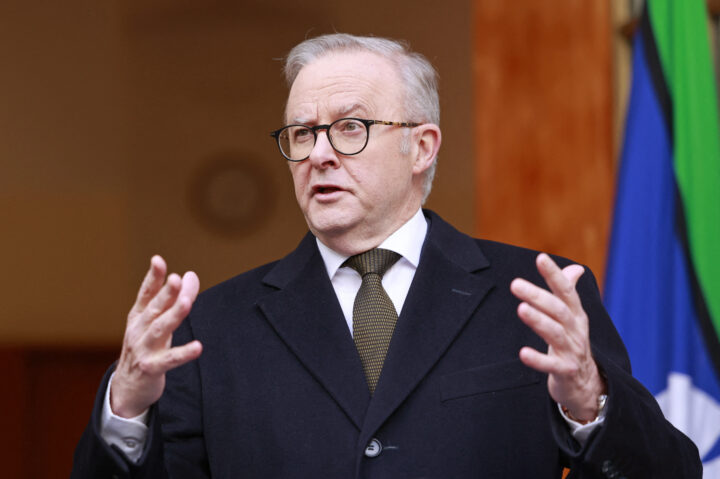
Australian Prime Minister Anthony Albanese speaks during a press conference in Canberra on August 11, 2025.
Australia expelled the Iranian ambassador in Canberra as well as three other embassy staffers on Tuesday, with Prime Minister Anthony Albanese accusing the Islamic Revolutionary Guard Corps of orchestrating attacks on a synagogue in Melbourne and a kosher restaurant in Sydney.
Albanese, speaking at a press conference alongside the country’s top intelligence official, foreign minister and home affairs minister, called the plots “extraordinary and dangerous acts of aggression orchestrated by a foreign nation on Australian soil.” The expulsion of Ahmad Sadeghi marks the first time Australia has expelled a foreign ambassador since World War II.
Canberra also withdrew its diplomatic staff from Iran and has encouraged Australian citizens to leave the country if they are able.
Australian intelligence indicates that Tehran was behind additional antisemitic attacks in the country since the Oct. 7, 2023, Hamas terror attacks. The country has seen an explosion of antisemitism, with a 316% year-over-year increase in antisemitic incidents in the year following the attacks.
Mike Burgess, the director-general of the Australian Security Intelligence Organisation, said that the plots were carried out “through a series of overseas cut-out facilitators to coordinators that found their way to tasking Australians,” describing the scheme as a “layer cake” of middlemen originating with the IRGC.
The expulsion of the Iranian diplomats comes shortly after the arrests of two individuals in connection with the December 2024 Melbourne synagogue attack, in which a synagogue was firebombed while nearly two dozen people were inside.
The arson at Sydney’s Lewis’ Continental Kitchen, which took place in October 2024, caused $1 million in damage to the kosher restaurant. Court documents released earlier this month indicate that a middleman, Sayed Moosawi, who was directing the Sydney attack, was to receive $12,000 for his work. Prior to the fire at Lewis’ Continental Kitchen, two men directed by Moosawi mistakenly set fire to a brewery with a similar name to the restaurant.
Please log in if you already have a subscription, or subscribe to access the latest updates.
 Continue with Google
 Continue with Apple