

















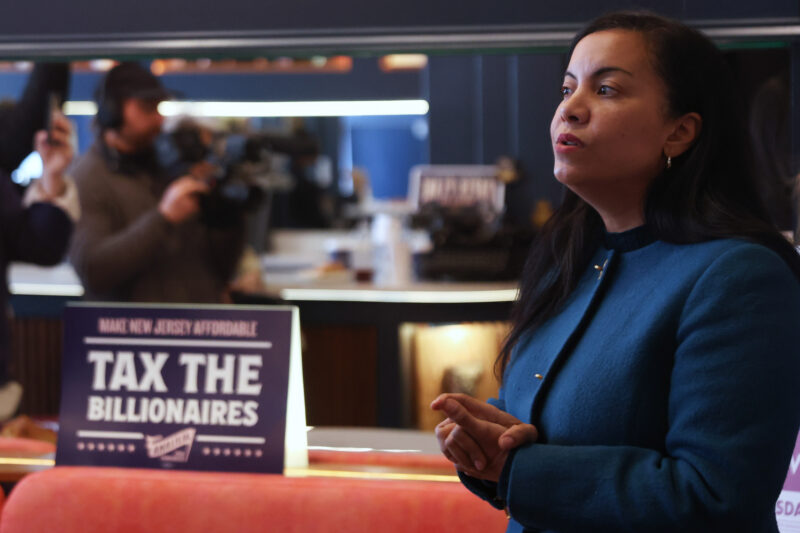























The far-left state senator is now making his attacks against the pro-Israel group a central message of his campaign
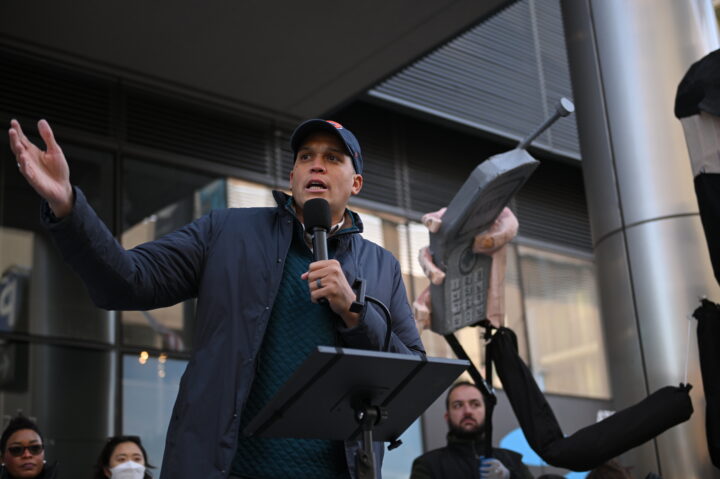
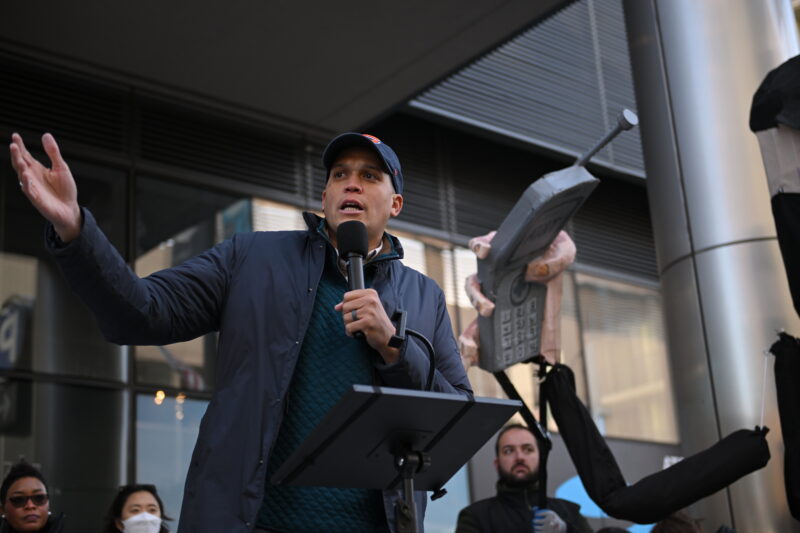
Daniel Boczarski/Getty Images for People's Action
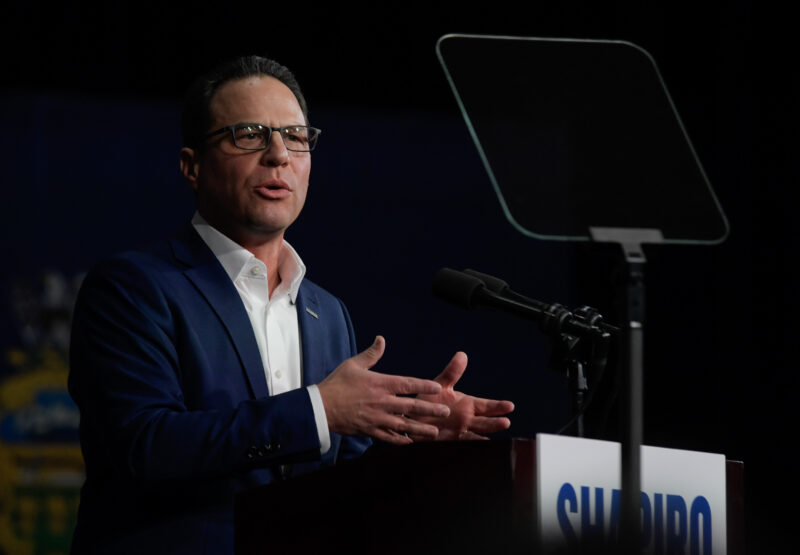
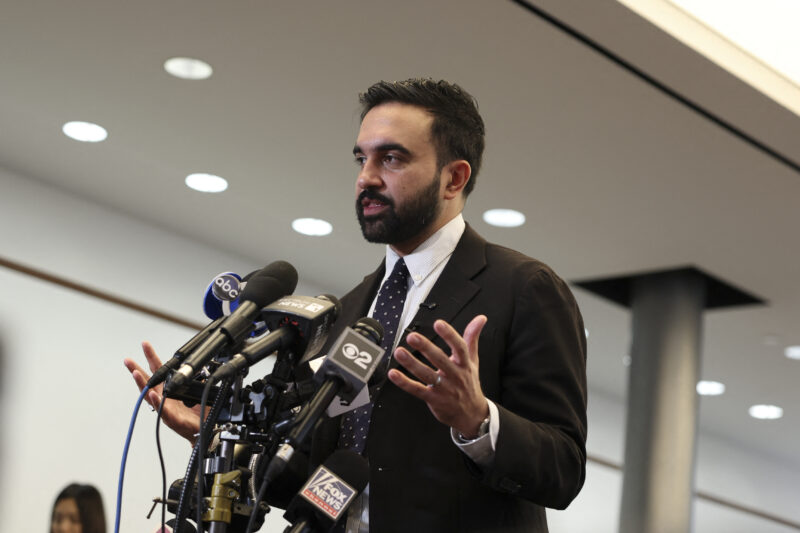
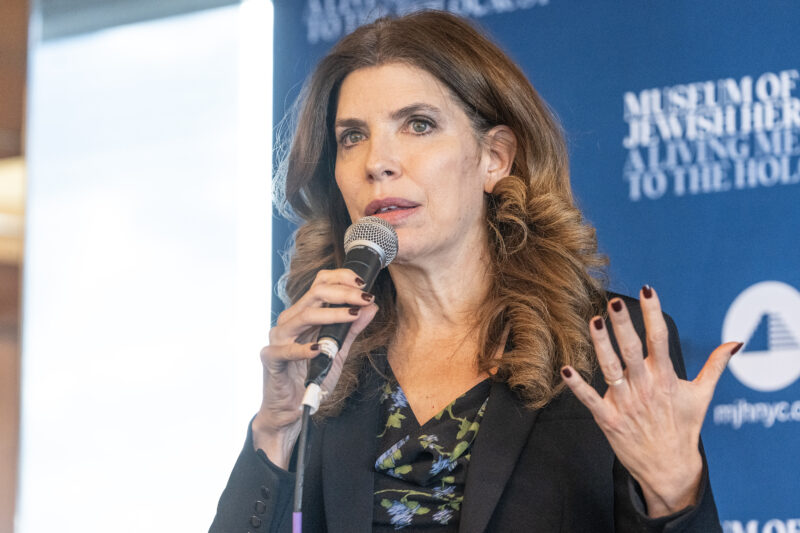
Sen. Robert Peters, IL State Senate 13th District, speaks during the protest in Chicago to hold AT&T accountable for contracts with DHS, CBP, and ICE on November 16, 2025 in Chicago, Illinois.


 Add JewishInsider on Google
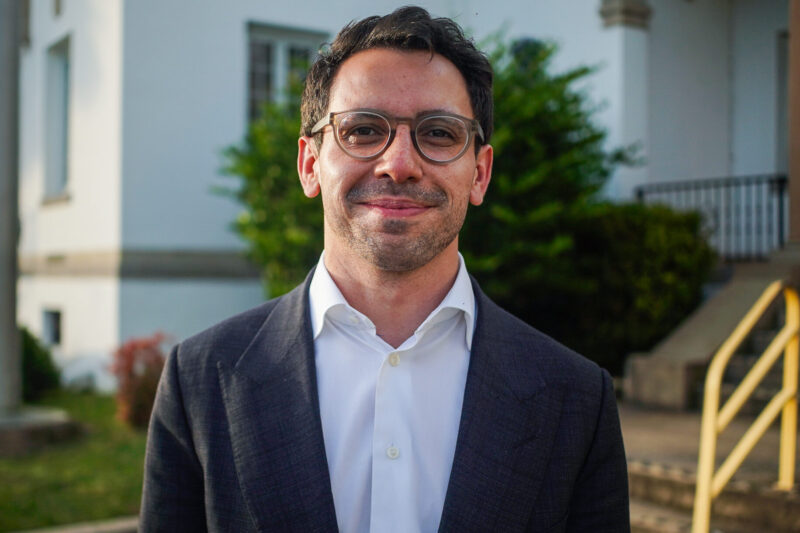
Robert Peters, a far-left state senator from Illinois who is now competing in a crowded Democratic primary for a safely blue Chicago-area House seat, has made anti-AIPAC messaging a central focus of his campaign, castigating the pro-Israel group as a corrupting force in congressional elections funded by Trump-aligned interests scheming to promote a “right-wing agenda.”
Just last week, for instance, Peters joined forces with a coalition of progressive House candidates in Illinois to decry AIPAC’s recently reported political engagement in key congressional races in the state, claiming that anyone who accepts support from the group will become “a ‘yes man’ to Trump donors to commit unspeakable horrors in another part of the world.”
Not long after he had launched his campaign last year, however, Peters met privately with an AIPAC official in Chicago and then filed an Israel position paper at the group’s request, according to a person with close ties to the organization who reviewed the document at the time it was submitted.
The behind-the-scenes engagement — rumors about which have circulated among Peters’ opponents — raises questions about the sincerity of his hostile rhetoric toward AIPAC as he now is building support from prominent Israel critics.
Most likely, the source familiar with the matter suggested to Jewish Insider this week, Peters was “seeking AIPAC’s good grace” in a strategic effort to preempt attacks from its super PAC, United Democracy Project, which often targets candidates who stray from pro-Israel messaging.
“Israel is a vital partner to the United States, and Congress must ensure that this special relationship is preserved,” Peters wrote in his paper, confirming in a separate section he is “committed to ensuring the U.S. continues to be an essential ally of Israel, including funding foreign aid to protect the people of Israel from terrorism, cyber threats and missile attacks.”
The group is now facing scrutiny over its alleged covert funding of a newly formed super PAC, called Affordable Chicago Now!, which is investing heavily in Peters’ race to help boost a top rival, Cook County Commissioner Donna Miller, a pro-Israel Democratic candidate. Peters, for his part, has accused “AIPAC and Trump donors” of “pouring cash” into Miller’s primary bid, warning “AIPAC and Trump allies” are now “trying to buy this seat,” though AIPAC has not endorsed her and UDP is not publicly involved in the race in Illinois’ 2nd Congressional District. (UDP did not respond to a request for comment.)
The policy paper that Peters allegedly submitted to AIPAC — screenshots of which were obtained by JI — is far more measured than the anti-Israel stances he now espouses. Most strikingly, he voiced support for upholding continued U.S. military aid to Israel, which the group views as one of its top litmus tests. Earlier this month, for example, UDP invested millions on attack ads in a special House primary in a wealthy suburb of northern New Jersey, hitting an erstwhile ally, former Rep. Tom Malinowski (D-NJ), who had entertained policies to condition assistance to Israel.
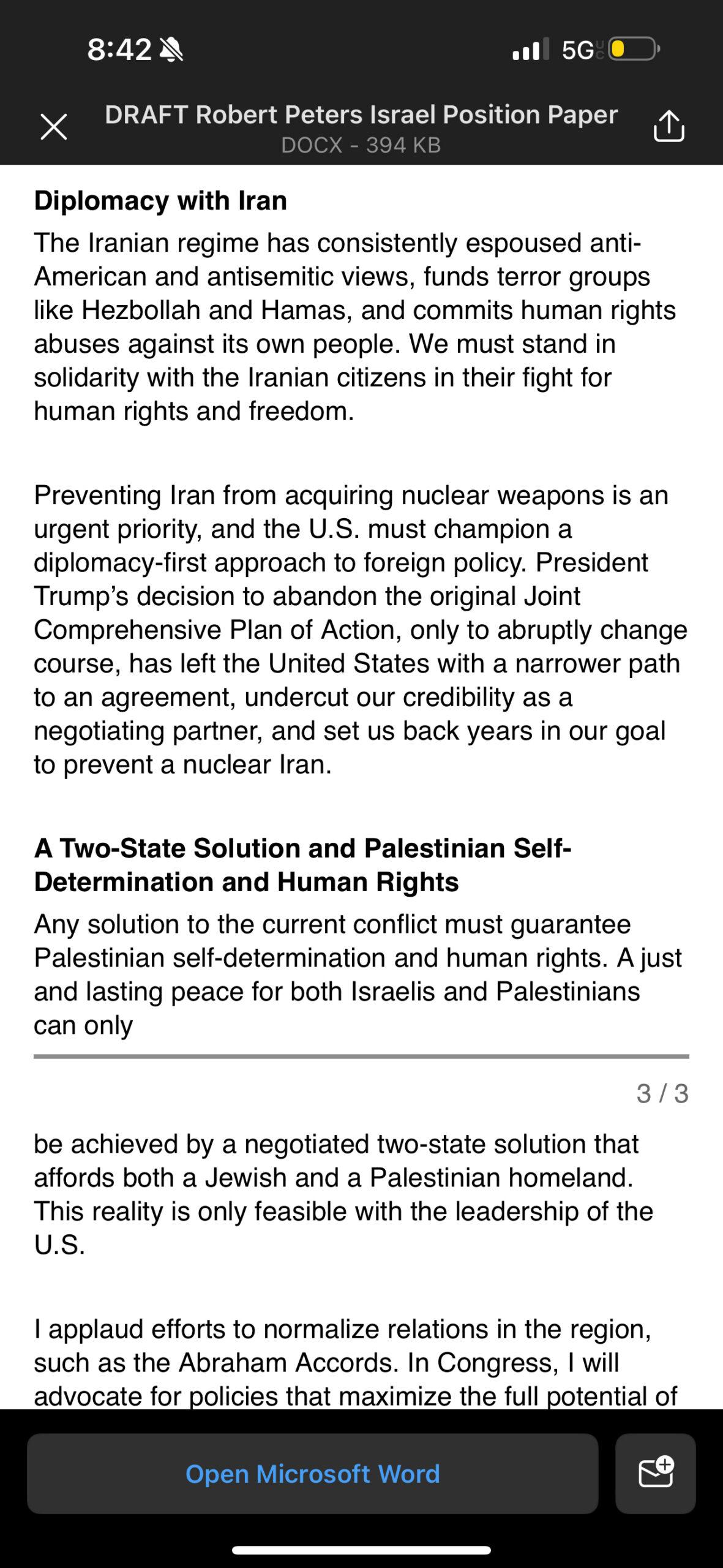



“Israel is a vital partner to the United States, and Congress must ensure that this special relationship is preserved,” Peters wrote in his paper, confirming in a separate section he is “committed to ensuring the U.S. continues to be an essential ally of Israel, including funding foreign aid to protect the people of Israel from terrorism, cyber threats and missile attacks.”
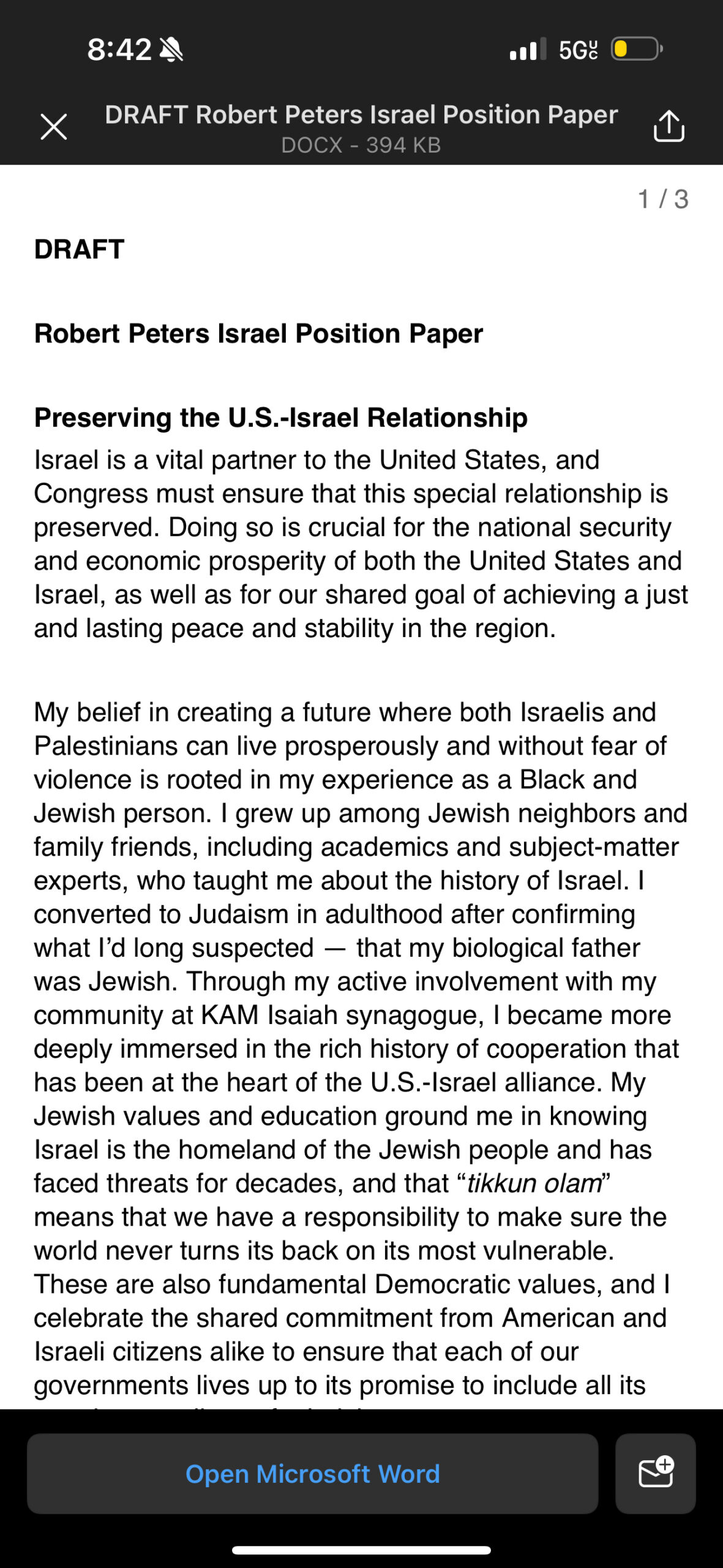
By contrast, Peters has more recently condemned AIPAC-backed candidates as pro-Israel pawns “OK with unconditional military aid” to support what he calls Israeli Prime Minister Benjamin Netanyahu’s “war machine,” which he says committed genocide in Gaza. If elected, Peters has pledged to sign on to the Block the Bombs Act, a bill that seeks to impose sweeping new conditions on U.S. weapons transfers to Israel.
Matthew Fisch, a spokesperson for Peters, said in a statement to JI on Wednesday that the state senator has shared his Israel position paper “with a range of stakeholders and individuals upon request, some of whom responded with feedback for our campaign.”
“Among those stakeholders was AIPAC staffer Martin Ritter, who has a longstanding relationship with Robert going back to his days as an organizer with the Chicago Teachers Union,” Fisch said. He claimed that Ritter, who directs AIPAC’s Midwest outreach in Chicago, “requested the document and provided feedback, which our campaign promptly rejected.”
Peters “is not and has never been open to receiving support from AIPAC for his campaign,” Fisch said, noting the candidate’s “positions on this issue are well documented and have been widely discussed.”
When JI first reached out to Peters’ campaign last October to inquire about the paper, Fisch said the document had been “drafted in the early months of the campaign to share with any and all stakeholders from across the spectrum of viewpoints,” and that it had “reflected Robert’s nuanced position on a range of subjects in the context of that moment.”
He did not respond to follow-up questions from JI at the time asking if the paper had been submitted to AIPAC.
Peters, a Jewish convert, had long been prominently opposed to Israel’s war in Gaza, joining at least one anti-Israel protest affiliated with the far-left Jewish Voice for Peace and IfNotNow, the latter of which is now backing his campaign. He called for a ceasefire in mid-November 2023, just over a month after the Hamas attacks of Oct. 7, writing in an opinion piece that he had “watched the unprecedented bombing campaign rain down on” Gaza and “saw that it was being done in our name, as Jews and as Americans.”
But even as Peters’ outspoken views on Israel would seem to preclude any outreach to AIPAC, the source familiar with his engagement, granted anonymity to discuss a sensitive topic, said he had regularly been in touch with the group at least until January, when he spoke with Ritter to express his concerns that the paper had been leaked.
Fisch confirmed that a call took place last month but said Ritter initiated it. “At the time, he falsely insisted to Robert that AIPAC was not supporting Commissioner Miller,” he told JI, “something that proved demonstrably false just a few days later.”
“Robert has always supported conditioning aid and ensuring it is in full compliance with the Leahy Law and international law,” Matthew Fisch, a spokesperson for Peters, told JI, adding the paper “does not mention the Block the Bombs Act because it was drafted prior to the bill’s introduction.”
Ritter, for his part, referred questions to an AIPAC spokesperson. “Like many advocacy organizations,” the spokesperson said in a statement to JI, “AIPAC routinely meets with candidates across the country to understand their views on issues important to its members.”
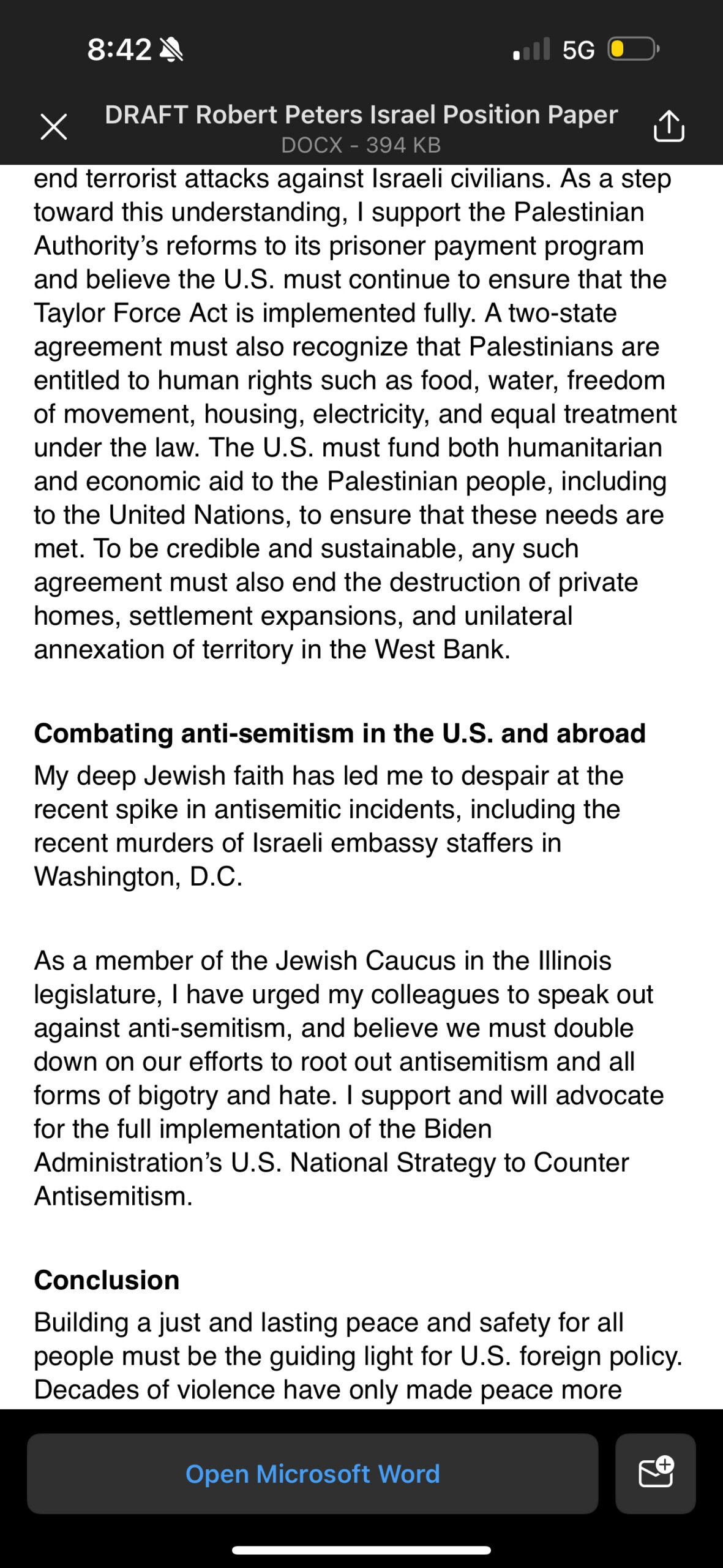
In some ways, the paper seems written specifically to meet AIPAC’s approval — including in its support for “fully” implementing the Taylor Force Act, a key legislative tool favored by the lobbying group that withholds direct aid to the Palestinian Authority until it ceases payments to convicted terrorists or members of their families.
But Fisch insisted that the paper is consistent with Peters’ long-standing Middle East policy positions. “Robert has always supported conditioning aid and ensuring it is in full compliance with the Leahy Law and international law,” he told JI, adding the paper “does not mention the Block the Bombs Act because it was drafted prior to the bill’s introduction.”
In a section of the paper on foreign aid to Israel reviewed by JI, Peters made no explicit argument for conditions, saying only that he supports “the continuation of aid in the framework of President Obama’s 2016 Memorandum of Understanding, compliant with existing U.S. law.” The 10-year agreement, set to expire in 2028, provides $3.8 billion in military aid and missile-defense funding to Israel annually — assistance the Block the Bombs Act is designed to challenge. Critics have argued the proposed legislation would effectively amount to an arms embargo on Israel for many key weapons systems.
Peters, 40, has largely positioned himself as a progressive front-runner in the March 17 primary, where 10 candidates are competing to fill the seat being vacated by Rep. Robin Kelly (D-IL), who is running for Senate. In addition to Peters and Miller, the primary field includes former Rep. Jesse Jackson Jr. (D-IL), who is drawing support from an AI-backed super PAC, and state Sen. Willie Preston, among others candidates.
During a recent candidate forum, Preston accused Peters of being dishonest in his AIPAC messaging. “Robert Peters tells you AIPAC hates him,” Preston said, according to video of the event reviewed by JI. “He sought their support — they just didn’t give it to him.”
Peters, in his own remarks at the forum, said that he shared a “position paper” with “Palestinian-led organizations,” among other organizations he claimed “groups like AIPAC fundamentally hate,” according to the video. He denounced AIPAC as a “right-wing, Trump-allied” organization, and said that “anybody taking” its support “is disqualified to represent” the district in Congress.
Peters has claimed major endorsements from leading Israel critics, including Sens. Bernie Sanders (I-VT) and Elizabeth Warren (D-MA) and Reps. Ro Khanna (D-CA) and Delia Ramirez (D-IL) — who introduced the Block the Bombs Act last May. He has also won support from anti-Israel groups such as the Working Families Party, which endorsed his campaign on Tuesday, and the anti-Israel AIPAC Tracker, which has argued that candidates “only submit a policy paper to AIPAC if” they are “angling for” support from the organization.
Peters is not the only Israel critic now seeking the Democratic nomination in an Illinois primary race to have allegedly engaged in discussion with AIPAC. Daniel Biss, the mayor of Evanston who is hoping to succeed retiring Rep. Jan Schakowsky (D-IL) in the suburbs of Chicago, sought backing from the group before he announced his run for Congress last year, JI has reported, though he denies having done so.
Biss has claimed publicly he met with AIPAC in an effort to stave off potential spending by the group in his race.
In recent weeks, AIPAC has become a particularly divisive subject of debate in Illinois as the group has ramped up its spending while facing accusations it is attempting to hide its involvement in some districts by operating under the cover of newly created super PACs not required to disclose their funding sources until after the primaries.
“He is practiced in the ways of politics,” Tom Bowen, a Democratic strategist in Chicago who is not involved in Peters’ primary, told JI on Wednesday. “That he submitted a paper in order to demonstrate he would be a collaborative elected official, I’m not surprised at all. Robert understands politics, and you have to build coalitions in order to legislate.”
Last week, for example, Schakowsky said she was rescinding her endorsement of Miller because of support the county commissioner has reportedly received from AIPAC-aligned forces in her primary. “Illinois deserves leaders who put voters first,” the congresswoman said in a statement, “not AIPAC or out-of-state Trump donors.”
In a separate Democratic House primary in the state, meanwhile, Anthony Driver Jr., a progressive candidate critical of Israel, said recently that he was rejecting a campaign contribution from a prominent Jewish party donor in Chicago, Michael Sacks, over his ties to AIPAC — a move Sacks lamented as a sign of growing “anti-Israel sentiment and outright Jew hate.”
Tom Bowen, a Democratic strategist in Chicago who is not involved in Peters’ primary, said he would not be surprised if the candidate had privately engaged with AIPAC, calling him a savvy political operator.
“He is practiced in the ways of politics,” he told JI on Wednesday. “That he submitted a paper in order to demonstrate he would be a collaborative elected official, I’m not surprised at all. Robert understands politics, and you have to build coalitions in order to legislate.”
As for why he is “saying what he’s saying today,” Bowen suggested that there is “obviously political opportunity in corralling support from the folks in Congress who make” Israel “a top issue for national fundraising.”
“In many races in Illinois now, it is very difficult to forge broad coalitions,” Bowen added. “Ultimately,” the candidates are working to build coalitions “they think they need to win.”
The far-left influencer, running competitively in a Chicago-area district with a sizable Jewish constituency, debated primary rivals Laura Fine and Daniel Biss on Wednesday

Nam Y. Huh/AP
Democratic candidates for Congress, State Sen. Laura Fine, center, speaks as Evanston Mayor Daniel Biss, left, and Kat Abughazaleh listen to her during U.S. House 9th District primary debate, in Chicago, Wednesday, Feb. 25, 2026.
At a televised debate in Illinois’ 9th Congressional District on Wednesday evening, far-left activist and social media influencer Kat Abughazaleh said she would not support continued aid for Israel’s Iron Dome, dodged a question on Israel’s right to exist and said that President Donald Trump is only considering strikes on Iran because he wants to “bomb more brown people.”
Questions on Israel policy and accusations about alleged pro-Israel spending in the race dominated much of the hourlong session, having taken on a outsized role in the primary.
Asked whether she supports Israel’s right to exist, Abughazaleh, who is Palestinian American, responded, “I think that this question is said as if it doesn’t exist. What we need is to ensure that any solution, whether it is a two-state, a single secular state, whatever it is, is negotiated not by America, but by the people that actually live there.”
She went on to highlight her own family’s history, explaining that her great-grandfather was Palestinian and was displaced from the land, where he owned a hotel.
“It’s really important that any solution has full civil and legal rights for everyone living there, regardless of their ethnicity, their religion, and that it is decided by the people who actually live there because we spend so much of our time as a country interfering in other countries and saying that we dictate how they live, and it’s just made places worse,” she continued.
Abughazaleh also said she would not support unconditional aid for defensive systems, specifically naming the Iron Dome missile-defense system.
“Defensive weaponry is an oxymoron. Weapons are inherently offensive,” she said. The Iron Dome system is designed to intercept incoming drones and projectiles and has no offensive applications.
Pressed again specifically about whether she supports Iron Dome, she said, “No, I don’t support — we need to condition all aid to any country, any ally, it doesn’t matter if it’s Israel. If we aren’t using our leverage, there is no reason to condition any aid.”
State Sen. Laura Fine, the pro-Israel moderate among the three front-runners in the race, responded that the “amount of death and destruction would be incredible, not just to the Israelis in Israel, but also to the Palestinians” if the Iron Dome were not funded, noting that she has taken shelter in safe rooms in Israel during past visits.
Abughazaleh retorted that she had not been to Israel “because my dad was scared I would get detained if I went.”
On Iran, Abughazaleh declared that “this administration doesn’t give a damn” about the Iranian protesters and that potential military strikes in Iran are “an effort for [Trump] to cement his power over more of the world and bomb more brown people.” She said strikes would be an impeachable offense.
She blamed U.S. intervention for the establishment of the Islamic Republic regime in 1979, but said she does support Iranian dissidents.
The far-left activist and influencer said she would want to serve on the House Foreign Affairs Committee if elected.
Both Evanston Mayor Daniel Biss, also running as a critic of Israel, albeit less strident than Abughazaleh, and Fine expressed opposition to military strikes against Iran, though both made clear that Iran should not have a nuclear weapon. Biss explicitly endorsed the 2015 Iran nuclear deal; Fine did not.
“We have an unstable leader who’s talking about bringing us into a war,” Fine said, adding Congress should look to cut the “bloated defense budget.”
Abughazaleh also defended a 2024 social media post in which she said that, “like 99% of attacks in history, both by military and terrorists, Oct. 7 was not in a vacuum. It had motivation, which is why they took hostages” — interpreted by many as defending or justifying Hamas’ attack and taking of hostages.
“I think it’s important to mention that, yes, it didn’t happen in a vacuum, because of [Israeli Prime Minister Benjamin] Netanyahu’s far right government, and because of a pattern of discrimination, a pattern of second-class citizenship, a pattern of exile and a pattern of displacement that my own family underwent,” Abughazaleh said. “Every civilian deserves to be safe. No child deserves to go to bed hungry. Every war criminal should be held accountable, and … we should recognize [Palestinian] statehood so they can negotiate a solution on equal footing.”
Fine indicated she would not support war crimes prosecution against Netanyahu, while Biss said that there “should be thorough investigations and I think the answer [to whether he committed war crimes] is likely going to be yes.”
Biss, who recently said at another forum he would not support any continued funding for arms to Israel, including Iron Dome, softened that stance at the Wednesday night debate and said he does support Iron Dome funding.
He otherwise doubled down on his support for conditioning U.S. aid to Israel and the Block the Bombs Act, saying that conditions are the only way to achieve peace and a two-state solution.
Biss also glossed over his own pivot on aid to Israel since entering the race. In a position paper he shared with AIPAC early in the race — which Biss himself released publicly — Biss’ campaign said he supports “continued aid to Israel in accordance with the 2016 Memorandum of Understanding” and an expanded MOU in the future.
But since entering the race, Biss has come out in support of conditioning aid and the Block the Bombs Act, which contradict the MOU. “I stayed true to my values and took the position that I believe is right, which is that we cannot allow unconditional aid to the Israeli government no matter what they do in Gaza,” Biss claimed, even though the position paper makes no mention of conditioning aid.
Abughazaleh declared that even meeting with representatives from AIPAC is unacceptable.
“The idea that you can separate yourself, even after meeting with them … an organization that supports this administration, and that is supporting a genocide is not a group you should meet with,” she said.
Fine: Israel is ‘more than just a strategic ally, it is a beacon of democracy in one of the world’s most volatile regions’

State Sen. Laura Fine/Facebook
State Sen. Laura Fine
Amid attacks from anti-Israel activists and groups over her support for Israel and backing from pro-Israel supporters, Illinois state Sen. Laura Fine, a Democrat running for an open Illinois House seat, unapologetically championed her backing for the Jewish state in a position paper obtained by Jewish Insider.
The paper offers an unflinching defense of Fine’s positions, including rejecting conditions on U.S. aid to Israel. Fine and other candidates, including Evanston Mayor Daniel Biss and far-left activist Kat Abughazaleh, are set to participate in a televised debate on Wednesday evening.
Fine described Israel in the paper as “more than just a strategic ally, it is a beacon of democracy in one of the world’s most volatile regions” with a bilateral relationship “rooted in shared values: democracy, pluralism, innovation, and a mutual commitment to peace and security.”
She emphasized that she “fully support[s]” the current U.S.-Israel Memorandum of Understanding on military aid, without “additional conditions … militarily or otherwise.”
“While the U.S. and Israel may not always agree on certain issues, halting or conditioning aid is not the right mechanism to solve our disputes or pressure our key allies,” Fine continued.
Fine’s stance is largely similar to that expressed by Biss in a position paper he authored early in his campaign and reportedly submitted to AIPAC — when he was seeking support from the pro-Israel group — and released publicly in January, after he had pivoted toward a more hostile stance.
In his original paper, Biss said he would support continued aid to Israel under the MOU, and that he “looks forward to seeing a renewed, expanded Memorandum of Understanding” in the future, while adding that “all military aid to every nation must be compliant with U.S. law.”
Now, Biss supports an offensive weapons ban on Israel and the Block the Bombs Act, which imposes unprecedented restrictions and conditions on U.S. aid to Israel. Most recently, at a candidate forum, Biss went even further, saying he would not support any continued funding for arms to Israel, including the defensive Iron Dome system.
Fine noted in her paper that the current U.S. package of aid includes systems to protect Israeli civilians, as well as supports the U.S.’ own industry and national security. She also emphasized the various non-military benefits that the U.S. sees from its relationship with Israel — offering as one example a procedure developed in Israel that treats tremors from Parkinson’s disease, which she said her family had directly benefited from.
Addressing the war in Gaza, Fine condemned Hamas’ Oct. 7, 2023, attacks, its use of Palestinians as human shields and its abuse of Israeli hostages, adding that the “devastating war that followed [Oct. 7] has claimed the lives of far too many innocent Palestinian civilians, leaving countless families in heartbreak and grief.”
She said that Hamas must disarm and its leaders must be brought to justice, adding that additional aid to Gaza is also critical.
“The United States has an essential role to play – not in dictating outcomes, but in advancing a durable peace through diplomacy, humanitarian support, and partnerships with regional allies,” the paper reads. “We must remain clear-eyed about the threats, steadfast in our values, and committed to a future rooted in justice, safety, and hope for all.”
She called for the continued pursuit of a two-state solution and for the resumption of peace talks between the two sides.
She also rejected the Boycott, Divestment and Sanctions movement, which she said aims to “delegitimize Israel’s right to exist” and “undermines” peace by pushing for “economic warfare and the isolation of the Jewish people and the state of Israel.”
To address the threats from Iran, Fine called for “strong, diplomatic efforts” to prevent Iran from obtaining a nuclear weapon, and to address its ballistic missile program and backing of regional terrorism. “The stakes are too high to tolerate halfway measures,” she said.
“Maximum sanctions and economic pressures should be utilized to bring them to the table to fully abandon this program,” Fine continued. “If Iran reaches nuclear breakout or intelligence reveals that they intend to share the material and knowledge with terror groups, I support military action as a last resort.”
Fine said that any Iranian civilian nuclear program is “too risky,” and that a deal must include “maximum inspections” and that the U.S. should aim for “dismantlement of this sector.”
The state lawmaker also expressed support for the Abraham Accords, and said she would work in Congress to expand the agreement to include Saudi Arabia and others.
Addressing antisemitism at home, Fine emphasized the need to act against this “grave and worsening issue,” highlighting “systemic antisemitism issues” in universities and other institutions.
“Far beyond criticism of Israeli government policy, anti-Jewish narratives and rhetoric are being normalized in ways that are deeply worrisome,” Fine said. “It’s critical members of Congress be ready to stand up and push back on antisemitism wherever it is present, even when it is politically inconvenient.”
She said that she has been alarmed, as a parent, to see the spread of “antisemitic propaganda” online, which is making Jewish students afraid.
The paper highlights Fine’s work in the state Senate working to support and protect the Jewish community, a significant population in the district, to enhance connections between Illinois and Israel and to fight legislation that would harm the community. She emphasized that it’s “important to me to use my position to educate and bring forth policy to lend a voice to the Jewish community.”
“As a proud Jewish woman, the safety, security, and prosperity of the State of Israel are deeply personal issues to me. I grew up in a conservative synagogue, became a Bat Mitzvah in Israel, and my husband and I have raised our children with the values of Tikkun Olam,” Fine said. “The tenets of Judaism provide the foundations of my values and have guided me and my family.”
A poll of the race commissioned by the Evanston Roundtable and conducted by the Democratic firm Public Policy Polling released Tuesday showed Biss in the lead of the race at 24%, followed by Abughazaleh at 17% and Fine at 16%, with 22% of voters undecided.
The relatively close race has fueled concerns among some in the local Jewish community that attacks on Biss, like those recently launched by a super PAC believed to have pro-Israel backing, could help open a lane for the stridently anti-Israel Abughazaleh to win.
Lt. Gov. Juliana Stratton seems to be running to the congressman’s left on Israel, even as Rep. Robin Kelly is the most outspoken critic of Israel in the race
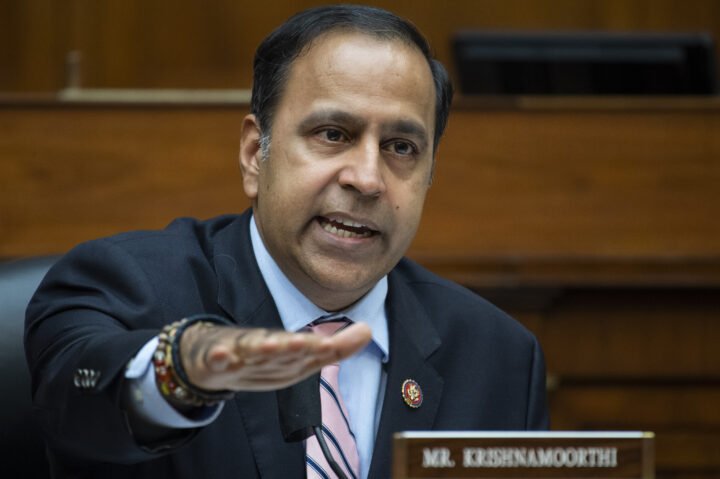
Tom Williams/CQ Roll Call/Bloomberg via Getty Images
Representative Raja Krishnamoorthi, a Democrat from Illinois
Democrats running for the open Senate seat in Illinois are increasingly trying to differentiate themselves on Israel policy ahead of next month’s primary. In the final weeks of the campaign, Illinois Lt. Gov. Juliana Stratton appears to be trying to straddle a line on Israel policy between Rep. Raja Krishnamoorthi (D-IL), who has a largely pro-Israel record, and Rep. Robin Kelly (D-IL), who has been increasingly critical of Israel.
Stratton, of the three, has the least established record on Middle East policy issues, and her approach was on display at a debate last week with fellow candidates, where she did not offer direct answers to questions on whether additional conditions should be applied to U.S. aid to Israel or whether the war in Gaza constituted a genocide.
Asked about conditions on aid to Israel, Stratton said that the “devastation” both on Oct. 7, 2023, and during the ensuing war in Gaza has been “horrifying” and she wants to “see the suffering end.”
“I can tell you that as our democratic ally in the Middle East, I believe that Israel has a right to safety and security, but at the very same time, I totally disagree with the way that [Israeli Prime Minister Benjamin] Netanyahu has responded to those attacks, and I believe that he should be removed from power, or he should step down, and there should be elections, as the people have been calling for,” Stratton said.
Israel is set to go to elections in October.
Stratton also called for aid to Gaza and for Palestinian leadership that can push toward a two-state solution.
Asked whether she would vote for a resolution led by Rep. Rashida Tlaib (D-MI) describing the war in Gaza as a genocide, Stratton said the war was “devastating and it was horrific” and that “we must do everything we can to make sure that we can be on a real, sustained path to peace,” but avoiding directly answering the question.
Krishnamoorthi emphasized that U.S. aid to Israel and all other allies is already subject to various conditions, which he said should be enforced. He “strongly condemned” both Hamas for the Oct. 7 attacks and Netanyahu for Israel’s conduct during the war.
“We need to take the next step,” Krishnamoorthi said. “That means Israel needs to withdraw from the Gaza Strip. Hamas needs to be demilitarized. An international stabilization force has to arrive, and then massive construction aid has to come in, to the point where we have a chance at a road to a two-state solution of Palestinian and Israeli states living side by side.”
When asked about classifying the war as a genocide, he said that the parties in the region “don’t agree on a credible assessment of what exactly happened” and suggested that debate over or the use of the term would be an obstacle to progress in the ceasefire agreement first implemented in October 2025.
“I want to see the language [of the Tlaib resolution], but I need to be comforted right now that this type of resolution doesn’t get in the way of progress right now for Gazans, because right now they’re going through hell as it is, and we got to get to a better place,” he responded, when pressed on whether he would vote for the Michigan congresswoman’s resolution.
Kelly touted her support for the Block the Bombs Act that would place sweeping restrictions on U.S. arms sales to Israel, and joined Stratton in calling for Netanyahu to resign, calling his leadership a “reign of terror.”
“A lot of people would say what happened on Oct. 7 was horrible, but there were a lot of things that happened before Oct. 7 also,” Kelly said. “I’m the only one on this stage that supported something like Block the Bombs and I’m the only one on the stage that said, it may not have started off like this but … genocide was the result.”
All three candidates said that a preemptive U.S. strike on Iran without congressional authorization would be illegal.
Krishnamoorthi emphasized that Iran cannot obtain a nuclear weapon, but argued that the U.S. must find a diplomatic solution to address the Islamic Republic’s nuclear and ballistic missile programs.
He added that any military action must be authorized by Congress and that he plans to support an upcoming war powers resolution to block military action against Iran without such authorization.
Stratton said that “we certainly don’t want to see a nuclear Iran … but what we also can’t have is a president who just decides whenever he gets a whim … and threatens to strike or commit some act of war. We need Congress to rein him in.”
Kelly accused Trump of seeking out war as a “distraction” from alleged failures on the home front, and demanded a diplomatic path using any tools and partners available.
Stratton is supported in the Senate race by Gov. JB Pritzer, who last week condemned AIPAC as a “pro-Trump organization.”
A Democratic strategist in the state said that it’s hard to tell where the race stands, but that public polling has put Krishnamoorthi in the lead. He noted that Krishnamoorthi is running an ad contrasting him with Stratton, indicating his campaign thinks Stratton may be making up some ground.
Pritzker’s super PAC recently began spending big backing Stratton and attacking Krishnamoorthi.
The strategist said that Kelly hasn’t been keeping up with the other two candidates in television advertising, but there are still opportunities to make up ground and increase her vote share. Kelly has largely been trying to court the most progressive voters and carve out the left-most lane for herself, but otherwise, the strategist said, there’s been little ideological difference among the candidates overall.
Even as the super PAC backing Miller isn’t officially affiliated with AIPAC, the progressive lawmaker’s move shows how pro-Israel donors are now shunned by some Dems

Keith Mellnick
Rep. Jan Schakowsky (D-IL)
Rep. Jan Schakowsky (D-IL) rescinded her endorsement of Cook County Commissioner Donna Miller, who is running in a Democratic congressional primary in Illinois’ 2nd District, over support Miller is reportedly receiving from AIPAC-aligned forces.
Miller has not been endorsed by AIPAC and neither the group nor its super PAC are publicly spending any money in the district. But it’s widely rumored in the Chicagoland area that pro-Israel forces are backing a new group, Affordable Chicago Now, that’s spending about $900,000 on behalf of Miller’s campaign. Schakowsky also said Miller is accepting individual donations from AIPAC supporters.
Schakowsky’s reversal is a notable step in a campaign by progressives to make even perceived ties to AIPAC or any individual donors who have supported the pro-Israel group toxic within the Democratic Party — even if their support for a candidate isn’t coming through AIPAC.
“Illinois deserves leaders who put voters first, not AIPAC or out-of-state Trump donors,” Schakowsky said in a statement. “I cannot support any candidate who is funded by these outside interests.”
It’s not clear how much influence Schakowsky’s endorsement will have outside her district, given her limited profile in a majority-Black district — as opposed to her wealthy, progressive Lakefront constituency. But it comes amid a broader campaign by left-wing activists in the Democratic Party to turn AIPAC and its donors into a burden for Democratic candidates.
The Illinois primaries are set to be a major test of pro-Israel donors’ influence and political instincts after a high-profile fumble in New Jersey, in which the group’s spending was seen as helping to elevate a far-left anti-Israel candidate.
Former Rep. Tom Malinowski (D-NJ), the target of AIPAC’s spending in New Jersey, in an op-ed released on Thursday, said that Democratic leaders should “collectively … refuse [AIPAC’s] support” and reject its endorsements and assistance — arguing that the group’s biggest donors are Republicans, even while acknowledging most AIPAC members are Democrats.
These four races will be something of a temperature check of the mood towards Israel in Democratic primaries
State Sen. Laura Fine/Facebook
State Sen. Laura Fine
After AIPAC’s super PAC suffered an embarrassing setback in this month’s New Jersey special primary election — unwittingly helping boost the fortunes of Analilia Mejia, an anti-Israel, far-left candidate, with its attacks against former Rep. Tom Malinowski (D-NJ) — all eyes will be on Illinois’ upcoming primaries, and the impact of a surge in pro-Israel spending on ads in four closely watched congressional contests.
AIPAC’s super PAC, the United Democracy Project, along with other outside groups boosting the fortunes of pro-Israel candidates, are betting big on four Chicago-area candidates in crowded Democratic primaries: Cook County Commissioner Donna Miller (for the seat of retiring Rep. Robin Kelly); Chicago City Treasurer Melissa Conyears-Ervin (for the seat of retiring Rep. Danny Davis); former Rep. Melissa Bean (for the seat of Rep. Raja Krishnamoorthi, who is running for Senate); and state Sen. Laura Fine (running for the seat of retiring Rep. Jan Schakowsky).
The biggest beneficiaries of outside group spending are Fine and Bean, receiving about $1.25 million apiece in air cover from Elect Chicago Women, a super PAC formed to boost their campaigns (and which appears to be a vehicle for pro-Israel supporters).
Both of those primaries, in the affluent Chicago suburbs, are developing differently.
The race to succeed Schakowsky, in a progressive-minded but notably Jewish Lakefront district, is shaping up to be the most hotly contested primary in the state. The field is similar to a lot of emerging Democratic primaries this year — one mainstream pro-Israel candidate (Fine), one harsh critic of Israel (Evanston Mayor Daniel Biss) and one all-out anti-Israel activist (social media influencer Kat Abughazaleh).
Fine, fueled by support from pro-Israel allies, raised over $1 million in the last fundraising quarter and was the first candidate to spend money on the air. That jump-start helped give her early momentum, with an internal poll from her campaign showing her tied for the lead with Biss at 21%, with Abughazeleh lagging in third place. (A subsequent internal poll released by Biss’ campaign showed Biss leading with 31%, while Fine and Abughazaleh were tied in second with 18% apiece.)
Biss has been spending ample time working to protect his left flank from the far-left Abughazaleh, giving Fine plenty of room to win over Jewish voters and moderates. But the district’s politics are generally progressive, making it less friendly terrain than the New Jersey district where AIPAC just suffered an unexpected defeat.
Bean’s old district is more moderate Democratic turf, and should be safer ground for a pro-Israel supporter like the former congresswoman. Polls show her with an early lead in a crowded field of candidates, but her most problematic opponent is anti-Israel activist Junaid Ahmed, who won 30% of the primary vote in a fringe challenge against Krishnamoorthi in 2022.
If someone as extreme as Ahmed comes out of left field to take the Democratic nomination, that would send shockwaves in Democratic and pro-Israel circles, as much as Mejia’s New Jersey win. And the fact that he won 30% of the Democratic vote four years ago means he can’t be ruled out when the winner just needs a narrow plurality to win.
AIPAC’s super PAC is directly involved in the Chicago race for Davis’ open seat, already spending a reported $2.8 million to promote the candidacy of Conyears-Ervin. The city treasurer ran against Davis in 2024, finishing in second place (trailing the congressman 52-21%), and narrowly ahead of anti-Israel activist Kina Collins (who is running again). Another anti-Israel candidate, union organizer Anthony Driver, Jr, won the backing of the Congressional Progressive Caucus’ PAC this week.
All told, this year’s primary features 13 Democrats, with a pro-Israel Jewish community leader, Jason Friedman, emerging as the leading fundraiser in the field. But with UDP’s money behind Conyears-Ervin, she’s looking like the favorite. It’s also notable that in this plurality-Black district, there’s been minimal backlash to AIPAC’s involvement in the race.
The other Chicago race featuring a clear divide on Israel is the primary to succeed Kelly, where Donna Miller has emerged as a front-runner thanks to her strong fourth-quarter fundraising. She’s also getting an assist from a new super PAC (Affordable Chicago Now!) spending nearly $1 million on her behalf. She’s facing the most serious competition from former Rep. Jesse Jackson Jr. and state Sen. Robert Peters, who has the support of national anti-Israel activists. (Jackson maintained a largely pro-Israel voting record when he served in Congress; his brother, Jonathan, has regularly voted for bills calling for restricting aid to Israel since elected in 2022.)
These four races will be something of a temperature check of the mood towards Israel in Democratic primaries. If pro-Israel candidates aligned with AIPAC end up winning three of the four contests, it will be a successful night. If they prevail on the toughest territory of the four — the Schakowsky seat — it would be a major victory and would take some of the sting over losing in New Jersey.
But if they lose more than half of these open-seat races, it would underscore the growing hostility towards Israel within Democratic Party circles — and the limited impact of financial firepower in taming the activist energy taking over the party.
Daniel Biss, Robert Peters, Junaid Ahmed and Anthony Driver Jr. are running on anti-AIPAC mantle
Daniel Boczarski/Getty Images for People's Action
Sen. Robert Peters, IL State Senate 13th District, speaks during the protest in Chicago to hold AT&T accountable for contracts with DHS, CBP, and ICE on November 16, 2025 in Chicago, Illinois.
Four progressive House candidates came together in the Chicago area on Tuesday to condemn reported pro-Israel spending in their districts, a sign of growing cross-district collaboration among candidates hostile to Israel as they seek to push back against pro-Israel interest groups.
The joint press conference included Evanston, Ill., Mayor Daniel Biss, state Sen. Robert Peters, activist Junaid Ahmed and union organizer Anthony Driver Jr. All four are endorsed by the Congressional Progressive Caucus PAC.
Driver’s attendance was particularly notable given that he has little public record on Israel policy issues. He’s running in the 7th Congressional District, where the AIPAC-linked United Democracy Project has spent $753,000 — and reportedly plans close to $3 million in spending — in support of Chicago Treasurer Melissa Conyears-Ervin. He was endorsed by the CPC on Tuesday.
“AIPAC is not your friend. … They are in the business of buying elections. They’re in the business of buying representation. They’re in the business of buying politicians,” Driver said. “Melissa Conyears-Ervin … is selling out our community.”
He added, addressing AIPAC directly: “You will lose, and when you do lose, may you never come back to this city again.”
Another anti-Israel candidate, Kina Collins, is also running for the seat.
“I was raised by a single mother on the West Side and I’m the full-time caretaker to my disabled sister who relies on SNAP and Medicaid. I’m going to fight for our communities in Washington because I know what Trump’s attacks have done to us,” Conyears-Ervin said in a statement to Jewish Insider. “I’m insulted that some of my opponents think a Black woman born and raised in this district would ever be anything but independent and fearless.”
The candidates broadly framed AIPAC as a pro-Trump, pro-Netanyahu group that is trying to buy the elections in their four districts, and suggested that accepting any funding from AIPAC affiliates will make lawmakers incapable of opposing the Trump administration.
Peters claimed that accepting support from the group means that candidates will be “a ‘yes man’ to Trump donors to commit unspeakable horrors in another part of the world,” activities in which he said AIPAC was directly involved.
Ahmed called the alleged AIPAC spending a “sinister plot” across all four races: “massive AIPAC spending designed to buy political power and silence the voices of the people. … [Former Democratic Rep.] Melissa Bean will look the other way as Israel commits a genocide. Melissa Bean will fight for the wealthy and the powerful and leave everyone else behind.”
Bean did not respond to a request for comment.
In the other districts — the 9th, 8th and 2nd — purported pro-Israel spending has come through newly created groups boosting three allied candidates: state Sen. Laura Fine, Bean and Cook County Commissioner Donna Miller.
Elect Chicago Women, the group backing Fine and Bean, has spent $1.26 million supporting Fine and $1.27 million supporting Bean thus far and Affordable Chicago Now, the group backing Miller, has spent $868,000.
In his race, Biss has been leaning aggressively into Israel and AIPAC-related attacks on Fine as a centerpiece of his campaign.
The “red box” on Biss’ website — where candidates share messaging that they hope super PACs involved in the race will boost — lists as his top priority informing voters that Fine is “bankrolled by Trump donors, MAGA Republican donors, and AIPAC.”
“She will side with AIPAC on policies that starve children and will fund their war in Gaza with billions of U.S. taxpayer dollars,” the website states.
“This is further proof that professional political candidate Daniel Biss will say anything to get elected,” a Fine spokesperson responded to JI. “He said he’d serve his full term as mayor and broke his promise. He says he’ll protect Medicaid but voted to eliminate coverage for 25,000 working Illinois parents. He can’t run a campaign pitting his record against Laura Fine’s because he doesn’t have one. Laura stood up to the insurance industry, corporate polluters and the gun lobby — and won.”
At a recent candidate forum, video of which was obtained by JI, Biss repeatedly attacked Fine for receiving donations from AIPAC and Trump supporters and accused her of supporting a “blank check” for Israel. On one occasion when Biss repeated the attack line, loud groans and grumbling could be heard from members of the audience.
Fine has denied any knowledge of the funding behind the outside group backing her — an idea that Biss has declared is “not credible,” though super PACs are legally prohibited from coordinating with campaigns and the group’s donors have not been publicly disclosed — and said she would also like transparency on the issue.
Biss has also faced scrutiny for the more than $350,000 in outside spending supporting him from 314 Action Fund, a Democratic pro-science group — to which UDP donated funds in a 2024 Oregon primary race when they were backing the same candidate. Biss has dismissed the idea that there are similarities in the outside support both he and Fine are receiving as “preposterous.”
Outside of the pro-Israel spending, new outside spending by the cryptocurrency-aligned Fairshake super PAC is also shaking up the race. The group is set to spend at least $1 million against Peters and state Rep. LaShawn Ford, who’s running against Conyears-Ervin, Driver and others in the 7th Congressional District.
Leading the Future, a super PAC funded by OpenAI President Greg Brockman and his wife, Anna, and venture capitalist Ben Horowitz, co-founder of Andreessen Horowitz, has plans for a seven-figure ad spend supporting former Rep. Jesse Jackson Jr. (D-IL) in the 2nd District and Bean in the 8th.
Biss, the Evanston mayor who’s now running for Congress, said the local police department did not determine that the encampment posed a threat to students
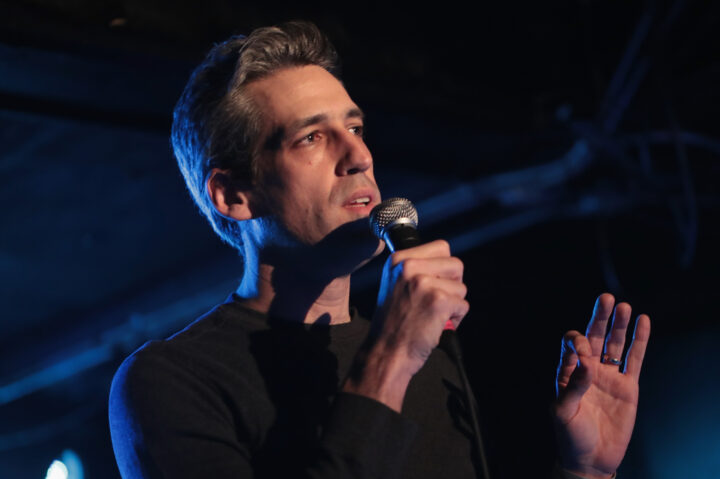
Scott Olson/Getty Images
Illinois Democratic gubernatorial candidate Daniel Biss speaks to fans gathered for a Pussy Riot show at Subterranean on March 6, 2018 in Chicago, Illinois.
Evanston, Ill., Mayor Daniel Biss, a Democratic congressional candidate, on Monday defended his decision in 2024 to withhold police support requested by Northwestern University to clear an anti-Israel encampment on the school’s campus.
The lack of police support, according to internal communications released by the House Education and Workforce Committee last month as part of an inquiry to Biss, forced the university to reach an agreement with the encampment, lacking the necessary law enforcement personnel to disperse and arrest the encampment members.
Jewish community members said the deal rewarded antisemitic behavior.
Biss, who is running for Congress in Illinois’ 11th Congressional District, asserted that the Evanston police department did not determine that the encampment posed a threat to students or the community, and that police officials had been concerned that forcibly clearing the encampment would worsen the situation.
“I did not, and would not, direct the Evanston Police Department to disperse a protest or arrest protesters against the advice of department leadership,” Biss wrote in a letter to Rep. Tim Walberg (R-MI), the chairman of the committee, on Monday. “Doing so would unnecessarily endanger officers, improperly suppress constitutionally protected speech, and substitute political judgement for the expertise of public safety professionals.”
Facing a federal investigation, Northwestern agreed to pay the Trump administration $75 million and cancel the agreement with the encampment participants.
Walberg also accused Biss of publicizing his refusal to provide police support as a means of burnishing his progressive political credentials. In his response letter, Biss denied this.
“Antisemitism is a dangerous and growing problem in our country and around the world, and one that I have taken seriously throughout my career,” Biss wrote. “In addition to its voluminous inquiries into universities, businesses, local municipalities, and other entities, I encourage the committee to also examine the rise of antisemitic rhetoric originating from within the federal government,” he continued, pointing to reported antisemitic comments by Customs and Border Protection Commander Gregory Bovino
Biss said he would provide a briefing to the committee, as requested by Walberg, on his decisions surrounding the Northwestern encampment, at a time to be determined.
AIPAC’s super PAC has recently thrown its support behind his opponent, Chicago Treasurer Melissa Conyears-Ervin
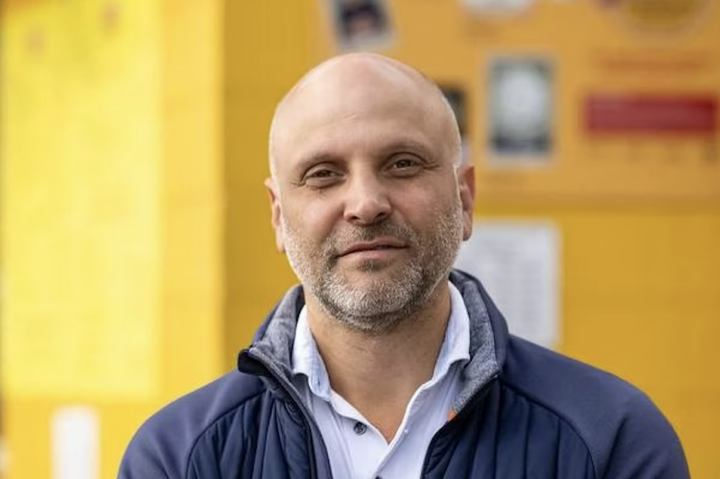
Campaign website
Jason Friedman
Jason Friedman, a prominent real estate developer and longtime leader in the Jewish United Fund, Chicago’s Jewish federation, is making waves in a crowded primary for Congress in Illinois’ 7th Congressional District, long represented by retiring Rep. Danny Davis (D-IL).
Friedman is facing off against candidates including Davis’ preferred successor, state Rep. LaShawn Ford; Kina Collins, a Justice Democrats-backed third-time candidate with an anti-Israel record; attorney Reed Showalter, also running on an anti-Israel platform; and Chicago Treasurer Melissa Conyears-Ervin, who previously ran for the seat as a strong supporter of Israel.
Friedman, who has been the strongest fundraiser in the field, is also running as a stalwart ally of the Jewish community. But AIPAC’s super PAC, United Democracy Project, is backing Conyears-Ervin’s campaign, airing a blitz of positive television ads this week promoting her candidacy.
In a statement seemingly responding to the UDP ads, Friedman said that he “joined this race to fight and deliver results for everyone. The people of the 7th District deserve a representative with integrity, not career politicians with ethical baggage who sell out their constituents to the highest bidder.”
Conyears-Ervin has faced several scandals in recent years, and paid tens of thousands of dollars in fines for ethics violations including misuse of city resources.
Friedman added that he “won’t be bullied and I won’t back down from doing what’s right — not now, not ever.”
Friedman told Jewish Insider in an interview last week he has “dedicated … my philanthropic life, to our Jewish community here in the city of Chicago. I’m really, really proud of it,” having served on the JUF board for years and at one point as head of government affairs.
He said that his Jewish faith has instilled the values of tzedakah and tikkun olam, as well as empathy and compassion, which have inspired him to be a good servant and steward of the community.
“It’s repairing the whole world, and that means being there for every community, not just the Jewish community … and fighting for them,” Friedman said. “That’s something that really guides me.”
He said the U.S.-Israel relationship is “very important to me” and that Israel “is a very important part of my Jewish identity” and “something that I will be engaged on” if elected. He has visited Israel at least a dozen times, including leading five JUF missions, and his son was bar mitzvahed in the Jewish state.
Asked how he would approach Israel policy as a member of Congress, Friedman said the JUF is a “big tent, as it relates to our Jewish community,” both in terms of politics and religious observance. He said that his involvement in JUF “forced me to be in a situation where I was consensus-building and using collaboration,” an approach he said would carry through to his work as a congressman, including in the U.S.-Israel relationship.
Friedman described himself as a “firm believer” in aid to Israel which has “proven incredible benefits over the years,” and that he is a “big believer and supporter” of the memorandum of understanding on military aid between the U.S. and Israel.
“For those that want to talk about ‘conditions’ — there already are conditions, the Leahy Law, and the State Department places conditions on all foreign aid. That already exists,” Friedman continued. “To the extent the State Department reviews that every single year. That’s something I support. You know, Israel should not be uniquely targeted or positioned [compared to] any other country that gets foreign aid.”
He said he would “exercise my oversight” as a member of Congress to ensure Israeli compliance “like every country that receives foreign aid should be in compliance.” Asked whether he believes the war in Gaza has included breaches of that compliance, Friedman said he wasn’t prepared to judge without access to State Department assessments of the war.
Asked about his reflections from leading JUF missions to Israel, Friedman said that he sees a trip as a success as when “the left-wing guys come back more right wing, [and] the right-wing people come back more left wing,” explaining that his goal is “to really try to expose people to many different ideas and thoughts,” to challenge their “preconceived notions of how things are supposed to be.”
“When they get there, they realize the complexity of what they see. This is not a black and white issue. It’s multi-layered,” Friedman said. “It’s multi-layered on the Israeli side. It’s multi-layered as it relates to the Israeli Arabs. It’s multi-layered as it relates to Israelis and Palestinians. It’s multi-layered as it relates to the regional actors in the region. It’s multi-layered as it relates to the religious complexity.”
When asked about accusations of genocide levied against Israel, Friedman said, “Here’s what my Jewish faith tells me: when I’m on the stump, this is what I say … innocent people shouldn’t be killed, they shouldn’t be beheaded, they shouldn’t be raped, they shouldn’t be taken hostage, and women and children shouldn’t starve.”
“The way you conduct the war matters, and Israel has a right of self-defense. I will always defend that, but this was a really tough thing for everyone involved, and there’s a lot of lessons to be learned,” he continued.
He also emphasized that the Oct. 7, 2023, attacks and the ensuing war have been “really, really challenging” for the global Jewish community and for Israel, from the attacks themselves, the antisemitism they unleashed and the war for which Israel seemed ill-prepared.
Friedman also said that Israel “has to move on” from Prime Minister Benjamin Netanyahu to “take itself seriously as a vibrant democracy.” He said that what the next government entails is up to Israeli voters, but that he has “no confidence” in Netanyahu or President Donald Trump to push toward peace.
Friedman said the U.S. should “stay consistently engaged in the region” to push the parties to “take risks for peace” in pursuit of a two-state solution. He acknowledged that both sides see such a deal as “very far-fetched” or even “pollyanish … but it doesn’t mean we still can’t be optimistic,” emphasizing the need to maintain hope and engage, alongside regional partners.
He said that Iran can “never be allowed to obtain nuclear weapons” and that the collapse of Iran’s regional proxies provided a “once in a long time opportunity” for the U.S. to strike Iran’s nuclear facilities last summer. But, he added, “time will tell about whether or not that was the right decision or not. I had concerns over it.”
He said his biggest current concern is finding ways to help support the Iranian people looking for freedom from the regime. As the administration continues to mull strikes, Friedman said military action “should be a last resort” and that the U.S. would have to “be very thoughtful and careful that doesn’t backfire.”
He said he also wants to see greater public support for protesting Iranians, noting, “it’s not lost on me that I haven’t seen a single campus protest in support of the Iranian people.”
As the father of a current junior at Barnard College in Manhattan, Friedman had direct personal exposure to some of the most vitriolic anti-Israel protests that roiled campuses nationwide.
As the protests accelerated, he said his daughter, a freshman at the time, called him and said that she was afraid on campus, and asked him to come pick her up.
“What I saw was shocking. And I was disheartened, not just as a father, but as a Jew, and [to] see that campus metastasize into what that became was heartbreaking,” Friedman said. “I saw members of Congress within my own party whipping up that encampment into a frenzy. I saw the [House] speaker come out on Low Steps and throw gasoline on a fire.”
“What gave me hope is I looked over at the Kraft Hillel Center and I saw people like [Reps.] Dan Goldman and Josh Gottheimer and Ritchie Torres, who were there for our community, who were trying to say, ‘What better place to have constructive dialogue and open dialogue than a university?’” he continued.
He said that his daughter’s courage in returning to campus helped inspire him to run for Congress.
He added that, while Barnard “really, really struggled, and it infuriated me many, many times,” the Trump administration’s efforts to crack down on campus antisemitism by cutting science research funding were “taking a howitzer to a knife fight” — particularly when more of the antisemitism issues emerged from humanities programs.
Democrats, he said, “could have done more and should have done more” to call out the antisemitism that was proliferating on campuses at the time, condemning those who created an unsafe environment for Jewish students, attacked them and vandalized campuses.
Friedman said he has also faced antisemitism in his congressional campaign. “It’s not lost on me that much of the vitriol I see in online comments to us or being publicly protested at places I show up is because I’m Jewish, and it’s very disheartening, and it’s tough to see,” he said.
Those attacks, he emphasized, have been based on “a perceived notion of who they think I am,” rather than his actual policies or platform, and that they have been difficult for him as a candidate and his staff.
“It’s a real challenge out there running as a Jewish candidate right now,” he said, while also emphasizing that these issues are not front-and-center or the ones he’s focusing on in conversations with most voters in the district. “I’m definitely up for the challenge.”
Asked about remedies the federal government can offer to address surging antisemitism, Friedman noted that, from his time at JUF, he has seen the importance of the federal Nonprofit Security Grant Program to protect Jewish community organizations, including the Jewish day schools his children attended.
And he expressed support for the long-stalled Antisemitism Awareness Act, which would codify the Department of Education’s use of the International Holocaust Remembrance Alliance’s working definition of antisemitism.
Friedman began his career with an ambition to work in politics, starting as a 13-year-old canvasser for then-Sen. Paul Simon (D-IL), attending the Democratic National Convention in 1992 at age 18 and working for Sen. Dick Durbin (D-IL). He dreamed of working for Al Gore in the White House, but ended up working for Rahm Emanuel and ultimately moving back to Chicago and transitioning out of politics.
He said he sees Davis’ retirement from Congress after nearly 30 years as a “once-in-a-lifetime opportunity” to return to politics. “I could either sit on the couch and keep complaining, or I could stand up and do something.”
Friedman described the district as one of contrasts — including both thriving areas of downtown Chicago and under-invested areas of the city and its suburbs. He said his priorities include public safety, quality education, affordability and pushing back against the Trump administration and its immigration enforcement activities in particular.
A white businessman, Friedman cuts an non-traditional profile for the district, which has historically been majority-Black and represented by Black leaders, though the district’s demographics have shifted in recent years with new development downtown.
Friedman argues that “my story is the 7th Congressional District story.”
His great-grandfather was a peddler on Maxwell Street, a hub for Jewish immigrants, his grandfather owned a hot dog stand and Friedman and his father have helped develop the district’s up-and-coming River North neighborhood.
He said that regardless of community, people in the district are looking for a candidate to stand up to the administration, are tired of career politicians and want to see real results, which he has delivered in his real estate business. He said that his family’s real estate business prides itself on its accessibility and that he would be similarly accessible to his potential constituents.
“If they’ve got a problem, pick up the phone, give me a call.”
State Sen. Laura Fine, former Rep. Melissa Bean and Cook County Commissioner Donna Miller are getting a big bump for their respective campaigns
State Sen. Laura Fine/Facebook
State Sen. Laura Fine
A pair of well-financed groups, whose origin is currently unknown, is set to begin running ads boosting moderate pro-Israel candidates in a series of open House seats in Chicago, each of whom is facing off against vocal anti-Israel opponents.
The ads — being run by newly formed super PACs Elect Chicago Women and Affordable Chicago Now — boost state Sen. Laura Fine, running in the 9th Congressional District, former Rep. Melissa Bean (D-IL), running in the 8th District and Cook County Commissioner Donna Miller, running in the 2nd District.
The ad buys for the two groups add up to millions of dollars across the three races.
Given that the groups were just launched, FEC filing policies will not require them to disclose their donors until close to Election Day. But the ads, which do not focus on Israel policy, are widely rumored to be connected to the United Democracy Project, the AIPAC-affiliated super PAC.
UDP did not immediately respond to a request for comment, and AIPAC has not made formal endorsements in any of the races in question.
Fine has established herself as a supporter of Israel during her campaign, and Bean had a pro-Israel record in office. Miller’s public record on the issue is less established.
A spokesperson for Evanston, Ill. Mayor Daniel Biss, running in the 9th, declared that ads were being run by “a right-wing dark money super PAC” and that Fine “is being propped up by Trump supporters, AIPAC donors, and right-wing super PACs.”
Biss has called for a ban on offensive weapons transfers to Israel and far-left influencer Kat Abughazaleh, another leading candidate in the race, has taken even stronger anti-Israel positions.
State Sen. Robert Peters, a 2nd District candidate who also strongly condemned Israel during the war in Gaza, posted a video earlier this week accusing “AIPAC and Trump donors” of “pouring cash” into Miller’s campaign, warning that “AIPAC and Trump allies” are “trying to buy this seat.”
One of Bean’s leading challengers in the 8th is Junaid Ahmed, who supports an arms embargo and an end to all military aid to Israel.
In several progressive-minded districts across the country, UDP has utilized similar pop-up groups and not disclosed its involvement until after Election Day.
The pro-Fine ad praises her record in office on issues like health insurance and gun control, as well as points to her support for a ban on Immigration and Customs Enforcement agents in Chicago. It calls her “the fighter we need to stop Donald Trump.”
ICE has become a major issue in the race, with both Biss and Abughazaleh attending anti-ICE demonstrations. Abughazaleh is under indictment for allegedly conspiring to injure ICE officers during a protest.
The pro-Bean ad highlights her support for the Affordable Care Act in her previous service in Congress, even though she “knew it might cost her an election,” and includes a photo of her with former President Barack Obama. It frames her new run for Congress as a continued effort to protect healthcare access from GOP attacks.
The pro-Miller ad highlights her work with Planned Parenthood and her work to protect pregnant mothers and combat domestic violence on the Cook County Commission. It also frames her as a fighter against President Donald Trump.
All three moderates — Fine, Miller and Bean — solidified their places as leading contenders in their respective races this week by leading in fundraising in the fourth quarter of 2025.
Fine also released an internal poll this week showing herself and Biss tied for the lead in her race, with Abughazaleh in third and other candidates trailing.
Bean is seen as the front-runner in her race, given her established record. Miller, in spite of her strong fundraising, could face headwinds running against former Rep. Jesse Jackson, Jr. (D-IL), who has strong local and institutional support but struggled to raise money last quarter.
Biss, who is running for Congress, accused Walberg in response of attempting to sabotage his primary campaign at the behest of AIPAC
Scott Olson/Getty Images
Illinois Democratic gubernatorial candidate Daniel Biss speaks to fans gathered for a Pussy Riot show at Subterranean on March 6, 2018 in Chicago, Illinois.
Rep. Tim Walberg (R-MI), the chairman of the House Education and Workforce Committee, accused Evanston, Ill., Mayor Daniel Biss on Wednesday of blocking city police from assisting Northwestern University in responding to the 2024 anti-Israel encampment on the campus protesting the war in Gaza — against the school’s request.
Biss, who is running in a competitive race for an open Illinois House seat, pushed back, accusing Walberg of attempting to sabotage his primary campaign at the behest of AIPAC.
“I write with grave concern regarding your failure to protect Jewish students at Northwestern University by refusing to give the university the police support it desperately needed to clear its violent and antisemitic encampment in April 2024,” Walberg said in a letter to Biss. “Just recently you touted this failure in a letter to Secretary of Education Linda McMahon, describing the individuals at the encampment as ‘peaceful.’”
Walberg also released internal communications by top Northwestern officials, including former President Michael Schill, about their communications with Biss and efforts to clear the encampment and conduct arrests.
Schill indicated to colleagues that more police would be needed than the school had available to successfully clear the encampment, but the school had to halt plans to do so after Biss communicated to the school that his position on the situation would not change.
Trustee Michael J. Sacks said in one message to Schill, “I know Biss well. If the winds blow in the wrong way he will throw you under the bus. No hesitation.”
Schill told other colleagues that Sacks and another trustee had said that Biss was untrustworthy and that Sacks had told him in a phone call that Biss was likely to publicize his refusal to provide police support “to shore up his progressive credentials.”
Northwestern, which is located in Evanston, ultimately signed a deal with student leaders of the encampment, acceding to several of the demonstrators’ demands in exchange for ending the encampment.
Walberg further denounced Biss for criticizing an agreement between Northwestern and the federal government. He requested that Biss brief the committee “on, in your words, ‘local law-enforcement coordination’ when it comes to antisemitic activity on college campuses in Evanston.”
Biss fired back, accusing Walberg of doing the bidding of AIPAC, which has formally taken no position in his primary race.
“Rep. Walberg’s inquiry is nothing more than a baseless political attack fueled by his top political patron, AIPAC,” Biss said in a statement. “It’s no coincidence that Rep. Walberg’s letter arrived just eight days before the beginning of early voting in the March primary election. They’re playing cheap political games in service to AIPAC’s right wing agenda. It is shameful.”
Biss added in a separate statement on X, “Trump and his Republican allies are attacking me for defending free speech. Let’s be clear: the GOP is trying to criminalize dissent and pressure local officials to silence peaceful protest. I won’t let that happen in our communities.”
Former Rep. Melissa Bean, who compiled a solidly pro-Israel record when in Congress last decade, is facing opposition from the far left in the Democratic primary
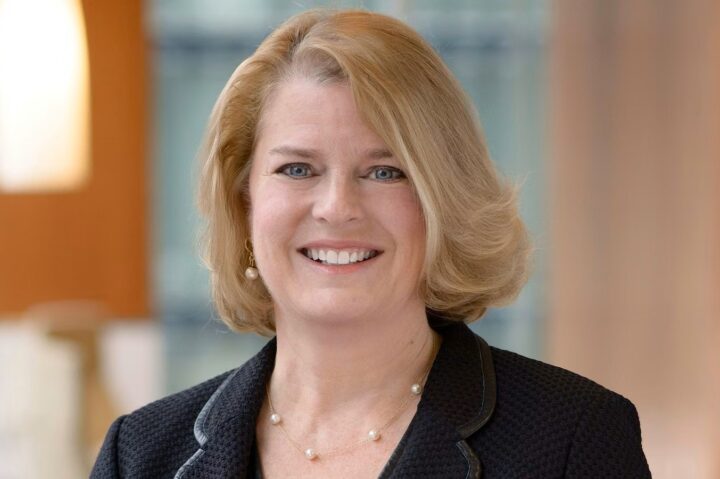
Melissa Bean campaign page
Former Rep. Melissa Bean (D-IL)
Former Rep. Melissa Bean (D-IL) has emerged as an early front-runner in the Illinois 8th Congressional District primary, though she’s facing off against a number of anti-Israel candidates.
Bean, who maintained a pro-Israel record in office, is running as a relative moderate. One of her leading challengers is likely to be Junaid Ahmed, who supports an arms embargo and end to all military aid to Israel, making a second run for the seat, with another candidate who has expressed support for policies cutting off aid to Israel, Yasmin Bankole, also showing some early strength in polling.
“Coming into it, you’d say Melissa would probably be the one to beat. The question is, has the party changed a lot, especially in primaries, since she was in the House last?” Pete Giangreco, a longtime Chicago-based Democratic political strategist, told Jewish Insider. “Has the party moved — or at least Democratic primary voters, have they moved to the left more than where Melissa is, is sort of an open question.”
Internal polling by the Bean campaign last September showed her with a narrow lead but only polling at 10%, followed by Ahmed at 8%, Cook County Commissioner Kevin Morrison at 5% and Bankole, a Hanover Park trustee, at 3%, with more than two-thirds of respondents undecided.
A late November poll by the campaign of military veteran and attorney Dan Tully found Bean leading at 20%, followed by Morrison at 10%, Bankole at 7% and Ahmed at 5%, with 46% undecided.
Businessman Neil Khot, who is self-funding his campaign, is also a wild card assuming he spends enough money to build name recognition ahead of the primary campaign.
The seat, in Chicago’s western suburbs, is currently held by Rep. Raja Krishnamoorthi (D-IL), who is running for the Senate.
Frank Calabrese, a Chicago political analyst, said he anticipates Bean will have a significant fundraising advantage in the next filing period, given her history in Congress and her post-congressional career as a banker. He named Bankole, Morrison and Ahmed as other top Democratic candidates.
Ahmed was endorsed last June by Rep. Ro Khanna (D-CA), and has also been backed by Reps. Delia Ramirez (D-IL) and Pramila Jayapal (D-WA) and the Congressional Progressive Caucus PAC, Justice Democrats, Track AIPAC and IfNotNow Chicago.
He has a degree of name recognition and an established fundraising base — particularly among progressive and Arab-American voters — from an unsuccessful run for the same seat in 2022, a political strategist involved in the race said. The strategist rated him as Bean’s strongest competitor.
As of the end of September, Ahmed led the race in fundraising, with $838,000, fueled by small-dollar donations from Arab-Americans.
Bean, who did not join the race until mid-September, raised $530,000 in her first few weeks in the race. Morrison raised $382,000 and Bankole $293,000 during the last fundraising quarter.
Khot was the first candidate to go on air with television advertisements, which Giangreco said could give him early momentum.
“I think you’d have to say Melissa is the favorite here, but she’s got to raise money and make her pitch, and I imagine that she’ll be on the air soon,” Giangreco said. “She got a little bit of a late start, so I think that’s probably why she’s not quite there yet on resources, and it’ll be interesting to see what the early spending for Neil Khot does.”
Morrison has a record as a local official and backing from various local leaders, as well as Reps. Eric Sorensen (D-IL), Mike Quigley (D-IL), Becca Balint (D-VT), Mark Takano (D-CA), Ritchie Torres (D-NY) and Jan Schakowsky (D-IL) and Equality PAC, the campaign arm of the Congressional Equality Caucus, which supports LGBTQ+ candidates.
Bankole is backed by Sen. Dick Durbin (D-IL), but Giangreco was skeptical that she’ll be able to put together a winning coalition.
“There are a number of candidates who are trying to kind of reinvent the Raja coalition. And you do have a large South Asian population there,” he said. “How many will vote in a Democratic primary is an open question, and there are multiple candidates who are going after Raja’s base, so I don’t know if that feels like a winning strategy.”
The strategist involved in the race noted that it has received significantly less attention than several of the other open-seat races in the Chicago area. The strategist characterized Bean and Ahmed as the candidates to beat at this point.
Bean, who served from 2005-2011 is likely to highlight her work in Congress, particularly her support for the Affordable Care Act, as she works to build up support. But the strategist said that Bean could be vulnerable, among the liberal base, to attacks on her as a banker, linking her to Wall Street.
They predicted that Ahmed and his backers will work to rally support from progressives like Sen. Bernie Sanders (I-VT) and to turn out support among the socialist-leaning left.
Giangreco was more skeptical of Ahmed’s chances running on a progressive platform.
“Unlike [in Illinois’s 9th Congressional District] and [5th Congressional District], that are far more progressive, or even [the 2nd Congressional District] … there isn’t a liberal bastion like those other places have, where there’s a well-grounded progressive round structure,” Giangreco said. “It doesn’t mean there aren’t progressive voters. It’s just less part of the culture of the Democratic primary electorate there.”
Though the Tully campaign polling put Ahmed behind other progressive candidates in the race, the strategist said that Ahmed’s fundraising has been strong and should be sufficient to help him pull ahead into the top tier of the race, and he will be best positioned to capture progressive left voters.
Other candidates currently polling lower, like Tully — who raised $630,000 as of the end of the previous quarter — are hoping that a heated battle between some of those more prominent candidates will push voters away and give them a chance to capture a share of the voters.
“Dan Tully is a really interesting candidate, veteran and all that, but — not to put everybody into a box — but veterans usually have a tough time raising primary money, they actually tend not to do as well in primaries,” Giangreco said.
Jewish military chaplains told JI about their drive to be ohr l’goyim, a light unto the nations

Courtesy
Rabbi Laurence Bazer reading Hanukkah cards sent to Jewish servicemembers
The women’s basketball team at Rochelle Zell Jewish High School in Chicago was practicing earlier this month ahead of its annual Senior Night when an announcement came over the intercom, presenting a special guest. That’s where the video starts — one of those designed-to-go-viral tearjerkers showing a child reuniting with their parent who is in the military.
“He is joining us after leaving the military service in Europe,” the announcer says. Team members start to look around, smiling but confused, when they see that the door to the gym is open.
“We are grateful for his dedication, especially his daughter Hannah,” the announcer continues. That’s when one athlete, in a long-sleeve practice jersey and a ponytail, begins to cry and run toward the door. “Thank you for your service and sacrifice, and welcome home, U.S. Army Chaplain Rabbi Aaron Melman.” Everyone cheers. Throwing her arms around her father, Hannah sobs.
Melman, a Conservative rabbi who since 2021 has served as a chaplain in the Illinois Army National Guard, had just returned from a U.S. Army base in Western Poland. He submitted his request for leave back in September but didn’t tell his daughter, who was devastated most of all to learn his deployment conflicted with the pinnacle of her high school basketball career. (She was more upset that he would miss that game than her graduation.) When she hugged him, Melman took off his cap and revealed a light brown yarmulke that matched his fatigues.
“We made it happen,” Melman tells his daughter in the video, smiling. Days later, RZJHS won at Senior Night. Hannah scored four points.
For more than two decades after he graduated from the Jewish Theological Seminary in 2002, Melman was a congregational rabbi in the northern suburbs of Chicago. He had thought, early in his career, about joining the military — his father served in the U.S. Army Reserves — but decided against enlisting, recognizing that serving in active duty would be challenging as he raised two young children.
But later, when his kids were older, the itch to serve returned. Melman was commissioned as an officer in the Illinois Army National Guard, a responsibility that typically required two days of service a month and two weeks each year, until he was sent to Poland earlier this year. That assignment made him one of several Jewish chaplains serving on the front lines of Europe, providing religious support and counseling to American soldiers — most of whom are not Jewish — who are stationed in Germany, Poland and other allied nations largely as a bulwark against Russia.
Many Jewish chaplains serve in the military only part-time. They fit the training into already-busy schedules leading congregations and providing pastoral care to people in their own communities.
Several military rabbis told JI that they view their mission as more than counseling the soldiers in their care and helping them deal with the hardships of military service. They explained that it’s also about reminding American Jews — many of whom have parents or grandparents who fought in World War II, Korea or Vietnam — about the value of service. During World War II, the military printed pocket-sized Hebrew bibles for Jewish soldiers. Today, some Jews don’t know anyone serving in the military.
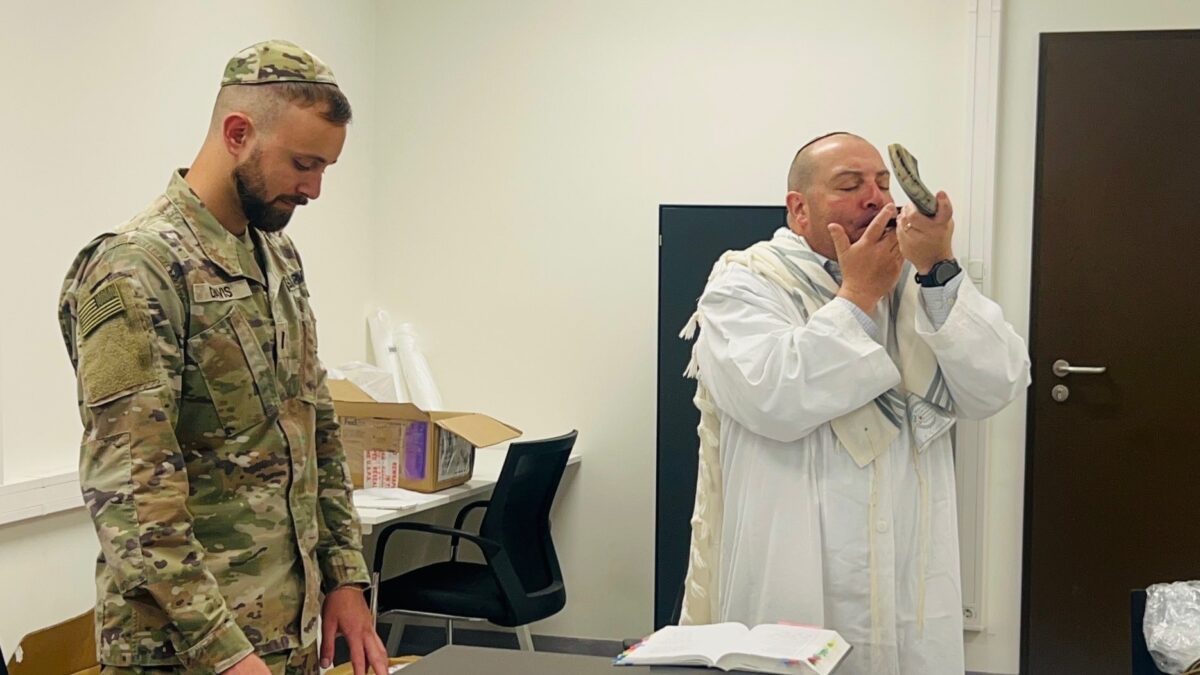
“Most Jews in America are not connected in any way, shape or form to the United States Armed Forces. The common reaction many of us get, when we go into the armed forces here in the States is, ‘Oh, you don’t want to go into the IDF?’ or, ‘Why didn’t you go into the IDF?’ And for the record, I happen to be a very strong Zionist,” Melman told Jewish Insider in an interview last week. “One of the things for me that I’ve really grown to appreciate is trying to connect the younger generation of American Jews into joining or thinking about joining the military and how important it is.”
Rabbi Aaron Gaber spent nine months at Grafenwoehr, a major American base in Germany, starting last summer. As a member of the Pennsylvania Army National Guard, his unit’s mission was to train Ukrainian soldiers, and Gaber was tasked with training Ukrainian chaplains. He took them to the Memorium Nuremberg Trials, a museum located inside the German courtroom where Nazi leaders were tried for their crimes after World War II.
“That created a whole conversation about moral integrity and personal courage. How do you say to your commander, ‘Don’t commit atrocities’? Or how do you keep your soldiers who are angry at what’s happening and want to do things that are unethical or immoral from doing that?” Gaber told JI. “That elicited a whole conversation on a theological level about light versus darkness, good versus evil, but also then on a practical level: How do you advise your commander in a way that gives him or her the option not to do something that shouldn’t be done?”
Most of Gaber’s job, when dealing either with Ukrainian troops or American, involved assisting people who were not Jewish.
“As a rabbi, I got to make sure every week there was a Protestant worship service happening,” said Gaber, who returned from Germany in June (and specified that he did not lead those services).
Last year, he volunteered to spend the High Holidays in Poland and Lithuania. He drove between several different bases to make sure Jewish soldiers had access to religious services, food and learning opportunities tied to the holidays.
“I take the idea of ohr l’goyim, or bringing light to the world, I was able to bring light to the world. I was able to help Jewish soldiers celebrate their faith. If I met 10 Jewish soldiers through the entire two weeks, that was a lot. So it was individual work,” Gaber said. “In one case, I had one soldier travel, I think, three hours each way to be able to spend an hour with me. He couldn’t go by himself, so he had a noncommissioned officer, one of his squad leaders, go with him. That was the length that the military can and does go to make sure soldiers can access their faith.”
Ohr l’goyim is a phrase that comes up often for Jewish military chaplains. For Rabbi Laurence Bazer, a retired U.S. Army colonel who is now a vice president at the JCC Association and the Jewish Welfare Board’s Jewish Chaplains Council, those words — from the Book of Isaiah — commanded him to be a light unto the nations. “And that’s not just to our own fellow Jews, but to the rest of the community,” Bazer told JI.
A friend of his from the North Dakota National Guard once took Bazer, who served in the Massachusetts Army National Guard, to visit North Dakota’s state partner in Ghana. He sat down with a group of Ghanaian soldiers and told them to ask him anything they might want to know about Judaism.
“Now, these are all Catholic, Protestant and Muslim chaplains from the Ghanaian army,” Bazer recalled. “I said, ‘You could ask me, like, why Jews don’t believe in the New Testament, or Jesus, whatever.’ That’s part of the role that I love doing, of being, again, ohr l’goyim, a light unto the nations, to be able to share the positive, affirming side of Judaism so that they felt enriched. It was all in true fellowship of, we’re all servants of the Divine.”

Bazer spent his final years in the military in Washington, working full time in an active duty role at the National Guard’s headquarters. He oversaw the religious response to the COVID-19 pandemic, the 2020 racial-justice protests and the Jan. 6 Capitol riot.
“I was advising commanders up to four stars at a senior level about what’s going on religiously, which really meant the moral welfare of their troops,” said Bazer, who had served in New York during the 9/11 attacks and later led the chaplaincy response to the Boston Marathon bombings in 2013. “That emotional level affects readiness, and chaplains are the key to help that readiness.”
In 2023, Bazer was asked to go to Europe to lead Passover services and programming for Jewish troops. He led Passover Seders in Germany and Poland, and then drove between Lithuania and Latvia, delivering matzah and visiting with Jewish soldiers.
The Seder at Grafenwoehr took place on a large lawn on the base. After he spoke about opening the door for the prophet Elijah, a symbolic act tied to hope that the Messiah will come, a Christian chaplain on base who had attended the Seder pulled Bazer aside. He pointed to a tower that stood next to the lawn.
“He says, ‘You know, Hitler used to go up there and watch,’” Bazer said. The base — now so central to America’s operations in Europe — was once used by the Nazis. “To think that back then he used to watch the Nazis do formation, and now, in 2023 we’re holding a Passover Seder on the same base in the shadow of that tower is an incredible experience.”
All of the open primaries in and around Chicago feature matchups between more mainstream candidates and anti-Israel opponents

Jacek Boczarski/Anadolu via Getty Images
Protesters gather in Chicago, United States on May 17, 2025.
With numerous incumbent House members retiring or seeking higher office, the 2026 election will bring four open seats to the deep blue Chicago area — a level of turnover unprecedented in recent history — each of which is being hotly contested by a series of diverse candidates. And in each of the districts — the 2nd, 7th, 8th and 9th — at least one viable candidate is staking out positions strongly critical of Israel.
Illinois’ Second District (of Rep. Robin Kelly, who is running for Senate):
The sizable Second District stretches from the south side of Chicago and runs nearly three hours south along the border with Indiana. It includes liberal, highly educated areas around the University of Chicago and Hyde Park, where anti-Israel state Sen. Robert Peters is likely to pull most of his support.
Peters, who converted to Judaism, has been critical of Israel’s operations in Gaza and joined at least one anti-Israel protest affiliated with the far-left Jewish Voice for Peace and IfNotNow, calling in mid-November 2023 for a ceasefire.
“I watched the unprecedented bombing campaign rain down on a densely populated community in Gaza — one that had no easy means to escape — and I saw that it was being done in our name, as Jews and as Americans,” Peters wrote in an op-ed. “I thought of the story of my own biological father’s family. I knew that the massive humanitarian crisis that is still unfolding in Gaza will not make the world safer for Jews, whether in Israel or anywhere.”
More recently, he condemned the “forced famine of millions of people in Gaza” and said on X, “No wonder the Trump administration supports the destruction of Gaza, Trump and his allies want to do the same thing to Black people here.”
Peters was adopted as a child, and discovered in 2022 that his biological father was Jewish; he went on to join a congregation and begin the process of formally converting. The state senator has the support of national anti-Israel activists.
“Robert is the only Jewish candidate in the race for Congress in Illinois’ 2nd District, and this issue is deeply personal for him. Robert believes the U.S. must lead the effort to broker a diplomatic resolution that brings home the hostages, ends the war, and that ultimately leads to a solution where both the Israeli and Palestinian people can enjoy lasting security and self-determination,” a Peters campaign spokesperson told JI.
Peters, according to Frank Calabrese, a Chicago political analyst, has established himself as the favorite of the progressive class, raised substantial amounts of money and picked up an endorsement from Sen. Bernie Sanders (I-VT). But Calabrese said he will struggle among the more moderate Black voters that live in the Chicago suburbs.
Calabrese said he sees former Rep. Jesse Jackson, Jr. as the prohibitive favorite to win the seat, describing Jackson as someone with “universal name ID,” hailing from a family that is “as close to royalty as you get. It’s comparable locally to the Kennedy family, in the south side of Chicago.”
As a member of Congress from 1995 until 2012, Jackson visited Israel on trips organized by the AIPAC-affiliated American Israel Education Foundation and the Jewish United Fund — taking criticism from anti-Israel activists. He was the keynote speaker for a pro-Israel event in Chicago in 2009, saying at the time, “I am honored to stand in solidarity with you today as we stand in support of Israel.”
Jackson’s brother, Rep. Jonathan Jackson (D-IL), a member of the House Foreign Affairs Committee, has grown increasingly critical of Israel’s prosecution of the war in Gaza, including supporting a call for the U.S. to unilaterally recognize a Palestinian state and serving as an original cosponsor of the “Block the Bombs Act,” which critics describe as an effective permanent arms embargo on Israel for many critical weapons systems.
Jackson resigned from office under investigation for misuse of campaign funds. He later pleaded guilty to fraud and served 30 months in prison. Calabrese said he thinks voters will largely be forgiving of that history.
He said that it would be “mind-blowing” for Jackson to rack up less than 25% of the vote, which might not be enough to win if there were a small number of other competitors, “but when you put seven, eight, nine people in the race on the ballot — it’s going to be Jesse Jackson.”
Other candidates Calabrese predicted will be most competitive include Yumeka Brown, a member of the Metropolitan Water Reclamation District of Greater Chicago, and Cook County Commissioner Donna Miller, both of whom he suggested could siphon some of the suburban Chicago vote.
Illinois’ Seventh District (of retiring Rep. Danny Davis):
Justice Democrats-affiliated Kina Collins is expected to make a third bid for the 7th District seat, after two primary challenges to retiring Rep. Danny Davis (D-IL). She has been opposed in past races by the AIPAC-affiliated United Democracy Project super PAC.
Collins has a long record of taking anti-Israel stances, having described the war in Gaza as a genocide just nine days after the Oct. 7, 2023, attacks on Israel, called for conditions on U.S. aid to Israel and repeatedly accused Israel of committing war crimes.
She has also suggested Israeli training is the source of American police brutality against Black Americans.
Collins finished third in the 2024 primary, with 19% of the vote. Calabrese said her core base lies with white progressive voters.
Davis’ handpicked replacement is state Rep. LaShawn Ford. But due to Ford’s poor performance during his 2019 mayoral campaign — he received just 1% of the vote — Calabrese said it’s “hard to call him a [clear] frontrunner,” even with Davis’ backing.
Calabrese described the field in general as “chaotic” and said none of the candidates have yet to pull away from the pack.
Ford joined a statement on Oct. 11, 2023, condemning violence against both Israelis and Palestinians.
“Hundreds of Israelis and Palestinians have been killed, and thousands injured,” the statement read. “We will not be able to achieve peace when millions of Palestinians are denied human rights.”
Facing criticism that the initial statement had suggested a moral equivalency between Israel and Hamas, Ford later offered his unequivocal condemnation of the “cowardly Hamas terrorists,” according to local media reports.
Melissa Conyears-Ervin, the city treasurer, is mounting her second bid for the seat, after challenging Davis in the 2024 primary, lagging well behind the congressman with just 21% of the vote. She ran on a strongly pro-Israel platform in 2024 and claimed Collins was antisemitic for accusing Israel of genocide.
Jason Friedman, a businessman who entered the race as a primary challenger to Davis, has a base in downtown Chicago and he may have a financial advantage, Calabrese said, but is an untraditional candidate for the majority-minority district, which has historically been represented by a Black lawmaker.
Friedman has been a member of the leadership of the Jewish United Fund and Jewish Federation of Metropolitan Chicago and was a board member of the Jewish National Fund. He led at least one JUF trip to Israel for young business professionals, and was honored with JUF’s Young Leadership Award. He testified before the Chicago City Council in 2012, urging divestment from Iran’s energy sector
“Trump and the United States have a moral obligation to create an environment to end the war and this humanitarian crisis, bring the hostages home, and create a path towards a true two-State solution,” Friedman said in a statement to Jewish Insider. “Netanyahu and his government have inexcusably put their own self-interests over the interests of Israel and the U.S.-Israeli relationship, and it must stop.”
Others in the race include Richard Boykin, a former chief of staff to Davis, and Anthony Driver, a former leader of the Chicago police oversight board and the former state executive director of the Service Employees International Union, which is supporting his campaign.
Illinois’ Eighth District (seat of Rep. Raja Krishnamoorthi, who is running for Senate):
The suburban 8th District race is also up for grabs — a recent poll conducted by one of the candidates found over two-thirds of voters undecided — and features an ideologically diverse set of candidates, including at least two prominent antagonists of the Jewish state.
Yasmin Bankole, a Hanover Park trustee, is vowing to cosponsor the “Block the Bombs Act,” saying, “Our tax dollars are supporting an unjustifiable humanitarian crisis in Gaza.” She has accused the Trump administration of being complicit in potential ethnic cleansing.
“What’s happening in Gaza is immoral, unconscionable, and it is the responsibility of Congress to act,” Bankole said in a position statement on her campaign website.
Earlier this year, she shared a photo of an emaciated child in Gaza, later revealed to suffer from cerebral palsy, writing in the caption, “This heartbreaking and deeply alarming photo has stopped me in my tracks. We must not look away while this modern day tragedy rages on. We must continue to shine a light on ALL injustices. I call on the U.S., Israel, and those in the international community to ensure that humanitarian aid reaches and is safely distributed in Gaza.”
She also signed onto a Jan. 9, 2024, statement organized by JVP calling for a permanent ceasefire.
Bankole is a former staffer for Sen. Dick Durbin (D-IL) and has the senator’s backing in the race. Calabrese said she is “getting a lot of buzz” and has a similar profile and potential support base to Rep. Lauren Underwood (D-IL), who represents a neighboring district.
Junaid Ahmed, a local small business owner, is making a second run for the seat, after attempting to challenge incumbent Rep. Raja Krishnamoorthi (D-IL) in 2024, winning just 30% of the primary vote. Ahmed is aiming to capture the progressive lane, according to Calabrese.
On his campaign website, Ahmed lists “Peace in Gaza and Palestinian self-determination” as a top campaign priority and describes the war in Gaza as a genocide.
On the site, he called for a “comprehensive arms embargo and the ending of all military aid to Israel, demonstrating the U.S. stands with our fellow democracies in enforcing international law” and for the U.S. to realize “the self determination of the Palestinian people and an end to the Israeli Occupation of the West Bank and Gaza.”
Ahmed also said he supports “a multilateral effort [to] ensure equal protections for Palestinians under international law” and “[c]omprehensive strategies to tackle Islamophobia, anti-Semitism, and anti-Palestinian discrimination here at home and across the globe.”
He said in September that “the United States has a moral duty to stop Israel from committing more [war] crimes” and that Israel’s actions “are hurting America’s standing in the world.”
“As humans, we have the moral obligation to stand up and speak out against these heinous and genocidal acts,” he said in August.
Ahmed’s advocacy against the U.S.-Israel relationship dates back well before the war in Gaza. In 2021, he said, “Your tax dollars are going towards oppressing the Palestinian people,” condemning government funding packages that included aid for Israel.
In 2022, he commemorated the “Nakba” — a term that translates to “catastrophe” and refers to the founding of Israel and exodus of Palestinians — describing it as a “a horrific tragedy that led to the ethnic cleansing of 800,000+ Palestinians from nearly 530 villages at the hands of settlers who would later found Israel in 1948.”
The leading moderate in the race is former Rep. Melissa Bean, who served in the House from 2005 to 2011. The district is significantly different than it was when Bean first ran, Calabrese noted, and she has been less active in local Democratic politics since she retired, meaning she’ll have to re-introduce herself to many voters.
Bean, in a 2016 story, was described as close with Rep. Brad Schneider (D-IL) when he was a pro-Israel advocate before his time in office, and she has spoken out in support of the U.S.-Israel relationship.
In addition to Bean, Bankole and Ahmed, other candidates include Kevin Morrison, a Cook County commissioner, businessman Neil Khot and Dan Tully, a former JAG officer who has donated a significant sum to his own campaign and could be a strong fundraiser.
In the case of Morrison, Calabrese said the Cook County Commission, where he serves, has traditionally served as a launching pad for officeholders including Johnson and Rep. Chuy Garcia (D-IL) — but the district is split between Cook County and DuPage County, where Morrison’s support is weaker.
Calabrese said that Khot could rally support from the sizable local Indian-American community, and that he has been a strong fundraiser, supplemented by his own personal funds.
Illinois’ Ninth District (seat of retiring Rep. Jan Schakowsky):
The Ninth District, which has one the largest Jewish constituencies in the state, has been the most-watched of the open Chicagoland seats, with prominent candidates including state Sen. Laura Fine, Evanston Mayor Daniel Biss and influencer and anti-Israel activist Kat Abugazaleh.
The race in the “very liberal district” which includes “the most liberal parts of Chicago” is turning into a sprint to the left, Calabrese said. The district also includes a large Middle Eastern population unfriendly to Israel, in addition to a sizable Orthodox Jewish community.
Fine represents the wealthier areas of the district and the more mainstream side of the Democratic Party. In an interview with Jewish Insider in May, Fine, who is Jewish, touted her pro-Israel platform and described herself as a staunch defender of the Jewish state who has long been outspoken against rising antisemitism fueled by Hamas’ Oct. 7, 2023, terror attacks and the ensuing war in Gaza.
The 58-year-old state lawmaker, who served in the state House before rising to the state Senate in 2019, is a co-chair of the legislative Jewish Caucus and calls herself a “proud Jewish woman,” noting that her bat mitzvah was held in Israel. “I have been on the front lines of the fight against antisemitism,” she told JI.
Calabrese said he believes Abugazaleh, despite widespread skepticism over her lack of political experience and short period of residence in the district, stands a serious chance of winning because “this [is a] very transient part of [the Chicago area]. It’s a lot of renters, it’s a lot of single people, it’s a lot of young people and they’re very activist. It’s people like Kat. … She’s raising money, she’s getting volunteers and she represents a good part of what the district’s like.”
Biss has also leaned into criticizing Israel on the campaign trail, calling for the U.S. to stop all offensive weapons shipments to Israel and unilaterally recognize a Palestinian state. A campaign spokesperson said he would support the “Block the Bombs Act.”.
“Years of experience have taught us that stern words from allies mean nothing to Netanyahu,” Biss said in a recent Substack post.
He added that recognizing a Palestinian state “would help lay the groundwork for a free and democratic Palestine, with a government that has no place for and provides no material support to Hamas or any other terrorist organization.”
He also wrote that, while he has deep familial connections to the state of Israel — his mother grew up in Israel, he spent significant time there and he had a cousin who served in the IDF after Oct. 7 — “other families have stories that paint a dramatically different picture. The creation of the State of Israel in 1948 was itself a violent trauma for Palestinians. And I have also spent time in the West Bank, decades ago, witnessing first-hand the cruelty of the occupation — and the way, already then, that it warped Israeli attitudes.”
Biss also criticized Israeli airstrikes on Iran and said the U.S. should “work to stop Iran from obtaining a nuclear weapon through diplomatic means, not reckless military strikes.”
Biss, as mayor of Evanston, represents the largest political entity in the district — a large potential pool of votes — is well known from a past run for governor and is politically well-suited to the district, Calabrese said.
“He’s liberal but not really leftist …. So he’s a really good compromise between what I consider establishment and activists,” Calabrese continued, though Biss has leaned more into an activist posture on the campaign trail, participating in heated protests in the area against ICE.
There are other candidates in the race, including Bushra Amiwala, an activist and member of the Skokie Board of Education and the first Gen Z woman elected to public office in the country and the youngest Muslim elected official as of when she was elected.
Amiwala also has a history of anti-Israel activism. She opposes all military aid to Israel, said the U.S. should “demand reparations” from Israel and urged senators to support legislation blocking certain arms transfers.
“To have so much of our taxpayer dollars funding a humanitarian crisis in Palestine is not OK. And I don’t think we need to spend any more money on this. We need to leverage the money we’ve already given Israel to force them to sit at the table and come to a ceasefire,” she told Chicago magazine.
She also accused Israel of deliberately starving Palestinians and said opponents unwilling to describe the war in Gaza as a genocide should drop out of the race.
“This is the new litmus test for Democrats and it doesn’t take a focus group or opinion poll to find the right answer,” Amiwala wrote in a fundraising email. “If you are so morally and ethically compromised on this issue, you are no better than a MAGA Republican and are undeserving of even calling yourself a Democrat.”
Amiwala also said that “we’ve seen AIPAC buy our elected officials,” referring to the group’s political spending, and suggested that U.S. aid to Israel is the reason Americans lack access to education and universal healthcare.
And she has condemned Israel’s “continuous illegal bombing of sovereign nations. Israel has caused countless bloodshed and ignored international law while bankrolled by the U.S. every step of the way.”
But Calabrese said he’s skeptical that anyone other than Abugazaleh, Biss and Fine stands a realistic chance of winning the seat.
Rep. Raja Krishnamoorthi and Lt. Gov. Juliana Stratton opposed the Sanders-led resolutions, but Rep. Robin Kelly (D-IL) said she would have voted for them
Tom Williams/CQ Roll Call/Bloomberg via Getty Images
Representative Raja Krishnamoorthi, a Democrat from Illinois
A divide is emerging in the Democratic Senate primary in Illinois over resolutions the Senate voted on earlier this week to block certain arms sales to Israel.
Lt. Gov. Juliana Stratton’s campaign and Rep. Raja Krishnamoorthi told Jewish Insider on Friday that they wouldn’t have supported the resolutions led by Sen. Bernie Sanders (I-VT), even as they condemned the humanitarian crisis in Gaza.
But Rep. Robin Kelly (D-IL) announced earlier in the day that she would have voted for the resolutions if she’d been in the Senate.
The split could help shape the potentially crucial Jewish community vote in the upcoming Senate primary.
“As a mother, it’s heartwrenching to see images of children forced to go without food. Israel and the United States need to take every possible step to end the humanitarian crisis and ensure aid is immediately and widely made available,” Stratton said in a statement to JI. “I continue to pray for a ceasefire that ends the suffering in Gaza, for the return of the hostages still held by Hamas to their families in Israel, and for lasting peace in the region.”
Stratton’s campaign elaborated that the lieutenant governor believes, “[w]e should all be speaking with a clear voice that the Netanyahu administration must be doing more to get food and aid to the citizens of Gaza right away, but Juliana believes that cutting off U.S. military aid to Israel could risk standing in the way of the ultimate goals of a true ceasefire and sustained peace.”
The campaign also said that Stratton believes in Israel’s “right to defend itself as one of the United States’ closest allies and the only democracy in the Middle East.”
The campaign said Stratton “strongly disagrees” with how the Israeli government led by Prime Minister Benjamin Netanyahu has executed the war in Gaza, but she “has been vocal in her support of Israel in the wake of the horrific terrorist attacks by Hamas on October 7th.”
Krishnamoorthi — who, in an interview with JI earlier this year, said he did not support efforts to cut off or condition U.S. aid to Israel — said Friday that the Sanders resolutions would not have solved the humanitarian crisis.
“We need an immediate ceasefire brokered by the U.S. and regional partners and that is swiftly accepted by Hamas, along with the release of the remaining hostages and the emergency provision of humanitarian aid,” Krishnamoorthi said in a statement to JI. “The U.S. must use all of its diplomatic influence to make that happen as quickly as possible. Ultimately, the only path to a lasting peace is a two-state solution. The first step and my focus today is ending the current humanitarian disaster and getting food in as quickly as possible. Wednesday’s resolutions did not right that wrong.”
He said that he has “long been a steadfast supporter of our nation’s alliance with Israel” and that it “had every right to defend itself,” but said that “[w]hat we see going on today in Gaza is a moral catastrophe.”
“As Americans, we can never sit by and allow widespread starvation and disease among a civilian population that includes the elderly, the disabled, women, and children,” Krishnamoorthi continued.
He highlighted that he wrote to Secretary of State Marco Rubio and Special Envoy Steve Witkoff on Friday, urging them to surge aid into the strip and to ensure accountability that it reaches its intended recipients.
He said in the letter that, despite acknowledging the starvation in Gaza, the administration has not done enough to remedy the situation. Krishnamoorthi also urged others in the region, including Hamas, to cooperate in the proper delivery of aid.
Kelly, meanwhile, said in a statement Friday that she would have voted for the resolutions.
“Israelis and Palestinians must work to secure a path forward where both peoples can live in peace, safety and security,” Kelly said in a statement. “I have supported Israel, but in this moment, I cannot in good conscience defend starving young children and prolonging the suffering of innocent families. Now is the time for moral leadership in the U.S. Senate.”
Both Sens. Dick Durbin (D-IL) — who is retiring — and Tammy Duckworth (D-IL) supported the resolutions.
Durbin has supported every similar effort Sanders has made since November to block various arms sales to Israel, but Duckworth had voted against them in the past and, in fact, argued forcefully against them in a letter to constituents.
The votes on Sanders’ proposal to cut Israel aid are also proving to be a dividing line in Michigan’s Senate primary: Rep. Haley Stevens (D-MI) announced Friday that she would have opposed them, while state Sen. Mallory McMorrow said she supported them.
Plus, Bibi plans a Beltway blitz

Jemal Countess/Getty Images for Fair Share America
Sen. Chris Murphy (D-CT) speaks at the U.S. Capitol on April 10, 2025 in Washington, DC.
Good Tuesday morning.
In today’s Daily Kickoff, we look at Sen. Chris Murphy’s leftward shift on Israel, and spotlight Rep. Raja Krishnamoorthi’s congressional votes and relations with Illinois’ Jewish community as he mounts a bid for Senate. We cover Israeli Prime Minister Benjamin Netanyahu’s upcoming trip to Washington, and report on a new lawsuit alleging the Nysmith School in Northern Virginia discriminated against Jewish students. Also in today’s Daily Kickoff: Doron Spielman, Karen Diamond and Susan Rice.
What We’re Watching
- Secretary of State Marco Rubio is meeting in Washington today with his counterparts from Japan, China and Australia.
- The Carnegie Endowment for International Peace’s Aaron David Miller is hosting a web event this morning with former CIA Director David Petraeus and analyst Karim Sadjadpour focused on Israel, Iran and the U.S.
- Former U.S. Ambassador to Israel Dan Shapiro is speaking this morning at a Center for International & Strategic Studies event on ties between North Korea and Iran.
- The Christians United For Israel summit continues today in Washington. Virginia Attorney General Jason Miyares, the Brandeis Center’s Ken Marcus and Israel Ambassador to the U.N. Danny Danon are slated to speak today.
- The Aspen Ideas Festival in Colorado wraps up today.
- New York City is slated to release the first round of ranked-choice voting results from last week’s primaries
What You Should Know
A QUICK WORD WITH JI’S JOSH KRAUSHAAR
The political developments over the last week couldn’t send a more dispiriting message about the viability of the political center — in both parties.
Last Tuesday, a self-proclaimed democratic socialist, Zohran Mamdani, who campaigned on a far-left agenda on issues ranging from the economy, crime and antisemitism, emerged as the Democratic standard-bearer for mayor of New York City.
Over the weekend, Sen. Thom Tillis (R-NC), one of the most pragmatic Republicans in the upper chamber, announced he wouldn’t be running for reelection after signaling he’d be one of two GOP votes against President Donald Trump’s “big, beautiful” budget reconciliation bill. His decision to retire came after Trump, in a Truth Social post, threatened to support a primary challenger.
Tillis, notably, was the deciding Republican vote scuttling the nomination of interim D.C. U.S. Attorney Ed Martin for, among other issues, his associations with a Nazi sympathizer.
And on Monday, Rep. Don Bacon (R-NE), one of only three House Republicans who represents a district that former Vice President Kamala Harris won in 2024, formally announced his retirement, making it all the more likely a more-partisan Democratic lawmaker will succeed him in the seat.
These are just the latest developments that underscore that moderation, pragmatism and bipartisanship are becoming endangered principles in a polarized political environment that rewards extremism and hot takes over thoughtful policymaking.
SOLIDARITY SNUB
Connecticut’s Jewish community wonders: What happened to Chris Murphy?

Two days after the Oct. 7, 2023, Hamas terror attacks, Sen. Chris Murphy (D-CT) spoke emotionally at the “Rally for Israel” in West Hartford, Conn. “This is a moment where we are going to have to stand as a nation with greater force, with greater purpose than ever, to make sure that Israel has what it needs,” Murphy said. But members of Connecticut’s Jewish community say Murphy strayed from that promise just weeks later. In late November 2023, Murphy said on CNN that he was open to placing conditions on U.S. aid to Israel, a position that astounded many of the people who had stood with him in West Hartford not long before. Since then, he has emerged as a vocal critic of Israel’s handling of the war in Gaza, and more than 18 months after the attack, the Connecticut Jewish community’s frustration with him has only grown, Jewish Insider’s Gabby Deutch reports.
Veering off: Murphy voted twice in support of resolutions put forward by Sen. Bernie Sanders (I-VT) that would block certain arms sales to Israel. Following Israel’s strikes on Iranian nuclear facilities, Murphy slammed Israeli Prime Minister Benjamin Netanyahu for sending the Middle East into a “new, deadly conflict.” His shift to the party’s left flank on Israel comes as Murphy positions himself as a leading voice in the Democratic Party in opposition to President Donald Trump’s policies and builds a stronger public profile for himself. He’s a regular on cable news shows and recently created a new political action committee to encourage protests against Trump, with plans to spend $2 million in the 2026 midterms, sparking rumors that he could mount a presidential bid in 2028. It’s not just Murphy’s foreign policy views that are concerning his Jewish constituents. Recently, the senator has emerged as one of the most prominent boosters of presumptive New York City Democratic mayoral nominee Zohran Mamdani, even as some of his Democratic colleagues have raised concerns about Mamdani’s refusal to condemn the phrase “globalize the intifada.”
Communal concerns: Rabbi Tuvia Brander, the spiritual leader of Young Israel of West Hartford, told JI that Murphy’s praise of Mamdani is “so beyond the pale of what is just in the basic interests of many of his constituents.”
PRAIRIE STATE OF PLAY
Rep. Raja Krishnamoorthi hopes to win the Jewish vote in Illinois Senate contest

As he competes for Illinois’ open Senate seat, Rep. Raja Krishnamoorthi (D-IL) is hoping that the state’s sizable Jewish community, concentrated in the Chicago area, will help him chart a path to victory in the Democratic primary, Jewish Insider’s Marc Rod reports.
Making his pitch: “I do think that [Jewish voters] have a desire for a strong U.S.-Israel relationship,” Krishnamoorthi said, “and I don’t think there’s anybody else with the track record in this race that I possess, showing strong support for that relationship, but also knowing why that relationship needs to continue to be strong on a bipartisan basis, and we need to take this out of politics.” Krishnamoorthi spoke to JI about his approach to antisemitism, Iran and the U.S.-Israel relationship.
WAR OF WORDS
Responding to Mamdani, Senate Democrats say ‘globalize the intifada’ slogan must be condemned

Several Senate Democrats told Jewish Insider’s Emily Jacobs and Marc Rod on Monday that calls to “globalize the intifada” are unacceptable and must be condemned, amid concerns from Jewish leaders and organizations over presumptive New York City Democratic mayoral nominee Zohran Mamdani’s defense of the slogan.
Mamdani musings: Senate Minority Leader Chuck Schumer (D-NY), who has thus far not endorsed Mamdani, told JI he plans to meet with Mamdani in a few weeks, when asked about Mamdani’s refusal to condemn the slogan. “Sen. Schumer condemns the phrase ‘Globalize the Intifada’ and believes it should not be used because it has such dangerous implications. As Senator Schumer said after the death of Karen Diamond, the attack in Boulder continues to serve as a grave reminder of the deadly consequences of the rise in antisemitism,” a spokesperson for Schumer told JI. “I don’t know what [Mamdani’s] position is on it, but I certainly think that the call to spread the intifada is the kind of incitement that can lead to extremist violence,” Sen. Richard Blumenthal (D-CT) told JI.
Read the full story here with additional comments from Sens. Jacky Rosen (D-NV), John Fetterman (D-PA) and Kirsten Gillibrand (D-NY) and Rep. Ritchie Torres (D-NY).
TRIP TALK
Netanyahu heading to D.C. next week to ‘take advantage of the victory’ in Iran

Israeli Prime Minister Benjamin Netanyahu’s White House visit next week is a chance to “take advantage of the victory” in Iran, he said at the start of a Cabinet meeting on Tuesday,Jewish Insider’s Lahav Harkov reports.
On the agenda: The trip to Washington “comes as a continuation of the great victory we achieved in Operation Rising Lion,” Netanyahu said, referring to Israel’s 12-day operation against Iran’s nuclear and ballistic missile program, which the U.S. joined. “Taking advantage of the victory is no less important than achieving the victory.” An Israeli official told JI on Tuesday that “everything” is on the agenda, including U.S.-Israel cooperation to stop Iran from rebuilding its nuclear program, next steps in Gaza and the possibility of establishing diplomatic relations with Syria and other Arab and Muslim countries.
Meanwhile at Aspen: Susan Rice, who served as national security advisor during the Obama administration’s inking of the nuclear deal with Iran, sharply criticized Trump’s decision to strike Tehran’s nuclear program while defending the 2015 agreement during a panel discussion at the Aspen Institute’s Ideas Festival on Monday,Jewish Insider’s Jake Schlanger reports. Rice joins a chorus of former Obama and Biden administration officials who have criticized Trump’s decision to strike Iran’s nuclear facilities, despite many experts concluding the damage to the program was significant.
Worth noting: The New York Times’ David Brooks, writing in a piece headlined “I Detest Netanyahu, but on Some Things He’s Actually Right,” adds context to consider when evaluating the strikes. “We may know in time what the bombings accomplished. In the meantime, we do know that Israel and the United States have the will and capacity to attack Iran anytime and anyplace. We do know that if Iran reconstitutes its nuclear program, Israel and America have the capacity to deliver a much more devastating and regime-threatening blow. We also know that Iran and its proxies have made some insanely self-destructive miscalculations since Oct. 7, 2023, and they must know that, too. These are ominous omens for the theocrats in Tehran.”
HOSTILE ENVIRONMENT
Brandeis Center files complaint alleging antisemitism at Virginia private school

The parents of an 11-year-old Jewish student at a private school in Northern Virginia say their daughter faced months of antisemitic harassment that went unaddressed by school officials, who also cancelled an annual event featuring a Holocaust survivor due to concerns that the event might exacerbate tensions related to the Israel-Hamas war. Days after the parents addressed the campus environment with school leadership, all three of their children were expelled, according to a complaint filed on Tuesday with the Office for Civil Rights in the Virginia Attorney General’s Office, Jewish Insider’s Haley Cohen has learned.
The allegations: According to the complaint, Kenneth Nysmith, headmaster and owner of The Nysmith School for the Gifted in Herndon, Va., canceled the event with the Holocaust survivor and expressed concern that it might inflame tensions within the school community in light of Israel’s ongoing war against Hamas in Gaza. The complaint, filed by the Louis D. Brandeis Center for Human Rights under Law and Washington-based firm Dillon PLLC, alleges several antisemitic incidents that the parents of the 11-year-old Jewish student say she faced in the months leading up to the cancellation of the Holocaust survivor event. The complaint recounts that in October 2024, their daughter’s history teacher asked students to work together on an art project to create a large drawing featuring the attributes of “strong historical leaders.” The students collaborated on a large artistic rendering of a strong leader, featuring Adolf Hitler’s face.
Elsewhere: The Brandeis Center, working with the Anti-Defamation League and Mayer Brown, filed a brief on Monday with the Department of Education’s Office for Civil Rights, alleging that officials in a Massachusetts school district did not adequately protect Jewish students from antisemitic harassment and discrimination.
BOOK REVIEW
‘When the Stones Speak’: Doron Spielman connects Jewish history to present-day Israel
After Israel waged war against an Iranian regime that has vowed to destroy the Jewish state and diaspora Jews face a heightened atmosphere of antisemitism stemming from the Israel-Gaza war, a new book aims to equip Israel supporters with “a foundation” to refute claims that Jews do not have ancient roots in the land of Israel. When the Stones Speak: The Remarkable Discovery of the City of David and What Israel’s Enemies Don’t Want You to Know, written by former IDF spokesperson Doron Spielman, does so by recounting discoveries made in Israel’s largest excavation site, the City of David, where Spielman has worked closely with archaeologists for two decades to uncover and promote the site’s historical significance. The book, Spielman suggested in an interview with Jewish Insider’s Haley Cohen, is aimed at what he calls “the middle group of people” — “logical, reasonable people” who don’t know whether they’re pro-Israel or anti-Israel.
Lay of the land: “When they understand that ‘when the stones speak,’ they tell the story of the truth of the Jewish people’s connection to the land,” that could help sway the conversation on college campuses. This middle group will come to understand, he said, that “at the very least [the Israeli-Palestinian conflict] is a fight between two people who think they’re indigenous, and at the very best they understand the Jews are people who have only one land, they’ve been there for 3,800 years and therefore they have a right to defend it.”
New York state of mind: Spielman hopes the book’s impact will also reach supporters of New York City mayoral candidate Zohran Mamdani, the presumptive winner of the Democratic primary last week amid his refusal to condemn the phrase “globalize the intifada” and denial that Israel has a right to exist as a Jewish state. “He’s denying the Jewish people their right to live as a nation in the one place they ever called home,” Spielman told JI. “When the Stones Speak cuts through the lies with facts on the ground — literally.”
Worthy Reads
Knockout Blow, But Not the End: The Times of Israel’s David Horovitz reflects on the 12-day war between Israel and Iran. “There is, however, absolutely no room or reason for hubris. Israel allowed itself to slip into existential peril, and the astounding success of the 12-day war is a temporary accomplishment. Iran is not going anywhere. And so long as the ayatollahs retain power, they can be relied upon to recommit to their efforts to wipe out Israel. … Along with delight and profound relief at the achievements of the war, the military and security top brass are resolved not to underestimate the regime and its single-minded determination to destroy Israel. This was a knockout blow in a life-or-death fight. But it is not the end of the existential struggle.” [TOI]
Not Science Fiction: In The Free Press, Matti Friedman considers the impact of Iran’s ballistic missile attack on the Weizmann Institute of Science. “When [neurobiologist Oren Schuldiner] heard that his lab was hit, he said, he had trouble grasping what this meant, and kept texting colleagues to ask what could be salvaged — there were two microscopes in the lab, for example, each worth nearly $1 million, and thousands of fruit fly specimens that he uses to map neural changes that may one day help us better understand diseases like schizophrenia and autism. Finally, a colleague who’d lost her own lab sent him a link to the Wikipedia page detailing the five stages of grief. ‘I understood that I was in denial,’ he said. Only when he made it back did he understand that the lab wasn’t damaged — it was gone, along with most of his work of the past 17 years.” [FreePress]
Lula’s Lurch:The Economist spotlights Brazilian President Luiz Inácio Lula da Silva, whose declining domestic popularity has coincided with his country’s deepening ties with Iran, Russia and China. “On June 22nd, hours after the United States struck Iranian nuclear sites with huge bunker-buster bombs, Brazil’s foreign ministry put out a statement. It said that Brazil’s government ‘strongly condemns’ the American attack, and that the strikes were a ‘violation of Iran’s sovereignty and international law.’ This strength of language put Brazil at odds with all other Western democracies, which either supported the strikes or merely expressed concern. Brazil’s friendliness with Iran is set to continue on July 6th and 7th when the BRICS, a group of 11 emerging-market economies including Brazil, China, Russia and South Africa, holds its annual summit in Rio de Janeiro. Iran, which became a member of the BRICS in 2024, is expected to send a delegation. The club is currently chaired by Brazil’s president, Luiz Inácio Lula da Silva, known as Lula. Originally, being a member had offered Brazil a platform from which to exert global influence. Now it makes Brazil look increasingly hostile to the West.” [TheEconomist]
Word on the Street
President Donald Trump signed an executive order lifting the majority of sanctions imposed on Syria over the last 50 years; the executive order includes steps to lift the Foreign Terrorist Organization status of the Hayat Tahrir al-Sham group that Syrian President Ahmed al-Sharaa previously led, as well as a review of Damascus’ role as a state sponsor of terror…
An Iran-linked hacking group that had previously accessed email accounts associated with Trump’s 2024 campaign threatened to release a new tranche of emails sent from Trump aides…
Satellite images obtained by CNN over the weekend indicate “ongoing activity at and near the ventilation shafts and holes caused by last week’s airstrikes” on Iran’s Fordow nuclear facility…
The Department of Health and Human Services’ Office for Civil Rights issued a 57-page report accusing Harvard of having acted with “deliberate indifference” toward antisemitism and anti-Israel discrimination on the Cambridge campus…
Elon Musk said he planned to support Rep. Thomas Massie (R-KY), who is facing an effort by the White House to recruit a primary challenger over Massie’s refusal to back the administration’s budget reconciliation bill; Musk was prompted by a social media post from former Rep. Justin Amash (R-MI) calling on the X owner to back Massie, but is already facing pushback from some in the Kentucky Jewish community…
Former Rep. Colin Allred (D-TX), who fell short in his bid to unseat Sen. Tex Cruz (R-TX) last year, announced his entry into Texas’ Senate race; Allred is seeking to challenge Sen. John Cornyn (R-TX), who is already facing a tough primary battle…
Karen Diamond, one of the more than two dozen people injured in last month’s antisemitic firebombing attack targeting a Boulder, Colo., march in support of the remaining Israeli hostages, died from her injuries, Jewish Insider’s Gabby Deutch reports…
Unilever cut off financial support for the charitable arm of its Ben & Jerry’s subsidiary, alleging that the ice cream company foundation’s trustees “have continued to resist basic oversight” and refused to provide audit documents…
A British court rejected a legal challenge by the Palestinian NGO Al-Haq that sought to stop the government’s exports to Israel of components of F-35 fighter jets; the court determined it lacked jurisdiction over the U.K.’s defense sector…
British musical group Bob Vylan is facing a criminal investigation over chants the duo led at the weekend Glastonbury music festival calling for “death to the IDF”; U.K. Prime Minister Keir Starmer also denounced the chants, which resulted in the State Department’s canceling of group members’ visas ahead of a planned U.S. tour…
An Australian court ordered a Sydney imam to remove from the internet past speeches that the court said were “fundamentally racist and antisemitic”; the cleric was also instructed to refrain from making similar speeches in the future…
The newly created Kinetica VC fund, founded by Yoav Knoll, Aaron Applbaum, Yitz Applbaum and Frederic Landau, is raising $150 million for investments focused on Israel’s tech industry; the firm has also recruited former U.S. Navy Secretary Kenneth Braithwaite, Joe Lonsdale and former Sen. Norm Coleman (R-MN) to join its advisory board…
Former Israeli hostages Liri Elbag, Karina Ariev, Naama Levy, Danielle Gilboa and Agam Berger visited the set of “Fauda” as the series films its fifth season…
Pic of the Day

Auburn men’s basketball coach Bruce Pearl spoke on Monday at the Christians United For Israel conference in Washington.
Birthdays

Television, film and theater actor, including early career roles in Yiddish theater, Michael Burstein turns 80…
Applied mathematician, statistician and physicist, professor emeritus at both MIT and Harvard, Herman Chernoff turns 102… Former U.S. assistant aecretary of education and research professor at NYU, Diane Silvers Ravitch turns 87… Nobel laureate in economics for 1997 and co-creator of the Black-Scholes model for valuing options and other derivatives, Myron Scholes turns 84… Noted British art dealer and founder of an eponymous London art gallery, Victoria Marion Miro turns 80… Born in a DP camp to her Holocaust survivor parents, she was the first Jewish woman to serve on the Canadian Supreme Court, Rosalie Silberman Abella turns 79… Israeli-Russian businessman, with holdings in energy and international real estate development, Shalva Chigirinsky turns 76… Partner in the Encino, Calif.-based law firm of Nolan Heimann, Douglas E. Mirell… Hall of Fame player and coach in the Women’s National Basketball Association and now an NBA broadcaster, Nancy Lieberman turns 67… Attorney and longtime Democratic activist in Pittsburgh, he is a regional chair of the ADL, Steven D. Irwin turns 66… Contributing editor at The Forward and CEO of the A-Mark Foundation, Rob Eshman… President emeritus of the Orthodox Union and a retired partner at Ropes & Gray, Mark (Moishe) Bane… Undersecretary of state for political affairs during most of the Biden administration, Victoria Jane Nuland (family name was Nudelman) turns 64… Journalist, filmmaker and educator, he is the co-founder of Aish[dot]com, Shraga Simmons turns 64… Professor of Jewish thought at Hebrew University, Benjamin Brown turns 59… Member of the Virginia House of Delegates since 2014, Marcus Bertram Simon turns 55… U.S. senator (R-IA), Joni Ernst turns 55… Screenwriter, producer and film director known for romantic comedy films, Marc Silverstein turns 54… Los Angeles resident, Adam B. Siegel… NASA astronaut, on her 2019 trip to the International Space Station she took novelty socks with Stars of David and menorahs, Jessica Meir turns 48… Co-founder of Edgeline Films, Elyse Steinberg… Hasidic musician mixing elements of dancehall, reggae, hip-hop and R&B, known by his stage name DeScribe, Shneur Hasofer turns 43… Rising senior and president of the school of business and finance at Ocean Township High School in Oakhurst, N.J., Samuel Peretz Fields…
Rep. Robin Kelly (D-IL) and Lt. Gov. Juliana Stratton are also competing to succeed retiring Sen. Dick Durbin

Alex Wong/Getty Images
Rep. Raja Krishnamoorthi (D-IL) speaks next to the famous tank man photo during a news conference in front of the U.S. Capitol to commemorate the 36th anniversary of the Tiananmen Square protests and massacre on June 4, 2025 in Washington, DC.
As he competes for Illinois’ open Senate seat, Rep. Raja Krishnamoorthi (D-IL) is hoping that the state’s sizable Jewish community, concentrated in the Chicago area, will help him chart a path to victory in the Democratic primary.
Analysts see the Jewish vote as potentially up for grabs in the election to succeed retiring Sen. Dick Durbin (D-IL), which pits Krishnamoorthi against Rep. Robin Kelly (D-IL) and Lt. Gov. Juliana Stratton. Krishnamoorthi, a suburban Chicago lawmaker seen as more moderate than his challengers in the race, says he’s best positioned to claim that lane.
“I think Jewish Americans are just like everyone else, first of all, and they care about the full range of issues that all voters care about,” Krishnamoorthi said, when asked by Jewish Insider in a recent interview why the Jewish community should back him.
“However, I do think that they have a desire for a strong U.S.-Israel relationship,” Krishnamoorthi continued, “and I don’t think there’s anybody else with the track record in this race that I possess, showing strong support for that relationship, but also knowing why that relationship needs to continue to be strong on a bipartisan basis, and we need to take this out of politics.”
On a series of key votes on Middle East and antisemitism issues since the Oct. 7, 2023, Hamas-led attacks in Israel, Krishnamoorthi has sometimes voted against legislation supported by Jewish and pro-Israel groups, but his record on those issues has been stronger than Kelly’s. On several occasions when the two have voted differently, Krishnamoorthi has sided with positions supported by leading Jewish and pro-Israel groups.
Krishnamoorthi was endorsed by AIPAC in his 2024 reelection race; Kelly was not.
The Illinois Senate hopeful took a mildly critical position, however, on the U.S. strikes against Iran’s nuclear program. “Iran cannot have a nuclear weapon. Cannot,” Krishnamoorthi said, while adding that the President Donald Trump “cannot take unilateral military action in Iran without congressional approval,” calling for a diplomatic solution to the conflict.
Several days later, Krishnamoorthi said in a letter to the president that conflicting reports about the strikes’ effectiveness “are deeply alarming and require further evaluation from the intelligence community,” and condemned the administration for reported plans to limit intelligence-sharing with Congress.
The Illinois congressman said in a CNBC interview the morning following Israel’s initial strikes on Iran that he “can understand why the Israelis would take action, especially when Iran is so intransigent at the bargaining table,” noting the International Atomic Energy Agency’s findings of Iranian malfeasance.
Krishnamoorthi went on to say that he is “100% in favor of a strong U.S.-Israel relationship” but also is “hoping we can de-escalate a little bit for a second, maybe give Iran a chance to come back to the negotiating table and make sure that we protect our U.S. troops and interests in the region.” He said he believed it was not too late for an agreement.
He characterized Iran as desperate for sanctions relief, adding that “there has to be a verifiable way that we know that their nuclear program is dismantled,” and that a deal should also address Iran’s other malign activities, such as its support for the Houthis.
Krishnamoorthi spoke to JI days after an antisemitic extremist attacked a hostage awareness march in Boulder, Colo., and after he joined 74 other Democrats — less than half of the caucus — in voting for a Republican-led resolution that condemned the attack while also praising Immigration and Customs Enforcement. Kelly voted against that resolution.
“I think there’s been a rise in antisemitism in this country … and I don’t think we have done enough to stem the rise. And I wanted to send a very clear message that this is intolerable,” Krishnamoorthi said, of his vote. “I also think that people need to understand that antisemitism is kind of the canary in the coal mine for a host of other ills that accompany it. If we don’t stamp this out with one voice, it’s not going to go away.”
Asked about the fact that the Boulder attacker, the Capital Jewish Museum shooter and the arsonist who attacked Pennsylvania Gov. Josh Shapiro’s home all cited the war in Gaza as the motivation for their actions, Krishnamoorthi said that leaders need to be mindful of the role their rhetoric can play in driving a nationwide surge of political violence.
“I think that what you say is important because it could potentially ignite violence. Politically violent rhetoric can then lead to violence,” Krishnamoorthi said. “We should, as politicians, as elected officials, be very careful with what we say about the conflict, any conflict — that goes for what’s happening in Gaza, but it really goes for what happens anywhere.”
He cited the phrase, “from the river to the sea” as one slogan that “to a lot of people … is code for potentially taking violent acts against a certain people.”
To address the antisemitism crisis in the United States, Krishnamoorthi said that Congress needs to move beyond nonbinding resolutions to binding legislation. He noted that he was a lead sponsor of the 2023 Hate Crimes Commission Act, which was supported by some Jewish groups, that would study the rise of hate crimes and issues of underreporting and provide recommendations on how to prevent hate crimes.
Krishnamoorthi voted in favor of the Antisemitism Awareness Act, which Kelly opposed. He opposed some resolutions the House has voted on regarding antisemitism since Oct. 7, 2023, voting “present” on a resolution describing anti-Zionism as antisemitic, and against a resolution calling for college presidents to resign after their testimony before the House Committee on Education and the Workforce.
On the former, he said he’d heard from Jewish and other constituents “that there’s a difference between being against Zionism and being against Jewish people” and that he didn’t “want to necessarily broaden the definition so much that people could not somehow be critical of the policies of Israel, and if they were, would be called antisemitic, because it turns out that a lot of Jewish Americans told me that they fell in that category.”
On the latter, he said that he thought the college presidents’ testimony was “terrible” and “unacceptable” but felt that government intrusion into private universities or other organizations’ hiring decisions “opens a Pandora’s box of potentially really bad outcomes.”
Looking at the ongoing war in Gaza, Krishnamoorthi said that the immediate goal should be to reach a ceasefire and hostage-release deal as soon as possible, and to work in the long term toward a two-state solution. He said that a Palestinian state must be peaceful and cannot be led by Hamas.
“The good news is there’s a lot of other neighbors that are willing to help fund this type of situation, if we would just like keep our eyes on the prize,” he said, “because ultimately, what we want to see is the Abraham Accords fully blossom into full recognition of Israel by her neighbors, including Saudi Arabia and all the Gulf states and the Palestinian state being funded by them, and then real trade and other commercial ties binding the region.”
He said he’s been particularly impressed by Jordan’s King Abdullah II in annual meetings between the Jordanian monarch and the House Intelligence Committee.
“When you have people like that — he’s literally putting his life on the line every day for this vision — then I have hope,” Krishnamoorthi said. “But getting there is obviously a huge challenge. But we have to kind of seize this moment.”
On the Intelligence Committee, Krishnamoorthi said he sees on a daily basis the value of the U.S.-Israel relationship, which provides “remarkable intelligence sharing” and innovative defense technologies that help protect U.S. personnel and interests.
He voted in favor of supplemental U.S. aid to Israel last year, and said he would not support legislation like that pushed by Sen. Bernie Sanders (I-VT) and other Senate progressives that seeks to block various arms transfers to Israel. He noted that all U.S. arms sales are already subject to conditions, that placing additional “onerous conditions” on aid to Israel to defend itself would not be consistent with U.S. interests.
Rabbi Barry Axler, a Chicago-area supporter of Krishnamoorthi who is co-chairing a fundraiser for the Jewish and pro-Israel community, told JI that Krishnamoorthi is a longtime friend of the Jewish community and hopes it will stand behind him.
“Of the three candidates running here, he’s the strongest by far for Israel, and I’m getting behind him as best as I can,” Axler said. “One is Robin Kelly, who … has not been the best friend of our community, of Israel. The other one is the lieutenant governor, Stratton, and she’s got no background at all with us.”
“Even if the other two had more or less strong records on Israel, Raja’s been there before and we just can’t abandon him,” Axler continued.
He said that Krishnamoorthi has told him that his family has strong ties to the Jewish community, having sent his children to a local Jewish Community Center preschool.
“He said, ‘Every Friday they used to come home and sing ‘Shabbat Shalom’ — but I put my foot down when they wanted to build a sukkah,’” Axler recounted.
One Jewish Democratic strategist said that none of the three major candidates have deep ties to the Jewish community, leaving Jewish voters up for grabs

Pete Marovich/Getty Images
Ranking Member Lauren Underwood (D-IL) questions acting FEMA Administrator Cam Hamilton as he appears before a Homeland Security Subcommittee Hearing on Oversight on Capitol Hill on May 7, 2025 in Washington, DC. Hamilton is testifying about the administration's disaster relief efforts, including why it has frozen nearly all FEMA's grant funding.
Rep. Lauren Underwood (D-IL) said on Monday that she would pass on an anticipated run for the Illinois Senate seat being vacated by Sen. Dick Durbin (D-IL) in 2026, leaving what’s likely to be a three-way race among Lt. Gov. Juliana Stratton and Reps. Raja Krishnamoorthi (D-IL) and Robin Kelly (D-IL).
“Our work is not done, and I’ve decided the most powerful way for me to defend our values and hold Donald Trump accountable is to help Democrats win back the House,” Underwood said in a statement, highlighting her leadership roles in the House Democratic Caucus and the Democratic Congressional Campaign Committee.
Stratton is backed by billionaire Illinois Gov. JB Pritzker, as well as Sen. Tammy Duckworth (D-IL), while Krishnamoorthi has $19 million in the bank for the race and members of the Congressional Black Caucus are backing Kelly.
Pritzker could put significant funding behind Stratton’s run and reportedly worked behind the scenes to block Underwood and other candidates from entering the race. Underwood, on CNN, denied that Pritzker had forced her to stay out of the race.
A Jewish Democratic strategist, speaking on condition of anonymity to discuss the race candidly, told Jewish Insider they see the Chicagoland Jewish vote — a sizable community — as largely still up for grabs given that none of the candidates have particularly deep ties to the Jewish community coming into the race. They said Jewish voters will likely take time to evaluate each of the candidates.
“I think there’s a lot of inroads for them to make,” the strategist said. “None of these have that long history with the Jewish community … [and] don’t come from natural Jewish areas.”
Kelly and Krishnamoorthi have mixed voting records on priority legislation for the Jewish community, having both opposed several bills and resolutions to combat antisemitism, counter Iran and sanction the Houthis and the International Criminal Court, among other issues.
On the handful of occasions the two have diverged on votes, Krishnamoorthi has generally come down on the side of Jewish and pro-Israel groups — for instance, he supported the Antisemitism Awareness Act, while Kelly opposed it.
The strategist said Kelly may have a shot at gathering Jewish voters’ support given that she has some existing connections with community leaders, from her time as state party chair in 2021 and 2022.
Krishnamoorthi does not currently represent a sizable Jewish community and has not been prominently involved in Jewish issues, the strategist added.
While Pritzker, who is Jewish, has strong ties to the Jewish community, he has led most of the Jewish outreach from the governor’s office, leaving less of a role for Stratton. The strategist said that Stratton “has a lot of room to grow, especially with Pritzker backing her,” and predicted she’ll make a play for the Jewish vote. “She has a very compelling story that I think will resonate with the Jewish community also.”
Chicago also has one of the nation’s largest Palestinian communities, potentially creating competing political incentives for candidates if Israel policy becomes a prominent issue in the race.
Frank Calabrese, a Chicago-based political strategist, said he sees Stratton and Krishnamoorthi as the likely frontrunners in the race overall at this early stage, with Stratton having an advantage given her relationship with Pritzker.
He said that Underwood’s decision not to run caught many, even well-connected political figures in the state, off guard. Calabrese said Underwood likely felt she would not be able to match Stratton and Krishnamoorthi in fundraising, even though she could have been an “ideal type of candidate.”
“I believe Robin Kelly is the weakest of the three just because it’s going to come down to fundraising,” Calabrese said, adding that Pritzker and his political operation have made strong inroads with the Black community, leaving Kelly at a disadvantage with a potential base. He noted that Kelly and Pritzker have preexisting tension — Pritzker forced her out as state party chair in 2022.
But Calabrese said that Stratton’s close ties to the state’s Democratic establishment — Pritzker and Duckworth — could end up being a liability with some Democrats and progressives, particularly the wing of the party that supported Sen. Bernie Sanders’ (I-VT) presidential campaigns. That said, Krishnamoorthi is not strongly aligned with the Sanders wing of the party either, he noted.
Tom Bowen, a Democratic strategist in the Chicago area, argued that the outcome of the race will ultimately be shaped by events over the course of the coming year and that early metrics are often unreliable, especially in multi-candidate races. He predicted that Democratic voters would “take their time” in deciding.
“It’s very obvious the governor’s hand is at work in this, and that he has a preference for the woman he believes should lead the state,” Bowen said. But he argued that might not help Stratton as much in a cycle when some Democrats are looking for big changes. “I’m not sure anybody else’s opinion but their own is going to be the deciding factor here.”
He said that candidates’ backgrounds, endorsements and fundraising are “not insignificant, but voters pay pretty close attention when there’s a moment of crisis, so the one who meets the moment is going to be the one who is successful.”
The Jewish Democratic strategist said they believe the field may not yet be entirely set, noting that businessman Chris Kennedy — brother of Health and Human Services Secretary Robert F. Kennedy Jr. — may also enter the race.
The strategist said that Underwood’s decision not to run makes sense given that she would have been competing against Stratton and Kelly, two other Black women, she is gaining seniority in the House Democratic Caucus and she is young, giving her time to continue to build her national profile.
They said that it’s likely a wide-open race at this point, adding that, while Kelly may currently be the underdog, there’s plenty of runway for her to gain ground if her allies in the CBC put significant backing behind her.
“Most people have no clue who these people are,” the strategist said, “Money helps, but at the end, they have to connect with the voters. And it’s such a diverse state.”
State Sen. Laura Fine is emerging as a pro-Israel front runner, among other Jewish candidates
State Sen. Laura Fine/Facebook
State Sen. Laura Fine
The next big intra-Democratic primary battle over Middle East policy is shaping up on the North Shore of Chicago in one of the most heavily Jewish House districts in the country, where longtime Jewish Rep. Jan Schakowsky (D-IL) said on Monday that she would not seek reelection.
Her widely anticipated retirement announcement had set off a behind-the-scenes scramble among several potential candidates eyeing the coveted open seat in Illinois’ deep blue 9th Congressional District, which includes part of Chicago and northern suburbs such as Evanston and Skokie.
The first major Democratic candidate to enter the race, Laura Fine, a Jewish state senator, launched her campaign on Tuesday morning and is emerging as a pro-Israel favorite in the developing primary, as she prepares to face several opponents who have been openly hostile to the longstanding U.S. alliance with Israel or drawn backlash from Jewish leaders over their approach to key issues involving Middle East policy.
In an interview with Jewish Insider on Monday, Fine touted her pro-Israel platform and described herself as a staunch defender of the Jewish state who has long been outspoken against rising antisemitism fueled by Hamas’ Oct. 7, 2023, terror attacks and the ensuing war in Gaza.
Calling Israel “one of America’s most important allies and the only democracy in the Middle East,” Fine said the country “was brutally attacked on Oct. 7 — and has every right to defend itself against the ongoing attacks.” The remaining hostages held in Gaza, she emphasized, “need to come home, now.”
“It’s frustrating that this conflict continues to rage,” she said of the Israel-Hamas war, advocating for a “negotiated, two-state solution that brings peace to both Israelis and Palestinians.”
Fine also backed continued security assistance to Israel that has faced opposition from some House Democrats and said that the U.S. needs to “work to safeguard Israel from the threat of Iran” — which is now in talks with the Trump administration over its nuclear program.
The 58-year-old state lawmaker, who served in the state House before rising to the Senate in 2019, is a co-chair of the legislative Jewish Caucus and calls herself a “proud Jewish woman,” noting that her bat mitzvah was held in Israel. “I have been on the front lines of the fight against antisemitism,” she told JI, pointing to her efforts to provide increased security funding to Jewish institutions as well as state grant money to the Illinois Holocaust Museum and other places.
“First and foremost, I’m really tired of Israel being used as a political football to score points,” Fine said, even as she stressed a commitment to fighting anti-Jewish harassment seen at Northwestern University in her own district.
Still, Fine said that she was unfamiliar with a key piece of federal legislation called the Antisemitism Awareness Act, which has remained stalled in the Senate even as it has been championed by leading Jewish advocacy groups. “That is something I will look into,” she said of the bill aimed at addressing the surge of antisemitic activity on college campuses in the aftermath of Hamas’ attacks. “I have been really focused on fighting antisemitism in Illinois.”
Meanwhile, Fine voiced skepticism of the Trump administration’s efforts to deport foreign students and strip colleges and universities of federal funds in the name of combating antisemitism. “First and foremost, I’m really tired of Israel being used as a political football to score points,” she said, even as she stressed a commitment to fighting anti-Jewish harassment seen at Northwestern University in her own district.
As the primary to succeed Schakowsky continues to take shape, Fine is expected to face Daniel Biss, her predecessor in the state Senate who is now mayor of Evanston, a progressive stronghold. During his 2017 campaign for Illinois governor, Biss, who is Jewish, faced scrutiny from Jewish community leaders over choosing a running mate who endorsed the Boycott, Divestment and Sanctions movement against Israel.
While he ultimately dropped his running mate amid the widespread backlash, the initial blunder could resurface as a potential red flag among pro-Israel activists assessing the race in its early stages. Biss did not respond to a request for comment on Monday about his plans for the race.
Like Schakowsky, Biss, 47, is more ideologically aligned with the left-leaning Israel advocacy group J Street, according to people familiar with his views on Middle East policy. The organization, which has embraced increasingly adversarial positions toward Israel in recent years, frequently feuds with AIPAC, the pro-Israel lobbying group whose political arm is currently monitoring the race but has “not yet made a decision” regarding an endorsement, according to a spokesperson.
Fine said that she has met with AIPAC as well as Democratic Majority for Israel, whose political arm has also played an active role in recent Democratic primaries where divisions over Israel have featured prominently. A spokesperson for DMFI PAC did not respond to a request for comment on its own plans.
Even before Schakowsky revealed that she would retire on Monday, the 14-term congresswoman had drawn a challenger to her far left, Kat Abughazaleh, a social media influencer of Palestinian descent who is making her opposition to Israel a central element of her long-shot campaign. In one fundraising text sent by her campaign, for instance, the 26-year-old political newcomer accused “Democratic leadership of caving to the pro-apartheid lobby,” while adding she “won’t vote to send unrestricted military aid to our ‘allies’ when the bombs are killing children and civilians.”
In previous online posts, Abughazaleh has described Israel a “genocidal apartheid regime” and invoked a phrase, “from the river to the sea,” that is widely interpreted as a call for Israel’s elimination as a Jewish state.
“I don’t know her, and we obviously disagree on some pretty critical issues,” Fine said of her rival on Monday. “I’ve been very clear today where I stand. I’m not going to attack my opponents. I’m focused on telling my story.”
“What does it mean, within American Jewry, where you stand on Israel — where you stand on American domestic issues?” Manny Houle, a pro-Israel strategist who is advising Danny Goldberg on a potential campaign told JI. “I absolutely believe that that will play out in the primary — from outside money into the district.”
While Abughazaleh, a recent transplant to the district, is not regarded as a serious candidate given her lack of experience and incendiary rhetoric, one Democratic campaign strategist who has worked in Chicago suggested that she could gain traction if the primary field attracts more established figures who end up splitting the vote.
In addition to Biss, the primary could also draw state Reps. Hoan Huynh and Daniel Didech as well as Danny Goldberg, an assistant state’s attorney in Cook County. Manny Houle, a pro-Israel strategist who is advising Goldberg on a potential campaign, said the likely preponderance of Jewish candidates in the race could provide an opportunity to engage in a lively debate about key issues relating to Israel and other communal concerns.
“What does it mean, within American Jewry, where you stand on Israel — where you stand on American domestic issues?” Houle, who has previously served as a progressive outreach director for AIPAC in the Midwest, told JI. “I absolutely believe that that will play out in the primary — from outside money into the district.”
With Schakowsky now preparing to leave the stage after more than a quarter century in Congress, pro-Israel leaders in Chicago and beyond are eager to support a new candidate who is more aligned with their views, as the outgoing progressive lawmaker has embraced more critical positions toward Israel amid its war in Gaza.
“For more than two decades, Congresswoman Schakowsky has been one of the most fearless and effective progressive voices in Washington,” Fine said. “I will try to make her proud by carrying her vision forward as we continue to fight for dignity, fairness and opportunity for all.”
David Rosenberg, the president of CityPAC, a pro-Israel advocacy group in Chicago that has met with Fine to discuss her campaign, said he has been disappointed by Schakowsky’s approach to Middle East policy, which has included calls to cut off aid to Israel.
The open-seat primary, he told JI on Monday, “presents a unique opportunity to hopefully see someone more supportive on our issues in her old seat.”
Speaking with JI, Fine, for her part, expressed appreciation for Schakowsky’s legacy, even as she acknowledged the two “won’t agree on everything.”
“For more than two decades, Congresswoman Schakowsky has been one of the most fearless and effective progressive voices in Washington,” Fine said. “I will try to make her proud by carrying her vision forward as we continue to fight for dignity, fairness and opportunity for all.”
Members of the community described the senator as an advocate for Israel

American Federation of Government Employees
Sen. Tammy Duckworth (D-IL)
With the Democratic National Convention just weeks away, speculation over Joe Biden’s running mate selection has hit a fever pitch. Biden told reporters on Tuesday that he’ll likely announce his pick next week, and one name reportedly on the shortlist is Illinois Sen. Tammy Duckworth (D-IL).
Members of Chicago’s Jewish community largely described Duckworth — a former Army combat helicopter pilot who lost both legs in Iraq — as a popular and well-respected senator who has a strong relationship with the local Jewish community.
“Senator Duckworth has been a great friend to the Jewish community and a champion on the issues they care about, from helping the widow, orphan and stranger, to ensuring a safe and secure Israel as a democratic, Jewish state,” Rep. Brad Schneider (D-IL), who is Jewish, told Jewish Insider.
Steve Sheffey, a Democratic activist in Chicago, echoed Schneider’s sentiments.
“She’s been absolutely outstanding on issues of concern to the Jewish community,” Sheffey told JI. “She’s very supportive of a strong U.S.-Israel relationship, she’s open, she’s got a great voting record on Israel.”
Alan Solow, a national co-chair of the 2012 Obama-Biden reelection campaign and the former chair of the Conference of Presidents of Major American Jewish Organizations, told JI that Duckworth’s relationship with the Jewish community has been harmonious.
“There have been no issues,” Solow said. “It’s been what one would expect in a state like Illinois, where we have a tradition of political leaders here hav[ing] strong, affirmative relationships with the Jewish community, and she’s done the same thing.”
Lauren Beth Gash, a former member of the Illinois House of Representatives and the vice chair of the Illinois Democratic Party, said she has known Duckworth for more than 15 years, since Duckworth’s first run for office. In 2006, Duckworth was the Democratic nominee in the race to replace retiring Rep. Henry Hyde (R-IL), but lost 51-49 to Peter Roskam, then a state senator.
“One of the reasons that I have supported Tammy is because she truly shares our values and the value of tikkun olam,” Gash told JI. “Personally, I feel as an American Jew that she is the kind of leader we can trust to fight for Israel, and that matters to me.”
Duckworth is largely in line with the Democratic mainstream on Israel — she supports a two-state solution, backed the JCPOA nuclear agreement with Iran, opposes BDS and supports continued U.S. military aid to Israel.
In the House, Duckworth co-sponsored a resolution condemning antisemitism and comparisons between Israel and Nazi Germany, as well as a bill providing resources to social services agencies to assist Holocaust survivors.
Recently, Duckworth has been vocal in her opposition to Israel’s potential unilateral annexation of parts of the West Bank. She signed a letter, along with 18 other Democratic senators, criticizing annexation as a “dramatic reversal of decades of shared understandings between the United States, Israel, the Palestinians and the international community.” She also co-sponsored a Senate resolution that said annexation would “jeopardize prospects for a two-state solution.”
Local supporters described Duckworth as well-informed about issues relating to Israel and the U.S. Jewish community.
“I’ve personally talked to her about Israel, and I have no doubt that she understands the issue and that she’s a good friend of both the Jewish community and the pro-Israel community,” Sheffey said.
Gash agreed, noting that Duckworth’s military service has given her a particularly keen understanding of Israel’s security needs.
“When you listen to her give a speech or just talk, you can tell that it’s real, and you can tell that she shares our values, and you can tell that it comes from a deep place of caring and concern, and not just someone who’s just running for office,” she said. “Tammy is the real deal, and that’s not as common as I’d like to to be.”
Gash told JI that Duckworth speaks frequently to local Jewish organizations, as well as national groups including J Street and AIPAC. Duckworth’s positions have earned her an endorsement from J Street PAC.
“The J Street Chicago chapter is proud to have a very strong relationship with Senator Duckworth and her staff,” J Street’s Midwest Regional Director Sam Berkman said in an email to JI. “The Senator has proven herself time and again to be a true friend of the pro-Israel, pro-peace movement.”
Duckworth has received criticism, however, from Republicans in the state.
“There’s a lot of fluff around her in the media, and most of that is because of the story of her service and sacrifice, which is all honorable, but if you actually were to put her on a national stage and have scrutiny, it would not go well for Biden in my view,” a GOP operative from Illinois told JI.
“On issues in the Jewish community [she’s been] absent or on the wrong side,” the Republican added, pointing to her opposition to annexation and endorsement from J Street.
While the Democrats who spoke to JI avoided endorsing any individual as Biden’s running mate, they agreed that Duckworth would be a strong choice.
“If Vice President Biden selected Senator Duckworth, I would enthusiastically support that,” said Solow — who added that he knows most of the individuals who are reported to be in consideration. “I’m sure she would do an excellent job if she were called upon to assume the duties of the presidency,” he added.
Please log in if you already have a subscription, or subscribe to access the latest updates.