


































The letter from CEO Kenneth Marcus follows a public spat in which Qatar's deputy ambassador accused the group of spreading disinformation about Qatari money in higher education

Bonnie Jo Mount/The Washington Post via Getty Images
Students cross a sky bridge in the temporary campus of Northwestern University in Qater on the Education City campus in Doha, Qatar, on November 2, 2015.


 Add JewishInsider on Google
The Louis D. Brandeis Center for Human Rights Under Law wrote to Qatari Ambassador to the U.S. Sheikh Meshal bin Hamad al-Thani on Wednesday amid a back-and-forth online, urging the Qatari Embassy to release a full public accounting of its funding to U.S. colleges and universities.
“There is a straightforward way for the Government of Qatar to demonstrate that public accounts of its activities are inaccurate or misleading: full disclosure,” Brandeis Center CEO Kenneth Marcus said in a letter to Al-Thani. “We therefore respectfully ask Qatar to provide a complete public accounting, to the people and the Congress of the United States, of the funding and other financial support that its government, the Qatar Foundation, and other Qatari governmental or government-controlled entities have provided to U.S. colleges and universities.”
Marcus urged that such a disclosure “should identify the recipients and amounts, disclose the agreements governing the funds, and explain what Qatar expected or received in return for its largesse. This should include any financial, academic, or other benefits, as well as any role in university governance, faculty or administrative appointments, academic programs, curriculum, research, public communications, or the operation of overseas campuses.”
Marcus argued that a public disclosure would “serve Qatar’s stated interest in correcting purported misinformation” and allow Congress, the administration, schools and the public to assess the relationships based on firsthand information.
“Qatar has described its support for U.S. higher education as beneficial to both countries,” Marcus said. “If that is so, complete transparency should strengthen Qatar’s position. If particular public allegations are false, the documents will demonstrate that fact.”
The Qatari embassy did not respond to a request for comment.
The letter follows a public exchange on social media between Marcus and Qatar’s deputy ambassador, Hamad Al-Muftah, who claimed that critics of Qatar are engaged in a “coordinated disinformation campaign” to manipulate data on foreign funding in U.S. higher education — the release of which has been repeatedly postponed by the Department of Education — in order to accuse the Qatar Foundation of malign activities.
“Their goal appears to be eliciting reactions from House Education Republicans and, more broadly, spreading disinformation that serves the interests of their controllers,” Al-Muftah asserted.
He posted a diagram that he claimed outlined a network including the Foundation for Defense of Democracies, Brandeis Center and Jewish Insider, as well as op-eds published in The Wall Street Journal and Chicago Tribune, which he claimed is intending to influence Republicans on the House Education Committee to investigate the Qatar Foundation.
Marcus responded in a thread on X, stating that the diagram “identifies no disinformation.”
“My colleagues have also presented evidence in the [Chicago Tribune] concerning the relationship between Qatari funding, foreign influence and anti-Semitism on U.S. campuses. You may not like their conclusions, but disagreement is not disinformation,” Marcus said, adding that Al-Muftah’s language invoked an antisemitic trope.
Al-Muftah responded that “we have zero intention to hide anything. Everyone is fully cooperating with the appropriate authorities to ensure complete transparency.” He also said that Qatar has “observed instances of data manipulation and the amplification of misleading information,” denying any connection between Qatari funding and protests on college campuses.
“Regarding the accusation of antisemitism, I am unclear about its origin and why it has been brought up,” he continued. “I simply presented the facts and observations regarding those involved.”
Al-Muftah also said that Qatar’s only intention is “to provide world-class education to individuals in the region.”
Al-Muftah told another critic that presenting the aggregate totals of Qatari funding to various universities is “misleading.”
“The overwhelming majority of this funding is for the operation of American university campuses in Qatar,” he said. “It pays for the education of students, faculty, facilities, and the day-to-day costs of running those campuses. It is not a blank check to the universities’ U.S. operations, nor is it evidence that Qatar is funding antisemitism or campus protests in America.”
A long-delayed federal report on foreign spending in education is due out on Friday, unless its release is again postponed, for what would be the fifth time.
The records were set to be published last week under Sec. 117 of the Higher Education Act, but were delayed for the fourth time in two months
Win McNamee/Getty Images
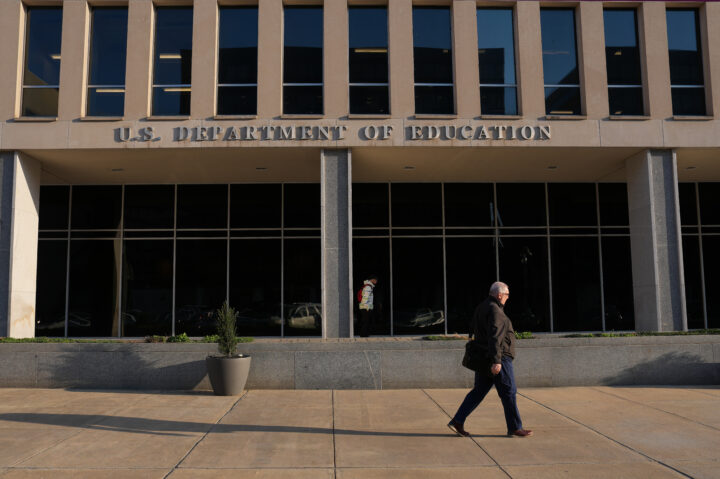
A person walks past the U.S. Department of Education on March 20, 2025 in Washington, DC.
The Brandeis Center for Human Rights Under Law urged the Department of Education on Monday to promptly release a long-delayed report on sources of foreign funding to American colleges and universities.
The records were set to be published last week under Sec. 117 of the Higher Education Act, but were delayed for the fourth time in two months, according to the Brandeis Center. The records were initially slated for release in mid-July. The Brandeis Center also filed a Freedom of Information Act request aiming to force disclosure of the reports, identities of those providing foreign funding and the details of the transactions.
In a letter to Secretary of Education Linda McMahon, Brandeis Center’s general counsel, Evan Slavitt, said that the “repeated postponements are increasingly difficult to reconcile with the transparency objectives of Section 117 and the Department’s own stated commitment to publishing this information. Moreover, the Department has not publicly identified the legal basis for continuing to withhold information that it has repeatedly announced would be released.”
Slavitt emphasized that disclosing the specific sources of foreign funding “can be critical to understanding the nature of the financial relationship, including whether funds originate with or pass through foreign governments, state-controlled entities, foundations, corporations, affiliates, or other intermediaries.”
Given the billions of dollars involved, he emphasized that this financing raises questions about “foreign influence, academic independence, research security, and compliance with other federal laws.”
U.S. colleges received $5 billion in foreign funding last year, with Qatar being the largest donor.
Slavitt urged the Department of Education to publish the report by Sept. 11, as well as to make public all underlying disclosure reports from colleges.
“The public should not be left waiting indefinitely as one announced disclosure date after another passes,” the letter states. “If there is a legitimate legal impediment preventing the Department from releasing this information, the Department should identify it. If there is not, the information should be released without further delay.”
Brandeis Center CEO Kenneth Marcus, a former assistant secretary of education, said in a statement, “While we commend Secretary McMahon for her prior work to increase transparency, the American people have a right to know more.”
“Four postponements in less than two months leave the American people waiting for information about foreign funding of higher-ed institutions that federal law requires to be open to scrutinization,” Marcus continued. “Americans deserve to know which foreign governments, state-controlled entities, or their intermediaries are sending billions of dollars into our campuses and classrooms and what influence may accompany that money. The Department should release the names and transaction information without further delay.”
Karen Paikin Barall, chief policy officer for the Brandeis Center, said in a statement, “The American people have a right to know who is funding our universities and what influence that funding may buy.”
“When foreign governments and entities provide billions of dollars to American institutions of higher education, that information should not be hidden from public view. Congress enacted Section 117 precisely because transparency matters,” Barall continued. “Students, parents, policymakers, and the American public deserve to know where this money is coming from and whether it is influencing what is taught, who is teaching it, and the policies and programs our universities pursue.”
Ken Marcus argued that reporting requirements have pressured employers to make hiring decisions based on race, rather than encouraging equal treatment

Kenneth Marcus, the president of the Louis D. Brandeis Center for Human Rights Under Law, urged the Equal Employment Opportunity Commission on Tuesday to repeal a longstanding rule requiring large employers to keep and report data on the racial, ethnic and sex makeup of their workforce.
Marcus was one of a slew of speakers who appeared before the commission to testify for and against the rule, which the commission has proposed repealing. He argued that the reporting requirements have resulted in employers feeling pressure to make hiring decisions based on race, rather than encouraging equal treatment.
“The Equal Employment Opportunity Commission should be fighting against discrimination rather than incentivizing employers to get their numbers right in ways that might violate the very laws that the agency was established to enforce,” Marcus said. “The commission should … avoid viewing either the collection or the elimination of demographic data as an end in itself. The proper objective is vigorous enforcement of Title VII against actual discrimination.”
Marcus said the EEOC should be focused on investigating and pursuing claims of discrimination against individuals, rather than monitoring demographic data.
“At the same time, we respectfully urge the commission to make equally clear that the elimination of demographic reporting cannot and should not result in diminished attention to other forms of discrimination, affecting not only Jews but also other groups,” Marcus said. “The measure of our civil rights laws is not whether the government counts members of identity groups. It is whether the government protects everyone equally.”
He said that the Jewish community’s experience “illustrates both the promise and the peril of demographic data collection. … History demonstrates that neither demographic classification nor demographic invisibility has ensured equal treatment. Only vigilant enforcement of the law can do that.”
“History demonstrates that data collection can protect vulnerable communities in some circumstances while exposing them to extraordinary danger in others,” he said.
In the past, Marcus argued, governments including the Nazi regime have used registries and other records to identify Jewish communities for persecution. In other cases, he continued, discrimination against Jews has gone overlooked and unrecognized based on demographic data because Jewish identity does not fit neatly into traditionally recognized demographic categories.
“Aggregate demographic data can therefore obscure rather than illuminate the reality of the discrimination which Jewish workers are facing,” Marcus said, arguing that a recent focus by employers on “demographic frameworks to guide diversity, equity and inclusion initiatives” has led to Jews and antisemitism being ignored, overlooked and stigmatized.
The report draws on interviews with more than 70 current and former employees of groups such as Human Rights Watch, Amnesty International and Doctors Without Borders
DAVID GRAY/AFP via Getty Images
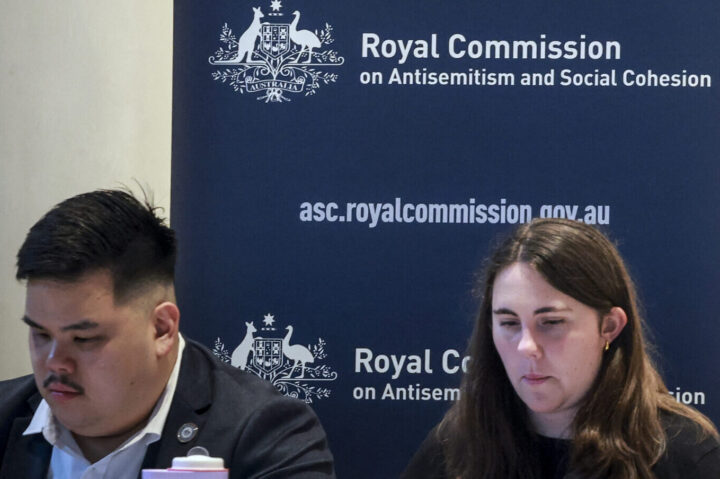
Officials can be seen outside the venue of the Royal Commission on Antisemitism and Social Cohesion in Sydney on May 25, 2026.
The human rights nonprofit sector has systematically ignored or suppressed employee complaints of antisemitism for years, according to a new report published on Wednesday by EiGHT, an organization based in Israel that was created after the Oct. 7, 2023, Hamas terror attacks to provide oversight of humanitarian NGOs.
The 63-page report was submitted to Australia’s Royal Commission on Antisemitism and Social Cohesion, which was formed after the Bondi Beach terror attack last December, as well as several United Nations bodies. It draws on interviews with more than 70 current and former employees of organizations such as Human Rights Watch, Amnesty International, Doctors Without Borders and Greenpeace. It alleges that the organizations’ biased treatment of Israel contributed to a hostile work environment for Jewish and Israeli employees.
“One of the rationales for the report was to give voice to victims, essentially, along the lines of human rights work that I edited every single day for 14 years,” EiGHT’s executive director, Danielle Haas, who was a senior editor at Human Rights Watch until 2023, told Jewish Insider. “It’s just a shame and shocking that the victims should be coming now from within the human rights and humanitarian world itself.”
The report is focused primarily on the treatment of employees within the sector, rather than research and output related to Israel and the Palestinian territories, though it argues that the two are linked — and that the wholesale adoption of anti-Israel narratives by these NGOs contributes to the hostile atmosphere facing Jewish employees. For instance, employees alleged that if they asked questions about an organization’s approach to Israel, they often faced pushback. One Australian employee of a global NGO claimed they were fired after raising questions about the quality of the group’s work on Israel.
“When the leadership is demonstrating utter disregard for Oct. 7 victims or for Jewish lives lost, it only follows logically that those underneath them will too,” Haas said.
The report paints a picture of institutional leadership that is resistant to both external and internal criticism.
“Documented complaints about hostile behavior related to Jews, Israel, or Israelis, and professional standards failures connected to Israel work have consistently failed to produce meaningful consequences,” the report states.
Most of the testimonies in the report are anonymous. Even the organizations described in many complaints are often kept anonymous, with language in some instances referring to sources only as “an employee at a global NGO.” Haas said this was due to fear of retaliation.
“What is truly disturbing is how fearful people are to speak openly, and I find that incredibly disturbing, that adult professionals in their field should repeatedly say that they don’t want to speak out because of fear of professional retaliation,” said Haas.
Complaints of antisemitism were often redirected into conversations about Israel, according to the report. An Amnesty International employee in Australia said that after the Bondi Beach attack, there was a tendency “to frame efforts to address antisemitism as attempts to restrict criticism of Israel.”
Haas said the report’s findings do not mean “human rights should be abandoned,” and she does not think the field is fundamentally biased or irrelevant. But she does not see the institutions named in the report as willing or even open to change.
The EiGHT report follows a survey from last year that found that 55% of Jewish workers at human rights NGOs have either experienced or witnessed antisemitic incidents at a current or former workplace. That survey was conducted by OLAM, a network of Jewish employees working in the field.
“Are these organizations lost causes?” Haas asked. “I think to some extent, very regrettably, they are, insofar as change can only happen when management is interested and takes necessary steps to rectify problems. One of the points the report makes is that there’s been an absolute lack of interest, in marked contrast to how they’ve dealt with issues and discrimination raised by other minority groups.”
Spokespeople from Human Rights Watch, Amnesty International, Doctors Without Borders, Greenpeace, UNICEF, the International Committee of the Red Cross, Plan International and Save the Children — all of which had current or former staff members interviewed for the report — did not respond to requests for comment.
Natalie Fath, global director of communications at Mercy Corps, a humanitarian aid NGO, told JI that the organization “reject[s] any characterization that suggests we value the lives or suffering of one population over another.”
“Mercy Corps’ communications are guided by our humanitarian mandate to protect human life, alleviate suffering and uphold the dignity of all people affected by conflict,” Fath said.
The Maryland senator also praised Graham Platner’s Senate candidacy, even as other leading Democrats have kept their distance
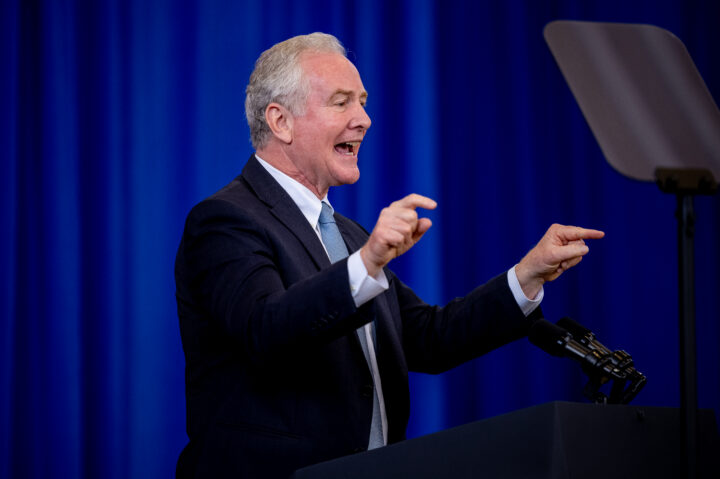
Sen. Chris Van Hollen (D-MD) speaks at a campaign event for Maryland Democratic candidate for U.S. Senate and Prince George's County Executive Angela Alsobrooks (Photo by Andrew Harnik/Getty Images)
Sen. Chris Van Hollen (D-MD), a leading critic of Israel in the Senate, publicly confirmed for the first time this week, after visits to key primary states, that he is considering a 2028 presidential bid — and argued that criticism of Israel should be a key litmus test for the emerging field.
Van Hollen has become an increasingly outspoken and virulent voice against Israel in the Senate and taken trips to states that will play a pivotal role in the 2028 presidential primary, fueling speculation that he is scoping out a presidential run.
“I went to New Hampshire because I was invited, but I would say kind of kicking the tires a little bit,” Van Hollen said on the “On NOTUS” podcast this week.
Asked whether he thinks any Democratic presidential candidate will be viable without criticizing Israel and supporting conditioning aid to the Jewish state, Van Hollen responded, “I think a Democratic presidential candidate should believe in the United States’ foreign policy based on advancing our values and our interests. And if you want to advance our values, you cannot apply one set of standards just to our adversaries and another to our friends and be taken seriously in the world about it.”
“I think any credible Democratic presidential candidate has to be willing to hold the government of Israel accountable when it’s violating human rights and violating international law and violating US interests because the Israeli-Palestinian issue, conflict goes to the heart of so much of the instability that we’ve encountered and paid for in the United States over decades,” Van Hollen continued.
He also argued that any Biden-era officials who don’t “plainly acknowledge how wrong they were and make it clear that lessons have been learned and that they would follow a very different approach” toward Israel should not be able to serve in any future Democratic administration.
Van Hollen also defended Maine Senate candidate Graham Platner, the Democratic nominee who has drawn controversy for his Nazi tattoo, far-left views and numerous scandals and controversies, as “the candidate in that race who is fighting for working people” and “somebody who’s going to shape things up and actually respond to the pocketbook issues of the people of Maine.”
The mayor lauded visiting former Irish President Mary Robinson and her controversial tenure as U.N. high commissioner for human rights
TIMOTHY A. CLARY / AFP via Getty Images
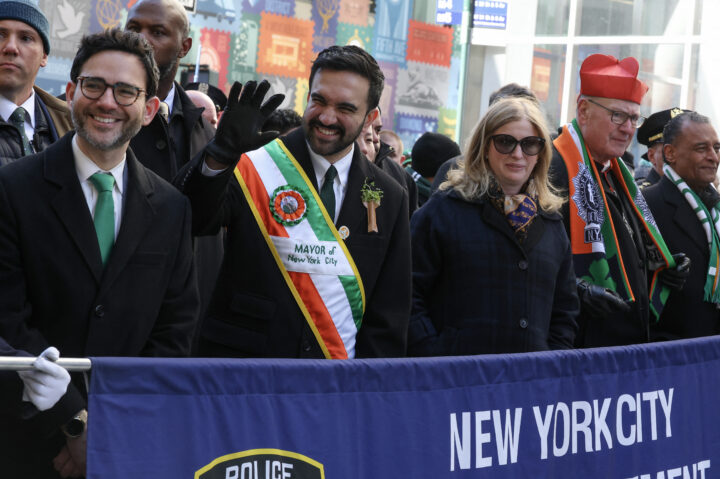
New York City Mayor Zohran Mamdani (2L), New York City Police Commissioner Jessica Tisch (2R) and Cardinal Timothy Dolan (R) participate in annual St. Patrick's Day Parade in New York on March 17, 2026.
New York City Mayor Zohran Mamdani took the occasion of St. Patrick’s Day and the presence of former Irish President Mary Robinson in New York to talk Middle East politics and praise Robinson’s controversial tenure as the United Nations’ high commissioner for human rights.
Speaking at a breakfast at Gracie Mansion, Mamdani acknowledged Robinson from the lectern and lauded her record of advocacy, particularly singling out her stance on Israel. The Irish presidency is a largely ceremonial role.
“I think also of how she stood steadfast alongside the people of Palestine,” the mayor said in listing Robinson’s accomplishments. “I say this as over the past few years as we’ve witnessed a genocide unfold before our eyes, there has been deafening silence from so many. For those who have long cared about universal human rights and the extension of them to Palestinians, silence, however, is nothing new. For Palestinians are so often left to weep alone. Yet former President Robinson has never been silent.”
During her tenure at the U.N., Robinson chaired a preparatory meeting for the 2001 World Conference against Racism, Racial Discrimination, Xenophobia gathering in Tehran that blocked the participation of the Simon Wiesenthal Center and representatives from the persecuted Baha’i faith. Robinson blamed the obstruction on “procedural and technical” issues, though she voiced support for the general right of such groups to take part.
The eventual conference, held in Durban, South Africa, was a notoriously disorganized fiasco that led to the end of Robinson’s commissionership. The conference saw the withdrawal of American and Israeli delegations over draft document language from Arab governments attempting to reinstate a repealed U.N. resolution that declared Zionism to be a form of racism and to compare Israeli policy to the Holocaust.
She was a founding member of The Elders, a group of veteran global leaders promoting “peace, justice, human rights and a sustainable planet,” and became the group’s chair in 2018. In 2014, she co-authored a Foreign Policy opinion piece with former President Jimmy Carter amid the 2014 Israel-Gaza war that called for “recognizing Hamas as a legitimate political actor.”
One of the students who led the effort was attacked by masked assailants on DePaul’s campus in 2024
Getty Images
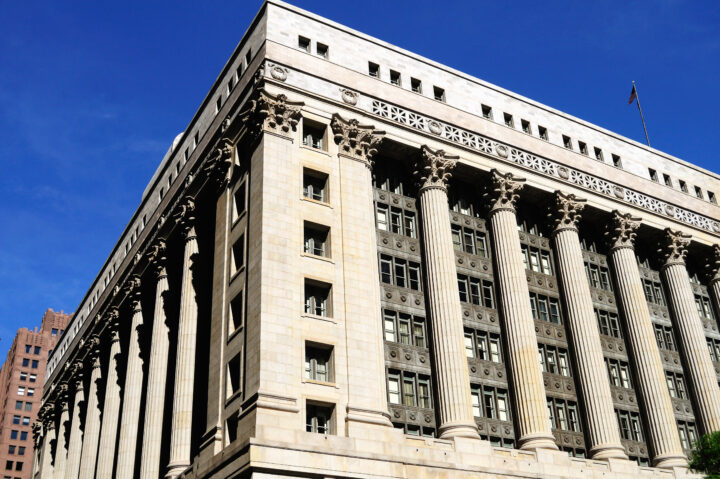
The City Hall
The Chicago City Council unanimously voted to adopt the International Holocaust Remembrance Alliance’s working definition of antisemitism into the city’s declaration of human rights this week, an effort spearheaded by two local university students with no prior political experience.
For Jake Rymer, a junior majoring in biological sciences at University of Chicago, and Michael Kaminsky, a senior studying criminology at DePaul, the push to pass the antisemitism ordinance was personal.
“I had only been on campus for two weeks when [the Oct. 7, 2023, terrorist attacks in Israel] happened and people I thought were my friends those first two weeks turned out not to be. They turned their backs on me when I needed their allyship,” Rymer told Jewish Insider. “I also started to see flaws in the city of Chicago and that there were things that needed to get changed that we could actually accomplish.”
Kaminsky, a vocal pro-Israel voice on campus, was attacked and injured by masked assailants on school property in 2024 in an alleged hate crime. He filed an ongoing lawsuit against DePaul, claiming the university failed to protect Jewish students.
“We were tired of being told by Jewish organizations to ‘suck it up and deal with it’ or that ‘help would come eventually,” said Rymer. “We realized that we as students — even though we don’t have legislative experience — have the ability to make meaningful change, so we decided to go ahead with it.”
The pair quickly learned the City of Chicago had never provided a clear definition of antisemitism in its municipal code. They garnered support from Alds. Raymond Lopez and Debra Silverstein last spring to begin drafting legislation to implement IHRA.
On Monday, Ordinance O2025-0019984 passed unanimously in committee and at the city council meeting. Because the ordinance is an updated version of one that already existed and it passed without objection, it becomes official upon publication — even though Democratic Mayor Brandon Johnson was not involved.
Section 6-10 of Chicago’s Municipal Code is now amended to include antisemitism as discrimination in the Chicago City Council’s declaration of general human rights. Antisemitism is defined by IHRA as a “certain perception of Jews, which may be expressed as hatred toward Jews.” Progressive critics of the definition argue that its Israel-related examples risk conflating antisemitism with legitimate political criticism while conservative critics claim that the definition is anti-Christian because one of its affiliated examples states that it’s antisemitic to accuse Jews of killing Jesus.
“Chicago has taken a clear and historic stand against hate by officially adopting the IHRA definition of antisemitism,” Silverstein, the city council’s only Jewish member, said in a statement. “At a time when antisemitic hate crimes are surging locally, this unanimous City Council action sends an unmistakable message that anti-Jewish hate has no place in Chicago.”
Chicago joins more than 1,200 entities worldwide, including 37 U.S. state governments and 98 city and county bodies that have adopted the definition.
Chicago’s adoption of IHRA was applauded by Alison Pure-Slovin, the Simon Wiesenthal Center’s director of social action and partnerships, Midwest/South. “Jewish communities today feel the familiar chill of rising hostility, and the old game of blurring the line between honest debate and open hatred is once again underway. Chicago’s action is not a gesture for the cameras. It is a statement that antisemitism will not be explained away, softened or disguised in polite language,” Pure-Slovin told JI.
Rymer expressed hope that “college campuses in the city of Chicago will follow the lead of Chicago aldermen and this could be applied in college communities to help define what antisemitism is and properly characterize it in case future incidents happen.”
He also encouraged students and community members in other cities to pick up on the “sense of momentum,” adding that he has “been in contact with other students to discuss plans to introduce this bill in other cities.”
In New York City, Mayor Zohran Mamdani has faced criticism from some Jewish leaders for repealing an executive order that implemented IHRA earlier this month. The revocation came as part of a blanket repeal of all of former Mayor Eric Adams’ executive orders following his September 2024 indictment on federal corruption charges.
“We want to set a standard for major cities in America that they can make initiatives like this happen,” said Rymer. “We can use the framework set here as support for any Jewish students interested in making a greater impact. We are very happy about the passing of this but it’s not the end of the work we’re doing. There’s a lot more change that can happen.”
In contrast with top candidates in the race, Kasky embraced stances far to the left of the Democratic mainstream

Sarah Morris/Getty Images
Co-founder of the student-led gun violence prevention group "Never Again," Cameron Kasky, speaks March For Our Lives II to protest against gun violence on June 11, 2022 in Los Angeles, California.
Cameron Kasky’s announcement on Wednesday that he was ending his bid for a coveted open House seat in the heart of Manhattan and pivoting to focus on advocating for human rights in the West Bank didn’t come as much of a surprise — given the 25-year-old progressive political activist’s almost exclusive fixation on targeting Israel as a first-time candidate.
Kasky, a Democratic upstart who was among a range of contenders vying to succeed retiring Rep. Jerry Nadler (D-NY) in the 12th Congressional District, had recently returned from a visit to the West Bank, and his experience meeting with Palestinians had left him with “one concern,” he said, motivating his decision to drop out of the primary and seek to promote legislation to counter Israeli settler violence in the territory.
Without providing specifics, Kasky said he looked forward to sharing more details of what he called a “West Bank human rights emergency plan” and said he had “consulted with experts extremely well-versed in the matter” to ensure that “the t’s are crossed and the i’s are dotted.”
Still, while Kasky framed his so far loosely defined next act as a “chance to do what must be done” in the wake of his brief “human rights-centered campaign,” as he described it, his explanation about the sudden withdrawal avoided mentioning that he had been seen as an unserious candidate struggling to gain any traction in the crowded race.
His harsh criticism of Israel generated online attention and helped him to build a relatively sizable and enthusiastic following on social media.
But Kasky’s early exit from the June primary, just two months after launching his bid, illustrates how digital clout is not a reliable indicator of meaningful voter support, particularly as a growing number of influencers has sought unsuccessfully to convert online popularity into a seat in Congress in a range of recent primaries.
It also underscores how Kasky’s anti-Israel views were likely alienating to many voters in one of the most heavily Jewish districts in the country — even as several far-left challengers across New York are taking on pro-Israel incumbents. One Democratic operative familiar with the district, which covers the Upper East and West Sides, called Kasky’s hostile positions on Israel a form of political “kryptonite.”
Former New York Gov. Andrew Cuomo, a pro-Israel moderate, won the district with 50% of the vote in November, beating now-Mayor Zohran Mamdani by five points.
In contrast with top candidates in the race, Kasky embraced stances far to the left of the Democratic mainstream, repeatedly accusing Israel of committing genocide in its war in Gaza, for instance, while pledging to vote against all aid to Israel, “‘defensive’ or otherwise,” as he wrote on his campaign site. He also said he was running to block what he called the “Greater Israel” agenda, accusing Israeli leadership of using “colonial violence” to expand the country’s territory across the Middle East.
Polling commissioned by a rival campaign, some details of which were relayed to Jewish Insider by a Democratic source familiar with the figures, showed Kasky far behind his leading opponents. Two recent polls put Kasky in sixth place, garnering just 5% of the primary vote in one and 8% in the other, according to the source, who shared the unpublicized numbers on condition of anonymity.
The polls showed two state assemblymen, Micah Lasher and Alex Bores, clustered at the top of the field along with Jack Schlossberg, a young Kennedy heir, and George Conway, a former Republican attorney and a prominent critic of President Donald Trump, the source confirmed on Thursday. While no candidate won more than 20% of the vote in either poll, Kasky was seen as operating in a lower tier and unlikely to break out.
His stances on Israel, among other issues, were “a dealbreaker” to a significant share of the electorate, the source noted to JI. “I don’t think that he had the means to become a compelling candidate and build a coalition,” he added.
Owing to his hasty departure from the race, some Democratic strategists and activists suggested that he had not intended to remain a candidate and was using his long-shot bid to build an online audience.
“Kasky saw the writing on the wall,” said another Democratic source who spoke with the candidate. “He did not have a sustainable campaign because it was never a campaign for Congress.”
For Kasky, a Jewish survivor of the 2018 shooting at Marjory Stoneman Douglas High School in Florida who became a gun control activist, “it was a campaign for new social media followers, the hard, hard left and activist clout,” the source told JI on condition of anonymity to offer a candid assessment. “He can absolutely claim victory for getting new followers on Instagram outside of Florida, but he achieved this milestone on the backs of the people he so shockingly vilified: NY-12 Jews.”
“He was never running to win,” added a Jewish Democratic leader familiar with Kasky’s abortive campaign, who was granted anonymity to weigh in freely about the race. “He was running to raise his profile and raise some money so he could continue to be an activist influencer.”
Kasky’s campaign, whose fundraising numbers will be reported later this month, did not return JI’s request for comment on Thursday.
Scott Stringer, a former city comptroller who previously lived in the district and now resides in Lower Manhattan, dismissed Kasky’s campaign as unviable from the beginning. “The bottom line is he wasn’t a factor when he was running, and he’s not a factor now that he’s not running,” Stringer, a Jewish Democrat backing Lasher in the primary, told JI. “I think he would have been better served by applying to his local community board.”
“There’s a whole lot of people on Twitter, unfortunately, who focus on Jewish hate,” he added. “But at the end of the day I think most people tuned out his rhetoric. I know I did.”
The NDAA will also include a nonbinding provision urging the administration to reimpose sanctions on Syria if its new government does not meet certain human rights conditions, source tells JI
Francis Chung/POLITICO via AP Images
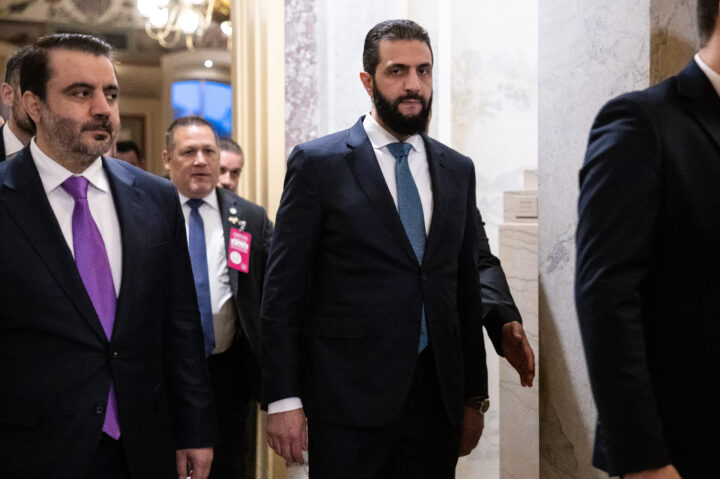
Syrian President Ahmed al-Sharaa departs a meeting in the Senate Foreign Relations Committee hearing room at the U.S. Capitol, Nov. 10, 2025.
A full repeal of human rights sanctions on Syria under the Caesar Civilian Protection Act is likely to pass Congress as part of the 2026 National Defense Authorization Act, after House Foreign Affairs Committee Chair Rep. Brian Mast (R-FL) signed off on the measure, according to a source familiar with the matter.
The NDAA, which Congress aims to finalize in early December after its Thanksgiving recess, will include a full repeal of the sanctions, but also a nonbinding provision urging the administration to reimpose sanctions on Syria if its new government does not meet certain human rights conditions, the source told Jewish Insider. Barring any unexpected developments, the provision should be on track to pass Congress in the must-pass legislation.
The Senate approved similar provisions in its version of the NDAA earlier this year, but the House version of the bill included no such language, and Mast’s approval was needed to incorporate the provision into the final version of the bill being negotiated between both chambers.
President Donald Trump has been urging Congress to repeal the sanctions, an effort supported by many Syrian diaspora activists, including Rabbi Yosef Hamra, the brother of the country’s last chief rabbi, who now lives in the U.S.
But others, including activists from other Syrian minority communities and some lawmakers, have argued that the sanctions should remain on the books to provide leverage and accountability to ensure the protection of minorities and the Syrian government’s cooperation on other matters like counterterrorism.
Mast had been skeptical of lifting sanctions, but indicated to JI his position was softening last week. He met earlier this month with Syrian President Ahmad al-Sharaa in Washington.
Mast told The Hill, which was first to report the news, that his position is that the sanctions should be, “Fully repealed, to have mechanisms, or rather a sentiment that sanctions should be reinstituted if a number of conditions are not met. … Still fully repealed.”
In one incident, a professor accused a student of having a Jewish ‘mind infection’ and harassed another on social media

Scott Eisen/Getty Images
Commencement preparations in front of the Great Dome at Massachusetts Institute of Technology's on April 15, 2025 in Cambridge, Massachusetts.
The Louis D. Brandeis Center for Human Rights Under Law filed suit in federal court in Massachusetts on Wednesday on behalf of two Jewish students, alleging that the university and a tenured professor violated Title VI of the Civil Rights Act of 1964, including harassment on social media and in mass emails.
“This is a textbook example of neglect and indifference,” Kenneth Marcus, founder and chairman of the Brandeis Center, said of the lawsuit, shared exclusively with Jewish Insider. “Not only were several antisemitic incidents conducted at the hands of a professor, but MIT’s administration refused to take action on every single occasion,” said Marcus, who served as U.S. assistant secretary of education in the Bush and Trump administrations.
While the lawsuit, Sussman v. MIT, addresses several antisemitic incidents caused by students, a large portion of the 71-page complaint focuses on alleged antisemitic actions from Michel DeGraff, a tenured linguistics professor.
The complaint states that through the spring and fall of 2024, DeGraff publicly harassed Lior Alon, an Israeli postdoctoral student, for serving in the Israel Defense Forces — posting Alon’s name and image on social media, and tagging Al Jazeera. The professor then published an article in European newspaper Le Monde in which he singled out the Alon by name, writing that the Israeli, “like many other Zionist counter-protesters, participate in well-rehearsed propaganda that erases the anti-Zionist Jewish students and misrepresents them.”
As a result, Alon said he was confronted by strangers in various locations, including his child’s daycare and at the grocery store. Alon emailed MIT President Sally Kornbluth expressing fears for his safety and the safety of his family, and requested that the posts be taken down.
Kornbluth — who is the only one of the three college presidents who testified in a now-infamous December 2023 congressional hearing on campus antisemitism who remains in her position — never responded to Alon’s concerns, according to the lawsuit, and no action was taken.
In November 2024, the complaint states that DeGraff harassed another Jewish student by sending a series of mass emails to his entire department, copying Kornbluth and other administrators, accusing the student of having a Jewish “mind infection” and threatening to use him as a “real-life case study” in a class the professor was teaching.
That same day, flyers were slipped under doors in a dormitory where this student previously lived, targeting him specifically in white lettering on a green band, styled after Hamas headbands, advocating for violence against Jews.
As a result of the harassment, the student left MIT before completing his Ph.D. program.
Other instances of antisemitic harassment detailed in the lawsuit include students occupying buildings and disrupting classes with antisemitic chants, students distributing “terror maps” promoting violence at campus locations deemed Jewish and an individual urinating on the Hillel building.
The Massachusetts school was among the 45 universities against which the Department of Education’s Office for Civil Rights opened Title VI investigations in March.
Wednesday’s lawsuit comes at a time when many elite universities are acquiescing to the Trump administration’s demands to crack down on the rise of antisemitic activity on campus that began in the aftermath of the Oct. 7, 2023, terrorist attacks. MIT, however, joined a lawsuit last month challenging the federal government’s attempt to cut research funding from schools that the administration says have not adequately addressed antisemitism.
Former U.S. Ambassador to the U.N. Nikki Haley also weighs in

Bill Clark/CQ Roll/AP Images
Republican Sen. Jim Risch (left) and Democratic Sen. Bob Menendez both condemned the U.N.'s report.
The Office of the United Nations High Commissioner for Human Rights (OHCHR) released a list of 112 companies on Wednesday that do business in Israeli West Bank settlements, sparking swift negative reactions from the Israeli government, many members of Congress and most mainstream American Jewish organizations.
Michelle Bachelet, the U.N. High Commissioner for Human Rights, said she was “conscious this issue has been, and will continue to be, highly contentious,” but that the list had been compiled “after an extensive and meticulous review process.” The report did not call for sanctions or boycotts of the specific companies listed, but is seen by many as a pressure campaign against the businesses.
The list included Airbnb, Booking.com, Motorola, TripAdvisor, General Mills and Expedia — though 94 of the entities were Israeli businesses.
In response, Israel cut ties with Bachelet for releasing the list without advance warning and without any coordination with Israeli officials. Prime Minister Benjamin Netanyahu called the U.N. Human Rights Council “a biased body that is devoid of influence” that works only to “disparage Israel.”
In a statement, House Majority Leader Steny Hoyer (D-MD) said that efforts to boycott or single out the Jewish state “mirror the kind of gross discrimination directed at Jewish people during some of history’s darkest moments.”
Rep. Eliot Engel (D-NY), the chairman of the House Foreign Affairs Committee, said the list is “wrongheaded and will embolden those who seek to use boycotts as a tool to pressure Israel.”
Reps. Michael McCaul (R-TX), Joe Wilson (R-SC) and Lee Zeldin (R-NY), members of the House Foreign Affairs Committee, released a joint statement calling the blacklist “yet another anti-Israel stunt that will not further peace in the region.”
Former U.S. Ambassador to the U.N. Nikki Haley tweeted that the body “hit a new low,” calling the timing of the publication “conniving and manipulative at best.”
Sen. Jim Risch (R-ID), chairman of the Senate Foreign Relations Committee, published a statement calling the report “incredibly biased,” and that it only offered further proof the OHCHR “is overly politicized and focusing a disproportionate amount of time and resources on Israel.”
Sen. Bob Menendez (D-NJ), the ranking Democrat on the Senate Foreign Relations Committee, accused the U.N. body of being “driven by politically motivated actors who seek to isolate Israel and undermine its right to exist.”
House Republican Whip Steve Scalise said the list “gives Israel’s enemies targets for violence and economic punishment.” Rep. Ted Deutch (D-FL) called the move “shameful,” and said it “will do nothing to further peace.” Rep. Brad Schneider (D-IL) said the list was “the most recent in a long series of discriminatory and shameful actions by the United Nations.”
Sen. Martha McSally (R-AZ) tweeted that the list is the list “discriminatory” and “absolutely appalling,” and Sen. John Boozman (R-AR) said the U.N. Human Rights Council “caved to anti-Israel voices.”
Condemnation also came from AIPAC, the Conference of Presidents and the American Jewish Committee.
None of the four members of “The Squad” — Reps. Ilhan Omar (D-MN), Rashida Tlaib (D-MI), Alexandria Ocasio-Cortez (D-NY) and Ayanna Pressley (D-MA) commented on the U.N. publication as of Wednesday evening.
Please log in if you already have a subscription, or subscribe to access the latest updates.
 Continue with Google
 Continue with Apple