















































Chicago City Council unanimously passes antisemitism legislation without mayor’s involvement
One of the students who led the effort was attacked by masked assailants on DePaul’s campus in 2024
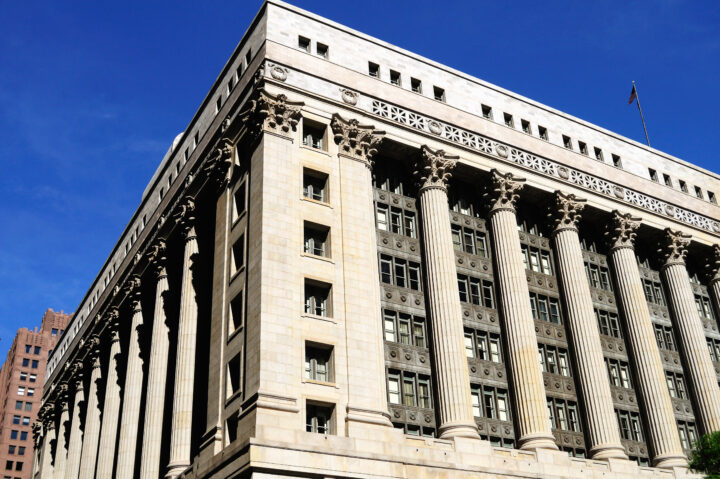
Getty Images
The City Hall


 Add JewishInsider on Google
The Chicago City Council unanimously voted to adopt the International Holocaust Remembrance Alliance’s working definition of antisemitism into the city’s declaration of human rights this week, an effort spearheaded by two local university students with no prior political experience.
For Jake Rymer, a junior majoring in biological sciences at University of Chicago, and Michael Kaminsky, a senior studying criminology at DePaul, the push to pass the antisemitism ordinance was personal.
“I had only been on campus for two weeks when [the Oct. 7, 2023, terrorist attacks in Israel] happened and people I thought were my friends those first two weeks turned out not to be. They turned their backs on me when I needed their allyship,” Rymer told Jewish Insider. “I also started to see flaws in the city of Chicago and that there were things that needed to get changed that we could actually accomplish.”
Kaminsky, a vocal pro-Israel voice on campus, was attacked and injured by masked assailants on school property in 2024 in an alleged hate crime. He filed an ongoing lawsuit against DePaul, claiming the university failed to protect Jewish students.
“We were tired of being told by Jewish organizations to ‘suck it up and deal with it’ or that ‘help would come eventually,” said Rymer. “We realized that we as students — even though we don’t have legislative experience — have the ability to make meaningful change, so we decided to go ahead with it.”
The pair quickly learned the City of Chicago had never provided a clear definition of antisemitism in its municipal code. They garnered support from Alds. Raymond Lopez and Debra Silverstein last spring to begin drafting legislation to implement IHRA.
On Monday, Ordinance O2025-0019984 passed unanimously in committee and at the city council meeting. Because the ordinance is an updated version of one that already existed and it passed without objection, it becomes official upon publication — even though Democratic Mayor Brandon Johnson was not involved.
Section 6-10 of Chicago’s Municipal Code is now amended to include antisemitism as discrimination in the Chicago City Council’s declaration of general human rights. Antisemitism is defined by IHRA as a “certain perception of Jews, which may be expressed as hatred toward Jews.” Progressive critics of the definition argue that its Israel-related examples risk conflating antisemitism with legitimate political criticism while conservative critics claim that the definition is anti-Christian because one of its affiliated examples states that it’s antisemitic to accuse Jews of killing Jesus.
“Chicago has taken a clear and historic stand against hate by officially adopting the IHRA definition of antisemitism,” Silverstein, the city council’s only Jewish member, said in a statement. “At a time when antisemitic hate crimes are surging locally, this unanimous City Council action sends an unmistakable message that anti-Jewish hate has no place in Chicago.”
Chicago joins more than 1,200 entities worldwide, including 37 U.S. state governments and 98 city and county bodies that have adopted the definition.
Chicago’s adoption of IHRA was applauded by Alison Pure-Slovin, the Simon Wiesenthal Center’s director of social action and partnerships, Midwest/South. “Jewish communities today feel the familiar chill of rising hostility, and the old game of blurring the line between honest debate and open hatred is once again underway. Chicago’s action is not a gesture for the cameras. It is a statement that antisemitism will not be explained away, softened or disguised in polite language,” Pure-Slovin told JI.
Rymer expressed hope that “college campuses in the city of Chicago will follow the lead of Chicago aldermen and this could be applied in college communities to help define what antisemitism is and properly characterize it in case future incidents happen.”
He also encouraged students and community members in other cities to pick up on the “sense of momentum,” adding that he has “been in contact with other students to discuss plans to introduce this bill in other cities.”
In New York City, Mayor Zohran Mamdani has faced criticism from some Jewish leaders for repealing an executive order that implemented IHRA earlier this month. The revocation came as part of a blanket repeal of all of former Mayor Eric Adams’ executive orders following his September 2024 indictment on federal corruption charges.
“We want to set a standard for major cities in America that they can make initiatives like this happen,” said Rymer. “We can use the framework set here as support for any Jewish students interested in making a greater impact. We are very happy about the passing of this but it’s not the end of the work we’re doing. There’s a lot more change that can happen.”
More Stories
RIPPLE EFFECT
New York’s suburban Dems face a Mamdani dilemma

AID ARGUMENTS
Michael Oren, Jonathan Schanzer split over when Israel should move past U.S. aid

analysis
Playing to the cameras in the West Bank
MINNESOTA MIC DROP
Jacob Frey, Betty McCollum join Minnesota Dem chorus condemning Piker event
DEBATE DIGS
Rogers describes El-Sayed as a national security threat in final Michigan Senate debate

Daily Overtime
Hillel disputes fired rabbi’s claim
Please log in if you already have a subscription, or subscribe to access the latest updates.
 Continue with Google
 Continue with Apple