









































Riyadh squandered a yearslong lull and fractured the anti-Houthi coalition with its UAE split, experts tell JI — and its new defense partners are hanging back
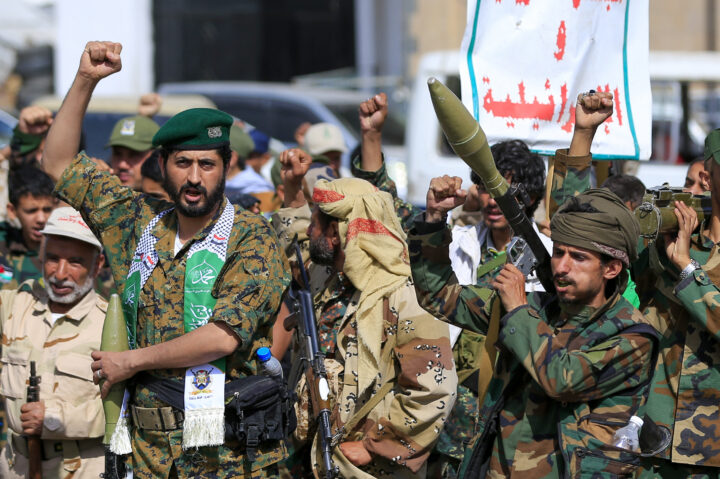
(Mohammed HUWAIS / AFP via Getty Images)
Fighters loyal to the Houthi authorities, shouts slogans during a rally to recruit more fighters, in Sanaa on September 10, 2026.


 Add JewishInsider on Google
Saudi Arabia is facing an escalating Houthi offensive along the Red Sea coast and direct attacks on its own territory, in what regional analysts describe as a turning point in Riyadh’s conflict with the Iran-backed terror group — and a crisis they say was created in part by Riyadh’s own miscalculations.
The Houthis recently gained major ground along the Red Sea, including the port city of Mokha and around the Bab al-Mandeb Strait, and escalated their attacks over the weekend by directly striking Riyadh’s King Khalid International Airport.
Regional analysts told Jewish Insider that Saudi Arabia’s current position stems in part from its failure to strategically prepare during a yearslong pause in fighting. Experts say that Riyadh’s rift with the United Arab Emirates has also weakened the anti-Houthi coalition in Yemen, making the challenge more daunting.
Current hostilities follow years of relative calm between Saudi Arabia and the Houthis that Riyadh worked deliberately to maintain. A U.N.-negotiated truce took effect in April 2022 and was extended twice in 60-day increments before formally expiring that October.
After its expiration, “instead of a formal U.N. truce, we had a backchannel between the Houthis and Saudi Arabia that kind of settled the conflict into a de facto truce,” said Allison Minor, director of the Atlantic Council’s Project for Middle East Integration. “Those conversations between the Saudis and the Houthis — there were discussions about what the future of Yemen would look like, the future of Saudi Arabia’s relationship with Yemen, and something certainly kept the Houthis from restarting the fight up until just recently.”
Underpinning that quiet was a broader diplomatic framework aimed at ending the Yemeni civil war, a conflict Saudi Arabia had been involved in for nearly 12 years.
“There was an international consensus around the need to wind down Yemen’s war through an agreement that included the Houthis,” April Longley Alley, a senior fellow at The Washington Institute for Near East Policy, said. That roadmap, she said, “would have included significant financial advantages for the Houthis in return for a ceasefire and for them being part of a political process.”
Riyadh kept that offer available even after the U.S. first designated the Houthis a foreign terrorist organization in 2021 — a designation revoked by the Biden administration and reinstated last year — and after the group began attacking Red Sea shipping in late 2023.
“The Saudis worked hard to keep the Yemen front quiet,” Alley said. “They kept communicating with the Houthis. They kept this potential for a deal very much on the table, but what we saw was just the limits of that approach.”
Riyadh’s tactic carried a risk that analysts say was well understood at the time: The Houthis have historically treated pauses in fighting as opportunities to strengthen themselves, including during the 2022 truce, Alley said.
Minor said Saudi officials were not naive about the group and had understood that another confrontation was likely, a conclusion she said they reached after the Houthis launched a campaign against Red Sea shipping that the group cast as solidarity with the Palestinians following the Oct. 7, 2023, Hamas terrorist attacks. The problem, she said, was what Riyadh did with the intervening time.
“I think that the criticism here is that the Saudis did not do as much as they could have to be prepared for that confrontation with the Houthis once it came,” she said.
Jonathan Schanzer, executive director at the Foundation for Defense of Democracies, similarly argued that Riyadh missed an opportunity in the pause in fighting. He noted that an agreement between Saudi Arabia and Iran, brokered by China in the spring of 2023, also provided Riyadh with time it didn’t take advantage of.
“The Saudis agreed to stop delegitimizing the Iranians in their media, including [the outlet] Iran International, and the Iranians agreed to restrain the Houthis. That was the arrangement that held, until it didn’t hold,” Schanzer said. “There is a legitimate question to ask about whether the Saudis exploited that time appropriately — whether they took advantage of that hiatus in fighting. I think the answer is no. I think they did not manage this time properly, and for that reason the Saudis have themselves to blame in part.”
The clearest evidence of that gap is the current state of the Yemeni forces. After a rift with the United Arab Emirates – which began developing in 2019 over differing visions for Yemen’s political future – recently ruptured, Saudi Arabia moved to consolidate its influence over the Yemeni government and merge its fragmented armed factions under a single command — an effort that was never completed, Minor said.
Attempting to finish that work now, she said, “while an active war is going on, when they’ve already lost significant territory on the west coast, is not going to be easy.”
Alley said Riyadh’s efforts to build deterrence on the ground, conducted in parallel with its diplomatic outreach, failed their first serious test. The Saudis, she said, were “building up the government of Yemen and trying to regroup and coordinate this very factious anti-Houthi coalition after they had in some ways pushed the UAE out.”
“They were trying to kind of have some deterrence on the ground,” Alley said. “But what we saw was that it wasn’t effective in defending Mokha and the Red Sea coast. The Houthis just were more militarily dominant on the ground.”
“I don’t see how you can have Yemeni forces on the ground really effectively confronting the Houthis and holding off further Houthi territorial gains if you don’t at least have Emirati acquiescence,” Allison Minor, director of the Atlantic Council’s Project for Middle East Integration, said. “Obviously, Saudi-Emirati tensions remain quite high, but as the Saudis are going to Egypt, to Turkey, to Pakistan, to the U.S., U.K., I really just feel like Abu Dhabi has to be part of that.”
The split with Abu Dhabi weakened the anti-Houthi coalition at a moment when Saudi Arabia needed it most, Alley said. “The Houthis are one command, one mission, and this other side has a tendency to fight each other.”
Minor said the damage from that rift is still visible in the current fighting. Expectations among Yemenis that government forces would perform better without Emirati involvement “does not seem to have been the case,” she said. The units hit hardest in the Houthi advance on the west coast were those of Tareq Saleh, long backed by the UAE, while forces tied to the Southern Transitional Council have stayed out of the fight.
“I don’t see how you can have Yemeni forces on the ground really effectively confronting the Houthis and holding off further Houthi territorial gains if you don’t at least have Emirati acquiescence,” Minor said. “Obviously, Saudi-Emirati tensions remain quite high, but as the Saudis are going to Egypt, to Turkey, to Pakistan, to the U.S., U.K., I really just feel like Abu Dhabi has to be part of that.”
Meanwhile, Riyadh has been unable to rely on its own partners for help. Despite having signed a mutual defense agreement with Turkey and Pakistan last month, neither has thus far come to Saudi Arabia’s aid. Pakistani officials have said publicly that Saudi Arabia has not activated the pact or specifically requested help inside Yemen.
Analysts said they were skeptical that the pact would hold significant weight even before the current fighting began.
“I was always pretty skeptical that the Mecca agreement would look like NATO Article V in the way that we tend to think about it,” Minor said. “It’s simply not the same. It’s not rooted in superpowers with the capabilities to actually provide a nuclear umbrella.”
Minor said the absence of a superpower guarantor is the defining limitation. Pakistan possesses nuclear weapons, she noted, but its officials “have been hesitant about the idea of extending that nuclear umbrella.”
“The Mecca Pact is, in my view, at least right now, a pact that was born of desperation in the face of Houthi and Iranian attacks on the kingdom,” Jonathan Schanzer, executive director at the Foundation for Defense of Democracies, said. “The notion of Turkey and/or Pakistan intervening on the Saudis’ behalf does not sound likely to me.”
“Simply the lack of a superpower also means that these are essentially middle powers who have much more nuance in their foreign relations and tend to be much more wary of getting involved in armed conflicts, especially outside of their own immediate environs,” she said. “It’s not surprising to me that they haven’t come to Saudi Arabia’s defense.”
The agreement’s real function, Minor said, is likely to be “much more in terms of security cooperation, sharing of technology, arms sales, etcetera, perhaps training and that sort of thing, than it is actively coming to their defense in the way that the U.S. has done for allies and partners in the past.”
Schanzer also noted that the Mecca agreement appeared to be “born out of desperation,” and predicted that Ankara and Islamabad are unlikely to intervene.
“The Mecca Pact is, in my view, at least right now, a pact that was born of desperation in the face of Houthi and Iranian attacks on the kingdom,” he said. “The notion of Turkey and/or Pakistan intervening on the Saudis’ behalf does not sound likely to me.”
“It may end up being a disappointment — there’s not much that they’re going to get out of this that they could take to the bank, so to speak,” Schanzer continued. “I think [Saudi Arabia is] going to find that they are still on their own.”
Alley said the pact appears to function primarily as posturing rather than a true defense mechanism. Still, she said she believes it is “too early” to make a final call on how the alliance will shake out, noting that the region is still at an “inflection point” with its aftermath still to be determined.
Analysts also drew a distinction between defending Saudi territory, which Riyadh’s partners are assisting with, and fighting inside Yemen, which they are not.
“From what I’ve seen, the Pakistanis and the Turks, just like other Saudi allies, are helping with the defense of Saudi territory,” Alley said. “But asking for these countries to help with a war inside of Yemen is just a very different type of ask that would come with pretty significant consequences for a country like Pakistan, who has a significant Shia population in particular.”
Minor said Riyadh’s broader search for backing has produced little. Saudi Arabia “feels that they need a strong international coalition to counter the Houthis,” she said, both for material support and to avoid the international criticism it drew earlier in the war. “But they haven’t been getting a ton of traction there, at least not yet.”
“It seems to me that the bar for U.S. intervention is still really high,” April Longley Alley, a senior fellow at The Washington Institute for Near East Policy, said. “President Trump in particular, from what we’ve seen from the reporting, is still trying very much to keep this bilateral truce with the Houthis and not to explicitly expand the war, particularly the regional war right now.”
The Trump administration, which declared a ceasefire with the Houthis in May 2025, has so far confined its role to intelligence, logistical support and helping defend Saudi territory, while maintaining direct communication with the Houthis. According to The New York Times, President Donald Trump had considered carrying out military strikes against the terror group over the weekend, however he abruptly called them off.
Secretary of State Marco Rubio, when asked about the Houthi attacks, told Fox News on Tuesday that the United States has a defense agreement with Saudi Arabia and intends to live up to its commitments. But experts said Trump appears “very hesitant” about becoming involved and they do not expect American forces to enter the Yemen war.
“It seems to me that the bar for U.S. intervention is still really high,” Alley said. “President Trump in particular, from what we’ve seen from the reporting, is still trying very much to keep this bilateral truce with the Houthis and not to explicitly expand the war, particularly the regional war right now.”
“Stepping up support — logistical support, intelligence sharing, help with the defense of Saudi territory — is something that I would expect to see,” she continued. “Doing more in Yemen, I think, is a really high bar right now. But you never know with this administration.”
Even defense assistance from Israel is “not off the table” for Riyadh, according to Schanzer, who argued that enlisting help from Jerusalem has “got to be in the back of the minds of Saudi decisionmakers right now.” However, he said the issue is whether Turkey and Pakistan would “put up with such an arrangement.”
Furthermore, Schanzer argued that Saudi Arabia’s problem does not stem from a lack of partners, but rather from a lack of genuine commitments.
“When you look right now at the number of partners that the Saudis have enlisted, at least on paper, to be partners or defenders of the kingdom, it’s actually rather lengthy,” he said. “The question really right now is whether the Saudis, with this help, are going to be able to do much to defend against Houthi attacks and to prevent debilitating strikes on key assets inside the kingdom. And on that, I have to say that I have doubts, because I don’t think that any one of these partners are fully committed to the mission at hand.”
Still, he said many countries are afraid to intervene out of a desire not to join the fight, something that has further hindered Riyadh.
“The fear actually comes from these Western countries that if they begin to help, they also may find themselves under attack — and that is a debilitating factor for the Saudis,” Schanzer said. “There’s not a lot of wiggle room here for them. They need more help than they’re getting, and I don’t see anyone stepping up to give it.”
Meanwhile, Senate Democrats framed the escalating Houthi offensive as more fallout from the Iran war
(Mohammed HUWAIS / AFP via Getty Images)
Fighters loyal to the Houthi authorities, shouts slogans during a rally to recruit more fighters, in Sanaa on September 10, 2026.
Senators returning to Washington on Monday offered mixed responses to the recent Houthi offensive inside Yemen and Saudi Arabia, with some Republicans telling Jewish Insider that the Iran-backed terror group’s moves warranted a response, while some Democrats framed the Houthi attacks as further fallout from the U.S. war against Iran.
The Iran-backed Yemeni terrorist group seized control of key port cities along the Red Sea coast, near the vital Bab el-Mandeb Strait, as well as Perim Island inside the waterway and the Hanish archipelago to the north. Drones fired from Iraq also struck and disabled a critical Saudi oil pipeline that the country had been using to bypass the Strait of Hormuz. The U.S. has thus far declined to intervene.
Republicans who spoke to Jewish Insider said they had not been fully briefed on the situation since returning to Washington on Monday after being away for the Senate’s extended August recess. Still, they said a forceful response from the Saudis was warranted.
“Everybody ought to work together to destroy the Houthis,” Sen. Rick Scott (R-FL) said. “It’s not just the Trump administration, the Saudis have resources. They need to use all their resources to destroy them. You can’t play games here. You’ve got to destroy them.”
Asked if the U.S. should take action against the terror organization, Sen. John Kennedy (R-LA) said, “I think we need to do just what we’re doing right now. We need to crank the sanctions up as high as we can and continue the blockade. The Saudis can do something. They have an army. They have weapons.”
“If I were the Saudis, I’d hit them back,” the Louisiana senator added.
Sen. Mike Rounds (R-SD) told JI that he did not know “what the administration’s plans are” as far as how the U.S. will approach the Houthis after this latest series of attacks, though he emphasized that it was imperative to find a resolution that “contained” the Houthis as quickly as possible.
“Look, it’s a very dangerous neighborhood down there right now. The Houthis have been causing some real problems, not just for Saudi Arabia but for trade throughout the rest of the world,” Rounds said. “The sooner we get that resolved down there and get them contained once again, the better off we’re all going to be.”
“There needs to be a response to any adverse action that they take, in my view — and an amplified response,” Sen. Bill Hagerty (R-TN) told JI.
Democrats generally framed the Houthi offensive as an extension and expansion of the Iran war.
“This war is metastasizing out of control,” Sen. Richard Blumenthal (D-CT) said, referring to the conflict with Iran. “Whatever support for it there may have been when it was confined to a certain geographic area, it was done without a strategic plan, without realistic objectives, without a clear understanding of the enemy, and now it is metastasizing with the costs potentially looming larger than ever.”
Sen. Tim Kaine (D-VA) suggested that the Houthis would likely de-escalate if the U.S. de-escalated, similar to how the group wound down attacks on Red Sea shipping during ceasefires in Gaza.
“It is a very predictable consequence of the Iran war, which we never should have gone into,” Kaine said. “The ties between the Iranians and the Houthis are very well-known. When the pace of U.S. activity in the region abates, the Houthis tend to abate. … They’ve been threatening to do this, and so the right thing to do is to find a ceasefire and stop the war in Iran.”
Trump issued his first comments of the day shortly before 6 a.m. ET, posting on his Truth Social site that “Israel and Iran must immediately stop ‘shooting.’”

Wisam Hashlamoun/Anadolu via Getty Images
A missile leaves a fiery trail across the sky over the West Bank city of Hebron on June 8, 2026, amid missile launches from Iran toward Israel.
Millions of people across northern Israel heard a familiar sound from their phones late Sunday night: an alert from Israel’s Homefront Command, notifying them for the first time in two months, of an incoming ballistic missile attack from Iran.
Just after sunrise, residents of Israel’s center — from Tel Aviv to Jerusalem — received the same notification, and groggily huddled in shelters as Iran, joined by its Houthi proxy in Yemen, launched fresh salvos at Israel. Shortly after, Israel struck a petrochemical plant in southwest Iran.
Last night’s initial Iranian attack came in response to Israeli strikes in the Beirut suburb of Dahiyeh, a Hezbollah stronghold that had in recent weeks been off-limits to the IDF in accordance with a U.S.-brokered ceasefire with Lebanon that limited Israeli action to southern Lebanon, another Hezbollah stronghold.
What matters more than how the latest round of fighting started is what will happen next. The escalating tit-for-tat strikes have again brought the region to the brink of another all-out war that could return the U.S. to active fighting, despite two months of efforts by the White House to reach a deal with Tehran.
Israeli media reported that its overnight strikes on Iran had been coordinated with the U.S., even as President Donald Trump spent Sunday afternoon on the phone with reporters trying to publicly de-escalate the situation.
Shortly after Iran’s initial missile attack on Sunday, Trump told Fox News that the incident was “certainly not going to help” the ongoing negotiations between the U.S. and Iran. He continued, “What I would suggest to Iran: You’ve shot your missiles, that’s enough, get back to the table and make a deal.”
Speaking to Axios, Trump said, “I am going to call [Israeli Prime Minister Benjamin] Netanyahu right now and tell him not to strike back. … Each of them had their fun. Israel had its strike and Iran had its strike. We don’t need another one.”
In the hours that followed, both Israel and Iran disregarded the president’s comments and continued their strikes.
Trump’s comments could be taken at face value — or viewed with some skepticism in light of the Israeli media reports that the strikes were coordinated with Washington. It would not, after all, be the first time in which the U.S. and Israel publicly emphasized their differences while privately remaining aligned — even amid alleged fissures in the relationship. That includes leaks to NBC News and The New York Times over the weekend that the Defense Department’s Defense Intelligence Agency had raised its counterintelligence threat level for Israel to the highest level. The Times named three U.S. officials that were allegedly being tracked for information on the Iran negotiations: White House Special Envoy Steve Witkoff, the Pentagon’s Elbridge Colby and Colby’s deputy, Michael DiMino.
But things move fast in the Middle East. Recall that last June, after 12 days of intensive strikes between Israel and Iran, joined by the U.S., a ceasefire was announced mere hours after Iran launched missiles at a U.S. airbase in Qatar. Addressing the overnight escalation between Israel and Iran — and Iran’s continued intransigence in the region — is likely to be the White House’s top order of business today. Indeed, Trump issued his first comments of the day shortly before 6 a.m. ET, posting on his Truth Social site that “Israel and Iran must immediately stop ‘shooting.’”
Negotiations between the Trump administration and Iran thus far have yielded little concrete success. The Strait of Hormuz remains closed. Iran has continued to attack ships transiting through the waterway, as well as other Gulf countries — such as Kuwait, whose major airport suffered significant damage after an Iranian drone struck the passenger terminal, killing one and injuring dozens. Gulf states have increasingly had to find alternative export routes. The region exists in a state of paralysis, unsure if or when a new round of fighting will again disrupt everyday life, work and travel.
Yesterday morning, the president told NBC’s “Meet the Press” that his red line for resuming military action in Iran would be if he didn’t believe the parties could reach a deal in a timely manner. The latest escalation has the potential to bring the U.S. and Iran to an accord — and the war to a more finite end — regardless of what Israel wants. (Trump told the Financial Times that Netanyahu would have to accept a U.S. agreement with Tehran because Washington “calls the shots.”)
But the latest exchanges could also trigger a new round of active warfare, nearly a year to the date that the 12-day war began. All eyes will be on Washington today to see what will play out.
The Houthis have spoken openly about their plans to initiate an invasion akin to Oct. 7 through Jordan and Syria
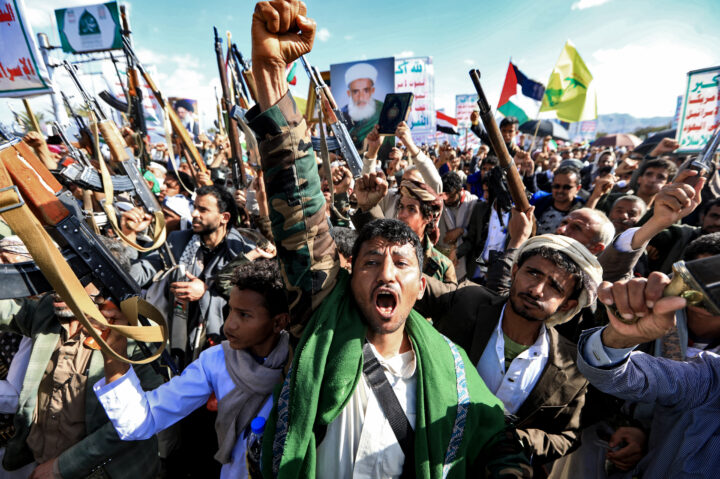
Mohammed HUWAIS / AFP via Getty Images
Supporters of the Iran-backed Houthi movement brandish their weapons as they rally in solidarity with Iran and Lebanon in the Yemeni capital Sanaa on April 10, 2026.
Like a desperate poker player holding an ace in the hole, Iran has a “strategic reserve” if the ceasefire in the war with Israel and the U.S. collapses and fighting resumes: the Houthis, the Tehran-backed Yemeni terrorist group.
How Iran plays the Houthi card has been the subject of concern in Israel, with analysts telling Jewish Insider that everything from a ground invasion from the east — with echoes of Hamas’ Oct. 7, 2023, rampage in southern Israel — to making good on the threat to block the Bab el-Mandeb Strait to further choke off international shipping remains in play.
Yoni Ben-Menachem, a senior Middle East analyst at the Jerusalem Center for Security and Foreign Affairs, told JI that the Houthis planned “to take revenge and bring back their honor” since Israel killed much of their leadership in August 2025.
“They see that Israel’s air defenses are strong, and it’s hard for them to reach military achievements with missiles and drones. They want to surprise Israel, so they are looking at ways to do it on the ground,” he said.
One scenario that Israel has actively prepared for, even before this year’s war with Iran, is a Houthi ground invasion via Syria and Jordan.
The IDF said in September that it has intelligence indicating that the Houthis initiated a training course named “Al Aqsa Flood,” as Hamas called the Oct. 7 attacks. The group planned to take advantage of the instability in Syria and political weaknesses in Jordan to invade Israel from the east, deploying tens of thousands of terrorists on a killing spree, heading toward Jerusalem. In January, the IDF’s Central Command led a training exercise, together with Israeli Border Patrol and police, on how to counter such a scenario.
In addition, the IDF has continued the construction of a security fence along the border with Jordan.
Yossi Mansharof, a lecturer at Haifa University, told JI that the Houthis speak openly about a possible land invasion in their media channels: “They say they intend to invade and … reach Dimona [in southern Israel], conquer [Israeli] towns.”
Mansharof said that while an invasion via the Red Sea and Eilat, at Israel’s southern tip, would be closer to the Houthis’ home base, such a move is “unrealistic; they would have to go undetected by the IDF.”
However, he said, the 186-mile border between Israel and Jordan is particularly porous, and if Hamas could break through the Gaza fence, as it did on Oct. 7, the Houthis may be able to do the same in Jordan. In addition, Iran has long worked to gain a foothold in Jordan.
“Iran is a shared enemy” of Israel and Jordan, Mansharof said. “Iran violates Jordanian sovereignty, and some of the missiles shot at Israel land in their territory. … Iran wants to establish terrorist infrastructure [in Jordan], and King Abdullah has said in Davos and in media interviews that he is concerned about Iran.”
In addition, Mansharof said, the Shi’a militias in Iraq, which shares a border with Jordan, have close ties with the Houthis.
A Houthi attack could also be part of an Iran-led multi-front assault on Israel, which Iranian officials — including a top advisor to Mohammad-Bagher Ghalibaf, Iran’s parliamentary speaker and leader of negotiations with the U.S. — have spoken about for years, Mansharof said.
“They want to advance a mutli-front attack on Israel from all of the axis of resistance arenas,” Mansharof said. “They want to end the story, not just have more rounds of fighting [with Israel]. … A Houthi invasion can be part of that.”
Ben-Menachem argued that a more realistic scenario in the near term is that the Houthis would help the Iranians by blockading Bab el-Mandab, a strait passing from the Gulf of Aden to the Red Sea, to cut off global shipping at a second point while the Strait of Hormuz, which is under Iranian control, remains closed. Saudi Arabia is reportedly especially concerned about this possibility, as the Gulf state uses the waterway to move much of its oil.
The Iranians have been saving the Houthis as their “strategic reserve” in case of renewed fighting with the U.S., Ben-Menachem said, and should the Yemeni terrorists join the war, “their target will be first the U.S. and then Israel.”
“The Iranians see that the most effective move is to pressure the U.S. and harm the world economy,” he said.
Still, Mansharof said, Israel “should not wait for the Houthis to take initiative. Israel needs to choose the timing [for military action], because at some point, the war with the Houthis will resume. … Israel needs to build advanced intelligence capabilities and cooperate with the Americans to create a jumping-off point. … It’s a just war of defense for Israel.”
Jerusalem’s recognition of Somaliland in December could provide Israel with a physical base for such an attack and would “break the supply chain of Iranian aid to the Houthis” from Somalia, which is just across the Gulf of Aden from Yemen, Mansharof noted.
Ben-Menachem said Israel’s announcement last year that it had discovered the Houthis’ plan served to undermine it.
“Israel must repeatedly warn them and say they know what they’re planning. We shouldn’t take it off the agenda, talking about it is part of the deterrence … [The Houthis’] success depends on the element of surprise. If we show that they can’t surprise us, it will lower their motivation,” he said.

Anna Moneymaker/Getty Images
President Donald Trump delivers remarks during a swearing-in ceremony for Special Envoy to the Middle East Steve Witkoff in the Oval Office at the White House on May 06, 2025 in Washington, where he provided an update on the Houthi conflict in the Middle East.
Good Wednesday morning.
In today’s Daily Kickoff, we look at how Capitol Hill is responding to the Trump administration’s Houthi ceasefire agreement, and report on a Washington Post correspondent’s condemnation of Israel’s military conduct following the paper’s citation by the Pulitzer Prize Board for its Gaza reporting. We preview today’s House Education & Workforce Committee hearing on campus antisemitism, and report on Sen. James Lankford’s voicing of frustration over the stalled Antisemitism Awareness Act. Also in today’s Daily Kickoff: Education Secretary Linda McMahon, Jessica Tisch and Jonathan and Mindy Gray.
What We’re Watching
- The House Education & the Workforce Committee is holding a hearing on campus antisemitism. The presidents of Haverford College, DePaul University and California Polytechnic State University (San Luis Obispo) as well as Georgetown professor David Cole, the former national legal director of the American Civil Liberties Union, are slated to testify.
- In the afternoon, the House Appropriations Committee is holding a hearing on FEMA.
- Later tonight, Israeli Ambassador to the U.S. Yechiel Leiter is hosting a Yom Ha’atzmaut celebration at the ambassador’s residence.
- Israeli Strategic Affairs Minister Ron Dermer is in Washington today for meetings with senior officials, including Secretary of State Marco Rubio and Middle East envoy Steve Witkoff.
- The Milken Global Conference wraps up in Los Angeles today with a three-part series on Israel in a post-Oct. 7 world. Former hostage Noa Argamani is slated to speak in conversation with Milken’s Richard Sandler, followed by author Noa Tishby. A third session, focused on the Israeli economy, will feature Pinegrove Venture Partners’ Tilli Kalisky-Bannett, Apollo Global Management’s Michael Kashani, Tel Aviv Stock Exchange Chairman Eugene Kandel and Israel Securities Authority Chairman Seffy Zinger. Earlier in the day, Rabbi Sharon Brous will sit in conversation about her book, The Amen Effect.
- The papal conclave to select the successor to Pope Francis, who died last month, began today. More below on Vatican-Jewish relations.
What You Should Know
A QUICK WORD WITH JI’S TAMARA ZIEVE AND MELISSA WEISS
President Donald Trump surprised lawmakers in Washington — as well as senior officials in Israel — with his announcement on Tuesday that the U.S. had reached an agreement with the Houthis to end strikes on the Iran-backed terror group in Yemen in exchange for the group’s cessation of attacks on vessels in the Red Sea.
The Houthis said that Trump’s claim related only to the group’s attacks in the Red Sea, and that the group’s “operations to support Gaza” — i.e. attacks targeting Israel — would continue, days after a Houthi ballistic missile struck the Ben Gurion Airport complex, injuring six.
Trump’s decision to strike a deal with the Houthis — even as the group vowed to continue its attacks on Israel — underscores the growing influence of isolationist thinking in the administration, raising questions about how U.S. leadership might redefine its commitments to allies under fire and the message this sends to Israel’s adversaries.
Pressed by reporters in the Oval Office yesterday about how Israel’s security might be affected by the deal, Trump replied that the issue was not a term of this agreement. “No, I don’t know about that frankly, but I know one thing: they [the Houthis] want nothing to do with us, and they’ve let that be known through all of their surrogates and very strongly,” Trump said.
“Trump’s announcement that the US will stop attacking the Houthis is a resounding message to the entire region: attack Israel, just leave us Americans alone,” Israeli political analyst Amit Segal wrote on X. “If I were Iranian, that’s how I’d interpret it.”
The move also calls into question the strength of the relationship between Trump and Israeli Prime Minister Benjamin Netanyahu. Barak Ravid wrote in Walla, “The fact that the ceasefire was agreed upon behind Israel’s back during the very days that the Houthis were launching missiles at Ben Gurion Airport and the IDF was bombing Sana’a indicates extremely serious coordination and trust issues between the Netanyahu government and the Trump administration.” A senior official in Jerusalem was still unsure of the announcement’s impact on Israel as of Wednesday morning.
“No attacks on US ships is good news,” Dan Shapiro, who served in senior roles in both the Biden and Obama administrations, including as U.S. ambassador to Israel from 2011-2017, said. “But the win is modest if attacks on others’ ships or on Israel continue. A terror org launching missiles around the region (incl to Israel’s airport) can’t continue.” He said that Israeli strikes may need to continue.
Another close ally of the U.S. involved in striking the Houthis was also not informed before Trump’s statement, and Secretary of Defense Pete Hegseth received at least one angry phone call from a foreign counterpart on Tuesday, an Israeli defense source told JI.
The pushback on Capitol Hill was swift. “Clearly, that’s a problem,” Sen. James Lankford (R-OK) said of the deal excluding terms ensuring the Houthis would stop firing at Israel. “The initial statement was they’ve got to stop firing at American ships. As much as I know is what’s actually printed. But clearly, they shouldn’t be able to shoot at us, our allies or any of the shipping in the area.” Read the full story here with additional comments from Sens. Rick Scott (R-FL), Lindsey Graham (R-SC), Thom Tillis (R-NC), Ted Cruz (R-TX), Richard Blumenthal (D-CT), Chris Coons (D-DE) and Chris Murphy (D-CT).
Jonathan Schanzer, the executive director of the Foundation for Defense of Democracies, told JI that decreased Houthi attacks on targets in the Red Sea might not necessarily lead to an uptick in attacks against Israel, noting that the ballistic missiles often used to target Israel are different weapons than those the Houthis have frequently used in the Red Sea. But, he continued, if U.S. strikes drop off, it could give the Houthis more ability and opportunity to maneuver weapons to launch sites.
Trump’s announcement also comes days after Mike Waltz’s ouster as national security advisor. Waltz, a former Green Beret who has advocated for a tougher U.S. stance against the Houthis and their Iranian sponsor, was a leading voice backing military action against the Yemeni group, which has fired dozens of ballistic missiles at Israel since December and significantly disrupted shipping routes in the Red Sea.
MEDIA MATTERS

A Washington Post correspondent who has faced scrutiny over major factual errors in her reporting on Gaza gave a scathing critique of Israel’s military conduct on Monday after the paper’s war coverage was named as a Pulitzer Prize finalist for international reporting — even as it has drawn accusations of bias stemming from its handling of the war with Hamas, Jewish Insider’s Matthew Kassel reports.
Critical comments: Louisa Loveluck, a London-based correspondent focusing on the Middle East who was cited among several Post journalists in the Pulitzer announcement for their reporting about the ongoing conflict, delivered virtual comments to the paper’s newsroom during which she decried Israel’s military actions in the wake of Hamas’ Oct. 7 terror attacks, according to audio of her remarks obtained by JI.
VATICAN VIEWS
Catholic cardinals shared Italian Jews’ concerns that pope ‘abandoned’ them, veteran journalist says

Italian Catholic cardinals showed solidarity with the local Jewish community, many of whose members felt Pope Francis was insensitive to the suffering of Israelis in the ongoing war, Maurizio Molinari, former editor-in-chief of major Italian daily la Repubblica, told Jewish Insider’s Lahav Harkov on Monday. Speaking as the cardinals began to gather in Rome to choose a new pope to replace Pope Francis, who died last month, Molinari noted that Italian Jewish and Catholic leaders have “historical strong relations.” Community leaders held one of their annual interfaith meetings in February, during which, Molinari said, “one of the rabbis who was there in the framework of this dialogue told the other side, the priesthood, ‘We felt that you abandoned us.’”
A journalist’s insights: Molinari said that the rabbi in the Jewish-Catholic interfaith meeting represented “the feeling that many [Italian] Jews had that after Oct. 7, the pope didn’t dedicate so much attention to the suffering of the Israeli victims as he did with the suffering of the Palestinian victims. No one is raising objections to solidarity towards the Palestinian victims. The question comes when there is no balance. That was the point raised.” While it is a taboo for senior figures in the Catholic Church to publicly criticize the pope, Molinari said that as part of his own reporting he found that “some of the most important cardinals that will sit inside the conclave to choose the pope share this feeling. They are well aware of the feeling of the Italian Jews, and they share it.”
The next pope: In The Atlantic, Vatican reporter Francis X. Rocca writes that with a globally diverse and unfamiliar College of Cardinals, the media is playing an outsized role in shaping the papal conclave, where Pope Francis’s successor remains uncertain.
campus questions

The House Education and Workforce Committee is holding the latest in its series of hearings on campus antisemitism with college presidents on Wednesday, this time focusing on colleges and universities outside of the most elite circles, Jewish Insider’s Marc Rod reports.
What to watch: The hearing will feature the presidents of Haverford College, California Polytechnic State University (San Luis Obispo) and DePaul University. David Cole, the former national legal director of the American Civil Liberties Union, is also set to testify. “This isn’t just an Ivy League issue,” Rep. Lisa McClain (R-MI), the new chair of the House Republican Conference, told Jewish Insider on Tuesday. “This is a widespread issue across academia. This shouldn’t be about partisanship, this is about public safety … My hope for tomorrow is that we get some actionable change from the universities.”
Protest pandemonium: After more than 30 anti-Israel demonstrators were arrested for occupying a University of Washington engineering building — causing more than $1 million worth of damage — the Trump administration announced on Tuesday night that the public university in Seattle would be the latest target in its widespread investigations of colleges for not doing enough to combat antisemitic activity, Jewish Insider’s Haley Cohen reports.
POLICY STANDOFF

Sen. James Lankford (R-OK) expressed frustration on Tuesday about the debate in the Senate Health, Education, Labor and Pensions Committee last week that added poison-pill amendments to and stymied a vote on the Antisemitism Awareness Act, potentially halting its progress in the Senate, Jewish Insider’s Marc Rod reports.
What he said: “In the past week, I watched our committee here break into a battle about, ‘Does this interrupt free speech?’ which just makes me scratch my head and say, ‘Of course it does not,” Lankford said of the AAA at an Orthodox Union event. “This just protects the speech that we all have, and protects the rights of every single individual and clearly puts a definition of what antisemitism looks like.” He also discussed the conversations he’d had with the administration regarding the freeze in reimbursements for Nonprofit Security Grant Program funding for synagogues and other institutions facing security threats, and his initial concerns — now allayed — that the administration might cancel grant programs wholesale.
ANSWERS FOR ACADEMIA

University leaders sparred over the direction of higher education in the era of the second Trump administration at the Milken Institute’s Global Conference on Tuesday, largely agreeing that universities have not done enough to maintain freedom of expression but differing over ways to address it, Jewish Insider’s Danielle Cohen reports.
Addressing antisemitism: Speaking on a panel titled “Hurdles and Hopes in American Higher Education,” Yeshiva University President Ari Berman argued that universities and their formal bodies, including the American Association of Universities, need to more clearly denounce antisemitism in the name of academic freedom. “There’s certainly no place in the academy [for antisemitism], because the core of the academy is academic freedom. … And that needs to be said. Tenured professors need to know it. The presidents need to say it: that antisemitism is hate, and that hate attacks the foundation of the university, which is academic freedom,” Berman said.
Coalition admonition: The American Jewish Committee — together with major groups representing U.S. universities — on Tuesday released a statement asking the Trump administration to reconsider its approach to combatting campus antisemitism, which it said involves steps that “endanger” academic freedom, Jewish Insider’s Haley Cohen reports.
MILKEN MOMENT

Secretary of Education Linda McMahon said on Tuesday that she was inspired by a program by PragerU to teach American children and families the history of the Fourth of July like the “Seder in the Jewish religion” where “once a year families share the stories of their heritage.” McMahon made the comment at the Milken Institute Global Conference in Los Angeles, prompted by a question from moderator Nina Rees about promoting civics education, Jewish Insider’s Melissa Weiss reports.
What she said: “Civics has just been removed from so many schools’ curriculums,” McMahon said, noting that she had visited PragerU earlier in the day and learned about the conservative organization’s “4th of July Declaration Ceremony,” the brainchild of PragerU founder Dennis Prager, who first advocated for the idea in 2007. “To have a similar kind of a program that kind of brings it back to ‘let’s start it at home,’” McMahon told Rees. “And then let’s spread to all of the different schools that we have.”
Worthy Reads
Damascus Debate: In Foreign Affairs, The Washington Institute for Near East Policy’s David Makovsky and Simone Saidmehr look at Israel and Turkey’s diverging interests and goals in Syria, which borders both countries, following the ascension of Hayat Tahrir Al-Sham leader Ahmed al-Shara as Syria’s president. “Turkey is clearly the power behind the new Syrian regime, largely because of its long-standing ties to HTS, and has helped Syria’s new leaders plan for reconstruction. Ankara also appears to be pursuing a defense pact with Syria that would expand Turkey’s influence, currently concentrated in the north, to the rest of the country. Israel is deeply alarmed by this trajectory. Two competing schools of thought have emerged on how to manage relations with Syria’s new regime. One set of Israeli officials holds that Israel should try working with Shara before deciding that he is an enemy. But another set, which includes Israeli Prime Minister Benjamin Netanyahu, believes that a moderate, centralized Syrian government is unlikely to emerge under Sunni Islamist leadership and that Israel should prepare itself for hostility by establishing informal spheres of influence.” [ForeignAffairs]
Charity Case: In The Wall Street Journal, Ira Stoll considers the legality of the Trump administration’s efforts to revoke Harvard’s 501(c)3 status. “On the education-or-propaganda question, first-year Harvard medical students were required to take a course on the ‘principles of advocacy and activism’ while focusing on ‘a most consequential public health threat — climate change.’ A high-profile Harvard task force recently reported ‘that certain faculty were injecting highly partisan discussions of the Israeli-Palestinian conflict and of American Jewish groups in courses that had no direct connection with these subjects.’ The task force described a divinity school program on religion and public life as ‘one-sided, ideologically partisan, and biased.’ At the education school, some sections of a required course featured a ‘pyramid of white supremacy’ illustrating ‘the day-to-day racist norms’ at work in American culture. Examples include the Anti-Defamation League, opposition to boycotting Israel, Wall Street, the war on terror and community policing.” [WSJ]
Word on the Street
President Donald Trump is expected to announce plans to rename the Persian Gulf when he travels to Saudi Arabia next week; the president will announce that the U.S. will refer to the area as the Arabian Gulf or the Gulf of Arabia…
Trump declined the suggestion that he might add a stop in Israel to his trip to the region next week — an idea first proposed by Israeli Ambassador to the U.S. Yechiel Leiter — but said a trip could happen in the future…
The State Department is shuttering the Office of Palestinian Affairs and merging the office into the U.S. Embassy in Jerusalem; the office was opened by the Biden administration in June 2022 to work with Palestinians following the first Trump administration’s moving of the Embassy from Tel Aviv to Jerusalem…
Sen. Jim Risch (R-ID) and 19 Senate Republicans, as well as nine House members, re-introduced the No Official Palestine Entry (NOPE) Act, cutting U.S. funding to any U.N. Agency that provides additional rights or privileges to the Palestine Liberation Organization…
NYPD Commissioner Jessica Tisch met on Tuesday with Chabad-Lubavitch officials at Chabad World Headquarters…
A new campaign is targeting Hasidic and Orthodox Jewish voters in Monsey, N.Y., with ads calling on voters to contact Rep. Mike Lawler (R-NY) to oppose proposals cutting Medicaid funding. But the group behind those ads has its own checkered history with Jewish community issues, Jewish Insider’s Marc Rod reports…
A federal judge in Washington state ruled that a lawsuit filed by former Israeli hostages against the Palestine Chronicle can move forward; the nonprofit news site had employed a Palestinian man who held hostages in his Gaza home at the time he worked as a correspondent for the outlet…
Police in Philadelphia are investigating a weekend incident at a bar, owned by Barstool Sports’ Dave Portnoy, where servers held an antisemitic sign requested by patrons; Portnoy slammed one of the patrons, a Temple University student, for crowdfunding in the wake of the incident…
Howell Township, N.J., is facing a religious discrimination lawsuit after members of the town’s zoning committee rejected an application to build a Jewish cemetery…
The Wall Street Journal spotlights Penny Pritzker, the senior fellow on Harvard Corporation who “stands at the center of the most consequential battle between a school and the U.S. government in more than half a century” as the Trump administration and Harvard administrators battle over federal funding and campus oversight…
Blackstone President Jonathan Gray and his wife, Mindy, are donating $125 million to Tel Aviv University’s health science and medical school, eJewishPhilanthropy’s Judah Ari Gross reports…
Friedrich Merz, of Germany’s Christian Democratic Union party, won the Bundstag’s second round of voting to become Germany’s next chancellor, hours after falling short by six votes in the first round…
An American F-18 fighter jet fell off the USS Harry S. Truman as it was landing, the second time in two weeks that a fighter jet on the aircraft carrier has been lost in the Red Sea…
A federal judge ordered the NSO Group to pay Meta $167 million in damages over the cybersecurity firm’s hacking of 1,400 WhatsApp accounts of journalists, human-rights activists and government officials through its Pegasus spyware…
Israeli Prime Minister Benjamin Netanyahu spoke on Tuesday with Russian President Vladimir Putin, during which time Netanyahu thanked Moscow for its assistance in securing the release of Russian-Israeli hostage Sasha Trufanov…
An American-Jewish man was reportedly killed while visiting Turkey to photograph wildlife; the Yeshiva World reported that Yitzchak Alishayiv, a former gabbai of the Vorhand Shteibel on Manhattan’s Upper West Side, was fatally stabbed by his host in the country…
Dr. Philip Sunshine, a pioneer in the field of neonatalology, died at 94…
Holocaust survivor Eve Kugler, who escaped Nazi Germany as a 10-year-old when she and her sister were sent to live with foster families in the U.S., died at 94…
Pic of the Day

U.S. Ambassador to Israel Mike Huckabee met former Israeli hostage Omer Shem Tov at an event on Tuesday night hosted by the Friends of Zion Heritage Center in Jerusalem welcoming Huckabee to Israel.
Birthdays

President of Harvard University, Alan Michael Garber turns 70…
Member of the New York State Assembly from 1993 to 2022, Sandra R. “Sandy” Galef turns 85… Senior member of the Mobile, Ala. law firm of Silver, Voit & Thompson, Irving Silver turns 85… Napa, Calif.-based media executive and podcast host, Jeffrey Schechtman… Theatrical producer at Press the Button Productions in Monterey, Calif., Jane J. Press… Former member of the Knesset for the Shas party, Rabbi Meshulam Nahari turns 74… Former deputy secretary of state, deputy national security advisor, currently the dean of Johns Hopkins SAIS, James Braidy “Jim” Steinberg turns 72… Director of films including “Fast Times at Ridgemont High,” “National Lampoon’s European Vacation,” “Look Who’s Talking” and “Clueless,” Amy Heckerling turns 71… Mayor of El Paso, Texas, from 2013 to 2017 and again from 2021 to 2025, Oscar Leeser turns 67… Professional poker player and hedge fund manager, Daniel Shak turns 66… CEO of Rationalwave Capital Partners, Mark Rosenblatt… Emmy Award-winning film, television and music video director, Adam Bernstein turns 65… Mexican actor best known for his work in telenovelas and the stage, Ari Telch turns 63… Founder of JewBelong, an organization to introduce people to the joy, meaning, relevance and connection that Judaism has to offer, Archie Gottesman… Chairman and CEO of Hertz from 2022 to 2024, Stephen Scherr turns 61… Former member of the Virginia House of Delegates, Mark H. Levine turns 59… CEO of the American Jewish Committee, he was previously a member of Congress for 12 years, Ted Deutch turns 59… Principal at Cornerstone Government Affairs, Keith Stern… Chief judge of the United States Court of Federal Claims, Matthew Hillel Solomson turns 51… Former member of the Knesset who served as interior minister and justice minister, she now chairs Kardan Real Estate Group, Ayelet Shaked turns 49… AIPAC leader and activist, Yana J. Lukeman… VP of sales at Harvey, Robert Warren Saliterman… Head of school at Manhattan Day School, Dr. Pesha C. Kletenik… Social entrepreneur, winemaker and CEO of Napa Valley’s OneHope, Jake Kloberdanz turns 42… Director of government affairs for the Port of Los Angeles, Arthur L. Mandel turns 40… CEO of Austin-based Harris Media, he has worked on four presidential campaigns, Vincent Robert Harris turns 37… Adventurer, dogsled racer, advice columnist and writer, she raced in and completed the 2019 dog sled Iditarod, Blair Braverman turns 37… Las Vegas-based fashion blogger, model, DJ and writer, known as Bebe Zeva, Rebeccah Zeva Hershkovitz turns 32… Film and television actress, Dylan Nicole Gelula turns 31… Actor and singer, Andrew Barth Feldman turns 23…
Please log in if you already have a subscription, or subscribe to access the latest updates.
 Continue with Google

 Continue with Apple