































Speaking at the G7 summit in France, the president said he could not enforce the provision since other countries also ‘have some.’
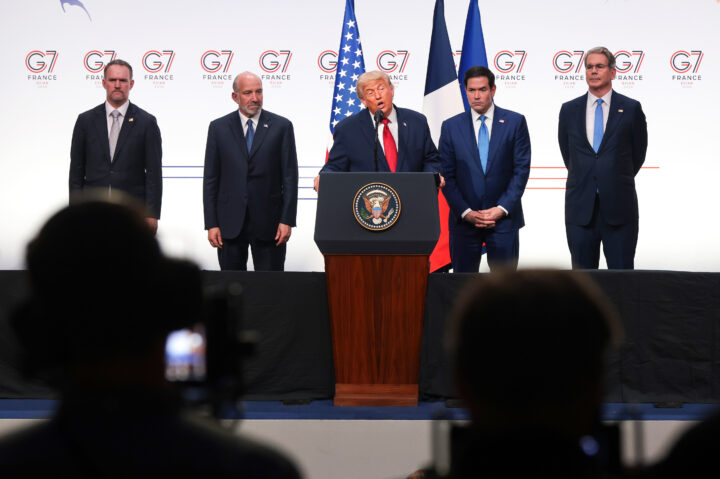
Photo by Anna Moneymaker/Getty Images
U.S. President Donald Trump is joined by (L-R) U.S. Trade Representative Jamieson Greer, U.S. Commerce Secretary Howard Lutnick, U.S. Secretary of State Marco Rubio and U.S. Treasury Secretary Scott Bessent as he speaks at a press conference during the G7 Leaders' Summit on June 17, 2026 in Evian-les-Bains, France.


 Add JewishInsider on Google
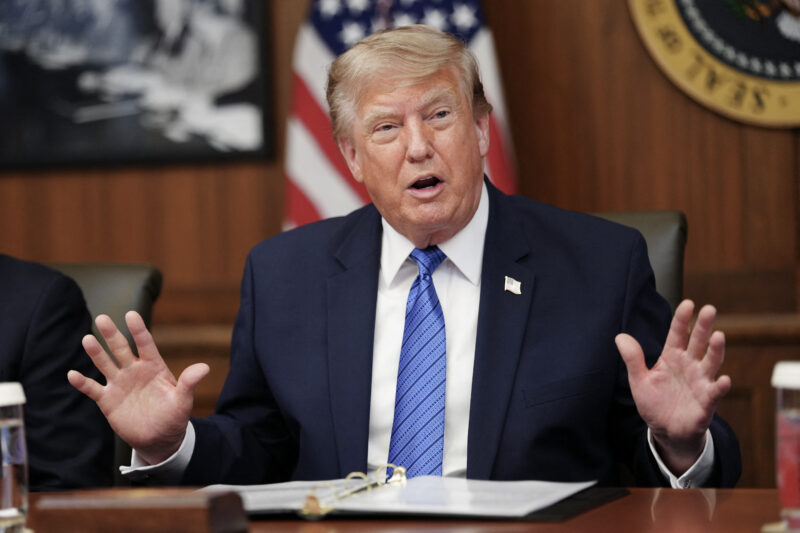
President Donald Trump on Wednesday said that the U.S. would not forbid Iran from possessing ballistic missiles, downplaying the threat despite it being a key war aim in the onset of the conflict. Speaking at the G7 summit in France, the president asserted that the majority of Iran’s missile capabilities have been destroyed and that he could not enforce the provision since other countries also “have some.”
Secretary of State Marco Rubio asserted in March that a key U.S. aim in the war would be “the destruction of Iran’s ballistic missile capabilities and their ability to manufacture them.”
“I mean, they have to have some, because other people have some … It doesn’t work that way. And missiles aren’t the problem,” Trump explained. “Missiles are, they hurt a little location, but they don’t blow up the planet.”
When asked whether it would be acceptable for the administration to allow Iran to keep its ballistic missiles, Trump argued that Tehran’s capacity has been significantly depleted over the course of the conflict.
“What are they keeping?” Trump responded. “We knocked out probably 84%-85% of their missiles. The rest are underground, they can’t even get them out. On the first night we knocked out hundreds of their missiles.”
Trump also asserted that Iran does not “want to be firing missiles right now,” noting that instead Tehran is likely focused on rebuilding what has been damaged during the war.
WATCH: When asked whether it would be acceptable for the administration to allow Iran to keep its ballistic missiles, Trump argued that their capacity has been significantly depleted over the course of the conflict.
— Jewish Insider (@jewishinsider) June 17, 2026
“What are they keeping?” Trump responded. “We knocked out… pic.twitter.com/Ysu5MfiZjt
The president also praised Israel as a “good partner” in the conflict and argued that the nuclear restrictions laid out in the U.S.’ agreement with Tehran are the ultimate victory for Jerusalem. According to Trump, if Iran were to acquire a nuclear weapon, “Israel would have been blown away.”
“Look, think of what Israel’s getting, they’re not going to be nuked, very simple,” Trump said. “I told [Israeli Prime Minister Benjamin Netanyahu], ‘Your biggest risk was that they [Iran] drop a nuclear weapon into the middle of Israel. They’d only need one, and there would be no more Israel. Think of it, Bibi, you got the best, the most important thing that you were asking for is that. So, I think they’re happy.”
Regarding the technical specifics of the deal, Trump stated that Iran has agreed to work with the U.S. to “turn over” its enriched material. He noted that while the material is secured “deep in the bowels of the earth” and monitored by cameras, technical discussions to remove the stockpiles would begin immediately. He insisted that, unlike the Obama administration’s implementation of the JCPOA, any relief Iran receives under this framework would be strictly “based on merit.”
Additionally, while Trump maintained that the U.S. did not enter the conflict seeking “regime change,” he argued that the war’s casualties effectively accomplished that by wiping out multiple tiers of Iranian leadership.
“They have a new group of leaders that I think is actually very smart, I think they’re far less radicalized, and I think they’re really good. They love their country,” Trump said. “You talk about regime change, nobody will say that, but … one set of leaders is all gone, the second set of leaders is all gone, their third set of leaders a little bit gone, but for the most part, I think that’s regime change.”
Trump also returned to vocalizing his frustrations with Israel’s military approach against Hezbollah in Lebanon.
“Israel, by the way, they’ve been a good partner again. I love them as a partner. They were terrific, but they could do a much better job with Hezbollah. On that, I don’t think they’re doing well, and I feel very bad for Lebanon,” Trump said. “I’m not saying they shouldn’t protect themselves. I’m saying, when two drones are shot into the desert and drop harmlessly, you don’t have to knock down buildings in Beirut. [Israel] could behave better, and frankly, they could do a better job.”
Trump characterized the ongoing conflict between Israel and Hezbollah as a “very small piece of the puzzle” compared to the agreement with Iran, though he said it “makes a lot of noise,” adding that he has urged Netanyahu to use a “softer touch” when conducting strikes.
“He happens to be a very good man. We’ve had an amazing partnership,” Trump said of Netanyahu. “We have a little dispute over Lebanon. I say you can do a little softer touch, maybe you don’t have to knock down a building every time somebody walks into it that’s from Hezbollah … but he will say we’re the big partner, he’s the very small partner, that’s true.”
The president contrasted the situation in Lebanon with what he described as major progress in the Gaza Strip, claiming that “Hamas has been very silent” as the U.S. attempts to disarm the group.
“Look at the job we’ve done in Gaza. Look at Hamas. Hamas has been very silent. You haven’t read anything about Hamas. We’re trying to get them unarmed,” Trump remarked. “They grew up with a machine gun in their hand … but they’ve actually behaved pretty well, considering this was not the lifestyle that they were taught to have.”
In an interview with JI, Ambassador Gilad Cohen discusses his push to persuade Japan not to recognize a Palestinian state at the UNGA
Courtesy Gilad Cohen
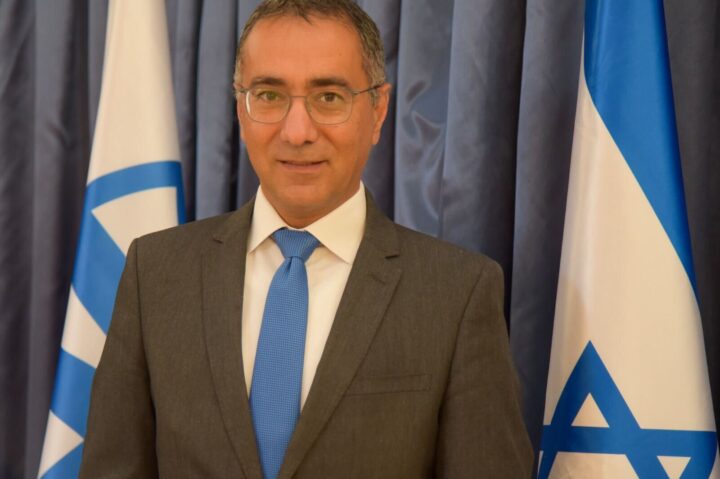
Israeli Ambassador to Japan Gilad Cohen
TOKYO — As Japan decided against recognizing a Palestinian state at the United Nations General Assembly on Friday, Israeli Ambassador to Japan Gilad Cohen told Jewish Insider in a wide-ranging interview in Tokyo that he is appreciative of Japan, “an important factor of the international community.”
On Friday evening, Japanese Foreign Minister Takeshi Iwaya called his Israeli counterpart, Gideon Sa’ar, to update him that after weeks of deliberation, Japan decided it will not recognize a Palestinian state at the UNGA.
“Sa’ar appreciated [the] decision and briefed [Iwaya] about Israel’s actions against Hamas chiefs in Qatar and IDF operations in Gaza,” Cohen told JI. “I join my foreign minister in appreciating Japan, a member of the G7, and an important factor of the international community, and for the deep friendship of our nations.”
“A recognition of a Palestinian state would be a reward to Hamas after the Oct. 7 terrorist attacks, would not contribute to peace and would not build on the trust of Israelis in the future,” he said. In recent weeks, Cohen relayed that message to Japanese ministers as the country weighed recognizing a Palestinian state as several governments, including those in Britain, France, Australia and Canada, have announced plans to do at the UNGA.
“This recognition is null and void because when you acknowledge a state there have to be conditions — what are the boundaries? Do you have effective control of the population? Nothing about that works with the Palestinians,” Cohen told JI. “Are they going to dismantle Hamas? Are they going to continue paying salaries for families of suicide bombers? Are they going to continue to have pacts with Iran against Israel? Is there going to be a repetition of Oct. 7 because they have a state? We are the Jewish people, we always have to be concerned and worried.”
For Cohen, who assumed office as ambassador of Israel to Japan in October 2021 following a stint as deputy director general for Asia and Pacific division in the Israel Ministry of Foreign Affairs, Japan’s consideration of recognizing a Palestinian state has been one of only a few disagreements he’s held with local politicians since arriving in Tokyo. In the immediate aftermath of the Oct. 7 attacks, “the Japanese government stood by Israel, called for an immediate and unconditional release of our hostages and said publicly that Hamas should be dismantled,” Cohen said.
“I thank the Japanese for acknowledging that Hamas is a terrorist organization and for saying that Iran is the number one destabilizer of the region. I want to thank the Japanese government for standing on the right side of history.”
When war broke out between Israel and Hamas soon after the Oct. 7, 2023, Hamas attacks on Israel, Japan, as a member of the U.N. Security Council, “was trying to influence the release of the hostages and not to [attack] Israel. They were not mediating, but there were messages Japan was trying to deliver for both sides in order to bring our hostages back,” Cohen recalled.
Looking ahead to the postwar period, Cohen suggested that Japan will contribute to rebuilding the Palestinian economy. “We will welcome any kind of investment in the Palestinian economy to revive it,” he said. “Economy is a major part of the vision of Palestinians living side by side with Israelis in peace and security.”
While tourism from Japan to Israel has seen a decline amid the war, Cohen said that joint business ventures between the two countries have increased over the past two years, as Israeli tech companies engage with Japan’s industrial giants and venture capital networks.
“Investments from Japanese companies in Israel were much higher in 2024 than 2023, including in AI and technology,” he said. “There is a saying that Israel can do things from zero to one and Japanese can take them from one to 10. Israeli innovation and startups can be combined with Japanese wisdom, experience and production ability that Israel doesn’t have.”
When it comes to creating cars, for example, an area that Japan is a global leader in, “Israel should focus on the brain of the car, systems that prevent accidents such as Waze and Mobileye,” said Cohen. “The synergy that we can learn from Japan — and we can share our experience with them — I see a lot of potential in economic relations. Japanese companies are looking at Israeli startups with great interest. In the last two and a half years, there have been direct flights from Israel to Japan, which is important because businessmen and investors do not have time to waste. This is an engine for connecting the people of Israel and Japan.”
Israel is among the handful of countries that Japan has a free trade deal with, an agreement signed by Cohen in March 2023. It allows 200 Israelis to come to Japan annually on a visa for one year of work, study and travel. At the same time, 200 Japanese citizens can come to Israel for one year to do the same.
Cohen sees himself not only as an ambassador of Israel “but also as representing the Jewish people in Japan,” he said, describing a small but vibrant community. Tokyo is home to two Chabad houses and a Jewish community center, which runs a pluralistic synagogue. The cities of Kyoto and Kobe also each have a Chabad. All five centers primarily cater to tourists.
It can be a challenge to navigate Holocaust education and antisemitism awareness in a country with limited historical exposure to those issues, Cohen said, recommending that all Japanese visit the Holocaust Education Center in Fukuyama City, near Hiroshima.
“The Japanese government comes to commemorate our Holocaust memorial days,” Cohen told JI. “They give thanks to [Chiune] Sugihara,” he said, referring to the Japanese diplomat who, while posted in Lithuania, saved thousands of Jews during the Holocaust. “We are participating in ceremonies to commemorate him. In Japan, he became a hero.”
“I see a lot of potential in the future when things calm down in the region,” continued Cohen. “I would like to have future agreements signed with Japan to boost the economy on both sides. I have many things on my agenda, but this will be after Rosh Hashanah.”
Plus, the political extremes horseshoe against Israel ͏ ͏ ͏ ͏ ͏ ͏

Chip Somodevilla/Getty Images
President Donald Trump waves as he boards Air Force One after leaving the G7 Leaders' Summit early on June 16, 2025 in Calgary, Alberta.
Good Tuesday morning.
In today’s Daily Kickoff, we report on the latest developments in the war between Israel and Iran, and cover President Donald Trump’s early departure from the G7 in Canada and comments about potential talks with Tehran. We also report on Trump’s rebuke of “kooky” Tucker Carlson over the commentator’s opposition to U.S. support of Israeli strikes, and look at how Jewish LGBTQ community leaders are approaching Pride celebrations that ostracize Jewish and pro-Israel individuals. Also in today’s Daily Kickoff: Scott Jennings, Jason Isaacs and Jeff Rubin.
What We’re Watching
- We’re continuing to monitor the ongoing situation in Israel and Iran, following another barrage of ballistic missiles fired at Israel by Iran this morning. More below.
- President Donald Trump is back in Washington today, after his early departure from the G7 in Alberta, Canada, where he will meet with senior advisors this morning in the Situation Room to weigh the level of U.S. involvement in the Israel-Iran conflict. Secretary of State Marco Rubio, Vice President JD Vance and Chairman of the Joint Chiefs of Staff Gen. Dan Caine are among those who will be meeting with the president.
- Reps. Thomas Massie (R-KY) and Ro Khanna (D-CA) are expected to put forward a war powers resolution today in the House that would force the administration to seek congressional approval ahead of any U.S. attack on Iran. Yesterday, Sen. Tim Kaine (D-VA) introduced a war powers resolution in the Senate. More below.
- Director of National Intelligence Tulsi Gabbard and CIA Director John Ratcliffe are slated to testify this morning before a Senate Appropriations subcommittee on the administration’s FY2026 budget request for the intelligence community.
- House Speaker Mike Johnson’s (R-LA) trip to Israel this week, in which Johnson was slated to address the Knesset, has been postponed due to the conflict between Israel and Iran. Read more here.
What You Should Know
A QUICK WORD WITH JI’S MARC ROD
We’ve written a lot about the so-called horseshoe theory of U.S. politics and foreign policy — the point at which the far left and the far right coalesce into agreement — but the Israeli campaign against Iranian military and nuclear targets is providing a particularly stark example of that convergence. The two factions find themselves openly and publicly aligned in opposition to any form of U.S. intervention in Israel’s campaign and against Israel’s operations in general.
An X post by Rep. Marjorie Taylor Greene (R-GA) on Sunday provided a distillation of that dynamic. Greene claimed that a regional war or global war, which would likely overwhelm the Middle East, BRICS and NATO, is inevitable and that countries would be “required to take a side.” She continued, “I don’t want to see Israel bombed or Iran bombed or Gaza bombed. … And we do NOT want to be involved or required to pay for ANY OF IT!!!”
Among those who supported Greene’s post were CodePink activist Medea Benjamin, who praised Greene’s “incredibly strong anti-war position!” and Drop Site News co-founder Ryan Grim, who called the Georgia Republican “presently the most sensible member of Congress.” Doug Stafford, the chief strategist for Sen. Rand Paul (R-KY), shared Benjamin’s post — and has repeatedly shared and praised both her and Code Pink in the wake of the Israeli operation. Read more here.
It’s not just Greene and Stafford. A host of prominent figures on the right, such as Rep. Thomas Massie (R-KY), Tucker Carlson, Steve Bannon, former Rep. Matt Gaetz (R-FL) and former Pentagon senior advisor Dan Caldwell are touting narratives about the conflict that would not be out of place at a far-left anti-Israel rally.
ISRAEL-IRAN WAR DAY 5
Israel kills Iranian military chief of staff as attacks from Tehran slow down

Israel killed Iran’s new top military commander and confidante of Iranian Supreme Leader Ayatollah Ali Khamenei days after eliminating his predecessor, the IDF Spokesperson’s Office announced on Tuesday, after a night in which missile launches from Iran towards Israel slowed down significantly. The Israeli Air Force struck a command center in Tehran, killing Ali Shadmani, Iran’s chief of war general staff, who had authority over the Islamic Revolutionary Guard Corps and the Iranian military. Shadmani, whom the IDF Spokesperson’s Office called “one of the closest figures to Supreme Leader Ali Khamenei,” was on the job for four days after Israel killed his predecessor, Alam Ali Rashid, early Friday, Jewish Insider’s Lahav Harkov reports.
Lower volume: Monday night and the early hours of Tuesday morning were the quietest since the beginning of the war with Iran on Friday. The IAF intercepted 30 projectiles launched from Iran toward Israel, with sirens mostly in northern and central Israel and no reports of injuries or damage to property. On Tuesday morning, Iran launched additional missiles at Israel, triggering sirens in the center of the country, including Jerusalem and the West Bank. The IDF said it intercepted most of the projectiles. Magen David Adom reported 14 injuries at eight impact sites, including a bus depot in Herzliya where the blast created a 13-foot-wide hole in the ground.
Top target: Israeli Prime Minister Benjamin Netanyahu did not rule out the possibility of targeting Iran’s supreme leader, Ayatollah Ali Khamenei, in an interview with ABC News on Monday, amid widespread speculation in Israel and beyond that the strikes on the Islamic Republic could pose an existential challenge to the regime.
DIPLOMACY DIARIES
Trump departs G7 early, denies ‘peace talks’ with Iran

President Donald Trump denied on Tuesday that he was attempting to facilitate “peace talks” with Iran as he returned to Washington after prematurely leaving a meeting of G7 leaders in Canada to monitor the ongoing war between Israel and Iran, Jewish Insider’s Danielle Cohen reports.
Word of warning: While still aboard Air Force One, the president told reporters that he wanted “a real end” to Iran’s nuclear program and he would be monitoring developments between Israel and Iran from the White House Situation Room. He suggested that Israel was unlikely to slow its strikes on Iranian targets in the coming days, saying that, “You’re going to find out over the next two days. You’re going to find out. Nobody’s slowed up so far.” But the president stopped short of addressing whether the U.S. would join Israel’s strikes, saying he hopes the Iranian nuclear weapons program “is wiped out long before that.”
French folly: French President Emmanuel Macron suggested to reporters on Monday that Trump had departed the G7 earlier to negotiate a ceasefire between Israel and Iran, saying that “the U.S. assured they will find a ceasefire and, since they can pressure Israel, things may change.” Trump slammed Macron and denied his claims, posting on Truth Social, “Publicity seeking President Emmanuel Macron, of France, mistakenly said that I left the G7 Summit, in Canada, to go back to D.C. to work on a ‘cease fire’ between Israel and Iran. Wrong! He has no idea why I am now on my way to Washington, but it certainly has nothing to do with a Cease Fire.” Trump said he had departed for something “much bigger than that.”
United front: The leaders of the G7 issued a joint statement on Sunday affirming “that Israel has a right to defend itself,” their “support for the security of Israel” and that “Iran is the principal source of regional instability and terror.” They further “urge[d] that the resolution of the Iranian crisis leads to a broader de-escalation of hostilities in the Middle East, including a ceasefire in Gaza.”
TRUMP CHECKS TUCKER
Trump rebukes ‘kooky Tucker Carlson’ on Iran

President Donald Trump rebuked Tucker Carlson at several points on Monday over Carlson’s comments opposing Trump’s support for Israeli strikes on Iran, Jewish Insider’s Marc Rod reports.
New nickname: Asked Monday at the G7 Summit in Canada about Carlson’s comments accusing Trump of being “complicit” in the war, Trump quipped, “I don’t know what Tucker Carlson is saying. Let him go get a television network and say it so that people listen.” Trump later posted on his Truth Social platform, “Somebody please explain to kooky Tucker Carlson that, ‘Iran CAN NOT HAVE A NUCLEAR WEAPON!’”
ALLIES AND ARMS
U.S. should help Israel destroy Fordow, some Senate Republicans say

Some Senate Republicans argued Monday that the U.S. should join Israel’s strikes on Iran to help it destroy deeply entrenched nuclear sites such as the Fordow facility, contending that Israel lacks the capacity to do so on its own. Others, though, argued that Israel may have alternative plans to attack Fordow, while still others suggested that the U.S. should hold back and focus on diplomacy unless U.S. personnel are attacked directly, Jewish Insider’s Marc Rod and Emily Jacobs report.
Unique needs: Assessments have long held that bunker-busting bombs and larger bombers, neither of which Israel has, are needed to eliminate Fordow, though some analysts have speculated in recent days that Israel has been developing alternative strategies to strike that site. “We have to. I think we have to help. I am going to be encouraging the president [to support Israel] because the greatest tragedy in the world would be if we left the Iranian regime in place with a nuclear easy startup. I’d hate to see Israel spending all those resources of people and dollars on getting the job 90% done,” Sen. Kevin Cramer (R-ND) told JI.
Read the full story here with additional comments from Sens. Lindsey Graham (R-SC), Mike Rounds (R-SD) and Pete Ricketts (R-NE).
War powers activated: Sen. Tim Kaine (D-VA) introduced a war powers resolution on Monday that aims to block the U.S. from taking military action against Iran in support of Israel’s ongoing operation against the regime, JI’s Marc Rod reports.
STRANDED BUT NOT ALONE
CNN’s Scott Jennings flew to Israel for the first time to understand Oct. 7 — and then war with Iran broke out

CNN contributor Scott Jennings traveled to Israel last week to bear witness to the atrocities Hamas committed during the Oct. 7, 2023, terrorist attacks. But in the wake of Israel launching its military operation to take out Iran’s nuclear facilities and prevent the regime from acquiring a nuclear weapon, Jennings is witnessing more than he expected to on his first trip to the Jewish state, Jewish Insider’s Haley Cohen reports.
And then some: “Not only did I get to fulfill my mission of understanding deeply the horrors of Oct. 7, but being here watching the war unfold against Iran, I feel like I am here at the beginning of the war to defend Western civilization,” Jennings, who is traveling with the AIPAC-affiliated American Israel Education Foundation, told JI from his hotel in Tiberias on Friday. “I think this has to end with a complete annihilation of Iran’s ability to make a nuclear weapon,” he said, calling on the U.S. to do “whatever we have to do to achieve that in concert with our special partner, Israel.”
PRIDE AND PREJUDICE
Proud, but pushed out: Why LGBTQ Jews are creating Pride spaces of their own

In early June, Rabbi Eleanor Steinman wrote to members of Temple Beth Shalom, the Reform congregation she leads in Austin, Texas, sharing the synagogue’s plans to celebrate Pride Month with several events in June. Steinman also revealed that, for the first time in more than two decades, her congregation would not be marching in the Austin Pride parade, which event organizers say draws 200,000 people each August, because of concerns about antisemitism. “The Austin Pride organization took an antisemitic stance in the midst of the Pride Parade and Festival last year,” wrote Steinman, who is gay. Ahead of last year’s Pride parade, slides were leaked from a presentation in which Austin Pride organizers said hate speech against Jews wasn’t welcome, including “symbols, images or flags used by terrorist and hate groups.” It was part of an education campaign for queer activists as anti-Israel sentiment exploded in the queer community after the Oct. 7, 2023, Hamas attacks and the ensuing war in Gaza, as it did in many other progressive spaces, Jewish Insider’s Gabby Deutch reports.
Backfiring and backtracking: But the effort to educate about antisemitism backfired. Anti-Israel activists pressured Austin Pride to disavow that message. Austin Pride not only backtracked on barring those slogans; it issued a statement pledging to support the Boycott, Divestment and Sanctions movement and stating that the organization does not work with the Anti-Defamation League. In the months that followed, Jewish leaders and LGBTQ activists pushed Austin Pride’s leadership to consider changing this stance, to no avail. “Despite attempts to meet with Austin Pride since then, a coalition of Jewish leaders were unable to create an environment where we felt we would be both safe and respected as Jewish LGBTQ+ and allies,” Steinman wrote in the email. It was a remarkable statement, tinged with bitter irony: The synagogue first started marching in Pride so that LGBTQ congregants would feel that they could bring their full selves to the Jewish community. Now some of those same congregants feel that they need to suppress their Jewishness in order to fully belong in the queer community.
Worthy Reads
Bibi Turns the Tables: The Wall Street Journal’s Walter Russell Mead considers how Israeli Prime Minister Benjamin Netanyahu has pivoted from a series of domestic and diplomatic crises to mounting one of the most significant military operations in Israeli history. “A coalition in revolt, prosecutors on his heels, powerful rivals looking to unseat him, chilly relations with Mr. Trump, growing opposition from Europe, skeptical military and intelligence chiefs and a hostile press — few leaders anywhere have faced this kind of pressure. By week’s end, Bibi had flipped the script. A series of military blows exposed the weakness of Iran’s sulphurously belligerent regime and demonstrated Israel’s military and intelligence supremacy in the Middle East. The government crisis subsided. Mr. Trump praised Israel’s audacious attack. As in the months after Oct. 7, 2023, a determined prime minister harnessed the Israeli military machine to orchestrate a dazzling series of victories that stunned the world even if they did not win it over.” [WSJ]
More Than Bombs: The Washington Post’s David Ignatius looks at potential avenues to regime change in Iran. “You’ll get no argument from me that it’s long past time for political change in Tehran. The clerical regime has been shedding the blood of Israelis, Americans, Saudis and anyone else who opposed its dictates since the 1979 Islamic revolution. The question is how change will come. What’s the road toward a dynamic country that’s worthy of Iran’s creative, cultured people? Here’s one obvious fact: Israel can’t bomb its way to this new Iran. A campaign of bombing of the kind Tehran is experiencing makes people hunker down, turn inward and often fight harder. Strategic bombing didn’t break the will of the British, German or Japanese people during World War II. It hasn’t yet destroyed Hamas in Gaza, either, for that matter.” [WashPost]
Hate’s Not on the Menu: In the San Francisco Chronicle, Manny Yekutiel condemned the recent vandalism of his eponymous Mission District cafe, which was graffitied with anti-Israel graffiti during recent anti-ICE protests. “A disturbing pattern is emerging — one that even here in San Francisco is endangering the core values this city is meant to uphold: tolerance, inclusion, civic engagement and common humanity. The act of hate at Manny’s is part of a larger danger facing the progressive movement and the country. We are living in a moment where real and painful disagreements are being used as an excuse to turn people against one another. Instead of standing together to fight injustice, some are choosing to let hate and bigotry divide us. We cannot allow that. If we lose the ability to sit across from people we disagree with and have hard conversations, we lose the very foundation of this movement.” [SFChronicle]
Word on the Street
Amos Hochstein, a former special envoy in the Biden administration, told CNBC that only the U.S. could dismantle the Fordow nuclear facility in Iran…
The Senate modified provisions of the Educational Choice for Children Act, a tax credit program for scholarships that could help families afford religious schools, in its version of the budget reconciliation bill; the Senate version of the bill decreases the total annual tax credit from $5 billion to $4 billion, but eliminated a sunset provision that had been in the House version of the bill, making the program permanent. The Senate version also modifies portions of religious liberty protections included in the House bill…
Senate Majority Whip John Barrasso (R-WY) told Jewish Insider he hasn’t had any discussions about calling a floor vote to discharge Joel Rayburn‘s nomination from the Senate Foreign Relations Committee, in which it appears Rayburn lacks the votes to advance…
The Florida Legislature earmarked $10 million in funds allotted for Jewish school security, $1 million above the amount recommended by Gov. Ron DeSantis earlier this year…
Chalkbeat interviews historian Natalia Mehlman Petrzela, who was tapped by the New York City Department of Education to develop a Jewish American history curriculum…
In an interview with Vulture, “White Lotus” actor Jason Isaacs, who is Jewish, reflected on his relationship with Mel Gibson, saying his “The Patriot” co-star, whose antisemitic rant following a 2006 DUI arrest went viral, has “done some things that are unconscionable and unforgivable”…
The New York Times looks at the legacy of Leonard Lauder, who died last week, on the beauty industry; Lauder was known for coining the concept of the “lipstick index”…
The Wing co-founder Audrey Gelman, who opened a home goods and tchotchkes store in Brooklyn in 2022, is pivoting to hospitality, opening a hotel in New York’s Hudson Valley…
The displays of several Israeli defense firms at the Paris Air Show were covered up during the annual gathering; French officials said the companies, including Elbit and Rafael, had disregarded an agreement not to display offensive weapons, while Israel’s Defense Ministry accused France of trying to tamp down competition…
The Wall Street Journal reports that Saudi Arabia, Qatar and Oman have appealed to the U.S. to pressure Israel to halt its strikes on Iran…
The Associated Press looks at how the escalation between Israel and Iran has affected flights and travelers across the region, stranding many far from home…
The Maccabiah Games, which had been slated to take place next month in Israel, are being postponed to 2026 due to the war between Israel and Iran, eJewishPhilanthropy’s Jay Deitcher reports…
Jeff Rubin announced his upcoming retirement from The Washington Institute for Near East Policy, where he served as communications director since 2011…
Pic of the Day

Ambassador Jim Jeffrey (center) poses with Antoun Sehnaoui (left) and Daniel Glaser, the co-founders of the U.S.-Israel Opera Initiative, at the organization’s launch on Sunday at the Kennedy Center in Washington. The program featured the premiere screening of the opera “Theodor,” about the life of Theodor Herzl. The performance was dedicated to Yaron Lischinsky and Sarah Milgrim, two Israeli Embassy staffers who were killed in a terror attack at the Capital Jewish Museum last month.
Birthdays

Comedian, actor, director, writer and producer, Michael Showalter turns 55…
Diplomat and attorney, undersecretary of state for International Security Affairs in the Carter administration, longtime U.N. special representative, Matthew Nimetz turns 86… Winner of the 2001 Nobel Prize in economics, professor at Georgetown and UC Berkeley, he is married to former Treasury Secretary Janet Yellin, George Akerlof turns 85… One of the world’s best-selling singer-songwriters over the course of seven decades, born Barry Alan Pincus, Barry Manilow turns 82… Former member of the Knesset for the Zionist Union party, Eitan Broshi turns 75… Chairman of the Federal Trade Commission during the Obama administration, Jonathan David (“Jon”) Leibowitz turns 67… Deputy administrator of the Federal Highway Administration during the first two years of the Biden administration, Stephanie Pollack turns 65… President of the San Francisco Board of Supervisors until earlier this year, Aaron Dan Peskin turns 61… Singer and composer, a pioneer of the Turkish and Arab music genres in Israel, Ofer Yoel Levy turns 61… Fashion designer, daughter of Reva Schapira, Tory Burch turns 59… Active in interfaith peace initiatives between Judaism and Islam and in encounters for Jews with Eastern religions, Rabbi Yakov Meir Nagen (born Genack) turns 58… Founder and chairman of Shavei Israel, Michael Freund turns 57… British historian, columnist and musician, Dominic Green, Ph.D. turns 55… International human rights attorney who serves as managing director of the law firm Perseus Strategies, Jared Matthew Genser turns 53… Screenwriter, television producer, director and voice actor, Matthew Ian Senreich turns 51… Advocacy, philanthropic and political counsel at Chicago-based Beyond Advisers, David Elliot Horwich… SVP for the economic program at Third Way think tank, Gabe Horwitz… Chief philanthropy officer of the Jewish Community Foundation and Jewish Federation of Broward County, Keith Mark Goldmann… VP of government affairs for the Conservation Lands Foundation, David Eric Feinman… Former rabbi of the Elmora Hills Minyan in Union County, N.J., now an LCSW therapist in private practice, Rabbi Michael Bleicher… NYC-based senior editor for The Hollywood Reporter, Alexander Weprin… Professional surfer and musician, his family owns Banzai Bagels on the Hawaiian island of Oahu, Makua Rothman turns 41… Founder and executive director of the Zioness Movement, Amanda Berman… Director of national outreach for the East at the New Israel Fund, Alexander Willick… Award-winning college football and basketball analyst for NBC Sports and SiriusXM, Nicole Auerbach… Member of the U.S. Ski Team’s alpine program, he competed for the USA in both the 2014 (Sochi) and 2018 (PyeongChang) Winter Olympics, Jared Goldberg turns 34… Senior art director at Business Insider, Rebecca Zisser… Shortstop for Team Israel at the 2020 Olympics, Scott Burcham turns 32… Actress best known for her roles in the CBS series “Fam” and the Netflix series “Grand Army,” Odessa Zion Segall Adlon turns 25… D.C.-based freelance foreign media consultant, she is also a real estate agent, Mounira Al Hmoud…
Though Trump said he did not leave in order to pursue a ceasefire between Israel and Iran, the U.S. is reportedly still seeking a meeting with the Iranians to reach a nuclear deal
Chip Somodevilla/Getty Images
President Donald Trump waves as he boards Air Force One after leaving the G7 Leaders' Summit early on June 16, 2025 in Calgary, Alberta.
President Donald Trump denied on Tuesday that he was attempting to facilitate “peace talks” with Iran as he returned to Washington to monitor the ongoing war between Israel and Iran.
Upon landing in the U.S. early Tuesday morning after prematurely leaving a meeting of G7 leaders in Canada — a move that White House Press Secretary Karoline Leavitt attributed to “what’s going on in the Middle East,” — Trump posted on Truth Social that he had “not reached out to Iran for ‘Peace Talks’ in any way, shape, or form. This is just more HIGHLY FABRICATED, FAKE NEWS! If they want to talk, they know how to reach me. They should have taken the deal that was on the table – Would have saved a lot of lives!!!”
On Sunday, however, Trump had written on Truth Social that “Iran and Israel should make a deal, and will make a deal” and “we will have PEACE, soon, between Israel and Iran! Many calls and meetings now taking place.”
While still aboard Air Force One, the president told reporters that he wanted “a real end” to Iran’s nuclear program and he would be monitoring developments between Israel and Iran from the White House Situation Room.
He suggested that Israel was unlikely to slow its strikes on Iranian targets in the coming days, saying that, “You’re going to find out over the next two days. You’re going to find out. Nobody’s slowed up so far.”
But the president stopped short of addressing whether the U.S. would join Israel’s strikes, saying he hopes the Iranian nuclear weapons program “is wiped out long before that.”
French President Emmanuel Macron suggested to reporters on Monday that Trump had departed the G7 earlier to negotiate a ceasefire between Israel and Iran, saying that “the U.S. assured they will find a ceasefire and, since they can pressure Israel, things may change.”
Trump slammed Macron and denied his claims, posting on Truth Social, “Publicity seeking President Emmanuel Macron, of France, mistakenly said that I left the G7 Summit, in Canada, to go back to D.C. to work on a ‘cease fire’ between Israel and Iran. Wrong! He has no idea why I am now on my way to Washington, but it certainly has nothing to do with a Cease Fire.” Trump said he had departed for something “much bigger than that.”
While at the G7, Trump took an aggravated tone with Iran’s failure to come to an agreement, writing on Truth Social that “Iran should have signed the ‘deal’ I told them to sign. What a shame, and waste of human life. Simply stated, IRAN CAN NOT HAVE A NUCLEAR WEAPON. I said it over and over again! Everyone should immediately evacuate Tehran!”
Israel had issued a warning earlier that day to residents of Tehran to evacuate ahead of impending strikes on military infrastructure in the capital city. Israeli media reported that the U.S. had joined Israel in attacking Iran, which was denied by White House spokesperson Alex Pfeiffer. “American forces are maintaining their defensive posture, and that has not changed. We will defend American interests,” he said. Trump later told reporters that his call to evacuate was because he wants “people to be safe.”
On Monday night, Axios reported that Middle East envoy Steve Witkoff is seeking a meeting with Iranian Foreign Minister Abbas Araghchi to reach a nuclear deal and end the military action between Israel and Iran. Trump reportedly said at the G7 that the U.S. and Iran “are talking on the phone, but it is better to talk in person.”
A senior U.S. official told Axios that Trump sees Israel’s assumed reliance on the U.S.’ bunker-buster bombs to effectively target Iran’s nuclear facilities as a point of leverage to force Iran into a deal, lest the U.S. supply Israel the assistance it is seeking.
Meanwhile, the Iranian Foreign Ministry said in a statement that the country’s parliament is preparing a bill to potentially pull Iran out of the nuclear Non-Proliferation Treaty. The U.N.’s nuclear agency had recently ruled that Iran was violating its obligations under the treaty — which allows a country to utilize civilian nuclear power in exchange for a guarantee it will not pursue nuclear weaponization — for the first time in almost 20 years.
Please log in if you already have a subscription, or subscribe to access the latest updates.
 Continue with Google
 Continue with Apple