










































































A Brookings Institution study found that of the 104 Democratic Socialists of America-backed candidates running for state legislature, nearly 75% have won their primaries

Spencer Platt/Getty Images
Members of the Democratic Socialists of America May 01, 2019 in New York City.


 Add JewishInsider on Google
The Democratic Socialists of America notched another win this week in Florida’s Democratic Senate primary, with the shock victory of state Rep. Angie Nixon, a DSA member, over a much better-funded, establishment-backed challenger.
The far-left group has also notched at least six new victories in deep-blue House districts where its members are all but guaranteed to be elected, and could lead four major U.S. cities — New York, Los Angeles, Seattle and Washington, D.C. — after the midterm elections.
But some of the group’s more overlooked victories have happened at the state level, where the DSA members could wield significant power if they win. A new study by the Brookings Institution, released Wednesday, found that of the 104 state legislative candidates endorsed by national or local DSA chapters in 2026, 76 have won their primaries or advanced to the general election without a primary.
At the local level, another 64 of the 99 DSA-endorsed candidates are moving on to the general election. By comparison, at the congressional level, only 20 of the 64 total DSA-endorsed candidates have made it to general election races.
In New York City, already a comparative bastion of DSA representation in the state Assembly and Senate, eight DSA endorsees have advanced to the general election, including state Senate candidate Aber Kawas, who downplayed the 9/11 attacks, as well as seven state Assembly candidates. In total, the group is expected to have at least 15 members in Albany next year.
Sara Forman, the former executive director of the New York Solidarity Network, a state-level Jewish advocacy organization, said that after New York City Zohran Mamdani’s victory, the DSA seems to be emboldened to “flex their muscles” nationwide, after previously taking a more “surgical” approach at the state and local level.
Forman, who is now a senior advisor at Optimistic Labs, said she thinks the group learned lessons from the Mamdani race, including targeting highly engaged communities and neighborhoods. She also emphasized that the group has spent two decades building out the infrastructure that fueled the recent victories highlighted in the Brookings data.
“The Jewish community needs to take a hard look at this and really decide whether or not we’re willing to break bread” with a group that only looks at the Jewish community for “how they can use us,” she continued, while adding that Jewish community members will likely need to engage with some DSA elected officials in some capacity..
The national DSA organization endorses only a small subset of the DSA-affiliated candidates running nationwide. But outside of New York, five of its endorsees have advanced to general election races in state assembly seats around the country, with some set to coast to election and others facing competitive general election races: Robert LeVertis Bell in Kentucky, Tammy Carpenter in Oregon, Chris Gilmer-Hill in Michigan, Luke Alfaro-Jungmann in New Mexico and Mathewos Samson in Georgia.
Local DSA groups have racked up many more wins, such as state Rep. Maryam Khan’s ouster of an incumbent in a recent Hartford, Conn.-area state Senate seat.
“It’s interesting to me that the places where you’ve seen a lot of the newer elected officials pop up were a little unexpected, Connecticut being one example,” Forman said.
The state-level wins carry the potential to advance the DSA’s agenda, particularly in places such as New York, where the DSA expects its endorsees to work as a bloc in coordination with DSA leaders.
The Brookings study found that most DSA candidates hailed from already liberal areas — 111 were from California and New York alone — and most from districts that heavily favor Democrats. And DSA candidates contested and were nominated in a small fraction of the 7,386 total legislative seats around the country.
“From one perspective, the story of DSA candidates’ influence is overblown. The scarcity of candidates and their lack of strong success rates overall make this look more like a skirmish than a war,” the study’s authors conclude. “Nonetheless, the high-profile wins, fueled by young, white, educated voters, represent a warning to the rest of the party. They signal that unhappiness with the Democratic establishment and, in the post-Biden world, opposition to elderly officeholders can be leveraged by young, charismatic DSA candidates — and reflect an impatience with party leadership that transcends ideology.”
The rapid rise of the far left has alarmed Jewish leaders, who have seen candidates aligned with the DSA or affiliated with other virulently anti-Israel groups and in some cases, embracing antisemitic views. Those ties haven’t stopped them from winning deep-blue primaries across the country.
“Just judging on Missouri, it’s worse than people are realizing,” said Stacey Newman, a former Democratic state lawmaker who now leads the Missouri Alliance Network.
She emphasized that St. Louis-area Democrats elected a growing number of far-left candidates — albeit most not formally DSA-endorsed — and others hostile to Jewish community interests to the Legislature even while reelecting a close Jewish community ally in Rep. Wesley Bell (D-MO). “They all have the same anti-Israel, anti-Jew platforms,” she said.
Forman said that Jewish advocates and their allies at the state level “need to be prepared for what I’m assuming is going to be the incoming push to try to make Israel a state and local issue,” as Mamdani and other DSA members did in New York State with legislation such as the Not On Our Dime Act.
“We really need to be making sure that our advocates and our allies are prepared to push back on that narrative,” Forman said, “but second of all, to remind people that state and local office has nothing to do with foreign policy.”
She said that the existing Jewish educational infrastructure needs to have the “toolkit to be able to say and push back hard and aggressively that this has no place in the state legislature,” and have its messaging clear and prepared.
Newman, whose group led advocacy for an antisemitism bill in the Missouri Legislature, said she feels that the Jewish community increasingly can’t rely on Democrats in Missouri’s legislature to support their priorities. And, she emphasized, much more policy work happens at the state level than the federal level.
“As a former Jewish state legislator, I’m petrified, because we’re all watching what’s happening around the country,” Newman said. “We’re watching Michigan, Wisconsin, we’re watching the Democratic Party throw caution to the wind.”
So far, the left of the party won three of the four contests, with the notable exception of Democratic Socialists of America-affiliated Wisconsin gubernatorial candidate Francesca Hong, who fell short against Milwaukee County Executive David Crowley
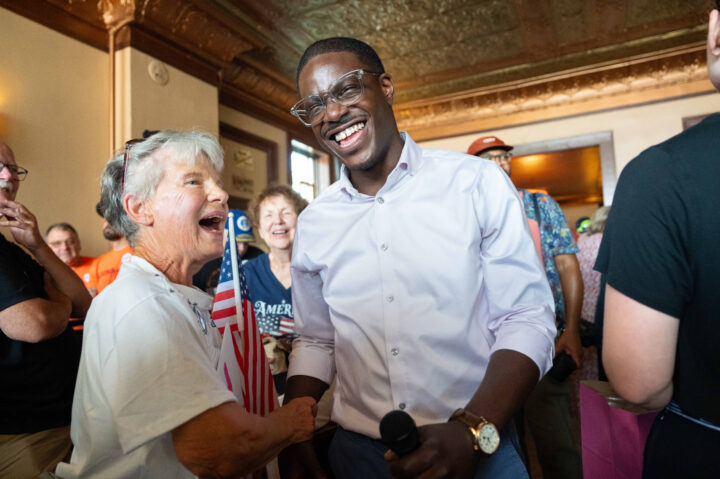
(AP Photo/Kayla Wolf)
David Crowley, Democratic candidate for Wisconsin governor, shakes hands with Karen Hilt, left, during a campaign stop Friday, Aug. 7, 2026, in Sheboygan, Wis.
In Tuesday’s newsletter, we wrote that four major Democratic primary races — in Minnesota, Wisconsin and Connecticut — would be key tests of the depth of the anti-establishment, anti-Israel left’s staying power.
So far, the left of the party won three of the four contests, with the notable exception of Democratic Socialists of America-affiliated Wisconsin gubernatorial candidate Francesca Hong, who fell short against Milwaukee County Executive David Crowley — in the night’s most high-profile race testing whether a socialist can win the Democratic nomination for an executive role in a pivotal battleground state.
Hong, who drew criticism from leading Democrats over her record of comments attacking Thanksgiving, support for defunding the police and overall embrace of the DSA’s radical platform, underperformed the primary polls showing her with a substantial lead in the race. But as Wisconsin Gov. Tony Evers and leading Democratic officials warned that her nomination could cost Democrats the governorship, her lead dissipated amid concerns about her electability come November.
Of note: Sen. Bernie Sanders (I-VT) and Rep. Alexandria Ocasio-Cortez (D-NY), the two leading members of the ideological left in Congress, declined to endorse Hong’s campaign.
The establishment’s unified — and effective — show of force against Hong offered a stark contrast to party leaders’ efforts in Michigan to stop far-left candidate Abdul El-Sayed from winning the nomination. In that race, party leaders were more equivocal in their support of Rep. Haley Stevens (D-MI), with Sen. Elissa Slotkin (D-MI) declining to support Stevens’ candidacy despite their similar political backgrounds. Even Gov. Gretchen Whitmer, who offered a late endorsement to Stevens, didn’t go after El-Sayed’s electability like Evers has in his comments speaking out against Hong.
The socialist speed bump in Wisconsin, however, was seemingly the only exception to an overall dominant showing from progressive candidates, highlighted by the left’s successes in Minnesota.
In the pivotal Minnesota Senate race, progressive Lt. Gov. Peggy Flanagan comfortably outdistanced moderate Rep. Angie Craig (D-MN) by nearly 20 points. Flanagan is one of Minnesota’s most progressive statewide officials, and campaigned as a strident critic of Israel. Flanagan will be facing former NBC Sports sideline reporter Michele Tafoya, who easily won the Republican nomination. Republican leaders believe Tafoya has broad appeal given her national television work, but winning a blue state like Minnesota given the GOP headwinds will be a very difficult task — even against a less-electable challenger like Flanagan.
The left is also celebrating the results in Craig’s suburban Minneapolis district, where the most anti-Israel and furthest-left candidate, former state Sen. Matt Little, easily outpaced two more-moderate challengers, including pro-Israel state Sen. Matt Klein. Little will be facing GOP state Sen. Eric Pratt in the general election, and will be favored in a district that Kamala Harris carried by six points in 2024.
In Connecticut, Rep. John Larson (D-CT) was handily defeated by a younger political challenger in former Hartford Mayor Luke Bronin, who moved to Larson’s left on Israel during the campaign, but was broadly seen as the more future-oriented candidate. The seat, with the largest Jewish constituency in the Nutmeg State, is a safe Democratic district.
On the Republican side, Sen. Darline Graham (R-SC) will be squaring off against Rep. Ralph Norman (R-SC) in a special election runoff later this month to fill the full term of her late brother Sen. Lindsey Graham’s Senate seat. Graham won 33% of the Republican vote in the crowded race, while Norman won 25%. Norman outpaced Rep. Russell Fry (R-SC) — the other sitting member of Congress in the race — by five points.
Norman is a hard-line fiscal conservative who was one of former House Speaker Kevin McCarthy’s (R-CA) biggest antagonists in his battle to remain as House leader. He also endorsed Nikki Haley in the 2024 presidential campaign, a factor that could lead President Donald Trump to redouble his backing for Graham’s candidacy.
Renewed scrutiny of congressional hopefuls Graham Platner and Adam Hamawy highlight the potential for far-left candidates to complicate the party’s midterm ambitions
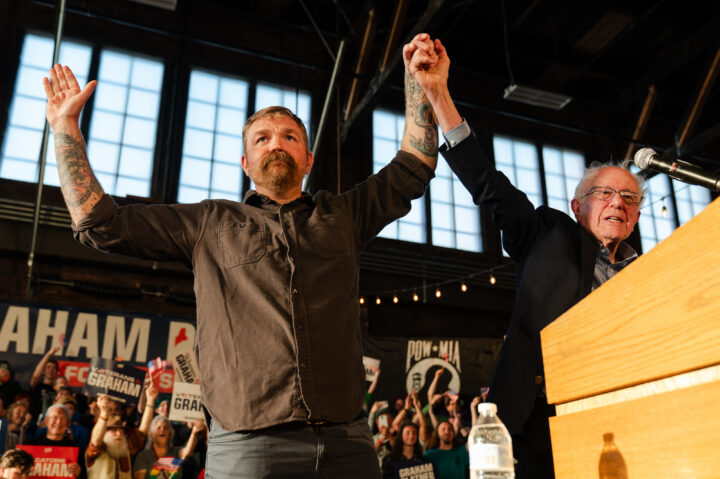
Sophie Park/Bloomberg via Getty Images
Graham Platner, Democratic Senate candidate for Maine, left, and Sen. Bernie Sanders (I-VT) during a Fighting Oligarchy event in Portland, Maine, on May 25, 2026.
The latest revelations that Graham Platner, the Democrats’ anti-establishment, far-left standard-bearer in the Maine Senate race, was sending sexually explicit texts to as many as a dozen women while he was married — an issue his wife raised to campaign staff as a potential liability — is another sign that the candidate’s extensive baggage may be too much for the party to handle. (As commentator Haviv Rettig Gur posted on X: “I’m starting to think that SS tattoo might have been a red flag.”)
Meanwhile, a New York Times interview, published over the weekend, with leading New Jersey Democratic congressional candidate Adam Hamawy about his past affiliations with Islamist extremists is going to raise more red flags for Democrats.
Asked about his travels with Omar Abdel Rahman, known as the “Blind Sheikh,” who was connected to the 1993 World Trade Center bombing, Hamawy downplayed the spiritual leader’s jihadist sermons. “He wasn’t preaching death and destruction all the time,” Hamawy said. “He had certain views that he spoke in certain forums, but that’s not what he did every single day.”
With the calendar now approaching June, it’s yet another reminder that Democrats are on the verge of nominating some truly radical and damaged candidates for congressional office as a critical mass of primaries take place this month.
Many of the races are taking place in safely blue seats, so Democrats haven’t raised that much concern over candidates such as Hamawy, whose terror ties (including volunteer work for what was later revealed as an al-Qaida front group) at the very least, raise questions about suitability for public office.
But others, such as Platner, are running in battleground Senate seats where the stakes couldn’t be higher. In California and Montana, candidates are running in swing districts where the battle for the House majority will be fought.
If May was the month that tested President Donald Trump’s power over the Republican Party (lesson: he’s still firmly in control of GOP voters), June will be the month that determines whether the Democratic Party is going to abandon its moderate moorings and nominate a roster of radicals.
The stakes couldn’t be higher — especially for Jewish Democrats, who have been among the leading voices alarmed by the rise of these candidates, who, not surprisingly, often hold virulently anti-Israel views and don’t have a problem mainlining antisemitic rhetoric.
While Platner’s expected nomination and Hamawy’s potential one are generating the most attention, several under-the-radar races will have a direct bearing on the Democrats’ midterm prospects.
In California’s congressional races, the pro-Israel advocacy group Democratic Majority for Israel has been involved in two swing-district races where the group fears left-wing candidates could jeopardize the party’s chances of a pickup. In the seat held by Rep. David Valadao (R-CA), the group endorsed Assemblywoman Jasmeet Bains and has been airing ads on her behalf in the Central Valley-based district.
Bains is facing a Democratic challenge from school board trustee Randy Villegas, who has landed endorsements from many of the leading anti-Israel lawmakers in Congress and who many Democrats fear could cost the Democrats a seat if he’s the nominee against the battle-tested Valadao.
In the race to succeed retiring Rep. Darrell Issa (R-CA) in a San Diego-area district, the pro-Israel group has endorsed San Diego Councilwoman Marni von Wilpert, who is running against Ammar Campa-Najjar, who is of mixed Palestinian and Mexican American descent and has twice unsuccessfully run for Congress. The district was redrawn to elect a Democrat, but it still remains a competitive battleground.
In Iowa, Democrats will be choosing whether to nominate the party-favored state Rep. Josh Turek, the more moderate candidate, or go with a true-blue progressive in state Sen. Zach Wahls. The nominee is expected to face Rep. Ashley Hinson (R-IA) in a state that Democrats hope will become competitive, given the rough national environment for Republicans.
And in Montana’s 1st District, in the race to succeed retiring Rep. Ryan Zinke (R-MT), Jewish leaders are alarmed by several candidates in the Democratic primary field over their anti-Israel rhetoric and online antisemitic activity. Army veteran Matt Rains appears to be the most mainstream Democratic candidate of the four in the race, but lags behind in fundraising.
The district has been solidly Republican since its creation, but in a Democratic wave, it’s competitive enough that it could flip. Given the extreme rhetoric of some of the Democratic candidates, however, that prospect would be less likely.
Also of note: Los Angeles voters will be determining which two candidates will square off in a runoff for mayor. Assuming embattled Los Angeles Mayor Karen Bass finishes in the top two, her opponent will either be running further to her left (Los Angeles City Councilwoman Nithya Raman) or to her right (reality star Spencer Pratt). The matchup will determine whether the campaign focuses more on catering to progressive voters or moderates disenchanted with the direction of the city.
Pro-Israel Democrats can express some relief after results out of North Carolina and Texas

JEFF KOWALSKY/AFP via Getty Images
People cast their in-person early ballot for the 2024 general election at the Northwest Activities Center on October 29, 2024 in Detroit, Michigan.
A strong anti-incumbent mood is apparent in the electorate, based on primary results from North Carolina and Texas’ congressional primaries Tuesday night. Meanwhile, one sitting Democratic lawmaker who lost support from AIPAC is narrowly fending off a challenge from a virulently anti-Israel challenger who campaigned in the closing days of the primary against the Iran war.
Big picture: There’s a deep skepticism of the political establishment throughout the country within both parties. Rep. Dan Crenshaw (R-TX), a center-right hawk who was one of the stars of the 2018 GOP freshman class, badly lost to state Rep. Steve Toth, a right-wing challenger backed by Sen. Ted Cruz (R-TX).
Sen. John Cornyn (R-TX) is doing a bit better than public polls suggested, but still is only polling in the low 40s against MAGA-aligned Texas Attorney General Ken Paxton in a race that’s headed to a runoff.
Rep. Tony Gonzales (R-TX), who has been enmeshed in scandal after his extramarital affair with a staffer, who later died by suicide, became public, is leading social media influencer Brandon Herrera, but is also only polling in the low-40s and will also be headed to a runoff.
On the Democratic side, Rep. Valerie Foushee (D-NC), who was boosted to office in 2022 with AIPAC support but has since grown more critical of Israel, is clinging to a one-point lead (49-48%) over Durham County Commissioner Nida Allam, who would have become one of the most anti-Israel lawmakers in Congress if she was elected. Allam was backed by the far-left Justice Democrats and received support from a new super PAC attempting to elect anti-Israel lawmakers.
The Iran war may have played a key role in the primary. Foushee won the early vote by an eight-point margin, but Allam carried the Election Day vote by six points — after airing an ad blasting the war in Iran and baselessly accusing the United States of targeting civilians.
And in a member-against-member Democratic primary in Texas, Rep. Al Green (D-TX), one of the most left-wing members of Congress who has been a reliable vote against Israel, is narrowly trailing newly elected Rep. Christian Menefee (D-TX), a more mainstream Democrat. Menefee looks like the favorite, but is short of the 50% necessary to avoid a runoff.
Meanwhile, former Rep. Colin Allred (D-TX) is on track to reclaim his old suburban Dallas seat, unseating Rep. Julie Johnson (D-TX) in the process. But he’s likely heading to a runoff as well.
All told, pro-Israel Democrats can express a bit of relief toward Tuesday night’s primary results. Assuming Foushee holds on to victory, it blocks the path of a Rep. Rashida Tlaib (D-MI) prototype from getting elected to Congress. If Allam prevailed, she could have held that safely Democratic seat — and an anti-Israel platform — for many years.
And Menefee’s advantage against Green in Texas is undoubtedly a win for Jewish voters, potentially replacing an anti-Israel detractor with a stronger ally (if he holds on in the runoff).
On the negative side, the successor to Rep. Jasmine Crockett (D-TX) in the House is expected to be Frederick Haynes III, the congresswoman’s pastor who delivered a scathing sermon against Israel one day after Hamas’ Oct. 7 terror attack against the Jewish state. Haynes was backed by Justice Democrats and an anti-Israel group (IMEU Policy Project), but didn’t have much serious primary competition.
The highest-profile race of the night was Crockett’s Senate primary campaign against state Rep. James Talarico. Talarico prevailed, defeating Crockett 53-46%, with most votes counted. Talarico is hoping to emerge as a sleeper candidate in red-state Texas, and some Democrats believe he has an outside chance of succeeding — especially if he faces the scandal-plagued Paxton.
A few general election showdowns also now look set: Rep. Don Davis (D-NC), drawn into a tougher district, will face a rematch against Republican retired Army Col. Laurie Buckhout this year. And Rep. Vicente Gonzalez (D-TX), drawn into a more Republican district, will face Republican attorney Eric Flores — in a key bellwether race of whether Republicans will be able to maintain their recent inroads with Hispanic voters.
Please log in if you already have a subscription, or subscribe to access the latest updates.
 Continue with Google

 Continue with Apple