














































































The letter, championed by the Caliifornia Democrat, currently has 30 Democratic co-signatories
Andrew Harnik/Getty Images
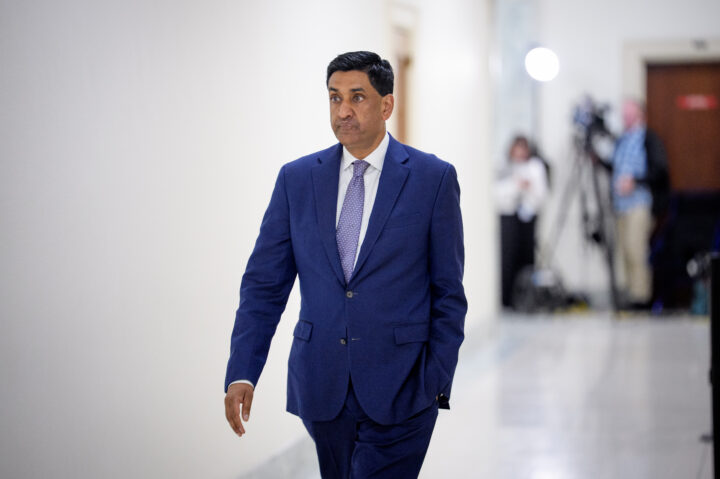
Rep. Ro Khanna (D-CA) on Capitol Hill on May 18, 2026, in Washington, DC.


 Add JewishInsider on Google
Rep. Ro Khanna (D-CA) and a group of at least 30 Democratic colleagues in the House and Senate are set to urge House and Senate leaders negotiating the 2027 National Defense Authorization Act to strip out a provision regarding U.S.-Israel cooperation that has drawn backlash from the far left and far right, according to a draft of the letter viewed by Jewish Insider.
Khanna has been a leading opponent of the provision since the NDAA came through the House Armed Services Committee, where his effort to remove the provision was defeated by a voice vote. House Republicans did not permit a vote on an amendment by Khanna and Rep. Thomas Massie (R-KY) to remove the provision when the bill came to the House floor.
The bill is likely to be largely finalized in negotiations between House and Senate committee leadership before it comes before both chambers for a final vote. Khanna’s letter, which is set to continue gathering signatures through Nov. 6, appeals to the chairs and ranking members of the House and Senate Armed Services Committees to strip the provision, versions of which have been included in both the House and Senate versions of the bill, as part of the negotiations.
The letter describes the provision as creating an “unprecedented integration of the United States defense industry with the defense industry of a foreign nation,” and describes the process to advance the provision as rushed and requiring greater deliberation as part of a “fundamental reassessment of the U.S.-Israel security relationship.”
“These provisions would significantly reduce Congress’ oversight of the U.S.-Israel defense relationship,” the letter states. “They would embed Israeli technology directly into acquisition programs and co-production lines, and once those commitments are made, the cost of reversing them may become prohibitive for any future President or Congress.”
The letter urges that, if the provision isn’t removed entirely, Congress should be required to reauthorize it annually, that human rights conditions should be added and that a counterintelligence certification should be required in advance of any technology transfer.
The provision, based on the U.S.-Israel FUTURES Act, would largely streamline and expand a variety of areas of cooperation that already exist between the U.S. and Israel. Its supporters, on a bipartisan basis, have argued that it significantly benefits the United States and its service members through access to Israeli technology and that opponents have misrepresented the provision and overstated the scope of its impact.
Supporters have emphasized that the provision would create no new programs nor provide for greater integration of the U.S. and Israeli militaries, and that it requires regular transparency reports to Congress and the public on the cooperative programs.
Khanna’s letter asserts that the provision would “reward” Israeli actions in Gaza, the West Bank and Lebanon, arguing, “These are not the actions of a government whose defense establishment should be granted deeper access to American military technology, nor rewarded with U.S. defense contracts.”
The letter further alleges that by utilizing Israeli technological innovations or working with Israel on such innovation, the U.S. would be “morally and legally implicate[d]” in alleged Israeli violations of international human rights law.
Though previous NDAAs already provided for U.S.-Israel cooperation on “emerging technologies” including artificial intelligence, cybersecurity, quantum computing and automation, with requirements to protect sensitive information and technology from adversaries, the letter frames the provision as a novel risk to U.S. technology security.
And it describes the provision as potentially damaging to American industry, though the cooperative programs are designed to support and grow the defense industrial bases of both countries.
The letter also again links the NDAA provision to a letter by Israeli Prime Minister Benjamin Netanyahu supporting winding down direct U.S. aid, which referenced an entirely separate resolution.
Current signatories to the letter include Sens. Jeff Merkley (D-OR) and Bernie Sanders (I-VT) and Reps. Don Beyer (D-VA), Andre Carson (D-IN), Greg Casar (D-TX), Joaquin Castro (D-TX), Jasmine Crockett (D-TX), Madeliene Dean (D-PA), Chris Deluzio (D-PA), Mark DeSaulnier (D-CA), Maxine Dexter (D-OR), Veronica Escobar (D-TX), Valerie Foushee (D-NC), John Garamendi (D-CA), Val Hoyle (D-OR), Jared Huffman (D-CA), Jonathan Jackson (D-IL), Pramila Jayapal (D-WA), Zoe Lofgren (D-CA), Stephen Lynch (D-MA), Jim McGovern (D-MA), Analilia Mejia (D-NJ), Chellie Pingree (D-ME), Mark Pocan (D-WI), Emily Randall (D-WA), Lateefah Simon (D-CA), Melanie Stansbury (D-NM), Derek Tran (D-CA), Gabe Vasquez (D-NM) and Bonnie Watson Coleman (D-NJ).
The proposed restrictions come after top Senate lawmakers publicly expressed frustration in recent months with the LAF’s failure to take concrete steps to fully disarm Hezbollah
MAHMOUD ZAYYAT / AFP via Getty Images
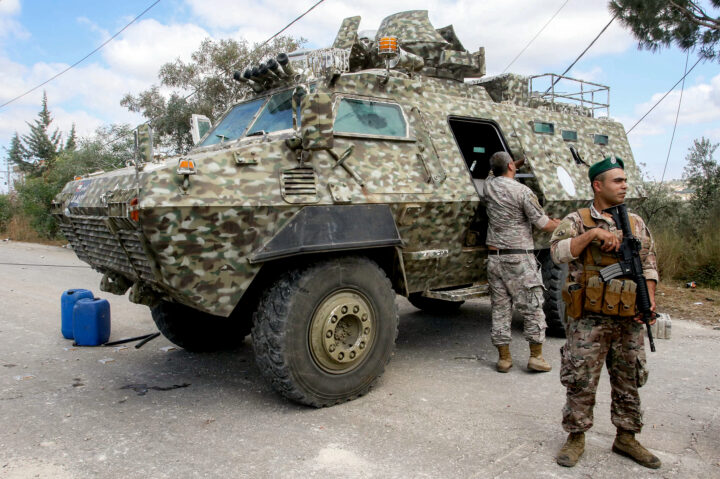
Lebanese army forces set up a checkpoint at the entrance of the village of Ghandourieh in southern Lebanon on June 15, 2026, preventing people from crossing towards villages the Israeli military is believed to have deployed.
The Senate’s version of the 2027 National Defense Authorization Act proposes sweeping new conditions on U.S. support for the Lebanese Armed Forces. The proposed restrictions come after top Senate lawmakers publicly expressed frustration in recent months with the LAF’s failure to take concrete steps to fully disarm Hezbollah, and argued that the U.S. should not provide unconditional funding for the LAF.
Sen. Roger Wicker (R-MS), the chair of the Armed Services Committee, which produces the NDAA, said in late April that “Congress should not support the LAF unless it acts to disarm Hezbollah completely — and immediately.”
Sen. Jim Risch (R-ID), who chairs the Foreign Relations Committee, echoed Wicker, adding that it was “well past time for the LAF to take tangible action to fully disarm Hezbollah and for the Lebanese government to follow through on long-promised economic reform. The era of complacency and unconditional bailouts must come to an end.”
Support for the LAF, which would be limited to no more than $36 million, is conditioned on the LAF’s work to disarm Hezbollah. No more than 5% of that funding can be provided until the administration certifies to Congress that Lebanon has outlawed Hezbollah’s activities and that the LAF is actively working to disarm Hezbollah, prevent the Iranian-backed group’s rearmament and prevent attacks on Lebanon’s neighbors — including Israel.
The administration would then be required to re-certify every 90 days to Congress that the LAF is continuing to act against Hezbollah to the full extent of its capabilities, with a mandatory suspension of aid if it cannot meet that certification.
The quarterly reports would also include specific data on the number of weapons seized from Hezbollah and other metrics regarding the LAF’s efforts to degrade Hezbollah, as well as the makeup and capacities of the LAF forces.
President Donald Trump on Tuesday publicly condemned Israel’s operations against Hezbollah, suggesting — in a move that baffled both lawmakers and experts — that Syria’s military could instead be called upon to deal with the Hezbollah threat.
The NDAA would block U.S. counterterrorism assistance to Syria until the administration can certify the Syrian government is taking action to demobilize, disarm and monitor foreign fighters and jihadists in the country, implement a system to “fairly integrate” the Kurdish-led Syrian Democratic Forces into the Syrian military and prevent attacks on minorities including Kurds and Druze.
The provision comes amid continued scrutiny on Capitol Hill of the Syrian government’s efforts to protect minorities after the U.S. withdrew sanctions on the Syrian government.
As previously reported, the NDAA, which was finalized last week but not released in full until Tuesday, includes a version of the FUTURES Act, which has become a hot-button issue in the context of the House version of the NDAA, seeking to centralize and expand existing defense collaboration efforts between the two partners.
But it also includes a second provision on joint development, requesting the administration provide Congress with a plan to establish a partnership between the U.S. and Israel on defense industrial priorities, with the goal of supporting the defense industrial bases in both countries, providing opportunities for industries in both countries to cooperate and collaborate and supporting defense development and startups in both countries.
The legislation additionally proposes boosting funding for cooperation on subterranean operations — previously billed as counter-tunnelling efforts — from $80 million to $100 million, and counter-drone programs from $70 million to $100 million. The bill also authorizes $1 million for cybersecurity cooperation with Israel.
That funding would still have to be approved separately in the appropriations process later this year.
The NDAA also includes two different provisions to enhance defense cooperation with both Israel and other Middle East allies.
One, the Abraham Accords Defense Cooperation Initiative, would establish a program to expand defense cooperation between the U.S. and the Abraham countries, to address various threats in the region. It encourages each country in the region to provide matching funds for the program.
The other, which pulls language from the OASIS in the Middle East Act, aims to develop a coordinated air- and missile-defense acquisition strategy alongside Israel, Abraham Accords members and other Middle East allies to ensure adequate resources to protect the U.S. and its allies in the event of future conflicts.
The provision further requires the administration to explain its work to replenish interceptor stockpiles that have reportedly been severely degraded in the war, assess the possibility for co-production with various Middle East allies of interceptor systems, consider an creating an air-defense stockpile in the Middle East and improve joint development and acquisition of low-cost interceptor options.
The NDAA, which provides formal congressional authorization for the Civil Military Cooperation Center overseeing the implementation of the ceasefire plan in Gaza, requires the administration to provide Congress with information on plans for and actual deployment of the International Security Force in Gaza and its involvement in disarming Hamas, as well as on granular, specific details on the amount and types of aid moving into Gaza.
Plans for the ISF have largely failed to materialize, and the force has not yet deployed inside Gaza, where efforts to disarm Hamas have stalled in light of the terrorist group’s intransigence.
Former U.S. Ambassador Daniel Shapiro called the provision largely ‘unremarkable,’ countering claims from the extremes that it would mark a surrender of U.S. sovereignty

Zack Frank
Capitol Building
A relatively routine provision that aims to facilitate expanded U.S. cooperation with Israel in the House’s draft of the 2027 National Defense Authorization Act has fueled outrage from the far left and far right, with some prominent figures making inaccurate claims that the provision would subjugate the U.S. military to Israel or otherwise compromise U.S. sovereignty.
The turmoil appears to have begun with an article published in the isolationist Quincy Institute’s Responsible Statecraft journal that claimed the legislation “would all but fuse the two countries’ armed forces together.”
The backlash has gained widespread attention, from current and former lawmakers, anti-Israel commentators and even a celebrity news account with more than 3.5 million followers on X — an unusual series of events for the wonky annual defense policy bill.
Critics are objecting to a provision in the bill, the “United States-Israel Defense Technology Cooperation Initiative,” which aims to expand and accelerate joint U.S.-Israel technological development and industrial cooperation; allow the U.S. to quickly adopt proven Israeli technologies; and promote joint training exercises, information sharing and co-production in areas including defense manufacturing, anti-tunneling, air- and missile-defense and various advanced technologies.
But the U.S. already has established cooperative programs in Israel in many of the areas enumerated in the bill, set up in previous years’ NDAAs and defense budget bills, without much fanfare — so the sort of cooperation laid out in the bill is hardly new, unprecedented or a significant change.
The language also closely hews to bipartisan legislation in both chambers, the U.S.-Israel FUTURES Act, which has 46 co-sponsors in the House and 11 in the Senate. Those bills aim to leverage U.S. and Israeli technology and innovation to assist in the defense of both countries.
“This provision promotes ongoing, and in some ways, expanded cooperation between the United States and Israel in developing key military technologies. It is quite unremarkable,” Daniel Shapiro, a former U.S. ambassador to Israel and senior Pentagon official who is now a distinguished fellow at the Atlantic Council, told Jewish Insider. “Those describing it as promoting ‘integration’ between the U.S. and Israeli militaries are making a mountain out of a molehill. But these days, there are a lot of people trying to make molehills into mountains in this arena.”
Critics on both sides of the aisle are mobilizing against the legislation.
Rep. Thomas Massie (R-KY) suggested that the legislation would undermine American sovereignty and vowed to introduce an amendment to strip it out of the bill if it makes it through the committee process.
Rep. Ro Khanna (D-CA), who sits on the Armed Services Committee, said he’ll try to remove the provision during the committee markup later this week. “Trump can’t kill the Massie/Khanna partnership no matter how much he posts on Truth Social,” Khanna said.
“Looking forward to posting that roll call vote from the Armed Services committee,” Massie responded. “Maybe they’ll go ahead and strip the provision instead of taking the vote, now that people are on to them.”
Anti-Israel commentators have also seized on the provision.
“This is what complete capture to a foreign government looks like and there hasn’t been a single shot fired,” former Rep. Marjorie Taylor Greene (R-GA) declared.
Former State Department official Josh Paul, an anti-Israel activist, claimed the provision would “intertwine our military with Israel’s” and give Israel “incredible leverage over America’s own defense priorities.”
The condemnation of this provision also foreshadows potential objections to future efforts to shift the U.S.-Israel relationship away from direct aid and toward jointly funded cooperative programs.
Indeed, Paul highlighted that likely shift as a reason to oppose this provision in a video on the subject.
In addition to the new cooperation provision, the NDAA draft includes language extending the U.S. weapons stockpile in Israel, counter-tunneling cooperation programs and counter-drone cooperation programs through 2029.
It authorizes $50 million for cooperative programs in emerging technology, as well as $100 million for each of the counter-drone and counter-tunneling programs and an annual $300 million for cooperative air defense systems including Iron Dome. All of that funding would still have to be appropriated separately.
It also praises the U.S. relationship with Jordan and urges efforts to expand cooperation with Amman, including on integrated air- and missile-defense systems and cybersecurity cooperation efforts.
Democrats are likely to push a range of other amendments related to the war in Iran at Thursday’s markup.
Notably, the bill backed by House Republicans also includes several provisions designed to hamstring isolationist-minded moves by the Trump administration, including limiting troop drawdowns from Europe and South Korea. It would also freeze construction of the “Trump-class” battleship until the technology is better developed.
Please log in if you already have a subscription, or subscribe to access the latest updates.
 Continue with Google

 Continue with Apple