





































David Flippo received the legal allowable limit in donations from commentator Robert Beadles in May and June, the only donations Beadles has made thus far this election cycle
(Bill Clark/CQ-Roll Call, Inc via Getty Images)
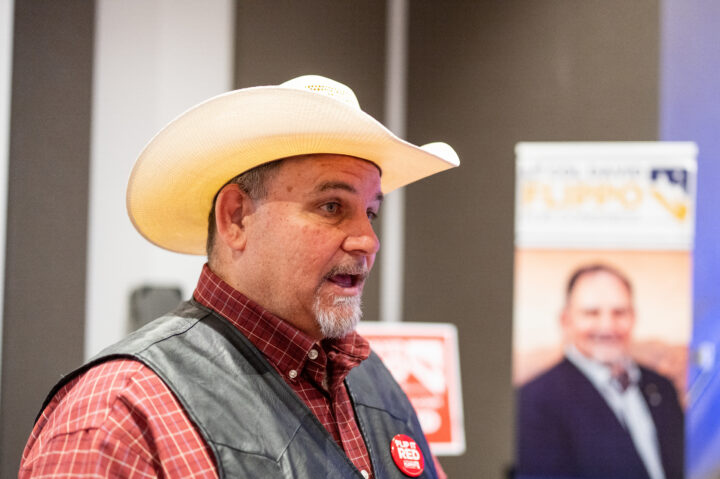
David Flippo, Republican candidate for Nevada's 4th Congressional district, speaks to Republicans gathered for the Freedom Rally and Candidate Roundup at the Ahern Hotel in Las Vegas, Nev., on Thursday, May 23, 2024.


 Add JewishInsider on Google
David Flippo, the Republican nominee in Nevada’s 2nd Congressional District, accepted a max-out donation from Robert Beadles, a prominent local GOP donor and commentator who has repeatedly promoted the Protocols of the Elders of Zion and other antisemitic conspiracy theories.
Flippo, a military veteran who is running in a district that strongly favors Republicans to replace Rep. Mark Amodei (R-NV), has positioned himself as a close ally of the Jewish community. But according to FEC records, he has received $7,000 in donations from Beadles — the legal allowable limit — in May and June of 2026, the only donations Beadles has made thus far this election cycle.
Beadles is one of several dozen donors to give similar max-out donations to Flippo’s campaign, but according to reporting by The Nevada Independent, Beadles is a prominent Republican activist and donor in the state who has worked to “reshape Nevada politics” at all levels.
The outlet reported that Beadles has repeatedly referenced and promoted in video streams and other commentary the Protocols of the Elders of Zion — the debunked antisemitic pamphlet claiming a global Jewish conspiracy to take over the world — as factual.
He discussed the Protocols on at least 12 livestreams in 2021 and encouraged listeners to read the work for themselves, denying evidence that the pamphlet is a fabrication. He has at times linked discussions of the Protocols to claims of election fraud in the 2020 presidential race.
Reached for comment, Flippo’s campaign described the candidate as an “an ardent supporter and close ally of the Jewish community,” noting that he serves as a member of the Republican Jewish Coalition leadership council and that he started a charity after the Oct. 7, 2023, Hamas attacks on Israel to send food to Israelis in need.
The RJC did not respond to a request for comment.
The Nevada Independent reported that Beadles’ history of antisemitic conspiracy theories goes back to at least 2009, when, in a book he wrote, he cited conspiracy theories that the Rothschilds, the Jewish banking family, had conspired to control various countries’ finances as well as worshipped Satan and had foreknowledge of the 9/11 terrorist attacks.
Beadles went on to state that he neither agreed nor disagreed with those conspiracies and that he had no proof of them, nor did their proponents. But, The Nevada Independent said, he “devoted the first three paragraphs of the introduction [to his book] to conspiracy theories involving the Rothschild family.”
Beadles also maintained an account on and was an early investor in Gab, the social media platform that became a hotbed of white nationalists and antisemites, and interviewed the site’s founder, Andrew Torba, who has engaged in antisemitism.
Beadles did not respond to a request for comment.
The Flippo campaign also told JI that his Democratic opponent, former state Rep. Teresa Benitez-Thompson, has “given into the rising anti-semitism of her own party by refusing donations from American citizens who support Israel”.
Benitez-Thompson has said on the campaign trail that she will reject support from AIPAC (not necessarily all supporters of Israel, as suggested by the Flippo campaign) and that the United Nations, which has described the war in Gaza as a genocide, “had the opportunity to leverage sanctions … but they didn’t move forward with any action.”
On her campaign site, she calls for the U.S. to phase out military aid to Israel and to place conditions on any further arms sales to the Jewish state.
The Flippo campaign noted that Benitez-Thompson has received donations from a prominent local politician affiliated with the Democratic Socialists of America which “engages in blood libel by calling Israel’s actions to defend itself genocide, celebrated the October 7th attack, and falsely describes Israel as an apartheid state.”
While Jewish community leaders expressed concerns about Aisha Wahab, one said they were skeptical that she was beatable and that the AIPAC spending risked further alienating the potential nominee
Tayfun Coskun/Anadolu via Getty Images
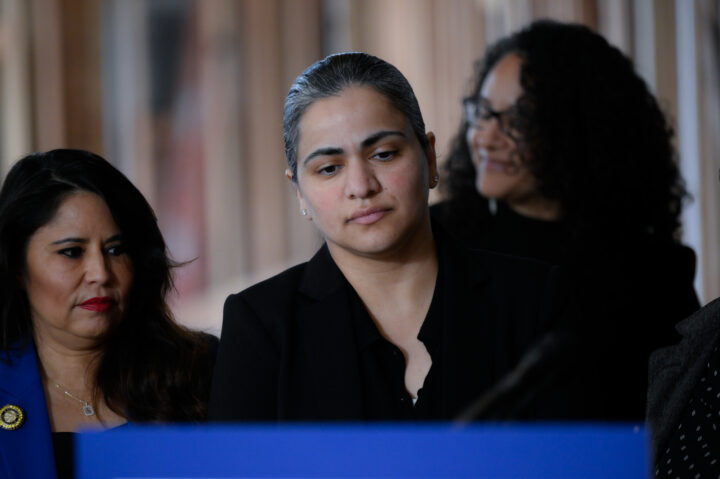
California state Sen. Aisha Wahab attends a press conference in Hayward, Calif., on March 2, 2026.
After a night of mixed results in Tuesday’s primary elections, AIPAC’s United Democracy Project super PAC is turning its eyes toward the special election runoff in California’s 14th Congressional District, where progressive state Sen. Aisha Wahab and moderate local mayor, Melissa Hernandez, are competing to replace disgraced former Rep. Eric Swalwell (D-CA).
Wahab entered the race as the heavy favorite and dominated the primaries for both the regular and special elections. In the special election primary, Wahab finished with 43% to Hernandez’s 17%, and led Hernandez 38%-17% in the regular primary. The special election runoff is set for Aug. 18.
Her record raises concerns for some members of the Jewish community — she has not been supportive of numerous priority bills and resolutions aimed at tackling antisemitism and has been a vocal critic of Israel, including describing the war in Gaza as a genocide and championing legislation in the state Senate on the issue.
UDP’s initial ad buy in the race totaled $1.2 million.
One of UDP’s ads accuses Wahab of being soft on crime — pointing to an amendment she led to a sex trafficking bill — and describes Hernandez as tough on crime and supported by police. Other pro-Hernandez groups are running with a similar message. Another highlights her background and work on affordability issues.
In a page on her website responding to attacks, Wahab’s campaign accused Hernandez of “relying on misleading attacks and AIPAC-linked dark-money PACs to tear Aisha Wahab down.” The page takes aim at Hernandez for having “denied the genocide in Gaza” — she declined to provide a yes-or-no answer on the subject at a candidate forum — and shared a spreadsheet naming all of the individual “AIPAC-linked donors” supporting Hernandez’s campaign.
“Wahab has accused Israel of committing genocide and has separately published the names of Jewish donors to her opponent on her website. She’s pretty extreme in her points of view on Israel,” UDP spokesperson Patrick Dorton told Jewish Insider. “It’s a race where Wahab is talking about ideological issues and Hernandez is talking about economic and affordability issues that are important to voters in the district.”
Bold America PAC, linked to the Congressional Hispanic Caucus, has spent more than $2 million so far attacking Wahab and supporting Hernandez. The group has taken some donations from an AIPAC-affiliated group. A new pro-Hernandez group, Safer Alameda County, has spent $51,000 so far.
Daniel Klein, the CEO of Jewish Silicon Valley — which is nonpartisan and does not take stances in elections — said that Jewish community leaders are paying close attention to the race, and he has heard significant concern about Wahab’s votes on major antisemitism legislation and her close relationship with state teachers’ unions, which have opposed antisemitism bills.
“That is, I think, creating some angst — or at least more attention to this race — amongst many members of the Jewish community and Jewish communal organizations,” he continued, relating conversations he’s had with members of the community. “These are pieces of legislation that are intended to protect our children, right? They should be fairly non-controversial.”
Wahab was one of three senators who voted against SB 1287, which required overhauls of campus codes of conduct to address antisemitic and anti-Israel demonstrations, and abstained from a floor vote on AB 715, which aimed to address antisemitism in K-12 schools.
Klein said he has not had the opportunity to meet with Wahab personally and is happy to meet with any elected leader. He said he had spoken with Hernandez, who seemed to him primarily focused on local issues and national partisan politics, rather than foreign policy, though he said that she seems to understand the Jewish community’s concerns about antisemitism and is receptive to hearing from the community.
“My record speaks for itself: I have consistently stood against antisemitism, supported the safety and security of Jewish communities, worked in partnership with Jewish colleagues, and defended Israel’s right to exist — while also maintaining that as an American elected official, I have both the right and the responsibility to question the policies of any foreign government and to speak out when innocent civilians are suffering,” Wahab said in a statement to JI.
Though she did not support the two bills mentioned by Klein, she has supported other priority legislation for the Jewish community in the state Senate. She also introduced a resolution in 2025 with Jewish state Sen. Scott Weiner calling for the release of hostages and an end to the humanitarian crisis in Gaza.
Another Jewish leader said Hernandez had attended various Jewish community events and generally has good relationships with the community but isn’t particularly involved with its issues. The district itself is not home to a sizable Jewish community.
Oleg Ivanov, executive director of StandWithUs Northern California, said, “We’re of course concerned that as a state senator, Aisha Wahhab has called Israel’s defense against the Hamas attack [on Oct. 7, 2023,] genocide. So we’re concerned that she is spreading this debunked blood libel about Israel, which we feel all that does is it makes Jews and Israelis here in her district unsafe. As we’ve seen in many cases, this kind of irresponsible language has led to direct violence against Jews and Israelis.”
Ivanov said he hasn’t had any interaction with Hernandez, but praised her for declining to describe the war in Gaza as a genocide. He also criticized Wahab’s opposition to antisemitism-related legislation.
But another Jewish leader in the district, who requested anonymity to speak candidly, said that the strong consensus among political observers in the area is that Wahab “pretty much [has] this in the bag, and that Hernandez is a lazy campaigner.” Other moderate groups that had looked at the district “just have not been impressed with Hernandez,” the leader continued.
The Jewish community, the leader said, doesn’t want Wahab to win, but that might already be a foregone conclusion.
“I’m not in principle against AIPAC getting involved in these kinds of primaries like some other people [are], but based on all the local knowledge that we’re hearing from politicos, it’s not a good use of time or money,” the leader said. “People are kind of scratching their heads — not because there aren’t concerns about Wahab … but let’s play where we can win.”
The leader said they’re also concerned that AIPAC’s involvement risks pushing Wahab further to left, describing Wahab currently as a less-than-ideal choice but necessarily aligned with the Squad — i.e., not opposed to Israel’s existence or outright at odds with the Jewish community.
The leader noted Wahab abstained on, rather than outright opposed, AB 715, one of the antisemitism bills. They also noted that Wahab’s family are refugees who escaped radical Islam in Afghanistan during the Soviet-Afghan war. Wahab has relationships with some Jewish community groups in the Bay Area, particularly social services organizations that have been involved in Afghan refugee resettlement work.
“I don’t like the idea that the pro-Israel community is jumping into a race they can’t win against the presumptive winner and potentially pushing her into the arms of the worst members of Congress,” the leader said. “I think that people need to play their cards carefully here. There’s shades of gray at play.”
William Lawrence, who has won support from progressive lawmakers and groups, has been under fire for his comments attacking Kamala Harris and denigrating Black political leadership
Wikimedia Commons
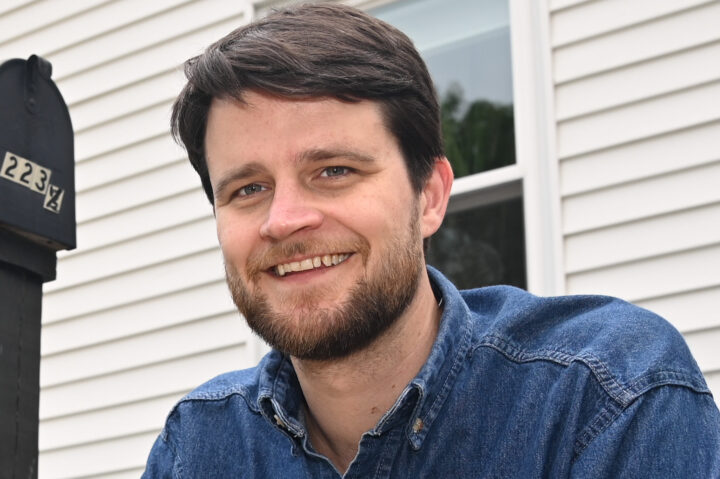
William Lawrence
William Lawrence, a virulent Israel critic gaining momentum among progressives in Michigan’s battleground 7th Congressional District, is facing a wave of criticism over past comments denigrating Black political leadership, attacking former Vice President Kamala Harris.
As a result, Lawrence is now facing the opposition of an outside group aiming to block him from winning the Democratic nomination.
The swing district, currently held by Rep. Tom Barrett (R-MI), is a critical pick-up opportunity for Democrats in order to take back the House. It was previously held by Sen. Elissa Slotkin (D-MI), and is currently rated by the Cook Political Report as a toss-up.
On the campaign trail, Lawrence has called for an end to U.S. aid to Israel and accused the country of genocide, something that the other Democratic candidates, former Navy SEAL Matt Maasdam and former U.S. Ambassador to Ukraine Bridget Brink, have declined to do.
During a candidate forum, Lawrence said that Israel “has refused every other form of accountability and we continue to arm them.”
“I don’t know how we can call ourselves a just nation, and my heart is pounding becasue it is dispiriting in our politics to see how many people still refuse” to call Israel’s war in Gaza a genocide, he said in response to the other candidates. “I support a lasting peace for all Palestinians and Israelis. Everybody deserves to live with security and in comfort. We got a lot of work to do with them.”
He said in September 2025 that the war in Gaza involved “war crimes on an historic scale,” adding that it’s a “moral necessity” to stop arming Israel, which is also “the best leverage the U.S. has to end the genocide in Gaza, apartheid conditions in the West Bank, ensure the hostages are finally freed, and move towards a lasting peace for Palestinians and Israelis.”
Asked on the campaign trail whether he views the Iranian regime as “evil,” Lawrence said he did not. “I do not believe any regime in the world is wholly good or wholly evil,” Lawrence said.
He has also called Israel’s operations in Lebanon “a war of aggression and territorial expansion” and said that the situation in Gaza constitutes an “ongoing genocidal siege,” despite the ceasefire and provision of humanitarian aid.
As early as Oct. 9, 2023, Lawrence condemned a public statement by American and European leaders denouncing the Hamas attacks and supporting Israel’s efforts to defend itself.
“This looks like a green light for Israel to bombard Gaza with impunity, regardless of the civilian toll or risk of a regional war. Scary hours. I fear for where this will end up,” Lawrence said.
Maasdam and Brink are preferred by moderate Democrats to face off against Barrett.
Lawrence is a co-founder of the Sunrise Movement, the far-left climate movement that has since refocused significantly on anti-Israel activism. He has also made opposition to data center construction a key feature of his campaign.
Lawrence has recently landed in hot water and faced condemnation from leaders and groups including the Congressional Black Caucus PAC over past comments in which he described Black political leaders as a “pillar” of the “establishment, capitalist, imperialist American power” who “[defang] the white left.” The CBC PAC called Lawrence a “national disgrace” and demanded that Lawrence’s supporters withdraw their backing.
The progressive candidate said that his comments had been “taken out of context” but the “way I made this point was clumsy, and I regret my choice of words.” He said that his comments were in response to “Black elected leaders in D.C. [who] have been among those supporting unnecessary U.S. wars and foreign intervention” and “my horror at the genocide in Gaza.”
He also described former Vice President Harris, Slotkin and Michigan Democratic Party chair Curtis Hertel, who ran for the seat in 2024, as “warmongers.” He said voting for Harris made him “sick” and was the “second or third circle of hell,” also calling her “despicable” and her campaign “cowardly.”
The 35-year-old progressive has gained attention in the past few weeks, picking up the backing of leaders including Sen. Bernie Sanders (I-VT), far-left Senate candidate Abdul El-Sayed and left-wing Reps. Jamie Raskin (D-MD), Ro Khanna (D-CA), Rashida Tlaib (D-MI), Delia Ramirez (D-IL) and Maxwell Frost (D-FL), as well as former Rep. Andy Levin (D-MI) and Pennsylvania state Rep. Chris Rabb, the Democratic nominee for a Philadelphia House seat.
Lawrence is also backed by the anti-Israel group TrackAIPAC, which has been accused of antisemitism; the Working Families Party; the Congressional Progressive Caucus; Sunrise Movement; and the Sanders-linked Our Revolution.
In a sign of concern from opponents about his momentum, Lawrence is now the target of a more than $500,000 ad buy from Crush MAGA PAC, which seeks to paint Lawrence as corrupt and unreliable.
The ad cites his support for the Uncommitted movement opposing former President Joe Biden in the 2024 primaries, work with Sunrise Movement (which the ad describes as a dark money group) and his holdings in a mutual fund (which the ad describes as investments in “Wall Street, big oil, and data centers”).
Lawrence asserted that AIPAC and Democratic Party insiders were responsible for the ad, something a United Democracy Project spokesperson denied, further suggesting that Lawrence’s comments were motivated by prejudice.
“We have absolutely no involvement in any way in running ads against William Lawrence in MI-07. It’s pure fiction and dishonest,” Patrick Dorton, spokesperson for UDP, the AIPAC-linked super PAC, said. “This assertion raises the question of whether Lawrence is trying to stir up some base prejudice in the Democratic primary against Democrats who support Israel. It’s immoral and shameful.”
The influx of outside cash will further compound Lawrence’s fundraising struggles. As of the end of April, Brink led the field with $2.3 million raised and $1.3 million on hand, followed by Maasdam with $1.7 million raised and $937,000 on hand and Lawrence with $572,000 raised and $351,000 on hand.
“Lawrence has the progressive lane to himself, the open question is how valuable that lane actually is outside of Lansing/East Lansing,” Michigan Democratic strategist Adrian Hemond told Jewish Insider. “[Michigan State University] students don’t come back until after the primary, so he’s reliant on high youth turnout to overcome his disadvantages with Black voters and seniors, but a sizable portion of the potential youth vote is home for summer break, i.e. not in East Lansing.”
But he also acknowledged that Brink and Maasdam risk splitting the more moderate lane.
In a potential acknowledgement of the political unpopularity of the war in Iran, Barrett has been one of the few House Republicans who has broken ranks with his party on Iran war powers votes, siding with Democrats to advance such measures.
Barrett also introduced legislation that would provide a limited authorization for military operations against Iran, limited in time and scope.
The top House Democrat’s decision not to fully endorse the congresswoman was highly unusual, as he later said he ‘stand[s] behind every single House Democratic incumbent’
Nathan Posner/Anadolu via Getty Images
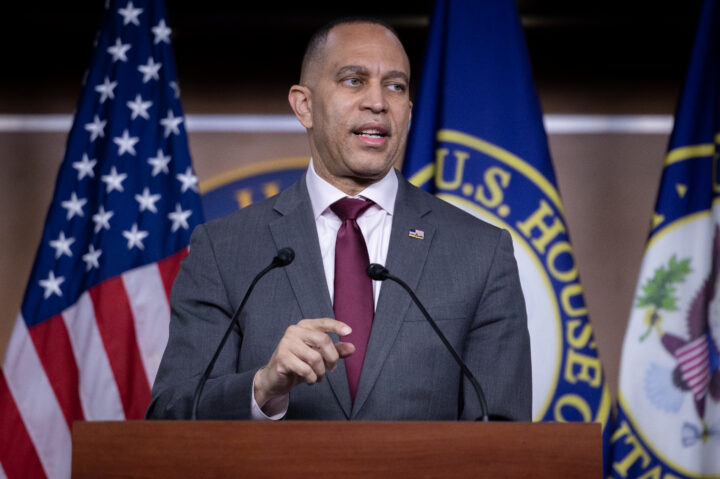
House Minority Leader Hakeem Jeffries (D-NY) speaks during his weekly press conference at the U.S. Capitol in Washington, DC on March 19, 2026.
House Minority Leader Hakeem Jeffries (D-NY) declined to fully back Rep. Debbie Wasserman Schultz (D-FL) on Tuesday, when asked at a press conference about her run in Florida’s 20th Congressional District, which has historically been represented by a Black lawmaker.
“Everybody has a right to run where they see fit,” Jeffries said. “They’ve got to go make their case to the people that they hope to represent moving forward, and that’s what I’ve communicated directly to Congresswoman Wasserman Schultz.”
Some Black Democrats in the state have condemned Wasserman Schultz for choosing to run in the 20th District after her current district was redrawn. But given that she is a member of House leadership, a longtime Democratic congresswoman and an incumbent, it’s highly unusual for Jeffries not to offer his full support to Wasserman Schultz, as he traditionally has done for incumbents of all stripes and affiliations.
Jeffries said that Wasserman Schultz has a “strong track record of accomplishment in Congress,” but also said that Florida’s redistricting was a deliberate effort to undermine Black representation.
“I think we all recognize the sensitivities of the moment in terms of an unprecedented, Jim Crow-like assault on Black political representation that has been unleashed by the Supreme Court’s outrageous decision to gut the Voting Rights Act,” Jeffries said. “And that’s an environment that all of us need to be sensitive to as we move forward.”
Jeffries’ decision not to offer his full support to Wasserman Schultz was also notable given that he said, moments later when asked about far-left challengers to other incumbents, “I stand behind every single House Democratic incumbent, whether they’re a member of the Congressional Progressive Caucus … a New Dem or Blue Dog, and I’m going to continue to do that, and then we’ll see what happens at the end of the day, in terms of what the voters decide.”
Wasserman Schultz maintained in a statement that she’d be the best advocate for the district.
“I’m thankful for the strong and broad support I’ve received all over CD20. I’ll continue to talk with Broward voters and make my case that I’ll be the most effective representative for this whole community, and as always, I’m not taking any support for granted,” she said.
Four Black candidates running in the seat met behind closed doors on Monday to discuss unifying around one candidate to take down Wasserman Schultz, the Miami Herald reported on Tuesday.
Two of the four Democrats in the race have also faced scrutiny over antisemitic activity online
Bill Clark/CQ-Roll Call, Inc via Getty Images
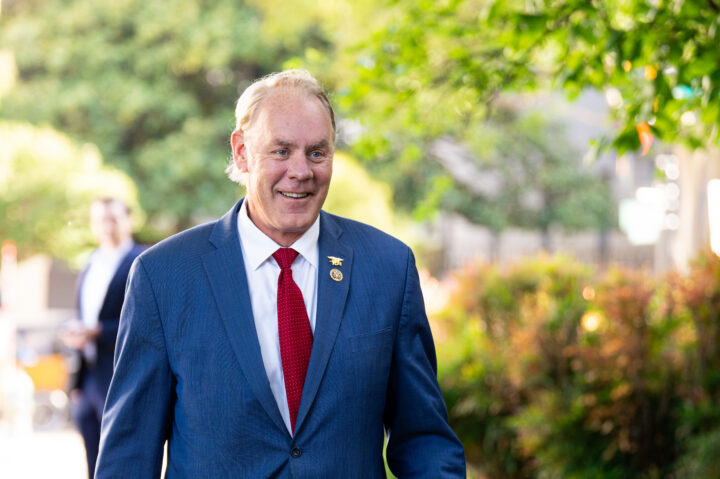
Rep. Ryan Zinke (R-MT) arrives for the House Republican Conference caucus meeting at the Capitol Hill Club in Washington on Wednesday, May 13, 2026.
In the contentious Democratic primary in Montana’s 1st Congressional District, Israel and antisemitism have become flashpoints in ways that members of the local Jewish community say they find concerning and potentially dangerous.
Rep. Ryan Zinke (R-MT), who currently represents the seat, is retiring at the end of his current term, and Democrats view it as a potential pickup opportunity in a favorable midterm climate. Former Sen. Jon Tester (D-MT) narrowly won the district in 2024, despite losing statewide. However, the Cook Political Report rates the district as “Likely Republican,” and the Democratic Congressional Campaign Committee hasn’t put the district on its target list at this point.
Though the district leans Republican, that hasn’t stopped a majority of Democrats in the field from racing to the left on Israel policy, a dynamic that was on clear display at a recent debate.
Ryan Busse, a businessman and author who is the top fundraiser among the Democratic candidates, declared that the U.S. has been “forced into a war by another country,” alleging that Israel dragged the U.S. in its military campaign against Iran.
“This war that we’re fighting, that you’re funding, that your tax dollars are funding, is largely a war propagated by Israel,” Busse said. “I’m not taking any AIPAC dollars, wouldn’t dream of it. I think we should be really wide-eyed about the degree to which Israel has too much influence over our foreign policy. “
He also declared that Israel is not a “functioning democracy” and said that Israel is committing war crimes with American tax dollars and that he would fight to stop that aid in Congress.
Russell Cleveland, a Navy veteran and entrepreneur, said that Israel “has a right to exist without fear, but that doesn’t mean that those rights can infringe on other countries’ rights or other people’s rights to exist without fear as well” and said that Israel committed genocide in Gaza.
He asserted that Israel is being held to a different standard than other countries and is effectively controlling U.S. policy.
“We have hitched our wagon so hard to Israel in turning a blind eye to their actions on a national stage that we’re willing to disregard what we would hold to account any other country for the same exact violence and war crimes and violations of international law,” Cleveland said. “We cannot allow another country to have that type of control on not only what we’re doing in terms of sending armaments and money, but also that’s an ally to the United States, so everything that they do, we too are responsible for.”
Sam Forstag, a wildland firefighter and union leader with the backing of prominent national progressives and D.C.-based groups, said that he agreed with Busse and Cleveland, also disavowing AIPAC support while blaming U.S. support for Israel for a lack of services and government assistance at home.
“We need to have strict enforced humanitarian requirements on any aid that we are providing countries overseas,” Forstag said. “That needs to apply to Israel, that needs to apply to any country, because if we cannot afford to feed our hunger, if we cannot afford to make sure that the elderly in this country are not living on the streets, we sure as hell cannot afford to rain cruelty in chaos overseas, Israel or Iran.”
Matt Rains, an Army veteran, rancher and photographer, was the only one of the four Democratic candidates to stake out an opposing view and offer a defense of the U.S.-Israel relationship.
He emphasized that he has spent time in the region, and that he understands “we need to value our alliance with Israel, and I am in support of that because I am against hatred, I’m against racism, I’m against antisemitism, I’m against terrorism.”
Rains said that actually working toward a two-state solution requires people who have firsthand experience and understand the situation on the ground, arguing that many draw incorrect conclusions from news reports.
Busse has been the top fundraiser in the field, pulling in $529,000, followed by Forstag with $448,000, Cleveland with $325,000 and Rains with $125,000. Cleveland, however, trails the rest of the field in cash-on-hand.
Antisemitic activity online has also cast a cloud over two of the candidates in the race.
Cleveland liked an antisemitic Instagram comment that read, “I wouldn’t vote for anybody who takes money from those stinking Jews,” on a post endorsing him.
Cleveland denied any knowledge of the post and disavowed it. He told the Bozeman Daily Chronicle that his campaign “incidentally liked [this] comment” and that “My team and I do not condone these types of antisemitic comments, nor support them. … This is antisemitic. I don’t approve of that comment. I wouldn’t have liked it intentionally.”
Busse’s son Lander has also landed in hot water over a series of controversial social media posts which included a spat with a local rabbi.
The younger Busse responded to a statement from Israeli Prime Minister Benjamin Netanyahu declaring that “Free Palestine is today’s version of Heil Hitler” with a gif of a “Breaking Bad” character saying, “Well, Heil Hitler b****.”
He also demanded that a local Chabad rabbi, Chaim Bruk, acknowledge that Israel is an apartheid state and conducting a genocide. When Bruk declined to do so, the younger Busse responded “aight then f*** you.”
He also said in another post “F*** ISRAEL.”
The elder Busse told the New York Post, “I don’t condone any language or actions that minimize the very real tragedy of the Holocaust, and I don’t condone any antisemitic behavior or language.”
He said he opposes antisemitism and that his son is “definitely not antisemitic in any way shape or form,” but denied having seen his son’s social media posts, which were subsequently deleted.
Bruk, the longest-serving rabbi in Montana, told Jewish Insider that he felt it was necessary to engage with Lander Busse as the son of a person running for office, when the younger Busse was spreading comments that could prompt hate against the Jewish community.
Bruk said that he also wanted to give the elder Busse “an opportunity to reach out and see if he has a very different opinion than his son — which he has not done as of today.”
Bruk argued that he’s seen little evidence that Busse’s own opinions differ from those of his son, noting that, while they haven’t engaged in the same sort of vulgarity, Busse, Cleveland and Forstag had all made concerning comments about Israel and Jews.
“I have always strongly opposed antisemitism and will continue to do so unequivocally. I am deeply troubled by the rise in antisemitic activity and rhetoric across our country, and I stand firmly with Jewish communities,” Busse said in a statement to JI. “At the same time, I am troubled by the current Israeli government’s policies and leadership. In my view, criticism of a government’s actions and policies should not be conflated with prejudice against an entire people or faith. We should be able to reject antisemitism in all forms while also engaging in honest and thoughtful discussion about the actions of governments, including Israel’s.”
But Bruk said he takes Cleveland at his word that he did not personally or intentionally like the antisemitic Instagram post.
Cora Neumann, a Jewish state senator who was a previous Democratic nominee for the 1st District seat, said she feels that many of the candidates for the seat are “getting pulled into national issues that don’t impact us, just to posture and play political games,” particularly when it comes to Israel.
She said she has found the attacks on AIPAC, which come despite the fact it hasn’t been involved in the race, “very problematic,” and has been concerned by candidates blaming Israel for the war in Iran. She said she has reached out to several of the candidates to share her perspective.
But she said she hasn’t seen many of the candidates in the race “take pause and think twice about the way you speak” about Israel, even after being warned that their rhetoric might fuel antisemitism, “which shows a disregard for a vulnerable population in the U.S. and around the world.”
“I think this is a poison that has taken hold in our party and it has made my family less safe, and there has been little to no action taken to combat it, locally or nationally,” Neumann told JI. “Democrats need to reflect on our values and who we are and if we really feel that this is acceptable. … Democrats need to seriously reflect on why they’ve let it get so out of hand.”
Asked about concerns from members of the local Jewish community about the way Israel and AIPAC have been invoked in the race, Cleveland said in a statement to JI that, “Being critical of the actions of Israel with regard to its military aggression and violation of international law is not antisemitic.”
“We cannot simply label criticism of any one country as prejudice just because many of us oppose more war, death and destruction. The best possible outcome in the region is one where all people, no matter whether they are from Israel, Palestine, or Lebanon, are treated equally and without prejudice,” Cleveland said. “I want peace for the people of Israel, just as I do for those in any other country or territory. I believe this can be achieved through application of freedom of religion, coexistence, and seeking strength through diversity. This, however, can only be achieved through strict adherence to international law and practice of equal rights of all people.”
In an interview with JI, Rains, an Army captain who served in Iraq and traveled throughout the world in that role and a subsequent one as a photojournalist, said that he has a “vital perspective” of understanding the dynamics in the region firsthand, rather than being “told by other people how to think and believe” on the internet.
His travels took him throughout Israel and the West Bank, and he said that he found many of the media narratives that people in the United States hear about Israel and the conflict to be exaggerated.
He said he feels that the other candidates in the race are “jumping on [the anti-Israel] bandwagon” without a proper understanding of the situation. “You just want to scream because it’s truly a lack of understanding and knowing what is reality and what you’re just being fed through the internet and buying into.”
He said that growing animosity toward Israel and calls to cut off aid are jeopardizing a critical alliance, which will ultimately make the United States less safe and lead to more regional instability and more wars.
He said that he’s also been stunned by what he has seen as an embrace of antisemitism in the United States, pointing significant blame toward the Trump administration for spreading and normalizing “comments that are there to rile up people.” He said that he would be vocal as a member of Congress in emphasizing that antisemitism is not acceptable.
He called the spread of antisemitic rhetoric in the primary race “one of the most shocking things of this campaign.” He said he didn’t anticipate that the issue would be one that he would campaign on, but said he felt a responsibility to not “let hatred creep in” in his own party.
Rains’ photojournalism work also brought him to Myanmar, where he said he was the first photojournalist on the ground documenting the Rohingya genocide in the early 2010s. Having seen such atrocities firsthand — and encountering fierce police resistance to documenting them — he called the accusations of genocide against Israel “absolutely frustrating,” and criticized those in his party who have spread that narrative.
Having worked on strategic planning matters in Iraq, Rains said that he’s been frustrated by what he saw as a failure of proper planning in the U.S. operations in Iran. “The threat of the regime [was] horrific,” Rains said, but he doesn’t have faith in the Trump administration to ensure that Iran is more stable and has better governance at the end of war.
“My biggest frustration is there’s a risk — kind of what happened in Afghanistan when we left there — for a worse government to backfill and make it more hostile than it was,” Rains said.
Bruk and Neumann both spoke positively of Rains’ stance on issues of concern to and of his engagement with the Jewish community.
Bruk said Rains is the only one of the four Democratic candidates who has visited the local synagogue and Chabad center and “made it clear that he stands with the Jewish people and he stands with the people of Israel and their right to their own nation.” He said Rains and his campaign had reached out to visit the synagogue of his own initiative.
Bruk said it’s important to him that the growing Montana Jewish community has a representative who cares about them and who “isn’t ready to throw them locally under the bus because of some international issue with which they agree or disagree” — regardless of potential policy differences on Israel.
Neumann said that she’s also been impressed by the “moral clarity” Rains has shown on the issue and others.
“I think to be able to stand up against the intense headwinds and national pressure to speak on Israel, even if it’s not relevant to your constituents, to be able to stand up against that pressure shows incredible moral character, and that’s what I look for in candidates,” Neumann said.
Bruk said he’d also had a conversation with Forstag and was optimistic that his rhetoric would change going forward. “I think he genuinely didn’t realize that it’s not just about some lobbying PAC that gives, you know, very little money to Montana at all, but it ends up creating an environment in which Jews become fair game,” Bruk said.
He said that he felt from their conversation that Forstag didn’t realize that AIPAC had had little to no involvement in politics in the state. Bruk said he emphasized to Forstag that invoking AIPAC on the campaign trail can increase the dangers to the Jewish community.
“I don’t think he realized the practical ramifications,” Bruk said, and said he was comforted to see Forstag’s rhetoric seemingly shift since then.
Neumann said she also found Forstag to be “receptive and sensitive to feedback on how problematic this disproportionate focus on Israel is.”
Her decision has sparked frustration from Black Florida Democrats, who say that the seat should be represented by a Black lawmaker
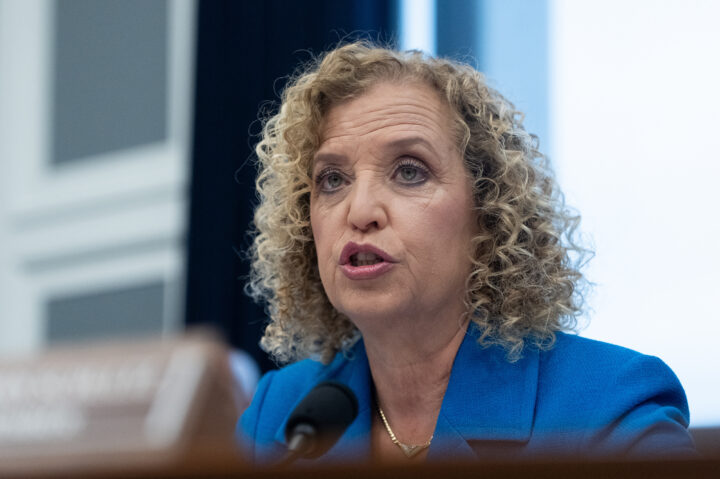
Aaron Schwartz/Bloomberg via Getty Images
Rep. Debbie Wasserman Schultz (D-FL)
Rep. Debbie Wasserman Schultz (D-FL) announced Friday that she plans to run in Florida’s 20th Congressional District, which has been represented by a Black lawmaker for more than three decades, after her current district was redrawn by Florida Republicans in an effort to secure more seats in the House.
The decision will pit her against scandal-plagued former Rep. Sheila Cherfilus-McCormick (D-FL), who is running again for the seat despite recently resigning ahead of an anticipated expulsion effort, progressive activist Elijah Manley and others running primary challenges against Cherfilus-McCormick.
Her decision has also sparked frustration from Black Florida Democrats, who say that the seat should be represented by a Black lawmaker.
In an announcement statement, Wasserman Schultz and her supporters emphasized Wasserman Schultz’s experience and seniority in the House as a key asset for the community.
“We cannot let Trump destroy Broward County’s power. Having somebody with that experience right now in these turbulent times is so important. … I’ll use all my seniority and clout in Washington to continue to make our lives more affordable and make Broward a safer, less expensive place to live, raise a family, and retire,” she said. “Some people do a lot of talking. I work hard to deliver results.”
Wasserman Schultz has served in Congress for more than 20 years, and is a senior member of the House Appropriations Committee, a member of House Democratic leadership and a former Democratic National Committee chairwoman. She one of several pro-Israel Democrats, including Reps. Jared Moskowitz (D-FL), Darren Soto (D-FL) and Kathy Castor (D-FL), who have had their districts redrawn by redistricting in the state.
Wasserman Schultz has long prided herself on representing a heavily Jewish constituency, joking to Jewish audiences about the number of Jewish retirees in her district.
State Sen. Shevrin Jones, the incoming Florida Democratic Senate leader, expressed disappointment with Wasserman Schultz’s decision while calling her a friend. He said in a statement he’s spoken to her about the issue and emphasized that “Black representation is a non-negotiable for me.”
“Everyone deserves to have a seat at the table to ensure our communities are represented by those with their same lived experience. This is not about Debbie because she has shown she can lead; that’s not the argument nor should it be the fight, at least not mine,” Jones said. “My fight is for Black representation, and I am in the business of expanding it, not diminishing it.”
In a joint statement, the Florida Legislative Black Caucus also criticized Wasserman Schultz’s decision.
“Congresswman Wasserman Schultz’s decision to pursue reelection in this historically Black district, despite explicit requests from the Black community to seek candidacy in a neighboring district, is disheartening,” the statement reads. “Building trust with Black leaders and constituents should be paramount for anyone seeking to represent a majority-Black district. Unfortunately, the actions taken by Congresswoman Wasserman Schultz suggest a failure to prioritize these essential values, perpetuating a narrative of performative allyship rather than meaningful connection.”
Manley condemned Wasserman Schultz as a carpetbagger and compared her to Florida Republicans who redrew the state’s congressional districts.
Wasserman Schultz told Politico she had engaged with more than 100 community leaders in the district, many of them Black, before making her decision, again emphasizing the need for an experienced lawmaker.
Other candidates in the race include Luther Campbell, a musician and free speech advocate, physician Rudolph Moise and former Broward County Mayor Dale Holness.
State Sen. John Cavanaugh, backed by left-wing Democrats, declined to sign a resolution supporting Israel and condemning Hamas on anniversary of Oct. 7 terrorist attack
Campaign page/Wikimedia Commons
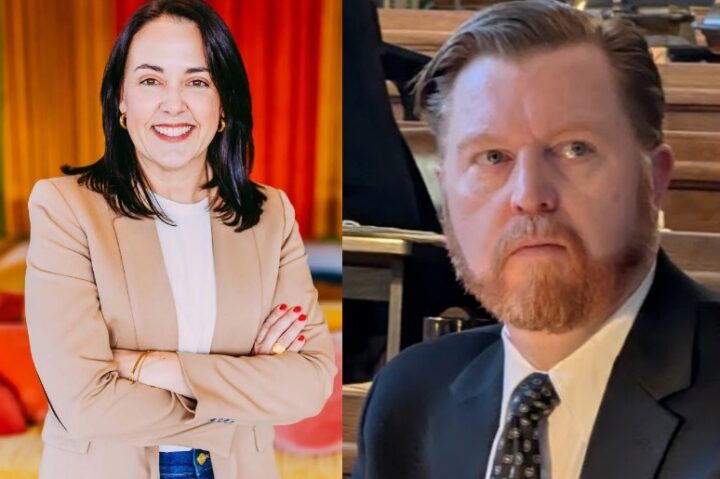
Denise Powell and John Cavanaugh
Nebraska’s 2nd Congressional District — the so-called “blue dot” in an otherwise red state — is a critical pickup opportunity for Democrats in November’s midterms. Vice President Kamala Harris won the district in 2024, and the popular, moderate Republican incumbent, Rep. Don Bacon (R-NE), is retiring.
The Democratic primary in the district on Tuesday is coming down to John Cavanaugh, a progressive state senator backed by a range of prominent left-wing leaders, and Denise Powell, a nonprofit executive backed by a host of Democratic political groups.
The outgoing Bacon has been an outspoken supporter of Israel, and is also a co-chair of the House’s bipartisan antisemitism task force, speaking out at times against members of his own party on the issue.
Cavanaugh was one of 10 state senators who declined to sign onto a resolution supporting Israel and condemning Hamas on the first anniversary of the terrorist group’s Oct. 7, 2023, attacks on Israel. “I support Israel and believe Israel has a right to exist. And I also believe a two-state solution is the only way to secure lasting peace,” Cavanaugh said in a statement to Jewish Insider in February.
He has been endorsed by the Congressional Progressive Caucus and a range of left-wing lawmakers including Reps. Jamie Raskin (D-MD), Pramila Jayapal (D-WA), Ro Khanna (D-CA), Greg Casar (D-TX), Chris Deluzio (D-PA), Adelita Grijalva (D-AZ), Jan Schakowsky (D-IL) and Mark Pocan (D-WI), as well as J Street.
Following the attempted terrorist attack on a synagogue and preschool in West Bloomfield, Mich., in March, Cavanaugh said on Facebook, “I’m horrified by the acts of violence we are seeing against Jewish Americans. Everybody has the right to worship in safety and security and while I’m thankful the gunman didn’t make it inside, violence like this shakes entire communities — my thoughts are with West Bloomfield.”
Powell is taking a more pro-Israel line, yet still falls to the left of other Democrats in the race on the issue. She said in a statement to JI earlier this year that she has “always unequivocally supported Israel’s right to exist and its right to defend itself.”
“My position is clear: I fully support providing aid to Israel and believe that we should ensure humanitarian aid reaches those in need,” the statement continued. “In order for the region to rebuild, it is imperative that we center our efforts around a two-state solution that both ensures Israel’s security and gives the Palestinian people the resources they need to reestablish their lives.”
She said during a candidate forum that she would have been hesitant to support a State Department funding bill that would have blocked funding to the United Nations Relief and Works Agency, provided $3.3 billion in military funding for Israel and penalized Palestinian international legal action against Israel, citing, in her statement to JI, concerns about “strip[ping] humanitarian aid to Gaza.”
Powell has been endorsed by Reps. Annie Kuster (D-NH), Emily Randall (D-WA), Norma Torres (D-CA), Andrea Salinas (D-WA) and former state Sen. Tony Vargas, the two-time Democratic nominee in the district, as well as the New Democrat Coalition, the Congressional Black Caucus, the Congressional Hispanic Caucus’ BOLD PAC, EMILY’s List and 33Elect Democratic Women.
Cavanaugh said at a candidate forum earlier this year that he wouldn’t accept funding from pro-Israel groups, while Powell said she wouldn’t accept backing from any special interest groups.
Democratic Majority for Israel filed with the Federal Election Commission its plans to spend $750,000 attacking Cavanaugh, but ultimately withdrew the buy. A person familiar with DMFI’s thinking told JI that DMFI PAC “decided to direct its resources into other races” for “strategic reasons” but remains focused on boosting pro-Israel Democrats who will help Democrats retake the House.
Nevertheless, Cavanaugh has repeatedly bashed Powell over the ultimately canceled DMFI intervention in the race.
“AIPAC aligned groups that are funded by Trump donors are now supporting Denise Powell. She said that she would refuse support from Democratic Majority for Israel or AIPAC, and now dark money groups are pouring millions into the Democratic primary here in NE-02 – and trying to hide it,” he said on X. “Voters deserve to know which out-of-state groups are funding these misleading attacks.”
Other candidates who have taken an outspoken pro-Israel stance, including district court clerk Crystal Rhoades and former Rep. Steny Hoyer (D-MD) aide James Leuschen, are seen as lagging behind in the race.
Gary Javitch, a board member of B’nai B’rith who hosted both Cavanaugh and Powell for lunch events with the Jewish community in Omaha and has long been involved in bipartisan pro-Israel politics in the state, described Cavanaugh as “the worst candidate [in the race] for people who favor Israel” and Powell as “very strongly pro-Israel,” based on their comments at the lunch events and their overall records.
“The Republican candidate is the closest to retiring [Rep.] Don Bacon,” Javitch added.
The expected Republican nominee is Omaha City Councilmember Brinker Harding, who faces no primary opposition.
Powell leads the field in fundraising with $1.6 million total raised, followed by Cavanaugh with $1.1 million. Harding, meanwhile, has raised $1.3 million. All other Democratic candidates trail significantly behind the three.
Notably, a GOP-linked outside group has been spending in the Democratic primary in an apparent effort to boost Powell, claiming Cavanaugh is a supporter of President Donald Trump. Yet other Republicans see Cavanaugh as the weaker challenger to Harding.
Powell and her allies — along with other candidates challenging Cavanaugh — have also argued that a Cavanaugh victory would have farther-reaching consequences for Democrats nationwide. If he wins, Nebraska’s Republican governor would appoint Cavanaugh’s replacement in the state Senate, likely delivering a stronger GOP majority in the chamber and potentially allowing Nebraska Republicans to overhaul the state’s electoral college apportionment.
Currently, the 2nd District has its own electoral college vote, apportioned separately, which went to Democrats in 2020 and 2024. Democrats assume that Republicans, given the chance, would move to a winner-take-all system in the electoral college — and would use the expanded Senate majority to pass other conservative priorities as well.
Cavanaugh has brushed off these criticisms as a “Republican talking point” spread by “dark money PACs.”
Conley, Davidson distance themselves from Senate votes to block Israel aid in Jewish community forum
The two Democratic candidates hoping to take on Rep. Mike Lawler generally defended continued aid; both emphasized the need for proper oversight of and accountability for U.S. aid

Anna Moneymaker/Getty Images
Senior Advisor to the Director of the Cybersecurity and Infrastructure Security Agency Cait Conley speaks to Politico Cybersecurity reporter Maggie Miller during Politico's annual AI and Tech Summit on September 17, 2024 in Washington, DC.
Cait Conley and Beth Davidson, two of the leading candidates in the Democratic primary in New York’s 17th Congressional District — among the most Jewish districts in the country — distanced themselves in a Thursday candidate forum from efforts by 40 Senate Democrats last week to block certain military sales to Israel.
Conley, a veteran who has worked in a variety of national security roles, said that she doesn’t believe that lawmakers should be trying to determine which specific systems should be provided to allies, but she also argued that the U.S. must continue to enforce global standards to ensure that all aid recipients are meeting U.S. standards.
“What I’m concerned about is what we are seeing is politicians now trying to make calls on what assistance should or should not go, whether this system or that, whether this thing or that, instead of actually relying upon the process that was designed where informed professionals are shaping what those packages are. There is a politicization of security that I do not believe is good for America’s national security or global stability,” Conley said during the Jewish Democratic Council of America forum.
She said that interference by lawmakers in determining what systems should be provided to Ukraine ultimately hurt the country’s ability to defend itself.
“I think we need to take politicians out of that equation and have a discussion on are the standards being met or not, and that is neutral to whatever ally we’re talking about,” she continued.
Conley also said she continues to believe in the importance of a strong U.S.-Israel relationship, but also wants to see long-term peace, guaranteed by a trusted third-party peacekeeping force in Gaza supported by U.S. reconstruction aid.
Davidson, a Rockland County legislator, said that she wants to see the U.S. use diplomatic tools and oversight to help bring about peace, rather than threatening aid to Israel. “I never want to have to be in a position where we are not in a position to provide Israel the aid it needs to fully defend itself and keep not only Israelis but Americans safe,” she said.
But she added that, “before voting for more funding, I would want to see a plan of how we bring this [Iran] conflict to a close, especially with a second conflict going on right next door,” and said that the “illegal war in Iran is actually making it more difficult to implement the [Gaza] peace plan.”
“It’s more important than ever that we understand what is happening with our tax dollars, what aid is being used for, and ensuring that it’s truly making Americans, Israelis, Palestinians and everyone in the region more safe.”
Davidson, who is Jewish, emphasized that the challenges the Jewish community are facing are personal to her and her family, and that her involvement in her synagogue leadership was what led her to public service.
She said that it’s “no secret” that Jewish support has been key to Rep. Mike Lawler’s (R-NY) past victories in the district because Jewish voters “felt homeless in the Democratic Party.”
“I’m the strongest candidate in this primary, because with me, Democrats and Jewish Democrats in particular don’t have to choose,” Davidson said. “I bring a strong voice against antisemitism, but also in favor of clean water, gun safety, hunger relief, lowering costs for working families, fighting for affordable health care, a proven record that I bring on so many of the issues that we all care about. So if you felt homeless, you have a home in my campaign.”
Davidson accused Lawler of politicizing the fight against antisemitism, and of turning a blind eye to President Donald Trump’s decision to cut funding for the Department of Education’s Office for Civil Rights.
She also highlighted her work to organize a solidarity event following the antisemitic stabbing attack in the predominantly Orthodox village of Monsey, N.Y., and to improve Holocaust education as a school board member.
Conley emphasized that she has past experience fighting antisemitism as an official at the Cybersecurity and Infrastructure Security Agency, which sent teams to faith-based institutions to help them improve their security. She said that the administration should be increasing funding and support for such programs, alongside the Department of Education, instead of slashing them.
Effie Phillips-Staley, who is staking out the progressive lane in the race and has adopted an increasingly anti-Israel platform, did not attend the forum.
In the 7th Congressional District Democratic primary, Conyears-Ervin faces, among others, Kina Collins, a Justice Democrats-backed, anti-Israel progressive candidate
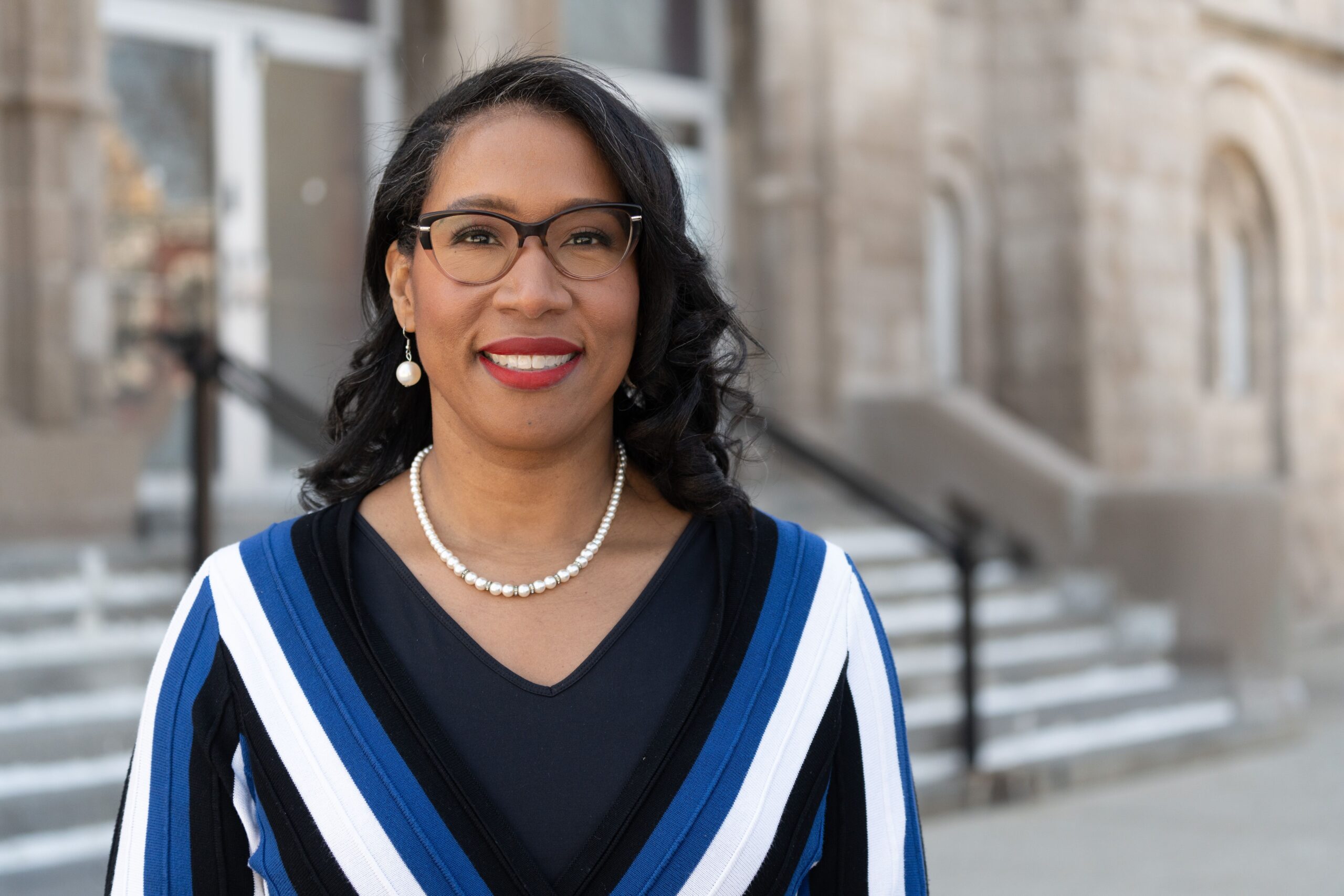
Courtesy
Melissa Conyears-Ervin
The United Democracy Project, the AIPAC-linked super PAC, launched a $500,000 ad campaign on Monday supporting Chicago Treasurer Melissa Conyears-Ervin, who is running in one of a series of hotly contested Chicago-area congressional primaries.
In the 7th Congressional District Democratic primary, Conyears-Ervin faces, among others, Kina Collins, a Justice Democrats-backed, anti-Israel progressive candidate who ran for the seat twice before. Conyears-Ervin herself is a repeat candidate, having run against incumbent Rep. Danny Davis (D-IL), who is retiring in 2024. Conyears-Ervin maintained strong support for Israel during her previous campaign.
The ad highlights Conyears-Ervin’s background as the daughter of a single mother reliant on public assistance and supporting a sister with disabilities who also depends on federal medical assistance programs. It frames her as a committed fighter against President Donald Trump.
“When Donald Trump attacks everything you believe in, you never back down,” the ad states. “For Melissa Conyears-Ervin, lowering costs, protecting health care and stopping Donald Trump is personal.”
Conyears-Ervin received 21% of the Democratic primary vote to Davis’ 52% and Collins’ 19% in 2024. In this year’s primary, she faces real estate developer and Jewish United Fund board member Jason Friedman, state Rep. LaShawn Ford — who is Davis’ preferred successor, emergency physician Thomas Fisher and Anthony Driver, a former leader of the Chicago police oversight board and a local union leader.
Conyears-Ervin finished 2025 fourth in total fundraising, trailing Friedman, Fisher and Ford.
She was also recently endorsed by the Chicago Teachers Union, which has supported various anti-Israel initiatives since Hamas’ Oct. 7, 2023, attacks on Israel.
Friedman, who is Jewish, has a record of support for and engagement with Israel through the JUF, including leading numerous JUF delegations to the Jewish state. He’s seen by some as an unconventional candidate for the historically Black-dominated district.
A pair of recently created super PACs began running ads last week backing moderate pro-Israel women in several other Chicago-area districts. Those groups are rumored to be supported by UDP or other pro-Israel backers, but the 7th District is the only one in which UDP is directly and publicly involved.
Crosswell, a former Republican who also served as a federal prosecutor, is touting his pro-Israel bona fides as he fights for the Democratic nomination against Rep. Ryan Mackenzie
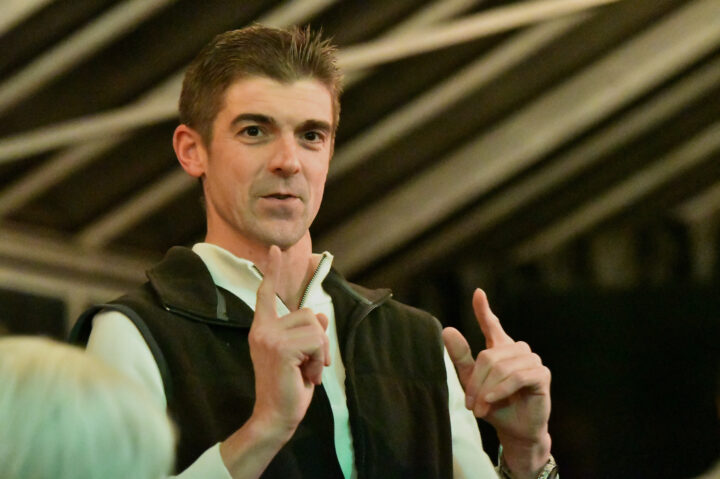
Marc Levy/AP
Ryan Crosswell, former federal prosecutor who quit the Department of Justice in protest, speaks at a campaign event for his run for Congress, Dec. 4, 2025, in Allentown, Pa.
Former federal prosecutor and Marine veteran Ryan Crosswell is hoping his military and professional background — as well as his past registration as a Republican — will provide a road map to winning the Democratic nomination and ultimately flipping a critical swing district in Pennsylvania.
The 7th Congressional District centered around Allentown and Easton and rated by the Cook Political Report as a toss-up is held by Rep. Ryan Mackenzie (R-PA), who himself flipped the seat in 2024. It was previously held by former Rep. Susan Wild (D-PA).
Crosswell, in an interview with Jewish Insider, characterized himself as a lifelong public servant and patriot, both as a Marine and as a federal prosecutor, who “always put my country first, even when it came at personal costs, as when I resigned from the Department of Justice because I felt I was being asked to do something that was inconsistent with my oath.”
Crosswell left the DOJ last February in protest of the Trump administration’s decision to drop corruption charges against former New York City Mayor Eric Adams.
He’s running for Congress because “this administration is dangerous,” and he wants to fight for affordability and safety for his constituents. He said his experience as an anti-corruption prosecutor makes him “uniquely suited to rebuild some of the guardrails that have been torn down.” He said that restoring those guardrails, including the public corruption section at the DOJ, is critical to having a “functioning democracy.”
Though he’s running in the Democratic primary, Crosswell was a registered Republican until after the 2024 election. But he said he’s voted consistently for Democratic presidential candidates since 2016.
“[We’re] at a point right now, there is one party that’s clearly on the right side of history, and one party is clearly on the wrong side of history,” Crosswell said.
Crosswell argued that he’s the best-placed candidate to flip Republican voters in November: He said a key takeaway from last year’s New Jersey and Virginia gubernatorial elections is that Democratic veterans are attractive candidates. He added that his background as a former Republican will help him connect with independent and GOP voters to “explain that the Republican Party is not what it once was.”
He also said that his experience as a veteran and federal prosecutor addressing a series of sensitive and high-profile issues makes him best prepared to address a range of subjects as a member of Congress in what he predicted “will be the most challenged Congress in American history.”
Croswell said that he’s “uncomfortable with cutting off aid” to Israel, as some in the Democratic Party are advocating for, “because Israel is surrounded by historical enemies and I don’t want to put the Israeli people in danger by cutting off aid.”
Crosswell is facing off against a series of other more liberal candidates in the primary, most notably Bob Brooks, the leader of the firefighters’ union who was endorsed by Gov. Josh Shapiro last month. Though Crosswell led among Democrats in fundraising as of the end of September, Shapiro’s endorsement and a fundraiser the popular governor held for Brooks last month are expected to help Brooks close the gap.
Crosswell described Israel as “an important ally to the United States” and the “only true democracy in the Middle East.” He visited Israel and the West Bank shortly before the Oct. 7, 2023, Hamas terror attacks. He said that he was “just so impressed by the Israeli people, their innovation and technology,” and their resilience in the face of both inhospitable environmental conditions and the enmity of surrounding nations.”
He said that he’s “uncomfortable with cutting off aid” to Israel, as some in the Democratic Party are advocating for, “because Israel is surrounded by historical enemies and I don’t want to put the Israeli people in danger by cutting off aid.”
He added that “no country is ever entitled to unconditional military aid from the United States under any circumstances, but I’m not willing to cut off aid now.”
Crosswell emphasized the need for the ceasefire in Gaza to continue, adding that those responsible for the Oct. 7 attack should be held accountable “through surgical special forces operations with a ceasefire in place.”
Asked about the U.S. strikes on Iran last summer, Crosswell said he’s “uncomfortable with direct military engagement in Iran at this time,” while adding that Israel must make its own decisions about “what the Israelis believe is necessary in their own interest.” Crosswell spoke to JI prior to the wave of public protests in Iran, which have led the Trump administration to contemplate renewed U.S. attacks.
“I would prefer to avoid U.S. engagement until it’s absolutely necessary,” he continued.
He said that, from his conversations in Israel and the West Bank during his visit, he believes both sides want peace, and emphasized the importance of continuing to pursue a two-state solution.
“It’s been frustratingly hard getting there, but it is the only solution and we can’t give up on it,” Crosswell said. “We need to demonstrate that we are advocates for peace, and that we’re advocating for both sides. We need to demonstrate that through our actions, that we’re committed to this, that we’re willing to have both sides at the table and to work through this, and we need to engage the other Arab nations.”
“I was a Justice Department prosecutor, and we have laws on the books to prosecute those who engage in hate crimes, and we should do that,” Crosswell said. “But I think also members of Congress — we need to be outspoken voices, and we need to speak out against it. And so I’d be in favor of any law that or any efforts to expand education on Jewish history, on the Holocaust, antisemitism, certainly any measures that can be taken to ensure the security of Jewish institutions and synagogues.”
He said that the U.S. should not, however, preempt direct negotiations between Israel and the Palestinians and recognize a Palestinian state. And he said that removing Hamas from leadership in Gaza is also a critical step to facilitate peace.
At home, Crosswell called the rise in domestic antisemitism “sickening” and said that it was “heartbreaking” to see armed guards outside a synagogue that he visited recently for an event.
“I was a Justice Department prosecutor, and we have laws on the books to prosecute those who engage in hate crimes, and we should do that,” Crosswell said. “But I think also members of Congress — we need to be outspoken voices, and we need to speak out against it. And so I’d be in favor of any law that or any efforts to expand education on Jewish history, on the Holocaust, antisemitism, certainly any measures that can be taken to ensure the security of Jewish institutions and synagogues.”
He added that, “more than anything else, it’s just being voices of moral clarity against hate against anybody, and in particular now, the antisemitic rhetoric and behavior that in some cases we’re seeing from both sides.”
Please log in if you already have a subscription, or subscribe to access the latest updates.
 Continue with Google
 Continue with Apple