






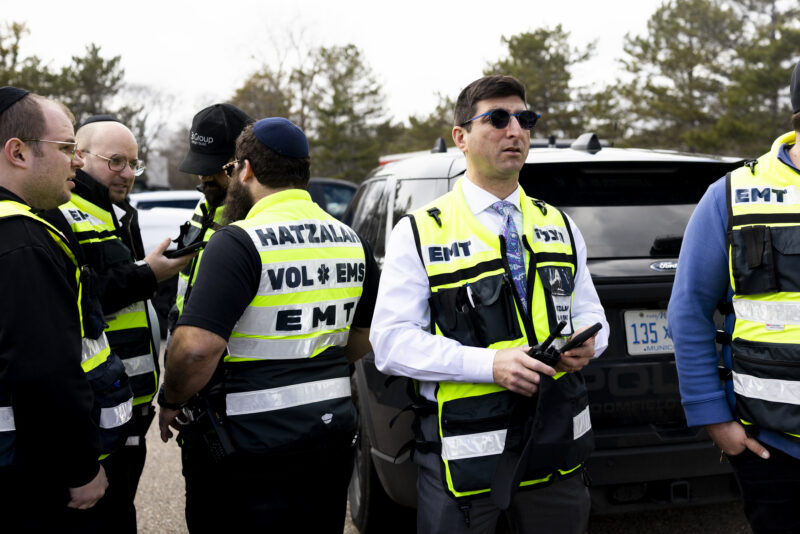































Jewish military chaplains told JI about their drive to be ohr l’goyim, a light unto the nations
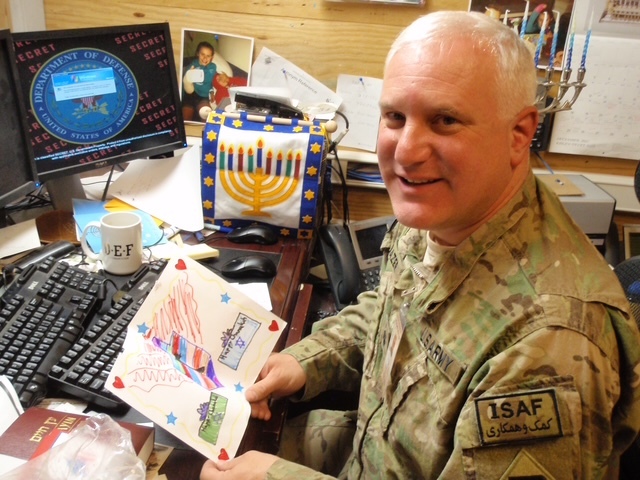
Courtesy
Rabbi Laurence Bazer reading Hanukkah cards sent to Jewish servicemembers


 Add JewishInsider on Google
The women’s basketball team at Rochelle Zell Jewish High School in Chicago was practicing earlier this month ahead of its annual Senior Night when an announcement came over the intercom, presenting a special guest. That’s where the video starts — one of those designed-to-go-viral tearjerkers showing a child reuniting with their parent who is in the military.
“He is joining us after leaving the military service in Europe,” the announcer says. Team members start to look around, smiling but confused, when they see that the door to the gym is open.
“We are grateful for his dedication, especially his daughter Hannah,” the announcer continues. That’s when one athlete, in a long-sleeve practice jersey and a ponytail, begins to cry and run toward the door. “Thank you for your service and sacrifice, and welcome home, U.S. Army Chaplain Rabbi Aaron Melman.” Everyone cheers. Throwing her arms around her father, Hannah sobs.
Melman, a Conservative rabbi who since 2021 has served as a chaplain in the Illinois Army National Guard, had just returned from a U.S. Army base in Western Poland. He submitted his request for leave back in September but didn’t tell his daughter, who was devastated most of all to learn his deployment conflicted with the pinnacle of her high school basketball career. (She was more upset that he would miss that game than her graduation.) When she hugged him, Melman took off his cap and revealed a light brown yarmulke that matched his fatigues.
“We made it happen,” Melman tells his daughter in the video, smiling. Days later, RZJHS won at Senior Night. Hannah scored four points.
For more than two decades after he graduated from the Jewish Theological Seminary in 2002, Melman was a congregational rabbi in the northern suburbs of Chicago. He had thought, early in his career, about joining the military — his father served in the U.S. Army Reserves — but decided against enlisting, recognizing that serving in active duty would be challenging as he raised two young children.
But later, when his kids were older, the itch to serve returned. Melman was commissioned as an officer in the Illinois Army National Guard, a responsibility that typically required two days of service a month and two weeks each year, until he was sent to Poland earlier this year. That assignment made him one of several Jewish chaplains serving on the front lines of Europe, providing religious support and counseling to American soldiers — most of whom are not Jewish — who are stationed in Germany, Poland and other allied nations largely as a bulwark against Russia.
Many Jewish chaplains serve in the military only part-time. They fit the training into already-busy schedules leading congregations and providing pastoral care to people in their own communities.
Several military rabbis told JI that they view their mission as more than counseling the soldiers in their care and helping them deal with the hardships of military service. They explained that it’s also about reminding American Jews — many of whom have parents or grandparents who fought in World War II, Korea or Vietnam — about the value of service. During World War II, the military printed pocket-sized Hebrew bibles for Jewish soldiers. Today, some Jews don’t know anyone serving in the military.
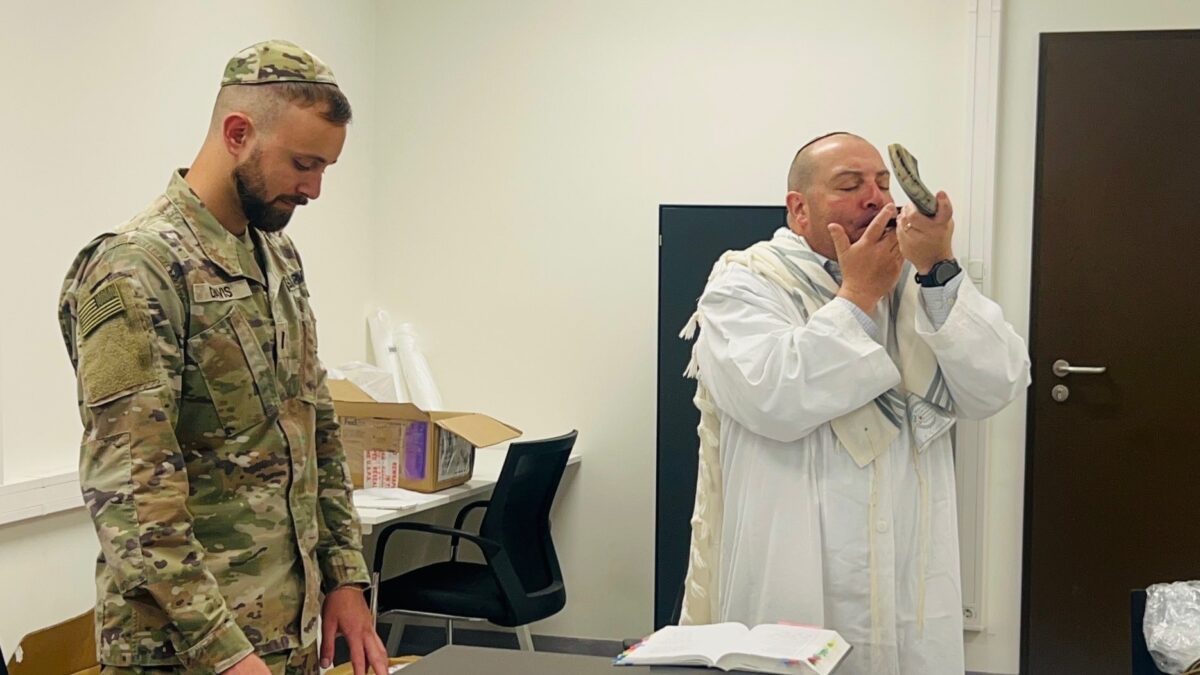
“Most Jews in America are not connected in any way, shape or form to the United States Armed Forces. The common reaction many of us get, when we go into the armed forces here in the States is, ‘Oh, you don’t want to go into the IDF?’ or, ‘Why didn’t you go into the IDF?’ And for the record, I happen to be a very strong Zionist,” Melman told Jewish Insider in an interview last week. “One of the things for me that I’ve really grown to appreciate is trying to connect the younger generation of American Jews into joining or thinking about joining the military and how important it is.”
Rabbi Aaron Gaber spent nine months at Grafenwoehr, a major American base in Germany, starting last summer. As a member of the Pennsylvania Army National Guard, his unit’s mission was to train Ukrainian soldiers, and Gaber was tasked with training Ukrainian chaplains. He took them to the Memorium Nuremberg Trials, a museum located inside the German courtroom where Nazi leaders were tried for their crimes after World War II.
“That created a whole conversation about moral integrity and personal courage. How do you say to your commander, ‘Don’t commit atrocities’? Or how do you keep your soldiers who are angry at what’s happening and want to do things that are unethical or immoral from doing that?” Gaber told JI. “That elicited a whole conversation on a theological level about light versus darkness, good versus evil, but also then on a practical level: How do you advise your commander in a way that gives him or her the option not to do something that shouldn’t be done?”
Most of Gaber’s job, when dealing either with Ukrainian troops or American, involved assisting people who were not Jewish.
“As a rabbi, I got to make sure every week there was a Protestant worship service happening,” said Gaber, who returned from Germany in June (and specified that he did not lead those services).
Last year, he volunteered to spend the High Holidays in Poland and Lithuania. He drove between several different bases to make sure Jewish soldiers had access to religious services, food and learning opportunities tied to the holidays.
“I take the idea of ohr l’goyim, or bringing light to the world, I was able to bring light to the world. I was able to help Jewish soldiers celebrate their faith. If I met 10 Jewish soldiers through the entire two weeks, that was a lot. So it was individual work,” Gaber said. “In one case, I had one soldier travel, I think, three hours each way to be able to spend an hour with me. He couldn’t go by himself, so he had a noncommissioned officer, one of his squad leaders, go with him. That was the length that the military can and does go to make sure soldiers can access their faith.”
Ohr l’goyim is a phrase that comes up often for Jewish military chaplains. For Rabbi Laurence Bazer, a retired U.S. Army colonel who is now a vice president at the JCC Association and the Jewish Welfare Board’s Jewish Chaplains Council, those words — from the Book of Isaiah — commanded him to be a light unto the nations. “And that’s not just to our own fellow Jews, but to the rest of the community,” Bazer told JI.
A friend of his from the North Dakota National Guard once took Bazer, who served in the Massachusetts Army National Guard, to visit North Dakota’s state partner in Ghana. He sat down with a group of Ghanaian soldiers and told them to ask him anything they might want to know about Judaism.
“Now, these are all Catholic, Protestant and Muslim chaplains from the Ghanaian army,” Bazer recalled. “I said, ‘You could ask me, like, why Jews don’t believe in the New Testament, or Jesus, whatever.’ That’s part of the role that I love doing, of being, again, ohr l’goyim, a light unto the nations, to be able to share the positive, affirming side of Judaism so that they felt enriched. It was all in true fellowship of, we’re all servants of the Divine.”

Bazer spent his final years in the military in Washington, working full time in an active duty role at the National Guard’s headquarters. He oversaw the religious response to the COVID-19 pandemic, the 2020 racial-justice protests and the Jan. 6 Capitol riot.
“I was advising commanders up to four stars at a senior level about what’s going on religiously, which really meant the moral welfare of their troops,” said Bazer, who had served in New York during the 9/11 attacks and later led the chaplaincy response to the Boston Marathon bombings in 2013. “That emotional level affects readiness, and chaplains are the key to help that readiness.”
In 2023, Bazer was asked to go to Europe to lead Passover services and programming for Jewish troops. He led Passover Seders in Germany and Poland, and then drove between Lithuania and Latvia, delivering matzah and visiting with Jewish soldiers.
The Seder at Grafenwoehr took place on a large lawn on the base. After he spoke about opening the door for the prophet Elijah, a symbolic act tied to hope that the Messiah will come, a Christian chaplain on base who had attended the Seder pulled Bazer aside. He pointed to a tower that stood next to the lawn.
“He says, ‘You know, Hitler used to go up there and watch,’” Bazer said. The base — now so central to America’s operations in Europe — was once used by the Nazis. “To think that back then he used to watch the Nazis do formation, and now, in 2023 we’re holding a Passover Seder on the same base in the shadow of that tower is an incredible experience.”
Pearl will make a decision by the end of September but is unlikely to enter the contest, sources tell JI

Bruce Pearl speaks at a Christians United for Israel event.
Auburn University men’s basketball coach Bruce Pearl is leaning against running to replace outgoing Sen. Tommy Tuberville (R-AL) and will make a final decision on entering the race by the end of the month, Jewish Insider has learned.
Pearl, 65, spent the summer meeting with GOP campaign operatives and Republican senators as he considered whether to enter the race following Tuberville’s announcement in late May that he was opting against seeking a second term in the Senate to run for governor of Alabama. At the beginning of the summer, Pearl had just finished the academic year coaching Auburn’s basketball team, which he joined in 2014 and where he has led the SEC team to six NCAA tournament appearances, including this year’s Final Four.
Two sources familiar with Pearl’s thinking told JI that he has not officially decided against running yet and has given himself until the end of September to make a final call, though he is unlikely to enter the contest.
Pearl declined JI’s request for comment on his plans.
If Pearl decided to get into the race, it would make him the most high-profile name in the crowded Republican primary to succeed Tuberville, who also coached at Auburn before jumping into politics, leading its football team from 1999-2008. It would also mean walking away from a lucrative contract with Auburn for a far more modest government salary.
Republicans already in the primary include Alabama Attorney General Steve Marshall, who has been the state’s chief law enforcement officer since 2017; Rep. Barry Moore (R-AL) and Jared Hudson, a former Navy SEAL and pro-Trump businessman.
The winner of the GOP primary is expected to go on to win the general election given Alabama’s conservative electorate.
The last Jewish Republican to serve in the Senate was former Minnesota Sen. Norm Coleman, who now chairs the Republican Jewish Coalition after losing his bid for a second term to former Sen. Al Franken by 312 votes in 2009. The late Sen. Arlen Specter left the GOP for the Democratic Party in the spring of 2009 while facing a primary challenge from former Sen. Pat Toomey (R-PA). Specter ultimately lost the Democratic primary for his seat and left the Senate in 2011.
The Auburn basketball coach has emerged as a vocal Jewish advocate and become increasingly politically involved in fighting the rise of domestic antisemitism and supporting Israel in recent years. He became one of the most outspoken voices in sports in the wake of Hamas’ Oct. 7, 2023, attacks on Israel.
Pearl often tells the story of his grandparents immigrating to the U.S. in 1929 to escape the pogroms in Eastern Europe (where most of the rest of his family perished in the Holocaust) and makes mention of his Hebrew name, Mordechai, in interviews.
He has also been active in the Jewish advocacy space for at least half a decade. He joined the U.S. Israel Education Association (USIEA) board of directors in 2021 and took over as chairman of the board in April of this year. The nonprofit focuses on educating government officials involved in advancing the U.S.-Israel relationship on the pro-Israel cause, and Pearl has led trips for his players to the Jewish state in recent years through the organization.
In his public comments, Pearl has been outspoken in support of Israel and has voiced his disapproval of any agreement between the U.S. and Iran that allows the latter to enrich uranium.
Speaking at a breakfast commemorating Jewish American Heritage Month on Capitol Hill in late May, Pearl argued that a Palestinian state had already been “tried” in Gaza in 2005 following the Israeli withdrawal from the area. “They had an opportunity and they turned it into a terrorist state. We cannot make that same mistake again,” Pearl said at the time.
“There cannot be another Palestinian state,” he continued. “We need to practice our faith and we need to put our faith into practice. My Jewish friends, we need to wake up and understand that when we said never again, we meant never again, but it happened again on Oct. 7.”
Pearl also encouraged the U.S. to back Israel in taking out Iran’s nuclear program through an airstrike campaign and praised the U.S. push in nuclear negotiations to force Tehran to ship enriched material to a location where it cannot be used.
“Enriched Uranium is for a weapon, not power. Iran says it will not give up its ability to enrich uranium against US demands. For Iran, it is a matter of national honor and part of their identity. If Iran had it, they would use it,” Pearl wrote on X in late May, adding that Iran must “dismantle it now” for the sake of achieving peace “or Israel needs to do it.”
Jewish Insider’s senior congressional correspondent Marc Rod contributed to this report.
Wednesday night marked the first time since 2006 that two Jewish players were picked in the same draft

Sarah Stier/Getty Images/Harry Langer/DeFodi Images via Getty Images
Danny Wolf/Ben Saraf
Brooklyn, if it’s possible, got even more Jewish on Wednesday night, when two members of the tribe were picked back to back by the Brooklyn Nets in the first round of the NBA draft.
The Nets tapped 6-foot-6 Israeli point guard Ben Saraf and Israeli-American 7-footer Danny Wolf, who starred at the University of Michigan, with the No. 26 and 27 picks, marking the first time since 2006 that two Jewish players were selected in the same NBA draft.
“Picking two Jewish players back to back is at worst a pretty kismet coincidence. They know what they’re doing,” James Hirsh, host of the Jewish sports podcast “Menschwarmers,” told Jewish Insider, referring to the Nets’ front office. “This is a pretty cool thing to happen.”
Hirsh said that the picks reflect a “growth of professional Jewish athletes in New York,” pointing to Max Fried, who signed with the New York Yankees as a starting pitcher last December. “It makes sense to have talent that your fan base is going to automatically support.”
Saraf, 19, is the son of two former Israeli professional basketball players and was born in Israel. He chose to wear the No. 77, according to media reports, because it is the Jewish numerical value of the word “mazal,” Hebrew for luck. He is currently playing in Germany.
Wolf, 21, led the Wolverines to a No. 5 seed in last year’s NCAA men’s basketball tournament after transferring from Yale University. He has been outspoken about the antisemitism he’s faced on the court, especially in the aftermath of the Oct. 7, 2023, terrorist attacks while playing at Yale. “There were more than 80 fans who came to the game disguised,” he told the Detroit Free Press in March about a game against Dartmouth. “And then minutes into the game they broke out chanting and holding Palestinian flags. And it was a small gym, so everyone’s focus turned to that.”
“I would hear it growing up, that noise about me being Jewish, and [so] you don’t expect much from me as a basketball player,” Wolf continued. “When I was younger, I kind of looked at [being Jewish] as an opportunity to prove myself.”
“The most beautiful thing about Judaism is the way it connects me with my family,” said Wolf, who attended a Solomon Schechter Jewish day school in the Chicago suburbs until fifth grade and obtained Israeli citizenship in 2023 to represent Israel at the FIBA U20 European Championship in Greece. “It transcends other things and brings us together.”
“You can’t teach height,” Hirsh quipped, noting that Wolf is the “tallest Jewish player the U.S. has ever seen.”
“That’s pretty unique for Jewish basketball players,” he said. “There’s a lot of excitement to see whether his game can transfer to the NBA level or not.”
The newest Nets players follow in the footsteps of Omri Casspi and Jordan Farmar, who became the first pair of Israeli teammates on an NBA roster when they played for the Sacramento Kings in 2017. Lior Eliyahu and Yotam Halperin were the last two Jewish players to be picked in the same NBA draft in 2006. Another Israeli player, 24-year-old forward Deni Avdija, plays with the Portland Trail Blazers after three years with the Washington Wizards.
The new Jewish players mark a fresh chapter for the team, whose minority owner Oliver Weisberg is an Anti-Defamation League board member. The Nets were embroiled in an antisemitism scandal in 2022 after point guard Kyrie Irving posted a link to a film that denied the Holocaust and blamed Jewish people for slavery. Irving, who refused to apologize for days, was suspended by the NBA. The Nets traded him in 2023.
The Fox Nation film ‘Rebound’ documents the Maccabees’ challenges and successes in the wake of tragedy

Courtesy Fox Nation
The Maccabees
It was Monday, Oct. 9, 2023. Israel was shocked and reeling just two days after Hamas perpetrated the worst terror attack in the Jewish state’s history, the deadliest massacre of Jews in a single day since the Holocaust.
Halfway across the world in New York City, it was the first day of practice for Yeshiva University’s basketball team, the Maccabees, a team that had been on a high from its 50-game winning streak that had ended the year prior.
But now the young athletes’ minds were far from wind sprints and free throw shots. Two teammates and their head coach, Elliot Steinmetz, were still in Israel, where they traveled to for the Sukkot holiday. Top-scoring guard Zevi Samet’s family was stuck in a bomb shelter on that harrowing day. Senior guard Adi Markovich’s friend was killed when Hamas infiltrated the Nova music festival in southern Israel.
The team of Jewish men — who bring a Torah along on weekend trips and before games play “Hatikvah” along with “The Star-Spangled Banner” have long been seen as unique in the NCAA. Consisting of six Israelis and three Americans who served in the IDF as lone soldiers and were called up for reserve duty — the team faced an unimaginable decision: drop out of the season in grief, or play through the crushing sadness, fear and rage and use their platform to exemplify their support for Israel and the Jewish people.
Clad in kippot, the players pushed through to make it to the NCAA Division III Tournament. Ultimately though, the team lost the 2024 Skyline Conference Championship to Farmingdale State College.
But the team’s pride and grit goes beyond the court — including a mid-season, eight-day visit to Israel. A new documentary, “Rebound: A Year of Triumph and Tragedy at Yeshiva University Basketball,” which premiered on Wednesday on Fox Nation, Fox News’ subscription service, tells that story.
“This was a devastating time and sometimes those are the most important times to document,” Pat Dimon, the film’s director, told Jewish Insider. “I told [Yeshiva University] I thought I was the right person for this and asked if me and my team could follow along.”
“This film is about more than basketball,” Yeshiva University President Rabbi Ari Berman told JI. “When you play for Yeshiva University you are not just playing for a school, you are playing for a people. In the wake of Oct. 7, our basketball team made a defining choice: to stand tall as proud Jews, embodying unity, and strength far beyond the court. Wherever we go, on and off the court, we stand as one — honored to represent our community and the enduring spirit of our people.”
Dimon, an Emmy Award-winning director, is known for his work on several sports films including “College Sports, Inc.,” “100 Days to Indy” and “24/7 College Football.”
But embedding himself with the Maccabees to direct “Rebound” was a distinctive experience for the seasoned director, who is not Jewish — one that included his first-ever trip to Israel, to see a scarred nation firsthand.

“That trip is the crux of the film,” Dimon said, recalling that team coach Steinmetz called the January 2024 visit the most “important decision he’s ever made personally and professionally with his team.” It included a meeting with 19-year-old former hostage Ofir Engel, a friend of teammate Tom Beza, and tour of his girlfriend’s home in Kibbutz Be’eri — where Hamas rampaged on Oct. 7, killing 101 residents and taking more than 30 captives including Engel. The team also went to the Nova musical festival grounds, visited with the families of the Israeli players, spent time with IDF soldiers and met wounded survivors of the attacks in the hospital.
Dimon recognized that the “inherent” viewer of the documentary will be Jewish. “I know how passionate they are about YU and the team. But I hope those aren’t the only viewers,” he said — noting that “sport transcends.” He believes the film can be used to engage wider audiences who otherwise aren’t connected to Israel or have not been paying attention to the global rise in antisemitism that followed Israel’s war with Hamas.
In brief remarks in the film, New England Patriots owner Robert Kraft echoed that sentiment, calling Yeshiva University “a special place.”
Sports are “global and reach across all faiths, cultures, races and genders,” according to Dimon. “Sport can be the prism we can all get behind.”
“I think this film is for everybody,” he said. “People of the Jewish faith, sports fans, anyone that wants to see how characters can use a painful situation to rebound.”

Former NBA player and coach Paul Westphal — decked out in a souvenir Masada hat — talked to Tablet’s Unorthodox podcast about his visits to Israel and his ties to the Jewish community. Westphal won the 1974 NBA championship with the Boston Celtics, and led the Phoenix Suns to the finals in 1993 as a coach.
Long relationship with Jewish community: Westphal said he grew up playing basketball every day for five years at the Phoenix Jewish Community Center. He’s visited Israel three times, and during his tenure as coach of the Sacramento Kings, the team drafted Omri Casspi, who became the NBA’s first Israeli player.
Christianity and Judaism: Westphal, who is Christian, spoke about the important role faith has played in his life. “I think that faith is the foundation of everything,” he said. “It’s so fantastic to be speaking to a group of Jewish people because I’m a Christian because of the Jews,” he added, referencing Jesus’ Jewish background.
Jews in the NBA: Westphal opened the interview by talking about some of the NBA’s legendary Jewish stars. “A little bit before my time, the Jews ruled the NBA,” he quipped. “[Red Auerbach] gave me the greatest advice I ever had. He said, ‘Dress British and think Yiddish.’”
On antisemitism: The basketball star spoke extensively with the three Tablet podcast hosts about modern antisemitism and anti-Zionism. “The same mentality [that existed in Nazi Germany] exists in the world today and you can see it,” he said. “My question is: When there are people who are sworn to exterminating you… why do a great number of Jewish people support causes, politics that are lined up with those people?”
Please log in if you already have a subscription, or subscribe to access the latest updates.
 Continue with Google
 Continue with Apple