











































Qatar applauded the gathering for its effort to ‘preserve [Jerusalem’s] Islamic and Christian identity’
Government of Qatar
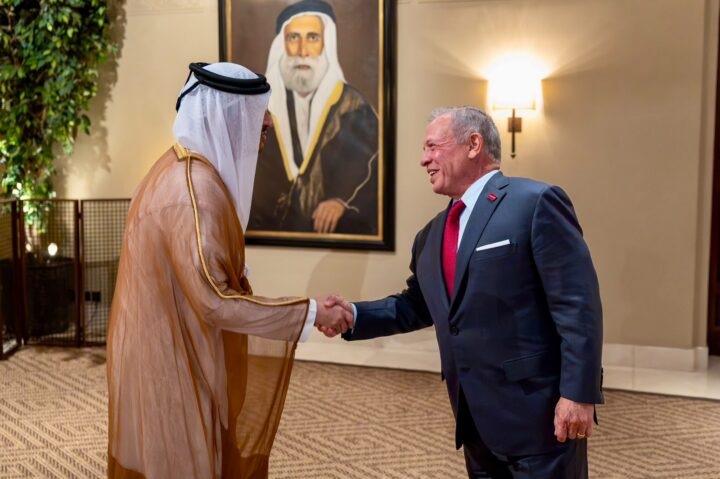
Qatari Prime Minister Sheikh Mohammed bin Abdulrahman Al Thani greets Jordanian King Abdullah at foreign ministers summit.


 Add JewishInsider on Google
A coalition of foreign ministers from Arab and Muslim countries met in Jordan on Wednesday to launch a coordinated campaign against Israeli policies in Jerusalem — a gathering marked both by the notable absence of key regional players and rhetoric that dismissed Jewish ties to the city.
The meeting brought together diplomats from Jordan, Egypt, Saudi Arabia, Qatar, Algeria, Iraq, Tunisia, Somalia and Morocco, alongside representatives from the Arab League, Indonesia, Pakistan, Turkey and Malaysia. Missing from the Amman summit were several close U.S. allies including the United Arab Emirates, Bahrain and Kuwait.
In a joint statement, the group denounced what it called an “unprecedented Israeli escalation in occupied Jerusalem and its Islamic and Christian holy sites,” accusing Israel of trying to alter “the Arab Islamic and Christian identity of occupied Jerusalem and its legal and demographic status” — omitting any mention of Jewish historical or religious ties to the city.
The ministers also claimed that Israel “has no sovereignty” over east Jerusalem.
The statement accused Israel of discriminatory practices against Christians, including “restrictions on access to the Church of the Holy Sepulchre and the observance of religious rites therein; interference in the affairs of churches and restrictions imposed on their institutions and properties; and attacks targeting clergy, worshippers and religious symbols.”
The ministers also warned that “Israeli attacks against Islamic holy sites in occupied Jerusalem constitute a blatant provocation to the sentiments of around two billion Muslims worldwide, and push towards a religious conflict with repercussions that will extend beyond the region and threaten regional and international peace and security.”
To operationalize their response, the ministers announced a coordinated international campaign — including a dedicated media platform — to document alleged Israeli violations against holy sites with a plan to present them to international organizations.
Qatar’s Foreign Ministry lauded the meeting, where it said the countries discussed “the Israeli escalation in occupied Jerusalem, and the joint efforts to preserve its Islamic and Christian identity.”
Israel’s Foreign Ministry forcefully denounced the joint statement, noting its exclusion of Jewish ties to the city.
“The declaration endorsed by the Foreign Ministers of the Arab Ministerial Committee, convened by Jordan, is built on false accusations, historical distortions, and a complete disregard for the facts,” the ministry said.
“It is particularly cynical to accuse Israel of violating freedom of worship while declaring that the entire Temple Mount is a place of worship exclusively for Muslims, ignoring the Jewish people’s historic connection to Jerusalem and its holiest sites,” the statement continued. “Under Israeli sovereignty, Jerusalem, the eternal capital of the State of Israel, has never been more open and accessible to worshippers of all faiths. Israel remains committed to preserving freedom of worship, maintaining the status quo on the Temple Mount, and taking all necessary measures to ensure public order and the safety of all visitors.”
Frustrated UAE leaders are questioning the ‘impotence’ of countries like Egypt — and warn that silence on Iranian aggression will push the Gulf closer to U.S., Israel
Gallo Images/"USGS/NASA Landsat data processed by Orbital Horizon"
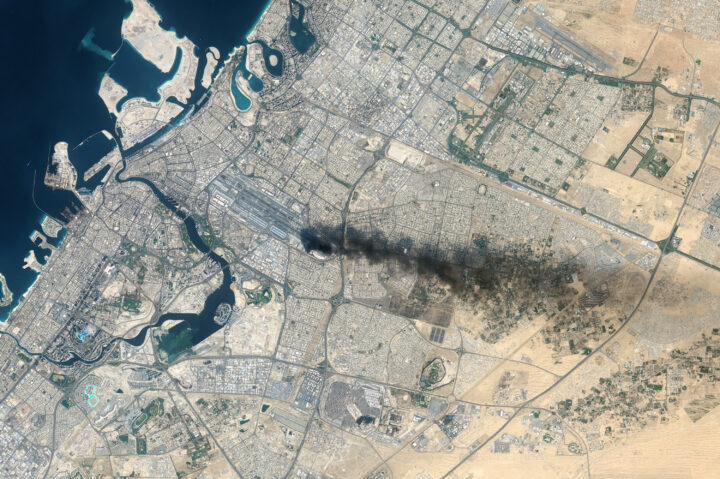
Satellite view of Dubai International Airport after a drone strike ignited a fuel tank fire. on March 16, 2026.
The United Arab Emirates has been publicly expressing its disappointment in Arab League countries like Egypt for not showing or expressing very little support for Gulf states under attack from Iran, a dynamic playing out more quietly in other Gulf states, as well.
In a post on X on Sunday that received significant attention, Anwar Gargash, an advisor to the UAE President Mohamed bin Zayed, said that “Iran’s brutal aggression against the Arab Gulf carries profound geopolitical repercussions … and the result is to bolster our national capabilities and the joint security, as well as to solidify our security partnerships with Washington.”
When French former diplomat Gérard Araud criticized Gargash’s approach, writing on X that “it means deepening your dependence on a country that has led yours into a disastrous conflict without caring about your interests,” Emirati Foreign Minister Abdullah bin Zayed backed up Gargash, responding: “We will never be blackmailed by terrorists.”
In subsequent posts, Gargash not only said that Iran’s attacks are bringing his country closer to the U.S., but criticized other Arab countries for not aligning themselves with the Gulf.
“Where are the joint Arab and Islamic institutions, chief among them the Arab League and the Organization of Islamic Cooperation, while our countries and peoples are subjected to this treacherous Iranian aggression? And where are the ‘major’ Arab and regional countries? … The Arab Gulf states were a support and partner to all in times of prosperity… So where are you today in times of hardship?” Gargash wrote.
As such, he argued, “in absence and impotence, it is unacceptable later to speak of the decline of the Arab and Islamic role or to criticize the American and Western presence.”
On Wednesday, Gargash followed up by distinguishing “those who offered genuine support” from “those who settled for statements without action.”
“The Emirates has proven its ability to confront and endure, and it does not need equipment and troops as much as it needs clarity of positions and knowledge of who can be relied upon in times of hardship,” he added.
Hussain Abdul-Hussain, a research fellow at the Foundation for Defense of Democracies and author of The Arab Case for Israel, told Jewish Insider that the UAE is not the only Gulf state that is expressing resentment towards Arab League states at this time, saying that similar messages have been published in Qatari newspaper editorials and have come out of Kuwait.
Some of the targets of that anger, he said, are Egypt and the Arab League, whose secretary-general, Ahmed Aboul Gheit, is an Egyptian diplomat.
“Gulf governments expected more denunciations of Iran as an aggressor. It took [Egypt] five days to say a word. The Arab League hasn’t met; they usually hold emergency summits and haven’t called for one. The foreign ministers met over Zoom and issued a statement that was a nothingburger,” Abdul-Hussain said.
While Egyptian President Abdel Fattah El-Sisi denounced the Iranian attacks and visited the Gulf, his remarks came across as weak, while Aboul Gheit called the attacks “audacious,” stopping short of a full denunciation, Abdul-Hussain argued.
“Even the adjectives they’re using are soft” in the eyes of Gulf leaders, Abdul-Hussain said.
The media in Egypt and Algeria, Abdul Hussain said, are showing “happiness … that Israel is being pounded. They’re happy with what Iran is doing and no one really seems to care about the Gulf states. The Gulf took 84% of the [Iranian] missiles, as opposed to Israel, which took 16%, and they still can’t straightforwardly say Iran is a problem?”
While Gargash did not specifically mention Israel, Abdul-Hussain interpreted Gargash’s remarks as meaning, “If we in the Gulf can’t rely on you Arabs and Muslims, we will have to find other allies to defend ourselves. That clearly means the U.S. and Israel.”
“The Emiratis feel vindicated, that they were right to move forward and seek their interests with Israel, because look at [other Arab states] now,” he added.
Prominent Emirati media personality Jamal Al Mulla said in a recent episode of his podcast “Arab Cast” that “the Gulf is hurt and will not forget how fellow Arab countries let it down.”
Al Mulla compared the current conflict to the 1991 Gulf War, when only 12 out of 22 Arab League members voted to condemn Iraq for invading Kuwait — “six Gulf countries and the six others were bought off by wealthy Gulf governments.”
“This round, the line is even clearer since aggression is not by an Arab League member against another, but by a non-Arab foreign country against Arab countries, and yet, the Arab League is shameful and so are countries like Iraq, Algeria, Sudan’s Burhan government and western Libya’s government,” he said.
Al-Mulla said that “when any Arab government wants not to take a position on anything, it inserts the Palestinian cause into its statement.”
Arab countries are “always citing Palestine as a distraction,” he added, and recounted that, in 1991, Palestinian leader Yasser Arafat told the Arab League that “the Kuwaiti problem will be solved only after the Palestinian cause.”
“When the shooting stops, I expect a few Gulf countries to rush to normalization with Israel. My money is on Kuwait, perhaps Saudi Arabia too,” Al Mulla said.
Abdul-Hussain agreed with Al-Mulla that Kuwait would return to its past pro-American stance and normalize relations with Israel.
“People in the Gulf were expected to support the Palestinians at all times during the Gaza war, with money, humanitarian aid, politically and diplomatically, and they get nothing in return,” Abdul-Hussain said. “I think they’re really hurt.”
Abdul-Hussain said that Hamas and the Palestinian Authority have not robustly denounced Iran. After initially only condemning the U.S. and Israel, Hamas released a statement two weeks into the war against attacks on the Gulf by Iran — one of its patrons — under pressure from Qatar, another of its patrons. The Palestinian Authority released a statement on the first day of the war expressing solidarity with the Gulf states and calling for de-escalation.
“The thinking in the Gulf is that this time, it’s our turn. We’re the victims. The Palestinians can wait,” Abdul-Hussain said.
The lawmakers also said unilateral recognitions of a Palestinian state are ‘performative’ and ‘risk emboldening Hamas’
Bill Clark/CQ-Roll Call, Inc via Getty Images
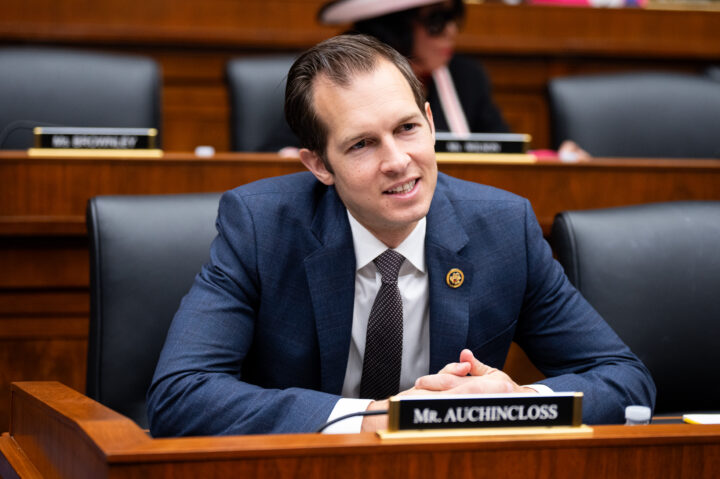
Rep. Jake Auchincloss (D-MA) participates in the House Transportation Committee hearing on Thursday, June 27, 2024.
A group of 30 House Democrats urged Secretary of State Marco Rubio to leverage a joint statement from the Arab League this summer — which called for Hamas’ disarmament and removal of power, the release of hostages and a path toward a two-state solution — as a potential diplomatic breakthrough for the region.
The lawmakers also condemned the unilateral recognition of a Palestinian state recently undertaken by several close U.S. allies.
“While there is much we disagree with in the statement, we do believe that this breakthrough presents a rare and urgent opportunity to ensure Israel’s security and create a brighter future for innocent Palestinians free from Hamas through American leadership,” the lawmakers said in a letter to Rubio on Thursday, emphasizing that it is the first time the Arab League has explicitly rejected Hamas.
“The statement made at the conference offers a unique opportunity — one that strengthens both Israel’s long-term security and Palestinians’ aspirations for self-determination under accountable, nonviolent leadership,” the letter continues. “While we once again emphasize that we do not endorse everything in the text, we recognize the unprecedented nature of the declaration and believe it presents a positive shift that opens the door to productive diplomacy and long-term solutions.”
The lawmakers urged Rubio to work with Israel to bring together regional and international partners to broker an agreement that would immediately and unconditionally free the hostages, remove Hamas from power in Gaza and achieve a “responsible deescalation of the conflict” in Gaza that would allow for rebuilding, governmental reform and peace.
They said that such an approach would be “far more constructive than recent unilateral and performative recognitions of a Palestinian state by other nations, which risk emboldening Hamas, entrenching division, and undermining the very legitimacy and peace such recognition purports to advance.”
“With regional partners signaling readiness to help facilitate both security and governance transitions, the United States has a pivotal role to play in turning principle into progress toward a two-state solution,” the letter reads. “This is a chance to protect Israel — our strongest ally — and align American values with regional momentum, and also leave a lasting legacy.”
The letter was led by Reps. Jake Auchincloss (D-MA), Debbie Wasserman Schultz (D-FL), Greg Landsman (D-OH) and Tim Kennedy (D-NY), joined by Reps. Dan Goldman (D-NY), Grace Meng (D-NY), Marilyn Strickland (D-WA), Emilia Sykes (D-OH), Josh Gottheimer (D-NJ), Frank Pallone (D-NJ), Jared Moskowitz (D-FL), Lois Frankel (D-FL), Kim Schrier (D-WA), Tom Suozzi (D-NY), Jimmy Panetta (D-CA), Brad Schneider (D-IL), Angie Craig (D-MN), Kevin Mullin (D-CA), Juan Vargas (D-CA), Ritchie Torres (D-NY), Chris Pappas (D-NH), Eric Swalwell (D-CA), Ted Lieu (D-CA), George Latimer (D-NY), Haley Stevens (D-MI), Darren Soto (D-FL), Greg Stanton (D-AZ), Nikki Budzinski (D-IL), Shri Thanedar (D-MI) and Wesley Bell (D-MO).
Craig, Pappas and Stevens are all running for the Senate in their respective states.
Democratic Majority for Israel supported the letter.
“The U.S. must act quickly to seize on this diplomatic opportunity which presents a unique opening to both ensure Israel’s security and create a future for Israelis and Palestinians free from the terrorist group Hamas,” the group’s CEO, Brian Romick, said in a statement. “While there is much we disagree with in the Arab League statement, its historic nature is unprecedented. By calling for the release of hostages, condemning the October 7 attacks, disavowing Hamas and endorsing a two-state path, Arab countries have signaled a potential willingness to be part of a new, constructive chapter for the Middle East.”
“At the same time, we call on all leaders to reject unilateral performative recognition of a Palestinian state which risks emboldening Hamas rather than advancing peace,” Romick continued.
The Arab League, in signing the declaration, condemned the Oct. 7 attack and called on Hamas to release the hostages to end the war for the first time
Selcuk Acar/Anadolu via Getty Images
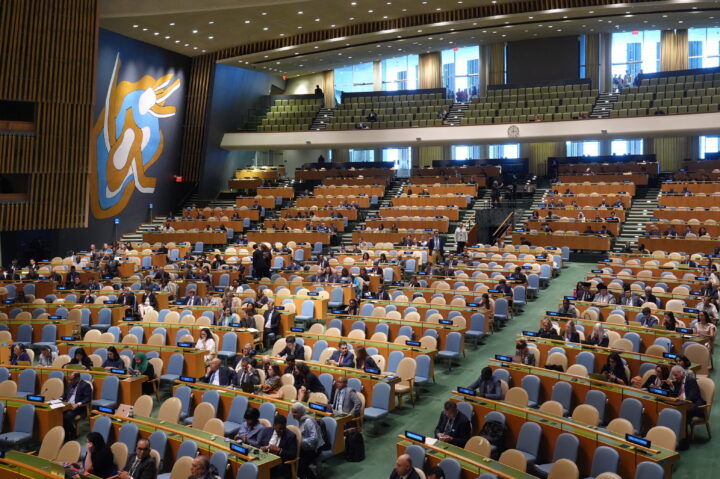
A general view of hall at the High-Level International Conference on achieving a peaceful resolution to the Palestinian question and implementing a long-term sustainable peace, reviving the prospect of a two-state solution at the United Nations headquarters in New York, United States on July 29, 2025.
Eleven countries declared their intention to recognize a Palestinian state in conjunction with Tuesday’s France and Saudi Arabia-sponsored conference at the United Nations on a two-state solution.
The Arab League, along with the entire European Union and seventeen additional countries, signed the “New York Declaration,” which details a plan starting with the immediate end of the war and concludes with an independent, demilitarized Palestinian state living peacefully next to Israel. The declaration calls for UNRWA — the U.N. agency for Palestinian refugees, some of whose employees participated in the Oct. 7 attacks — to take part in the transition, and for the Palestinian Authority to implement reforms and hold democratic elections within a year.
Notably, by signing the declaration, for the first time, the entire Arab League — including Hamas benefactor Qatar — condemned Hamas’ Oct. 7 attacks on Israel and called for the terrorist group to disarm, give up its rule over Gaza and release the hostages in order to end the war.
A separate statement, the “New York Call,” was signed by 15 Western countries, six of whom already recognized a Palestinian state, and another nine who “expressed or express willingness … to recognize the state of Palestine as an essential step towards the two-state solution, and invite all countries that have not done so to join this call.”
Most U.N. member states — 145 out of 193 of them — recognize a Palestinian state, the vast majority of them having followed the Soviet Union in doing so in 1988. Nine of them took the step after the Oct. 7 attacks and the start of the war in Gaza. Eleven more announced the intention to do so this week.
The countries that joined the “New York Call” were Andorra, Australia, Canada, Finland, Luxembourg, Malta, New Zealand, Portugal and San Marino.
The declaration came hours after British Prime Minister Keir Starmer said that his country will recognize a Palestinian state by September if Israel does not reach a ceasefire with Hamas — though Hamas is the one who rejected such a deal last week — and commit to not annexing the West Bank and agree to reviving the idea of a two-state solution.
Last week, ahead of the conference, French President Emmanuel Macron announced that Paris would also recognize a Palestinian state in September at the U.N. General Assembly.
The response from Jerusalem was overwhelmingly negative, with Israeli Prime Minister Benjamin Netanyahu warning that recognizing a Palestinian state “rewards Hamas’s monstrous terrorism and punishes its victims … Appeasement towards jihadist terrorists always fails.” Foreign Minister Gideon Sa’ar called the statements “a reward for Hamas … at a time when Israel is still fighting in Gaza and there are still Israeli hostages there,” and “a rash and ill-considered decision, primarily driven by internal political considerations and pressures.”
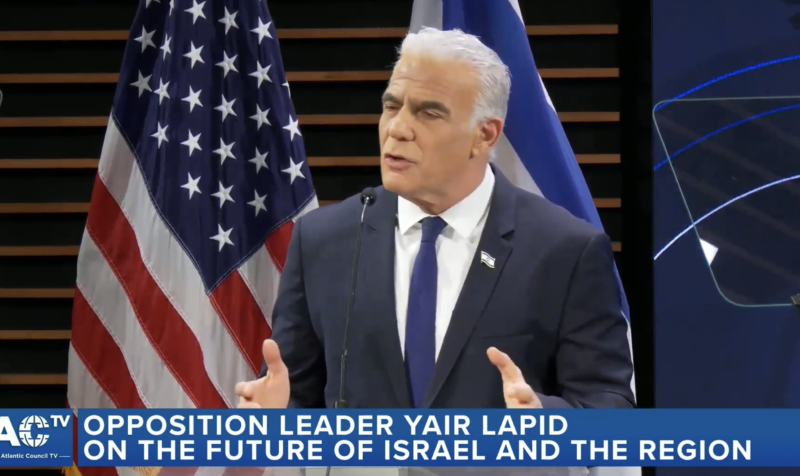
Israeli opposition leader Yair Lapid wrote that “if Europe genuinely wants a Palestinian state to come into being one day, it needs to … demand that the Palestinians change … Declaring support for those who handed out candy in the streets of [the West Bank cities of] Nablus and Hebron on the morning of Oct. 7 does not advance a two-state solution. If anything, it pushes it further away.”
The State Department also called the conference an “unproductive and ill-timed publicity stunt” that will “embolden Hamas and … undermine real-world efforts to achieve peace … It keeps hostages trapped in tunnels.”
Former hostage of Hamas Emily Damari, a British citizen, posted on X that Starmer’s recognition of Palestinian statehood “risks rewarding terror [and] sends a dangerous message: that violence earns legitimacy … Recognition under these conditions emboldens extremists and undermines any hope for genuine peace. Shame on you.”
The Hostages Families Forum said that “recognizing a Palestinian state while 50 hostages remain trapped in Hamas tunnels amounts to rewarding terrorism … The abduction of men, women, and children, who are being held against their will in tunnels while subjected to starvation and physical and psychological abuse, cannot and should not serve as the foundation for establishing a state … The essential first step toward ensuring a better future for all peoples must be the release of all hostages through a single, comprehensive deal.”
Dan Diker, president of the Jerusalem Center for Security and Foreign Affairs, said in an interview with Jewish Insider that the move to recognize a Palestinian state emboldens Hamas, in that it convinces them that “they’re winning the long game. Hamas now says ‘The West is with us.’ This is exactly what they want, to pressure and corner Israel to succeed, and Hamas will say, ‘We’re not going to release the hostages.’ They’re just biding their time.”
Emmanuel Nahshon, the Israeli Foreign Ministry’s former deputy director for public diplomacy and a former ambassador to Brussels who resigned in protest against the government last year, told JI that 11 countries saying they’ll recognize a Palestinian state in one week creates “a slippery slope” towards diplomatic isolation for Israel.
“This enables countries that were friendly with Israel to criticize us publicly, and strengthens extremely radical elements in those countries,” Nahshon said. “It’s a kind of perfect storm with the purpose of delegitimizing Israel.”
Among those countries, he said, are Canada, the Netherlands and France.
“These are countries that we always considered to be like-minded, in terms of a point of reference for the State of Israel. We don’t want to compare ourselves to African dictatorships; rather, we see ourselves like Western European democracies. Now, Western European democracies are growing more and more distant from Israel,” Nahshon said.
Diker said that 11 countries recognizing a Palestinian state is “very dangerous in the perception war.”
“This is the greatest success for what was originally a Soviet plan, that the Palestinians under [PLO leader Yasser] Arafat and [Palestinian Authority President] Mahmoud Abbas and then Hamas inherited. The strategy is to divide … Western states from Israel, isolate Israel, and cause it to bleed to death,” he said.
Diker noted that France and the U.K.’s position is especially consequential because they are permanent members of the U.N. Security Council aligned with the U.S. If London and Paris follow through and recognize a Palestinian state, the U.S. will be the only permanent member of the UNSC not to do so.
Diker said that “what Starmer and Macron … [did] is an ill-advised move … The PA have not satisfied any of the requirements for statehood. They don’t have a functioning government; they don’t have control over the population or the ability to engage in international relations — they have 100 political warriors they call diplomats and all they do is subvert Israel.”
Nahshon added that the countries “are not stupid; they know that even if they recognize a Palestinian state it doesn’t mean there is a Palestinian state. You can trust the international community that they understand fully well that it won’t have practical, immediate implications, certainly not when Palestinians are unable to run their own state and possibly unwilling to have their own state, because if you ask most Palestinians, they would rather destroy Israel.”
Rather, he said the move to recognize a Palestinian state “sends a message to Israel of criticism and disapproval,” Nahshon said. “It’s addressed first and foremost at Israel … It’s a vote of no confidence addressed at the Israeli government saying, ‘We are very unhappy with the way you run the war in Gaza and with the free hand given to extreme settlers.’ The message is addressed to Netanyahu and his government.”
Diker pointed out that Starmer is “a well-heeled international lawyer, a human rights lawyer,” and that he and Macron “see themselves as being the human rights conscience of the Europeans” but put pressure mainly on Israel, “ironically, while Hamas kills and tortures its own people while they’re seeking humanitarian aid.”
“Israel has had a very serious problem in leading the narrative,” Diker said. “This is narrative warfare … [that] brought us to where we are … Israel has got to pull itself together and prosecute a soft power war.”
Diker called for there to be widely-released images of “Israeli soldiers handing food and aid to the Gazans. That is political, cognitive warfare. We should be seen doing that.”
Asked if that might be a domestic political risk to the current Israeli government, Diker said: “If we’re totally isolated internationally, it’s a fundamental threat to our existence. We can’t operate in a vacuum.”
Please log in if you already have a subscription, or subscribe to access the latest updates.
 Continue with Google
 Continue with Apple