




































































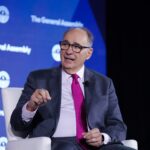

Cruz ties support for Somalia ambassador nominee to U.S. recognition of Somaliland
The Texas senator issued the warning at a Senate Foreign Relations Committee confirmation hearing for 10 pending nominees, after Devin Kennington declined to agree with Trump’s comments

Tom Williams/CQ-Roll Call, Inc via Getty Images
Sen. Ted Cruz (R-TX) is seen after the Senate luncheons in the U.S. Capitol on August 4, 2026.


 Add JewishInsider on Google
Sen. Ted Cruz (R-TX) said on Tuesday that he will condition his support for President Donald Trump’s nomination of Devin Kennington to be U.S. ambassador to Somalia on the State Department “following the president’s guidance” and formally recognizing Somaliland’s independence.
The Texas senator, who has been pushing for U.S. recognition of Somaliland since last year, issued the warning at a Senate Foreign Relations Committee confirmation hearing for 10 pending nominees, after Kennington declined to agree with Trump’s comments at a campaign rally last month that Somaliland is “a totally different country,” rather than a region of Somalia, or promise to encourage the Trump administration to pursue formal U.S. recognition of Somaliland.
“I think this administration has been very clear that it wants further engagement with Somaliland,” Kennington said. “Obviously, I think we recognize their position on China is favorable to us. I think there’s several commercial and economic opportunities that are available to us. As you noted, I think they play a key role in Red Sea security. So I think from my position, I do believe that we have an interest in enhancing U.S. engagement with Somaliland.”
Cruz repeatedly emphasized Somaliland’s strategic importance for U.S. priorities in the Horn of Africa, telling Kennington, “I firmly believe that U.S. recognition of Somaliland would advance our national security interest in the Horn of Africa and beyond.”
Citing the president’s October comments and what he described as Somaliland’s strategic importance for U.S. priorities in the Horn of Africa, Cruz called on the State Department to issue formal recognition of Somaliland as an independent nation and asked Kennington to explain the delay.
“I think President Trump is exactly right. Somaliland is not Somalia,” Cruz said. “The president has made his position clear, and I believe it is time for the United States to formally recognize Somaliland. Now, despite the President’s clear position, somehow at Foggy Bottom, the State Department has not moved forward with recognition. What specifically is preventing the State Department from doing so?”
Kennington said he could not answer Cruz’s question, nor could he answer his follow-up questions on the existence of obstacles that were preventing the U.S. from recognizing Somaliland.
“I think the State Department should follow the president’s guidance,” Cruz then replied. “And I think your confirmation depends on the State Department following the president’s guidance.”
The State Department did not respond to Jewish Insider’s request for comment on Cruz’s ultimatum, though the Texas senator wrote on X on Tuesday evening, “President Trump has rightly said that Somaliland is ‘a totally different country’ than Somalia. That is exactly the correct policy. It is long past time for the U.S. to recognize Somaliland.”
“Today I questioned the nominee to be ambassador to Somalia to confirm that he agrees [with] President Trump’s position. He declined to do so,” Cruz wrote on X. “I told him that whether he is confirmed or not will depend on whether the State Department follows the president’s guidance.”
The confirmation hearing also included testimony from Rep. Wesley Hunt (R-TX), the nominee to be U.S. ambassador to Saudi Arabia, and Dino LaVerghetta, the nominee to be U.S. ambassador to Kuwait.
LaVerghetta told the committee that he would prioritize maintaining Kuwait’s status as “a reliable platform for American diplomacy and operations,” and argued that the countries’ “security partnership” was “at the heart of this relationship,” pointing to U.S. forces helping liberate Kuwait in 1991 and the country’s hosting of “a major contingent of American forces.”
LaVerghetta was nominated to be ambassador to Kuwait in late September, after Republicans joined Democrats in blocking the original nomination of Amer Ghalib, the former mayor of Hamtramck, Mich., over his history of antisemitism and lack of foreign policy experience. White House officials told committee Republicans after Ghalib’s contentious confirmation hearing last October that Trump insisted that Ghalib still receive a vote on his confirmation and would not withdraw the nomination because he credited Ghalib with helping him turn out Michigan’s Arab American vote and win the state in the 2024 election.
That vote never occurred, and the Senate ultimately sent Ghalib’s nomination back to the White House in January. Ghalib announced his appointment as an advisor to the president on Arab-American affairs, a role that does not require Senate confirmation, last month.
Hunt faced questions at the hearing from several committee Democrats over how he plans to approach the Saudi nuclear program; how he’ll push the kingdom to follow through with normalizing relations with Israel; and his past comments about Islam.
Sen. Jeff Merkley (D-OR) pressed Hunt on whether he believed the Trump administration should be willing to add additional protocols to the U.S.-Saudi nuclear agreement that would place restrictions on the kingdom’s nuclear program. Hunt acknowledged the importance of ensuring Riyadh’s willingness to address proliferation concerns and allow for stronger International Atomic Energy Agency inspections of their program, though he argued that maintaining a positive alliance with Saudi Arabia and expanding U.S. economic and trade ties was the only way to have real influence on the kingdom.
“We cannot let perfection be the enemy of great. We need to try to get as close to the gold standard as possible,” Hunt said. “We also need to understand that if we aren’t the ones that are able to provide them with this program, then they, the Saudis, may turn to China or, God forbid, even Pakistan. If that’s the case, then we have absolutely no say in the direction that they could take their nuclear program.”
“The number one trade partner to Saudi Arabia is China, and it needs to be the United States of America,” he continued. “As we continue to work toward peace in the region, especially as it pertains to the Abraham Accords, which this is obviously, tangentially related to, we have to continue from a diplomatic standpoint to push forward to get as close to that standard as possible.”
During her questioning, Sen. Jacky Rosen (D-NV) brought up the nuclear agreement between the U.S. and Saudi Arabia and asked Hunt if it was his understanding that the U.S. will not move forward with a nuclear deal with the Saudis without the kingdom normalizing relations with Israel. Hunt replied: “I think that is actually a part of the negotiation process.”
Rosen then pressed Hunt on how he would approach the issue with the Saudi government, to which he replied, “That’s actually a part of the negotiation process as well. We all know that we have to start at one place until we get to the finish line. I think we already did have the Abraham Accords under President Trump’s first administration and I think it’s time for us to get back to that standard.”
“I think we are living in a time where there’s a lot of unrest,” Hunt said. “We are all under attack, and I do believe that us normalizing relations with Israel has got to be paramount to get back to where we were back in 2016. I am not so naive to think that we are going to be the panacea to fix this … These factions have been warring for generations, but it is my job for the next two years, if confirmed, … to get as close to that as possible.”
Sen. Jeanne Shaheen (D-NH), the top Democrat on the Foreign Relations Committee, expressed concern over several of Hunt’s past statements on Islam and about Saudi Arabia itself. She pointed to him saying in January that “the mandate that’s been given to Islam is to basically go to other countries and infiltrate them, have a heavy population and then eventually take them over.”
Asked by Shaheen if this was his view of Islam, Hunt replied, “As someone that was stationed in the region for two years, I understand kind of how things operate in that region. I also understand that that’s not the view of every Muslim in the entire world, but there certainly is a faction to where that is absolutely correct.”
“Some of my friends that I served with at West Point, some of my friends that I have worked with that are practicing Muslim Americans,” he said. “They’ve approached me and they have said, ‘Wesley, we appreciate some of the statements that you have made about Sharia law and about some of the issues with my religion because my family fled there to live in a free country like America, to not have to be under that sort of rule.’”
“So while I totally understand your question, I do think that there are some cultural differences that we are going to have to diplomatically work through, I also recognize that as a United States congressman, my job as an ambassador is going to be very, very different.”
More Stories
FAITHFUL FURY
Top Christian pro-Israel group goes after Vance for ‘dog whistle’ blaming Jews for midterm defeat
LEADING THE PACK
Rebeca Grynspan gains ground in latest U.N. secretary-general straw poll
FRIENDLY FOES
Rep.-elect Adam Hamawy declines to call Iran a U.S. adversary in CNN interview
STAFF SHAKEUP
Trump taps Stephen Miller as chief of staff after Susie Wiles resigns
ON NOTICE
At G7 summit, Rubio puts International Criminal Court in crosshairs
FUNDING FIGHT
Top Senate Dem says ‘looking at all options’ to end Iran war ahead of December funding deadline
Please log in if you already have a subscription, or subscribe to access the latest updates.
 Continue with Google

 Continue with Apple