






































































At G7 summit, Rubio puts International Criminal Court in crosshairs
Rubio: ‘We believe we can inflict tremendous damage on the ICC, unless they see the error of their ways’
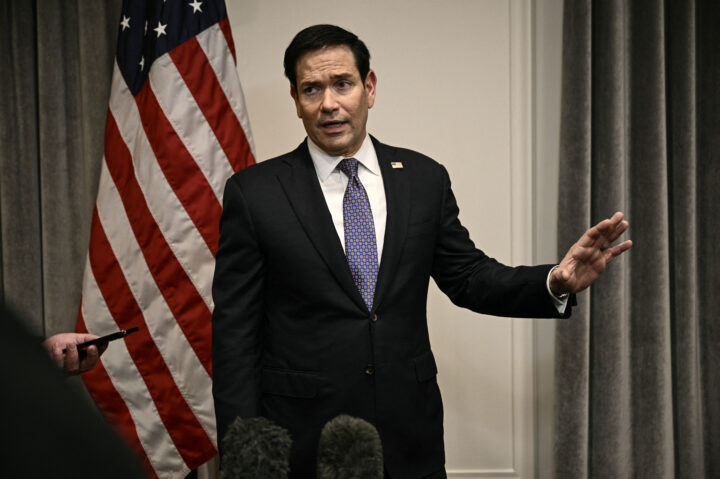
Brendan SMIALOWSKI / POOL / AFP via Getty Images
Secretary of State Marco Rubio speaks to the press on the sidelines of the G7 foreign ministers summit at the InterContinental Paris - Le Grand in Paris on November 9, 2026.


 Add JewishInsider on Google
Secretary of State Marco Rubio warned Monday that the United States could inflict “tremendous damage” on the International Criminal Court unless it changes course, while reaffirming President Donald Trump’s push to transition U.S. military assistance to Israel from military financing toward conventional weapons sales.
Speaking to reporters on the sidelines of the G7 foreign ministers’ meeting in Paris, Rubio also revealed that Washington views two or three candidates favorably in the race to become the next United Nations secretary-general, though he declined to identify them publicly.
The remarks came as G7 foreign ministers gathered for two days of discussions on major international conflicts — including the wars involving Iran and Russia — amid sharp policy disagreements between Washington and its European allies over the ICC and broader Middle East strategy.
Rubio reiterated the administration’s firm opposition to the ICC’s assertion of jurisdiction over nationals of countries that are not parties to its founding treaty. The organization has previously issued arrest warrants for Israeli Prime Minister Benjamin Netanyahu and former Defense Minister Yoav Gallant over alleged war crimes in Gaza, even as Israel is not a party to the Rome Statute.
“We raise it everywhere we go, and that is the ICC as a court that continues to claim that they have jurisdiction over individuals from countries that are not members of that treaty,” Rubio said. “And we’ve tried for a year and a half to get them to reform [in] a nice way, and they haven’t been willing to do so. So we’ll have to try a different approach.”
“I’m not going to talk about what we might do or not do as a result of it,” he continued. “Suffice it to say that we believe we can inflict tremendous damage on the ICC, unless they see the error of their ways.”
While the Trump administration has already imposed sanctions on the court and its officials, Rubio did not specify what additional measures Washington might pursue. He cited severe concerns that its jurisdictional overreach could eventually set a precedent for prosecuting American service members, similar justification to his announcement of a major diplomatic offensive against the ICC in July.
“Bottom line is, we’re not going to have some American servicemen or American military commander standing trial at some illegitimate court that we’re not a member of. It’s as simple as that,” Rubio said.
When pressed on U.S. military assistance to Israel, Rubio confirmed Trump’s framework for shifting the relationship away from U.S. military aid.
“The president’s expectation is that Israel is now prosperous and rich enough to be able to be a sales country — they can buy weapons from us, but we no longer have to provide the financing,” Rubio said. “It’s something the Israelis themselves have offered up.”
“We’ll negotiate the timeline,” he added. “The president wants it as soon as possible. He thinks it makes sense to do it as soon as possible.”
The comments follow Trump’s announcement last week that he and Netanyahu had agreed to phase out roughly $4 billion in annual U.S. military financing to Israel by the end of 2026.
Rubio also discussed the race to succeed U.N. Secretary-General António Guterres, whose second five-year term ends Dec. 31. He said that while the administration sees several qualified contenders, it is deliberately withholding public endorsements.
“If I told you who the U.S. wanted, it would doom them to lose,” Rubio said. “There’s a couple really good candidates, people that we like — two or three — and that process will work itself out.”
“We don’t have a candidate that’s the U.S. candidate,” he added. “We see two or three very qualified people, and we’re going to let the voting continue on that front.”
His comments follow an eighth Security Council straw poll in which Costa Rica’s Rebeca Grynspan strengthened her lead with 12 encouragement votes, ahead of Argentina’s Rafael Grossi and Guyana’s Carolyn Rodrigues-Birkett. The latest poll used undifferentiated ballots, leaving it unclear whether the leading candidates face opposition from any of the five veto-bearing permanent members.
Rubio stressed that Washington’s primary consideration is whether the next leader will drive comprehensive reforms across an international body that has struggled to respond effectively to global security threats.
“In the end, what we’re interested more than anything else is that it be someone that’s committed to U.N. reform,” Rubio said. “I think it’s one of the things that’s going to save the UN.”
“I think it’s troubling for a lot of people that the U.N. really is not at the center of any of the global crises that are going on right now,” Rubio added. “[And it] has not played a meaningful role in a major global crisis in quite a while, so the whole system is in need of reform.”
Turning to the situation in Gaza, Rubio fielded questions about the U.S.-backed ceasefire framework, which has faced implementation hurdles surrounding Hamas’ disarmament, future governance and plans for an international stabilization force under Trump’s Board of Peace initiative.
“Part of that obviously starts with, you know, shelter and the need for heat at some point here, and obviously given the winter approaching and all these other needs that are necessary in order to sustain life,” Rubio said. “All of that was part of the Board of Peace program. All of that was part of the way the ceasefire came together. [It has], in some ways, fallen behind schedule for a variety of reasons, but we expect it to catch up.”
His remarks came as the Board of Peace issued a statement on Monday pressing Hamas to disarm and relinquish governing authority while calling on Israel to do more to address shelter and winterization needs in the enclave after severe flooding. Rubio noted that Washington expects Israel to meet its humanitarian commitments, highlighting coordination with the World Food Program and the necessity of reestablishing local infrastructure like bakeries so Gaza can become self-sustaining.
More Stories
ROCKY START
Rep.-elect Chris Rabb’s silence on antisemitic protest frustrates Philly’s Jewish community
PRESCHOOL PRECEDENT
Supreme Court hears oral arguments in religious preschool case
PRESIDENT’S POV
Trump blames midterm losses on Iran war and ‘great dislike’ of Israel
PENTAGON SHOWDOWN
Hegseth accuses Massie of carrying out personal vendetta in impeachment effort
Daily Overtime
DSA captures more House seats in blue wave
MICHIGAN POSTMORTEM
Some in Michigan Jewish community worried about future after El-Sayed victory
Please log in if you already have a subscription, or subscribe to access the latest updates.
 Continue with Google

 Continue with Apple