















































Meta defends content moderation policies, touts usage of AI to track Holocaust denial
Meta’s director of content policy spoke at a ‘Hack the Hate’ tech conference as the ADL released a report documenting antisemitism spreading unchecked on its platform Instagram
Shahar Azran/WJC
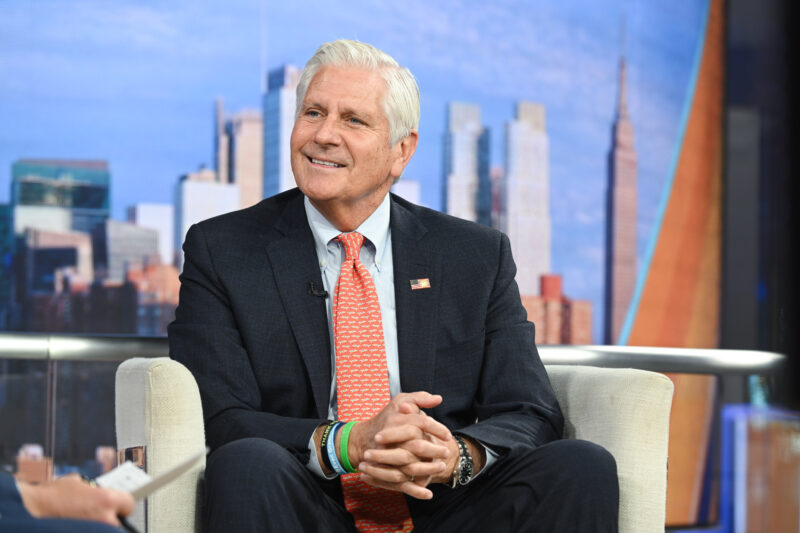
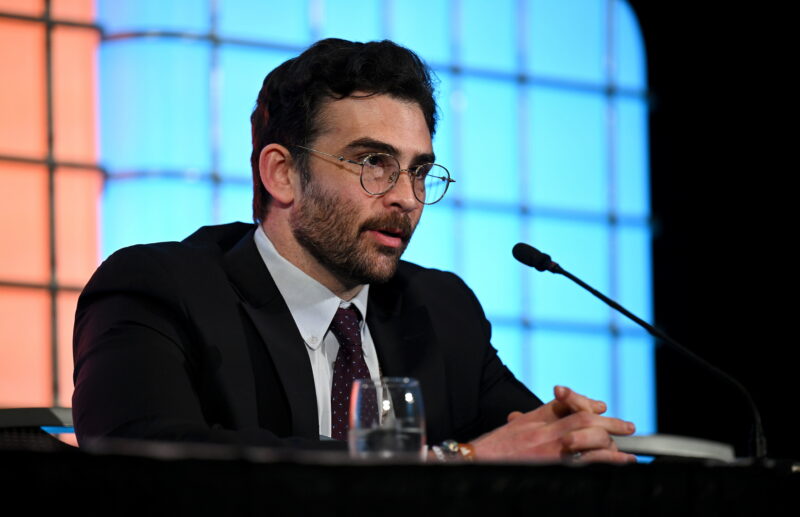
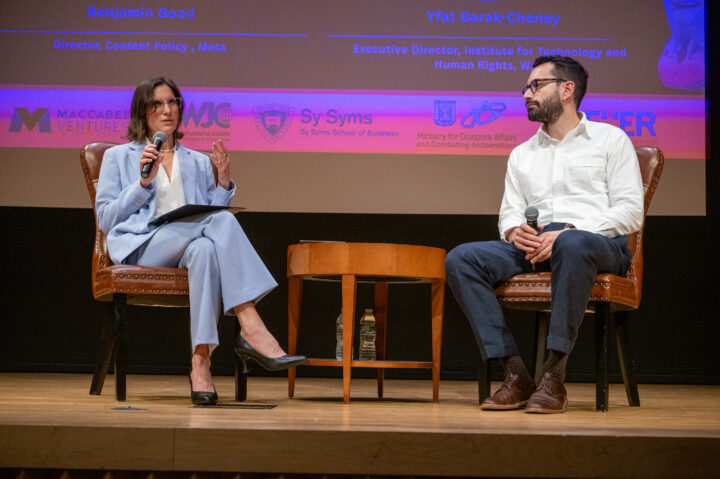
Ben Good, Meta's director of content policy, speaks at the 2026 Hack the Hate summit in Manhattan.


 Add JewishInsider on Google
Amid accusations that Meta’s moderation policies enable antisemitic content to circulate on its platforms, a Meta leader on Tuesday highlighted efforts to combat online Jew-hatred, including restrictions on Holocaust denial.
“We remove Holocaust distortion and denial, not because it’s false, which it is, but because it’s antisemitic. It is hate speech against Jewish people, so we’ve drawn a clear line against it,” said Ben Good, director of content policy at Meta, the parent company of Instagram, Facebook and WhatsApp.
Good spoke at “Hack the Hate NYC 2026,” an event at the Yeshiva University Museum in Manhattan spotlighting Israeli tech experts and Jewish leaders working to combat digital antisemitism.
Good, who leads Meta’s team that writes content policies — the rules for what can be posted to the platforms — spoke during a fireside chat with Yfat Barak-Cheney, executive director of the Institute for Technology and Human Rights at the World Jewish Congress.
“Those are policies that govern the global speech of 3 billion people, so we take the responsibility extremely seriously. We want to make sure people can express themselves maximally but we also have to keep our community safe,” said Good.
The event was held as Jewish communities in Israel and around the world marked Yom HaShoah. Barak-Cheney noted that it took four years of advocacy from groups like WJC for Meta to recognize Holocaust denial as antisemitism. In October 2020, the company updated its policies to explicitly prohibit content that denies, distorts or minimizes the Holocaust.
Even after that recognition, she said, the situation remains “especially alarming because it’s not just that we see a larger quantity of AI-generated material, but the quality is different, it’s getting better.”
“Holocaust denial is looking very realistic,” she said. “There’s fabricated quotes. I am worried that we’re losing our grip on the reality of the Holocaust. Does Meta see this as alarming from the inside as it is from our point of view?”
“I have seen new trends putting words in people’s mouths that were not said, having prominent Nazis say things that aren’t true. Those violate our policies. It’s hate speech and we remove it,” said Good. “The same goes for a lot of other conspiracy theories that are misinformation but really are about dehumanizing Jewish people. The most prominent one being the centuries-old tropes that Jewish people control the media or government. We know that underlies dangerous acts so we remove it.”
Good said that Meta, which uses AI-generated content moderation, has “tremendous potential to advance AI systems in dealing with what we call ‘integrity work’ in social media.”
He said that “traditional machine learning,” utilized about two years ago, required being fed “a ton of data, some content that violates [Meta policies], some that doesn’t and they begin to understand [and match] patterns.”
Modern LLMs are able to analyze context on their own, said Good, allowing for more accurate reasoning.
“That is extremely important in an area such as Holocaust denial because it’s very coded and can often be long-form speeches and text which can be hard to understand even for a human,” said Good. “The LLMs are really good at understanding coded language and context.”
But even as Meta has made strides in addressing Holocaust denial, the Anti-Defamation League released a new report on Wednesday revealing that Instagram failed to remove 93% of reported extremist and hateful content, tying the trend directly to Meta’s efforts to roll back content moderation last year.
A spokesperson for Meta told Jewish Insider after the report was released that “over two-thirds of the accounts and posts flagged by the ADL were removed prior to the publication of this report, while some did not violate our policies.” ADL told JI it gave Meta a two-week window from reporting the content to getting a response from the platform.
The January 2025 rollback of content moderation included ending the platform’s third-party fact-checking program and replacing it with a system modeled after the community notes feature on Elon Musk’s X.
At the time, some Jewish leaders expressed concern that the move would “open the floodgates to content” that could target Jewish communities and individuals, and called the decision a “step back” in the fight against rising antisemitism. Meta had said the relaxed guidelines aim to “allow more speech by lifting restrictions on some topics that are part of mainstream discourse.”
“The name of the game isn’t just relying on the magic of AI and setting it loose on our platform,” said Good. “Instead, we have to be extremely positive that it understands our written policies and will apply and enforce them. We don’t want to leave the guesswork to the technology. We will always be reporting our enforcement metrics. But this is a chance to bring contextual understanding to content moderation.”
Barak-Cheney asked Good what guardrails Meta, which produces its own AI system called Llama, has in place to stop its LLMs from generating content that might be antisemitic.
“We do train the models on our safety standards,” said Good. “The unique challenge with generative AI is that it’s interactive and adaptable. When we train the models to prevent harm, we’ve learned it’s not so much the ‘what’ but the ‘why.’ It’s not so much telling the model that it can or can’t say this, it’s explaining to the model why we have certain rules, prohibitions and standards and reasoning with it so it can extrapolate that reasoning into situations.”
“This can mean a number of things, but an old-school way of doing it would be to say ‘here are 500 words we consider slurs, don’t say them.’ A more dynamic rule might be ‘this is what a slur is, this is why we consider a word a slur and these are the circumstances in which you can say it,’ and let the model reason through various situations,” explained Good.
He added that “there’s no limit” to how much help antisemitism watchdogs can provide to Meta.
“To be clear, we understand that generally it’s our job to understand how problems manifest and address them, but when people who are on the ground in a given space give us reports and intel it allows us to validate our own research in a way that helps us make decisions better. The policy shouldn’t be a bunch of people in Silicon Valley deciding things. They should be decided collaboratively,” Good said.
The event, attended by some 150 Jewish leaders and innovators, opened with remarks from Rabbi Ari Berman, president of Yeshiva University. It was organized by Generative AI for Good and the 8200 Alumni Association, which preserves the legacy of IDF Unit 8200, in partnership with the Israeli Ministry for Diaspora Affairs and Combating Antisemitism, Gesher Israel, Maccabee Ventures, President Isaac Herzog’s Voice of the People Initiative, the World Jewish Congress’ TecHRI and Yeshiva University’s Sy Syms School of Business.
More Stories

medical moves
Jewish groups praise new HHS guidelines aimed at combating antisemitism in healthcare

PROTEST POLITICS
Incoming anti-Israel members of Congress protest against Netanyahu outside U.N.

MONEY MATTERS
Treasury moves to terminate tax-exempt status for some universities, private schools

NO COMPROMISE
El-Sayed refuses to tone down Israel attacks despite prompting from Democratic podcast hosts
SECURITY ADVOCACY
‘Life and death’: Survivors of antisemitic attacks lobby Congress for security aid
MEMORIAL EVENT
State Department plans memorial for American victims of Oct. 7 attack
Please log in if you already have a subscription, or subscribe to access the latest updates.
 Continue with Google
 Continue with Apple