























Meta’s director of content policy spoke at a ‘Hack the Hate’ tech conference as the ADL released a report documenting antisemitism spreading unchecked on its platform Instagram
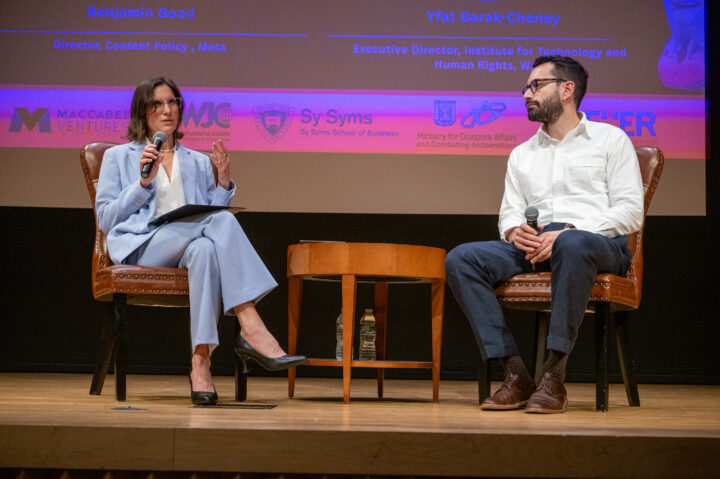
Shahar Azran/WJC
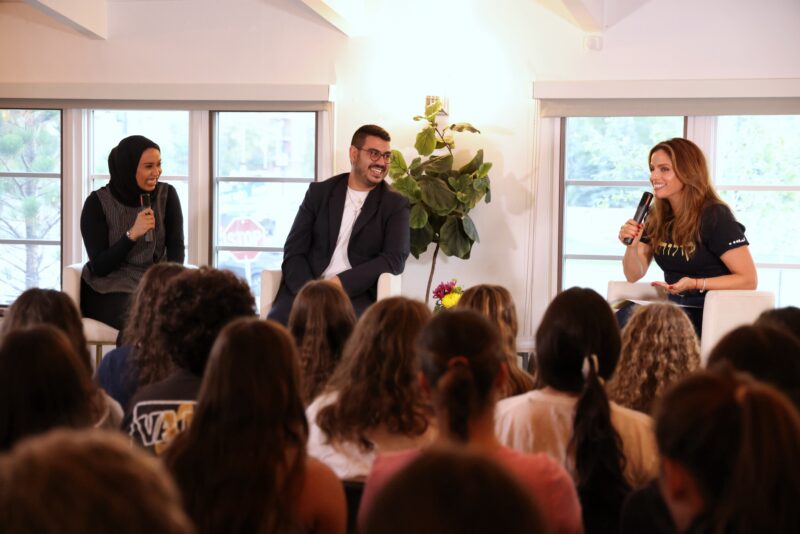
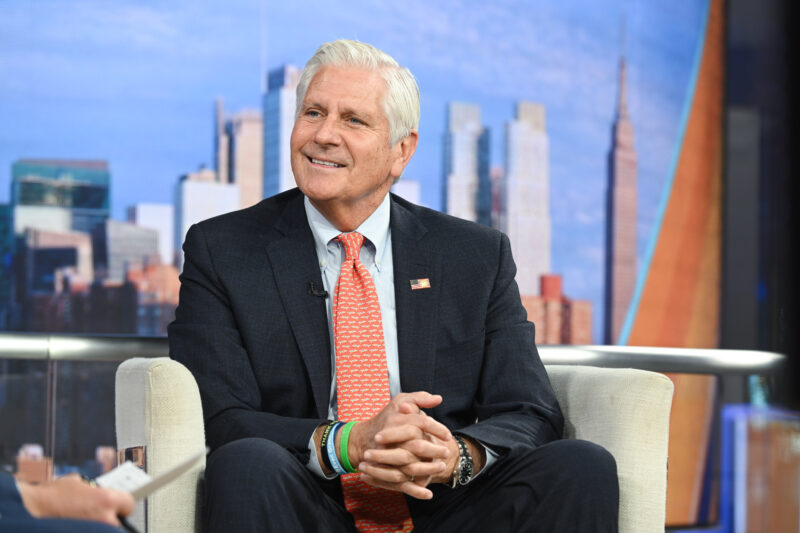
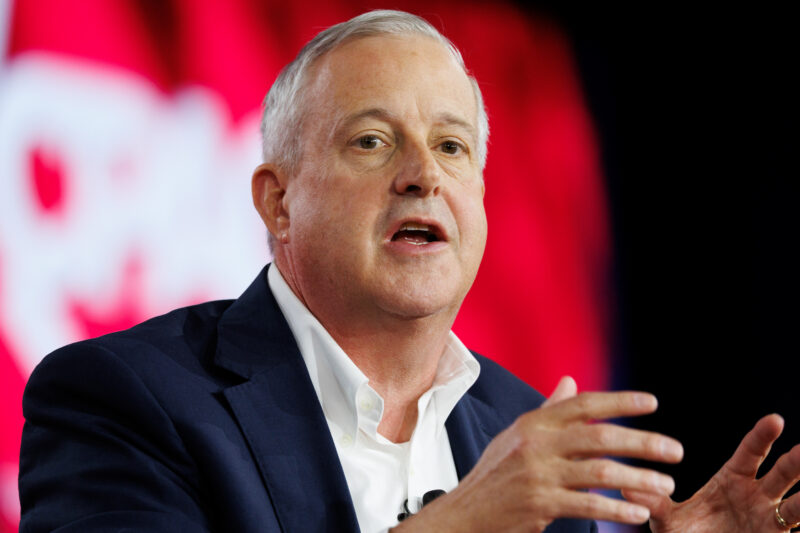
Ben Good, Meta's director of content policy, speaks at the 2026 Hack the Hate summit in Manhattan.


 Add JewishInsider on Google
Amid accusations that Meta’s moderation policies enable antisemitic content to circulate on its platforms, a Meta leader on Tuesday highlighted efforts to combat online Jew-hatred, including restrictions on Holocaust denial.
“We remove Holocaust distortion and denial, not because it’s false, which it is, but because it’s antisemitic. It is hate speech against Jewish people, so we’ve drawn a clear line against it,” said Ben Good, director of content policy at Meta, the parent company of Instagram, Facebook and WhatsApp.
Good spoke at “Hack the Hate NYC 2026,” an event at the Yeshiva University Museum in Manhattan spotlighting Israeli tech experts and Jewish leaders working to combat digital antisemitism.
Good, who leads Meta’s team that writes content policies — the rules for what can be posted to the platforms — spoke during a fireside chat with Yfat Barak-Cheney, executive director of the Institute for Technology and Human Rights at the World Jewish Congress.
“Those are policies that govern the global speech of 3 billion people, so we take the responsibility extremely seriously. We want to make sure people can express themselves maximally but we also have to keep our community safe,” said Good.
The event was held as Jewish communities in Israel and around the world marked Yom HaShoah. Barak-Cheney noted that it took four years of advocacy from groups like WJC for Meta to recognize Holocaust denial as antisemitism. In October 2020, the company updated its policies to explicitly prohibit content that denies, distorts or minimizes the Holocaust.
Even after that recognition, she said, the situation remains “especially alarming because it’s not just that we see a larger quantity of AI-generated material, but the quality is different, it’s getting better.”
“Holocaust denial is looking very realistic,” she said. “There’s fabricated quotes. I am worried that we’re losing our grip on the reality of the Holocaust. Does Meta see this as alarming from the inside as it is from our point of view?”
“I have seen new trends putting words in people’s mouths that were not said, having prominent Nazis say things that aren’t true. Those violate our policies. It’s hate speech and we remove it,” said Good. “The same goes for a lot of other conspiracy theories that are misinformation but really are about dehumanizing Jewish people. The most prominent one being the centuries-old tropes that Jewish people control the media or government. We know that underlies dangerous acts so we remove it.”
Good said that Meta, which uses AI-generated content moderation, has “tremendous potential to advance AI systems in dealing with what we call ‘integrity work’ in social media.”
He said that “traditional machine learning,” utilized about two years ago, required being fed “a ton of data, some content that violates [Meta policies], some that doesn’t and they begin to understand [and match] patterns.”
Modern LLMs are able to analyze context on their own, said Good, allowing for more accurate reasoning.
“That is extremely important in an area such as Holocaust denial because it’s very coded and can often be long-form speeches and text which can be hard to understand even for a human,” said Good. “The LLMs are really good at understanding coded language and context.”
But even as Meta has made strides in addressing Holocaust denial, the Anti-Defamation League released a new report on Wednesday revealing that Instagram failed to remove 93% of reported extremist and hateful content, tying the trend directly to Meta’s efforts to roll back content moderation last year.
A spokesperson for Meta told Jewish Insider after the report was released that “over two-thirds of the accounts and posts flagged by the ADL were removed prior to the publication of this report, while some did not violate our policies.” ADL told JI it gave Meta a two-week window from reporting the content to getting a response from the platform.
The January 2025 rollback of content moderation included ending the platform’s third-party fact-checking program and replacing it with a system modeled after the community notes feature on Elon Musk’s X.
At the time, some Jewish leaders expressed concern that the move would “open the floodgates to content” that could target Jewish communities and individuals, and called the decision a “step back” in the fight against rising antisemitism. Meta had said the relaxed guidelines aim to “allow more speech by lifting restrictions on some topics that are part of mainstream discourse.”
“The name of the game isn’t just relying on the magic of AI and setting it loose on our platform,” said Good. “Instead, we have to be extremely positive that it understands our written policies and will apply and enforce them. We don’t want to leave the guesswork to the technology. We will always be reporting our enforcement metrics. But this is a chance to bring contextual understanding to content moderation.”
Barak-Cheney asked Good what guardrails Meta, which produces its own AI system called Llama, has in place to stop its LLMs from generating content that might be antisemitic.
“We do train the models on our safety standards,” said Good. “The unique challenge with generative AI is that it’s interactive and adaptable. When we train the models to prevent harm, we’ve learned it’s not so much the ‘what’ but the ‘why.’ It’s not so much telling the model that it can or can’t say this, it’s explaining to the model why we have certain rules, prohibitions and standards and reasoning with it so it can extrapolate that reasoning into situations.”
“This can mean a number of things, but an old-school way of doing it would be to say ‘here are 500 words we consider slurs, don’t say them.’ A more dynamic rule might be ‘this is what a slur is, this is why we consider a word a slur and these are the circumstances in which you can say it,’ and let the model reason through various situations,” explained Good.
He added that “there’s no limit” to how much help antisemitism watchdogs can provide to Meta.
“To be clear, we understand that generally it’s our job to understand how problems manifest and address them, but when people who are on the ground in a given space give us reports and intel it allows us to validate our own research in a way that helps us make decisions better. The policy shouldn’t be a bunch of people in Silicon Valley deciding things. They should be decided collaboratively,” Good said.
The event, attended by some 150 Jewish leaders and innovators, opened with remarks from Rabbi Ari Berman, president of Yeshiva University. It was organized by Generative AI for Good and the 8200 Alumni Association, which preserves the legacy of IDF Unit 8200, in partnership with the Israeli Ministry for Diaspora Affairs and Combating Antisemitism, Gesher Israel, Maccabee Ventures, President Isaac Herzog’s Voice of the People Initiative, the World Jewish Congress’ TecHRI and Yeshiva University’s Sy Syms School of Business.
Howard Lutnick: ‘We are here because the victims of the Holocaust can continue to remind us that apathy must be overcome by meaning, neglect supplanted by remembrance and indifference surmounted by love’
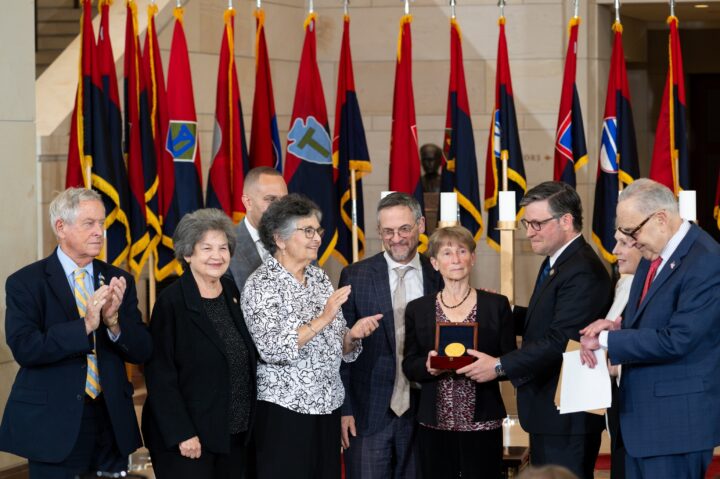
Courtesy Lois Frankel
Commerce Secretary Howard Lutnick, congressional leaders, newly appointed U.S. Holocaust Memorial Museum Board Chair Jeff Miller and others spoke alongside Holocaust survivors on Capitol Hill on Tuesday at the U.S.’ annual commemoration of Yom HaShoah.
At the event, House Speaker Mike Johnson (R-LA) and other lawmakers presented a congressional gold medal — Congress’ highest honor — to the family of Benjamin Ferencz, the youngest of the U.S. prosecutors at the Nuremberg trials. Ferencz’s daughter, accepting the award, echoed her father’s motto — ”law, not war” — also imprinted on the medal itself.
In his remarks, Lutnick said that “President [Donald] Trump has shown through action, not just words but bold action, that he is the greatest friend of the Jewish people,” pointing the president’s work to free the hostages who were still in captivity in Gaza on Yom HaShoah last year.
Lutnick also recounted his visit last year to Poland, where he commemorated the liberation of Auschwitz and Birkenau, an experience that “left an indelible impression on my wife and me.” He drew a line from those atrocities to the 9/11 attacks, in which Lutnick, the former CEO of Cantor Fitzgerald, lost friends, family and many of his colleagues.
“Both groups of the fallen are made up of common heroes whose memory on earth will be lost if not for the determined effort by organizations like the Holocaust Memorial Museum to keep their legacy alive and ensure that the refrain ‘Never Again’ echoes for generations to come,” Lutnick continued. “We are here because the victims of the Holocaust can continue to remind us that apathy must be overcome by meaning, neglect supplanted by remembrance and indifference surmounted by love.”
Miller, a lobbyist who was recently appointed to replace former Ambassador Stuart Eizenstat as the Museum’s board chair, described Holocaust remembrance and the mission of the museum as a critical duty.
“The fight against antisemitism and Holocaust denial is one of the defining moral challenges of our time,” Miller said. “For as long as the museum stands, as long as the truth of the Holocaust is taught, and as long as the people of conscience refuse to surrender to hatred, the [forces] of antisemitism, will find that they have not awakened our fear, but our unbreakable will and our determination to never, ever surrender in the fight against evil.”
Miller also acknowledged the rampant and growing modern problem of antisemitism. He warned that Holocaust denialism has been spreading, particularly online, that antisemitism has returned “not quietly, but openly,” with Hamas’s Oct. 7, 2023, attacks serving as a “brutal reminder of what happens when hatred of Jews is allowed to go unchecked,” and Jews facing attacks and feeling afraid globally.
He said that he’s seen his own daughters face antisemitism on their college campuses, a challenge that “demands leadership, moral clarity and action.”
Then-Gen. Dwight D. Eisenhower’s warning at the end of World War II that some would eventually try to deny the Holocaust, “has become reality,” Miller said.
“The Holocaust demonstrates that hate began with the Jews but did not end with the Jews. That lesson cannot be more urgent today, and that is why the work of the United States Holocaust Memorial Museum matters so deeply,” Miller said. “Antisemitism has once again shown its face in our time with shocking boldness. Let the world hear this clearly: We will confront it. We will expose it, and we will defeat it, because the promise of Never Again is not negotiable.”
Miller offered particular thanks to Trump, calling him the greatest friend of the Jewish people and Israel, saying that the Jewish people “owe President Trump a lifetime of gratitude” for his efforts to free the hostages in Gaza and push back against antisemitism on college campuses and elsewhere.
But he also said that the challenge of antisemitism goes beyond any institution, individual or administration, and is instead a question of “the responsibilities of free people in every generation,” emphasizing that the Holocaust began with “lies, with propaganda, with conspiracy theories.”
Johnson highlighted modern manifestations of antisemitism particularly on college campuses and in support for the Oct. 7, 2023, Hamas terrorist attacks on Israel.
“Today, the work is even more important than ever, not only because those who personally witnessed this tragedy grow fewer in number each year, but because denying and distorting the truth of the Holocaust has become something, once again, that is tolerated and in some cases, even defended,” Johnson said. “On college campuses, leaders of once respectable institutions have excused hateful ideas as ‘context.’ The flags of radical Islamic terrorist groups have become commonplace on campus quadrangles, and safe spaces are reserved not for the Jewish students threatened by physical violence on those campuses, but for those who chant ‘From the river to the sea’ and ‘Long live Hamas.’”
He said that these “dangerous ideologies” have “dangerous consequences.”
House Minority Leader Hakeem Jeffries (D-NY) emphasized that neutrality and silence are not options in the face of antisemitism.
“It’s important that we continue to take a side,” Jeffries said. “We have no other moral choice, because we know the violent and deadly history and reality of antisemitism. Jewish life has included, for thousands of years, pain, pogroms, persecution, prejudice, expulsions, the terrorist attack on Oct. 7 and the Holocaust. Never again must always mean never again.”
Senate Minority Leader Chuck Schumer (D-NY) highlighted the need to call out antisemitism wherever it arises.
“We must continue to keep our eyes open today, at a time when antisemitism sadly runs rampant around the world once again,” Schumer said. “The responsibility falls on all of us. We must remember how the Holocaust happened, how too many stood silent in the face of evil, and how the death of democracy in Europe enabled the death of 6 million Jews. The poisons of fascism and antisemitism come from the same vial.”
Other lawmakers who spoke included Reps. Lois Frankel (D-FL) and Joe Wilson (R-SC) and Sen. Kirsten Gillibrand (D-NY), who led the legislation awarding Ferencz with the gold medal. Sarah Bloomfield, the director of the USHMM, delivered remarks on behalf of Ferencz’s son, and several Holocaust survivors shared their stories as well.
Moore said it’s his ‘governing philosophy’ to ‘unapologetically confront and condemn antisemitism’ at a Yom HaShoah remembrance event
Jewish Community Relations Council of Greater Washington
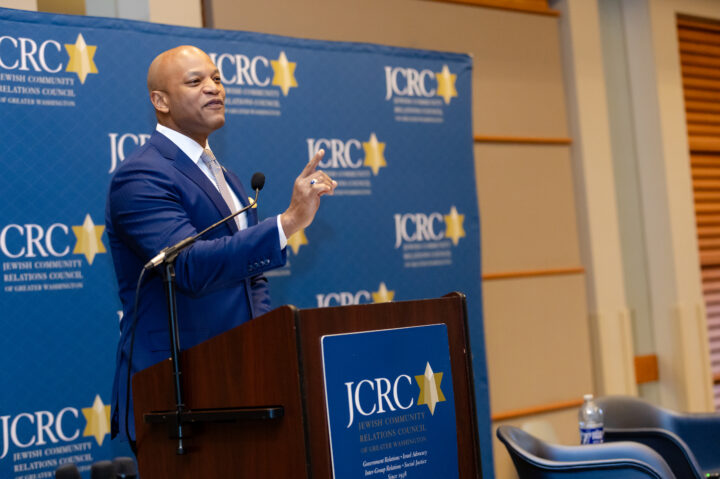
Maryland Gov. Wes Moore speaks at the Jewish Community Relations Council of Greater Washington's annual Maryland "Lox & Legislators" breakfast on Dec. 3, 2025.
Maryland Gov. Wes Moore pledged that his administration “will always support Maryland’s Jewish community” in recorded remarks for an event Monday evening marking Yom HaShoah, Israel’s Holocaust memorial day, at Beth Tfiloh Congregation in Pikesville, Md., a heavily Jewish suburb of Baltimore.
The Maryland governor, a potential Democratic presidential contender, said that it is his and his state’s “governing philosophy” to “unapologetically confront and condemn antisemitism and persecution wherever it arises,” to provide no refuge to hate, denial and conspiracy theories, to ensure that everyone feels safe to worship and to “realize the full promise of tikkun olam.”
“These are difficult times, but we’ll get through them together,” Moore said.
Moore emphasized the “responsibility” of those living today to commemorate the 6 million Jews who died in the Holocaust “because time does not carry memory forward on its own — people do.”
“We must work together to protect our history and condemn those who would try to deny it, and we can work together to be part of a change that we hope to see in the world, especially right here in Maryland, in this moment,” Moore continued.
He said that it’s important to continue to elevate the voices of Holocaust survivors while they are still living, and that it will be the “moral responsibility of our generation and our children’s generation to never forget.”

Grace Yoon/Anadolu via Getty Images
Pro-Palestinian students at UCLA campus set up encampment in support of Gaza and protest the Israeli attacks in Los Angeles, California, United States on May 01, 2024.
Good Thursday morning.
In today’s Daily Kickoff, we look at the drop in anti-Israel campus activity this semester, and talk to Jewish Democrats in Georgia about Sen. Jon Ossoff’s recent votes on Israel legislation. We also spotlight the Zikaron BaSalon gatherings to commemorate Israel’s Holocaust Remembrance Day, and cover “Borrowed Spotlight,” a project that pairs Holocaust survivors with celebrities to raise awareness about antisemitism and the Holocaust. Also in today’s Daily Kickoff: Abe Foxman, Secretary of State Marco Rubio and Omri Miran.
What We’re Watching
- Yom Hashoah events continue in Israel and around the world today as governments and communities commemorate the Holocaust. In Poland, the International March of the Living’s ceremonies kick off this afternoon. Earlier today, Israeli Prime Minister Benjamin Netanyahu laid a wreath at Israel’s Yad Vashem memorial.
- The American Jewish Historical Society is hosting a virtual lunch with former Harvard President Lawrence Bacow.
What You Should Know
A QUICK WORD WITH JI’S MELISSA WEISS
“We have a very strong environment for Jews on campus.” It’s the kind of rhetoric often offered up by university presidents, whether they’re discussing campus climate with prospective students, journalists or members of Congress.
It’s what Cornell President Michael Kotlikoff told Jewish Insider last month, days after he was announced as the school’s president after serving in an interim role for eight months.
On Wednesday, Kotlikoff announced that the school was rescinding an invitation to R&B star Kehlani to perform at the school’s annual “Slope Day” event, citing the singer’s history of making antisemitic and anti-Israel comments. (In one of her music videos, Kehlani opens with the text “Long Live the Intifada”; in a social media post, she referred to Zionists as “scum of the earth.”)
The rapid and decisive response from Cornell, one of 60 schools that received a warning from the Department of Education’s Office for Civil Rights over allegations of antisemitic discrimination and harassment, is not an isolated example.
At Princeton, administrators swiftly moved to open an investigation earlier this month into an event disruption during a talk by former Israeli Prime Minister Naftali Bennett. In addition to the anti-Israel activists who disrupted Bennett’s talk inside the auditorium, more than 150 demonstrators gathered outside the on-campus event, which ended early after a fire alarm was pulled.
And Yale, a third school included on the Department of Education’s warning list, announced an investigation on Wednesday into an unauthorized encampment on the New Haven campus, which was quickly taken down by campus security. In a statement, the university vowed “immediate disciplinary action” against students who participated in the encampment despite prior warnings and disciplinary measures, in addition to revoking the status of Yalies4Palestine as a registered student organization.
Whether it’s the threats of funding cuts and freezes from the Trump administration (which has already frozen $1 billion in grants to Cornell), or an attempt at course correction, administrators are responding to campus unrest and anti-Israel organizing more rapidly — and forcefully — than in the past.
Call it the Trump effect. The combination of executive orders targeting universities, funding freezes and federal investigations — coupled with activist fatigue and a refocusing on other issues, such as the government’s immigration crackdown and deportation efforts — have reshaped the campus landscape this semester.
At this point last year, dozens of coordinated encampments had sprung up across the country. The encampments were followed by efforts to disrupt spring graduations — a threat so significant that Columbia canceled its main commencement ceremony last year, denying the traditional pomp and circumstance to the class of 2024.
This year’s commencement ceremonies, which will take place in the coming weeks, will be the next test for administrators. If they stand up to anti-Israel disruptors, it will be another feather in the Trump administration’s cap. But if they don’t, they may again face the ire of an administration that has shown little restraint — for better or for worse — in addressing the scourge of campus antisemitism.
losing steam
For a brief moment, it looked like 2024 all over again: Tents were erected at Yale University’s central plaza on Tuesday night, with anti-Israel activists hoping to loudly protest the visit of far-right Israeli National Security Minister Itamar Ben-Gvir to campus. Videos of students in keffiyehs, shouting protest slogans, started to spread online on Tuesday night. But then something unexpected happened. University administrators showed up, threatening disciplinary action, and the protesters were told to leave — or face consequences. So they left. The new encampment didn’t last a couple hours, let alone overnight. The quick decision from administrators at Yale to shut down anti-Israel activity reflects something of a vibe shift on American campuses, Jewish Insider’s Gabby Deutch and Haley Cohen report.
Losing steam: “In general, protest activity is way down this year as compared to last year,” Hillel International CEO Adam Lehman told JI. There is no single reason that protests have subsided. Jewish students, campus Jewish leaders and professionals at Jewish advocacy organizations attribute the change to a mix of factors: stricter consequences from university leaders, fear of running afoul of President Donald Trump’s pledge to deport pro-Hamas foreign students and the issue generally losing steam and cachet among easily distracted students. But the lack of protests does not mean that campus life has returned to normal for Jewish students, many of whom still fear — and face — opprobrium for their pro-Israel views.
REBUILDING BRIDGES

Jewish leaders in Georgia say that Sen. Jon Ossoff’s (D-GA) reversal in early April on efforts to block U.S. aid to Israel marks an important step toward repairing relations with the Jewish community, but several said that he’ll need to do more and show he’ll remain on that track going forward to regain their trust, Jewish Insider’s Marc Rod reports.
State of play: Ossoff’s votes last November in favor of resolutions led by Sen. Bernie Sanders (I-VT) attempting to block arms sales to Israel shocked and frustrated Jewish Democrats in Georgia, who could help tip what could be a razor-thin margin of victory in Ossoff’s 2026 reelection campaign. The November votes prompted condemnation from a coalition of 50 Jewish organizations in Georgia and led a group of Democratic donors to offer to support Republican Gov. Brian Kemp if he runs for the seat. Jewish leaders said that Ossoff’s reversal on the aid resolutions, as well as a series of private meetings with Jewish leaders and other more public moves, have begun to rebuild trust. But some, including major donors, said they’re not yet committed to supporting him next year.
keeping their stories alive
She forgot Yom Hashoah – then created a movement that changed the way Israel remembers the Holocaust

Holocaust survivor Avigdor Neuman told his story in front of the Knesset’s Chagall tapestries, in Jerusalem. In Hostages Square in Tel Aviv, thousands gathered to hear survivor Aliza Landau recount her experiences, along with the parents of hostages speaking about their sons’ continued captivity in Gaza. Dozens of teenage volunteer EMTs gathered at a Magen David Adom ambulance station in northern Israel to hear Holocaust survivor David Peleg speak. Women gathered in a Pilates studio in central Israel to hear a fellow member share her mother’s story of survival. And in hundreds of living rooms around Israel on Wednesday evening, Holocaust survivors or their children told countless stories to small groups. One of those locations, in the central Israel city of Hod Hasharon, is the home of Adi Altschuler, the founder of Zikaron BaSalon – “memory in the living room.” In between preparations to host 40 people for her own Yom HaShoah event, Altschuler spoke to Jewish Insider’s Lahav Harkov about how her initiative has become a ubiquitous way for Israelis to mark Yom Hashoah, the day that Israel commemorates the Holocaust.
The spark: The idea for Zikaron BaSalon brewed slowly, beginning in 2010, when Altschuler, 38, forgot about Yom Hashoah altogether. “I don’t have a personal family connection to the Holocaust,” she recounted. “I felt that I couldn’t connect to the topic … I was scared of it and deterred from it.” Altschuler heard sad music on the radio one day, and then talked to her mother on the phone and asked if something tragic had happened – because in Israel, when there is a terror attack, the music stations only play sad songs. Her mother reminded her that Yom Hashoah was beginning in a few hours and asked her how she planned to commemorate the day. “I said, I don’t know, maybe I’ll watch ‘Schindler’s List,’” Altschuler said. “My mother was angry with me, so I went with her to a ceremony in Tel Aviv. I was 24 years old and I was the only one there who was under 60. That was when it occurred to me that I am part of the last generation who will meet Holocaust survivors … I said to myself, what will Yom Hashoah look like in 30 years? … What will happen when there aren’t survivors anymore?” she asked.
MIXED MESSAGING
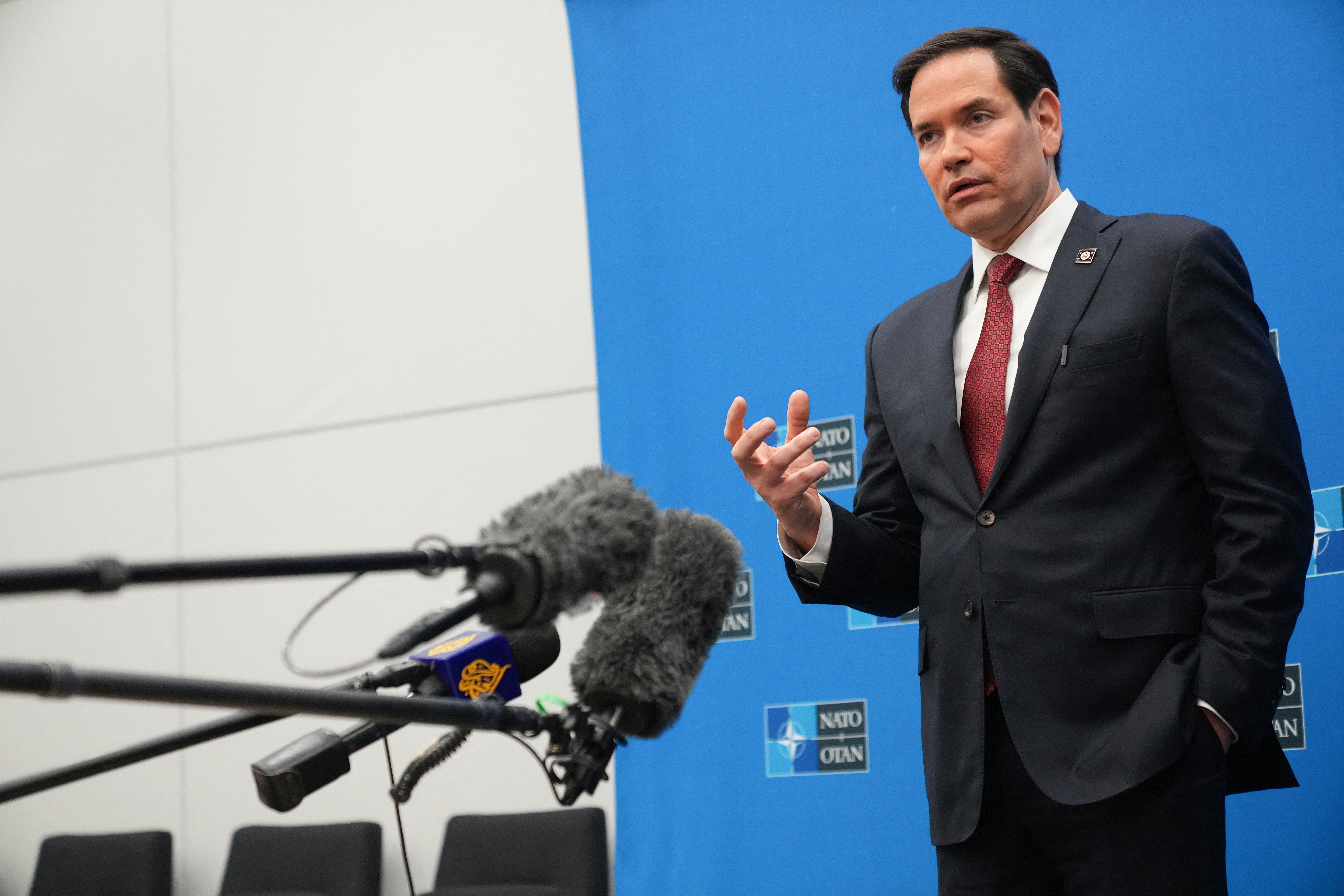
Secretary of State Marco Rubio suggested he was open to Iran maintaining a civil nuclear program and did not explicitly rule out allowing the Islamic Republic to enrich uranium itself, even as he expressed concern about such activity in an interview with The Free Press’ Bari Weiss on Wednesday, Jewish Insider’s Matthew Kassel reports.
On the record: “If Iran wants a civil nuclear program, they can have one just like many other countries in the world have one, meaning they can import enriched material,” Rubio told Weiss on the Free Press’ “Honestly” podcast. “But if they insist on enriching uranium themselves, then they will be the only country in the world that ‘doesn’t have a weapons program’ but is enriching,” he added. “I think that’s problematic.” His comments came as the Trump administration faces scrutiny over its mixed messaging amid ongoing nuclear negotiations with Iran.
SOUNDING THE ALARM

Abe Foxman, the former Anti-Defamation League national director, offered pointed criticism of the Trump administration in a Holocaust Remembrance Day commemoration at the Capitol on Wednesday. “As a [Holocaust] survivor, my antenna quivers when I see books being banned, when I see people being abducted in the streets, when I see government trying to dictate what universities should teach and whom they should teach. As a survivor who came to this country as an immigrant, I’m troubled when I hear immigrants and immigration being demonized,” Foxman said, to sustained applause from the audience, Jewish Insider’s Emily Jacobs reports.
More from his speech: Foxman, who led the ADL for nearly three decades, made the comments while delivering an address at the 2025 Days of Remembrance, which was organized by the U.S. Holocaust Memorial Museum in Washington. Foxman also praised the Biden administration and the second Trump administration for each committing to addressing antisemitism. “We live in very chaotic times, where our values, our history, our democracy are being tested. As a survivor, I’m horrified at the explosion of antisemitism — global and in the U.S. I’m appreciative of President Biden’s historic initiative on antisemitism and thankful to President Trump’s strong condemnation of antisemitism and his promise to bring back consequences to antisemitic behavior,” Foxman said.
COUTURE MEMORY

Someone you recognize and someone you don’t. Someone who lives in the spotlight and someone who doesn’t — Hollywood A-listers posing with Holocaust survivors. That was the premise fashion photographer Bryce Thompson conjured up in an effort to amplify the stories of the last living generation of Holocaust survivors. The idea was initially fueled by antisemitism that Thompson, who is not Jewish, saw his friends, neighbors and mother, who converted to Judaism, facing in recent years. But the project — which took three years to complete — assumed even greater relevance after the Oct. 7, 2023, Hamas terrorist attacks, the ensuing war in Gaza and the record high levels of anti-Jewish incidents in the U.S. that followed, Jewish Insider’s Haley Cohen reports.
Behind the scenes: A new collection of photographs shot by Thompson, called “Borrowed Spotlight,” debuted on Tuesday to coincide with Yom Hashoah, Holocaust Remembrance Day, with the release of a coffee-table book and weeklong exhibition at Detour Gallery in Manhattan. It features Hollywood heavyweights including Cindy Crawford, Jennifer Garner and Chelsea Handler. With years of experience photographing high-profile shoots for publications including GQ, ELLE and Glamour, Thompson initially expected that the photos would speak for themselves. But he told JI that the most impactful moments were the ones between shots. “Those were the moments they interacted the most,” he said of his photography subjects.
Worthy Reads
Northern Exposure: In Foreign Affairs, Shira Efron and Danny Citrinowicz posit that Israel has an opportunity to combine diplomacy with military action to secure the border and prevent malign forces from retaking power in Syria. “If the new Syrian government remains moderate and can consolidate its authority, the upside for Israel would be huge. It would have a stable neighbor not beholden to Iran — one that possesses an effective military that can do its own work to address threats from extremist groups. Israel is not a passive bystander to the trajectory of Syrian politics. It can encourage Shara’s moderation by welcoming Damascus’s overtures, such as the arrest, on April 21, of two senior leaders of the Palestinian Islamic Jihad terror group. Further, Israel should articulate publicly that its territorial advances are designed to be temporary until a responsible force can secure the other side of the border. Until Damascus has such capabilities, Israel should minimize friction with Syria’s population and its new government by reducing its visible military footprint and communicating with Shara’s team through back channels. At the same time, Israel should capitalize on the gains it has made to secure the Israeli-Syrian border by demanding a diplomatic agreement to ensure the protection of Syria’s Druze community and to demilitarize the Golan Heights.” [ForeignAffairs]
Farewell to Arms: In Newsweek, the Foundation for Defense of Democracies’ Sinan Ciddi and Jonathan Schanzer argue against the U.S.’ potential sale of weapons to Turkey, spotlighting Turkish Foreign Minister Fidan’s ties to terror regimes and anti-American forces. “Before becoming foreign minister, Fidan headed Turkey’s intelligence agency (MIT) from 2010 to 2023. During that time, Fidan steered Turkey away from its Western alliances, aligning it instead with Islamist regimes and extremist movements. Fidan was central to making Turkey a safe haven for Hamas. Beginning in 2011, he enabled the group to operate on Turkish soil — raising funds, recruiting, and coordinating attacks against Israel. Hamas reportedly received a Turkish pledge of $300 million in 2011, and today maintains offices in Ankara and Istanbul with access to Turkish leadership, including President Recep Tayyip Erdogan. On October 7, as Hamas carried out its slaughter of 1,200 Israeli civilians, Hamas leader Ismail Haniyeh reportedly celebrated from Turkey. Fidan’s record extends beyond Hamas. Turkey became a strong advocate of the Muslim Brotherhood, allowing the Islamist movement to establish institutional presence in Turkey. Ankara championed the Muslim Brotherhood government under Mohamed Morsi in Egypt before its downfall in 2014.” [Newsweek]
Sounding the Alarm in Europe: In The Free Press, Haviv Rettig Gur considers how early Zionists understood the looming peril that awaited Europe’s Jewish community at the start of the 20th century. “At the start of the twentieth century, only a minority of Jews were political Zionists. Most Jews still clung to the hope that, despite pogroms and oppressive laws, European liberalism would ultimately win out; or to the promise of universal equality trumpeted by the communists; or to the ultra-Orthodox call for a return to the physical, cultural, and spiritual safety of a renewed ghetto. The Zionists were a minority. Right up until they weren’t. Right up until Europe itself left Jews with no other choice. Put very simply: Zionism, alone among Jewish movements and cultural worlds of the diaspora in the nineteenth and early twentieth centuries, knew what was coming. The early Zionists saw only dimly, vaguely, the bloodletting that would come. But this foreknowledge rested on serious analysis and theory, and recommended clear action. This was true across the political spectrum of the Zionist movement, from socialists to liberals to right-wing Revisionists.” [FreePress]
Word on the Street
White House senior official Seb Gorka said that the Trump administration’s counterterrorism plan, which he said would be “utterly, completely” different from the Biden administration’s approach, will likely be ready in a month…
Defense Secretary Pete Hegseth had the Signal messaging application, which was linked to the same application on his cell phone, installed on his desktop computer in the Pentagon in an effort to work around the building’s poor reception and communicate with senior administration officials…
Sen. John Fetterman (D-PA) called on the Trump administration to drop its nuclear talks with Iran and mount an attack on its nuclear program, saying, “You’re never going to be able to negotiate with that kind of regime that has been destabilizing the region for decades already, and now we have an incredible window, I believe, to do that, to strike and destroy Iran’s nuclear facilities”…
The Senate Health, Education, Labor and Pensions (HELP) Committee will hold a vote on the Antisemitism Awareness Act and another piece of antisemitism legislation next Wednesday, Sen. Bill Cassidy (R-LA) announced, Jewish Insider’s Emily Jacobs reports…
Sen. Dick Durbin (D-IL), the Senate Democratic whip, announced on Wednesday that he will not seek reelection to a sixth term, setting up a competitive primary contest to fill his seat and his leadership role, Jewish Insider’s Emily Jacobs reports…
Rep. Jan Schakowsky (D-IL) said she will make an announcement about her political plans in early May, following reports that she had told colleagues she intends to retire at the end of her current term…
The Department of Justice canceled hundreds of what Attorney General Pam Bondi called “wasteful grants” to community and local organizations, including funds for programs that were intended to decrease hate crimes against American Jews…
A Pennsylvania Air National Guard member and self-described “Hamas operative” who was already facing charges tied to the vandalism of a synagogue and Jewish federation office in Pittsburgh was charged this week with making false statements about his loyalty to the U.S. and building pipe bombs…
The FBI conducted several raids on homes in the Ann Arbor, Mich., area; an anti-Israel activist group in the area said that the raids were targeting protesters…
Harvard is delaying the release of reports from the school’s antisemitism and Islamophobia task forces, which were initially slated to be released in early April, amid its broader fight with the Trump administration over campus antisemitism and federal funding…
President Donald Trump signed an executive order requiring universities to disclose foreign funding in excess of $250,000…
Current and former Barnard College employees received a text message survey from the Equal Employment Opportunity Commission that asked whether the recipients had Jewish or Israeli ancestry and probed recipients’ experiences with antisemitism on the campus; the move is part of the government’s efforts to investigate discrimination at the New York City school…
A judge in New York ruled that the Art Institute of Chicago must return a 1916 drawing by Egon Schiele to the heirs of an Austrian Jewish art collector who was killed in the Holocaust…
Hamas released a video of Israeli hostage Omri Miran; the video was the first sign of life from the Kibbutz Nahal Oz resident since July, when hostages who were released earlier this year last reported having seen him in Gaza…
Palestinian Authority President Mahmoud Abbas called on Hamas to release the remaining 59 hostages, referring to the terror group as “sons of dogs” who had given Israel “excuses” to prolong the war in Gaza…
Jordan announced its planned enforcement of a ban on the Muslim Brotherhood’s operations in the Hashemite Kingdom, five years after a court ruling approving the group’s disbandment and nine years after shuttering the group’s headquarters in Amman; 16 people were arrested in Jordan earlier this month on charges that they planned to launch attacks in the country…
The New York Times interviews Syrian President Ahmed al-Shara about his first months leading the country following the ouster of Bashar al-Assad, as well as his approach to relationships with the West…
A new report from the Institute for Science and International Security found that Iran is fortifying the areas around two of its nuclear facilities, which it has refused to allow international inspectors access to…
Pic of the Day
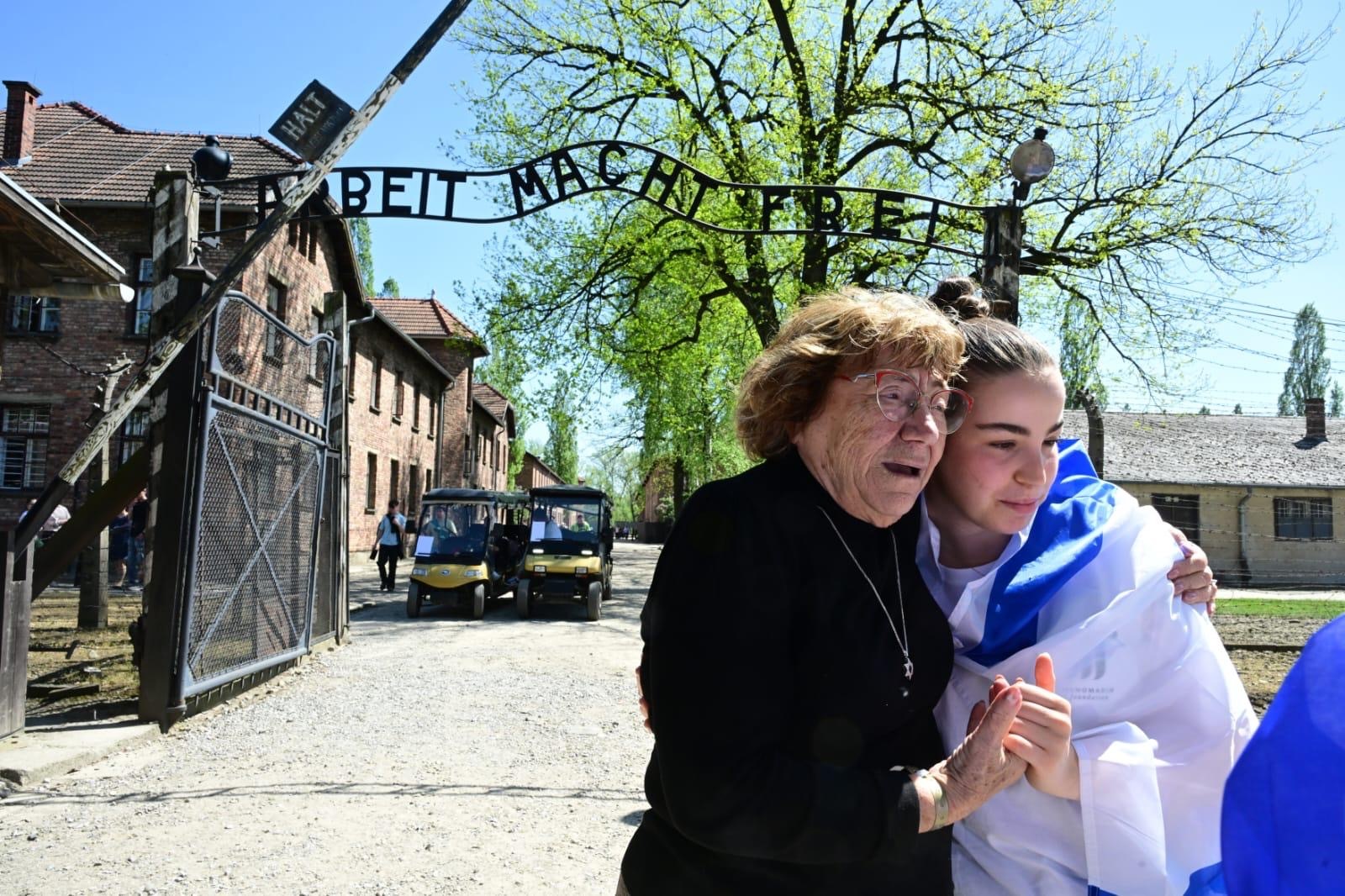
Released Israeli hostage Agam Berger stood with Holocaust survivor Gita Kaufman at the entrance to the Auschwitz concentration camp in Oświęcim, Poland, on Wednesday. Berger is part of a delegation of released hostages participating in the annual International March of the Living program alongside Holocaust survivors from around the world.
Birthdays
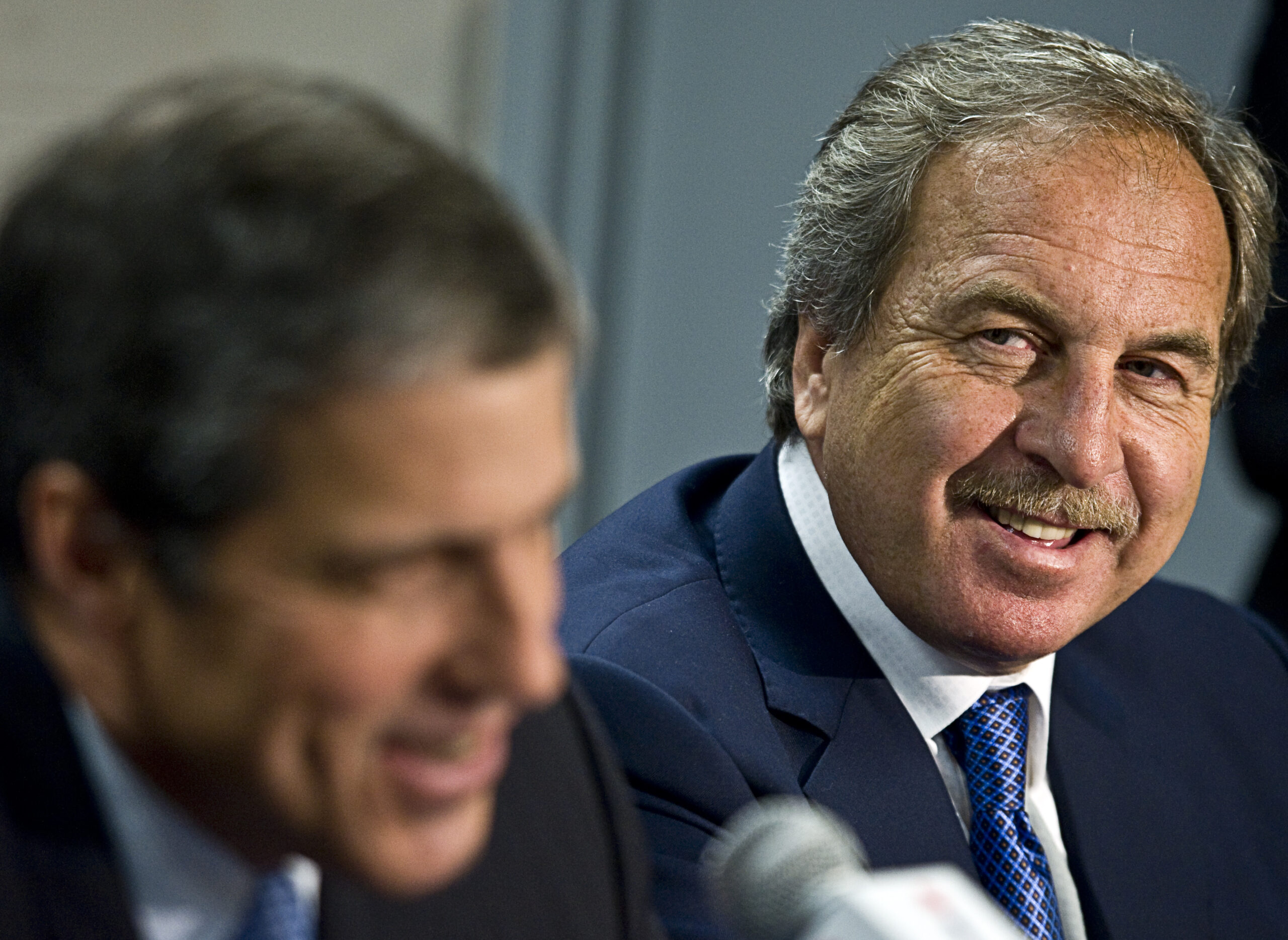
Former president of basketball operations for the Washington Wizards of the NBA for 16 seasons, himself an NBA player for 9 seasons, Ernest “Ernie” Grunfeld turns 70…
Rabbi emeritus at Washington’s Adas Israel Congregation, Rabbi Jeffrey A. Wohlberg turns 84… Emmy, Grammy, Oscar, Tony and Peabody Award-winning singer and actress, Barbra Streisand turns 83… Delray Beach, Fla. resident, Phyllis Dupret… Distinguished professor emeritus at the University of Maryland, College Park, Jeffrey C. Herf turns 78… Former president and publisher of USA Today, then chairman of theStreet, Lawrence S. Kramer turns 75… Israeli designer, architect and artist, Ron Arad turns 74… President of Cincinnati-based Standard Textile, Gary Heiman… Israeli singer descended from the Jewish diaspora in Kurdistan, Ilana Eliya turns 70… Columnist for Foreign Policy, Michael Hirsh turns 68… Author of books for children and teens, Deborah Heiligman turns 67… Managing director at global consulting firm Actum, and author of books about Bernie Madoff and Rudy Giuliani, Andrew Kirtzman turns 64… CEO and President of Wells Fargo since 2019, he was previously the CEO of Visa, Charles Scharf turns 60… President of sales and marketing at Pimlico Capital, and rabbi of Baltimore’s Shomrei Mishmeres HaKodesh, Carl S. (Rabbi Chaim) Schwartz turns 55… Deputy chief of staff for Montgomery County (Md.) Councilmember Sidney Katz, Laurie Mintzer Edberg… Emmy Award-winning television writer, producer and film screenwriter, known as the co-creator and showrunner of the television series “Lost,” Damon Lindelof turns 52… National political director at AIPAC, Mark H. Waldman… Israeli model, actress, entrepreneur, lecturer and activist, Maayan Keret turns 49… Film and television actor, Eric Salter Balfour turns 48… Brandon Hersh… Partner at Apollo Global Management, Reed Rayman… Special assistant to POTUS and senior speechwriter in the Biden administration, Aviva Feuerstein turns 38… Tech and innovation reporter at Automotive News, Molly Boigon…
BIRTHWEEK: American Jewish Committee ACCESS New York board member, Sam Sorkin (was yesterday)…
Please log in if you already have a subscription, or subscribe to access the latest updates.
 Continue with Google
 Continue with Apple