






























A former trade policy analyst at the conservative think tank said that many new hires were fixated on conspiracy theories about the Holocaust
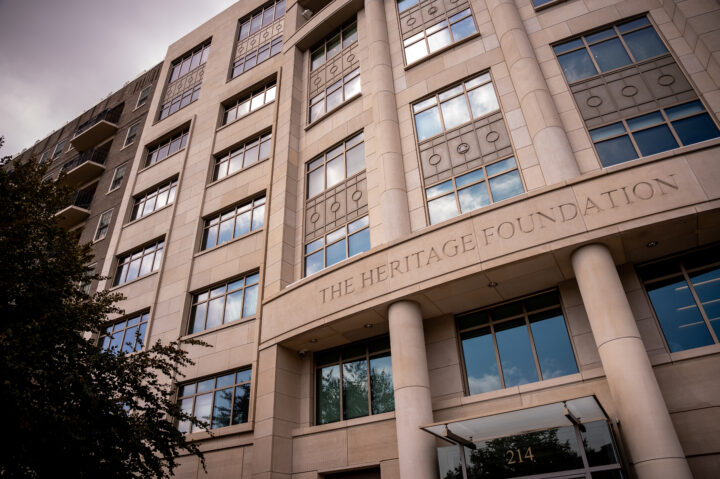
Andrew Harnik/Getty Images
An exterior view of The Heritage Foundation building on July 30, 2024 in Washington, DC.


 Add JewishInsider on Google
Nine months after the Heritage Foundation came under fire for defending Tucker Carlson’s friendly interview with a neo-Nazi, the conservative think tank is facing fresh scrutiny over accusations that it has enabled an extreme culture in which new hires feel free to question the Holocaust and to engage in historically revisionist debates about World War II, with no apparent internal policing from leadership.
Former Heritage employees, who had been part of a mass staff exodus stoked by its president’s refusal to disavow Carlson for hosting the neo-Nazi influencer Nick Fuentes on his podcast last October, told The New York Times Magazine in a newly published investigation that they encountered troubling debates during their time at the organization over issues like “whether the Holocaust happened or not” and “who was the bad guy and who were the good guys” in the war against Hitler.
Andrew Hale, a trade policy analyst at Heritage who left in January to join a rival think tank launched by former Vice President Mike Pence, recalled that prior to departing he had found new hires were fixated on antisemitic conspiracy theories about the Holocaust and Israel of the sort popularized by Fuentes, Carlson and Candace Owens, the extreme-right podcast host.
Hale confirmed to Jewish Insider in an interview on Wednesday that new, particularly younger, staffers at Heritage “openly said things which were antisemitic, whether they realized it or not,” crediting their views to an obsession with far-right social media channels.
“The Heritage Foundation had an opportunity to combat antisemitism and misogyny but instead they chose to hire people with these views,” Hale argued, while claiming that the think tank’s “original goals have been subverted under the current leadership” and is now “a force for antisemitism and misogyny.”
Brian Phillips, a Heritage spokesperson, called Hale’s claim about the Holocaust debate “absurd” but did not address related allegations from former staffers, whom the think tank sought to discredit as “self-serving, bitter and vindictive” in a statement to the Times Magazine.
“There is no debate at the Heritage Foundation whether the Holocaust happened and our record opposing antisemitism is long, consistent and public,” he said in a brief email statement to JI, sharing a link to a page on Heritage’s website detailing such efforts.
The foundation, which had long been influential to Republican administrations, has found itself on the defensive after its president, Kevin Roberts, posted a controversial video to social media last fall in which he dismissed Carlson’s critics as part of a “venomous coalition,” among other terms widely interpreted as antisemitic tropes.
“Heritage is catering to a conspiratorial streak popular with Gen Z Republicans, perhaps out of the belief that it’s the future of the party,” Daniel Samet, a fellow with the conservative American Enterprise Institute who focuses on U.S.-Israel relations and Middle East policy, told JI. “It’s one thing to have serious heterodox views. It’s another to spew dreck about Jews. Heritage is failing to draw a line in the sand.”
Among those who left the organization over their discomfort with Roberts’ decision and handling of the fallout were the leaders of an antisemitism task force that opted to sever ties with the think tank last November, even as they voiced hope to “collaborate” again.
Late last month, Luke Moon, a conservative Christian activist and co-chair of the task force, returned to Heritage as a part-time visiting fellow to support its “efforts to combat antisemitism,” the organization said in a statement.
Moon has said he chose to join the organization after Yoram Hazony, an Israeli American political theorist and national conservative leader who has denounced Carlson as antisemitic, became a member of its board in May.
But Moon said on Wednesday his recent experience had been “the opposite” of the internal culture that former staffers had described to The Times. “They’re almost a little overzealous to have me there,” he told JI. “There’s a real frustration in the reputation being tarnished.”
Still, others who left the think tank said that they remained unconvinced Roberts had meaningfully reckoned with his remarks. Yaakov Menken, the executive vice president of the Coalition for Jewish Values who resigned from the antisemitism task force last year, said that Roberts had not distanced himself from the rhetoric he used in his defense of Carlson.
“Anyone who thinks I belong to a ‘venomous coalition’ either doesn’t understand antisemitism or is a part of spreading it,” Menken told JI. “Heritage cannot combat antisemitism and endorse it at the same time.”
Josh Blackman, a legal scholar who also resigned from Heritage last year, said he had “not seen any public or private action taken by” the think tank “to adequately address” concerns over antisemitism that precipitated departures. “Until changes are made, I’m not sure how Heritage can be seen as a credible partner in the fight against antisemitism,” he told JI.
While Moon acknowledged that there were “certainly” issues at Heritage last fall, he said the think tank no longer employed problematic staffers like the former chief of staff who had written Roberts’ scripted comments about Carlson.
“There’s an explicit and very clear expectation on me to take on antisemitism on the right,” he said, adding that Heritage had also hired a researcher to help him with such work. “They’ve been very clear to me where they stand on antisemitism.”
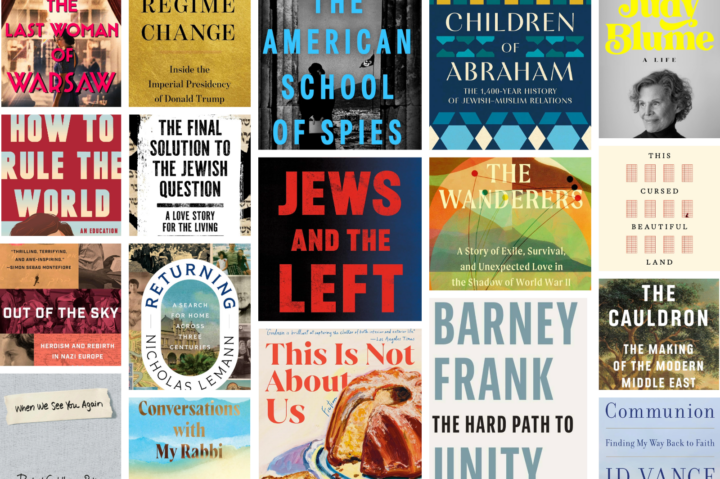
Take a look at the banner new releases we’re recommending from this spring, as well as books we’re looking forward to in the coming months
Memorial Day Weekend marks the unofficial summer kickoff, and for observant Jews, the long weekend is made even longer with the two-day holiday of Shavuot, starting Thursday evening, which commemorates the day the Jews received the Torah at Mount Sinai.
Jews mark the day by studying at all-night learning sessions at synagogues and JCCs around the country. We know that many will also use the occasion to jump-start summer reading goals, so the Jewish Insider team has compiled our summer reading list — beginning with some banner new releases from this spring, and looking towards books coming out this summer.
RECENT RELEASES:
Allegra Goodman, This Is Not About Us (February)
The author of several novels with heavily Jewish themes, Goodman returns to Jewish characters in this novel about a decades-long feud between two Jewish sisters that started with a misunderstanding about apple cake.
Mark Oppenheimer, Judy Blume: A Life (March)
The journalist published the definitive biography of beloved YA author Judy Blume, based on more than 100 interviews with Blume and her inner circle — though she disapproved of the finished product.
Nicholas Lemann, Returning: A Search for Home Across Three Centuries (March)
The longtime New Yorker staff writer traces his family’s history from Germany to New Orleans, recounting the ways they reckoned with religion, race and belonging.
Matti Friedman, Out of the Sky: Heroism and Rebirth in Nazi Europe (March)
One of Israel’s most celebrated English-language writers tells the story of the young Jews who had made it to Mandate Palestine but chose to parachute into Nazi Europe to try to rescue their Jewish brethren — ultimately failing in their mission — and examines what motivated them.
Daniela Gerson, The Wanderers: A Story of Exile, Survival, and Unexpected Love in the Shadow of World War II (March)
The journalist recounts the story of how she and her wife discovered that decades before the two of them met, their grandparents had escaped the Nazis through Soviet Russia on the same route.
Judy Batalion, The Last Woman of Warsaw: A Novel (April)
Better known for her nonfiction work, including a 2021 bestseller about Jewish female resistance fighters in the ghettos of Poland, Judy Batalion released her debut novel about the intersecting lives of Jewish women in Warsaw in the late 1930s.
Rachel Goldberg-Polin, When We See You Again (April)
The world got to know Goldberg-Polin when she became a tireless advocate on the global stage for her son, Hersh, who was kidnapped by Hamas on Oct. 7, and killed almost a year later. Her book chronicling her grief, which was published last month, soared to the top of the best-seller list.
Theo Baker, How to Rule the World: An Education in Power at Stanford University (May)
The Stanford student, who chronicled the campus chaos of 2023-2024 with a crucial article in The Atlantic, investigates the ways that Stanford undergrads, located just miles from the tech billionaires of Silicon Valley, are seeking out power, influence and money in place of an education.
UPCOMING RELEASES:
Rabbi Eli Schlanger and Nikki Goldstein, Conversations With My Rabbi: Timeless Teachings for a Fractured World (May 26)
Three years before the rabbi was murdered in the Hanukkah terror attack at Bondi Beach in Australia last year, he got to know Goldstein after praying by her bedside as she recovered from a near-death experience that brought her to the ICU three years earlier. Goldstein, a secular Jew, and Schlanger, a Chabad rabbi, recorded their conversations about faith in the hope of writing a book together. She finished the project after Schlanger’s death.
Batya Ungar-Sargon, The Jews and the Left (June 2)
The conservative journalist examines American Jews’ historic ties to liberal politics and argues that their alliance has been fundamentally broken in the aftermath of the Oct. 7 attacks and the war in Gaza.
Marc David Baer, Children of Abraham: The 1,400-Year History of Jewish–Muslim Relations (June 9)
The professor of history at the London School of Economics and Political Science looks at the centuries of cooperation and coexistence between Jews and Muslims in the Middle East that predated the current regional conflicts.
Stephan Talty, The American School of Spies: The Archaeologists Who Fought the Nazis and Saved the Treasures of Ancient Greece (June 9)
The journalist and novelist recounts the true story of a group of American archaeologists who trained as spies during World War II in order to go undercover and protect Greek artifacts that were at risk during the war.
JD Vance, Communion: Finding My Way Back to Faith (June 16)
The vice president’s forthcoming book — his second memoir, to be published nine years and a political lifetime after the release of Hillbilly Elegy, about his childhood growing up poor in Appalachia — will discuss his connection to Christianity and his decision to convert to Catholicism.
Maggie Haberman and Jonathan Swan, Regime Change: Inside the Imperial Presidency of Donald Trump (June 23)
Two of America’s top White House reporters tell the story of the first year of President Donald Trump’s second term, and how he learned to use political power more effectively than in his first term.
Dara Horn, The Final Solution to the Jewish Question: A Love Story for the Living (Sept. 1)
Her 2021 book of essays reckoning with the curiosities of modern antisemitism, People Love Dead Jews, went about as viral as a book possibly could. She published a children’s book in 2025, but this will be her first book for adults in years. Aside from announcing its scheduled release, her publisher has not shared any information about the project.
Simon Sebag Montefiore, The Cauldron: The Making of the Modern Middle East (Sept. 8)
The British historian presents a history of the last 125 years of the modern Middle Eastern, surveying the key events and narratives — both accurate and misguided — that led to the current state of the region.
Barney Frank, The Hard Path to Unity: Why We Must Reform the Left to Rescue Democracy (Sept. 15)
The trailblazing politician served in Congress for 32 years, representing suburban Boston. The Jewish Democratic lawmaker, who was also the first openly gay member of Congress, died this week at 86. His upcoming book argues that the political left must reform itself so it does not cater to its most extreme adherents.
Evan Gershkovich, This Cursed Beautiful Land: A Russian-American Story (Sept. 29)
The Wall Street Journal journalist who spent over a year wrongly imprisoned in Russia details his harrowing experience in the Russian carceral system against the backdrop of the country’s history and culture.
Edmonds refused to identify Jewish prisoners of war to SS soldiers, saving over 200 lives
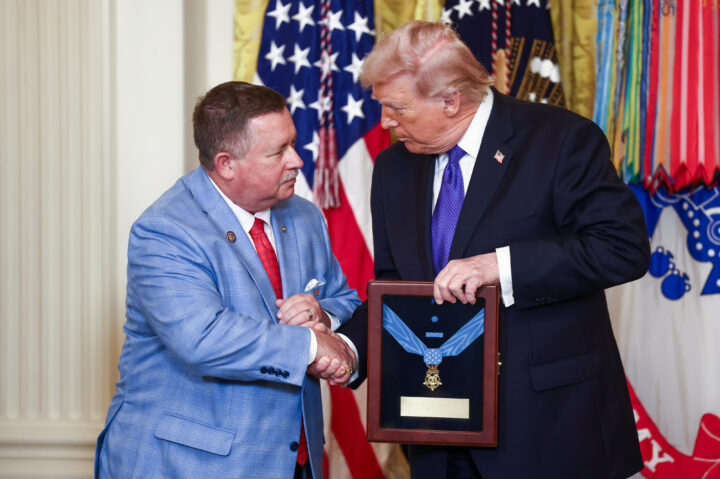
Jim Lo Scalzo/EPA/Bloomberg via Getty Images
President Donald Trump presents Chris Edmonds with the Medal of Honor on behalf of his father, Army Master Sergeant Roderick Edmonds, during a ceremony in the East Room of the White House in Washington, DC, US, on Monday, March 2, 2026.
President Donald Trump posthumously awarded the Medal of Honor on Monday to Army Master Sgt. Roderick “Roddie” W. Edmonds, a World War II soldier whose defiance of a Nazi order saved more than 200 Jewish American prisoners of war.
“In 1941 Roddie Edmonds of Knoxville, Tenn., enlisted in the U.S. Army and soon rose to one of the youngest master sergeants in the military,” Trump said during the White House ceremony. “In 1944, he sailed to Europe to fight in World War II … and soon found himself on the front lines of the Battle of the Bulge.”
During the battle, Edmonds and his unit were captured by German forces and interned at Stalag IXA, a prisoner-of-war camp in Germany. As the senior non-commissioned officer among more than 1,200 American POWs, Edmonds was responsible for the welfare of his fellow soldiers.
Trump recounted the pivotal moment that would define Edmonds’ wartime legacy: on January 26, 1945, an SS officer ordered “only American Jews” to assemble for roll call the next morning, warning that anyone who disobeyed would be shot.
“There were more than 200 Jewish American soldiers in the camp,” Trump said. “Roddie knew their separation from the group would mean certain death, so that night, he summoned his team and devised a plan.”
Edmonds directed his senior leaders to have all 1,200 American prisoners present themselves for roll call. The next morning, the American soldiers “fell in line together, shoulder to shoulder.” The action enraged the Nazi commandant, who Trump said “pressed the barrel between Sgt. Edmonds’ eyes,” and demanded that Edmonds identify the Jewish soldiers or be shot.
“Staring right back into the raging face of evil, Sergeant Edmonds replied fearlessly: ‘We are all Jews here,’” said Trump. Edmonds also invoked the Geneva Convention, warning the commandant that executing prisoners for refusing to identify their religion would constitute a war crime.
“The Nazi officer lowered his weapon and the soldiers erupted,” said Trump. “With total disregard for his own life, Roddie had saved over 200 of his fellow service members and their camp was liberated two months later.”
Edmonds’ actions have been recognized as extraordinary moral courage. In 2015, Israel’s Yad Vashem awarded him the title Righteous Among the Nations, the highest honor for non-Jews who risked their lives to save Jews during the Holocaust. Edmonds is one of only five Americans on that list and the sole U.S. serviceman so honored.
Edmonds died in 1985 without ever having received official recognition for the actions that saved hundreds of lives. In fact, the events had remained unknown, even to his family, until uncovered decades later by his son, Chris Edmonds.
More than eight decades later, Trump said the Medal of Honor “so courageously earned” by Edmonds will not be forgotten. Edmonds’ son accepted the medal on his father’s behalf.
During an appearance on the ‘On The Record’ podcast, Sen. Lindsey Graham urges Gulf nations to prioritize regional stability and make tough choices on Iran
Sean Gallup/Getty Images
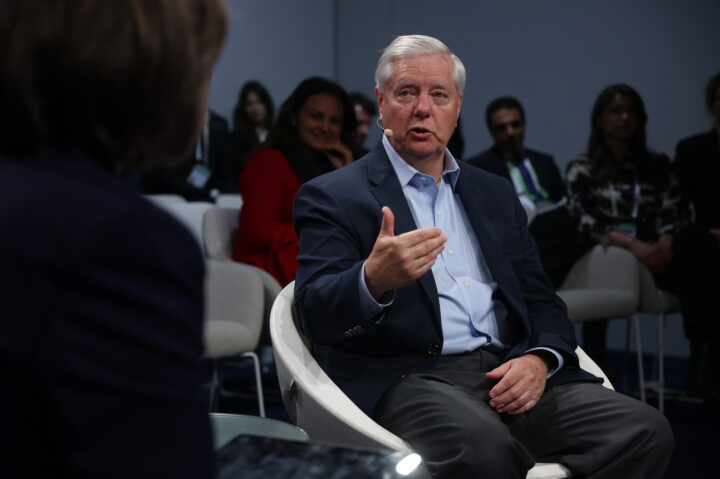
Sen. Lindsey Graham (R-SC) speaks at the 62nd Munich Security Conference on February 13, 2026 in Munich, Germany.
Sen. Lindsey Graham (R-SC) on Thursday rejected the suggestion from some in the Arab world that the deaths of civilians in Gaza does not align with Christian values. Graham made the comments during an appearance on an episode of the “On The Record” podcast with Hadley Gamble, while discussing how Israel’s war in Gaza had impacted regional stability in the Mideast and delayed normalization efforts with the Saudis.
“I just don’t buy that at all, because what did we do in World War II? Did we think for one minute about starving the Germans? Did we bomb every city into smitherreens?” Asked if that meant he was comparing Israel’s response to Hamas’ Oct. 7, 2023, attacks on the Jewish state to how the U.S. responded in World War II, Graham responded affirmatively.
“This is an absolute, existential threat to the Jewish people. What happened on October the 7th was 1,200 people were slaughtered, raped and murdered, and filmed by radical Islamists who would kill every Jew if they could.”
Gamble then pressed Graham on Israel “flattening Gaza,” which the South Carolina senator said he took no issue with.
“Just flatten it. We flattened Berlin. We flattened Tokyo,” Graham said. “Were we wrong to drop an atomic bomb to end the Japanese reign of terror? Were we? In my view, if I were Israel, I would have probably done it the same way. Without military victory, there is no hope of breaking radicalism. We flattened Germany. We flattened Japan.”
“It’s a TV war. We didn’t have TV in World War II. The behavior of the United States was to pursue total destruction of the enemy. That was our behavior. Take Tokyo and Berlin,” he added. “Those people who are trying to say this is just another conflict, it’s not another conflict. It’s existential to the Jewish state.”
Graham, who is in the Middle East for meetings with Israeli, Emirati and Saudi officials, also criticized Saudi Arabia for “attacking the United Arab Emirates pretty viciously for being in the Abraham Accords” and questioned assertions that the kingdom’s ongoing dispute with the Emiratis was solely based on differences in Sudan and Yemen.
“Saudi Arabia is now moving backward. They’re attacking the United Arab Emirates pretty viciously for being in the Abraham Accords,” Graham said. “There is no good reason for this. You can have disputes about Sudan and Yemen, but they’re basically declaring war.”
Asked if he believed the dispute “is all about Israel,” Graham replied: “I don’t know what this is about. I know the consequences. [Mohammed bin Zayed], the president of the United Arab Emirates, I’m going to meet him, you could not ask for a better partner. You could not ask for a better partner than the United Arab Emirates. They’ve stuck with the Abraham Accords through Gaza.”
In a post on X after his meeting on Thursday with Saudi Crown Prince Mohammed bin Salman, Graham praised the kingdom while acknowledging his concerns about achieving normalization with Israel.
“The Crown Prince is dealing with the aftereffects of October 7 like all leaders in the region, particularly with the tremendous loss of life in Gaza,” Graham wrote. “Having said that, his vision for the region is for conservative Islam to coexist — with tremendous economic opportunity — for the people of Saudi Arabia, the Middle East, and the entire world. He is the first Arab leader in modern history that’s expressed a vision not only for the faith, but for economic empowerment that is simply stunning when absorbed, and will set the tone for the region for generations to come.”
Graham criticized Gulf state opposition to regime change in Iran over fears about potential fallout as politically weak.
“That is a short-sighted view of the problems you face over here,” he said. “You’ve got domestic problems, so do I. I’ve got domestic problems. It’s probably better for me to be at home than it is here, so I don’t have a lot of tolerance anymore for people having to make uncomfortable decisions, because I have to make them all the time.”
Pressed on Saudi concerns about oil prices and regional instability, Graham said all of the Gulf states needed to “suck it up.”
“I’m telling everybody over here to suck it up. You’ve got to suck it up to bring about real change. Real change doesn’t come without sacrifice. Now, this region is going to change one way or the other,” Graham said. “There are two scenarios. … The inflection point is weeks away, not months away. That’s why I’m here. That’s why I haven’t slept, because it’s either going to go really good or really bad.”
Later Thursday, Graham warned in a post on X that the U.K. should not deny the U.S. the ability to use British military bases to attack Iran.
“If it turns out to be true that Britain is denying the United States the ability to use British bases against Iran if there is a necessity for an attack – it would be beyond surprising,” Graham tweeted. “I’ve been a military lawyer most of my adult life. What they’re saying about the status of Diego Garcia, the joint US-UK military base, is a huge question.”
“To my friends in Britain, sitting this one out puts you on the wrong side of history and is yet another example of how much our alliances throughout Europe have degraded,” the tweet concluded.
Kelly Neumann is serving as the fundraising co-chair for gubernatorial candidate Jocelyn Benson and Senate candidate Mallory McMorrow and has fundraised for several other Michigan Democrats
Facebook/Kelly Neumann
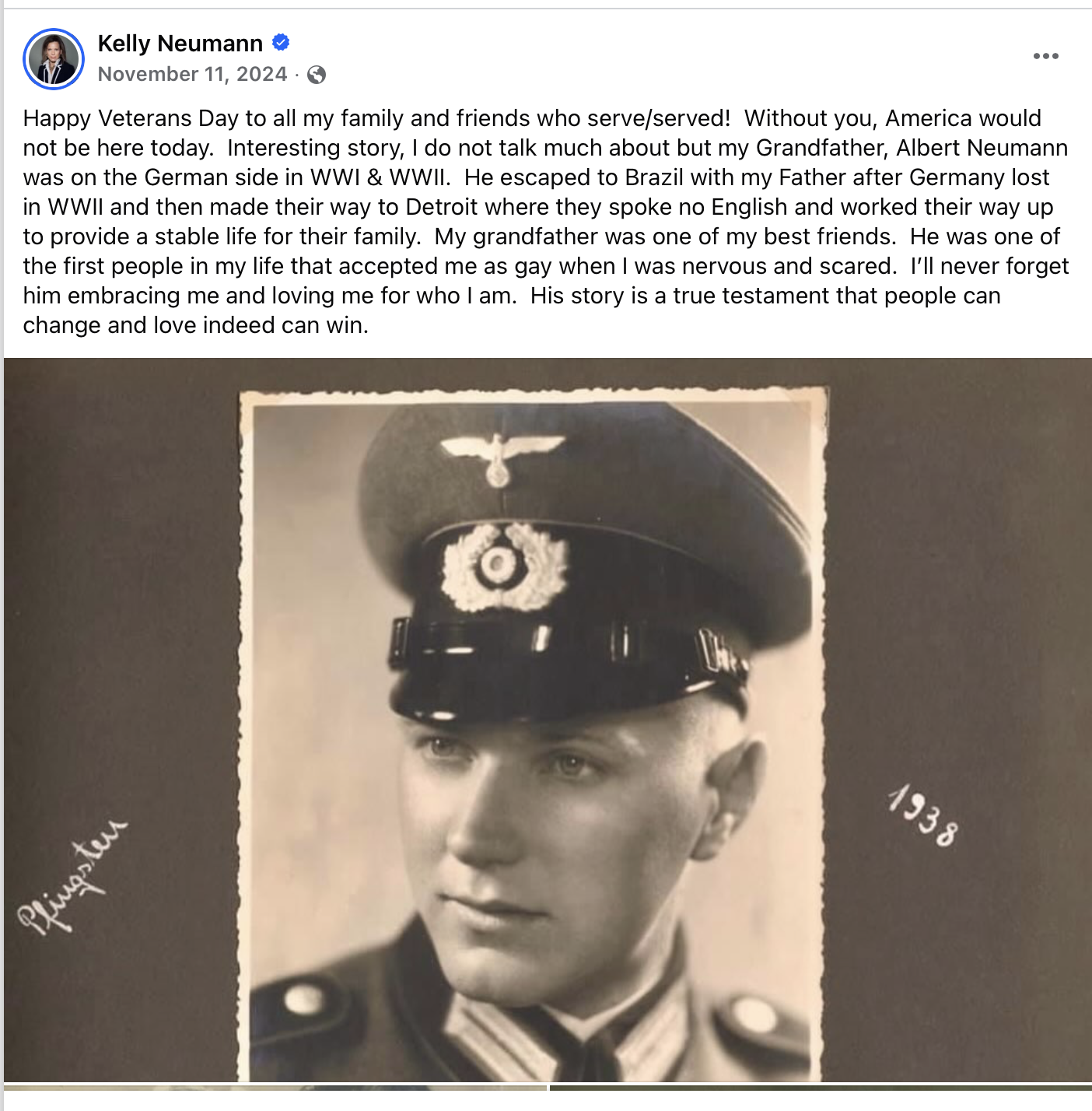
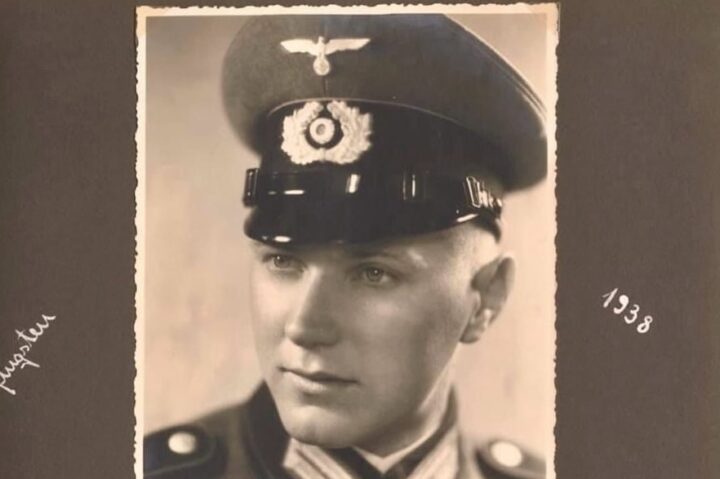
Picture of Kelly Neumann’s grandfather, Albert Neumann, that she shared on Veterans Day in 2024
Kelly Neumann, a prominent Michigan Democratic fundraiser who is supporting several major Democratic candidates in the state, shared a social media post on Veterans Day in 2024 honoring her grandfather, who served in the Nazi regime’s army in World War II.
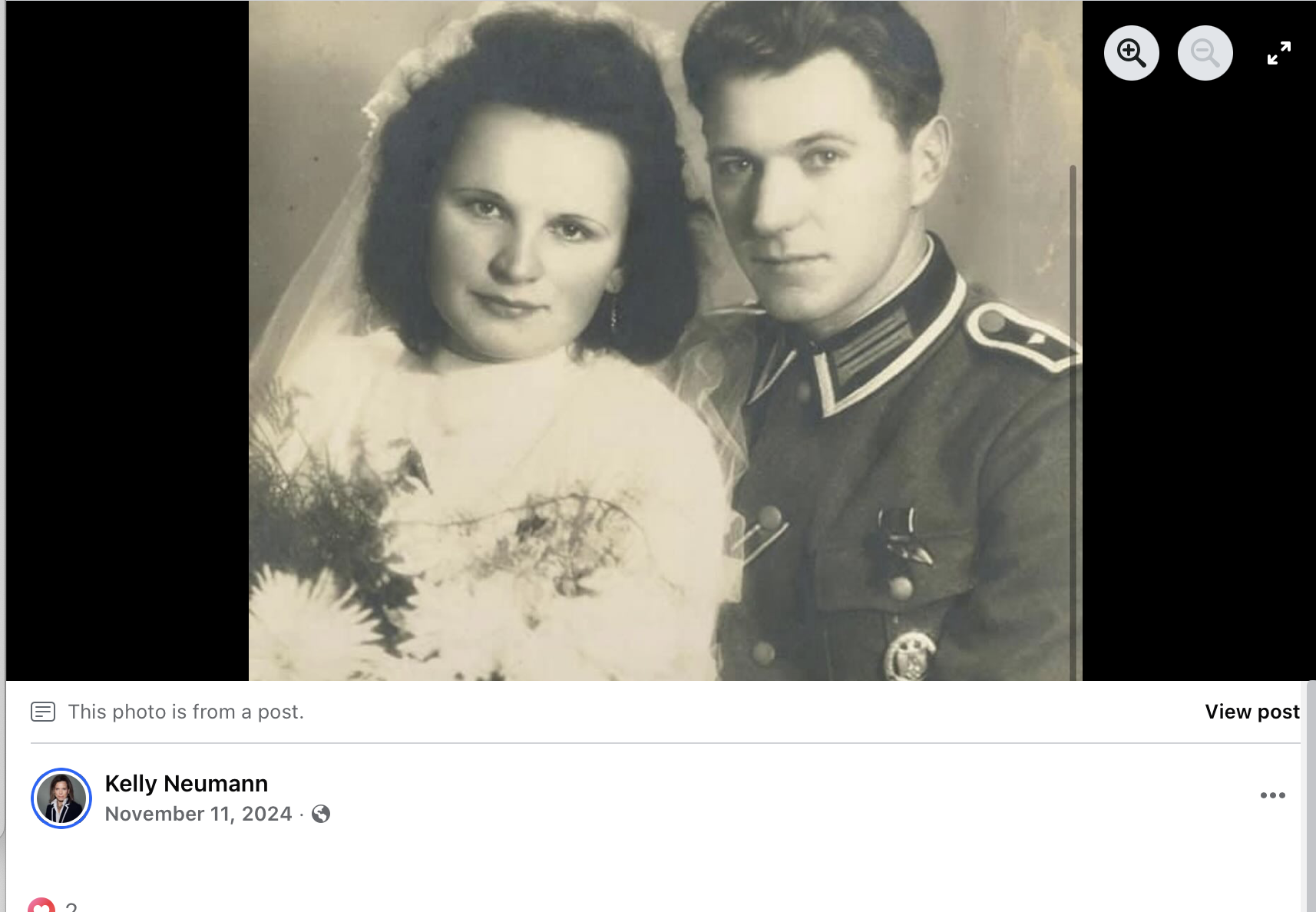
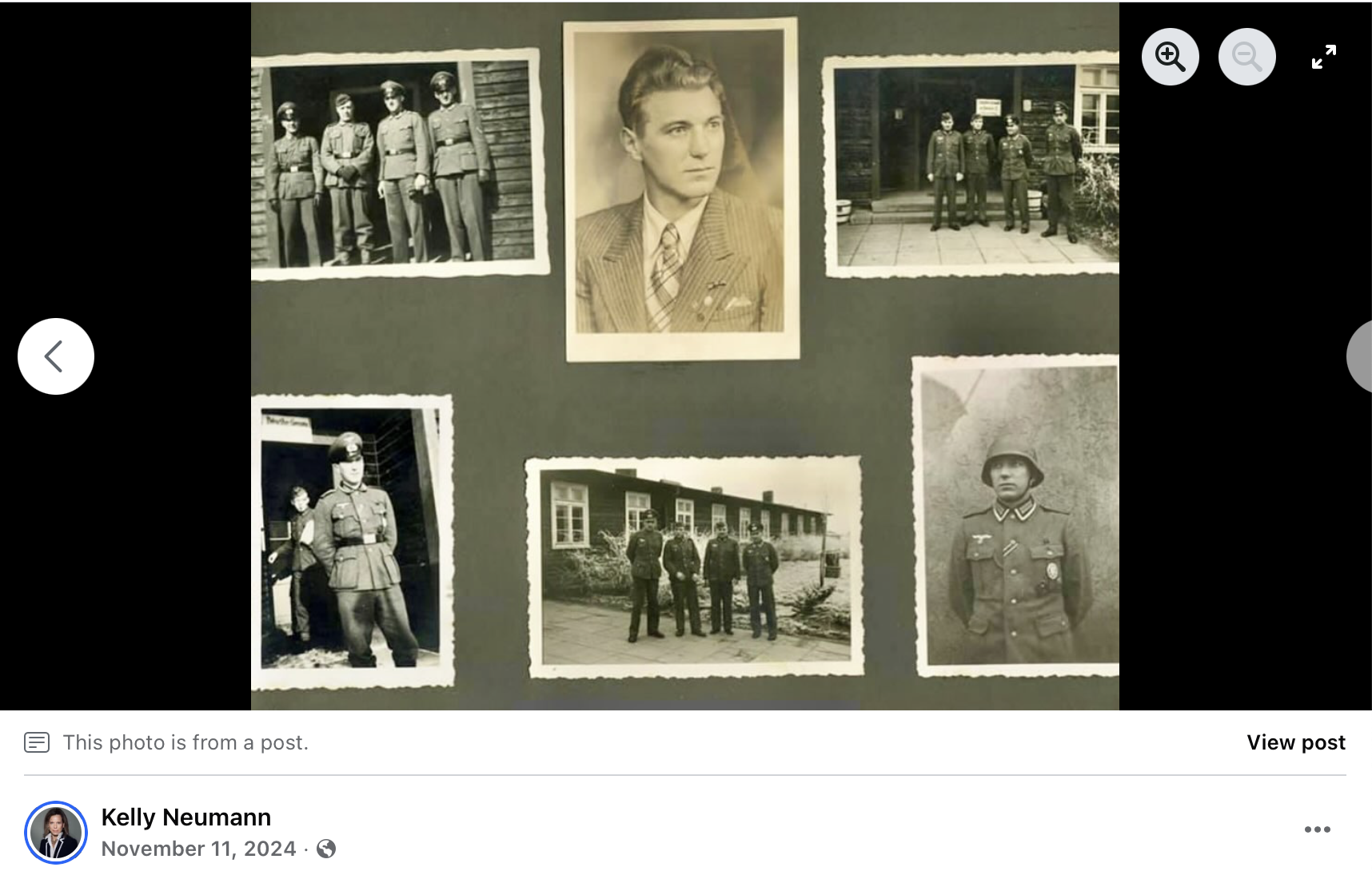
The post includes multiple photos of Neumann’s grandfather in Nazi regalia, including what appears to be an officer’s uniform.
“Happy Veterans Day to all my family and friends who serve/served! Without you, America would not be here today,” the post, shared on Facebook and Instagram by Neumann, a local attorney, reads. The Facebook post, which remained online as of initial publication of this story, was subsequently deleted. “Interesting story, I do not talk much about but my Grandfather, Albert Neumann was on the German side in WWI & WWII. He escaped to Brazil with my Father after Germany lost in WWII and then made their way to Detroit where they spoke no English and worked their way up to provide a stable life for their family.”
Neumann went on to say that her grandfather “was one of my best friends. He was one of the first people in my life that accepted me as gay when I was nervous and scared. I’ll never forget him embracing me and loving me for who I am.”
“His story is a true testament that people can change and love indeed can win,” Neumann concluded.
Neumann is serving as a co-chair of the finance committees for state Sen. Mallory McMorrow, who is running for U.S. Senate, and Secretary of State Jocelyn Benson, who is running for governor. Neumann has co-hosted several fundraisers for McMorrow’s campaign, as recently as last Friday, as well as multiple fundraisers for Benson’s campaign.
In March 2025, Neumann also hosted a $50,000 fundraiser for Rep. Haley Stevens (D-MI), now running for Senate against McMorrow, and is a member of Rep. Kristen McDonald Rivet’s (D-MI) fundraising “cabinet.” She hosted a December fundraiser for state Sen. Jeremy Moss, a Jewish, pro-Israel Democratic candidate for the House.
Neumann appears to be well-connected in Democratic politics¸ having hosted events alongside various other prominent Michigan Democrats. She has also shared photos with former Presidents Barack Obama and Joe Biden and Vice President Kamala Harris and professed to being in personal contact with multiple Democratic senators — albeit prior to the 2024 Veterans Day post.
FEC records indicate she has never personally donated directly to Stevens or Moss’ campaigns, and she’s been critical of Stevens during her Senate candidacy.
Arik Wolk, a spokesperson for Stevens’ campaign, distanced her from Neumann. “Haley rejects antisemitism in all forms, and has spent her career standing up to and calling out hate. Had Haley seen the post celebrating Ms. Neumann’s grandfather’s service to the SS, Ms. Neumann would not have hosted that event,” Wolk said.
Neumann, and the other candidates whom she is supporting this cycle, did not provide comment.
The parade was an example of how Beijing has used WWII not only to encourage nationalism, but to project power internationally, from Jerusalem to Taipei and beyond
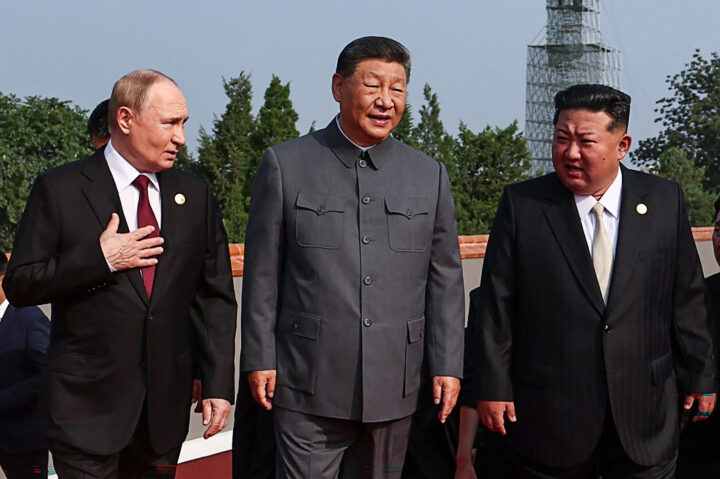
Alexander KAZAKOV / POOL / AFP) (Photo by ALEXANDER KAZAKOV/POOL/AFP via Getty Images
Russia's President Vladimir Putin walks with China's President Xi Jinping and North Korea's leader Kim Jong Un before a military parade marking the 80th anniversary of victory over Japan and the end of World War II, in Beijing's Tiananmen Square on September 3, 2025.
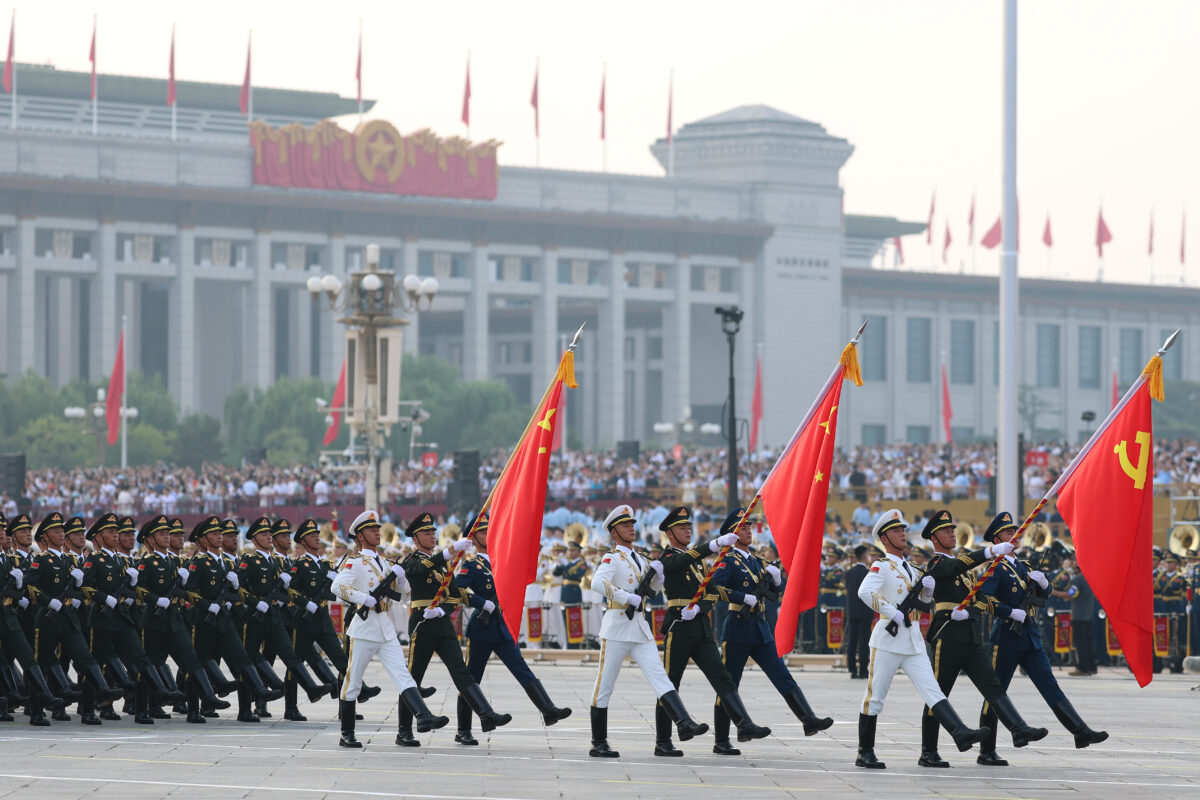
China showcased its growing aggressiveness on the world stage in a major military parade on Wednesday, showing off missiles and fighter jets to mark the 80th anniversary of Japan’s surrender in World War II with Russian President Vladimir Putin and North Korea’s Kim Jong Un in attendance.
The parade was an example of how Beijing has used WWII not only to encourage nationalism, but to project power internationally, from Jerusalem to Taipei and beyond.
President Donald Trump pushed back against the spectacle in Beijing, writing on Truth Social that Chinese leader Xi Jinping ought to “mention the massive amount of support and ‘blood’ that the United States of America gave to China in order to help it secure its FREEDOM from a very unfriendly foreign invader. Many Americans died in China’s quest for Victory and Glory. I hope that they are rightfully Honored and Remembered for their Bravery and Sacrifice! …Please give my warmest regards to Vladimir Putin, and Kim Jong Un as you conspire against The United States of America.”
The parade came shortly after China hosted a summit with Putin, Indian Prime Minister Narendra Modi and other Eurasian leaders, deepening ties among major powers not aligned with the West. The attendees issued a communique last week strongly condemning “the military aggression launched by Israel and the United States against Iran” in June.
China has also used World War II and Holocaust terminology in recent weeks as it continues its hostility against Israel, calling Israel’s war a “genocide,” even as the Chinese Embassy in Israel held an event highlighting Beijing’s positioning with the Allies in World War II.
The recent statements reflect a broader double game China has played in its relations toward Israel, consistently showing hostility to Israel on the international stage since the Oct. 7, 2023 Hamas-led attacks, while within Israel, the Chinese ambassador has pursued a friendlier posture.
Last month, Beijing, in a statement from the Chinese Communist Party’s Information Office, accused the U.S. of “serving as an accomplice to the genocide in Gaza.” The statement, Tuvia Gering, a fellow at the Atlantic Council and the Institute for National Security Studies at Tel Aviv University, said, marked the first time an official Chinese document accused Israel of genocide.
Gering told Jewish Insider that “you see the word [genocide] being used more and more by Chinese academics, and they are the ones who help formulate China’s Middle East policy … In recent months, I have been seeing it used much more frequently, as well as other accusations against Israel and Jewish people.”
“From the beginning of the war, there have been comparisons between the Jewish state and Japanese imperialists,” Gering said. “From the Chinese perspective, [Japan] did some of the most terrible things, like what the Nazis did to us. That vile, inhumane violence is ingrained in every child in China’s psyche from a young age.”
The Chinese consul-general in Osaka, Japan, has published posts on X over the course of the Gaza war comparing Israel to Nazis and “a demon … that will even devour a baby,” and saying “we must get rid of it once and for all.” Beijing has not apologized for the diplomat’s statements.
That being said, Gering posited that the use of the word “genocide” was unlikely to reflect a policy shift by Beijing “because of the sensitivity to how the word is being used against China” in relation to its Uyghur minority.
The genocide accusation came in response to the State Department’s report on human rights practices in China in 2024, which opened by stating that “Genocide and crimes against humanity occurred … in China against predominantly Muslim Uyghurs.”
As such, Gering said the use of “genocide” in an official document is primarily meant to target the U.S.
Similarly, Carice Witte, founder of SIGNAL Group, a think tank focused on China-Israel relations, told JI that the statement is an example of Beijing “using Israel as a tool.”
To China, she said, “the Middle East and Israel are much more about great power competition than the local issues.”
“Israel is a very small country that is no longer of great interest to China, and its positions on Israel are not about Israel as much as they are about China’s global interests,” Witte said. “By saying the U.S. supports genocide in Gaza, that is not about Israel, but about the U.S. and the global south. Because so many countries hate Israel, [China] believes that if they criticize Israel, more countries will support them.”
A source involved in China-Israel relations who spoke on condition of anonymity told JI they heard a Chinese diplomat say that “they use the Palestinians to make trouble for the U.S. the way the U.S. uses Taiwan to make trouble for them.”
Ten days after Beijing accused Israel of genocide, the Chinese Embassy in Israel held a ceremony marking 80 years since the end of World War II in the Pacific arena, and honoring “Jakob Rosenfeld, a Jewish doctor whose heroic contribution to the Chinese people’s fight against fascism is a lasting symbol of international solidarity,” the invitation read.
Gering also noted that China has made diplomatic use of the fact that over 20,000 Jews escaped the Holocaust to Shanghai, including, famously, the entire Mir Yeshiva from Lithuania. They fled to an enclave in Japanese-occupied Shanghai that did not require a visa for entry, until 1941, when Japan forced the Jewish refugees into a ghetto and banned Jewish immigration to the city. The only Chinese diplomat known to have played a role in helping Jewish refugees was a representative of the Republic of China, which the Chinese Communist Party that currently rules China later defeated in a civil war.
Like many other countries, including China’s ally Russia, which also holds WWII victory parades, Beijing “employs selective historical memory,” Gering said. “There is a very obvious, explicit utilization of memory … Undermining or silencing the voices of victims of the Holocaust and refugees in Shanghai … When you listen to Chinese ambassadors, you think that there was a unique civilizational benevolence by the Chinese people, who opened their arms when the rest of the world rejected Jews … It’s a complete distortion of the story of the Jewish refugees who lived in squalid conditions.”
Israel generally does not push back against that narrative for “political expedience,” Gering said, explaining that “it is good for soft power to say we share their sentiment of anti-fascism.”
Witte said that China’s politicization of World War II and the Holocaust reflects a broader “two-pronged path. On the one hand, China has a big-picture policy and the Beijing stage is for the track that is harsh on Israel. Local policy, where the embassy is the stage, is the pro-Israel track.”
“Obviously, Beijing is exponentially louder, more recognized and more heard than the embassy,” she added.
Gering pointed out that Chinese Ambassador to Israel Xiao Junzheng, who arrived at his post in December, “emphasizes friendship between Jews and Chinese people, while Chinese propaganda says Israel is committing genocide and compares Jews to Nazis.”
Xiao “has been given a mandate to act like nothing [bad] happened,” Gering added. “He even wrote an article saying not to let the war define the relationship. Even though … [the CCP] legal advisor said the Hamas attack [on Oct. 7, 2023] was A-OK, don’t split hairs, let’s talk about Chinese cars and how many Jews we saved. They’re kind of forgetting about Jews living today.”
**
Gering also expressed concerns about Beijing’s recent use of Nazi terminology to describe the government in Taiwan.
The CCP newspaper, People’s Daily, published an article that compared Taiwan’s President William Lai and the ruling Democratic Progressive Party to the Nazis. The article also described civil society groups seeking to educate Taiwanese citizens to be prepared for possible missile attacks from China and to recognize Chinese propaganda in the media as “Nazi-like.”
The article “even feigns concern for their democracy, which is ironic in a CCP mouthpiece,” Gering said.
Gering expressed concern that the language is similar to that used by Russia in the years before its invasion of Ukraine.
“The denazification card is what Putin’s Kremlin used as a pretext for its invasion and its ongoing war in Ukraine,” Gering noted. “This prompts us to ask if this is a precursor to a People’s Liberation Army [Chinese military] denazification campaign in Taiwan.”
Still, Gering said, Taiwanese politics are very divisive, and opposition politicians have also called the current government Nazis, leading to condemnation by Israeli and German diplomats in Taipei. “That gave a hechsher [kosher certification] for the CCP to use this kind of pernicious rhetoric, as well,” he said.
“In the more immediate term, it’s probably just a tactical way for the CCP to sow division and weaken the Taiwanese leadership and democratic institutions,” he added.
The legislation aims to address obstacles raised by recent Supreme Court rulings against Holocaust survivors and their descendants, among other issues

FILE - This May 12, 2005 file photo shows an unidentified visitor viewing the Impressionist painting called "Rue St.-Honore, Apres-Midi, Effet de Pluie" painted in 1897 by Camille Pissarro, on display in the Thyssen-Bornemisza Museum in Madrid. Lilly Cassirer surrendered her family's priceless Camille Pissarro painting to the Nazis in exchange for safe passage out of Germany during the Holocaust. The Supreme Court is hearing the case about the stolen artwork. (AP Photo/Mariana Eliano, File)
A group of House members introduced legislation on Friday that aims to bolster efforts by Holocaust survivors’ families to reclaim or receive recompense for art stolen from their relatives during World War II, addressing issues in past legislation that have hampered repatriation efforts in the courts.
Identical legislation was recently introduced in the Senate by Sens. John Cornyn (R-TX) and Richard Blumenthal (D-CT). The House bill is being sponsored by Reps. Laurel Lee (R-FL), Scott Fitzgerald (R-WI), Jerry Nadler (D-NY), Jamie Raskin (D-MD) and Maggie Goodlander (D-NH).
The new bill, the Holocaust Expropriated Art Recovery (HEAR) Act Improvements of 2025, aims to fill gaps left by the original HEAR Act, passed in 2016. The legislation eliminates a time limit included in the original bill that led some courts to dismiss suits filed under the original law. It also extends the law in perpetuity, beyond its original 2026 expiration date.
The bill also specifically addresses issues raised in recent Supreme Court cases, in which the court has ruled against the families of Holocaust survivors, stating that, “in order to effectuate the purpose of the Act to permit claims to recover Nazi-looted art to be resolved on the merits, these defenses must be precluded.”
The new bill aims to ensure that the defenses used in those cases cannot be applied going forward, and aims to ensure that such cases are not thrown out or defeated on technicalities.
“The Nazi regime stole not only lives but legacies, including cultural and family treasures that carry deep personal and historical meaning,” Lee said in a statement. “This bill ensures that families who lost everything during the Holocaust are given a fair shot at justice. These claims should be decided on the truth, not on legal loopholes or paperwork deadlines. With this legislation, we reaffirm our commitment to standing with Holocaust survivors and their families. They deserve to have their stories heard and their property returned. It’s never too late to do the right thing.”
Nadler, a lead sponsor of the original HEAR Act said, “As a matter of principle, we affirm that in the United States, everyone who has a credible claim deserves to have their day in court. This bill realizes that principle and ensures that every family has the right to a fair and just process based solely on the merits of their claim. We cannot fix the past, but this bill is a promise to the victims of the Holocaust that the United States is committed to creating a fair judicial process for the return of property that was wrongfully stolen during the darkest period of human history.”
David Schaecter, a Holocaust survivor and president of Holocaust Survivors Foundation USA, said, “To allow museums here and in Europe, and foreign governments to keep Nazi looted art perpetuates the crimes of the Nazi regime, and demeans the memory of six million Jewish souls. We applaud Congress for making sure that families can recover their treasured legacies, and that the true history of the Nazis’ brutal campaign of murder and theft cannot be erased or trivialized by the scoundrels who refuse to return looted art.”
Gideon Taylor, the president of the World Jewish Restitution Organization, said that reclaiming these stolen belongings “is not simply about returning possessions; it is about restoring history, identity, and a measure of justice to those who lost everything.”
Joel Greenberg, president of Art Ashes, which helps fund the recovery of Nazi-looted art, said the legislation “renews and strengthens the HEAR Act, which is set to expire, by closing critical loopholes and addressing key oversights.”
“It reaffirms our commitment to ensuring that rightful owners of Nazi-looted art — and their families — receive the restitution they are owed,” Greenberg continued. “Any museum that knowingly retains stolen works is complicit in perpetuating the injustice inflicted on Holocaust victims. We have both a moral and legal obligation to correct these wrongs and to ensure the crimes of the Holocaust are neither forgiven nor forgotten.”
The legislation is supported by around two dozen Jewish and pro-Israel organizations.
Please log in if you already have a subscription, or subscribe to access the latest updates.
 Continue with Google
 Continue with Apple