












































































The president made the comments on Fox News after the IRGC attempted a surprise ballistic missile attack on U.S. forces in the region
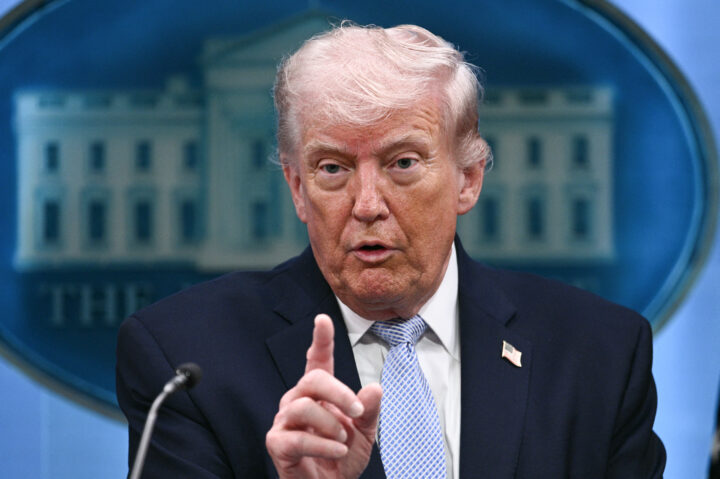
Brendan SMIALOWSKI / AFP via Getty Images
US President Donald Trump speaks about the conflict in Iran in the James S. Brady Press Briefing Room of the White House on April 6, 2026, in Washington, DC.


 Add JewishInsider on Google
President Donald Trump warned on Wednesday that the U.S. would “beat the f**king sh*t out of” Iran following an attempted surprise ballistic missile attack by the Islamic Revolutionary Guard Corps on American forces in the region, even as he signaled a willingness to keep diplomatic channels open.
“We’ll be hitting them hard,” Trump told Fox News’ Trey Yingst. “They’re going to get a beating.”
But Trump added that he’s “going to let them keep talking,” referring to ongoing indirect U.S.-Iran negotiations.
The president’s comments followed a spate of attacks on Tuesday evening into Wednesday morning by Iran and its proxies. In addition to the IRGC surprise attack, Iran also directed more than 30 drone attacks by its proxies in Iraq over several days on “U.S. forces and Saudi energy infrastructure,” CENTCOM said, leading the U.S. and Saudi Arabia to conduct joint strikes on logistics and weapons sites in eastern Iraq early Wednesday. The Jordanian military also announced that it had intercepted five missiles launched from Iran on Tuesday night.
The attacks ended a pause in hostilities between the parties, which began last Friday, and came after Trump’s disclosure on Monday that the U.S. remains engaged in “very deep talks” with Iran. But the president has repeatedly threatened to reengage in military action if diplomacy collapses.
Cassidy said Trump raised his voice after the senator defended his vote backing a resolution directing the administration to withdraw U.S. forces from Iran
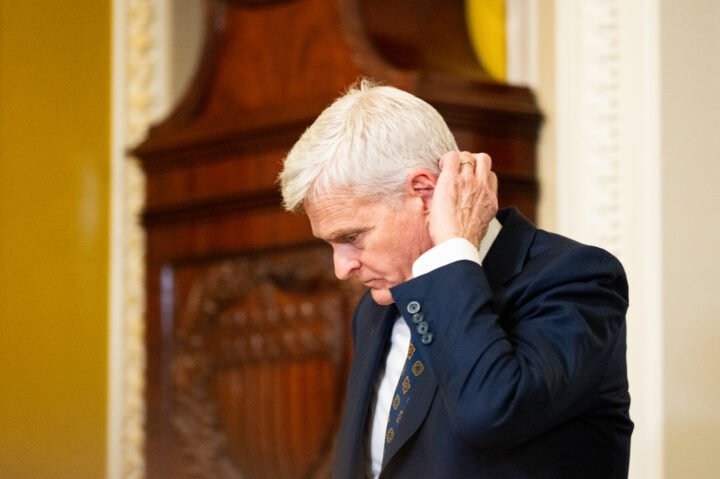
Bill Clark/CQ-Roll Call, Inc via Getty Images
Sen. Bill Cassidy, (R-LA), walks through the Ohio Clock Corridor before President Donald Trump arrives for the Senate Republicans' lunch meeting in the U.S. Capitol on Wednesday, June 24, 2026.
President Donald Trump engaged in a shouting match with Sen. Bill Cassidy (R-LA) during a closed-door lunch with Senate Republicans on Wednesday over the outgoing Louisiana senator’s support for a war powers resolution directing the administration to withdraw U.S. forces from Iran that passed the chamber the previous day.
Cassidy acknowledged the incident after the luncheon concluded, telling reporters that the dispute began when the president questioned aloud why any Republican would vote for the resolution. The Louisiana senator stood up from his chair and asked Trump if his question was rhetorical or if he wanted an explanation. Cassidy said Trump responded by asking for an explanation, which the senator obliged.
The Louisiana senator said that he told the president, “You have not told the American people what’s going on. It was supposed to last four weeks, it has lasted for four months. Our original objectives have not been achieved. And I want to know what’s going on.”
He went on to say that Trump “did not particularly care for my comments” and “raised his voice,” prompting Cassidy to grow angry. At some point during the confrontation, other GOP senators encouraged Cassidy to sit down and tried to “deescalate” the situation. Cassidy obliged his colleagues and stopped engaging the president.
“I lost my temper,” Cassidy said. “That’s not appropriate, it’s the Irish in me. But I, again, matched his tone, and his volume. It went back and forth.”
Cassidy accused Trump of making several negative comments about him, including a remark about Cassidy losing his reelection bid to a Trump-backed challenger. Another GOP senator said that Cassidy referred to Trump as “my brother” at one point instead of his formal title, which Trump responded to angrily.
Still, the senator said that Cassidy remained respectful of the president during the exchange, and attributed the blowup in part to Trump’s longstanding frustration with Cassidy on a range of issues, including his impeachment in 2021.
Cassidy noted that he would continue to vote for the war powers resolutions until he is briefed on the war effort. Sens. Lisa Murkowski (R-AK), Susan Collins (R-ME) and Rand Paul (R-KY) joined Cassidy in helping Democrats pass a war powers resolution in the Senate for the first time on Tuesday, delivering the upper chamber’s first rebuke of the president’s war.
He added that he will be satisfied once the administration briefs Congress on the details of the U.S. memorandum of understanding with Iran. “You say everything’s fine, but on the outside, it doesn’t look like everything’s fine,” he said of the Trump administration’s handling of diplomatic efforts to end the war in Iran.
“I make no apologies for standing up to the president, if you will, trying to demand that more information be shared with the American people,” Cassidy said. “If someone tries to bully you into not asking that question, I’m not going to accept that either. I am sticking up for the American people, even if I’m speaking to the president.”
The meeting was organized by Sen. Rick Scott (R-FL) and comes at a time of heightened tension between Trump and the Senate Republican conference over the war powers vote; Trump’s demands that the Senate pass his signature voter ID bill, for which Senate Republicans say they lack the votes; and, most recently, Trump’s last-minute decision on Wednesday morning to cancel a signing ceremony at the Capitol for a much-anticipated bipartisan housing package.
A large group of Senate Republicans — including Senate Majority Leader John Thune (R-SD), Majority Whip John Barrasso (R-WY), Sens. John Hoeven (R-ND), Jerry Moran (R-KS), Thom Tillis (R-NC), Mike Rounds (R-SD), Katie Britt (R-AL), Kevin Cramer (R-ND), Tim Scott (R-SC), Mike Crapo (R-ID), John Kennedy (R-LA), Collins, Murkowski and others — huddled on the Senate floor for an extended period after the contentious meeting, in what appeared to be an at-times animated conversation.
Following the luncheon, Scott told reporters that Trump was “very forceful about what he cares about,” also noting that the president talked about Iran “a lot.”
“[Trump] is very comfortable he’s going to get a deal,” Scott said. “[Iran is] doing exactly what he wants. He was very disappointed that somebody would vote on the war powers resolution to stop him in the middle of negotiations, so that frustrates him.”
Scott suggested he understands Trump’s heated demeanor: “If I was the president, I was in the middle of a negotiation to protect American lives, I would be frustrated too.”
Scott said that Trump told senators that Iran is not telling the truth about the talks, and that if Iran doesn’t agree to a good deal, the U.S. will return to military action.
“He said Iran’s agreeing to whatever his requests are. Don’t believe in anything [that] the Iranian press is putting out, because it’s a complete lie,” Scott said. “He’s very comfortable that they’re not gonna have nuclear weapons, they’re not going to have the money to be able to continue to support Hamas, Hezbollah and the Houthis, so he’s very comfortable that we’re going to have a good deal.”
Kennedy, who has been skeptical that the Iranian regime will hold to the terms of any deal but supportive of the administration’s negotiation efforts, offered a similar view.
“I’m in the middle of serious negotiations, trying to settle a conflict, and one of my mates undermines me,” Kennedy said of the president’s perspective. “I’m going to be mad too, and he was mad as a murder hornet about that. He’s right to be mad, in my opinion. Not criticizing anybody for their vote, but these next 60 days are critical,” he added, referring to the 60-day window for further negotiations established in the agreement with Iran.
“We ought to support him, whether you like him or not,” Kennedy continued. “I don’t know how it’s going to end up, you’ll have plenty of time to assess it after 60 days, but we’re going to give peace a chance for 60 days.”
Cramer said that Trump was “very detailed” in his discussion of the situation in the Middle East, but he and other Republicans said there was little opportunity for them to ask questions.
Like Scott, Cramer said Trump disputed Iran’s characterizations of the talks. “He emphasized again that everything they’re saying they’re not giving up, they’re giving up,” Cramer said. “My trust is in our administration until such time as they sign something that’s foolish.”
Another GOP senator, speaking on condition of anonymity, said that Trump emphasized to the group that he could “blow everything up” but that that would have harmed many Iranians, which he wanted to avoid.
The senator told JI that the president explained the MOU to senators — including the financial benefits Iran stands to gain and his decision to strike Iranian nuclear sites in 2025 — and defended his diplomatic overtures to the Iranian regime. They said that Trump told the group, “Without any question in his mind, the number one thing is that Iran is just not going to be able to have a nuclear weapon, ever.” The senator said Trump expressed “so much compassion for Israel” in his remarks.
Trump also warned the lawmakers, according to the senator, that, “If we don’t watch out, what we do here can screw up a whole lot of stuff when you’ve got people that are negotiating” a possible deal with Iran.
Rounds said the president provided senators “more of a briefing in terms of what [the administration is] doing over [in Iran] than we’ve heard to date.” However, Rounds noted that “most of it to me was consistent with what we’ve learned” in previous classified briefings.
When asked whether Republican senators explained to Trump that there is a lack of votes to pass his voter ID bill, the SAVE America Act, Rounds said, “We really didn’t get into that.”
Sen. Tommy Tuberville (R-AL), a strong supporter of the president, praised Trump’s performance in the meeting, telling reporters after the luncheon, “You can’t take it personal. You’ve got to go in knowing that the head coach is coming into the … room.”
“The president did a hell of a job of getting his message over, and sometimes in a loud voice, sometimes not so loud,” Tuberville said. “That’s how you do it. That’s how I did it. Not to say it’s perfect. He came in and got his point across, and I think when we all left, we understood where he [stands].”
Sen. Roger Marshall (R-KS) similarly dismissed the shouting match between Trump and Cassidy as indicative of the president having an issue with the Senate GOP conference.
“I think it’s great for a family to have these types of discussions,” Marshall said. “You all act like no one ever yelled at each other. I didn’t go into a doctor’s hospital board meeting where there wasn’t yelling at each other. I think it’s perfectly fine if you’re trying to air your grievances.”
Sen. John Cornyn (R-TX), meanwhile, sarcastically told reporters that there “was quite a unity message” during the meeting.
Cornyn also remarked that Trump spoke for an hour and 15 minutes and that there “wasn’t really an opportunity” for him to get a question in.
The president’s continued push for the Senate to pass the SAVE America Act, despite lacking the votes without abolishing the 60-vote filibuster threshold, was also a major point of contention.
“He wants the SAVE Act, that much is clear,” Kennedy told reporters. “I want to say that I’m on the record for any way to get the SAVE Act passed. I still think there’s potential through reconciliation, but some of my Senate colleagues don’t agree with it. … It’s clear he wants it.”
“I know there’s frustration over the SAVE Act passage, but we simply don’t have the votes because we’re not going to nuke the filibuster,” Tillis said. “We’ve made it clear multiple times, if the SAVE Act requires nuking the filibuster it’s simply not going to happen and that’s been obvious long before today.”
The resolution passed 50-48 with GOP Sens. Paul, Murkowski, Collins and Cassidy voting with Democrats in favor
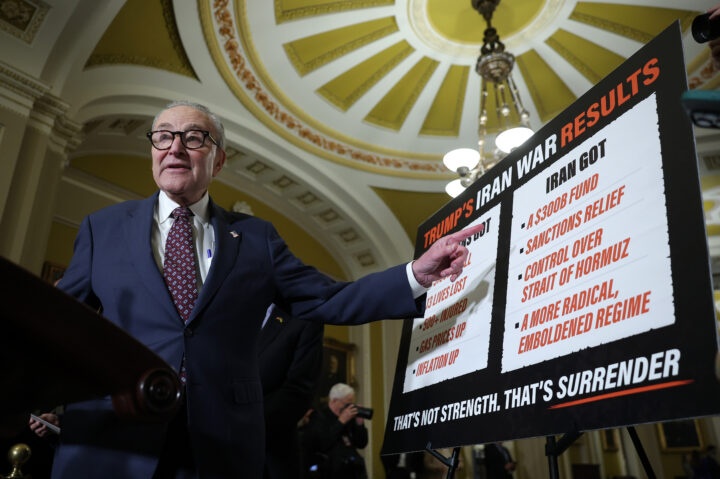
Photo by Kevin Dietsch/Getty Images
U.S. Senate Minority Leader Chuck Schumer (D-NY) speaks to reporters after the weekly Senate policy luncheons at the U.S. Capitol on June 23, 2026 in Washington.
The Senate voted on Tuesday to pass a House-passed war powers resolution directing the administration to withdraw U.S. forces from Iran — a congressional rebuke of the administration over the war in Iran — though legally its effects are likely to be largely symbolic.
The resolution passed by a 50-48 vote, with Republican Sens. Rand Paul (R-KY), Lisa Murkowski (R-AK), Susan Collins (R-ME) and Bill Cassidy (R-LA) again voting in favor and Sen. John Fetterman (D-PA) voting against it. Ultimately, GOP absences enabled the resolution to go forward.
But the resolution, now passed by both chambers, came in the form of a concurrent resolution, which is not submitted to the president and, based on past court precedent, is not seen as carrying the force of law — though a House Democratic aide argued to CNN that the measure would be binding.
Rep. Greg Meeks (D-NY), the ranking member of the House Foreign Affairs Committee and lead Democratic sponsor of the war powers resolution, insisted in a statement, “Regardless of what President Trump says, this measure is binding under the War Powers Resolution, and I will explore all legal avenues to ensure the Executive complies with the will of Congress.”
Unlike previous efforts, however, the concurrent resolution did not require other procedural votes by the Senate, allowing Democrats to take advantage of the Republican absences and move directly toward final passage to deliver a message of rebuke to the administration.
The Senate still has other war powers resolutions pending, including one which passed an initial procedural hurdle, but currently lacks the support to pass through an additional procedural vote and final passage with full attendance. That legislation, which comes in a different form as joint resolutions, would be presented to the president if passed and set up a potential veto or other legal fight.
Republicans warned that adopting the resolution would send a further signal to Iran that it does not need to negotiate or make any compromises with the U.S. as part of ongoing talks.
The defense secretary also alluded to targeting energy infrastructure if Iran doesn’t agree to concessions in order to end the war
AUL LOEB / AFP via Getty Images
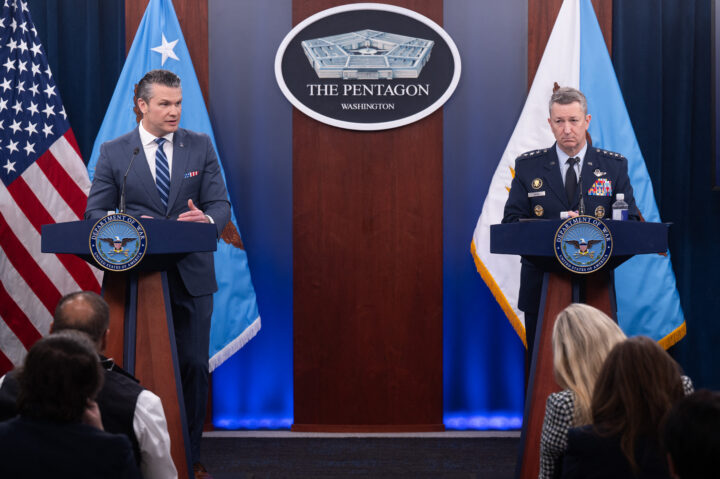
(L/R) Secretary of Defense Pete Hegseth speaks alongside Chairman of the Joint Chiefs of Staff General Dan Caine during a press briefing at the Pentagon in Washington, DC, on April 16, 2026.
Defense Secretary Pete Hegseth warned on Thursday that U.S. forces are “maximally postured” to resume military operations in Iran, and specifically target energy infrastructure, should the country’s current leaders not agree to a negotiated settlement to end the war.
Hegseth made the comments during a press briefing at the Pentagon on Thursday morning alongside Joint Chiefs of Staff Chairman Gen. Dan Caine and Admiral Brad Cooper, the commander of U.S. Central Command. The defense secretary spoke directly to Iranian leadership in his opening remarks, cautioning that while President Donald Trump would “rather not have to” resume operations and go after Iran’s energy industry, the U.S. was prepared to do so if negotiations failed.
“There is an alternative, as our negotiators have said. You, Iran, can choose a prosperous future, a golden bridge, and we hope that you do for the people of Iran. In the meantime, and for as long as it takes, we will maintain this successful blockade,” Hegseth said. “But if Iran chooses poorly, then they will have a blockade and bombs dropping on infrastructure, power and energy.”
Hegseth said that CENTCOM was continuing “to implement an ironclad blockade” and ensuring “that our forces are maximally postured to restart combat operations should this new Iranian regime choose poorly and not agree to a deal. That is what we urge this morning, that this new Iranian regime choose wisely.”
“To the KH [Kataib Hezbollah] leadership and IRGC leadership: We’re watching you. Our capabilities are not the same, our military and yours,” Hegseth said. “Remember, this is not a fair fight, and we know what military assets you are moving and where you are moving them to. While you are digging out — and this is exactly what you’re doing, digging out of bombed out and devastated facilities — we are only getting stronger.”
Caine clarified during his remarks that the U.S. is not blockading the Strait of Hormuz in its entirety; rather, “the U.S. action is a blockade of Iran’s ports and coastline.”
“Let me be clear, this blockade applies to all ships regardless of nationality heading into or from Iranian ports,” Caine said. “Enforcement will occur inside Iran’s territorial seas and in international waters.”
In his message to Iranian leaders, Hegseth emphasized the work U.S. military and intelligence forces have done since the start of the ceasefire to ensure their readiness in the event of diplomatic efforts failing.
“You have no defense industry, no ability to replenish your offensive or defensive capabilities. You only have what you have. You know that and we know that. You can move things around but you can’t actually rebuild. You can dig out for now but you can’t reconstitute,” Hegseth said to the Iranians. “But we can. We are reloading with more power than ever before, and better intelligence, even more importantly better intelligence, than ever before.”
“As you expose yourself with your movement to our watchful eye, we are locked and loaded on your critical dual-use infrastructure, on your remaining power generation and on your energy industry,” he continued. “We would rather not have to do it, but we are ready to go at the command of our president.”
The vote showcased how the Iran war has quickly become a partisan issue, despite lawmakers on both sides of the aisle expressing long-standing concerns about the threat from Iran

GETTY IMAGES
A general view of the U.S. Capitol Building from the National Mall, in Washington, D.C., on Thursday, May 29, 2025.
With the U.S.-Israel operation against Iran widening, the Senate voted 53-47 on Wednesday afternoon — largely along party lines — to block a procedural vote on a war powers resolution that would have forced the immediate withdrawal of U.S. forces from combat with Iran.
Sens. Rand Paul (R-KY) and John Fetterman (D-PA) broke with their respective parties as expected, with Paul voting for and Fetterman voting against the motion, with all other lawmakers voting along party lines.
The vote showcased how the Iran war has quickly become a partisan issue, despite lawmakers on both sides of the aisle expressing long-standing concerns about the threat from Iran and its malign activities and some Democrats offering a degree of positive commentary about the U.S. strikes.
Though widely expected to fail, Democrats view the resolution, and a similar one up for a vote in the House tomorrow, as a critical avenue to go on record with their opposition to the Trump administration’s military offensive. Many Democrats believe U.S. military engagement in Iran will be politically unpopular in a midterm election year, and are objecting to the administration’s decision not to seek congressional authorization for the operation.
Pressed by Jewish Insider in the days leading up to the vote, several top Democrats backing the resolution did not offer a clear articulation of the potential implications and impacts the resolution would have when U.S. assets and embassies are actively under fire from Iran.
Two argued, in spite of the directive contained in the legislation for U.S. forces to immediately withdraw, that the resolution would nevertheless allow for an orderly completion of the mission and drawdown of U.S. personnel.
Around 40 Democratic senators — most of the caucus — sat together at their desks on the Senate floor as the vote began, a break with usual Senate practice, which sees senators mingle on the floor and filter in and out of the chamber as votes proceed.
The tactic was likely designed to signal the nearly unified Democratic opposition to and concern about the legislation.
Republican Sens. Jerry Moran (R-KS), Lisa Murkowski (R-AK) and Susan Collins (R-ME) had all declined to tell reporters, in the days before the vote, how they planned to vote, but all three ultimately voted with their party against the motion.
Sen. Todd Young (R-IN), a prominent Republican advocate for reclaiming congressional war powers, said in a statement earlier Wednesday that he believed, based on the information he received, “there was a very real possibility of Iran escalating those threats against us and our service members, so President Trump made the difficult decision to direct strikes.”
He said the danger to U.S. forces and allies “will only grow if we limit the President’s military options at this critical moment. An abrupt disengagement could pose increased risks to American lives and interests.”
At the same time, he also called for hearings and debate about the administration’s aims and strategy, particularly as the war continues.
Collins said in a statement, “Passing this resolution now would send the wrong message to Iran and to our troops. At this juncture, providing unequivocal support to our service members is critically important, as is ongoing consultation by the Administration with Congress.”
Sen. John Curtis (R-UT) said after the vote, “I will say very clearly: Yes, I wish I would have been consulted. I wish my vote would have been asked for before this. But the president did act within his legal bounds to do what he has done.”
Murkowski, Collins, Paul, Young and Sen. Josh Hawley (R-MO) recently voted with Democrats in favor of a procedural vote on a similar resolution to end U.S. operations in Venezuela, but Hawley and Young ultimately flipped on the vote on the resolution itself, leading the Venezuela resolution to fail.
Paul argued that the war in Iran was contrary to Trump’s campaign message of opposing regime change and preemptive wars, which he said had resonated with him and with other Trump voters.
The general GOP unity around the resolution isn’t necessarily a signal that all Republicans are directly in lockstep behind Trump’s efforts, however, or that they would remain so regardless of how the campaign proceeds.
Hawley — who generally favors a more restrictionist foreign policy — for example, told reporters on Tuesday that he believed Trump would need congressional approval to put troops on the ground in Iran. But Sen. Rick Scott (R-FL) offered the opposite view.
Collins said in a statement that “sustained combat operations require full engagement with Congress. The Administration has adhered to the provisions of the War Powers Act that require notification to Congress within 48 hours of hostilities commencing, and it has provided numerous classified briefings to Congress.”
Some former Democratic officials have questioned the wisdom of the approach taken by the war powers resolutions up for debate in the Senate and House, which demand the immediate withdrawal of U.S. forces from combat with Iran.
They’ve argued that it’s unreasonable, unrealistic and dangerous for U.S. forces to be required to pull out immediately, without any drawdown period.
“We have U.S. servicemembers in harm’s way. Some are flying combat sorties as we speak. We can’t call them in the cockpit and say ‘Congress has prohibited you from completing this mission. Please turn around and stop what you’re doing.’ If that sounds a little strange, it is because the Ro Khanna [D-CA] resolution requires that very strange outcome,” Jeremy Bash, a former chief of staff at the Department of Defense and Central Intelligence Agency under the Obama administration, told JI, referring to a similar resolution in the House.
“An immediate withdrawal is dangerous for our troops. Any pullback needs to be orderly and safe. We need to give the combatant commander at least a few weeks to do this safely,” Bash continued. “For a war powers resolution to be credible, it has to build in several days for the commanders to act responsibly to protect their troops. This cannot be done immediately.”
Without congressional authorization, the administration is required under law to end the operation 60 days from its start.
The House is set to vote on similar legislation tomorrow, with most lawmakers again expected to vote along party lines.
The vote was held open for an extended time to allow Sen. John Cornyn (R-TX) to return to the Senate after his Tuesday night primary election.
Washington reporter Matthew Shea contributed reporting.
Without setting a definitive timeline, officials said more U.S. troops are headed to the region and would not rule out a U.S. ground invasion
Alex Wong/Getty Images
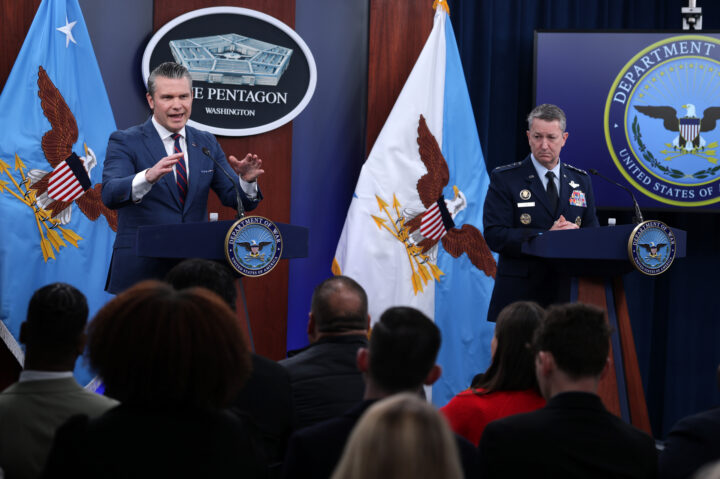
Secretary of Defense Pete Hegseth (L) speaks with Chairman of the Joint Chiefs of Staff General Dan Caine (R) during a news conference at the Pentagon on March 2, 2026 in Arlington, Virginia.
President Donald Trump and senior U.S. defense officials laid out an open-ended timeline for the ongoing operation against Iran on Monday, announcing more U.S. forces are headed to the region to carry out the American and Israeli campaign aimed at dismantling Tehran’s long-range strike capabilities and nuclear ambitions.
Speaking to reporters at the White House on Monday morning, Trump said that U.S. forces were “already substantially ahead of our time projections” with their mission in Iran, but added that the American military was prepared to continue the operation beyond his initial four-to-five week timeline.
“Whatever the time is, it’s OK. Whatever it takes,” Trump said at a Medal of Honor ceremony. “Right from the beginning, we projected four to five weeks, but we have capability to go far longer than that. We’ll do it.”
The president told CNN Monday morning that the “big wave hasn’t even happened. The big one is coming soon.”
Adm. Brad Cooper, head of CENTCOM, “will receive additional forces even today,” said Gen. Dan Caine, chairman of the Joint Chiefs of Staff, during a separate press briefing alongside Defense Secretary Pete Hegseth. “This rapid buildup of forces demonstrated the joint forces ability to adapt and project power at the time and place of our nation’s choosing.”
Caine also made clear the weekend barrage was only the beginning.
“This is not a single overnight operation,” he said. Caine noted that the operation was the result of “months, and in some cases years,” of planning. “The military objectives that CENTCOM and the Joint Force have been tasked with will take some time to achieve, and in some cases, will be difficult and gritty work. We expect to take additional losses.” Four U.S. servicemembers have already been killed in the course of the operations.
While officials emphasized that there are currently no American boots on the ground in Iran, Hegseth declined to rule out the possibility, saying the United States “will go as far as we need to go to advance American interests.”
Trump similarly kept the door open to a ground invasion in an interview with the New York Post. “Every president says, ‘There will be no boots on the ground.’ I don’t say it,” Trump said. “I say ‘probably don’t need them,’ [or] ‘if they were necessary.’”
Hegseth likewise acknowledged that a military effort “of this scope will include casualties” and declined to provide a timeline for completion. “President Trump has all the latitude in the world to talk about how long it may or may not take, four weeks, two weeks, six weeks, it could move up. It could move back,” Hegseth said.
“The commander in chief sets the tempo in terms of this fight. As I said, it’s on his terms,” said Hegseth. “Why in the world would we tell the enemy exactly how long we’ll go or how far we’ll go?”
“To the media outlets and political left screaming ‘endless wars’ — stop,” Hegseth added. “This is not Iraq. This is not endless.” He argued that the operation is “clear, devastating, decisive” with narrowly defined objectives: “destroy the missile threat, destroy the Navy, no nukes.”
Trump also laid out his four priorities for the campaign: “First, we’re destroying Iran’s missile capabilities … Second, we’re annihilating their navy … Third, we’re ensuring that the world’s number one sponsor of terror can never obtain a nuclear weapon … And finally, we’re ensuring that the Iranian regime cannot continue to arm, fund, and direct terrorist armies outside of their borders,” he said.
Hegseth insisted the campaign is not designed to topple Iran’s government, stressing that “this is not a war of regime change.” However, he noted that “the regime sure did change, and the world is better off for it today.”
Iranian leadership “had every chance to make a peaceful and sensible deal, but Tehran was not negotiating,” said Hegseth. “They were stalling, buying time to reload their missile stockpiles and restart their nuclear ambitions.”
Hegseth framed the military confrontation as the culmination of decades of Iranian aggression against the United States, arguing that Tehran’s missile and proxy network had created a conventional shield for its nuclear ambitions and left American forces and allies in its crosshairs.
“For 47 long years, the expansionist and Islamist regime in Tehran has waged a savage, one-sided war against America,” said Hegseth, calling the moment a “generational turning point.”
“We didn’t start this war, but under President Trump, we are finishing it,” Hegseth said.
Speaking about cooperation with partners, Hegseth noted that Israel “did a great job in the conduct of that operation,” also stating that the U.S.’ integrated air and missile defense network has intercepted “hundreds of ballistic missiles targeting U.S. forces, our partners and regional stability.”
“As the threat grew, our partners surged in beside us,” said Hegseth. “Air defense batteries in Qatar, the UAE, Kuwait, Jordan and Saudi Arabia joined the fight. Proof that years of training, trust and hard-earned integration pay off.”
Please log in if you already have a subscription, or subscribe to access the latest updates.
 Continue with Google

 Continue with Apple