






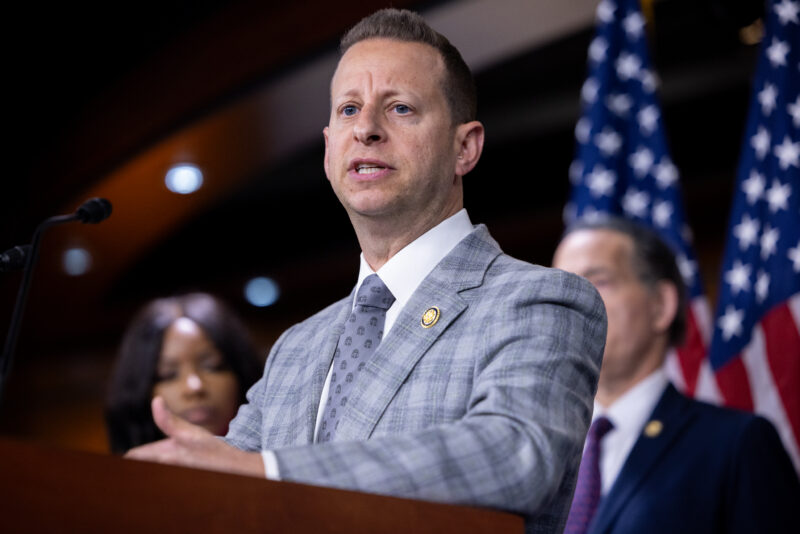




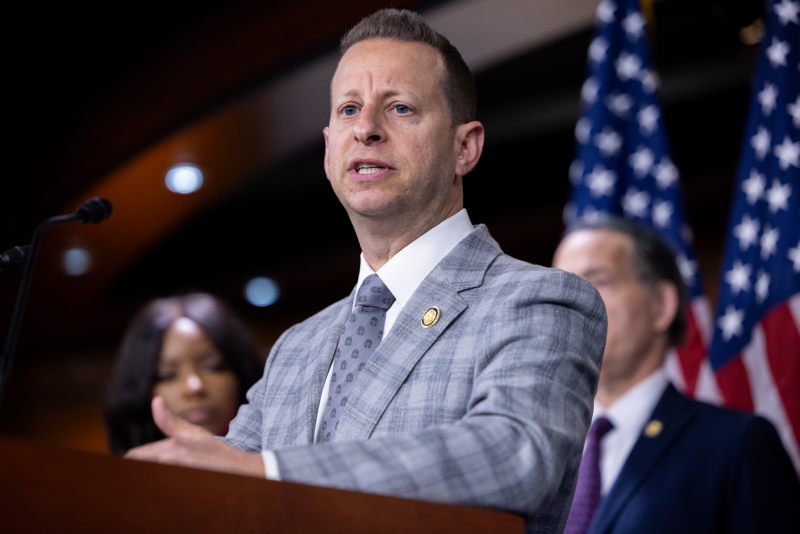





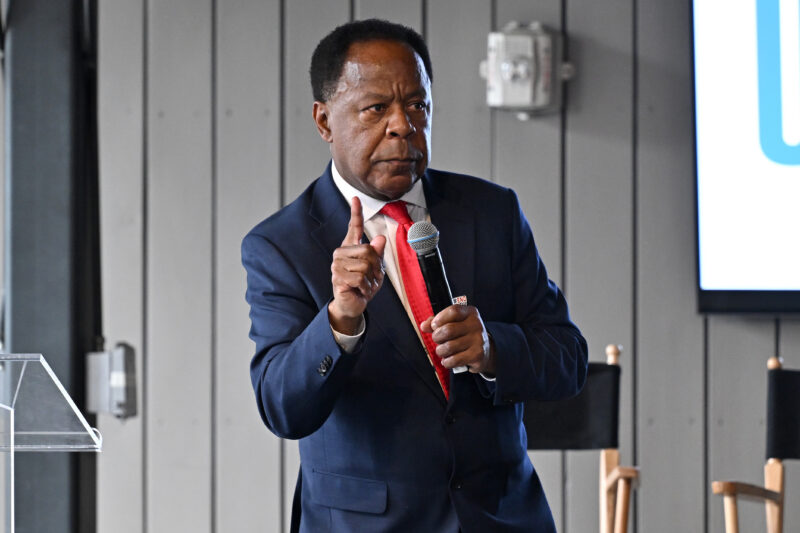
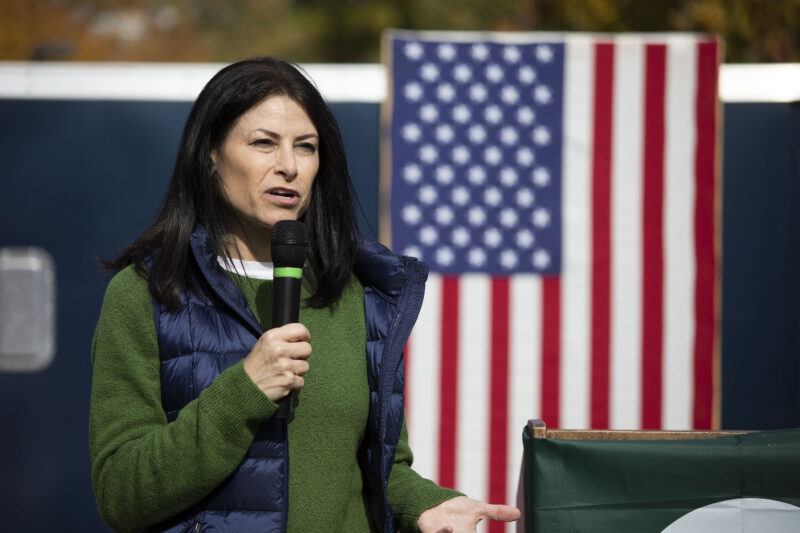
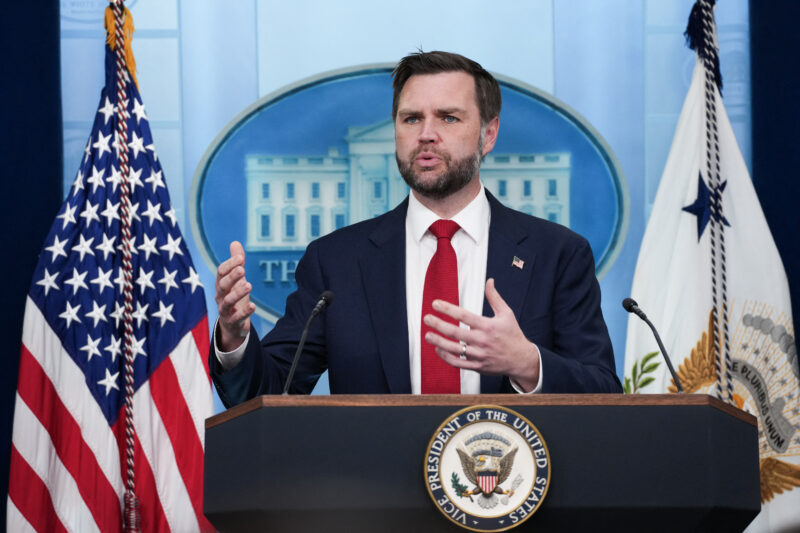



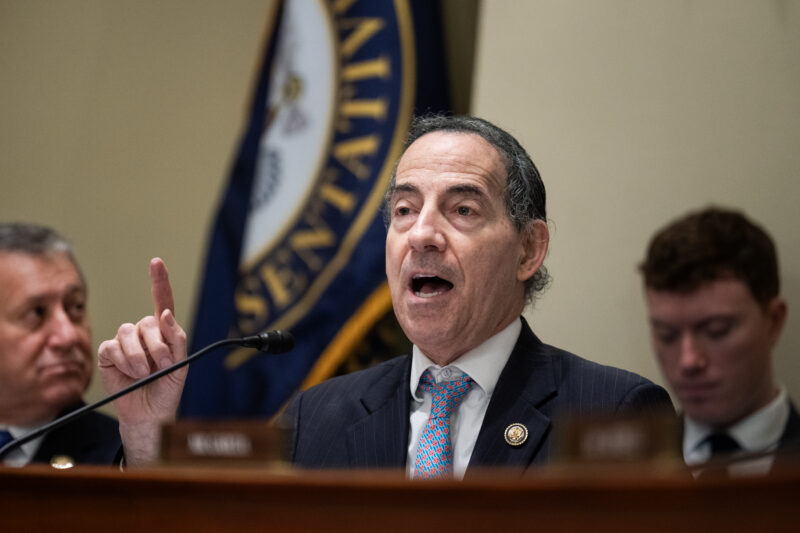




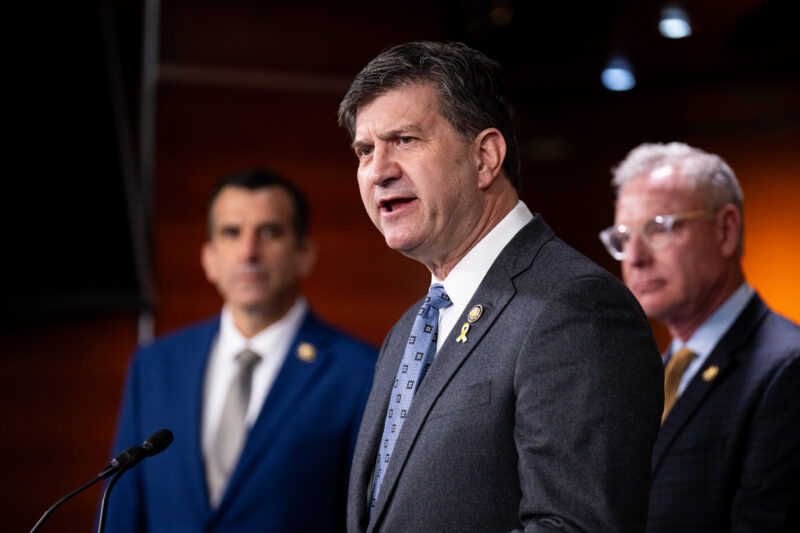




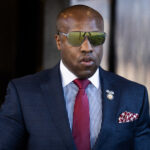
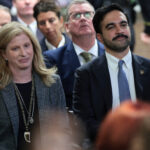
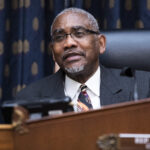



House Minority Leader Hakeem Jeffries and Reps. Alexandria Ocasio-Cortez and Greg Casar were noncommittal when pressed by JI

Bill Clark/CQ-Roll Call, Inc via Getty Images
Democratic Caucus Chair Hakeem Jeffries, D-N.Y., right, and Rep. Pete Aguilar, D-Calif., hold their press conference following the House Democrats caucus meetings in the Capitol on Wednesday, July 27, 2022.


 Add JewishInsider on Google
Several House Democrats, including in leadership and top progressives, remain divided or notably noncommittal over whether Israel’s right to exist in safety and security should continue to be a policy position of the Democratic Party moving forward.
The official 2024 Democratic Party Platform, released by the DNC for former President Joe Biden and former Vice President Kamala Harris, stated that party leaders “believe a strong, secure, and democratic Israel is vital to the interests of the United States” and that the party’s “commitment to Israel’s security, its qualitative military edge, its right to defend itself … is ironclad.”
However, the Democratic Party has continued to face internal division over how to exercise that support, or to what extent that support should continue to exist at all.
When asked on Tuesday whether support for Israel’s right to exist in safety and security should continue to be an official policy position of the Democrat Party moving forward, House Minority Leader Rep. Hakeem Jeffries (D-NY) was noncommittal and avoided the question.
He instead told Jewish Insider that Democrats are “continuing to focus on driving down the high cost of living, fixing our broken healthcare system and cleaning up corruption in an environment where the Trump cartel is the most corrupt administration in American history.”
Rep. Alexandria Ocasio-Cortez (D-NY) also did not provide a concrete answer, instead telling JI she is “less concerned with slogans” and more interested in “what it would mean in terms of policy.”
“I think what is being litigated, and what has been litigated, is that it’s a vague statement,” Ocasio-Cortez said on whether the Democratic Party should affirm Israel’s right to exist as an official platform position. “I’m less concerned with slogans and more about the United States’ commitment in honoring its own laws and defending and protecting human rights and preventing war, catastrophe and needless death across the board.”
Ocasio-Cortez said that the main “ideal” behind the party’s approach to Israel is that “Palestinians are safe, that Israelis are safe” and that conflict in the region is “de-escalated.”
“I think that when we start litigating phrases that are not attached to the material commitments, then we create a lot of conflict where there doesn’t need to be,” she added.
Rep. Greg Casar (D-TX), who chairs the House Progressive Caucus, said that the party’s position is clear on supporting the safety of Israeli civilians, but argued that there is a difference in providing funds to an Israeli government that some Democrats disagree with.
“Democrats have been very clear — every Democrat I’ve spoken to has been very clear that security, peace and safety for Israeli civilians is a priority and is our position,” Casar said. “It’s just that I don’t think that giving $3.3 billion in weaponry to the Netanyahu regime actually helps with that cause.”
Casar said he believes “deeply in the safety and security of everyday folks in Israel.”
“What I think is at issue here is the human rights violations that have occurred because of decisions by the Israeli government and the Israeli military, and the fact that I think America’s national security interests, as well as, in my view the security interests of everyday people in Israel … are being harmed by Netanyahu’s decisions.”
Meanwhile, other House Democrats expressed strong backing for continued support of Israel. Rep. Pete Aguilar (D-CA), the No. 3 Democrat, who chairs the House Democratic Caucus, said support for Israel’s existence and security should “absolutely” remain part of the Democratic Party platform moving forward.
“I think that supporting a free Jewish state is important for Democrats and it’s important for our country,” Aguilar said. “Israel is a lone democracy in the region.”
“That doesn’t mean that we agree with everything that Israel is doing, and we shouldn’t sign onto a policy statement that says that, and we wouldn’t,” Aguilar continued. “But do they have a right to exist and defend themselves? Yes, but the manner in which they conduct [themselves] that matters a great deal to Democrats.”
Rep. Jamie Raskin (D-MD), similarly said: “Absolutely, of course it should be.” He criticized “right-wing politics and right-wing government” for having “undermined” Israel. “We’ve got to stand up for the democratic forces in Israel and against all of that reactionary politics.”
Rep. Jim McGovern (D-MA) stated that while “everybody [in congress] … all have their own individual opinion” on the subject, he believes that “Israel has a right to exist” and that “[Israel’s] security should be ensured.” Still, the Massachusetts congressman issued sharp criticism of the Jewish state’s handling of the war in Gaza and said the Democratic party platform should “stand loud for human rights.”
“I also believe that what Netanyahu is doing against Palestinians are war crimes and they need to stop,” McGovern said. “So I think we need to, in our party platform, make it clear that we stand loud for human rights, that we are committed to the human rights of every single individual on this planet.”
A Pew Research Center poll published in April of this year found that 8 in 10 Democrats and Democratic-leaning independents responded as having an unfavorable view of Israel. Among Democrats 76% of those 50 years or older hold unfavorable views of Israel, while 84% of Democrats 18-to-49 years old held negative views.
Earlier this year, the DNC referred a resolution on Israel – which would have labeled the Jewish state’s actions in Gaza as a genocide and called for conditioning U.S. military aid to Israel – to a working group on the Middle East.
The penalty is less severe than the original legislation endorsed by Gov. Kathy Hochul, which would have charged such obstruction as a felony, but expands the buffer zone to 50 feet
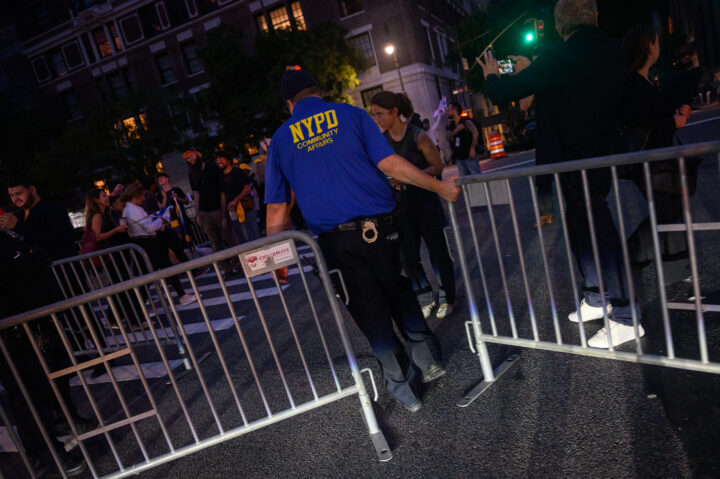
Alexi J. Rosenfeld/Getty Images
NYPD officers set up barricades separating pro-Israel and anti-Israel protesters on Sept. 25, 2025 in New York City.
The final version of the New York state “buffer zone” legislation passed by the state Legislature on Tuesday makes it a Class B misdemeanor — one of the lowest levels of criminal offense — to “knowingly” infringe on the right of access or egress to a religious institution, or to cause those entering or exiting to fear for their safety from a distance of less than 50 feet.
The language is less punitive than the legislation that Gov. Kathy Hochul initially endorsed, which would have made it a low-level felony for demonstrators to obstruct doorways and driveways at houses of worship. But the 50-foot enforcement zone in the final draft is twice as large as the one described in the earlier versions of the bill, and would apply to sidewalks as well as private parking lots and other entry points.
The measure explicitly covers community centers, as well as any other sort of facility that “a reasonable person would know that religious adherents collectively recognize as a place to regularly gather for or hold religious services, observance, prayer, assembly, education, instruction, or devotional practice” — indicating that the bill also shields religious schools.
UJA-Federation of New York, which became a leading proponent for the measure following pro-Hamas protests that targeted synagogues in Manhattan and Queens, applauded the measure ahead of its passage as part of the legislative package around the New York state budget.
The Jewish advocacy group particularly praised Hochul — as well as state Sen. Sam Sutton and Assemblymember Micah Lasher — for championing the proposal.
“We commend Governor Hochul and the state legislature for taking decisive action to protect New Yorkers by passing ‘buffer zone’ legislation, ensuring that safety and security remain a top priority across our communities,” the group said in a statement to Jewish Insider. “Governor Hochul, Senator Sutton, and Assemblyman Lasher have demonstrated strong leadership in their unwavering effort to help ensure safe access to critical community institutions and safeguard the right to worship free of harassment and intimidation.”
The state legislation is distinct from a recently passed city law compelling the NYPD to develop formal protocols for deploying security perimeters around houses of worship during protests. Both measures, as well as a separate New York City bill to establish security perimeter policy around schools — vetoed by Mayor Zohran Mamdani, but since modified and reintroduced in the New York City Council — have received criticism from civil liberties groups, who allege they could interfere with First Amendment protections.
Hochul, for her part, heralded the measure as a victory for freedom of worship. The measure goes under her pen Tuesday evening, her office told JI.
“Every New Yorker should be able to enter their house of worship and practice their religion without fear,” the governor said in a statement. “As we’re witnessing an alarming rise in hate-fueled attacks and blatant antisemitism, I’m grateful our buffer zones legislation has passed and New Yorkers will be safer because of it.”
If elected mayor of Washington, D.C, Janeese Lewis George’s victory would hand a major win to Washington’s Democratic Socialists of America chapter
Craig Hudson for The Washington Post via Getty Images
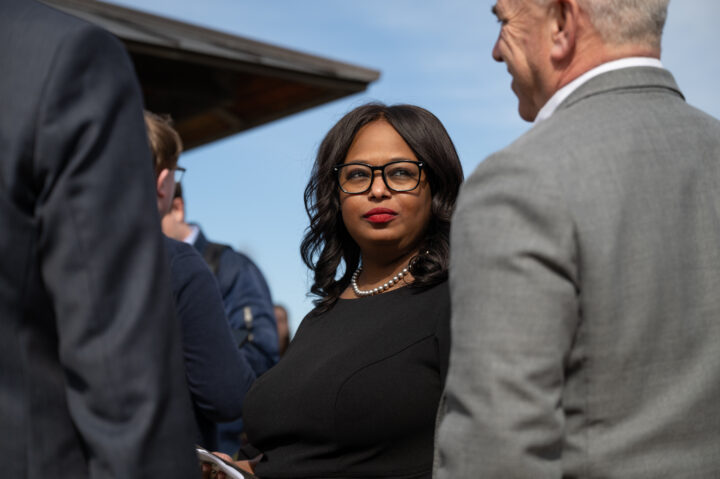
D.C. councilmember and mayoral candidate Janeese Lewis George is seen on Capitol Hill for a press conference in Washington, DC on March 10, 2025.
The open race for mayor of Washington, D.C., has been largely uneventful ahead of next month’s primary — so much so that the first TV ads run by the leading candidates, Kenyan McDuffie and Janeese Lewis George, sound nearly identical. Both candidates tout affordability and safety on the campaign trail, with promises to build more housing and stand up against President Donald Trump.
But if elected, Lewis George’s victory would mark a significant shift away from the centrist brand of politics espoused by outgoing Mayor Muriel Bowser over the last 12 years, and would instead hand a major win to Washington’s Democratic Socialists of America chapter, of which Lewis George has been a member for years.
Lewis George has faced criticism throughout the campaign from some in the Jewish community for comments she made on a DSA endorsement questionnaire pledging to boycott events that “promote Zionism” and criticizing Jewish activists’ approach to combating antisemitism. Ron Halber, CEO of the Jewish Community Relations Council of Greater Washington, on Tuesday called DSA an “evil” organization that seeks “to make being Jewish unacceptable in polite society.”
DSA has activated its small but growing membership to knock on doors for Lewis George, a member of the D.C. Council, tapping into a grassroots energy that they hope translates into success at the ballot box. Rep. Rashida Tlaib (D-MI), one of two DSA members currently serving in Congress, attended a recent DC DSA rally alongside Lewis George.
DSA’s Metro DC chapter is relatively small. Yet its current roster of roughly 3,400 members represents a massive increase from its pre-2016 nadir of just 200 members — and mirrors DSA’s growing clout nationally.
“For most of the ‘80s and ‘90s and 2000s, DSA was a small organization with maybe 5,000 or 8,000 people at the most. I would say the average age was probably over 60, maybe higher than that,” said Peter Dreier, an emeritus professor of politics at Occidental College in Los Angeles. “Then Bernie [Sanders] ran for president in 2016 and started talking about democratic socialism in a way that made sense to, particularly, a lot of young people, and he kind of opened the door to people to be in DSA.”
Overall, DSA is still a small organization on the fringes of Democratic politics. Even the highest membership counts — adding up DSA’s local chapters — don’t top 100,000. But the unexpected popularity of Sanders’ 2016 presidential run sparked a resurgence of interest in democratic socialism not seen in generations, and that has continued well past his two campaigns. A 2025 Gallup poll found that 42% of Democrats have a positive image of capitalism, down from 54% a decade ago, while 66% have a positive view of socialism.
“If [young people] don’t remember the Cold War, then what do they think when they hear the word socialism? There’s still a battle over that, but they’re more likely to think, ‘Oh, countries that have more equality, or students that get free or almost free higher education, everybody has access to healthcare,’” said Dreier.
“We are going to raise money and develop a plan over the course of the next few months to try to make them toxic, to make it unacceptable for major figures in the party or anybody actually running for office to be affiliated with the DSA, the way it should be unacceptable to be affiliated with [neo-Nazi influencer] Nick Fuentes if you’re running as Republican,” Third Way’s senior vice president for public affairs, Matt Bennett, said.
The key question now facing capital-D Democrats — one they sound unsure of how to answer, or perhaps unwilling — is how to handle an insurgent faction that has galvanized people over its straightforward messaging on corporations (bad), taxing the rich (good) and Medicare for All (necessary), while at the same time promoting far-left positions like prison and police abolition that are nowhere near the Democratic mainstream. The group has long promoted the Boycott, Divestment and Sanctions movement, as well as calling for an arms embargo on Israel, and its members passed a resolution last year affirming their commitment to anti-Zionism. On Oct. 7, 2023, DSA released a statement holding Israel accountable for the Hamas attacks and calling on members to take to the streets to protest U.S. support for Israel.
The centrist Democratic group Third Way plans to launch a major PR campaign against DSA in the coming months, one of the group’s executives told JI, arguing that its far-left positions and incendiary brand of politics will be harmful for the party’s electoral prospects.
“We are going to raise money and develop a plan over the course of the next few months to try to make them toxic, to make it unacceptable for major figures in the party or anybody actually running for office to be affiliated with the DSA, the way it should be unacceptable to be affiliated with [neo-Nazi influencer] Nick Fuentes if you’re running as Republican,” Third Way’s senior vice president for public affairs, Matt Bennett, said.
In the decade since Sanders’ 2016 campaign, DSA has had an outsized impact on national politics. The 2018 congressional victory of Rep. Alexandria Ocasio-Cortez (D-NY), a DSA member, raised the group’s profile. A steady stream of more than 200 DSA-aligned candidates have been elected to state and local offices since, culminating with the election of DSA member Zohran Mamdani as mayor of New York City last year.
“To the degree that people need to pay attention to DSA, it’s because they built this kind of political machine,” said Micah Sifry, a journalist focused on left-wing political organizing. “In a time when people are, for the most part, not very organized, the ability of any small group, relatively speaking, to punch above its weight grows.”
Perhaps unsurprisingly, New York has the largest bench of DSA-affiliated state lawmakers. The group has slowly but steadily been gaining electoral power in state and local offices in some unexpected places, too, like Minnesota, Colorado, Delaware and Wisconsin. The group’s largest foothold is in city council races, where a small but committed cadre of volunteers can swing elections in low-turnout races.
National Democratic leaders are divided about how to treat the small but vocal socialist minority in the party.
House Minority Leader Hakeem Jeffries (D-NY) declined to support Mamdani in the primary election but ultimately endorsed him ahead of the general election last year. Weeks later, Jeffries voted in favor of a Republican-led resolution condemning socialism. He has been skeptical of the left-wing ideology throughout his political career: “There will never be a moment where I bend the knee to hard-left democratic socialism,” he said in 2021. A spokesperson for Jeffries declined to comment this week when asked if he believes Democrats should be welcoming socialists into the party.
Democratic National Committee Chair Ken Martin has been more open-minded about socialists. Asked by Fox News last year whether progressives like Mamdani and Ocasio-Cortez make his job harder, he said no.
“The party is a big tent. But just like we have to believe it’s a big tent, the DSA also has to believe it’s a big tent, and I’m not sure they do,” Brian Romick, CEO of Democratic Majority for Israel, said. “Democratic leaders want to win elections, and that means a big tent, and that means that Democratic base voters and pro-Israel voters and moderate people who maybe voted for [Donald] Trump sometimes because they’re concerned about prices have to be in the tent.”
“I don’t think they make it difficult at all,” Martin said in August 2025. “The difference between the Democratic Party and the Republican Party is that we’re a big tent. We have lots of people in that tent from all of the different ideological wings, from conservative Democrats, to centrists, to progressives, to these new leftists.” A DNC spokesperson did not respond to multiple requests for comment this week.
Brian Romick, CEO of Democratic Majority for Israel, told Jewish Insider this week that he is concerned about the inroads DSA is making in the party. He agreed with Martin that the Democratic Party should be a big tent, but noted that DSA members — who are at times intent on putting litmus tests even on would-be allies — don’t extend the same understanding to more moderate members of the party.
“The party is a big tent. But just like we have to believe it’s a big tent, the DSA also has to believe it’s a big tent, and I’m not sure they do,” Romick said. “Democratic leaders want to win elections, and that means a big tent, and that means that Democratic base voters and pro-Israel voters and moderate people who maybe voted for [Donald] Trump sometimes because they’re concerned about prices have to be in the tent.”
The questionnaire Lewis George filled out in Washington to earn DSA’s endorsement reveals how important hard-line opposition to Israel is to the organization, which requires even candidates for local offices with no connection to foreign policy to all but disavow the Jewish state. Most voters who support DSA-aligned candidates likely are not drawn to them because of their views on the Middle East; Mamdani’s message was first and foremost about affordability. But DSA’s growing reach among Democrats gave a foothold to anti-Israel views that may have once been rare, though global attention on the war in Gaza also contributed to shifting Democratic orthodoxy on the conflict. (Other far-left groups like Justice Democrats have played a role, too.)
Zach Shartiag, a Jewish Democratic campaign operative from Chicago, told JI that Democrats he has talked to who support DSA candidates generally do not do so because of DSA’s stance on Israel, even if the activists are themselves critical of Israel.
“People might be very anti-Israel now, but at the same time, it’s like, what does that have to do with local politics?” said Shartiag, who is currently working on a congressional campaign in Hawaii. “I’ve talked to a lot of people, just in general, normal humans, and it’s like, ‘Yeah, I might be against what Israel’s doing, but what does that have to do with the local and the city and the state?’”
The full picture of DSA’s influence in the party will not be known until all the votes are tallied at the end of this year’s midterm elections. A number of DSA-affiliated candidates are gaining ground in congressional primaries, such as Pennsylvania state Rep. Chris Rabb, who has garnered progressive endorsements in a Philadelphia-area open seat, and New York state Assemblymember Claire Valdez, who has Mamdani’s backing for her congressional campaign.
Still, the election outcomes in states across the country this year will present only a partial picture of where the Democratic Party is moving. In the same year that Mamdani won in New York City, for instance, Democratic moderates Abigail Spanberger and Mikie Sherrill won gubernatorial races in Virginia and New Jersey, respectively.
The only certainty, then, is that the battle between centrists and socialists will continue into 2028.
“I think you’re going to have a real mixed verdict, with us yelling about our side and the left yelling about their side,” Third Way’s Bennett acknowledged. “So what that means is, unsurprisingly, we’re going to go into the presidential primary season with the two camps demanding that they are right.”
Dario and Daniela Amodei, who are Jewish, are heading the AI giant as it sues the Department of Defense over its ‘supply-chain risk’ label

David Paul Morris/Bloomberg via Getty Images
Dario Amodei, co-founder and chief executive officer of Anthropic, left, and Daniela Amodei, co-founder and president of Anthropic, during the Bloomberg Technology Summit in San Francisco, California, US, on Thursday, May 9, 2024.
Siblings Dario and Daniela Amodei are like countless other Americans who have built a family business together. Except that the business they have built is artificial intelligence giant Anthropic, one of the fastest-growing companies in America — and in the five years since they left cushy jobs at rival OpenAI to start it, they have each amassed billions in wealth.
From the beginning, the Amodeis have said the principle driving their approach to Anthropic is safety. They think other AI companies are not paying enough attention to safety risks as the technology’s capabilities grow each day. Until now, that ethos has been a point of curiosity for the consumers playing around on the company’s Claude chatbot, and a selling point for the businesses spending large sums of money to employ Claude in enterprise settings.
But a dispute over Anthropic’s stated commitment to safety has now put the company squarely in conflict with the Trump administration. On Monday, Anthropic sued Secretary of Defense Pete Hegseth, Secretary of State Marco Rubio and several other Trump administration officials over Hegseth’s decision to designate Anthropic a national security “supply-chain risk” last month, after the company told the Pentagon that it would not allow its technology to be used for mass domestic surveillance or in fully autonomous weapons.
“I believe deeply in the existential importance of using AI to defend the United States and other democracies, and to defeat our autocratic adversaries,” Dario Amodei said in February. “However, in a narrow set of cases, we believe AI can undermine, rather than defend, democratic values. Some uses are also simply outside the bounds of what today’s technology can safely and reliably do.”
Amodei now finds himself facing off against President Donald Trump — an uncomfortable position for the CEO of a company that actively has hundreds of millions of dollars in contracts with the federal government, and that has said it wants to continue those working relationships. The complaints allege that the federal government’s actions targeting Anthropic go beyond what is legally allowed according to the supply chain statutes, and that the Trump administration is ideologically motivated in targeting Anthropic. (A Department of Defense spokesperson has said the organization does not comment on ongoing legal matters.)
Defense Secretary Pete Hegseth is “within his right to cancel the contract. But I think that the people in the Department of War, they’re trying to turn the screw. They’re trying to make it tough for Anthropic to survive,” Will Rinehart, a senior fellow at the American Enterprise Institute who researches tech policy, told Jewish Insider. “It’s one thing to say, ‘Hey, we no longer want to work with Anthropic.’ But it’s quite different to basically use this supply-chain risk designation and to then go after Anthropic, because that [designation] was developed to be basically weaponized against China.”
Dario and Daniela Amodei grew up in San Francisco with parents who wanted them to be engaged with the world. Their mother, Elena Engel, is Jewish, and she worked to build libraries in the Bay Area. Their father, Riccardo Amodei, was a leathersmith from Italy.
“They gave me a sense of right and wrong and what was important in the world,” Dario Amodei told journalist Alex Kantrowitz in 2025. They “imbu[ed] a strong sense of responsibility.”
Amodei initially went into the hard sciences. He went to college at Caltech, where he authored a memorable op-ed in the campus newspaper calling on his fellow students — including in the sciences — to be more engaged with world politics, and in particular to speak out against the Iraq war.
“We are distracted not by the sex scandals and sensationalism of the rest of the world, but by problem sets, computer games and bizarre arguments about the availability of donuts. We, who have so much power to influence the future, have bafflingly renounced our right to it,” Amodei wrote in 2003. “We have the privilege and duty to preserve the ethical integrity of our community, our nation and humanity.”
It’s an ethos he brought with him when he transferred to Stanford, and then to Princeton, where he earned a PhD in physics. Early in his career, he began working on AI technology. He worked as a deep learning researcher at Google, before spending nearly five years at OpenAI, rising to become its vice president of research.
Daniela Amodei, meanwhile, did not come from the STEM world. She worked in politics for a period, first on the campaign and then in the congressional office of former Rep. Matt Cartwright (D-PA). Then she worked for the payments company Stripe before joining OpenAI two years after her brother.
Over time, after raising concerns about the likely impacts of AI, Dario Amodei decided that the leaders of OpenAI were not taking his critiques as seriously as he hoped. So he and Daniela left the company to start Anthropic, where he is CEO and she is president.
Since then, Anthropic has been wildly successful. It launched Claude a year after OpenAI launched ChatGPT, which was the first time most people outside of the tech world began to use and understand generative AI. And while Claude has a fraction of the active users as ChatGPT, the company primarily focuses on selling its technology to businesses.
Even as Claude has grown, the Amodei siblings still talk about the potential dangers of AI. Dario Amodei famously said in 2025 that the tool could erase half of all entry-level white collar jobs in the next five years.
“I’m incredibly optimistic about the technology,” he said in December. “But nothing that powerful doesn’t have a significant number of downsides.”
Anthropic has framed itself as an advocate for greater safeguards on the technology. Amodei came to Washington in September to speak about the topic as the company doubles down on its lobbying efforts. The group plans to donate $20 million this year to congressional candidates who want to regulate the AI industry — via a political group that was created in direct opposition to fundraising efforts being supported by OpenAI.
“We’ve seen lots of bad things: We’ve seen teenagers being driven to commit suicide by LLMs,” Amodei said. “We can imagine much larger-scale catastrophe. So the thing we’ve always advocated for is basic transparency requirements around models.”
For a company that is so upfront about its values, a test of those battles was inevitable. But no one expected the foe to be the Pentagon.
Young American Jews between the ages of 18-29 have faced the brunt of rising antisemitism, with 47% saying they were a target of antisemitism over the last year, compared to 28% among those 30 and over
Spencer Platt/Getty Images
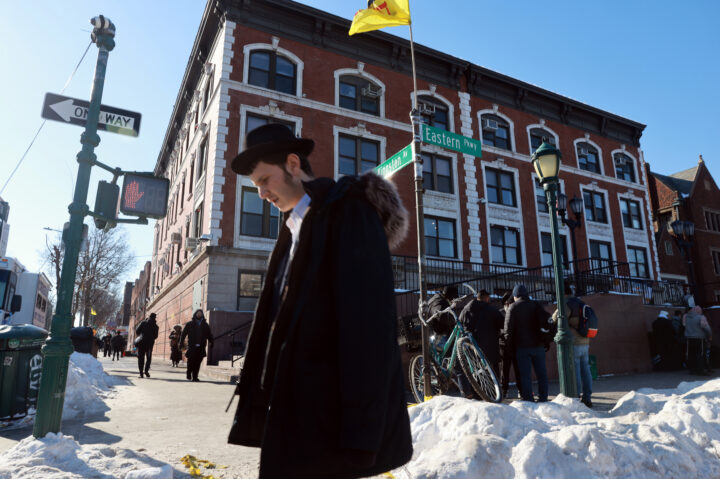
Members of the Hasidic Jewish community gather outside of the Chabad Lubavitch world headquarters, on January 29, 2026, in New York City.
Nearly two-thirds of Jewish Americans say they feel less safe than a year ago, according to the American Jewish Committee’s newly released annual survey of Jewish public opinion, reflecting a heightened fear of antisemitism in the aftermath of several high-profile attacks against Jews and Jewish institutions.
As notable: About one-third of American Jews reported being a target of antisemitism — whether it was physical or in a virtual space. Nearly one-fifth said they would consider leaving the country as a result of antisemitism, a number that’s been on the rise over the last several years (up from 6% in 2024).
Young American Jews between the ages of 18-29 have faced the brunt of rising antisemitism, with 47% saying they were a target of antisemitism over the last year, compared to 28% among those 30 and over.
At the same time, about two-thirds (65%) of Jews overall said they felt safe attending Jewish institutions, while 60% said they were not worried about being a victim of antisemitism in the next year.
The polling, conducted by SSRS between September and October 2025, shows that both reported antisemitic incidents and fear of facing antisemitism have plateaued but are still near historic highs, when compared to the AJC’s previous surveys. (SSRS surveyed 1,222 Jewish respondents in one survey between Sept. 26-Oct. 29; it separately surveyed 1,033 U.S. adults between Oct. 3-5.)
Antisemitism continues to be particularly prevalent on college campuses, where 42% of students have reported anti-Jewish hate during their time in school — up from 35% in the AJC’s 2024 survey. The vast majority of Jewish parents (80%) said that the level of antisemitism on a campus plays a role in deciding where their student will attend college.
There’s also a noticeable gap between the near-universal view among Gen Z Jewish Americans that antisemitism is a problem (93%) and the significant but much smaller share of non-Jewish young Americans who think it is a problem (61%).
In addition, there is a noticeable spike in American Jews being exposed to explicit antisemitism when scrolling on social media. Over half of Jewish respondents (54%) said they’ve dealt with antisemitism on Facebook — up seven points in the last year. Over one-third (38%) said they’ve experienced antisemitism on YouTube — an 11-point spike in the last year. And two-fifths of Jewish respondents said they’ve experienced antisemitism on Instagram — up eight points since 2024.
Also significant: The survey asked Jewish respondents whether the phrase “globalize the intifada” — one that New York City Mayor Zohran Mamdani has pointedly declined to condemn — would make them feel unsafe. The vast majority (69%) of American Jews said it would either make them feel “very unsafe” or “somewhat unsafe.”
Among non-Jews, interestingly, the poll found very few (only 13%) had seen or heard the phrase “globalize the intifada” at all in the last year — possibly a reflection of why Mamdani’s refusal to condemn the slogan didn’t become a bigger political problem for him.
But among the general public, there was a wide awareness of how such virulently anti-Israel sloganeering is intermingled with antisemitism. More than three-quarters of overall respondents (79%) said that believing Israel has no right to exist is antisemitic, while about two-thirds said that anti-Zionist slogans like “Free Palestine” and “globalize the intifada” were connected to antisemitic incidents.
Please log in if you already have a subscription, or subscribe to access the latest updates.
 Continue with Google
 Continue with Apple