










































The committee is now slated to vote on the bill on the week of Nov. 30

Tom Williams/CQ-Roll Call, Inc via Getty Images
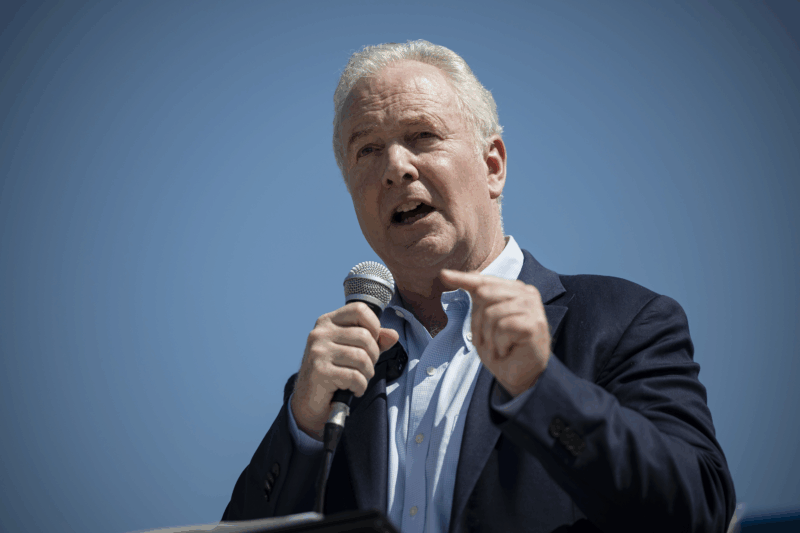
Sen. Ted Cruz (R-TX) is seen after the Senate luncheons in the U.S. Capitol on August 4, 2026.


 Add JewishInsider on Google
The Senate Judiciary Committee postponed a planned markup and vote on the Right to Worship Act, a bill establishing buffer zones outside of religious institutions during worship services.
The bill was scheduled to be marked up on Tuesday morning. A source familiar with the matter cited ongoing negotiations between Sen. Ted Cruz (R-TX), the lead Republican sponsor of the bill, and Democrats on the committee led by Sen. Dick Durbin (D-IL), the committee’s ranking member, as the reason for the postponement.
The source said both sides are trying to find consensus on the bill’s language in hopes of facilitating a bipartisan effort, rather than Republicans advancing the legislation through a contested markup.
News of the postponement came at the outset of Tuesday’s business meeting, when committee Chairman Chuck Grassley (R-IA) announced that the vote would not be taken up that morning as talks continue.
“I understand that there is disagreement about the scope of the protections that would be afforded in the Right to Worship bill,” Grassley said. “It is being held over so that Ranking Member Durbin and Sen. Cruz’s office can continue to work through those differences, but I’m hopeful that we can vote on it at an upcoming markup.”
The committee is now slated to vote on the bill at their next markup, which will take place the week of Nov. 30.
The legislation has faced repeated delays in moving through the committee. It was initially scheduled for a vote prior to the Senate’s October recess, but was postponed when the Senate canceled planned session days before departing.
The bill, a bipartisan and bicameral effort launched in response to incidents of harassment and violence at synagogues and other houses of worship, has received some pushback from the Council on American-Islamic Relations and other groups in the Muslim community but has support from groups representing a wide array of faiths, including the Islamic Society of North America.
Despite this, supporters of the legislation have emphasized that it is neutral to both the religion of the institution and the nature of demonstrations targeting religious institutions.
Jewish Insider senior congressional correspondent Marc Rod contributed to this report.
The planned meeting on Thursday was canceled after the Senate left town early; the chamber is not expected to return until after the midterm elections

GETTY IMAGES
A general view of the U.S. Capitol Building from the National Mall, in Washington, D.C., on Thursday, May 29, 2025.
The Senate Judiciary Committee canceled a planned Thursday meeting where the committee was set to discuss and vote on the Right to Worship Act, a bipartisan and bicameral bill that would create buffer zones outside of religious institutions during worship services.
The committee announced earlier this week that the bill was on the committee’s agenda for a meeting this week — a significant sign of progress for the still relatively new legislation, which supporters hope to pass before the end of the year. But the meeting was canceled after the Senate finished its work for the week on Wednesday and left Washington until after the midterm elections.
House Speaker Mike Johnson (R-LA) has previously expressed support for the bill.
Muslim, Sikh, Hindu and evangelical groups also turned out in support of the federal buffer zone legislation that would protect against harassment outside of places of worship
Marc Rod
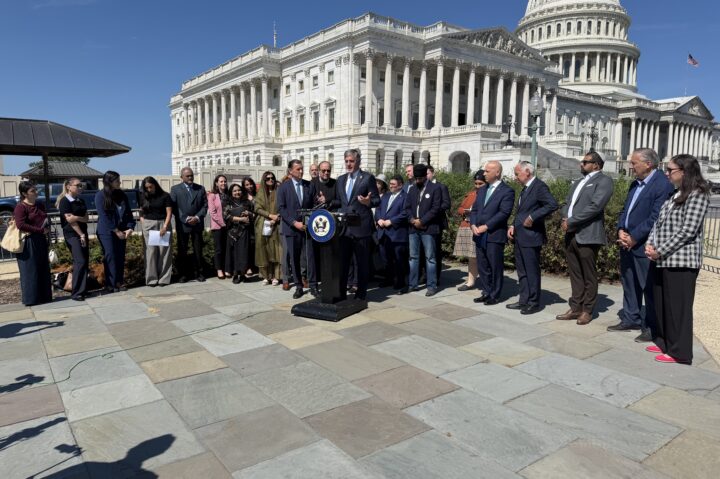
Reps. Tom Suozzi (D-NY) and Brad Knott (R-NC) rally with religious groups in favor of the Right to Worship Act on Sept. 16, 2026.
Reps. Brad Knott (R-NC) and Tom Suozzi (D-NY) rallied outside the Capitol on Wednesday alongside more than two dozen representatives of religious community organizations in support of the Right to Worship Act, their federal bill establishing buffer zones outside of religious institutions to protect them from disruptions.
House Speaker Mike Johnson (R-LA), who has been involved in supporting the bill behind the scenes, also expressed his support for it in a statement to Jewish Insider.
“Religious liberty is regarded as our ‘First Freedom.’ Our Founders listed it first in the Bill of Rights because they understood how essential it was to the foundation of our Republic. But that right rings hollow if worshippers must brave harassment or worry for their safety as they exercise their religion,” Johnson said.
“Americans of all religious affiliations deserve the right to do so without fear and the Right to Worship Act ensures they can, while also maintaining the First Amendment right to peaceful protest,” he continued. “I commend Rep. Knott for his leadership on this legislation and his steadfast defense of our fundamental freedoms.”
Knott and Suozzi’s press conference included representatives from various nondenominational Jewish groups and the Orthodox movement, as well as leaders from the evangelical, Sikh, Hindu, Muslim and even Scientology communities. The Reform and Conservative movements are also supporting the bill.
Knott and Suozzi praised each others’ work on the bill and ability to compromise to put out this consensus bill.
“I commend Rep. Suozzi again for his monumental effort in assembling this team behind us, this team around the country, that was so valuable in crafting this legislation,” Knott said.
“It’s a very rare hallmark in this town when you have a senior legislator like Rep. Suozzi come to a freshman legislator on the House floor and say, ‘Look, we’re trying to do the same thing. I will lay down my bill and join forces with you so long as we can get this thing across the finish line.’ And had he not done that, I don’t know if we’d be here today,” he continued.
Suozzi previously had introduced separate buffer zone legislation that contained a somewhat different formula than the Right to Worship Act.
Knott said he’d been in contact with various colleagues including Rep. Jamie Raskin (D-MD), the ranking member of the Judiciary Committee, which has jurisdiction on the bill, and has seen significant support.
Suozzi likewise praised Knott as “a former prosecutor, new member of Congress from North Carolina, very well respected by his colleagues, and somebody that I personally admire, especially getting to know him over the past couple months, and listening to him speak, and seeing his intellect and his compassion work together to try and get a bill done across party lines.”
At one point in the press conference, a shofar sounded in the distance from somewhere on the Capitol grounds.
Also speaking in support of the bill were Anti-Defamation League CEO Jonathan Greenblatt; Jewish Federations of North America CEO Eric Fingerhut; Jessica Bernton, the American Jewish Committee’s director of congressional affairs; Nathan Diament, executive director of the Orthodox Union Advocacy Center; Rabbi Yossie Charner, Agudath Israel of America’s director of congressional affairs; Elizabeth Cullen, Hadassah’s director of government relations; Hadas Alterman, Stand With Us’ director of legislative strategy; and Combat Antisemitism Movement President of U.S. Affairs Alyza Lewin.
Diament urged that the bill be the first order of business when the House returns in November, after its extended recess that began Wednesday.
They were joined by representatives from the National Association of Evangelicals, American Muslim and Multi-faith Women’s Empowerment Council, Hindu American Foundation, United Sikhs, BAPS Swaminarayan Sanstha (a Hindu group) and the Coalition of Hindus of North America.
Suozzi and Knott acknowledged that the legislation’s applicability to the repeated incidents during which anti-Israel protesters have demonstrated outside of or broken into events at synagogues promoting aliyah to Israel or land sales in Israel and the West Bank would likely have to be litigated in court if the bill passes.
“There’s going to be litigation that will come. That’s why we spent so much time speaking to constitutional experts about this process,” he said. “There’s going to be litigation about that question and about others as well. The bill really focuses heavily on religious services, so that’ll be a real question and a real challenge as to whether or not that will withstand the constitutional challenge.”
He added that he hopes the bill “sends a message that we all have to do better in the process.”
Knott added that the bill requires “a substantial, focused, intentional effort to prevent someone from entering or otherwise worshipping. Within the buffer zone, if you hold a sign that says, ‘Israel, do better,’ that’s perfectly consistent with this law. If I grab a worshipper by the lapel pin and said, ‘You’re committing whatever crime you allege,’ that’s a disruption that’s not sanctioned with this bill.”
He said, “The definition targets the focused, intentional disruption, not the benign peaceful [one],” adding that the bill is intentionally focused on incidents in which “where people use an organized, established house of worship to target specific people.”
During the press conference, Suozzi specifically credited a constituent, Abraham Hamra, with first bringing the buffer zone issue to his attention and prompting him to craft his original bill, the SACRED Act.
Hamra told JI that his family is from Syria and came to the United States to seek religious freedom. He said he felt “we couldn’t stand idly by and just complain” after protesters disrupted an event in Park East Synagogue in nearby Manhattan. He started a petition calling for buffer zone legislation, which gathered 10,000 signatures.
A member of the board of Long Island’s Holocaust Memorial and Tolerance Center brought the petition to Suozzi’s attention and connected him with Hamra.
“This bill is now a reality, and honestly, it is a bill that’s going to protect what’s great about America, because the First Amendment gives us the right to speech and the right to worship,” Hamra said. “If we protect both of those rights, we continue having the America that many refugees flee to, the America that enables so much success, and that’s why I started this petition, hoping that this bill would be introduced.”
Both Suozzi and Knott also credited various leaders from the Jewish and other communities for their work on the bill, including Greenblatt and the ADL and Diament and the OU, as well as Hudson Bay Capital CEO Sander Gerber and Moshe Davis, the former director of the New York City Mayor’s Office to Combat Antisemitism, who have been heavily involved in the effort.
Rep. Brad Knott said he’s seen the rise in incidents targeting houses of worship accompanied by a ‘partisan application of laws from the prosecutor’s office’

Tom Williams/CQ-Roll Call, Inc via Getty Images
Rep. Brad Knott (R-NC) during a House Judiciary Committee hearing on Jan. 22, 2026.
Rep. Brad Knott (R-NC), the lead House Republican sponsor of the Right to Worship Act, a federal buffer zone bill to protect religious institutions from disruptive and threatening protests, said on Wednesday that the bill aims to give targeted worshipers a recourse particularly where prosecutors fail to step in or take action.
Knott, a former federal prosecutor, said in an interview with Jewish Insider that he got involved with the effort because of a spate of incidents targeting houses of worship of various religions around the country. “There’s really no secret that places of worship, especially traditional faith, have come under attack,” Knott said, pointing to incidents targeting Catholic, Christian and Jewish institutions.
He made repeated reference to demonstrations that have disrupted religious services at synagogues across the country, as well as to an incident in Minnesota where a group of anti-Immigration and Customs Enforcement demonstrators disrupted a church service, accompanied by journalist Don Lemon, who has been federally charged in the incident.
The North Carolina congressman said that he’s seen the rise in incidents targeting houses of worship accompanied by a “partisan application of laws from the prosecutor’s office” — leaving those targeted with little recourse if local and federal prosecutors declined to press charges.
The new bill would provide victims a recourse to sue those who disrupted their services in civil court, as well as provide prosecutors the option to file suit.
“When you look at the needs of the country, and the increasing partisanship of local prosecutors, this bill is needed for people who want to worship as they have for years and years and years in this country,” Knott said.
He offered the example of the Minnesota church case, where state officials declined to file charges, “strictly for political and partisan reasons. I don’t care if they’re on the right. I don’t care if they’re on the left. That is fully, fully inappropriate.”
He described such disruptions as a problem on both sides of the aisle, but also said that he sees more active and aggressive demonstrators from the anti-Israel and Black Lives Matter movement willing to disrupt sacred spaces.
The North Carolina congressman said he got involved with the issue to help protect both the rights to free speech and freedom of religion.
“If we lose those rights, if people become apathetic, if we allow the people who are disruptive to intimidate folks away from churches, away from cathedrals, away from synagogues, that’s a real problem and we start to lose the fabric of who we are as Americans,” Knott said. “Why else would I be in Congress but for trying to protect innocent people, trying to ensure that the constitutional standards and privileges we have are protected and maintained and to ensure that people who are bad actors are dealt with appropriately.”
Time is short to pass the bill before the end of the congressional session, particularly with many big-ticket items on the House’s agenda and almost no time remaining in session before the election. But Knott expressed optimism that the bill can rally strong support and pass this year, particularly as it is moving through the House and Senate in parallel.
Knott acknowledged that colleagues have approached the legislation with skepticism and concerns about potentially infringing upon the First Amendment but said that once it has fully been explained to them, each of the colleagues with whom he’s discussed the bill, particularly those with backgrounds in the law, have been onboard.
“If we have time to deliberate and explain it, I believe this bill could be very, very bipartisan and, if not unanimous, close to unanimous passage in both houses,” he said. “Every conversation I have had, people have gotten it. They’ve agreed … that makes sense.”
He emphasized that the bill contains robust protections for the First Amendment, specifically allows for peaceful protest within the buffer zone, does not address any specific content or faith, only addresses conduct that isn’t already covered by the First Amendment and involves civil penalties and requires proof of a “substantial disruption” with “specific intent” in order to win damages from a jury.
There are no immediate plans to move the bill forward in the House Judiciary Committee — although the Senate could also take the bill up first — but Knott said that House Speaker Mike Johnson (R-LA) is strongly supportive of the bill, and that he has discussed it with other members of GOP leadership, who have also been supportive and in some cases interested in joining as cosponsors.
“Whenever it’s explained, it gets momentum as a bill that meets the need of the day. And whenever that sentiment accrues, it should pass,” Knott said. “We’re working on it, and as soon as there’s an opening, again, whether it’s through suspension or the traditional committee markup, I think that we’ll do it.”
Knott was the initial House sponsor of the bill, and, in collaboration with outside advocates, came together with Rep. Tom Suozzi (D-NY), who was working on a separate buffer zone bill. In a recent Fox News interview, Knott praised Suozzi’s work on and contributions to the bill, as well as his help in securing Senate cosponsors, Sens. Ted Cruz (R-TX) and Elissa Slotkin (D-MI).
The Ohio Republican said the committee is investigating Middle East funding of universities
Heather Diehl/Getty Images
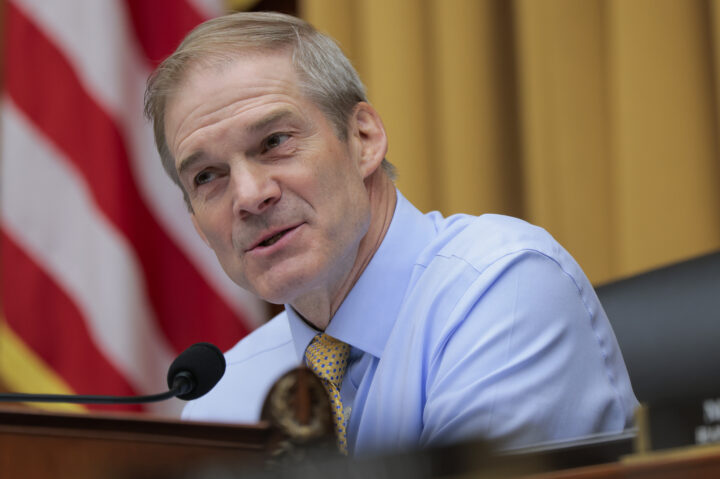
Chairman Jim Jordan (R-OH) speaks during a House Judiciary Committee hearing in the Rayburn House Office Building on March 4, 2026 in Washington, DC.
LAS VEGAS — Rep. Jim Jordan (R-OH), the chair of the House Judiciary Committee, said that he’s hoping to take action in the committee on antisemitism in the remaining months of the congressional term, and also previewed plans for a hearing on the International Criminal Court.
Several major pending bills on combating antisemitism, including the Right to Worship Act, Jewish American Security Act and the Antisemitism Awareness Act, fall at least in part under the jurisdiction of Jordan’s committee, which could help move them forward to the full House.
“We want to try to be helpful in that,” Jordan told Jewish Insider, acknowledging that there are several pending bills on the subject. “We’ve been supportive of all of those in the past, so we’ll see what we can get done here in the last few weeks of September, or maybe even in the lame duck session” after the midterm elections.
Jordan said he hadn’t paid much attention to a whistleblower investigation opened by his Democratic counterpart, Rep. Jamie Raskin (D-MD), into allegations that the administration had mishandled its investigations of antisemitism on college campuses.
“We know what happened. You know, it’s like, what are we supposed to do? Not believe our lying eyes, as the old line goes?” Jordan said. “The vast majority of Americans have common sense, and they saw what took place on these campuses.”
He praised the work being done on the issue by the Justice Department, and said his own committee is also examining funding from Middle Eastern nations flowing to universities.
Jordan also defended the U.S. war in Iran, calling it consistent with President Donald Trump’s pledge not to allow Iran to obtain a nuclear weapon, even as he acknowledged that it is contributing to cost of living concerns.
“I know that things cost too much, but we’re working on that,” he said. “But we’ve got to also understand this regime … 47 years, largest state sponsor of terrorism, killed Americans, killed Israelis, killed others, killed thousands of their own people — they are bad, and you cannot let that regime get a nuclear weapon.”
He expressed full support for the supplemental funding request for the war submitted by the administration.
“I understand we’ve got running huge deficits, got a big debt, and we’ve got to address that problem too. But this is national security, and you have to do that,” he said.
Jordan also argued strongly for maintaining the “special relationship” between the U.S. and Israel, explaining that the two countries’ shared Judeo-Christian heritage is important to him, especially as an evangelical.
“There are 190-some countries in the world, and the left focuses on attacking two. The radical left focuses on attacking the United States and Israel,” he said. “They’re two countries with shared values and principles, but they’re also two countries with a special purpose, and started in such similar ways.”
The House Freedom Caucus co-founder, who made a brief run for the House speakership in 2023 that was blocked by fellow Republicans, said he would be supporting House Speaker Mike Johnson (R-LA) to remain in his role if Republicans maintain control of the House.
Asked if he would make a bid for minority leader if Republicans lose the House, Jordan insisted that would not happen.
“We’re going to keep the majority. I’m focused on that,” he said, noting that he’s traveled to more than a dozen states in the past month to rally with GOP candidates. “We’ve got to win. … They will ruin this amazing thing called America — the left will ruin it if they get power.”
The bipartisan and bicameral bill would ban activity that knowingly disrupts or impedes access to scheduled religious services within 100 feet of the entrance to a house of worship
Andrew Lichtenstein/Corbis via Getty Images
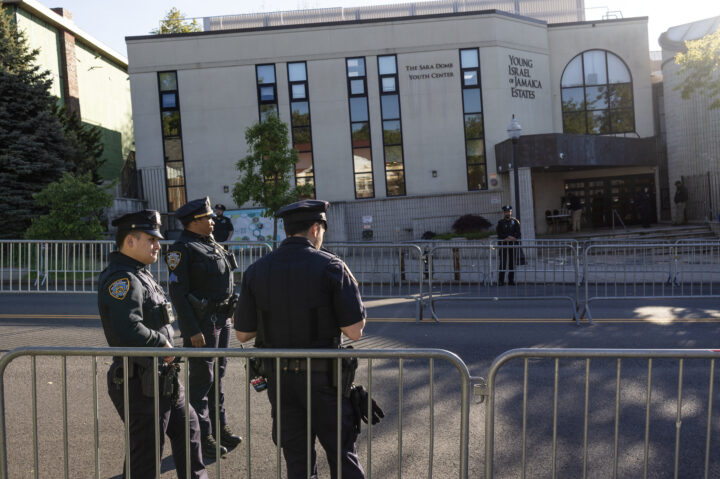
New York City police officers fence off and guard the Jewish Orthodox synagogue Young Israel of Jamaica Estates on May 12, 2026, in the borough of Queens, New York City.
Sen. Elissa Slotkin (D-MI) joined Sen. Ted Cruz (R-TX) and Reps. Brad Knott (R-NC) and Tom Suozzi (D-NY) on Thursday in introducing the Right to Worship Act, a federal bill that would ban activity that knowingly disrupts or impedes access to scheduled religious services within 100 feet of the entrance to a house of worship during that time.
The bill is the product of months of negotiations among lawmakers and outside supporters. Cruz, Knott and Suozzi’s involvement, as well as the outlines of the bill, were first reported by Jewish Insider earlier this week. The legislation comes in part in response to a series of incidents of violence and harassment around Jewish institutions across the country.
The bill would ban activity that “meaningfully interferes with the ability of people to participate in the scheduled religious service, to the extent that the conduct causes a substantial interruption to the service’s normal operation” or “unreasonably hinders or deters a person from entering a house of worship, or threatens or intimidates a person, in a manner that prevents participation at a scheduled religious service.”
The legislation would bar such activities both during and in a one-hour period before and after any scheduled religious service.
The bill would carry escalating civil fines for repeated offenses, as well as allow impacted individuals, the U.S. attorney general or a state attorney general to commence a civil suit under the law.
It would include specific protections to permit demonstrations subject to federal, state or local permits and under reasonable time, place and manner restrictions.
Though it restricts conduct specifically during scheduled religious services, the bill does not require religious institutions to publicize their worship schedules.
It instead defines scheduled services as ones that are “observably underway or imminently beginning or concluding, as evidenced by the gathering or dispersing of congregants,” as well as any regularly occurring service “of which the defendant had actual knowledge” or any service about which the defendant was otherwise notified beforehand.
“Today, many Americans are unable to worship without fear of harassment, assault, or other forms of intimidation. The right to worship freely is foundational to our nation and was one of the motivations for its founding. No American should ever feel that their choice is between worshiping in fear and not worshiping at all,” Knott said in a statement. “The Right to Worship Act protects peaceful speech while restoring essential protections for Americans by empowering worshippers against those who seek to intimidate them.”
“I look forward to this bill becoming law and appreciate the many contributions made through bipartisan, bicameral work,” Knott, who became involved with the process at the recommendation of House Speaker Mike Johnson (R-LA), continued.
Slotkin, in a statement to JI, highlighted rising attacks on religious institutions in her state and nationwide.
“No one should ever fear going to their house of worship. Period,” Slotkin said. “The Right to Worship Act prohibits disruptive conduct, within 100 feet of a religious institution, that’s used to threaten or impede access. I look forward to working with my colleagues on getting this important piece of bipartisan legislation passed.”
Suozzi said in an interview with JI after announcing the bill, “I don’t think that a person should have to show particular courage just to pass a gauntlet to attend a religious service.”
”I don’t want to discourage protest, and I don’t want to discourage people from speaking out, but I don’t want to encourage a protest such that it makes it uncomfortable for someone to walk into their religious service or to bring their children to a religious service. It shouldn’t be that you [have to] stand up to this type of either threatening or intimidating behavior [to go to a religious institution],” he continued.
Suozzi said the bill would build upon the SACRED Act, an alternative and more limited version of a federal buffer zone bill he introduced earlier this year, as he looks to garner further bipartisan support. Suozzi engaged in extensive negotiations over the legislation, ultimately yielding a bipartisan compromise agreement.
“The First Amendment guarantees every American the right to freely exercise their faith, and Congress has a duty to ensure that guarantee is met,” Cruz said in a statement to JI earlier this week. “In recent years, we have seen organized acts of hate meant to disrupt and deny that right, which have been untenably defended as speech. That is why I am introducing the Right to Worship Act, and I urge my colleagues to support it.”
The bill is also being cosponsored by Reps. Josh Gottheimer (D-NJ) and Mike Lawler (R-NY).
The bill was developed in large part by Hudson Bay Capital CEO Sander Gerber, previously an architect of the Taylor Force Act, and Moshe Davis, who led the New York City Mayor’s Office to Combat Antisemitism under Eric Adams. Some Jewish groups — including the Orthodox Union, Combat Antisemitism Movement and Anti-Defamation League — have been working behind the scenes to support the bill and, ahead of its introduction, additional Jewish groups coalesced behind it.
The issue is a personal one for Gerber, whose father’s Ann Arbor synagogue has for more than two decades faced weekly antisemitic demonstrations during Shabbat services. His father has pursued various legal avenues to stop the incidents, including appealing the issue to the Supreme Court, to no avail.
“This issue’s been plaguing my father and the family for many years, and it’s a start — the Congress taking action to correct problems that local municipalities don’t have the infrastructure to deal with,” Gerber told JI.
Davis, who previously worked on the issue in the New York City government, told JI, “I am proud of Senators Cruz and Slotkin and Representatives Knott and Suozzi, who stepped up today to protect the right to worship.”
“The Right to Worship Act is the product of serious thought and deliberation, and it is the right way to address the disruptions and intimidation we have seen outside houses of worship across the country,” Davis continued. “I urge everyone to join this effort. No American should be afraid to walk into their house of worship.”
Suozzi said he thought the bill strikes a compromise that protects both freedom of speech and freedom of religion. He described it as the result of “very good, fair, but hard negotiating of people who really just want to get something done.”
The legislation leans on standards of reasonableness — barring conduct that “unreasonably hinders or deters” entrance to a house of worship when the perpetrator “reasonably should be aware” that their conduct “will cause such disruption or impediment” to religious services.
“This is not about people who are standing nearby and holding a sign, standing there quietly,” Suozzi said. “This is about people yelling and screaming or people who are doing it week after week after week after week only at the religious service.”
He said the negotiations were geared toward finding a standard that would be able to hold up if challenged in court and said that various lawyers were involved in crafting the bill. He said he’s also open to amendments and other viewpoints.
Gerber said that Suozzi had been a “great partner” and “worked hard to find a text to make this truly bipartisan, at the same time ensuring that it would address the Ann Arbor synagogue situation, which was my primary concern.” He said Suozzi “really cares about this situation.”
He also praised Cruz’s “courage … to be the lead introducer” in the Senate, which required significant legal knowledge and expertise to navigate the free speech issues involved. He praised Knott for taking a leading role in the issue as well.
Despite the short time remaining in the current congressional session, Suozzi said he feels fairly confident that the legislation can pass this year, noting the bipartisan support for and significant interest in the legislation.
Gerber put the chances of passing the bill before the end of the year at an optimistic 70%.
“It’s strongly bipartisan, it makes a lot of sense. The challenge will be if people on the fringe try to slow down the procedural process, and I hope there will not be amendments that might slow down the process,” Gerber continued. He urged the Senate and House Judiciary Committees to take the bill up.
The bill is supported by the Anti-Defamation League, Agudath Israel of America, American Jewish Committee, BAPS Swaminarayan Sanstha, Coalition of Hindus of North America, Hadassah, Hindu American Foundation, Islamic Society of North America, Jewish Federations of North America, UJA-Federation of New York, Orthodox Union, United Sikhs, Combat Antisemitism Movement and the American Muslim & Multifaith Women’s Empowerment Council (AMMWEC).
In a press release, the ADL said that the bill “builds on a framework the ADL helped develop” as part of the SACRED Act, Suozzi’s previous bill. The group said it documented more than 530 incidents of harassment at synagogues last year.
“No one should have to push through a hostile crowd or shout over a bullhorn in an attempt to pray,” ADL CEO Jonathan Greenblatt said in a statement. “ADL has championed safe worship zone legislation from the beginning, working hand in hand with lawmakers and other key stakeholders to build support and consensus around a critical bipartisan solution. The Right to Worship Act is the product of that work. We are grateful to Senators Cruz and Slotkin and Representatives Knott and Suozzi for their commitment to ensuring everyone, regardless of their faith, can worship freely and safely.”
The ADL said in the release that the bill strikes “the right balance” between protecting worship and protecting speech.
“Freedom of religion is not just the freedom to believe as your faith instructs. It must include the right to practice one’s religion without fear of harassment or violence,” said Nathan Diament, executive director of the Orthodox Union Advocacy Center, who was also deeply involved in negotiations and crafting the bill. “No one in America — be they Jewish, Christian, Muslim, or of another faith — should have to choose between their religion and their safety.”
The OU also emphasized that the bill “carefully strikes the balance” between free speech and protecting the freedom of religion.
“Every community deserves to gather safely in their house of worship,” Eric Fingerhut, CEO of JFNA, said in a statement. “Too often, we’ve seen Jewish Americans and other faith communities targeted or intimidated simply for practicing their faith. The Right to Worship Act gives law enforcement and communities the tools they need to prevent these disruptions before they escalate, while still respecting every American’s First Amendment rights. Safety and religious freedom aren’t in tension; this bill shows how we can protect both.”
AJC highlighted that more than a quarter of Jews said in an AJC survey last year that institutions with which they were affiliated had been targeted by vandalism, threats or attacks in the past five years.
“Every American should be able to gather and practice their faith without fear of intimidation, harassment, or violence,” AJC said in a statement. “Safeguarding the right to worship freely is fundamental to protecting religious liberty — one of our nation’s founding principles. We thank Senators Cruz and Slotkin and Representatives Knott and Suozzi for introducing this bipartisan bill and urge all of their colleagues to support it.”
Rabbi A.D. Motzen, the national director of government affairs at Agudath Israel of America, said that recent incidents outside synagogues nationwide demonstrate the need for the legislation.
“Houses of worship are sacred spaces. The Right to Worship Act helps protect Americans of all faiths by creating a 100-foot buffer zone around houses of worship and imposes civil penalties on those trying to disrupt or impede those gathering for religious services. Unfortunately, recent incidents in front of synagogues around the country highlight the need for additional protections,” Motzen said.
Alyza Lewin, president of U.S. affairs for CAM, said that the bill “answers the need for urgent national-level action to protect houses of prayer at a time of rising antisemitism across the United States.”
“For far too long, and particularly in the aftermath of Oct. 7, Jews have had to endure violent threats and intimidating harassment just to enter synagogues to practice their faith and gather as a community,” Lewin said. “This bill protects two First Amendment rights — to speech and the free exercise of religion. By balancing the two, the law will ensure that Jews, and members of all faiths, are able to worship and study in peace.”
Anila Ali, president of AMMWEC, said, “Every American should be able to enter a mosque, church, synagogue, temple, or any other house of worship without fear, intimidation, or harassment. Religious freedom is one of our nation’s most fundamental liberties, and protecting the right to worship peacefully strengthens — not weakens — our democracy. AMMWEC is proud to support the Right to Worship Act because every faith community deserves equal protection under the law.”
The bill has been spearheaded by Sen. Ted Cruz and Rep. Brad Knott; Cruz’s staff reached a compromise on Sunday with Rep. Tom Suozzi to secure his support.
Jewish Federations of North America
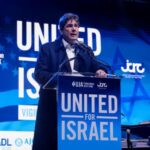
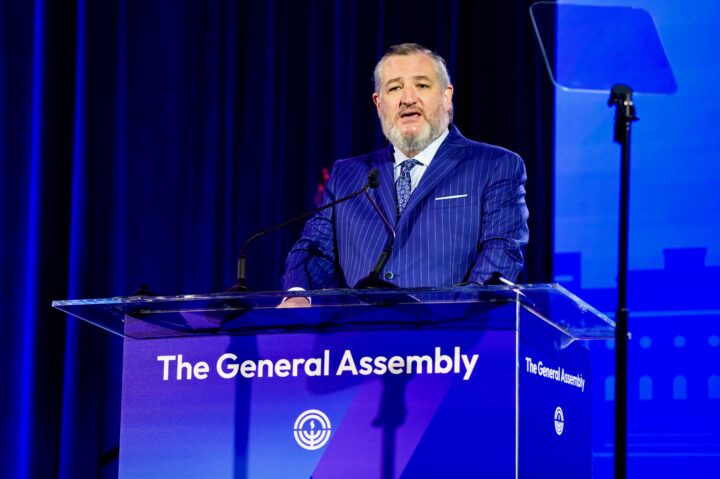
Sen. Ted Cruz (R-TX) speaks at the Jewish Federations of North America's General Assembly on Nov. 18, 2025.
Sen. Ted Cruz (R-TX), Rep. Brad Knott (R-NC) and Rep. Tom Suozzi (D-NY) are preparing to introduce federal legislation that would establish a 100-foot buffer zone around religious institutions, within which conduct that disrupts religious services or interrupts access to the place of worship would be banned during religious services.
The Right to Worship Act aims to address demonstrations around synagogues and other houses of worship that have become a growing concern for the Jewish community following anti-Israel and antisemitic protests outside synagogues that have turned violent. Several states have pursued similar legislation.
Cruz and Knott have been working on the bill for some time, and two sources familiar with the situation said that “intense negotiations” had been ongoing between Cruz and Suozzi’s teams to reach a bipartisan compromise balancing the desire to protect religious worship and free speech rights. A source said a deal was reached on Sunday evening.
“The First Amendment guarantees every American the right to freely exercise their faith, and Congress has a duty to ensure that guarantee is met,” Cruz said in a statement to Jewish Insider. “In recent years, we have seen organized acts of hate meant to disrupt and deny that right, which have been untenably defended as speech. That is why I am introducing the Right to Worship Act, and I urge my colleagues to support it.”
According to draft bill text viewed by JI, the buffer provision would impose fines for such activity, and impacted individuals, the Department of Justice or state attorneys general would be able to bring suits under the statute. It also includes language protecting non-disruptive First Amendment activity.
Knott did not respond to requests for comment and Suozzi did not comment for this article.
Sander Gerber, the CEO of Hudson Bay Capital and a lead architect of the Taylor Force Act, helped craft the new legislation, inspired in part by the decades-long weekly antisemitic protests outside his father’s synagogue in Ann Arbor, Mich. — an issue Gerber’s father previously sought to appeal to the Supreme Court.
Gerber said that officials at various levels, including the Department of Justice under the Trump administration have said that they’re unable to step in under the existing FACE Act because the conduct at the Ann Arbor synagogue is not physically threatening or obstructive. The FACE Act, invoked on multiple occasions by the current Justice Department, bars the use of force, threats or obstruction to block access to reproductive health services or to obstruct the right to worship.
“The Ann Arbor City Council passed a resolution saying these protesters are antisemitic. The mayor said he can’t move them away because his legal team won’t let them. Leo Terrell at DOJ said there’s nothing he can do because they’re not threatening,” Gerber told JI. “So it’s a gap in the FACE Act. Here you have intentional disruption [and] harassment, so how do you navigate free speech within that?”
Moshe Davis, who led former New York City Mayor Eric Adams’ office to combat antisemitism, has also been involved in crafting the bill, which he said aims to fill gaps in existing law and in some of the state and local buffer zone bills like the one in New York City, which he described to JI earlier this year as “watered down.”
He said he began working with Gerber on the legislation after being pushed out of the New York City government by Mayor Zohran Mamdani, and the pair got in touch with House Speaker Mike Johnson (R-LA) — who has been strongly supportive — about the effort after a spate of incidents at houses of worship, as well as communicated with the Department of Justice to work through any potential First Amendment Issues. He also praised Cruz and his staff’s work on the bill.
“I started this work in New York City, responding to the mobs targeting synagogues,” Davis told JI. “What we have seen since is a national problem that reaches every faith and requires a federal answer. No American should be afraid to walk into their house of worship.”
Johnson did not respond to requests for comment.
Nathan Diament, the executive director of the Orthodox Union Advocacy Center, which has also been working to support the bill, said, “The need for this legislation in the face of recent actions taken against shuls, as well as other houses of worship, is clear. And — it’s realistic for Congress to pass this bill in September.”
Suozzi previously introduced the SACRED Act, an alternative buffer zone bill, earlier this year, with the backing of several major Jewish community groups. Suozzi’s bill, cosponsored by Max Miller (R-OH), is different from the new one in that it allows greater leeway for demonstrations inside the buffer zone as long as they are nonviolent and nonthreatening.
Suozzi’s bill was also backed by the Anti-Defamation League, American Jewish Committee, Orthodox Union, Hadassah, Hindu American Foundation, Islamic Society of North America, Jewish Federations of North America, UJA-Federation of New York, the Holocaust Memorial and Tolerance Center and Agudath Israel of America. Leaders of communities impacted by antisemitic violence have been lobbying in support of Suozzi’s bill.
“No one should have to fight their way through harassment and intimidation to simply pray in peace. That’s why ADL is grateful members like Senator Cruz and Representatives Suozzi and Knott have recognized the urgency of this growing problem and made a clear commitment to protecting safe access to houses of worship,” Lauren Wolman, the senior director of government relations and strategy for ADL said in a statement.
“ADL has always championed the core principle at the heart of this issue: everyone, regardless of their faith, should be able to worship freely and safely,” Wolman continued. “We look forward to continuing to work with Congress to build consensus around the long-overdue critical protections needed to help safeguard the First Amendment right to religious worship.”
In the Senate, Sen. Bernie Moreno (R-OH) previously expressed interest in attempting to advance the SACRED Act by unanimous consent.
Davis said that advocates have also been in communication with groups representing other religions to secure their support as well. NORPAC, the grassroots pro-Israel group, lobbied in favor of the bill in advance of its formal introduction during its Capitol Hill advocacy day in May, and the Combat Antisemitism Movement has worked to support the legislation as it has taken shape.
The Family Research Council, a Christian group, is also among the organizations supporting the bill.
Proponents have already launched an advocacy website, ProtectingWorship.org to rally support for the bill in advance of its introduction. The site highlights incidents targeting both the Jewish and Christian communities, and defends the constitutionality of the legislation.
“Outside synagogues, churches, mosques, and temples, organized groups have learned to exploit a gap in federal law — surrounding houses of worship with amplified noise, blocking entrances, and creating an atmosphere of intimidation designed to make worshippers turn around and go home,” the website states. “They stop just short of physical violence, because they know the law stops there too.”
The website emphasizes the bill is narrowly tailored, of significant government interest, that there are many other channels for protest and that it’s neutral to the content of the protests. It also provides legal memoranda from two different law firms supporting the draft legislation.
Please log in if you already have a subscription, or subscribe to access the latest updates.
 Continue with Google

 Continue with Apple