




























































The bill would create criminal and civil penalties for individuals who attempt to intimidate or obstruct access to houses of worship within a 100-foot zone
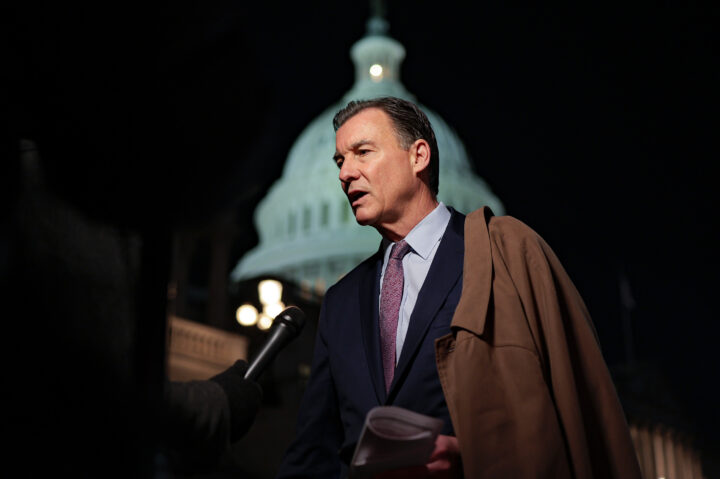
Heather Diehl/Getty Images
Rep. Tom Suozzi (D-NY) speaks with members of the media outside the U.S. Capitol on December 17, 2025 in Washington, DC.


 Add JewishInsider on Google
Rep. Tom Suozzi (D-NY), joined by Rep. Max Miller (R-OH), introduced the SACRED Act this week, a new bill aimed at protecting attendees at religious institutions from harassment and threats by demonstrators — a phenomenon seen repeatedly outside synagogues that has spurred “buffer zone” legislation in New York and elsewhere.
The bill, which applies within 100 feet of a religious institution, would create criminal and civil penalties for individuals who attempt to intimidate or obstruct someone in a manner that causes reasonable fear for physical safety to prevent them from entering or exiting a place of worship. It also applies — within that 100-foot zone — to individuals who intentionally approach within eight feet of a person seeking to exercise their freedom to worship, for the purpose of intimidating or harassing them.
The bill builds on the existing FACE Act, invoked by the Trump administration in recent lawsuits, which bans the use of force, threats or physical obstruction to prevent an individual from exercising their religious freedom at a place of worship.
Unlike some legislation at the local and state level, the bill would not ban all protests within the 100-foot buffer zone, specifically permitting peaceful picketing and other non-disruptive demonstrations.
First offenders would be subject to fines or up to one year in prison, with repeat offenders subject to greater fines and up to three years in prison. The bill would also create a civil right of action for both victims of harassment as well as the Department of Justice and state attorneys general.
Suozzi told Jewish Insider the bill was prompted by constituents from various religious communities who have expressed concern about “aggressive action” against them at their places of worship.
The spate of incidents outside synagogues has been “very disturbing,” Suozzi said, adding that he’s been hearing an unprecedented amount of fear and concern from Jewish friends and supporters since the Oct. 7, 2023, Hamas attacks — ”[they] have said things to me that I never heard before, things like ‘We don’t know what to do? What would we do if they came for us?’ People are genuinely scared, and we see this hateful behavior not just [against] Jews but against other religious minorities as well.”
He described the bill as a delicate, and carefully crafted, balance designed to uphold First Amendment rights to both freedom of speech and freedom of religion.
“This is a very, very sensitive topic that involves First Amendment rights and also people’s concern about their safety and their not only their right to free speech, but also their right to worship,” Suozzi said. He added that he had consulted with a constitutional scholar, Erwin Chemerinsky, dean of Berkeley Law School, in drafting the bill, who said it is compliant with the First Amendment.
“If you’re doing a peaceful protest and you’re leafleting or something like that — we don’t have a problem with that. It’s with these people that are going up to people and yelling at them and saying meanspirited, awful things with an intent to try to physically stop them from entering into their religious institution [that are the issue],” Suozzi continued, adding that even offensive but peaceful speech like opposing a religion or Zionism would be permitted.
“It would be [banned] if you came up close to people and you start yelling in their faces and saying, ‘you’re a Zionist pig,’ or something like that — trying to intimidate them,” he explained.
Miller said in a statement, “Every American deserves to practice their faith free from fear, intimidation, or harassment.”
“The SACRED Act ensures that people can access their place of worship safely and without obstruction, while still preserving First Amendment protections for peaceful expression,” he continued. “This commonsense legislation draws a clear line: intimidation and threats have no place in our communities.”
Suozzi emphasized that the bill is different from other recent state- and local-level buffer zone legislation, and he took pains to avoid modeling the bill after a Massachusetts law that was struck down in court which had banned all protests within a 35-foot zone. The eight-foot “floating buffer zone” was based on a Colorado law that was upheld by the Supreme Court, he said.
And, he said, “we’re only focused on people’s conduct, not their speech.”
In New York City, a slice of which falls within Suozzi’s district, the City Council recently passed buffer zone legislation for educational and religious facilities, but Mayor Zohran Mamdani is reportedly considering a veto. He has until the end of the week to do so, or the legislation will become law by default.
Suozzi said he sees much of the harassment at synagogues as linked to social media, which rewards extremism, and deliberate efforts by adversaries like Iran, China, Russia and North Korea to enhance division in the country.
“So we have to take new actions to try and address that. And this is a way to say, ‘You can disagree. You can protest. You can disagree completely with what I think — even though I think that you’re wrong, you’re completely allowed to do that, but you’re not allowed to come close to a person and try and scare them and try and prevent them from feeling safe to go practice their religion,’” Suozzi said.
Suozzi is set to be joined by Anti-Defamation League CEO Jonathan Greenblatt for a press conference on the bill at the Holocaust Memorial and Tolerance Center of Nassau County on Friday morning.
“No one should have to face harassment or intimidation as they are trying to pray in peace at a place of religious worship,” Greenblatt said in a statement. “This important and much-needed legislation reflects both the urgency of this moment and the fundamental principle that every person should be able to practice their faith freely and safely.”
Leaders from several communities impacted by antisemitic violence lobbied in favor of the bill on Capitol Hill earlier this week.
It’s also being backed by the American Jewish Committee, Orthodox Union, Hadassah, Hindu American Foundation, Islamic Society of North America, Jewish Federations of North America, UJA-Federation of New York, the Holocaust Memorial and Tolerance Center and Agudath Israel of America.
In a statement, AJC CEO Ted Deutch emphasized that the group’s recent national survey found that more than a quarter of American Jews said that an institution with which they are affiliated has been targeted in the last five years, and more than half have changed their behavior out of fear of antisemitism.
“At a time of rising threats against Jewish institutions, we applaud Representatives Suozzi and Miller for introducing the bipartisan SACRED Act to ensure safe access to houses of worship,” Deutch continued.
“Houses of worship are sacred spaces and visitors gathering there to pray or attend communal events should be free from harassment. The SACRED Act helps protect communities by creating a buffer zone around places of religious worship and individuals and imposes penalties for violations of this law,” Rabbi A.D. Motzen, the national director of government affairs for Agudath Israel, said in a statement.
“Unfortunately, recent incidents in front of synagogues around the country highlight the need for additional protections,” Motzen continued.
Eric Fingerhut, the CEO of the Jewish Federations of North America, said, “Every American deserves to practice their faith free from intimidation, harassment, or fear at the doors of their place of worship. With incidents targeting synagogues and other houses of worship continuing to rise, we need this federal legislation to protect our fundamental right to religious freedom.”
“Intimidating and harassing people exercising their right to worship is unacceptable — anytime, anywhere,” said Carol Ann Schwartz, national president of Hadassah. “Hadassah has heard from Jewish women who are afraid to display symbols of their faith and who constantly watch their synagogue doors for attackers. The antisemitism these women face reflects the erosion of public safety at every place of worship, and we must act to keep sacred spaces safe.”
Owens and Kent are set to speak at a far-right Catholic advocacy gala, while one Catholic leader called to ‘reject the conspiracies … against our Jewish brothers and sisters’
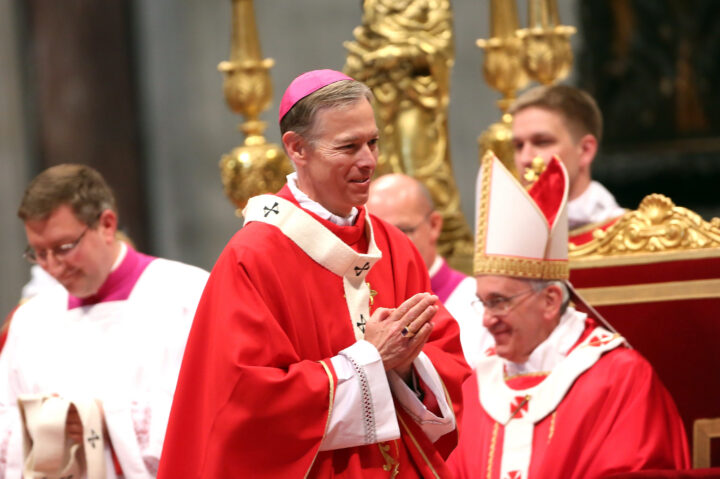
Franco Origlia/Getty Images
Archbishop of Portland Alexander King Sample receives the Pallium from Pope Francis during the Solemnity of Saint Peter and Paul at Vatican Basilica on June 29, 2013 in Vatican City, Vatican.
In the 24 hours before a fringe Catholic political group planned to host a gala in Washington honoring a number of public figures who have faced accusations of antisemitism, several prominent members of the American Catholic Church stated unequivocally that antisemitism is not a part of their religious doctrine.
“The Jewish community is attacked at a far higher rate than any other religious group in the United States. If we Catholics, in truly living out the Gospel, are to defend religious freedom with integrity, we must clearly speak out against antisemitism,” Archbishop Alexander K. Sample, the archbishop of Portland, Ore., said in a video posted by the U.S. Conference of Catholic Bishops on Wednesday.
Sample is the chairman of the religious liberty commission at the USCCB, the membership organization of current and retired Catholic bishops in the United States. The video was timed with the upcoming Easter holiday, which Sample said has “at times been the occasion for outbursts of hatred and even violence against Jews” by Catholics who collectively hold the Jews responsible for the crucifixion of Jesus.
“As Catholics, we are called to walk in the truth and so to reject the conspiracies and lies that lead to harassment and even violence against our Jewish brothers and sisters,” said Sample.
On Thursday morning, Vince Haley, the director of the White House Domestic Policy Council, delivered greetings from President Donald Trump at the annual National Catholic Prayer Breakfast in Washington. Haley, who is Catholic, wrapped up his own remarks with a call for Catholics to take a stand against antisemitism.
American Catholics have a responsibility, Haley said, “to render assistance to and speak out tirelessly in defense of our beloved Jewish neighbors and fellow citizens in the face of rising attacks and the tidal wave of hatred that is being manufactured against them.”
“Hatred toward Jewish people is ugly, despicable, an affront to the Sacred Heart of Jesus, and surely an occasion of terrible grief for our Jewish mother, Mary,” Haley continued. “And such evil should be condemned loudly and often by all people of goodwill, especially us.”
Neither Haley nor Sample mentioned the Catholic Prayer for America Gala, an event being hosted on Thursday night in Washington by Catholics for Catholics, a far-right political advocacy organization with a mission of targeting Catholic politicians who they deem to be insufficiently supportive of their perspective on church doctrine.
But the gala raised eyebrows across Washington when the organization announced just hours after Joe Kent resigned as director of the National Counterterrorism Center in protest of Trump’s policy toward Iran earlier this week that Kent would speak at the event.
Kent, who has a history of ties to far-right extremists and sought the support of antisemitic influencer Nick Fuentes during a 2022 congressional run, claimed that the U.S. was driven into war by “Israel and its powerful American lobby.”
The event’s lineup already featured a who’s who of right-wing media personalities who have faced accusations of antisemitism.
Carrie Prejean Boller, a former beauty pageant contestant who was fired from the White House Religious Liberty Commission Task Force in February after a disruptive anti-Zionist tirade at a public hearing, will be speaking. She was invited soon after the blow-up at the hearing, and in the weeks since she has doubled down on posting antisemitic content online.
At the Religious Liberty Commission hearing, Prejean Boller came to the defense of the far-right influencer Candace Owens, who since parting with the Daily Wire in 2024 has become a reliably antisemitic voice on social media. Owens will also be speaking at the Catholics for Catholics event, along with Michael Flynn, who served as national security advisor for the first 22 days of Trump’s first term.
The resolution affirms the Jewish ‘right to pray and worship on the Temple Mount,’ though the current Israeli policy is to restrict Jewish prayer at the holy site
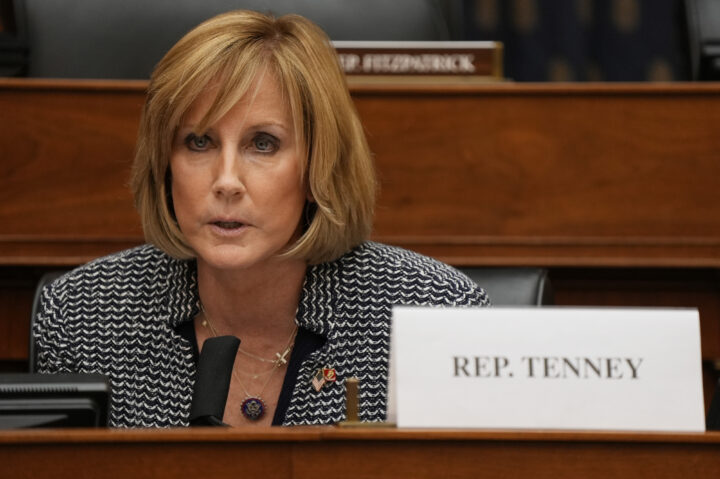
Ken Cedeno-Pool/Getty Images
Rep. Claudia Tenney speaks as at the House Committee on Foreign Affairs on March 10, 2021 in Washington, DC.
Rep. Claudia Tenney (R-NY) will introduce a resolution this week affirming Israel’s sovereignty over the Temple Mount, a sacred site for Jews, Christians and Muslims, and demanding equal freedom of worship for all, Jewish Insider has learned.
The resolution, if adopted, would put the House of Representatives on record as affirming “the inalienable right of the Jewish people to full access [of] the Temple Mount and the right to pray and worship on the Temple Mount, consistent with the principles of religious freedom.” It also “reaffirms its recognition of Jerusalem as Israel’s undivided capital, as reaffirmed repeatedly in United States policy and law, which includes Israeli sovereignty over the Temple Mount.”
The resolution describes the Temple Mount as “the holiest site in Judaism” and “a holy site for Christians and Muslims,” and makes note of the impediments faced by Jews and Christians in accessing the site that have restricted their prayer rights.
“Israel upholds religious freedom for all by ensuring access to holy sites for people of all faiths, however, Jewish and Christian rights on the Temple Mount are severely restricted as compared to the rights of Muslims,” the resolution reads.
The resolution points out that “Muslims can currently enter the Temple Mount from 11 different gates, but non-Muslims can only enter the Temple Mount from 1 gate,” and that “the hours of the lone non-Muslim gate is severely restricted compared to the Muslim gates.”
“Non-Muslims are not permitted access to the Temple Mount on Friday or Saturday, preventing Jews from observing Shabbat upon the Temple Mount,” it states.
Many rabbinic authorities, including the Israeli chief rabbinate, posit that Jews should not ascend to or pray on the Temple Mount, Judaism’s holiest site and the former site of the First and Second Temples, because of ritual purity questions.
The Al-Aqsa Mosque and Dome of the Rock were built on the Temple Mount after the destruction of the Second Temple. Jews largely worship at the nearby Western Wall, which is the remaining portion of the barrier that once enclosed the Temple Mount.
Israel gained control of the Temple Mount in the Six Day War, and allowed Muslim worship to continue on the holy site unimpeded. After Israel made peace with Jordan in 1994, the status quo was formalized, by which the Jordanian Islamic Trust determined religious use of the site.
While Jewish visits to the Temple Mount came to a near-total halt during the Second Intifada in 2000-2005, in the past decade, it has grown increasingly popular among religious Zionist Israelis and other Israeli Jews to ascend the mount, with numbers reaching the tens of thousands each year. This has also included praying on the site, usually silently, despite police instructing otherwise.
Israeli Prime Minister Benjamin Netanyahu has always said that Israel will maintain the status quo on the Temple Mount, restricting Jewish prayer. However, in recent years, National Security Minister Itamar Ben-Gvir has pushed for police to ignore any infractions, and he himself has prayed at the Temple Mount.
Over the past century, Arab and Palestinian leaders have used claims that Jews or Israel are trying to take over the Temple Mount to incite violence, from the 1929 Hebron Massacre to the Oct. 7, 2023 attacks, which Hamas named the Al-Aqsa Flood.
The resolution states that the House of Representatives “supports the Government of Israel in its efforts to safeguard the rights of Muslim worshippers, and integrity of Islamic structures there, in accordance with Israel’s current policies.”
Rep. Clay Higgins (R-LA) cosponsored the resolution, while the right-wing Zionist Organization of America and the Endowment for Middle East Truth endorsed it.
Yehuda Kaploun and former Rep. Mark Walker have not yet had committee hearings scheduled

Joe Raedle/Getty Images
President Donald Trump and Rabbi Yehuda Kaploun light a candle during an Oct. 7th remembrance event at the Trump National Doral Golf Club on Oct. 7, 2024 in Doral, Florida.
Several major Jewish organizations are expected to call on the Senate to “swiftly” confirm President Donald Trump’s nominees for special envoy to monitor and combat antisemitism and international religious freedom ambassador.
The groups, led by the Jewish Federations of North America, are writing in a letter to Senate Majority Leader John Thune (R-SD) and Senate Minority Leader Chuck Schumer (D-NY) that filling the roles is “of utmost importance in fighting growing antisemitism and ensuring freedom of religion or belief worldwide,” according to a draft obtained by Jewish Insider. The letter is set to be sent on Tuesday, according to a source with knowledge of the draft.
“We dare not delay in filling these critical positions that protect human rights around the world,” the letter states. “To that end we strongly urge you to prioritize filling these positions, sending a powerful signal to governments around the world that the United States upholds our constitutionally guaranteed rights to life and liberty, to freedom of religion and belief, and calls on them to do the same.”
In April, Trump tapped Rabbi Yehuda Kaploun, an Orthodox businessman and Chabad rabbi who served as a campaign surrogate, to serve as the next U.S. special envoy to monitor and combat antisemitism. In the Biden administration, that role was filled by Deborah Lipstadt, a Holocaust historian at Emory University. In May, the two authored a joint op-ed, with former antisemitism envoy Elan Carr, calling for action after two Israeli Embassy staffers were killed outside the Capital Jewish Museum in Washington.
Trump named former Rep. Mark Walker (R-NC) as the U.S. ambassador-at-large for international religious freedom. Both positions require Senate confirmation, and neither has had a confirmation hearing yet.
“We believe that these ambassador-at-large positions are crucial to protecting vital human rights, promoting religious freedom and vigorously confronting the global surge in antisemitism,” the Jewish organizations wrote.
JFNA CEO Eric Fingerhut told JI on Tuesday that the positions must be filled to help Jewish organizations combat rising antisemitism.
“The 141 Jewish Federations across our system are on the front lines of responding to and combatting antisemitism, and every single day we hear from them about the elevated levels of antisemitism our communities are facing,” Fingerhut said. “The government is a critical partner in our fight against antisemitism, both at home and around the world, so we must make sure that these roles do not remain vacant.”
A spokesperson for Thune did not respond to a request for comment.
A spokesperson for Schumer referred to the hold the Senate minority leader currently has on dozens of Trump nominees, and Trump’s recent message to Schumer to “go to hell” after bipartisan negotiations broke down. The spokesperson declined to comment specifically on Kaploun or Walker.
“President Trump has focused on promoting religious freedom and fighting antisemitism in a historic way,” White House deputy press secretary Anna Kelly told JI in a statement. “He wants all of his nominees confirmed as quickly as possible, including Yehuda Kaploun and Mark Walker, whose roles will be critically important to protecting Americans of faith.”
Current signatories to the letter include the Conference of Presidents of Major American Jewish Organizations, the Anti-Defamation League, the Orthodox Union, the Israeli-American Council, the Zionist Organization of America, Hadassah, American Jewish Committee, Agudath Israel, B’nai Brith International, the Louis D. Brandeis Center for Human Rights Under Law, NORPAC, Combat Antisemitism Movement, Religious Zionists of America and the American Association of Jewish Lawyers and Jurists.
A White House spokesperson did not respond to a request for comment.
This story was updated at 9:35 a.m. ET on Aug. 27, 2025.
GHF head Johnnie Moore said the world is turning a blind eye to Hamas violence against aid workers
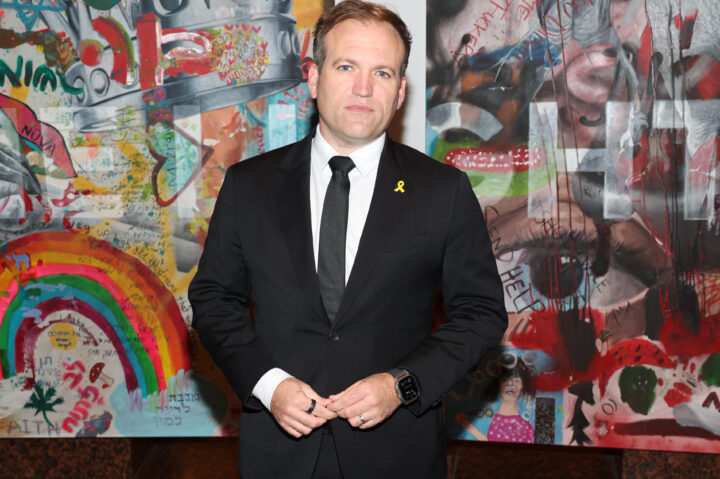
Jerritt Clark/Getty Images for Museum of Tolerance
Reverend Dr. Johnnie Moore, President of the Congress of Christian Leaders attends the Museum Of Tolerance Commemoration of the one-year anniversary of the October 7 attacks at Museum Of Tolerance on October 06, 2024 in Los Angeles, California.
Rev. Johnnie Moore, a member of President Donald Trump’s evangelical advisory committee, has years of experience with complex situations in the Middle East. He helped evacuate Christian refugees under threat from ISIS and has advocated for religious freedom and tolerance for minorities in the region.
But the challenges Moore faces as executive chairman of the Gaza Humanitarian Foundation, the U.S. group, supported by Israel, that began distributing food and humanitarian aid in Gaza in May, have been unique.
Since its inception, GHF has faced a pervasive negative narrative in the international media and among aid organizations. More recent statements from U.N. and other aid groups in effect accuse the GHF of being an IDF front luring Gaza residents to one place so they can be attacked, while largely ignoring Hamas violence against Palestinians working with the GHF.
In a wide-ranging interview this week with the Misgav Institute for National Security’s “Mideast Horizons” podcast, co-hosted by Jewish Insider’s Lahav Harkov, Moore pushed back against what he says are false narratives about the group’s work and accused aid organizations of “sabotage” and spreading disinformation, while acknowledging the challenges of aid distribution in an active war zone.
*****
GHF is addressing “a problem that everyone knew and admitted existed … and now everyone has amnesia,” Moore said. “The vast majority of humanitarian assistance that has gone into the Gaza Strip over many, many, many years, was almost immediately diverted into the hands of Hamas, and then used for various nefarious purposes. And I’m not talking about some of the aid — I’m talking about almost all of the aid.”
As such, the mission of GHF is to equally and directly distribute aid to Gazans without having it be “used to prolong a conflict or hoarded,” he said.
Since the beginning of GHF’s operations on May 26, the organization has opened four distribution sites in southern Gaza, from which it said it has provided Gazans with over 958,000 boxes of food. Moore said the GHF calculates meals with a greater caloric value than what the U.N. aid organizations distribute, and by the GHF’s count, it has distributed over 54.8 million meals.
“In an objective world, this would be viewed as an incredible success,” Moore said. “To my great surprise, we poked a number of bears that I wasn’t anticipating, and not all of them are Hamas threatening our local aid workers and the Americans helping these people. A lot of [the antagonists] wear suits and are in places like Geneva and New York City.”
Moore quipped that he has faced “lots of trouble” in his career advocating for religious freedom for Christian minorities around the world, including death threats and sanctions from the Chinese Communist Party, but that the negative response to GHF is unique.
“Respectable — I don’t even call them respectable anymore — elite organizations that we would assume [have] good intent have just attacked us again and again. The whole time, we’re like ‘cooperate with us … teach us, let’s find ways of solving problems together,’” to no avail, he said.
Moore said he would have liked to collaborate with major humanitarian organizations, such as the World Food Program, but that the U.N. has “been trying to sabotage us from the very beginning.”
“We’d really like the people whose job it has been to do this for many years to decide to help us,” he added. “Instead, they spread lies that originate in Hamas and try to shut us down, and I can’t think of anything more immoral than trying to shut down an operation that’s … feeding millions and millions of meals every day.”
Moore said details his staff on the ground in Gaza have heard from residents have been “a shock to us,” and revealing about other humanitarian aid groups’ conduct.
“Early on, we had a number of people who wanted to confirm that the aid was free, because in every other circumstance, their experience was that the aid that was coming in from the United Nations and other organizations was being taken and sold to them. It was unbelievable to them that we were giving this stuff away for free,” Moore said.
Moore pushed back against news stories associating death and killing in Gaza with the GHF and its distribution sites, slamming them as “lies.”
“We didn’t wait for a ceasefire to start our aid distribution. We’re distributing aid in the middle of a hot war,” he said. “There have been incidents in the Gaza Strip of civilians being killed. But what’s clear is that there is this very intentional disinformation campaign that is trying to say that … the GHF is a death trap, that we exist not to feed people 50 million meals, but to lure people. This is the lie that they keep telling.”
Hamas has dedicated extensive efforts to delegitimizing GHF in the eyes of the world and trying to threaten and scare Gaza residents seeking food from GHF, Moore said.
“They release these statistics every single day and they say that all these people are being killed at our aid sites or in close proximity to our aid sites,” Moore said. “This is their primary way of both trying to scare Gazans [from] getting our aid, trying to force us to shut down, trying to force European governments not to fund us, for the United Nations to continue opposing us.”
Moore has been actively pushing back on social media against false claims about GHF, and called on the media and international organizations to scrutinize claims from the terrorist organization in Gaza, “but no one is asking hard questions,” he lamented.
“What about the prolific evidence that we do have of Hamas intentionally killing people and then attributing their murder to the GHF or others?” he added.
Moore said that “sometimes you read all these crazy headlines and you’re like, ‘Am I deceiving myself here?’ but we’re actually talking to the people [of Gaza] every day, and it seems [reality] really is in many cases the exact opposite.”
On the ground in Gaza, Moore says people are adapting to GHF’s mode of distribution, with families often getting together to trade if one needs more of one product than another. GHF also tries to be flexible under the circumstances, having morning and evening distribution times when needed to keep the process more orderly.
Some Israeli politicians have maintained that providing aid for Gaza hinders the achievement of Israel’s war aims. Some on the right, who oppose letting any aid into Gaza, argue that if Hamas can pocket humanitarian aid and make money selling it, they will continue to control the enclave. And Hamas does still retain a significant measure of control over the area, despite more than 20 months of IDF operations.
Moore agreed with the argument that Hamas’ ability to take control of aid was “prolonging the conflict,” but said that GHF’s “mission is not related to the war.”
Still, he said that he thinks Hamas feels very threatened by GHF: “The fact is that Hamas continues to threaten Gazans and killed 12 of our local workers two weeks ago and nearly killed others and tortured others … Hamas took them to the Al Nasr Hospital and piled the dead and the injured outside … and wouldn’t let them get medical treatment, in order to send a message.”
“So I think it’s a hard argument to make that Hamas doesn’t oppose what we’re doing or isn’t somehow feeling threatened by what we’re doing,” Moore added. “Think of the fact that they issued bounties on the heads of Americans … They’re doing everything they can to shut [the GHF] down, which means that every time our aid workers, local or American, step into [Gaza], they are risking their lives in order to feed people.”
Moore noted that GHF does not operate in northern Gaza, where U.N. trucks continue to enter and are often taken by Hamas: “There was one day where 55 U.N. trucks went in and literally 52 were hijacked at gunpoint by Hamas or Hamas-linked militants,” he said. Another example he recalled was a time when “there was a [U.N.] truck that went in … Hamas wasn’t able to hijack the truck. So what does Hamas do? Hamas kills civilians around the truck to try to keep the civilians from getting what they can.”
“Amidst all of this, the U.N. literally told the BBC that none of their aid had been diverted. Zero. That was the official statement,” Moore said. “The U.N. is just lying through their teeth.”
Moore declined to share who funds GHF, but said that “the seed funding … principally came from a couple of countries, not Israel, that wanted to remain totally secret for political reasons.” Moore said he supports the decision of those countries not to reveal themselves, because of the negative narrative about the GHF, and expressed appreciation for the Trump administration for contributing to the foundation and encouraging others to do the same.
*****
Last month, Moore visited Syria with Rabbi Abraham Cooper of the Simon Wiesenthal Foundation and a Syrian Muslim refugee who had fled the country. In Damascus, Moore met with al-Sharaa for nearly three hours.
Moore’s approach to al-Sharaa’s new government in Syria, he said, “comes down to two things. Number one … You’re saying nice things, but can we trust you? And number two, if we can trust you, are you actually capable of doing these things?”
Following the meeting, Moore said, “I absolutely believe there will be peace between Syria and Israel.”
“I think the first priority in Syria has to be the stabilization of Syria. But I definitely left that conversation with a very clear idea of what needed to be done, of how it could be done, and of the probability in the right time of it being done in order to see peace all across the region.”
There have been contradictory reports in recent days as to whether al-Sharaa is willing to acknowledge Israeli sovereignty in the Golan Heights. Moore suggested that peace between the countries may involve things that make both sides “uncomfortable.”
“I do think many of us, including many people in Israel, misread certain aspects of this new government, all for good reasons,” Moore added, referring to those who highlight al-Sharaa’s history as a leader of an Al Qaeda affiliate in Syria. “Those of us who focus on the Middle East … have a tendency to be, we can be cynical, we can be conspiratorial, we can be a bit paranoid sometimes … But I always say the most valuable commodity in the Middle East is not oil or gas, it’s trust. If there’s no trust, nothing exists. And our visit was a trust-building exercise, and it was far more beneficial than I expected.”
Moore called al-Sharaa “a type of unicorn.”
“He comes from an Islamist orientation, no question whatsoever. But I’m not sure you can take this person and easily profile him,” Moore said. “This is the last gasp of a lot of extremists and when I met with Shahra, I viewed him as being more like [Saudi Crown Prince Mohammed bin Salman] as almost any other of the leaders that I’ve that I’ve met with, in terms of his generation, and the way he talks about solving problems and all of these things. This is a younger generation of leaders in a region with a lot of older leaders who think only about the past. I think al-Sharaa, like MBS, and a few other leaders, are future-oriented.”
Moore called for the U.S. to help Syria rebuild, because the country’s economy and infrastructure are in shambles.
*****
Moore has also been a longstanding advocate for a strong U.S.-Israel relationship and evangelical support for Israel.
Asked about polls showing decreasing support for Israel among young evangelicals, and the rise of figures such as Candace Owens and Tucker Carlson who have used Christianity as an argument against such support, Moore said he thinks the decline is exaggerated as is the influence of the podcasters.
“For a long time, there was exaggerated concern about a rise of antisemitism on the right while we were watching this incredible surging of antisemitism on the left. Well, now, I’m sorry to say, but we’re seeing it on both sides,” Moore said. “Yet, it actually isn’t the right. OK, it’s a type of pseudo-libertarianism. You know that isn’t a part of the institutional right, but because of the internet, it’s much more influential.”
Still, he added, “I’m not seeing some of these actors becoming more influential among evangelicals. I’m seeing evangelicals reject these influencers as they start talking about things that evangelicals actually know quite well … like skepticism about, you know, the evangelical relationship with Israel.”
Moore said he summarizes the relationship between evangelicals worldwide with the Jewish community, and Israel in one sentence: “Your book is our book; your heroes are our heroes; and your values, while we interpret them differently, are our values.”
“You have this massively dispersed religious movement around the world, 700 million people, and they all generally feel the same, 80-90% of them, about the Jewish community and Israel, because they get it from the Bible,” he said. “I’m not focused very much on politics these days, as we try to feed Gaza, but I think the evangelical community all around the world is a positive force and I don’t think the macro trends are changing at all.”
Human rights advocates demand officials 'immediately address this unlawful pattern of religious discrimination'

Flickr
The U.S. Immigration and Customs Enforcement (ICE) agency is denying claims that it violated the religious rights of Muslim detainees at a Florida detention center by failing to provide them with halal meals since the start of the COVID-19 pandemic.
ICE policy stipulates that detainees must receive “a reasonable and equitable opportunity to observe their religious dietary practice,” but conditions that requirement “within the constraints of budget limitations and the security and orderly running of the facility.”
In a letter, signed by attorneys from Muslim Advocates, Americans for Immigrant Justice (AIJ) and King and Spalding LLP, the groups allege that officers at the Krome North Service Processing Center in Miami consistently served Muslim detainees “rotten and expired” halal meals, at times forcing them to choose between eating pork-contaminated meals or expired meals.
The facility, like many institutions, has transitioned since the start of the pandemic to a satellite meal preparation and service model that provides pre-portioned meals to all detainees in an effort to limit the risk of infection. According to the letter, Muslim detainees have been served pork meals, including sausages and ribs, despite officers knowing their religious requirements.
When detainees brought their complaints to a chaplain, according to the letter, they were told: “it is what it is.”
The groups called on the agency and the Department of Homeland Security to “immediately address this unlawful pattern of religious discrimination” and “ensure that no detainee at Krome or any other ICE facility across the United States is forced to choose between their faith and starvation.”
Citing First Amendment protections and the Religious Freedom Reformation Act, the letter calls on DHS and ICE to immediately “train, supervise, and discipline all personnel involved in this systematic denial of detainees’ rights.”
According to Lily Hartmann, a Human Rights advocate at AIJ, many of the Muslim detainees, who come from Somalia, Jamaica, Tunisia, Egypt and Guatemala, have been in ICE custody for over a year. “The immigration detention system is meant, through its abuses, to wear people down so that they give up fighting their immigration case.” Hartmann told Jewish Insider, adding of the Krome incidents: “This is just one example of how that is done.”
Nimra Azmi, a staff attorney at Muslim Advocates and a signatory to the letter, told JI in an email, “officials at Krome know these are Muslim detainees who are being served rotten meals or meals that violate their faith and they do not care.”
In a statement to JI, an ICE spokesperson denied the allegations. “ICE’s Performance Based National Detention Standards cover all aspects of detention, to include reasonable accommodation of religious dietary practices. Any claim that ICE denies reasonable and equitable opportunity for persons to observe their religious dietary practices is false.”
ICE policy only requires religious dietary accommodations “within the constraints of budget limitations and the security and orderly running of the facility.” The spokesperson did not explain if the alleged conduct could be permissible under those constraints.
Jewish groups, including the American Jewish Committee and Bend the Arc, condemned the allegations. In a tweet, AJC wrote “If these allegations are true, they are beyond despicable! No one should be forced to choose between food and their religious beliefs. We call on @ICEgov to change this inhumane and un-American policy.”
Please log in if you already have a subscription, or subscribe to access the latest updates.
 Continue with Google
 Continue with Apple