



















































The potential terrorist attack against Temple Israel is a reminder of the consequences of what can happen when antisemitism is allowed to become normalized in our society

JEFF KOWALSKY/AFP via Getty Images
Families leave after being reunited outside Temple Israel synagogue after an assailant rammed his truck into the building in West Bloomfield, Michigan, a suburb of Detroit, on March 12, 2026.


 Add JewishInsider on Google
It’s a testament to the level of security, staff preparation and good fortune that a potential terrorist attack against Temple Israel in suburban Detroit was foiled yesterday. The fact that no one other than the heavily armed perpetrator was killed after driving a vehicle filled with explosives into a synagogue filled with preschoolers, counts as something of a miracle.
It’s also a reminder of the consequences of what can happen when antisemitism is allowed to become normalized in our society, moving unchecked through our social media feeds and political discourse, all amid the record levels of hate crimes committed against Jews simply for their identity.
Even as politicians are reflexively speaking out against antisemitism in the aftermath of the attack, it’s hard to forget the poisonous rhetoric many on the extremes have advanced that could easily activate a lone-wolf extremist to commit an unspeakable crime.
On the hard left, opposition to Israel’s war in Gaza has morphed into accusations of genocide, attacks against AIPAC as a uniquely sinister organization, conspiracy theories that Israel tricked the U.S. into war with Iran and euphemizing the support of terrorism as merely being “pro-Palestinian.”
Rep. Ro Khanna (D-CA), who has emerged as one of his party’s leading anti-Israel voices as he mulls a presidential campaign, had the audacity to say he “stands with” antisemitic streamer Hasan Piker — along with New York City Mayor Zohran Mamdani, who has refused to condemn “globalize the intifada” rhetoric and anti-Israel Democratic Senate candidate Graham Platner — during the Michigan synagogue terror attack.
Former Obama deputy national security advisor Ben Rhodes and his “Pod Save America” colleagues are now declaring that anyone who supports the Iran war — a group that may well include some Jewish Democrats in Congress who are sympathetic to the operation’s aims, even if they have reservations — should be primaried, and have no place within the Democratic Party.
On the hard right, extremist podcasters are broadcasting the most undiluted antisemitism in media since the days of Father Coughlin in the 1930s. Tucker Carlson has devoted much of his show to promoting conspiracy theories about Jews, while other social media influencers have found that attacking Israel and questioning Jewish influence is a ticket to building a niche audience in online spaces. Gatherings of young right-wingers have all too often become cesspools of anti-Jewish hate.
Sen. Ted Cruz (R-TX), who has emerged as a leader in speaking out against right-wing antisemitism, cautioned that Republicans may be losing the fight to contain the scourge — especially among a younger generation of conservatives.
All this is happening amid relative bipartisan silence towards the social media companies that often profit through division, using tech-tailored algorithms to feed extreme content to unsuspecting audiences. It’s no coincidence that polls indicate dramatic levels of antisemitism and extremist views from the youngest Americans, who are marinating in echo chambers instead of reading the headlines dispassionately from newspapers, as the generation before them did.
That the only fatality from yesterday’s attack in West Bloomfield Township, Mich., was the assailant is a testament to the time, energy and money that the Jewish community, with some federal assistance, has dedicated to ensuring security for its many institutions across the country. The FBI’s recent active shooter preparedness drill held for clergy and staff at the synagogue undoubtedly led them to be prepared in that fraught moment Thursday.
But a strong defense — hardening security for Jewish institutions — requires a complementary offense, in leaders confronting rising extremism whenever it rears its ugly head. It shouldn’t take the avoidance of a mass casualty event to get candidates across the political spectrum to start speaking out against antisemitism, as Platner did on Thursday.
We saw some signs of growing courage from political leaders this week in calling out the hate emanating from their fringes. Cruz, who called Carlson “the single most dangerous demagogue in this country,” at an antisemitism conference this week co-sponsored by the Republican Jewish Coalition and National Review, was joined by Sens. Tom Cotton (R-AR) and Jim Banks (R-IN) in speaking out against anti-Jewish hate.
The moderate Democratic think tank Third Way directly confronted Khanna on Thursday for his praise of Piker and other anti-Israel figures in the party. “Our side has a real antisemitism problem too that too many Democrats are failing to face squarely,” Third Way VP Matt Bennett bluntly told JI, in one of the few public intraparty acknowledgements about the growing threat.
The country feels like it’s at a boiling point, with few institutional leaders providing the guardrails necessary to contain growing extremism and hate. We saw on Thursday where unchecked extremism leads. It will take leaders to put principles ahead of political expedience for the wave of antisemitism to subside.
As state Sen. Jeremy Moss, a Democrat who represents the district where the attack took place, wrote: “When I was growing up, antisemitism was primarily in history books and black and white film reels. Today it was in real color right up the road at Temple Israel … This is a fire that will take all of us to snuff out.”
The annual confab, which kicks off today, will focus more on Europe’s shifting relations with the U.S.
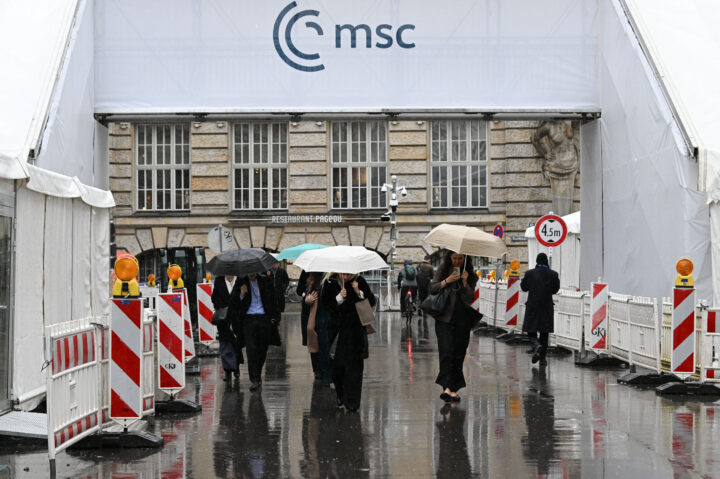
THOMAS KIENZLE / AFP via Getty Images
People with umbrellas walk past a pedestrian bridge with the logo of the Munich Security Conference leading to the venue of the 62nd Munich Security Conference (MSC) the hotel "Bayrischer Hof" in Munich, southern Germany on February 12, 2026.
A who’s who of the world’s major political leaders, past and present, are descending on Munich for the annual Munich Security Conference. After last year’s forum, in which Vice President JD Vance, who was leading the U.S. delegation, took an abrasive tone against Europe in his keynote address that rankled some attendees, Secretary of State Marco Rubio will lead this year’s delegation.
Unlike last year, when the Israel-Hamas war featured prominently on the agenda, this year’s MSC schedule has relatively little time dedicated to talking about the conflict, with just two sessions expected to touch on Gaza. And while last year’s attendee list included a number of Israelis, including President Isaac Herzog and Defense Minister Israel Katz, there are no current Israeli officials slated to speak. (Former Foreign Minister Tzipi Livni will join one of the panels on Gaza reconstruction.)
Also absent this year is a Qatari presence. Qatari Prime Minister and Foreign Minister Mohammed bin Abdulrahman Al-Thani, who spoke last year about de-escalating tensions in the Middle East, is not on this year’s schedule, nor are any other Qatari officials.
Sens. Lindsey Graham (R-SC) — back this year after skipping the 2025 MSC to travel to the U.S.-Mexico border — and Sheldon Whitehouse (D-RI) will lead a bipartisan congressional delegation that includes Sens. Lisa Murkowski (R-AK), Mark Warner (D-VA), Chris Coons (D-DE), Richard Blumenthal (D-CT), Steve Daines (R-MT), Jacky Rosen (D-NV), Peter Welch (D-VT), Andy Kim (D-NJ) and Elissa Slotkin (D-MI).
Rep. Alexandria Ocasio-Cortez (D-NY) is slated to speak on two panels today, one on the “rise of populism,” and another on the “future of U.S. foreign policy,” the latter in conversation with Michigan Gov. Gretchen Whitmer and Matthew Whitaker, the U.S.’ representative to NATO. Matt Duss, a former foreign policy advisor to Sen. Bernie Sanders (I-VT) who has been critical of the U.S.-Israel relationship and is now advising the New York Democrat, said that she will use her perch in Munich to give the “working-class perspective” on the intersection of domestic politics and foreign policy.
AOC isn’t the only millennial member of Congress to be addressing the MSC this year. Rep. Yassamin Ansari (D-AZ), the first Iranian American Democrat elected to Congress, will be speaking on Sunday on a panel titled “Under Reconstruction: A World Order for the Next Generation.”
The conference kicks off this afternoon with a sit-down with German Chancellor Friedrich Merz, followed by a panel discussion on “The International Order Between Reform and Destruction,” which will feature U.S. Ambassador to the U.N. Michael Waltz, the EU’s Kaja Kallas, Saudi Foreign Minister Prince Faisal bin Farhan Al Saud and Colombian Defense Minister Pedro Arnulfo Sánchez Suárez.
A town hall session focused on Gaza rebuilding efforts will take place later this afternoon. Speakers include Nickolay Mladenov, the Bulgarian diplomat serving as the head of the Gaza Board of Peace, Sen. Chris Murphy (D-CT), Livni and Palestinian Authority Foreign Affairs Minister Varsen Aghabekian. Concurrent to that panel is a session focused on maritime security, with Yemeni President Rashad al-Alimi, whose country has been used by the Iran-backed Houthis as a launching pad for attacks on ships transiting through the Gulf, set to speak.
Later in the day, CNN’s Christiane Amanpour will moderate back-to-back sessions on the future of Iran: the first with exiled Iranian Crown Prince Reza Pahlavi and British-Iranian actress and activist Nazanin Boniadi; and the second with Graham, the Carnegie Endowment for International Peace’s Karim Sadjadpour, European Parliament President Roberta Metsola and Manal Radwan, a senior advisor in Saudi Arabia’s Foreign Ministry.
Rubio will kick off Saturday’s sessions with a mainstage conversation with MSC Chairman Wolfgang Ischinger, followed by Chinese Foreign Minister Wang Yi. Also on Saturday morning, former U.K. Prime Minister Tony Blair and the International Committee for the Red Cross’ Mirjana Spoljaric Egger will speak on a panel about peace deals.
Later in the day, Elbridge Colby, the Defense Department’s under secretary of war for policy will speak in conversation with Foreign Policy’s Ravi Agrawal before joining a larger panel focused on security in the Indo-Pacific.
The Middle East will take center stage again on Saturday evening, during a session titled “Building on Momentum in the Middle East: From Promise to Progress?” that will feature another appearance by Saudi Foreign Minister Prince Faisal bin Farhan Al Saud, joined by Norwegian Foreign Minister Espen Barth Eide and Sigrid Kaag, who now sits on the executive board of the Board of Peace.
Prince Faisal will also speak alongside U.K. Foreign Minister Yvette Cooper and White House senior advisor Massad Boulos in a session Saturday focused on ending the war in Sudan.
Nazi imagery and signs threatening violence were placed around the hub of Jewish life in Charlotte

Foundation of Shalom Park website
Shalom Park
Political leaders in North Carolina are condemning the Nazi symbols and antisemitic graffiti discovered earlier this week at a hub of Jewish life in Charlotte.
Shalom Park, where the vandalism took place, is a manicured 54-acre campus that is home to a Jewish Community Center, Jewish federation, community foundation, two synagogues, a preschool, a school, a library and a day camp, among other Jewish services, including a dedicated multi-car security detail. Signs were posted around the park featuring a swastika and a noose with language encouraging people to join the Nazi party.
The incident was met with widespread condemnation from current and prospective statewide leaders.
“These ugly, hate-filled images left in Charlotte’s Shalom Park are unacceptable. My heart goes out to the Jewish North Carolinians who had to bear witness to this hateful ignorance,” Democratic Gov. Josh Stein, who is Jewish, told Jewish Insider. “Every person, regardless of religious background, deserves to live and worship without fear or intimidation. I am dedicated to doing everything I can to root out antisemitism in North Carolina.”
Sen. Ted Budd (R-NC) said in a statement to JI, “Antisemitism has no place in our state. The vandalism at the Charlotte JCC was a clear act of hate, but it will not silence our commitment to standing with the Jewish community. I am grateful to those who swiftly restored Shalom Park to its purpose as a place of peace and respect.”
On Thursday afternoon, Sen. Thom Tillis (R-NC) posted on X, “It’s deeply disturbing to see hateful imagery like this in Charlotte. Antisemitism is unacceptable and has no place in North Carolina or anywhere in America. I stand with our Jewish neighbors in condemning this hatred wherever it appears.”
The two leading candidates in the race to replace Tillis, who is retiring, echoed his condemnation of the Nazi imagery.
“This was a deplorable act of hate meant to intimidate and scare our Jewish neighbors — it’s unacceptable and those responsible should be held accountable. My thoughts are with the families and children of the Charlotte Jewish community,” former Gov. Roy Cooper, the expected Democratic nominee in the state’s high-profile Senate race, told JI.
“Antisemitism continues to rise across the country and it’s on all of us to root out antisemitism in all of its forms,” Cooper added. “I’ve fought against antisemitism and hate throughout my career and would continue working to keep all North Carolinians safe as U.S. senator.”
Michael Whatley, the likely GOP nominee in the race to succeed Tillis, told JI, “The antisemitic materials and Nazi imagery found at Shalom Park are vile and unacceptable. Antisemitism has no place in Charlotte or anywhere in America. We stand with the Jewish community and condemn this cowardly act in the strongest terms.”
Shalom Park has primarily been financed through the Leon Levine Foundation, whose president also spoke out following the incident.
“While this moment demonstrates that there are still pockets of hate in our community, it does not define who we are. In response, friends, neighbors, and allies have come together in a powerful show of solidarity,” Tom Lawrence, president and CEO of the foundation, said in a statement to JI.
“We are deeply grateful to our many Jewish community partners who have met this moment with clarity of voice and action,” he added. “We are confident that our Jewish community is taking all appropriate measures to remain safe while continuing to engage joyfully and openly in Jewish life, learning, and celebration.”
Mayor Jacob Frey, running for reelection, told JI, ‘Minneapolis stands with our Jewish neighbors. Hiding behind hate to spread fear against any religion is cowardly and unacceptable in our city’

Stephen Maturen/Getty Images
Minneapolis Mayor Jacob Frey speaks during a press conference at City Hall August 28, 2025 in Minneapolis, Minnesota.
Several key Minnesota political leaders across the ideological spectrum condemned the vandalism of a synagogue in Minneapolis on Wednesday as an act of antisemitism.
Temple Israel, which had been vandalized previously, was spray-painted with the message “watch out Zionists” as well as red triangles — a symbol used by Hamas to mark Israeli targets.
Sen. Amy Klobuchar (D-MN) told Jewish Insider, “This is an unacceptable act of antisemitism that must be unequivocally condemned. After a summer marked by political violence in our state, we must all stand up, speak out, and act to combat hate.”
Sen. Tina Smith (D-MN) told JI that the vandalism “was a horrific thing for the congregants of Temple Israel and the Jewish community in Minneapolis to have to experience.”
“We need to call out these brazen acts of antisemitism and come together to make sure our friends and neighbors know they are safe and supported,” she continued.
Minneapolis Mayor Jacob Frey, running in a competitive race for reelection, said, “This morning, Temple Israel woke up to anti-Semitic threats — a reminder that hate still tries to find a foothold. It won’t find one here. Minneapolis stands with our Jewish neighbors. Hiding behind hate to spread fear against any religion is cowardly and unacceptable in our city.”
Frey’s primary challenger, state Sen. Omar Fateh, said in a statement to JI, “Anti-Semitism has no place in our city, and the hate speech found at Temple Israel this morning is unacceptable. Minneapolis cannot and will not tolerate violence against our communities, and we stand with our Jewish neighbors.”
Fateh has staked out anti-Israel positions, and some of his associates have endorsed the Oct. 7 attack.
Rep. Angie Craig (D-MN), who is running for Senate, said that the incident was “alarming and unacceptable. And it’s a sobering reminder that antisemitism is on the rise.”
“This is not who we are as Minnesotans. We must stand with our Jewish neighbors in the face of this blatant antisemitism and reject all hatred in our communities,” Craig continued.
Lt. Gov. Peggy Flanagan, who is also running for Senate, described the vandalism as “anti-Semitic hate.”
“My heart is with the congregants of Temple Israel and our entire Jewish community. Hate has no home in Minnesota, and every house of worship should be a safe place to pray,” she continued. “Hate attacks against all faith communities have reached historic highs, and Minnesota is not an exception.”
She went on to highlight the recent shooting at Minneapolis’ Annunciation Catholic Church, a fire and break-in at an Islamic center and attacks on the Somali community.
“Threats, hate, and destruction don’t put us on a path to peace — they make us all less safe. In this moment, it is up to us to stand up against hate, lead with kindness, and find a way to draw all our communities closer,” Flanagan concluded.
Rep. Ilhan Omar (D-MN), who represents the district in which Temple Israel is located, did not respond to a request for comment and does not appear to have addressed the vandalism publicly.
Please log in if you already have a subscription, or subscribe to access the latest updates.
 Continue with Google

 Continue with Apple