







































Brandeis Center founder Kenneth Marcus indicated the administration is receptive to taking action on an ‘extraordinary surge’ in health care-related antisemitism

Getty Images
Nurses station in busy hospital


 Add JewishInsider on Google
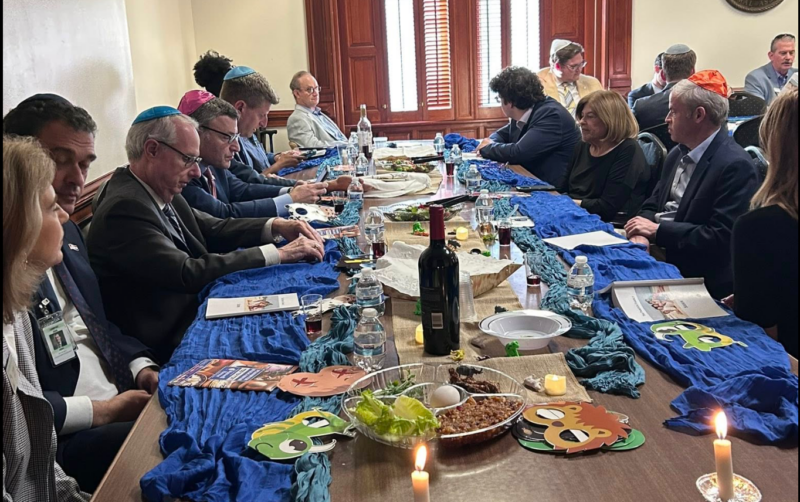
Representatives from several Jewish groups met with Paula Stannard, the director of the Department of Health and Human Services’ Office for Civil Rights, last week to discuss potential action to counter antisemitism in health-care and medical education.
The meeting, organized by the Brandeis Center for Human Rights Under Law, also included representatives from the American Jewish Medical Association, Hadassah (The Women’s Zionist Organization of America), the Anti-Defamation League, Jewish Federations of North America and StandWithUs.
Kenneth Marcus, the founder of the Brandeis Center, told JI that the meeting was the second sit-down between the Brandeis Center and HHS leadership, given an “an extraordinary surge in health sector related antisemitism reports” to Brandeis and a “greater involvement by HHS in antisemitism and other civil rights issues than we’ve seen before, so meeting with HHS has become much more important.”
He said that, in the first meeting, which was just between Brandeis and HHS, his organization “made clear the nature and scope of the problem of antisemitism in health care,” particularly the “decolonizing therapy” movement in mental health spaces that has characterized Zionism as a mental illness to be treated.
The second meeting, last week, which lasted around an hour, brought in other Jewish communal groups to share additional information.
Eveline Shekhman, the CEO of AJMA, called the meeting “very productive.”
“We went in with the goal of coming collectively, and also to take a look at how we can use the government relations arm to work and partner with the government, so in that way, we could take a look at what’s going on in the workplace environment, as well as medical schools and all the other various stakeholders that would have a part in it, which includes the [medical] associations, the unions,” Shekhman said.
She said that the AJMA representatives sought to communicate the various forms and examples of antisemitism that providers and medical students have faced.
“This has a different level of gravitas because of the life and death nature of it. … When people are distracted in the ER and the OR by politics, and particularly by antisemitism, it really puts vulnerable people, patients at risk,” Andrea Wolf, AJMA’s director of advocacy added. “And then on top of that, if a patient comes in as an identifiable Jew, wearing a magen david or a yarmulke, or something like that, we’re not sure anymore that they can get the same level of care as someone who’s not identifiably Jewish.”
Dan Granot, senior director of government relations for ADL, said in a statement, “ADL’s data shows a troubling rise in antisemitism within health care settings. We must use all levers of government to respond to this crisis. Hospitals must remain places of healing, not hate.”
“As a member of the federal Task Force to Combat Antisemitism, the Department of Health and Human Services has a key role in confronting this scourge,” Granot continued. “We welcome HHS taking this challenge seriously and appreciate the opportunity to engage in a constructive discussion on what should be done to protect patients, providers, and future providers alike.”
Rachel Dembo, the director of policy and government relations for JFNA, said, “Nobody seeking medical care should be exposed to hate. Unfortunately, we have seen many disturbing instances of antisemitism creeping into medical settings, and too many instances where institutions failed to act or, worse, were permissive of antisemitism. We appreciate HHS OCR for taking this issue seriously and look forward to continuing to work with them and Congress to ensure Jewish Americans have access to hate-free health care.”
HHS is looking both at potential civil rights violations by individual institutions as well as at the possibility of broader policymaking to combat antisemitism in the field generally, Marcus said. He said that the problems in health care are wide-ranging, and come from patients, providers and healthcare students, in educational, hospital and medical association and conference settings.
“HHS has an extraordinarily wide jurisdiction. Since they fund such a high percentage of colleges and universities, they could certainly address many of the same sorts of situations that the Education Department’s Office for Civil Rights is handling,” Marcus explained. “But they also fund medical practices, health care of various sorts, and some associations, such as the American Psychological Association, where there have been concerning reports of antisemitic activity.”
He said HHS could issue informal guidance in the form of a dear colleague letter on antisemitism, but added that he’s “concerned at the appearance that HHS continues to fund some decolonizing therapy activity,” which he said he would like to see addressed in guidance and in enforcement activities.
Wolf said that AJMA is also pushing for a “more robust and accurate reporting mechanism” for incidents of antisemitism, noting that “our biggest challenge right now is not having a clear sense of the pervasiveness and the facts on the ground.”
Wolf and Shekhman said AJMA would also support an HHS dear colleague letter — reminding entities of their legal responsibilities and duty to combat antisemitism — and further work across administrative agencies and with Congress to address antisemitism and expand scientific partnerships between the U.S. and Israel.
Wolf said AJMA is also working to track donations to medical schools by bad actors.
HHS was involved in, and announced the revocation of, funds from various university-affiliated medical programs as part of the administration’s crackdown on campus antisemitism in early 2025. But that activity tapered off and faded from the public eye in the latter part of the Trump administration’s first year.
“What we’re looking for is a second wave of Health civil rights enforcement,” Marcus said. He noted that much of that early action was undertaken by personnel in acting capacities who in some cases are no longer at the agencies, and was driven largely by initiative from the White House.
“Now we’re looking for something different,” Marcus continued, calling for “more activity of a more institutionalized sort, such as investigations by HHS career officials throughout their regional apparatus” by the Office for Civil Rights and a “more normalized effort through the HHS bureaucracy taking on the issue of antisemitism.”
He said his conversations with Stannard and HHS have made him “optimistic” that such efforts would be forthcoming from the administration.
Wolf emphasized that AJMA aims to take a more collaborative approach with both the government and with medical schools themselves, and to serve as a resource to both. She said that HHS does not “condone or encourage investigations” of medical schools by HHS, “but once they are open by HHS, there’s really no better source of facts than AJMA membership, and so we will work with the government to help them.”
She said AJMA is happy that the administration is now taking a “more thoughtful and more targeted” approach to addressing antisemitism “without threatening a lot of scientific funding.”
Sen. Chris Murphy argued that there are no provisions in federal law that give the government any authority to condition funding on the ‘viewpoint diversity’ of the faculty

Jemal Countess/Getty Images for Fair Share America
Sen. Chris Murphy (D-CT) speaks at the U.S. Capitol on April 10, 2025 in Washington, DC.
Senate Appropriations committee members sparred on Thursday over the Trump administration’s sweeping moves to combat campus antisemitism, including withholding hundreds of millions of dollars from some elite institutions.
The debate was sparked by an amendment proposed by Sen. Chris Murphy (D-CT) that would prevent the administration from spending any funding on the Office for Civil Rights until the Department of Education inspector general certifies that enforcement actions targeting colleges and universities are being carried out in accordance with law and regulation.
The amendment was voted down along party lines. It’s unclear at this point how much funding the bill — which has not yet been released in full — actually provides for the Office for Civil Rights. The Trump administration had requested substantial cuts to the office’s budget.
Murphy said that the actions taken by the Office for Civil Rights have been undertaken “without going through any of the prescribed processes that we have put in law and previous administrations have put in regulation,” to allow schools and the public to contest and litigate against the decisions before losing federal funding.
“I think the extraordinary ways this administration is ignoring the law or going around the law requires us to do due diligence in making sure that when we appropriate money it gets used for the proper purposes,” Murphy said.
He called the administration’s suspension of funding to Harvard University particularly egregious, specifically highlighting the administration’s demand for greater viewpoint diversity in Harvard’s faculty.
Murphy argued — as he has previously — that there are no provisions in federal law that give the government any authority to condition funding on the “viewpoint diversity” of the faculty.
Sen. Shelley Moore Capito (R-WV), the ranking member of the subcommittee responsible for Department of Education funding, pushed back, describing the administration’s actions as necessary and proper to counter “rampant” antisemitism on campuses and address a lack of action by the prior administration.
“Some of those higher education institutions have come to the table with the administration and said, ‘Yes, we’re gonna make changes, and that’s because of the violations of the office of what is under the Office of Civil Rights Under Title VI,’” Capito said. “Your amendment would halt the work of the Office of Civil Rights.”
Capito warned that any pause in Office for Civil Rights activities would likely drag on significantly.
She compared the situation on college campuses to the Nazi regime in World War II.
Sen. Jon Ossoff (D-GA), who is Jewish, condemned the administration’s actions.
“I utterly reject this administration’s cynical exploitation of this issue, which it uses as a fig leaf to take control of and impose its will on institutions of higher education and other critics,” Ossoff said.
During the committee meeting, Democrats emphasized that the Department of Education funding bill as a whole defied Trump’s wishes to defund and dismantle key parts of the department.
The Virginia university contended with several high-profile incidents of antisemitism last year

Robert Knopes/UCG/Universal Images Group via Getty Images
Graduates pass a statue of George Mason on the campus of George Mason University, Fairfax, Virginia.
George Mason University is the latest target of the Trump administration’s investigations into universities for allegedly violating Title VI of the Civil Rights Act of 1964 by not cracking down on harassment of Jewish students.
The Department of Education’s Office for Civil Rights launched the investigation on Tuesday, according to a letter first obtained by the Free Beacon. The school has until July 21 to provide detailed information requested by the administration, including all complaints surrounding antisemitism.
“George Mason University has received notice of an impending investigation and a request for data,” a university spokesman told the Free Beacon. “The university believes the allegations to be false, and is working on a timely and comprehensive response.”
The public university in Northern Virginia contended with several major incidents of antisemitism on its campus during the last academic year. The administration faced scrutiny from several pro-Israel individuals affiliated with the school about its response, perceived to be lackluster, after pro-terrorism materials were found in the home of two of its students and a third student was charged with plotting a mass causality attack in November.
George Mason’s administration suspended its Students for Justice in Palestine chapter after two of the group’s student leaders vandalized a campus building with anti-Israel graffiti — and barred the two women from campus for four years. The university also expelled a freshman student who was charged with plotting a terror attack against the Israeli consulate in New York. Administrators later conducted a meeting with Jewish groups to discuss safety and security on campus.
But the university’s response to the incidents avoided any mention of the suspects’ antisemitic motivations or their Islamist sympathies. The police search of the home of the George Mason SJP leaders, sisters Jena and Noor Chanaa, found firearms, scores of ammunition and pro-terror materials, including Hamas and Hezbollah flags and signs that read “death to America” and “death to Jews.”
The OCR investigation into the university comes as the federal government has frozen billions of dollars in federal funding following similar investigations at several elite colleges including Columbia, Harvard and Northwestern.
Please log in if you already have a subscription, or subscribe to access the latest updates.
 Continue with Google
 Continue with Apple