





































































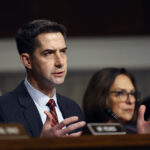






In the first meeting between the pontiff and a major AJC delegation since his election, Leo reaffirmed Nostra Aetate and, in a shift from Francis, steered clear of the Gaza war
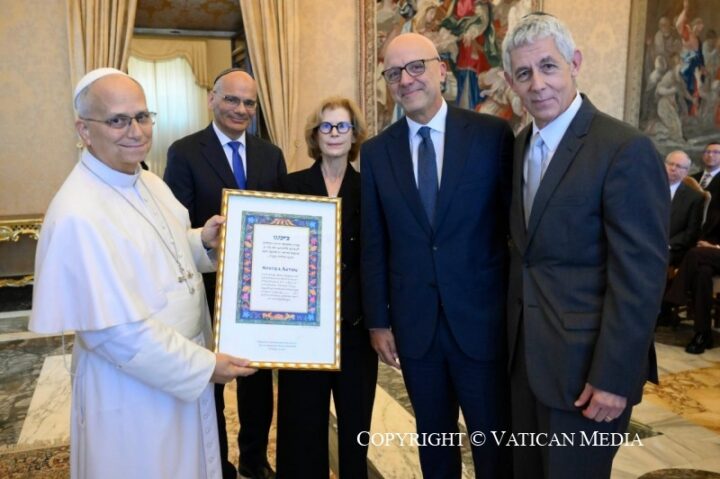
Vatican Media
American Jewish Committee CEO Ted Deutch and other AJC leaders meet with Pope Leo XIV at the Vatican, Oct. 22, 2026


 Add JewishInsider on Google
In a meeting at the Vatican with American Jewish Committee CEO Ted Deutch and other AJC leaders from around the country on Thursday, Pope Leo XIV pledged to combat antisemitism.
“Rooted in our shared spiritual heritage, this friendship also calls us to defend human dignity, to serve the poor, to protect religious freedom and to promote justice and peace,” the pope told the Jewish leaders. “Essential to this commitment is the rejection of all forms of religious and ethnic hatred and discrimination.”
Speaking to Jewish Insider after the meeting, AJC leaders emphasized the significance of the meeting and of the pope’s commitment to rejecting antisemitism, given both the massive influence that the pope and the Catholic Church hold around the world and the Church’s own history of fomenting antisemitism.
Leo reaffirmed his commitment to the 1965 Nostra Aetate declaration, in which then-Pope Paul VI rejected antisemitism and the charge of deicide against Jews and highlighted the shared spiritual heritage between Jews and Catholics.
“Differences of opinion, however profound, must never give rise to prejudice and hostility, which undermine the moral foundations of our society,” Leo said.
Deutch told JI that the meeting was “very powerful because of what the Pope said to us about his commitment, the Church’s commitment to fighting antisemitism and ongoing commitment to engage in the dialogue that we participate in throughout the year.”
“There was a genuine connection as he spoke about the Church’s longstanding engagement with AJC and the importance of maintaining the strong relationship, and the importance of approaching these challenging issues with mutual respect,” Deutch continued.
Rabbi Noam Marans, the director of interreligious affairs for AJC, emphasized that Leo’s reaffirmation of Nostra Aetate is a declaration that “the millennia of demonizing Jews and Judaism was not in the spirit of the original Christian teaching.”
Given the pope’s and the Catholic Church’s influence with 1.4 billion Catholics worldwide as well as those of other religions who listen to and respect him, Marans added that “it’s impossible to overstate [their] power … to make a significant contribution in confronting antisemitism.”
The AJC and the United States Conference of Catholic Bishops have collaborated on a project that aims to teach about antisemitism and antisemitic sentiments through a specifically Catholic lens, and are launching an updated version of the project next month, according to Marans.
“We learned that the church is reaching out across the world to its leadership, to encourage them to prioritize the confronting of antisemitism and the development of Jewish friendships,” Marans said. “These are laudable, and we need more because of our belief that antisemitism is not a Jewish problem; it is a societal problem. The Catholic Church and its history has a particular responsibility. We’re grateful for what they’ve done, and we hopefully will do even more.”
Deutch said that AJC intends to continue conversations with the Church to ensure that its commitment to combating antisemitism “extends to all of the forces confronting the Jewish community today all around the world, and the different ways they manifest themselves,” and called the meeting with the pope “an opportunity” to deepen that work.
Deutch said that Pope Leo’s decision to meet with the group so soon after undergoing surgery for lung cancer is an “important statement” and a “powerful reminder of why dialogue matters” which created opportunities for “deeper engagement with the Catholic Church at a time when it’s never been more important.”
Though AJC and Marans have met with Pope Leo and other senior Catholic leaders, this was the first major AJC delegation to meet with the pope since he assumed his position last year.
The group presented Pope Leo with an artwork created in Jerusalem featuring an excerpt from the Nostra Aetate declaration in both the original Latin and in Hebrew. The piece is inspired by an Italian ketubah from 1822.
AJC leaders also had an opportunity to address the pope one-on-one to thank him for his comments and wish him well in his recovery. Deutch said that, based on what he’s read about Pope Leo’s surgery, the pope seemed remarkably healthy.
“He was engaged and personable, and warm, and seemed genuinely thrilled to be able to participate in the meeting with us,” Deutch said.
Marans said that Pope Leo “chose not to focus” on issues related to Israel and the war in Gaza while speaking with AJC, which proved to be a point of friction between his predecessor, Pope Francis, and the Jewish community and Israel.
Marans said he believes that Pope Leo has undertaken a “seemingly deliberate effort … to ease the tension” and shift away from Francis’ intense focus on the war in Gaza, at least in terms of the rhetoric that he and other Church officials use.
He said that Pope Leo has “focused on addressing the challenges and differences of opinion in the spirit of the 60-year dialogue” and using “careful language when talking about sensitive topics,” which Marans said has been helpful for Catholic-Jewish relations, “even when he has spoken about difficult issues regarding the Israeli-Palestinian conflict.”
The group also met with Cardinal Pietro Parolin, the functional head of government for the Holy See. During the meeting, Marans said that Parolin also delivered an “unequivocal commitment by the Church to combat antisemitism,” and also directly addressed the subject of Israel head-on, linking the Church’s diplomatic relationship with Israel directly to its commitment to fighting antisemitism.
“At a moment when we constantly face leaders in politics who attempt to distinguish between their so-called commitment to fighting antisemitism and their obvious disdain for the state of Israel, this was one of the leaders of the Vatican, specifically linking the commitment, the Church’s commitment to fighting antisemitism, with its [agreement establishing relations with Israel],” Deutch said. “It’s a very, very powerful statement.”
Marans said AJC has worked hard to convey to the Church the “indispensability of identification with the state of Israel and Zionism to modern Jewry.”
While in Rome, the AJC group also met with Rabbi Riccardo Di Segni, the chief rabbi of Rome, and will meet with other Vatican leaders, leaders of the Jewish community and Italian government officials, which Deutch said are critical at a time when antisemitic and anti-Zionist content has cropped up in sometimes-violent protests in Italy and throughout Europe.
Deutch said that AJC will communicate to Italian leaders the way that demonization of Israel, including accusations of genocide, have fomented rising antisemitism and highlight the need to continue to stand with Israel against those seeking to deny its right to exist.
Marans said that the group heard from Di Segni that the Jewish community in Italy is “deeply concerned” and “feel[s] threatened, particularly by the bleeding from the anti-Israel rallies into antisemitic tropes.”
Deutch said that the message from Italian Jewish community members has matched what AJC has been hearing across Europe, that the protests and riots have had a “dramatic” impact in the Jewish community and left it “very much on edge.”
He said he was particularly struck by seeing young Jewish students running from the school to their parents’ cars at the end of the day at a Jewish school in Rome — something they’ve been trained to do for decades since a 1982 terrorist attack on a synagogue in Rome. The school has also removed a Jewish insignia from students’ shirts out of concern about violent antisemitic attacks.
“This is not a world that we should have to live in, and that conversation that we had, and watching the young kids run, and older kids in their plain shirts, is something that I think is going to guide us in the work we do for some time to come,” Deutch said.
The letter, released by JINSA on the third anniversary of Oct. 7, argues that such allegations may affect the way the U.S. and its allies conduct future conflicts

Majdi Fathi/NurPhoto via Getty Images
A photograph shows destroyed buildings in Jabalia, in the northern Gaza Strip, on December 9, 2025.
A group of more than 75 American military leaders is pushing back against allegations that Israel has committed genocide in Gaza, arguing in a letter released Wednesday that the accusation is unsupported by the legal standard for genocide and contradicted by the conduct of the Israeli military during the war.
“As retired senior military leaders and legal experts, on this, the third anniversary of Hamas’s October 7, 2023 brutal attack on Israel, we reject claims that Israel committed genocide in Gaza,” the letter, released by the Jewish Institute for National Security of America, says. “The allegations that Israel committed this crime do not meet the established definition and standards of genocide, are unsupported by established facts, nor do they stand up to common sense scrutiny.”
The signatories argue that a finding of genocide requires evidence that a protected national, ethnic, racial or religious group was targeted for destruction, in whole or in part, and contend that Israel’s actions in Gaza do not meet that standard.
“Israel has neither intended to, nor destroyed, Palestinians as a group in Gaza,” the letter reads. “All the evidence, in fact, points to the contrary conclusion: that, after suffering a barbaric, indiscriminate massacre by Hamas terrorists on October 7, 2023, the Israel Defense Forces (IDF), acting in justified self-defense, went to extreme lengths to protect civilians in Gaza, including from Hamas.”
The authors also dispute arguments that the number of civilian deaths establishes genocide, saying casualty figures from Gaza are unreliable.
“Genocide is not a quantitative crime; there is no number of civilian casualties that constitutes genocide,” the letter says. “Nor are the claimed casualty numbers from Gaza credible. Issued by Hamas themselves and, at the very least, not distinguishing between civilians and combatants, they cannot be relied upon.”
They argue that the war must be viewed in the context of fighting an enemy that operates among civilians, drawing on their own experiences commanding U.S. forces in similar combat environments.
“We understand that the loss of civilian life in Gaza is tragic, but we also know that such tragic outcomes do not necessarily violate the law of armed conflict,” the letter says. “Further, established legal precedent makes clear that civilian deaths occurring during combat, however tragic, are insufficient, by themselves, to support a finding of genocidal intent.”
“Many of the signatories to this letter have commanded United States armed forces in combat against enemies who regularly hide behind civilians and put those civilians intentionally in harm’s way,” the letter continues. “Fighting under those complexities is especially difficult.”
The letter then points to the extensive measures taken by the IDF to reduce civilian casualties as evidence that the military took precautions and lacked genocidal intent during its operations in Gaza.
“The IDF has provided civilians with numerous advance warnings, leaflets, phone calls, text messages, radio and TV broadcasts, and social media notices, evacuation instructions, protected corridors, and tactical pauses to help move them out of harm’s way,” the letter says. “Repeatedly, Israel has called off strikes because of the presence of civilians.”
The authors also cite Israel’s provision of humanitarian and medical assistance to Gaza as evidence that its conduct is inconsistent with an intent to destroy Palestinians as a group.
“More than 3.5 million tons of food, 48,000 tons of medical supplies, 5,000 tons of baby food, and up to 15,000 cubic meters per day of water desalinated by Israel have been sent into Gaza,” the letter says. “Over half a million Gazan children were vaccinated during the war and some 5,000 Gazans evacuated for medical treatment abroad.”
“These are not the actions of a genocidal state but of a professional military ethically and legally committed to the protection of civilian life,” the authors add.
They condemned “inflammatory statements” by some Israeli political officials that have been cited as evidence of genocidal intent, while arguing that those remarks do not reflect the conduct of the Israeli military. The letter did not point to any specific officials, though leaders including former Israeli Defense Minister Yoav Gallant, Finance Minister Bezalel Smotrich and National Security Minister Itamar Ben-Gvir have been accused of such incitement.
“Such inflammatory statements are disgraceful,” the letter says. “Yet, while it deserves unequivocal condemnation, rhetoric from politicians uninvolved in military decision-making is in no way reflective of actual IDF operations.”
The signatories warn that how the Gaza war is judged could affect the way the U.S. and its allies conduct future conflicts, urging readers to apply what they describe as the established legal standards of the 1948 genocide convention.
“Failure to do so incentivizes future adversaries to deliberately endanger civilians and then exploit civilian suffering to portray lawful operations as genocide, weaken public support, and divide our alliances,” the letter says. “The precedent established today regarding Israel will shape the conditions under which American forces fight tomorrow.”
A prominent Jewish Democratic fundraiser in the state said he’s not currently prepared to vote for El-Sayed without changes to the nominee’s stances
Bill Pugliano/Getty Images
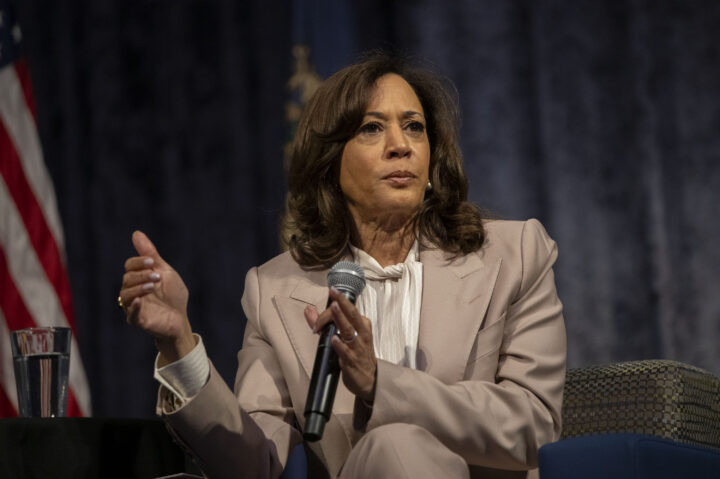
Former Vice President Kamala Harris speaks at the 38th Annual Michigan Democratic Women's Caucus Legacy Luncheon on April 18, 2026 in Detroit, Michigan.
Michigan Jewish leaders on Tuesday urged former Vice President Kamala Harris — who is set to campaign with the party’s Senate nominee, Abdul El-Sayed, in Michigan this week — to appeal to El-Sayed on issues related to antisemitism and Israel.
Meanwhile, one prominent Jewish Democratic leader and fundraiser in the state said that, without seeing significant changes in rhetoric from El-Sayed, he’s not willing to vote for him, even as the state’s Jewish attorney general, Dana Nessel, said this week that she plans to support El-Sayed.
The group of Jewish leaders, writing to Harris under the banner of the Nonnegotiable Michigan campaign, said that they are longtime supporters of her and the Democratic Party, and called on her to press El-Sayed to accept the five demands on Jewish issues and Israel that the Nonnegotiable campaign has presented.
The leaders highlighted Harris’ own history of fighting antisemitism and standing with the Jewish community, including hosting a Hanukkah celebration at the vice president’s residence and working with her Jewish husband, Doug Emhoff, on the national antisemitism strategy.
“As Vice President, you told us plainly that antisemitism ‘must be condemned unequivocally’ — no caveats, no context, no hesitation,” the letter reads. “When you accepted the Democratic nomination –– with many of us in Chicago cheering you on –– you proudly affirmed your commitment to Israel’s sovereignty and safety; you knew that promise did not contradict Palestinian dignity, security, freedom or self-determination, which you called for in the very same breath.”
The leaders said that Harris’ own stance and her understanding of antisemitism is clear, while El-Sayed “has had every opportunity to meet our request to support our basic needs. So far, he has declined even to respond” while employing antisemitic tropes and rejecting Israel’s existence as a Jewish state.
“When you stand beside Dr. El-Sayed on September 22nd, we urge you to call on him to say what he has thus far been unwilling to say: that Jewish safety, including for Zionists, is nonnegotiable,” the leaders said. “That our right to define our own identity is nonnegotiable. That Jewish statehood and self-determination in our ancestral homeland is nonnegotiable. That our full, proud participation in the Democratic Party is nonnegotiable.”
During a press call on Tuesday morning, David Kramer, a prominent Jewish donor and top Democratic official, said he was still uncomfortable supporting El-Sayed unless he agreed to a set of conditions the Jewish community laid out earlier this month. Kramer served as finance chair for Sen. Elissa Slotkin’s (D-MI) 2024 campaign and was campaign chair for Rep. Haley Stevens’ (D-MI) 2026 Senate campaign. He was also a prominent member of the Jewish Democratic effort supporting Harris in Michigan in 2024.
“I was involved with Michigan Jews for Harris. We had a pretty significant group that was, and we were proud to stand with her, and particularly proud of the work that she did with Doug Emhoff to combat antisemitism, and felt that she was a stalwart supporter of our community and the U.S.-Israel relationship,” Kramer told Jewish Insider. “We think that she’s particularly well-suited to raise non-negotiables with Abdul, given her support of our community and her unique understanding of our issues and the need for our security.”
Kramer told reporters that, if El-Sayed does not embrace the five conditions laid out by the Nonnegotiable campaign, “I’m not comfortable, at this point, voting for him.” Other Jewish leaders on the call, largely clergy who said that they were not willing to disclose who they were voting for, stopped short of explicitly making such a commitment.
Cantor Regina Lambert-Hayut added that Harris has a “very particular bird’s-eye view of what it means to be on the receiving end of a constituency feeling unheard or unsupported,” referencing the Uncommitted Campaign — which El-Sayed helped lead in 2024.
That campaign “cost — maybe fully or maybe in part — Democrats the election,” Lambert-Hayut said.
“I feel that she really understands this, and maybe she, someone with her integrity and her wisdom, could help appeal to Dr. El-Sayed to understand that every constituent matters, and to completely ignore the Jewish constituency, especially those of us who want to be able to support him, is something that I hope that she would be able to help him understand better,” she continued.
Rabbi Michael Moskowitz also emphasized that the Nonnegotiable campaign’s message extends beyond El-Sayed and Michigan. “It’s a national message we need to get out there to any candidate to understand how we feel as a Jewish community, and if that our votes count, and they need to help us in the midst of these concerns.”
El-Sayed responded dismissively when pressed on his support for the Uncommitted campaign on Tuesday, ahead of his appearance with Harris, arguing that the campaign was only designed to oppose President Joe Biden, not Harris, though many prominent Uncommitted leaders continued to pressure and protest Harris through the general election.
Kramer’s comment that he is not currently prepared to vote El-Sayed stands in contrast with Nessel, the Democratic AG, who endorsed him on Tuesday. Nessel made the endorsement alongside El-Sayed on the “For the Sake of Argument” podcast hosted by progressive activist Lori Goldman.
Nessel had previously been critical of El-Sayed and the Michigan Democratic Party more broadly, saying that she felt unsafe attending the party convention, but subsequently told Jewish Democrats in the state that they should put the “needs of the world above even our own self-interest and, yes, even our own survival.”
Kramer praised the Michigan Democratic Party and elected officials for their prompt condemnation of an incident last week in which an activist harassed and threatened Stevenson Capitol Hill for her support for Israel.
The activist involved is an officer of the Michigan Democratic Party, but the party is undertaking removal procedures. He also signed onto a letter of Jews supporting El-Sayed’s campaign, though El-Sayed also condemned his actions.
“It’s of great concern when any leader is accosted that way and things are thrown at them that are so damaging and alarming,” Moskowitz said on the press call.
While emerging technologies will be a major topic of conversation during the three-day trip, most eyes — and markets — are on the tenuous ceasefire between the U.S. and Iran
ANDREW CABALLERO-REYNOLDS/AFP via Getty Images
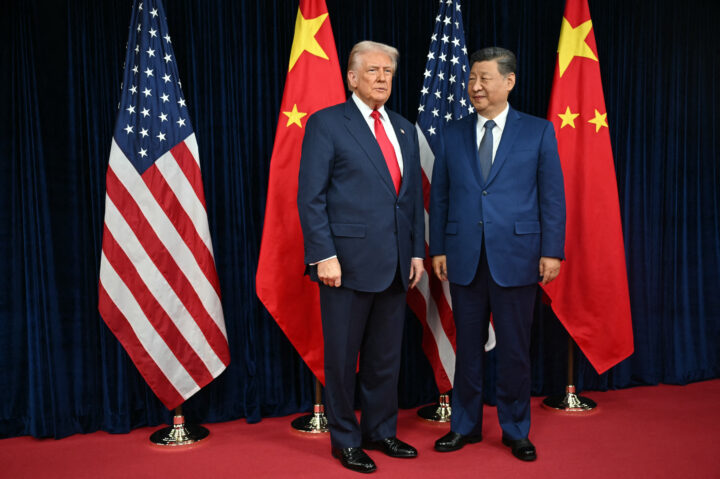
President Donald Trump (L) and Chinese President Xi Jinping arrive for talks at the Gimhae Air Base, South Korea, on October 30, 2025.
There will be a number of items on the agenda when the two most powerful men in the world — President Donald Trump and Chinese President Xi Jinping — meet in Beijing tomorrow, chief among them tech and AI. The president is bringing with him a roster of top business leaders, including Elon Musk, Nvidia’s Jensen Huang, Apple’s Tim Cook, Goldman Sachs’ David Solomon, Meta’s Dina Powell McCormick, BlackRock’s Larry Fink and Blackstone’s Stephen Schwarzman.
And while emerging technologies will be a major topic of conversation during the three-day trip, most eyes — and markets — are on the tenuous ceasefire between the U.S. and Iran.
“We have a lot of things to discuss,” Trump told reporters before departing for China. “I wouldn’t say Iran is one of them, to be honest with you, because we have Iran very much under control.” Nonetheless, the president said, “We’re going to have a long talk about [Iran]. I think he’s been relatively good, to be honest with you.”
Beijing has, after all, been playing a major role in the U.S.-Iran conflict — even if it has done so from the margins: serving as the largest importer of oil from the Islamic Republic in violation of U.S. sanctions, meeting with top Iranian officials (including last week’s sit-down between Xi and Iranian Foreign Minister Abbas Araghchi) and transferring weapons to Iran through third countries.
Indeed, the summit, delayed from earlier this year due to the war, comes amid reports of a U.S. intelligence assessment that Iran has restored access to 30 of its nearly three dozen missile sites, and days after Washington rejected an Iranian response to a U.S. proposal that fell short of the Trump administration’s demands.
China’s interest isn’t purely power-driven: it’s also economic. Being able to purchase Iranian oil at steeply discounted prices — owing to Tehran’s global economic isolation — has meant that China has not felt the same financial pressures as the West.
Trump, who has spent much of his second term welcoming leaders to Washington, will be on Xi’s home turf, face-to-face with a leader who is opting not to use his leverage to push Iran into making concessions. The longer the uncertainty continues, the more restless even the president’s most fervent supporters will get — especially with the midterms approaching.
That dynamic is already beginning to play out on Capitol Hill. Yesterday, JI reported on divisions among Republican senators over whether the U.S. should reengage militarily with Iran, while last week, Rep. Tom Barrett (R-MI), who is facing a tough reelection battle in his swing district, became the first GOP lawmaker to introduce an authorization for use of military force in Iran.
All of that is good for Xi, and gives him little incentive to use China’s economic and diplomatic leverage over the Islamic Republic, which while knocked down a few pegs, has managed to maintain control despite the severe blows it has been dealt.
The Iranian regime has been able to survive in large part because it knows how to play the long game: to drag out negotiations, give breadcrumbs instead of the whole loaf and wreak just enough havoc to serve as a disruptor without prompting massive retaliation. It has enough to survive, for now.
Xi finds himself in a similar dynamic: unbound by pending elections, unaffected by rising energy costs and distanced from military action in the Middle East, Beijing is — unlike Trump — does not need a quick resolution to the conflict.
National Security Action named Maher Bitar, a former Biden official and Students for Justice in Palestine student activist, as its new leader
Screenshot/C-SPAN
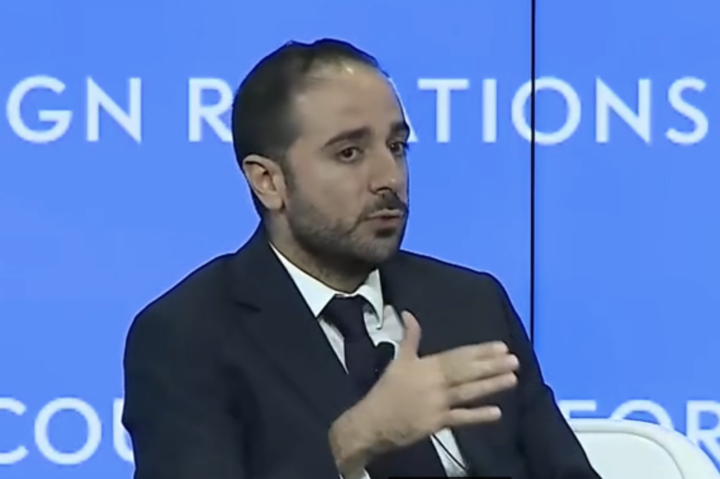
Maher Bitar
Several top Jewish Democrats are expressing concerns about the ideological direction of a newly revived foreign policy group now aiming to shape the party’s approach to Israel in the 2028 presidential election as well as a future Democratic administration.
National Security Action, an influential Democratic foreign policy organization that launched in 2018 and helped staff the Biden administration, is returning to the political arena with a new leader, Maher Bitar, who has served in high-level defense and intelligence roles on Capitol Hill and in the White House, the group confirmed on Sunday.
Bitar, a deputy assistant to President Joe Biden and coordinator for intelligence and defense policy at the National Security Council who most recently served as chief counsel and national security advisor to Sen. Adam Schiff (D-CA), has faced scrutiny over his past record of anti-Israel activism.
During his time in the Biden administration, Bitar, who is Palestinian American, drew criticism from Republican lawmakers who alleged that he had demonstrated bias against Israel, citing, among other things, his past board membership with Students for Justice in Palestine while attending Georgetown University. As a student, he had also helped organize a pro-Boycott, Divestment and Sanctions conference and was shown in a university yearbook performing a dance in front of a banner that called to “divest from Israeli apartheid.”
Ben Rhodes, a former deputy national security advisor in the Obama administration who is now a leading left-wing critic of Israel, co-founded NSA with Jake Sullivan, most recently Biden’s national security advisor. Sullivan drew headlines last year when he came out in support of withholding arms to Israel, an argument he reiterated last month on “Real Time With Bill Maher” while defending the majority of Senate Democrats who had recently voted to block some weapons sales to the Jewish state.
Both sit on NSA’s board and will be involved in the group, Rhodes told Axios, saying he is invested in building a “pipeline” to help “populate a Democratic administration” as well as crafting “ideas that can form a progressive or Democratic foreign policy going forward.”
“The center of gravity has shifted on the relationship with Israel, and there will be a debate about the nature of the relationship going forward,” Sullivan told the outlet.
“We urge National Security Action to continue to be an honest convener about these important issues,” Brian Romick, the president of Democratic Majority for Israel, told Jewish Insider. “There is a strong majority of Americans, including Democratic primary voters, who support the U.S.-Israel relationship because they understand that doing so is in the best interest of the United States.
“DMFI is proud to advocate for those voices and we recognize they have a major role to play in choosing our 2028 nominee,” Romick said.
Bitar told Axios, which first reported his role, that NSA would be a “big-tent” organization seeking to unite the party. “We are not excluding anyone,” he said, noting that the group will serve as a “hub” to discuss Democratic foreign policy “to be ready for 2028 and beyond.”
A former senior foreign policy official in the Biden administration, who was granted anonymity to address a sensitive issue, told JI that Bitar “was part of a small cohort of senior White House advisors who worked to actively undermine President Biden’s policy preferences by inserting their own anti-Israel ideology, especially” following Hamas’ Oct. 7 attacks.
“National Security Action exists to help empower our leaders and broad community of stakeholders to communicate effectively about foreign policy and bring together a wide range of perspectives,” David McGonigal, a spokesperson for the group, said in a statement to JI.
“Maher’s deep relationships across the national security community and the outpouring of support for his appointment — including from members of Congress and organizations such as J Street, the Jewish Democratic Council of America and the Nexus Project — underscore how National Security Action is uniquely positioned to carry out this important mission.”
Ethan Wolf, a Democratic strategist who previously worked as a communications director for Rep. Tom Suozzi (D-NY), told JI he was “concerned National Security Action is rewriting everything they’ve ever stood for and putting their pen in the hand of a ‘Pod Save America’ bro,” referring to Rhodes’ association with the left-wing political podcast hosted by former Obama officials who have grown increasingly hostile to Israel.
DMFI, for its part, also alluded to Rhodes and the podcast in a heated social media post on Monday. “Democrats and Americans do not want Pod Save America hosts dictating our future national security platform,” the group wrote.
Despite other reservations over Bitar’s new role, some Jewish Democrats voiced positive views about his extensive resume.
“Maher has held multiple high-level national security positions in government — in the House, in the Senate and in the Biden and Obama administrations — where he was deeply respected for his pragmatism, depth and expertise,” said Halie Soifer, CEO of the Jewish Democratic Council of America. “I enjoyed working with Maher in the Obama administration and think National Security Action is lucky to have him at the helm.”
Daniel Shapiro, a U.S. ambassador to Israel in the Obama administration who served as a top defense official in the Biden administration, said he had worked with Bitar “in various capacities for over a decade, and know him to be a thoughtful and talented national security professional.”
“When we agree and when we disagree — and we do both — Maher has always been dedicated to pursuing smart, strategic, productive policy in the national interest,” Shapiro told JI. “I am confident we will continue to have a productive dialogue. And I completely reject the prejudiced attacks against him based on his Palestinian-American identity.”
In an unsolicited statement shared by a spokesperson for Schiff, the senator said Bitar “has been devoted to addressing the country’s most complex foreign policy challenges while upholding our values and protecting America’s national security interests.”
“In this new role with National Security Action, I know Maher will continue to provide the great insights and leadership we need to get through these turbulent times,” Schiff told JI.
Joel Rubin, a progressive strategist involved in Jewish and pro-Israel causes, acknowledged what he called a “freak-out” among some Jewish leaders over Bitar, but expressed optimism that the new NSA head would be open to constructive dialogue on a divisive issue.
“As long as multiple voices are included at the table, and I have no reason to believe they won’t be, this is the reality of the Democratic Party,” said Rubin, who is releasing a new book on Democratic foreign policy this week.
Michael Makovsky, the president and CEO of the hawkish Jewish Institute for National Security of America, said, “Given the recent anti-Israel statements and actions of possible Democratic presidential candidates, even historically pro-Israel ones such as Rahm” Emanuel “and centrist former officials like Jake Sullivan, it will be interesting to see if the big tent the organization says it’s seeking will include real pro-Israel voices.”
NSA is also hiring an associate director for polling and outreach to “support its work advancing a smart, principled vision of U.S. foreign policy, while pushing back on the Trump administration’s reckless national security policies,” according to a job listing posted to its website.
The group’s previous executive director, Caroline Tess, a former National Security Council official in the Obama administration, stepped down in 2025.
Rep. Ritchie Torres: ‘Hopefully you’ll have a Democratic Party with enough successors to sustain and strengthen the U.S.-Israel relationship’
Nathan Posner/Anadolu via Getty Images
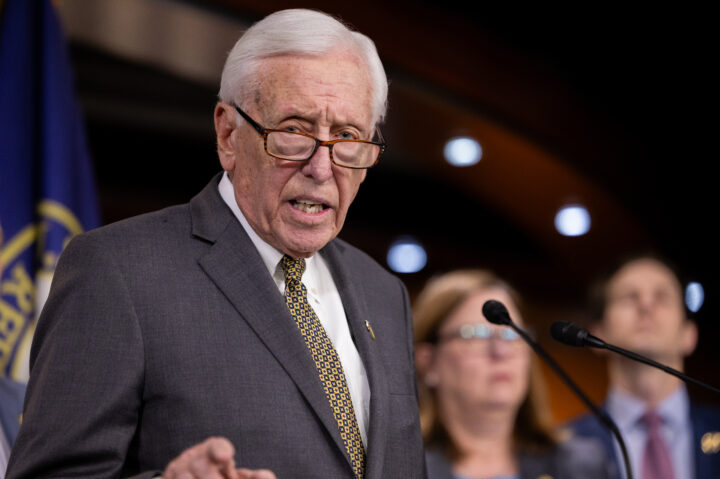
Congressman Steny Hoyer (D-MD) speaks at a press conference in Washington, DC on February 24, 2025.
Democratic lawmakers and leaders are lauding Rep. Steny Hoyer (D-MD), the longtime former No. 2 Democratic House leader, as a champion for Israel and say that his retirement, announced Thursday, will deprive Democrats of one of the leading congressional advocates of a strong U.S.-Israel relationship.
Hoyer, 86, has served in Congress since 1981, and was the second-most senior House Democrat from 2007-2023. A prominent voice respected by colleagues on both sides of the aisle, Hoyer has for years led first-term Democrats on trips to Israel with the AIPAC-affiliated American Israel Education Foundation. His retirement comes at a time of a sea change on Israel policy among Democratic lawmakers and the party base.
Though he has at times offered criticism of Israeli policies and voted — despite serious objections — for the 2015 Iran nuclear deal, Hoyer has remained among the most steadfast and outspoken Democratic supporters of Israel during the war in Gaza and was largely supportive of the U.S. strikes on Iran last June.
Rep. Ritchie Torres (D-NY) told Jewish Insider that Hoyer has “historically … been one of the guardians of the U.S.-Israel relationship within the Democratic Party.”
“He will have no replacement, but hopefully you’ll have a Democratic Party with enough successors to sustain and strengthen the U.S.-Israel relationship,” Torres continued.
“He has been a great friend to Israel. I’ve traveled to Israel with him. I’ve stood with him in the Appropriations Committee to make sure Israel gets the financial support that it needs to be secure,” Rep. Lois Frankel (D-FL) told JI. “When you look around this chamber, it’s hard to find many members who have been so long standing advocate[s] for the security of Israel.”
“You see a new wave of of members coming in on both sides who don’t really have the historic context of the importance of security for Israel — and so, yeah, he’s a big loss,” Frankel continued.
Rep. Jared Moskowitz (D-FL) told JI that Hoyer’s retirement would be a “huge loss” for supporters of the U.S.-Israel relationship.
“We’re seeing that — not just with people like [Hoyer], but other senior members — that when they leave, the people who are replacing them are not just [not] pro-Israel. They’re anti-Israel,” Moskowitz said. “What flavor of anti-Israel are we going to get? So for the pro-Israel community, it’s a whole separate concern.”
Hoyer’s suburban Maryland district is safely Democratic, and includes the eastern D.C. suburbs and the outskirts of Annapolis and Baltimore. Five candidates have already declared their candidacy in the district, and several ambitious Maryland political figures could join the race.
Former House Speaker Kevin McCarthy (R-CA) noted in a statement that the two leaders’ experience leading delegations to the Jewish state was one of the factors that united them across the partisan divide.
Brian Romick, the CEO of Democratic Majority for Israel, who previously served as Hoyer’s chief of staff and worked for the congressman for almost three decades — beginning as a teenage campaign volunteer — said that one of the critical lessons Hoyer taught him was “why America must remain a steadfast friend of Israel.”
“I helped him lead 12 congressional delegations there, ensuring that members of Congress learned not just about the important strategic relationship between the United States and Israel but also about the miracle of Israel’s very existence,” Romick said. “Those trips were powerful and transformative experiences for us. He worked relentlessly to ensure Israel had the resources it needed to defend itself by itself and fought back against attempts to undermine the U.S.-Israel relationship.”
“Our country, the Democratic Party and the pro-Israel movement are all in a better place today because of his service,” Romick continued.
In a statement, AIPAC praised Hoyer as “one of the most principled champions of the U.S.-Israel alliance to ever serve in Congress.”
“His unwavering commitment to building bipartisan support for Israel’s security, leadership on dozens of congressional delegations to Israel, and moral clarity in defending this partnership have made an impact that will be felt for generations to come,” the organization said.
Outside of his support for Israel, colleagues praised Hoyer as a leader, mentor and a steadfast champion of Congress as an institution.
“Congressman Hoyer is just a very good friend,” Frankel said. “I love him, and I’m going to miss him a lot, and his legacy is amazing. … His departure is going to be a loss in a lot of areas. I mean, the man is amazing, and his historic knowledge of this body is just awesome.”
Moskowitz said that the “institution won’t be the same without him.”
“Steny’s record on a whole host of issues — and also, when new members come in, Steny’s one of the folks that takes you on a tour of this building,” Moskowitz continued. “He brings you along, he helps train you, he also makes you understand when you’re in the majority how you govern, and when you’re in the minority, how you [can] be the loyal opposition. His presence is going to be deeply missed.”
Torres called Hoyer “an institution” who has “dedicated 45 years of his life to serving Congress.”
“You’d be hard-pressed to find someone who has a greater reverence for Congress as an institution than Steny Hoyer,” he said.
Romick lauded Hoyer for teaching him “lessons that will stay with me for a lifetime,” and said that his work with Hoyer “profoundly … shape[d] my career and my character.”
“His strong leadership and ability to build consensus to pass important legislation improved the lives of Americans,” Romick added.
Even McCarthy, in his statement, said that Hoyer “earned the mutual respect of his colleagues on both sides of the aisle — as a fair dealer, a respected leader, and an institution within the institution he most loved,” calling Hoyer “a good friend” and “the only one trustworthy in his party’s leadership team.”
“The House, his constituents in Southern Maryland he has represented for over 40 years, and our nation are indebted to the service of a statesman like Steny Hoyer,” McCarthy said.
The IDF said it targeted Hamas’ senior leadership amid explosions in Doha

Screenshot/X
Israel strikes Hamas leadership in Doha, Qatar on Sept. 9, 2025.
Israel conducted a strike against senior Hamas leaders, the IDF said on Tuesday, following reports of explosions in Doha, Qatar.
The operation, whose Hebrew name translates to “Judgment Day,” reportedly targeted Khalil al-Hayya, Hamas’ chief negotiator in hostage and ceasefire talks, and longtime senior Hamas official Khalid Mashaal, as well as Hamas officials Zaher Jabarin and Nizar Awadallah, though reports conflict as to the success of the strike.
Israeli Prime Minister Benjamin Netanyahu and Defense Minister Israel Katz said in a joint statement that the Israeli defense establishment unanimously supported the strike.
“The action is totally justified in light of the fact that Hamas leadership initiated and organized the Oct. 7 massacre and did not stop launching murderous actions against Israel and its citizens since then, including taking responsibility for the murder of our civilians in the terrorist attack in Jerusalem yesterday,” they stated.
President Donald Trump was informed of the strike in advance and supported it, Israel’s Channel 12 reported. Netanyahu’s office said that “today’s action against the top terrorist chieftains of Hamas was a wholly independent Israeli operation. Israel initiated it, Israel conducted it, and Israel takes full responsibility.”
“The IDF and [Israel Security Agency (Shin Bet)] conducted a precise strike targeting the senior leadership of the Hamas terrorist organization,” the IDF Spokesperson’s Office stated. “For years, these members of the Hamas leadership have led the terrorist organization’s operations, are directly responsible for the brutal October 7th massacre, and have been orchestrating and managing the war against the State of Israel.”
The IDF said that it used precision munitions and intelligence to reduce harm to civilians.
Hamas leadership is based in the Al-Qatar neighborhood of Doha, where the explosions took place, according to videos posted on social media.
Qatar said it “strongly condemns” the strike in a statement posted to X by Majed Al-Ansari, spokesman for the Qatari Ministry of Foreign Affairs, which described the operation as “a cowardly Israeli attack that targeted residential buildings housing several members of the Political Bureau of Hamas in the Qatari capital, Doha.”
“This criminal assault constitutes a blatant violation of all international laws and norms, and poses a serious threat to the security and safety of Qataris and residents in Qatar,” he added, and said that Qatar “will not tolerate this reckless Israeli behavior and the ongoing disruption of regional security, nor any act that targets its security and sovereignty.”
The strike took place days after the Trump administration sent a Gaza ceasefire and hostage deal proposal via intermediaries, which Israel accepted and a senior Hamas official based in Istanbul rejected.
Earlier Tuesday, Netanyahu left a hearing in his ongoing corruption trial early due to “an exceptional security matter,” Israeli public broadcaster Kan reported.
In 1997, Israel attempted to assassinate Mashaal, the head of Hamas’ political bureau at the time, in Jordan, but gave Amman the antidote for the poison after then-King Hussein threatened to cancel the peace treaty between the countries.
Dennis Ross and David Makovsky’s new book claims that past Israeli leaders have made brave moves, but Netanyahu prioritizes political considerations

Washington Institute
David Makovsky and Dennis Ross.
Former U.S. negotiators and veteran diplomats David Makovsky and Dennis Ross are out with a new book this week. During an in-depth conversation with Jewish Insider, the pair discussed their latest work titled Be Strong and of Good Courage: How Israel’s Most Important Leaders Shaped Its Destiny.
Makovsky and Ross focus on four Israeli prime ministers — David Ben-Gurion, Menachem Begin, Yitzchak Rabin and Ariel Sharon — who, the book says, “met the bar of history” by making courageous decisions that shaped the present and future of Israel.
Ross told JI that they decided to write the book out of a concern that Israel is on a path towards “one state for two peoples,” due to indecision by the Israeli government. “Historically, there have been Israeli leaders who always rose to the occasion and understood that when you face big stakes, you have to make a choice; realize that while there’s always a cost in making a decision, there’s also at times even a higher cost from not making a decision,” Ross said.
Another objective of the book, the authors wrote, was to provide U.S. leaders with ideas that would “make it easier for an Israeli prime minister, whoever it might be, to make a decision” by providing them “political tailwind” to convince the settler community to support an initiative that is of strategic value to Israel’s security.
According to Makovsky, the focus on Ben-Gurion, Begin, Rabin and Sharon was intended to highlight the successes of those leaders. While previous prime ministers — such as Ehud Barak and Ehud Olmert — also made far-reaching offers to move towards peace with the Palestinians, “for whatever reason there wasn’t a breakthrough,” he asserted.
“We thought it’s important for the public to understand that there are people who rose to extraordinary challenges and were successful’’ because they chose to deal with the issue and not kick the can down the road. “They were making a decision that was going to produce either high costs or a terrible political blowback and they were prepared to take that on anyway.”
Makovsky stressed that he and Ross wrote the book as “two centrists. There’s no discourse of polarization, no name-calling of anybody. We’re trying to drive some inspiration from the past in facing the challenges of the future. And, maybe, this book defies political gravity in Washington.”
The former journalist and diplomat said they are “trying to address an issue that is hyper-politicized in a very dispassionate way — because we don’t think that this issue was solved in the end zones of the political spectrum. We think we need to galvanize a consensus in the middle and we think the way to look at it is not to bash people over the head on either side of the parties — in this country or in Israel — but to look at the leaders who actually made a difference.”
Ross warned that Israel is approaching a tipping point at which the option of a two-state solution will no longer be viable. “We make the case that there is no two-state outcome anytime soon. I mean, if you ask me, we are talking 10 to 20 years at a minimum,” he said. “But it’s that tipping point that you have passed where you lose the ability to separate Israelis from the Palestinians, then your only outcome is one state.”
Both Ross and Makovsky agree that Israeli Prime Minister Benjamin Netanyahu’s lack of decision on this issue is driven by political convenience, not ideology or stubbornness. Makovsky is bothered that Netanyahu never made an effort to prepare his base for compromise.
“It is disappointing that someone who’s clearly very bright and is very capable — he’s certainly not shy in shaping the public’s response on Iran — when it comes to political survival, he is always focused on survival rather than changing the public’s attitude on this issue,” he said. “And I think that sets him apart from these other four leaders. These other four leaders found not just that they had to take a right course, but they had to explain it. They did not sugarcoat the problem, because they were problem-solvers. I think that when Netanyahu’s intellectual conclusions clash with his political imperatives, he tends to go with the political imperative.”
Ross echoed the last chapter of the book with regards to Netanyahu: “You don’t become prime minister unless you have political smarts and capability and insight. You certainly don’t become Israel’s longest-serving prime minister, as Netanyahu has, unless you also have an enormous amount of talent,” the former Mideast envoy said. “What we describe him as is someone that — when it comes to dealing with the Arabs, managing what was the Arab awakening, looking at the nature of the Iranian threat — he has been strategic in character and in policy. When it comes to dealing with the Palestinians, we describe him as being political, always trying to find a way to manage his political base even as he’s also trying to manage what he sees as pressures from the outside.”
Turning to the upcoming Israeli repeat election, Ross expressed concern that the Israeli-Palestinian issue is not even discussed as something that has a longterm effect on the Jewish and democratic future of Israel.
“I would love to see a discussion in the Israeli election on separation,” he said. “My guess is, if that actually was the discussion, you’d find most Israelis say, ‘yeah, we think we should separate from the Palestinians.’ The problem is that there isn’t a policy today that reflects that.”
Please log in if you already have a subscription, or subscribe to access the latest updates.
 Continue with Google

 Continue with Apple