

















‘If anything, I might have forced Israel's hand,’ Trump said after Rubio’s previous comments were interpreted as placing blame on Israel
Samuel Corum/Sipa/Bloomberg via Getty Images
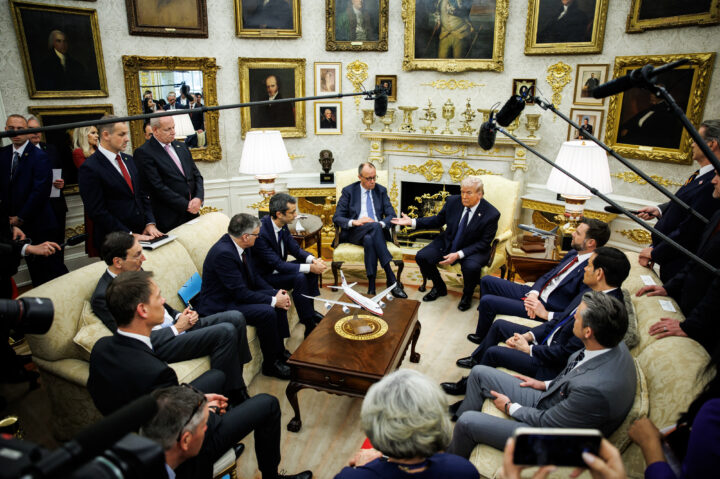
Friedrich Merz, Germany's chancellor, center left, and US President Donald Trump during a meeting in the Oval Office of the White House in Washington, DC, US, on Tuesday, March 3, 2026.


 Add JewishInsider on Google
A chorus of senior Trump administration officials, including White House Press Secretary Karoline Leavitt, Secretary of State Marco Rubio and Defense Secretary Pete Hegseth sought to offer a decisive rebuttal on Tuesday to what they deemed to be a false narrative, which had spread like wildfire a day before.
They were all responding to the political tumult and online furor that erupted after Rubio briefed congressional leaders about the U.S. military operation in Iran on Monday afternoon.
A narrative quickly formed — based in large part on a viral post on X from the White House clipping an excerpt of Rubio’s comments — that Trump decided to strike Iran because Israel was already planning an attack, which would then prompt Iranian retaliation, thus putting American troops at risk.
“The president made the very wise decision — we knew that there was going to be an Israeli action, we knew that that would precipitate an attack against American forces, and we knew that if we didn’t preemptively go after them before they launched those attacks, we would suffer higher casualties,” Rubio told reporters.
The White House shared that sound bite in a post on X that was viewed more than 13 million times in less than a day. Rubio’s Monday messaging about Israel was echoed by House Speaker Mike Johnson (R-LA) after he and other congressional leaders received Rubio’s briefing.
The question that was then posed dozens of times by reporters to policymakers: Had Israel forced America’s hand and dragged the U.S. into war?
Never mind that Rubio also said in those same remarks the U.S. was not “forced” to strike because of an impending Israeli action. “No matter what, ultimately, this operation needed to happen,” Rubio said. The White House shared that sound bite on X Tuesday morning, drawing 500,000 views, a fraction of the visibility of the earlier post. “No, Marco Rubio Didn’t Claim That Israel Dragged Trump into War with Iran,” was the headline Leavitt posted on X. But the damage had already been done.
Fox News host Sean Hannity asked Israeli Prime Minister Benjamin Netanyahu the same question in a Monday night interview. “You don’t have to drag him into anything,” Netanyahu said of Trump. “He does what he thinks is right for America.”
Another reporter then posed the question to Trump directly on Tuesday during an Oval Office meeting between the president and German Chancellor Friedrich Merz.
“No,” Trump said decisively. “I might have forced their hand.” Hegseth then chimed in on X boosting Trump’s message: “This is 100% correct.”
Rubio similarly refuted a reporter who said the U.S. needed to get involved because Israel was going to strike Iran.
“Your statement is false,” he said Tuesday during another visit to Capitol Hill for all-member briefings in the House and Senate. “Somebody asked me the question yesterday, did we go in because of Israel … I told you this had to happen anyway. The president made a decision, and the decision he made was that Iran was not going to be allowed to hide behind its ballistic missile program, that Iran was not going to be allowed to hide behind its ability to conduct these attacks. That decision had been made.”
The question, he said, was “a question of timing, of why this had to happen as a joint operation. Not the question of the intent.”
Some questions remain unanswered. Trump told reporters alongside Merz that Iran was going to attack first, but it was not clear whom he expected Iran to attack, the Israelis or the Americans. A White House spokesperson did not respond to requests for comment.
“We were having negotiations with these lunatics, and it was my opinion that they were going to attack first,” Trump said. “Based on the way the negotiation was going, I think they were going to attack first, and I didn’t want that to happen. So if anything, I might have forced Israel’s hand, but Israel was ready, and we were ready, and we’ve had a very, very powerful impact.”
Even as the White House refuted the narrative that Israel had pulled the U.S. into war and put American servicemembers at risk, Democratic lawmakers and right-wing podcasters turned it into an online rallying cry.
“So Netanyahu now decides when we go to war? So much for America First,” Sen. Ruben Gallego (D-AZ) said in a post on X on Monday. Ben Rhodes, the deputy national security advisor to President Barack Obama, argued Trump could not bring himself to say no to Netanyahu: “Donald Trump is so weak that he couldn’t tell Bibi Netanyahu no, so now we are at war,” he said in response to the Rubio clip.
Sen. Mark Warner (D-VA), who was in Monday’s briefing by Rubio, afterward described the strikes as “dictated by Israel’s goals and timelines” and said he opposed them.
On the right, Matt Walsh of The Daily Wire sharply criticized Rubio. “So he’s flat out telling us that we’re in a war with Iran because Israel forced our hand. This is basically the worst possible thing he could have said,” Walsh wrote.
The conservative pundit Megyn Kelly said that the American servicemembers who have so far died in the campaign did not give their lives for the United States. “No one should have to die for a foreign country. I don’t think those four service members died for the United States. I think they died for Iran or for Israel,” she said on Monday.
Now progressive Jewish groups are attacking the White House, saying that pinning the war on Israel feeds into antisemitic conspiracy theories.
“Shifting blame for American military decisions to Netanyahu is an abdication of responsibility and comes with the dangerous side effect of fueling antisemitic sentiment in the United States,” J Street President Jeremy Ben-Ami said Tuesday.
The Jewish Democratic Council of America called Rubio’s language “unprecedented, dangerous and deeply irresponsible.”
“As Jewish Americans, we’re deeply concerned about the consequences of the White House effectively blaming Israel for its decision to launch a war against Iran, which has now spread to the entire Middle East,” JDCA said in a Tuesday statement.
The Republican Jewish Coalition, meanwhile, spent Tuesday reposting messages from the White House, the Senate Republican Caucus and the Pentagon that Israel had not, in fact, dragged the U.S. into war.
Rubio attempted to offer a final rebuttal of the narrative about Israel driving the war when he was back on Capitol Hill on Tuesday. He acknowledged how his comments the day before had spread — although he did not mention that the White House played a role in amplifying them.
“If you’re going to play the statements, you need to play the whole statement, and not clip it to reach a narrative,” said Rubio.
The publication, founded to provide coverage explicitly hostile to Israel, has credulously interviewed several Hamas leaders
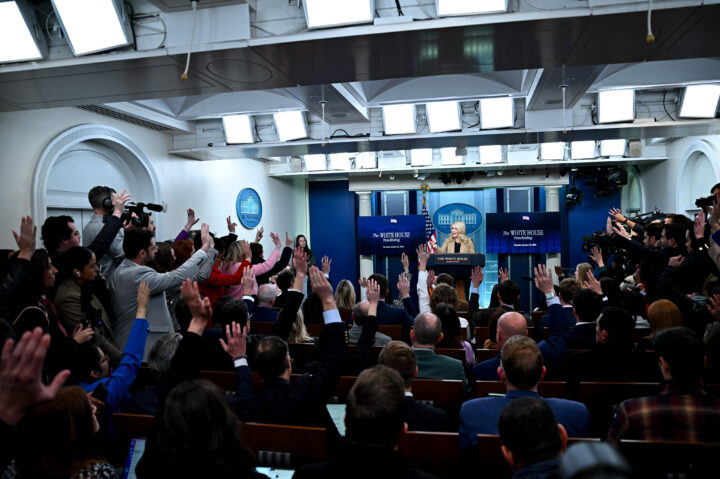
Graeme Sloan/Bloomberg via Getty Images
James S. Brady Press Briefing Room of the White House in Washington, DC, US, on Thursday, Jan. 15, 2026.
In her first week on the job last year, White House Press Secretary Karoline Leavitt announced that she planned to shake up the establishment-oriented press corps by creating a seat at White House press briefings reserved for new media outlets — a broad category that would include “independent journalists, podcasters, social media influencers and content creators,” she said.
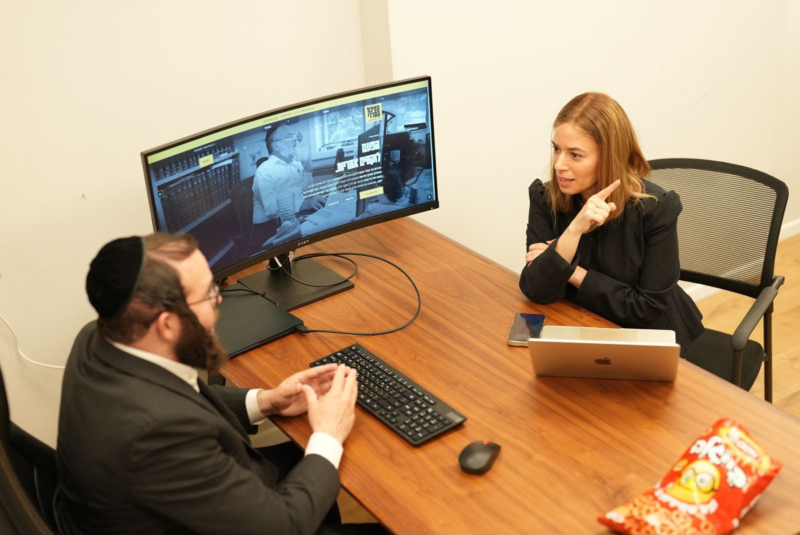
One recent pick for the daily new media seat in the rotation stood out: Drop Site News, a publication founded in the summer of 2024 to offer reporting explicitly hostile to Israel over the war in Gaza and the U.S. response to it.
The far-left Drop Site’s inclusion among the outlets in Sunday’s press rotation — the group of TV, radio and print outlets selected to travel with and report on the president for the day — was a marked contrast to the mostly right-wing outlets like The Federalist and Gateway Pundit that are usually selected. Some newer, more centrist sites like Semafor and NOTUS have also been selected for the new media seat.
Drop Site launched in July 2024 with an 8,000-word interview with two senior Hamas leaders in an article described as an “exclusive” conversation with officials from the terrorist group about “their motivations, political objectives and the human costs of their armed uprising against Israel.” Since then, the outlet has gained a reputation of credulously reporting on Hamas’ claims and repeating the group’s propaganda.
Last April, Drop Site’s official X account, which has 273,000 followers, shared a message from Hamas calling for “days of rage in the face of the occupation and its supporters.” Drop Site has also vigorously argued that claims that Hamas terrorists raped anyone during the Oct. 7 attacks in Israel are false, despite widespread Israeli testimony to the contrary. A recent social media post from the site called it a “racist lie” to claim that rape occurred on Oct. 7.
A national security reporter at Drop Site said in a post on X in January that Iran “should have fired every single missile on Oct. 8 while Israel was in disarray.” Amid anti-government protests in Iran that were violently suppressed by the regime last month, Drop Site shared a video that reportedly showed thousands of people marching “to express unity with the Islamic Republic’s leadership and reject what officials described as foreign-linked unrest and plots aimed at destabilizing the country.”
Drop Site was founded by Jeremy Scahill, Ryan Grim and Nausicaa Renner, veterans of the far-left investigative outlet The Intercept and outspoken critics of Israel. Scahill described Drop Site as “a non-aligned, investigative news organization” that will take “big swings at powerful people and institutions.” Grim did not respond to a request for comment on Monday.
The news outlet is a nonprofit, funded by reader contributions. It is fiscally sponsored by Social Security Works Education Fund, a Washington organization that educates about the importance of Social Security benefits. Open Society Foundations, George Soros’ philanthropic organization, donated $250,000 to Drop Site in 2024 to support its Middle East coverage, the Washington Free Beacon reported.
In September 2025, Drop Site promoted a fundraiser to “help the journalists in Gaza City evacuate safely.”
Drop Site’s inclusion in the press pool occurred on a Sunday, when Leavitt did not host a press briefing, so its reporter did not get the opportunity to ask a question. Still, the outlet chosen to fill the new media slot is selected by the White House communications team, not by the independent White House Correspondents Association.
A White House spokesperson did not respond to a request for comment.
In December, Scahill went to Doha, Qatar, to interview Khaled Meshaal, who spent 20 years leading Hamas’ political bureau. Drop Site published the text of their interview in full, in which Meshaal offered a look at how Hamas views the publication: “I appreciate your keenness to conduct this interview and for providing this space and platform for me and for all those who represent the Palestinian cause,” Meshaal said.
As conflicting accounts emerge about the strike’s outcome, Trump voices frustration while Netanyahu says the operation could bring the war in Gaza closer to an end
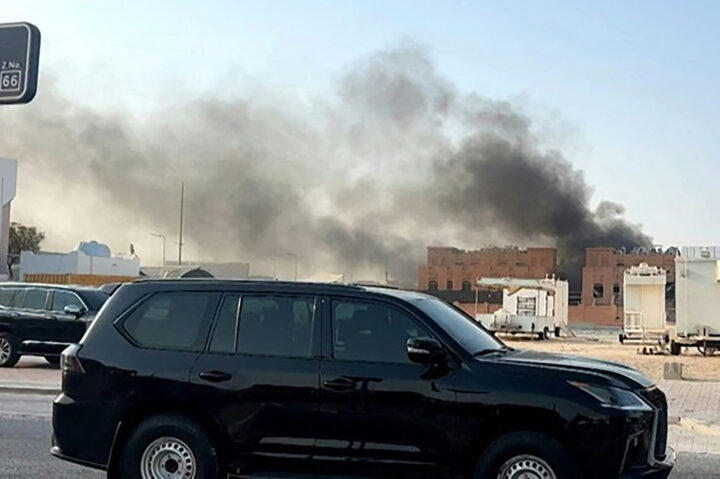
JACQUELINE PENNEY/AFPTV/AFP via Getty Images
This frame grab taken from an AFPTV footage shows smoke billowing after explosions in Qatar's capital Doha on September 9, 2025.
Nearly a day after an Israeli airstrike targeted a meeting of high-level Hamas officials in Doha, Qatar, there are more questions than answers, both in Jerusalem and Washington. Israel has not confirmed which officials were killed in the strike, while Hamas has said that five officials from the group, including the son of Hamas’ chief negotiator, Khalil al-Hayya, were killed in addition to a member of the Qatari security forces.
Israeli reports earlier today indicate that the strike did not kill the most senior echelon of the terror group, which for years has been based in Qatar, a U.S. ally.
Amid ongoing uncertainty over the success of the strike, the operation was met with rare condemnation from the White House, first from Press Secretary Karoline Leavitt and then from President Donald Trump himself, who said he “was very unhappy about it, very unhappy about every aspect” — perhaps, in part, because the operation is not believed to have taken out the most senior Hamas officials.
But it was Trump himself who said over the weekend on his Truth Social site that he had “warned Hamas about the consequences of not accepting” the ceasefire and hostage-release deal that had been put forward by the U.S.
At the same time that Trump officials, including the president, were criticizing the operation, U.S. Ambassador to Israel Mike Huckabee was embracing Israeli Prime Minister Benjamin Netanyahu at the U.S. Embassy’s belated Independence Day celebration in Jerusalem, where the prime minister addressed a smaller group of VIPs attending the party.
“Israel acted wholly independently and we take full responsibility for this action,” Netanyahu said of the Doha strikes. “This action can open to an end of the war in Gaza.”
Israeli officials and defense sources said on Wednesday that they are waiting for better intelligence before commenting on who was killed, but they viewed the operation as a success.
Israeli Defense Minister Israel Katz warned that there could be additional strikes of this kind: “The long hand of Israel will act against its enemies anywhere in the world. There is no place where they can hide. Whoever was a partner in the Oct. 7 massacre will be fully brought to justice.”
Everyone from Israeli Opposition Leader Yair Lapid to Finance Minister Bezalel Smotrich put out statements praising the IDF and Shin Bet and saying the terrorists got what they deserved.
At the same time, the Hostages and Missing Families Forum said the affiliated families felt “deep concern and heavy anxiety” that their loved ones would pay the price. “We know from survivors who have returned that the revenge directed at the hostages is brutal. The chance of bringing them back now faces greater uncertainty than ever before.”
However, Shimon Or, uncle of hostage Avinatan Or, said on Kan radio that “this action brings us closer to bringing Avinatan and the rest of the hostages. …We will not bring back the hostages anymore with military operations and ‘the gates of hell,’ but with control over Gaza.”
Meanwhile, Israeli officials have pushed back on criticism that the strikes would affect ceasefire talks, briefing press in Hebrew and English that the operation will help talks, because there are other channels for negotiations.
White House Press Secretary Karoline Leavitt: ‘Unilaterally bombing inside Qatar … does not advance Israel or America’s goals’
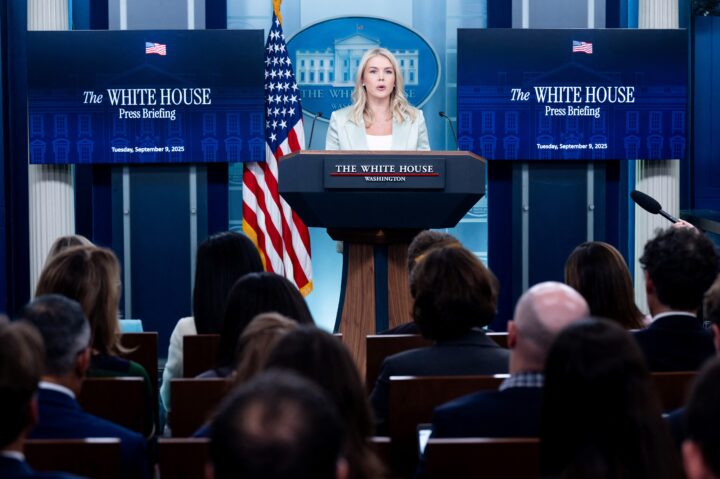
SAUL LOEB/AFP via Getty Images
White House Press Secretary Karoline Leavitt speaks during a press briefing in the Brady Briefing Room of the White House in Washington, DC, on September 9, 2025.
In a prepared statement on behalf of President Donald Trump, White House Press Secretary Karoline Leavitt on Tuesday criticized the Israeli strike on Hamas leaders in Qatar and expressed regret that it had taken place in Doha, adding that the U.S. had warned Qatar about the strike when the U.S. itself became aware.
She said Trump had also vowed to Qatari leaders that such an attack would not be repeated in Qatari territory.
“This morning, the Trump administration was notified by the United States military … as Israel was attacking Hamas, which very unfortunately was located in a section of Doha, the capital of Qatar,” Leavitt said. “Unilaterally bombing inside Qatar, a sovereign nation and close ally of the United States that is working very hard and bravely taking risks with us to broker peace, does not advance Israel or America’s goals.”
Pressed repeatedly on whether Israel had notified the U.S. about the attack, as some reports indicated, or whether the U.S. military had detected it independently, Leavitt did not specify, repeating only that the U.S. military had notified the White House.
She said that Trump “immediately directed” Middle East envoy Steve Witkoff to notify Qatar about the upcoming attack when the administration learned about it.
“The president views Qatar as a strong ally and friend of the United States and feels very badly about the location of this attack,” Leavitt continued.
She did add, however, that the administration views eliminating Hamas as “a worthy goal.”
Asked whether Trump would impose “consequences” on Israeli Prime Minister Benjamin Netanyahu for the strike or provide a “directive … to Netanyahu in terms of what’s allowed in the future,” Leavitt said that “that’s a decision only the president can make.”
Leavitt said that Trump had spoken to Qatari Emir Tamim bin Hamad Al Thani, Prime Minister Mohammed bin Abdulrahman Al Thani and Netanyahu after the attack.
She said the president “assured [the Qatari leaders] that such a thing will not happen again on their soil” and thanked Qatar for “their support and friendship to our country.”
She said that both Trump and Netanyahu agreed that they want to make peace quickly and said Trump “believes this unfortunate incident could serve as an opportunity for peace,” and that Trump had conveyed his displeasure about the location of the strike to Netanyahu.
“He expects all of our friends and allies in the region — that includes both Qatar and Israel — to seek peace as well, and he wants to see that happen, and he’s working with all of our allies in the region to get that done,” Leavitt said.
Leavitt denied that Trump’s post on social media over the weekend offering a “last warning” to Hamas to accept a ceasefire deal was a reference to the impending Israeli attack.
The White House’s expressed concern about the location of the attack puts the administration at odds with many senior members of Trump’s own party in the Senate, who were quick to express support for the Israeli attack, and aligns more closely with top Senate Democrats who have been more critical of the attack and where it took place.
Asked about the White House’s opposition to the strike, multiple Senate Republicans who had earlier in the day expressed support for the Israeli attack declined to comment.
Meanwhile, Sen. Chris Coons (D-DE) said, “I will actually agree with President Trump that it doesn’t advance our interests in terms of advancing negotiations for the release of hostages or the ceasefire that is urgently needed in Gaza.”
“I have not gotten any briefing on the details of how it was approved, whether or not the Trump administration was aware and supported it, but in the middle of a hostage negotiation that is urgently needed to free the hostages, to end the fighting, to deliver humanitarian relief and to address Hamas — to take a strike in Doha against Hamas leaders, I think puts at risk any peace process,” Coons said. He added that he wants to be briefed on further details.
Press Secretary Karoline Leavitt: ‘In both accounts, the president quickly called the prime minister to rectify those situations’

ANDREW CABALLERO-REYNOLDS/AFP via Getty Images
President Donald Trump (R) meets with Israel's Prime Minister Benjamin Netanyahu in the Oval Office of the White House in Washington, DC, on February 4, 2025.
White House Press Secretary Karoline Leavitt said on Monday that President Donald Trump was “caught off guard” by recent Israeli actions in Syria and Gaza, noting that he had called Israeli Prime Minister Benjamin Netanyahu to air his concerns.
Leavitt made the comments after being asked if the president had “expressed his frustration” with Netanyahu directly over the fatal attack on the Holy Family Catholic Church, the only Catholic church in Gaza, and the IDF’s move to strike government buildings in Damascus, Syria’s capital, last week during sectarian clashes that drew in Syrian government forces and left more than 1,000 people dead. The strikes on Syria came as the Trump administration has thrown its full support behind the new government and urged Israel to normalize relations with the war-torn country.
“The president enjoys a good working relationship with Prime Minister Bibi Netanyahu and stays in frequent communication with him. He was caught off guard by the bombing in Syria and also the bombing of the Catholic Church in Gaza,” Leavitt told reporters outside the White House.
The White House press secretary went on to note that Trump and Secretary of State Marco Rubio stepped in to prevent an escalation in Damascus and to demand answers on the church strike.
“In both accounts, the president quickly called the prime minister to rectify those situations, and we saw Secretary Rubio intervene when it came to Syria. We saw a deescalation there. And as for the bombing of the Catholic church in Gaza, the prime minister did put out a statement saying this was an accident and they deeply regretted that action on behalf of the State of Israel following his conversation with the president,” Leavitt explained.
The strike on the church killed three and injured 10, including a priest.
Leavitt later added when asked about the church bombing, “The president’s message on this conflict we’ve seen in the Middle East taking place for far too long, that has become quite brutal, especially in recent days, you’ve seen reports of more people dying. I think the president never likes to see that. He wants the killing to end.”
Earlier Monday, U.S. Ambassador to Turkey Tom Barrack, who is also serving as special envoy to Syria, criticized Israel’s actions in the country, telling the Associated Press that Jerusalem’s intervention in Syria “creates another very confusing chapter” in the region and “came at a very bad time.”
“The United States was not asked, nor did they participate in that decision, nor was it the United States’ responsibility in matters that Israel feels is for its own self-defense,” Barrack told the outlet of Israel’s strikes on Syria.
Barrack conceded that “both sides did the best they can” in negotiations leading up to the ceasefire he announced between Israel and Syria over the weekend, praising the two countries for trying to find common ground on issues such as the transfer of Syrian forces and military equipment from Damascus to Sweida, where members of the Druze religious minority have been under frequent attacks from Sunni Muslim Bedouin tribes.
Following Trump's suggestion that he was supportive of regime change in Iran, Press Secretary Karoline Leavitt said he was 'just raising a question'

Anna Moneymaker/Getty Images
White House press secretary Karoline Leavitt speaks to reporters outside of the West Wing of the White House on June 02, 2025 in Washington, DC.
Despite President Donald Trump posting on Truth Social on Sunday suggesting that he sought regime change in Iran, White House Press Secretary Karoline Leavitt downplayed his remarks when speaking to reporters on Monday morning.
“The president was just raising a question that I think many around the world are asking,” Leavitt said. “If the Iranian regime refuses to give up their nuclear program or engage in talks, we just took out their nuclear program on Saturday night, as you all know. But if they refuse to engage in diplomacy moving forward, why shouldn’t the Iranian people rise up against this brutal terrorist regime? That’s the question the President raised last night.”
Trump posted earlier, “It’s not politically correct to use the term, ‘Regime Change,’ but if the current Iranian Regime is unable to MAKE IRAN GREAT AGAIN, why wouldn’t there be a Regime change?”
His comments were at odds with other senior administration officials who have insisted that the U.S. strikes were solely intended to disable the Iranian nuclear program and that Trump still remained focused on securing a diplomatic solution.
“We do not want regime change,” Vice President JD Vance said on NBC News’ “Meet the Press” on Sunday. “We do not want to protract this or build this out anymore than it’s already been built out. We want to end their nuclear program and then we want to talk to the Iranians about a long-term settlement here.”
Leavitt insisted to reporters that the U.S. was successful in completely destroying the Iranian nuclear program, despite signs that the fortified nuclear site of Fordow was severely damaged, but not completely destroyed. In the days prior to the strike, satellite imagery also showed trucks stationed at Fordow, leading some analysts to speculate that Iran evacuated some of its uranium stockpile.
Please log in if you already have a subscription, or subscribe to access the latest updates.
 Continue with Google
 Continue with Apple