









































































Democrats on both sides of the vote argued that the U.S. is not actually engaged in hostilities in Lebanon, while Rep. Rashida Tlaib criticized Lebanon’s talks with Israel

Jabin Botsford/The Washington Post via Getty Images
Rep. Rashida Tlaib (D-MI) speaks during a hearing on Capitol Hill on Wednesday, Dec. 01, 2021, in Washington, D.C.


 Add JewishInsider on Google
Nearly all House Democrats voted for a Lebanon war powers resolution on Tuesday that aimed to block U.S. support for Israeli operations against Hezbollah, though the legislation failed to secure a House majority, with nearly all Republicans and 22 Democrats voting against the measure.
It was the second time that Rep. Rashida Tlaib (D-MI) has forced a vote on a Lebanon war powers resolution, though her first resolution faced opposition from key Democratic leaders who viewed it as poorly drafted and overbroad.
Tuesday’s resolution directed the removal of U.S. armed forces from “any hostilities in Lebanon,” but included exemptions for continued security cooperation with the Lebanese Armed Forces and the protection of U.S. diplomatic facilities in Lebanon. Tlaib’s original resolution, which failed in early June, directed the administration more broadly to “remove the United States Armed Forces from Lebanon.”
Reps. Henry Cuellar (D-TX), Don Davis (D-NC), Laura Gillen (D-NY), Jared Golden (D-ME), Vicente Gonzalez (D-TX), Josh Gottheimer (D-NJ), Adam Gray (D-CA), Steny Hoyer (D-MD), Greg Landsman (D-OH), George Latimer (D-NY), Susie Lee (D-NV), Jared Moskowitz (D-FL), Donald Norcross (D-NJ), Jimmy Panetta (D-CA), Marie Gluesenkamp Perez (D-WA), Brad Schneider (D-IL), Brad Sherman (D-CA), Darren Soto (D-FL), Tom Suozzi (D-NY), Norma Torres (D-CA), Juan Vargas (D-CA) and Marc Veasey (D-TX) were the only Democrats to oppose the resolution.
Reps. Lauren Boebert (R-CO) and Thomas Massie (R-KY) were the only Republicans to support it.
In comments on the House floor on Monday evening, Tlaib appeared to criticize Lebanese diplomatic negotiations with Israel, which have been aimed at a shared goal of disarming and defanging Hezbollah.
“To the Lebanese government: Learn the lessons of the countries before you and the lessons of Lebanon’s own history. The Israeli government does not abide by any agreements. They have violated every single ceasefire in all the so-called peace agreements,” Tlaib said.
“Wake up, the so-called agreement is not protecting Lebanese people. This is about apartheid government and structure expanding into your country,” she continued. “Do not abandon your land and your people and become another subcontractor for the Israeli occupation.”
She asserted that the Lebanese government is letting “outsiders divide your people” and foment “greater instability and another civil war.” She continued to dismiss the role of Hezbollah in the conflict — including its own repeated violations of ceasefire agreements — and claimed that the Lebanese people broadly, rather than Hezbollah, are Israel’s target.
Tlaib argued that the U.S. “is currently engaged in illegal and unauthorized hostilities in Lebanon” by providing intelligence to and coordinating with Israel, further claiming that the U.S. is exercising command and control over Israeli operational decisions. She suggested that the U.S. provision of spare parts and maintenance for Israel’s Air Force also constitutes hostilities in Lebanon.
Rep. Greg Meeks (D-NY), the ranking Democrat on the House Foreign Affairs Committee, said that the updated resolution “corrected the flaws” of the previous one and “will not infringe upon America’s national security interests in Lebanon, while ensuring we stay out of another forever war that is not in our interest.”
But, unlike Tlaib, Meeks emphasized that he’s not aware of any U.S. forces engaged in hostilities in Lebanon. He said the resolution would prevent any forces from being deployed in such a capacity without congressional support.
Meeks expressed support for efforts by Israel and Lebanon to ensure their citizens’ safety and security but said “this does not justify disproportionate airstrikes which have killed too many civilians, including medical workers and journalists, as well as destroyed civilian infrastructure throughout Lebanon.”
He also praised the recent framework agreement between Israel and Lebanon, signed under the auspices of the U.S.
Schneider, one of the few Democrats who opposed the resolution, said that the resolution “has surprised many of my colleagues, who have noted that the U.S. is not engaged in hostilities in Lebanon,” and called it “unprecedented and deeply irresponsible.”
He said that Tlaib is “advancing a novel, controversial and counterproductive theory” that intelligence sharing and targeting assistance constitute U.S. involvement in hostilities in Lebanon, which would implicate the U.S. in hostilities in many places around the world, including in Russia. He said that passing such a war powers resolution “undermines the purpose” of the War Powers Act and “weakens Congress’ ability to check the Trump Administration.”
Schneider also warned that passing the resolution would embolden Hezbollah and Iran and undermine the recent Israel-Lebanon framework deal, potentially encouraging the two to launch a full-scale war against the Lebanese government.
House Democratic leadership opposed Tlaib’s resolution, but said they’ll support a different effort of hers to block U.S. support for Israeli operations against Hezbollah

Tom Williams/CQ-Roll Call, Inc via Getty Images
Rep. Rashida Tlaib (D-MI) attends the House Financial Services Committee on Wednesday, March 29, 2023.
The House rejected a war powers resolution by Rep. Rashida Tlaib (D-MI) on Thursday that aimed to block U.S. support for Israeli operations against Hezbollah in Lebanon, after House Democratic leaders publicly came out against the effort.
But the Democratic leaders said they would support a future effort by Tlaib along similar lines that will include carveouts for other U.S. operations inside Lebanon, indicating that Tlaib’s next effort is likely to pick up greater Democratic support.
The resolution failed by a vote of 324-92, with most votes in favor of the resolution coming from progressive House Democrats, though several more moderate lawmakers also voted in favor. The Congressional Progressive Caucus whipped in favor of the resolution. Rep. Thomas Massie (R-KY) was the only Republican who supported the effort, and 117 Democrats — a majority of the caucus — voted against it.
Reps. Betty McCollum (D-MN) and Derek Tran (D-CA) voted present.
Tlaib’s resolution, which directed the administration to “remove the United States Armed Forces from Lebanon” within seven days, aimed to cut off U.S. logistical and intelligence support for Israeli operations against Hezbollah. Tlaib has consistently ignored or downplayed Hezbollah’s role in the conflict, describing Israel’s operations as being against Lebanon and the Lebanese people writ large.
Democratic critics said that the legislation would also require the U.S. to remove military guards from its diplomatic facilities and U.S. servicemembers that train and advise the Lebanese Armed Forces. Tlaib insisted that other U.S. operations would be able to continue, in spite of the strict wording in her legislation that indicated they would be impacted.
House Democratic leaders Reps. Hakeem Jeffries (D-NY), Katherine Clark (D-MA) and Pete Aguilar (D-CA) said in a joint statement that they support efforts by the LAF to defeat Hezbollah — making no mention of Israel — and said that they “do not support any effort by the Trump administration to entangle the United States in a war in Lebanon or other parts of the Middle East.”
They said that, since there are no U.S. troops involved in hostilities in Lebanon, a more prudent path would be to pursue an alternative resolution Tlaib introduced, with support from Rep. Greg Meeks (D-NY), the ranking member of the House Foreign Affairs Committee.
The statement came after multiple days of behind-the-scenes wrangling and negotiations over the legislation.
Tlaib’s alternative resolution directs the administration to remove U.S. forces “from any hostilities in Lebanon” within seven days, and includes a specific carveout for diplomatic protection and cooperation with the LAF.
Despite introducing the alternative resolution herself, Tlaib said on X, “The people of Lebanon can’t wait another month for Congress to act.”
Rep. Brad Schneider (D-IL), who said Tlaib denied him the opportunity to speak on the House floor on the legislation, emphasized in a video statement that the legislation might impact U.S. support for the LAF and U.S. diplomatic security and highlighted that Hezbollah is a threat to the Lebanese people, in addition to attacking Israel since early February.
“We need to find a path where Lebanon and Israel can live in peace, and this resolution doesn’t help us. It doesn’t send a message to the president or the Trump administration. It doesn’t send a message to the Netanyahu government,” Schneider said. “It sends a message to Lebanon and Hezbollah that what they’re doing is acceptable. It sends a message to the Lebanese people that once more they’re pawns in someone else’s fight.”
Rep. Jared Moskowitz (D-FL) told Jewish Insider, “The United States is not at war with Lebanon nor is there any indication that we’re going to war with Lebanon. So it’s an unnecessary war powers vote.”
Debate over the resolution on Tuesday turned heated when Rep. Max Miller (R-OH) accused Tlaib of “advocat[ing] for terrorists on a daily basis” and of “hang[ing] out with” with Hezbollah “butchers.”
His remarks were struck from the congressional record with an objection from Tlaib, but he said in a statement read out on the House floor by a colleague that he stood by his remarks.
CPC members constitute nearly 45% of the House Democratic caucus

Monica Morgan/Getty Images
Rep. Rashida Tlaib (D-MI) speaks at the “Bridging Community and Normalization with the Republic of Cuba and the United States of America" event.
The leadership of the Congressional Progressive Caucus, whose members constitute nearly 45% of the House Democratic caucus, is encouraging members to vote for a war powers resolution led by Rep. Rashida Tlaib (D-MI) which aims to prevent any U.S. cooperation with or assistance for the Israeli operations in Lebanon, Jewish Insider has learned.
Tlaib is expected to force a vote on the resolution this week. The backing of the CPC leadership does not guarantee support from all 95 of the caucus’ members, but indicates that Tlaib’s resolution could pick up substantial support among congressional Democrats.
CPC Chair Rep. Greg Casar (D-TX) did not respond to a request for comment.
The resolution currently has nine cosponsors along with Tlaib: Reps. Delia Ramirez (D-IL), Nydia Velázquez (D-NY), Chuy García (D-IL), Valerie Foushee (D-NC), Yassamin Ansari (D-AZ), Lateefah Simon (D-CA), Ilhan Omar (D-MN), Val Hoyle (D-OR) and Ro Khanna (D-CA).
House Foreign Affairs Committee Ranking Member Greg Meeks (D-NY), who has been at the forefront of other war powers efforts that aim to stymie the Trump administration, hasn’t yet publicly weighed in on Tlaib’s effort.
House Minority Leader Hakeem Jeffries (D-NY) said he hadn’t reviewed the legislation yet.
Tlaib, in advocating for the resolution, has largely ignored Hezbollah’s role in the conflict. An FAQ circulated by her office last week asserted that Hezbollah is not the true target of Israel’s operations.
“Israeli leaders’ statements and actions have made it clear that this invasion is not about Hezbollah. Indiscriminate bombings, the demolition of entire towns and villages, and illegal forced displacement orders have targeted the entire population across wide swaths of Lebanese territory,” the FAQ reads in a section entitled, “What about Hezbollah?”
“The U.S. enabling and supporting another Israeli invasion and indefinite military occupation in Lebanon will only lead to more death and destruction. It is clear that if we are serious about achieving peace and security for all, we must use our leverage to put an immediate end to this invasion,” the section continues.
While she framed the resolution as cutting off U.S. support for Israel’s operations, she said it would not impact U.S. assistance or support for the Lebanese Armed Forces.
Gabbard also said Tehran has the ‘intention to rebuild’ its nuclear capabilities that were ‘obliterated’ in last summer’s strikes
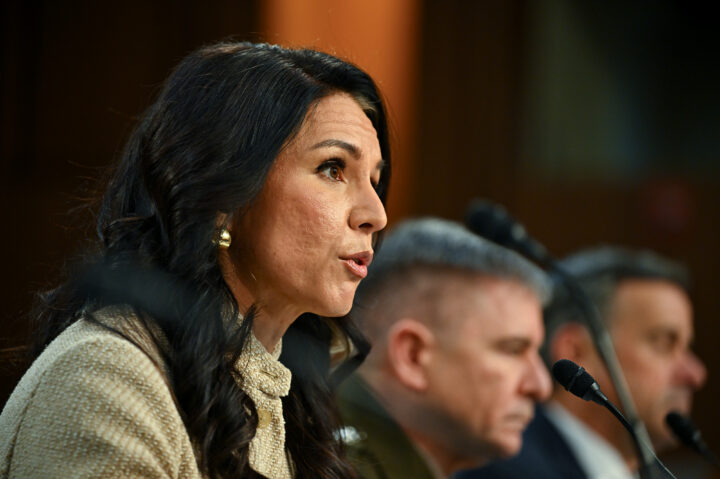
Graeme Sloan/Bloomberg via Getty Images
Tulsi Gabbard, director of National Intelligence, speaks during a Senate Intelligence Committee hearing on worldwide threats in Washington, DC, US, on Wednesday, March 18, 2026.
Director of National Intelligence Tulsi Gabbard said that the U.S. and Israeli operations against Iran have largely destroyed Tehran’s “power projection capabilities” in the region, but that the regime remains standing, if weakened.
“The [intelligence community] assesses that Operation Epic Fury is advancing fundamental change in the region that began with Hamas’ attack on Israel on Oct. 7, 2023, and continued with the 12-day war last year, resulting in weakening Iran and its proxies,” Gabbard said at a hearing of the Senate Intelligence Committee on worldwide threats on Wednesday.
“The IC assesses the regime in Iran appears to be intact but largely degraded due to attacks on its leadership and military capabilities,” she continued. “Its conventional military power projection capabilities have largely been destroyed, leaving limited options. Iran’s strategic position has been significantly degraded.”
If the Iranian regime survives the current war, Gabbard said that it would “seek to begin a yearslong effort to rebuild its military, missiles and UAV forces.”
She further said that, if the regime remains standing, internal tensions and resistance to the regime inside Iran are likely to increase as the country’s economy continues to struggle under U.S. and international sanctions.
Gabbard said in her opening statement that Iran “was trying to recover from the severe damage to its nuclear infrastructure sustained during the 12-day war, and continued to refuse to comply with its nuclear obligations” to the International Atomic Energy Agency.
Democratic senators pressed her throughout the hearing on apparent differences between those comments and her written remarks provided to the committee before the hearing, in which Gabbard said that Iran’s nuclear enrichment program was “obliterated” and that it had made “no efforts since then to try to rebuild” its enrichment capacity.
Under questioning, Gabbard affirmed that stance, but said Iran “maintained the intention to rebuild” its nuclear capabilities. She said she had omitted those remarks from her oral testimony for time reasons.
CIA Director John Ratcliffe throughout the hearing appeared to take a more aggressive and assertive stance on Iran than Gabbard, an isolationist and longtime opponent of war with Iran, offering a clear explanation and justification for the U.S. strikes.
Ratcliffe said that Iran was continuing its nuclear and ballistic missile development, and that he disagreed with an assessment by former National Counterterrorism Center Director Joe Kent that Iran did not pose an imminent threat, which Kent alleged in his resignation letter.
“I think Iran has been a constant threat to the United States for an extended period of time, and posed an immediate threat at this time,” Ratcliffe said.
Ratcliffe said that the U.S. operation was “detailed” and “thoughtful” with specific goals to address a long-running and growing threat.
He said that Iran was continuing to build and develop missiles “at alarming rates” such that its offensive capabilities were on track to outpace and overwhelm the U.S.’ ability to build defensive weaponry.
At the same time, Ratcliffe said the U.S. strikes last summer were a “wild success” and that Iran was “unwillinging and incapable” of enriching uranium to 60% purity since those strikes.
Gabbard, meanwhile, repeatedly declined to say whether the intelligence community had assessed Iran to be an imminent threat to the United States, asserting that only the president has the ability to determine whether any threat is imminent, to the frustration of committee Democrats.
In her opening statement, Gabbard also said that Iran’s space launch capabilities would allow it to develop an intercontinental ballistic missile by 2035, if Iran decided to pursue that, though that assessment is pending updates after U.S. military operations.
Sen. Tom Cotton (R-AR), the chair of the Intelligence Committee, suggested in his question that the timeline was much shorter, and that Iran actually could have had an ICBM that could threaten the homeland in six months.
Ratcliffe did not explicitly confirm that timeline, but emphasized that Iran’s missile program was a present and growing threat, which “if left unimpeded … would have the ability to range missiles to the continental U.S.”
“It’s one of the reasons why degrading Iran’s missile production capabilities that is taking place right now in Operation Epic Fury is so important to our national security,” Ratcliffe continued.
Pressed repeatedly by Democrats on whether the intelligence community had warned the President Donald Trump of the likelihood — as previously assessed by intelligence officials — that Iran would attack Gulf states and close the Strait of Hormuz in the event of a war, Gabbard and Ratcliffe both emphasized that the administration was aware of and had taken steps to prepare for those threats, despite comments by Trump that such moves by Iran were unanticipated.
Gabbard also described “the spread of Islamist ideology, in some cases, led by individuals and organizations associated with the Muslim Brotherhood” as “a fundamental threat to freedom and the foundational principles that underpin Western civilization.”
She said that Islamists are using such ideologies to recruit and solicit financial support for terrorism globally, and that such activity has been increasing in Europe.
Gabbard called the Trump administration’s designation of certain Muslim Brotherhood branches as terrorist organizations, “a mechanism to secure Americans.”
Ratcliffe said the CIA is “very focused” on counterterrorism, including the Muslim Brotherhood, and that the administration has had significant success, which he could share further in a classified setting.
Four Democrats and two Republicans broke with their parties to oppose and support the resolution, respectively
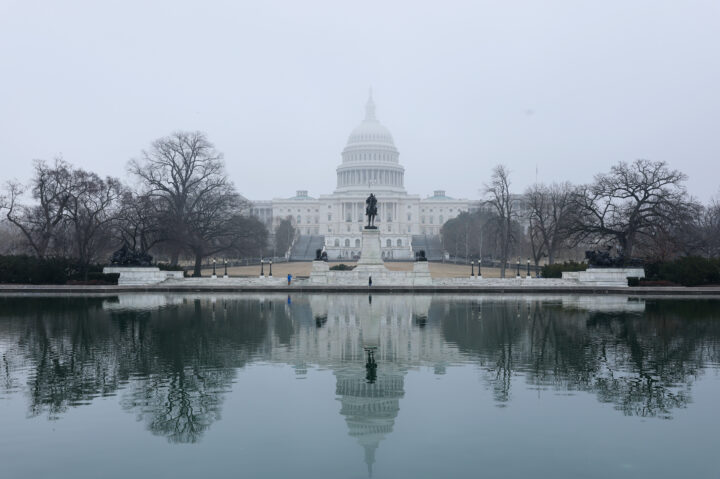
Anna Moneymaker/Getty Images
U.S. Capitol on March 05, 2026 in Washington, DC.
A day after Republican senators blocked a vote to end the U.S.-Israeli operations in Iran, the House voted 219-212 to defeat a similar war powers resolution, with four Democrats breaking with their party to oppose an immediate end to the war, and two Republicans voting with other Democrats to oppose military action.
Reps. Greg Landsman (D-OH), Jared Golden (D-ME), Henry Cuellar (D-TX) and Juan Vargas (D-CA) were ultimately the only Democrats to vote against the resolution, which was led by Reps. Ro Khanna (D-CA) and Thomas Massie (R-KY). Reps. Josh Gottheimer (D-NJ) and Jared Moskowitz (D-FL), who said they would oppose the resolution before the war began, ultimately voted in favor.
On the Republican side, Massie and Rep. Warren Davidson (R-OH), both of whom have isolationist leanings, were the only members of the GOP to support the resolution.
Moskowitz had argued before the war that voting preemptively on the resolution would remove U.S. leverage in negotiations, but argued that the situation has since changed and that the U.S. is now in a full-scale war.
“I didn’t flip at all,” Moskowitz told Jewish Insider. “Circumstances have changed since my first statement two weeks ago.”
In a statement, he condemned Iran and its regime, saying he is “happy that [Ayatollah Ali Khamenei] is no longer able to reign terror on his country,” but added, “Regardless of how one feels about this war, or this President, Congress’s constitutional role in any declaration of war is a completely separate issue,” expressing concern at the erosion of congressional war powers over the past year.
“We must reestablish our Article I authority which grants Congress all legislative powers,” Moskowitz said, adding that he did not believe the resolution would prevent continued efforts to protect U.S. bases and personnel nor intelligence sharing with allies.
Gottheimer emphasized in a statement that the U.S. “simply can’t afford to get this wrong — we must win and crush” the Iranian regime’s military capabilities, emphasizing that he is not, in principle, opposed to military action against Iran and that the regime “deserves the punishment they’re receiving.
“With the defeat of the War Powers Resolution in the Senate, the vote in the House today shifted from an unacceptable call that could put our troops in harm’s way to a clear call for this Administration to articulate the goals for the mission, the end game, and their plan to avoid a protracted conflict,” Gottheimer continued — suggesting that he voted for the resolution because it was, in essence, symbolic given that it did not pass the Senate.
“Unlike some of my colleagues who are opposed to combatting the Iranian regime, the world’s leading state sponsor of terror, I’m supporting this resolution to send a clear message to the Administration: the American people deserve a coherent explanation of what precipitated this war, what success looks like, and how we will know when the mission has been achieved,” he continued, criticizing “shifting justifications and objectives” from the administration. “I’m not opposed to taking action against Iran. I believe that steps to address the persistent threats are merited and necessary to protect our broader national security interests.”
He pledged to make sure the military has sufficient resources, signaling that he may support supplemental funding for the mission if and when requested.
The beginning of combat operations, the loss of some American soldiers and the administration’s inconsistent messaging and strategy — as well as an aggressive push from Democratic leadership — likely helped Democrats close ranks on the war powers resolution.
After the vote, Rep. Greg Meeks (D-NY), the ranking member of the House Foreign Affairs Committee, said that he would call up another war powers resolution 60 days from the start of the war, the limit under which an administration can conduct military operations without congressional authorization under the War Powers Act.
“Members who voted against today’s WPR on the assumption that Trump’s war will be swift or limited will not have that excuse once we’ve entered the third month of open-ended hostilities,” Meeks said.
Like Moskowitz and Gottheimer, a handful of other Democrats who have offered a degree of support for the U.S. operations in Iran ultimately voted for the resolution. Some have pointed to concerns about constitutional process and the administration’s failure to seek congressional approval for the war, rather than opposition to the war in general.
“I will vote for the war powers resolution because I cannot support unchecked authority for the administration to engage, indefinitely, in an already deadly war with unknown size and scope, especially considering Secretary [of Defense Pete] Hegseth’s suggestion that he is willing to” use ground troops in the operation, Rep. Tom Suozzi (D-NY), a moderate House Democrat, said.
At the same time, Suozzi said that “Iran is weaker and the regime’s leadership has been decimated — those are good things. If these operations make the region more secure and America safer, those would also be good things.” He added that the war powers resolution would not prevent Congress from authorizing the use of force in Iran “if necessary and properly presented to Congress.”
Davidson, one of the two Republicans who voted for the resolution. said on the House floor on Wednesday that operations against Iran were just, and potentially necessary, but unconstitutional.
“For some this debate will be about whether we should even be fighting in Iran. For me, the debate is more fundamental: is the president of the United States, regardless of the person holding the office, empowered to do whatever he wants?” Davidson said. “That’s not what our Constitution says. … I rise in support of this war powers resolution today because the moral hazard posed by a government no longer constrained by our Constitution is a grave threat.”
Davidson argued that his Republican colleagues were ignoring the clear definition of what constitutes a war, and repudiating Trump’s campaign promises.
The House resolution, unlike the Senate version, included no specific protections to allow for continued U.S. intelligence sharing with Israel and other allies, and defensive operations to protect allies like Israel and U.S. forces.
Earlier this week, Gottheimer, Landsman, Suozzi, Cuellar, Golden and Reps. Jimmy Panetta (D-CA), Jim Costa (D-CA), Vicente Gonzalez (D-TX) and Adam Gray (D-CA) had introduced an alternative resolution that would give the administration 30 days from the start of the war to wind down operations in Iran, rather than demanding an immediate halt, while banning any ground operations.
Gottheimer said in his statement he plans to call up his resolution during the week of March 23, but he hopes that, “Between now and then, I hope either the conflict has reached its objectives or the Administration has made a strong case to Congress and the American people for why this mission must continue.”
But most ultimately voted for the Massie-Khanna resolution.
Suozzi said that the Gottheimer resolution “would prevent a reckless and potentially unsafe removal of our forces and allow us to continue to protect American troops and our allies in the region during this perilous time,” a seeming indictment of the war powers resolution he nevertheless supported.
Top lawmakers supporting the war powers resolution have largely failed to articulate what the implications of immediately ending operations would be, with some claiming, in spite of the resolution’s language, that U.S. forces would be allowed to finish their mission and wind down.
Some former Democratic officials argued that Gottheimer’s alternative effort would be a more prudent path, with U.S. forces and embassies under fire from Iran, and that any realistic and safe withdrawal would take time. One also argued that the resolution, if brought to a vote, might pick up enough Republican support to pass.
Daniel Silverberg, a former advisor to Rep. Steny Hoyer (D-MD), emphasized that a similar effort to cut off the U.S.’ Libya operations led by “one of the most ardent anti-war activists in the House,” then-Rep. Dennis Kucinich (D-OH), included a 15-day wind-down provision.
“The Massie-Khanna resolution lacks it. The notion that Democrats would not, at a minimum, support that amendment to allow for a responsible withdrawal of forces is problematic from a national security perspective and from a messaging perspective,” Silverberg said.
Jeremy Bash, a former chief of staff at the Department of Defense and Central Intelligence Agency under the Obama administration, told JI that the Khanna-Massie resolution “requires [a] very strange outcome” that would be “dangerous for our troops” and that it was not “credible” because it lacked any buffer period.
All parties are planning for what could be a conflict that stretches across weeks, despite the decapitation of nearly all of Iran’s senior-most officials in the opening salvos of the war
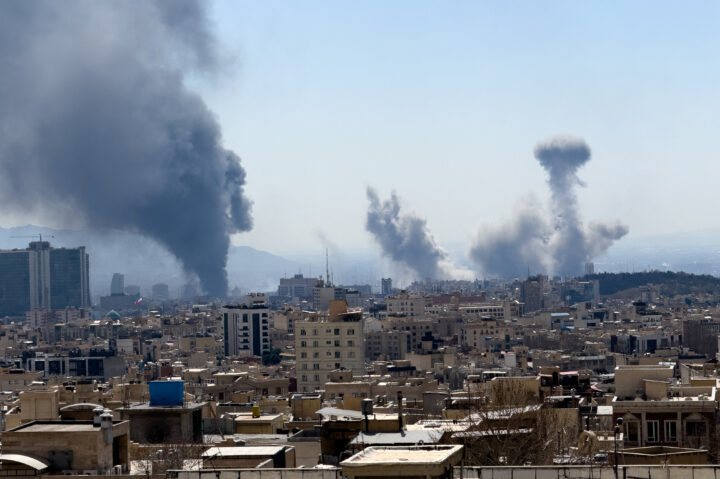
Mahsa / Middle East Images / AFP via Getty Images
Plumes of smoke rise following reported explosions in Tehran on March 1, 2026, after Iran's supreme leader, Ayatollah Ali Khamenei, was killed a day earlier in a large U.S. and Israeli attack, prompting a new wave of retaliatory missile strikes from Iran.
As joint U.S.-Israeli operations against Iran and the Islamic Republic’s ballistic missile and drone attacks continue into a third day, all parties are planning for what could be a conflict that stretches across weeks, despite the decapitation of nearly all of Iran’s senior-most officials in the opening salvos of the war.
On his Truth Social site, Trump doubled down on his push for Iranian protesters to take action, calling on “all Iranian patriots who yearn for freedom to seize this moment, to be brave, be bold, be heroic and take back your country. America is with you. I made a promise to you, and I fulfilled that promise. The rest will be up to you, but we’ll be there to help.”
Trump said on Sunday that the U.S. had sunk nine Iranian warships and destroyed its naval headquarters as it works to dismantle the country’s entire naval fleet.
The president told numerous media outlets over the weekend that the time frame for operations would take four to five weeks, but said that Iranian officials “want to talk, and I have agreed to talk, so I will be talking to them.” Read more here.
Ali Larijani, the head of Iran’s National Security Council, refuted the claim, saying, “We will not negotiate with the United States.”
With the status of talks and any potential off-ramps in question, strikes continue in Israel and Iran, with Iranian proxy Hezbollah entering the hostilities early this morning with missile barrages targeting northern Israel.
The last 48 hours have scrambled and deepened alliances across the Middle East as a number of Arab states coalesced behind the U.S. In a joint statement released Sunday night, the U.S., Bahrain, Jordan, Kuwait, Qatar, Saudi Arabia and the United Arab Emirates slammed Iran’s “indiscriminate and reckless missile and drone attacks against sovereign territories across the region” and said the countries “stand united in defense of our citizens, sovereignty, and territory, and reaffirm our right to self-defense in the face of these attacks.”
Canada and Australia — both led by left-leaning governments that have clashed with the Trump administration — quickly announced their support for the U.S.- and Israel-led operation — though neither country’s official statement mentioned Israel. British, French and German leaders called on Saturday for the resumption of nuclear negotiations, pivoting a day later to calling on Iran to cease its “indiscriminate and disproportionate missile attacks.” Fox News reported that the U.K. is providing air policing and sharing intelligence, and Prime Minister Keir Starmer said Sunday that the U.K. is giving the Pentagon access to British bases in the region.
Israel and the U.S. prepared for the operation over the last two months. The Washington Post reported on Sunday that Trump’s decision to move forward with the operation came amid a “weeks-long lobbying effort” by Israel and Saudi Arabia — which was denied by a Saudi spokesperson in Washington. Israeli officials have for the last several months traveled back and forth between Jerusalem and Washington for White House meetings, while Saudi Defense Minister Prince Khalid bin Salman was in Washington last month for meetings with administration officials as well as Jewish communal leaders.
In Washington, Congress is set to resume later this week and vote on two war powers resolutions being led by Sens. Tim Kaine (D-VA) and Rand Paul (R-KY) and Reps. Ro Khanna (D-CA) and Thomas Massie (R-KY) that, if passed and able to override an inevitable presidential veto, would force the Trump administration to end its operations against Iran.
The assassination of Iran’s supreme leader, Ayatollah Ali Khamenei, has put officials and figures who are critical of the Trump administration in the awkward position of praising the killing of the supreme leader, who has directed attacks that have killed tens of thousands over decades and overseen the expansion of Tehran’s vast proxy network, while continuing to criticize Trump. Rep. Steny Hoyer (D-MD), previously a member of House Democratic leadership, called the strikes “an act of war” and the goal — “to stop Khamenei’s fanatical regime from committing further acts of terror — “defensible,” while blasting what he called Trump’s “unilateral, unconstitutional decision to go to war without congressional approval.”
Sen. Chris Coons (D-DE) called Khamenei a “brutal dictator with the blood of Americans and Iranian civilians on his hands,” before stating that “his death does not mean regime change is imminent, and the potential consequences of these strikes are unpredictable, dangerous, and global.”
Please log in if you already have a subscription, or subscribe to access the latest updates.
 Continue with Google

 Continue with Apple