









































Some United Auto Workers chapters have moved beyond workplace advocacy to target Israel and Jewish communities, such as in the ongoing push to unionize Israeli-owned Breads Bakery
Kevin Dietsch/Getty Images
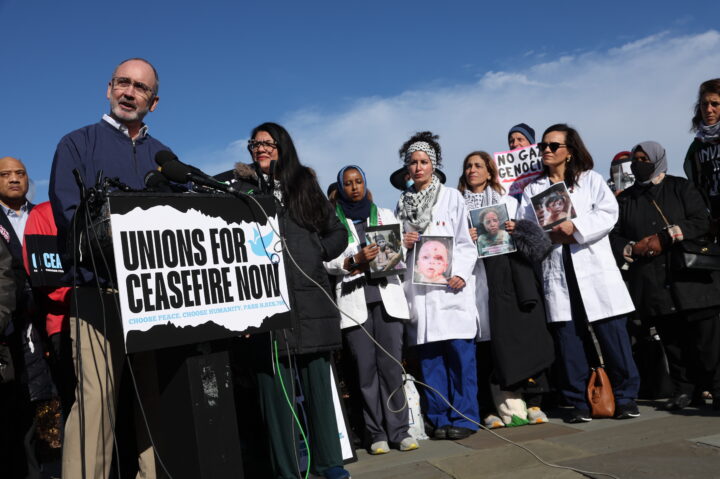
Shawn Fain, president of the United Automobile Workers, joins lawmakers at a press conference calling for a ceasefire in the Middle East outside of the U.S. Capitol on December 14, 2023 in Washington, DC.


 Add JewishInsider on Google
The United Auto Workers historically evokes imagery of assembly lines, picket lines and blue-collar solidarity. But the UAW, one of the largest unions in the country, has increasingly drifted away from its core mission of representing autoworkers in the workplace, driven by individuals pushing an extreme anti-Israel political agenda that leaves critics questioning the relevance to workplace issues.
The most recent example came earlier this month, when 30% of the 275 employees of the Israeli-owned Breads Bakery signed union authorization cards for UAW Local 2179, the percentage necessary to petition the National Labor Relations Board for a union election. The group, which calls itself “Breaking Breads,” said in a statement, “Workers are demanding a living wage, safe workplace, and basic respect.”
But the group’s demands also include that the management of the New York-based bakery chain, CEO Yonatan Floman and founder Gadi Peleg, “halt use of bakery profit to materially support the Israeli occupation.” Breaking Breads, which has a Palestinian flag emoji in its Instagram bio, also condemned the bakeries’ participation in the Great Nosh, an annual Jewish food festival in New York City, and said it will not participate in baking cookies with an image of the Israeli flag.
Deborah Lipstadt, who served as the State Department’s antisemitism envoy under President Joe Biden, told Jewish Insider that “many institutions and organizations, whether they be universities, unions [or] city councils, a small group is able to go in and organize, and with the minority of members, push a policy.”
Lipstadt, a historian who has served on Emory University faculty for more than 30 years, said she has “seen similar situation[s] on university campuses and [within] professional academic organizations where a small group, sometimes just a few individuals, is able to gain control and push the organization in a certain direction, even if the vast majority of members don’t agree. I wonder if that is the same thing happening” with the Breads unionization push, she said.
“There are fewer Jews in the unions,” continued Lipstadt, adding that she frequently encourages Jewish college students to get involved in student government for this reason. “What is not surprising to me is that we find activists inserting themselves and pushing the union in a more extreme fashion,” she said.
A number of labor unions have seen a rise of antisemitism and anti-Israel activity since the Oct. 7, 2023, Hamas terrorist attacks, despite many being historically supportive of Israel, dating back nearly a century, when many American unions donated money to the Histadrut, Israel’s national labor union. Multiple groups have now taken legal action against UAW branches in response to certain campaigns, which some legal experts allege were discriminatory against Israelis and Jews.
UAW did not respond to a request for comment from JI.
“Unions exist to protect and support all workers, not to be used as platforms for ideological campaigns that single out or target specific communities,” Karen Paikin Barall, chief policy officer at the Louis D. Brandeis Center for Human Rights Under Law, told JI.
The Brandeis Center won a settlement in November against the Association of Legal Aid Attorneys, part of UAW Local 2325. In their complaint filed in federal court in September 2024, three union members who sued to block an anti-Israel resolution proposed weeks after the Oct. 7 attacks described being targeted as “snitches,” “losers,” “disgusting,” “dictators in training” and “Zionist ghouls” in the ALAA’s internal discussion boards. The plaintiffs also said they were accused of “spreading lies and misinformation” by talking about “Jewish babies being murdered, and women being raped” on Oct. 7.
“What we are seeing now is campus-style activism moving into the labor movement, with unions being treated like college campuses rather than professional workplaces governed by civil-rights law,” said Barall. “When unions prioritize an obsessive focus on a foreign conflict over the real, day-to-day concerns of workers and tolerate rhetoric that marginalizes Jews, it undermines both the credibility of the labor movement and the fundamental principles on which unions were founded.”
Patrick Semmens, vice president of the National Right to Work Legal Defense Foundation, a nonprofit that fights against unions and for worker mobility and freedom of representation, told JI that the push to unionize Breads Bakery, which is still in an election period, has not yet crossed a legal line into discrimination.
But NRTW has seen it before — the group provided free counsel to a group of Columbia University Jewish graduate students who filed a legal complaint in September over a set of demands from Student Workers of Columbia, UAW Local 2710. Those demands included seeking amnesty for students who had been expelled due to violations of university conduct during anti-Israel protests, negotiations over police access on campus and pushing for Columbia to eliminate a study abroad program in Israel.
“UAW has been one of the most aggressive [unions] and to many people the most offensive,” Semmens told JI. “The argument with Columbia is that if they take this to an extreme and demand using their government-enforced bargaining powers to do things that are discriminatory, then they can cross a line and become illegal. The graduate student case at Columbia argues that. There were pretty radical demands.”
The Columbia University case is also connected to the Breads Bakery campaign.
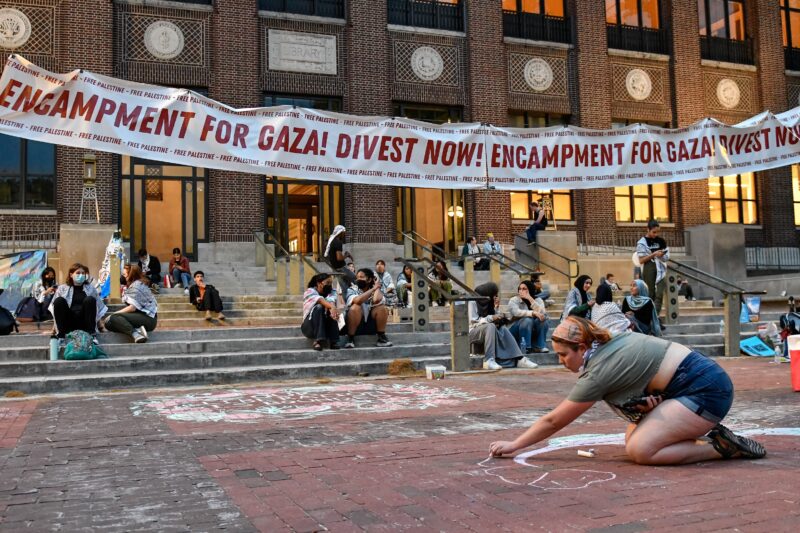
Columbia graduate student Johannah King-Slutzky, who was arrested during the 2024 encampment and takeover of Hamilton Hall on Columbia’s campus and was subsequently suspended, is now involved in the Breads Bakery unionization push, even though she has never worked for the bakery.
“Part of UAW’s ‘contract negotiations’ with Columbia is demanding [King-Slutzky] be reinstated,” said Semmens. “It’s all tied together.”
Semmens estimates that “30 or 40% of UAW-represented individuals are now on college campuses, so that’s a real force.”
He added that anti-Israel activity within UAW accelerated after the March 2023 election of its president, Shawn Fain, a well-known figure on the progressive left and an outspoken critic of Israel since Oct. 7.
“He ran as an outsider and his base of support was not so much the traditional blue-collar workers but very much college campuses and graduate students,” Semmens told JI. “That’s what put him in power, so that’s why you see so much of that coming to the forefront of UAW now.”
Fain’s “strongholds within the union in terms of internal union election are a very radical political contingent. From our perspective, that’s unfortunate, especially for workers or grad students who aren’t traditional employees but are roped under this system,” said Semmens. “If they dissent from these positions, they find that the union that’s supposed to be representing them is actually trying to discriminate against them.”
Neither Fain nor King-Slutzky could be reached for comment.
Please log in if you already have a subscription, or subscribe to access the latest updates.
 Continue with Google
 Continue with Apple