

























































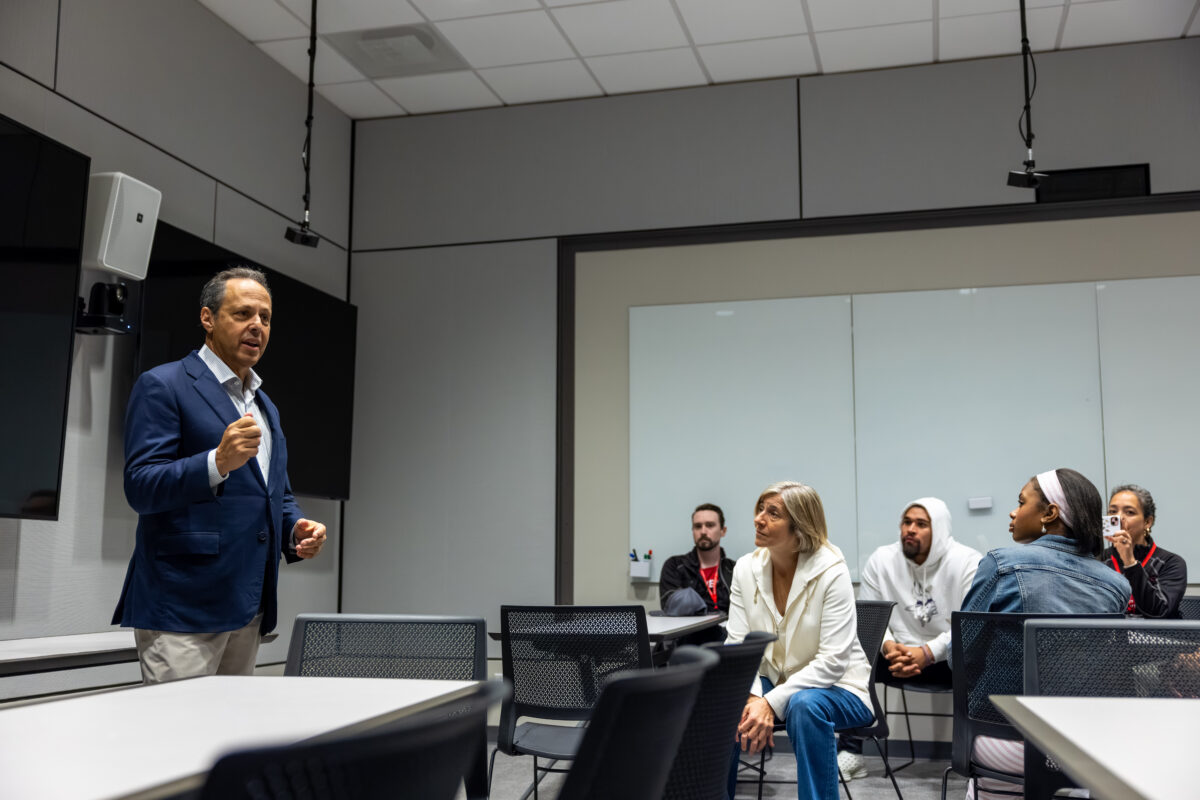
The players also toured the National Museum of African American History as part of the D.C. visit
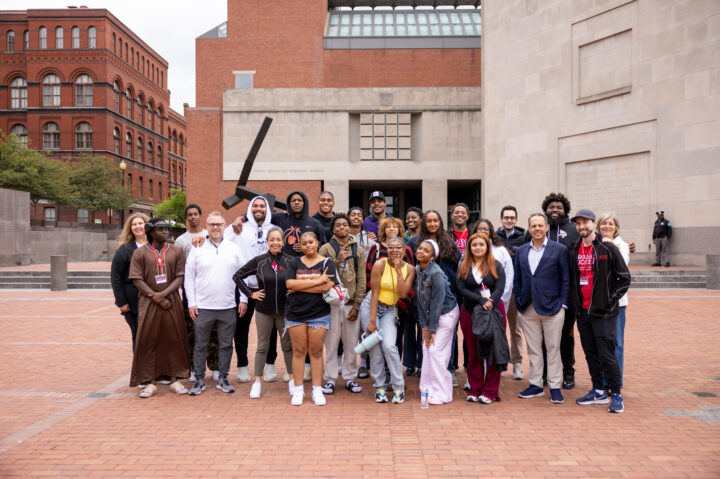
Maddie Crooke/Minnesota Vikings
Minnesota Vikings owner Mark Wilf leads players, high school students on Holocaust Museum trip


 Add JewishInsider on Google
Minnesota Vikings owner Mark Wilf, the son of Holocaust survivors, believes that his family’s history and his role owning an NFL franchise give him a unique responsibility: to use his platform to educate younger generations about the dangers of antisemitism and bigotry.
That mission was on display Saturday, when Wilf was joined by Vikings defensive tackle Levi Drake Rodriguez, offensive lineman Walter Rouse, defensive end Elijah Williams and former Vikings tight end Visanthe Shiancoe as the group took a tour of the U.S. Holocaust Memorial Museum together with a group of Black and Indigenous Minneapolis-area high school students.
The visit marked the sixth such trip coordinated by the Vikings and the nonprofit Project Success and was aimed at exposing students to history through tours of both the Holocaust museum and the National Museum of African American History and Culture.
“It’s very important for young people to learn about history and how they can make an impact on the world and society,” Wilf told Jewish Insider during the group’s guided tour of the Holocaust museum. “To learn the history of the world — where sometimes there’s hatred and bigotry and see what it can lead to — and also learn the impact of an individual: how an individual can change things, can fight back and how we can set an example by being tolerant and learning from each other.”
Wilf and his brother, Zygi Wilf, have owned the Minnesota Vikings since 2005. Wilf’s family has long supported Holocaust education and survivor organizations, including Yad Vashem, the U.S. Holocaust Memorial Museum and the Museum of Jewish Heritage in New York. He is the current chair of the Jewish Agency for Israel, after recently serving as chair of the Jewish Federations of North America.
During World War II, Wilf’s father, Joseph, was deported with his family to a Siberian labor camp. His mother, Elizabeth, survived by escaping the Lvov ghetto and hiding in a barn with her family until liberation. Joseph and Elizabeth met at a displaced persons camp in Germany after the war, married and came to America.
For Wilf, the Vikings’ partnership with Project Success connects his professional platform with that family legacy.
“My parents, grandparents, are all Holocaust survivors, so it’s deeply personal to myself and my family,” Wilf said. “We’re very privileged to be in this country and as Americans, and being part of the NFL … so I’m going to use that platform to help educate.”
The veteran Vikings owner acknowledged that antisemitism is “much more out there” today, but emphasized that the need for education remains constant. “It doesn’t matter when the time is, to be educated is important,” he said. “Every generation has to learn that history over and over again. The bigotries, the prejudices, the hatreds — these lessons are always critical to making society better.”
“All these lessons from history, these things happened, and now, by going through these museums and being on the street, they [the students] are now witnesses, and they have a responsibility to tell, to learn that as individuals they can make an impact,” he added.
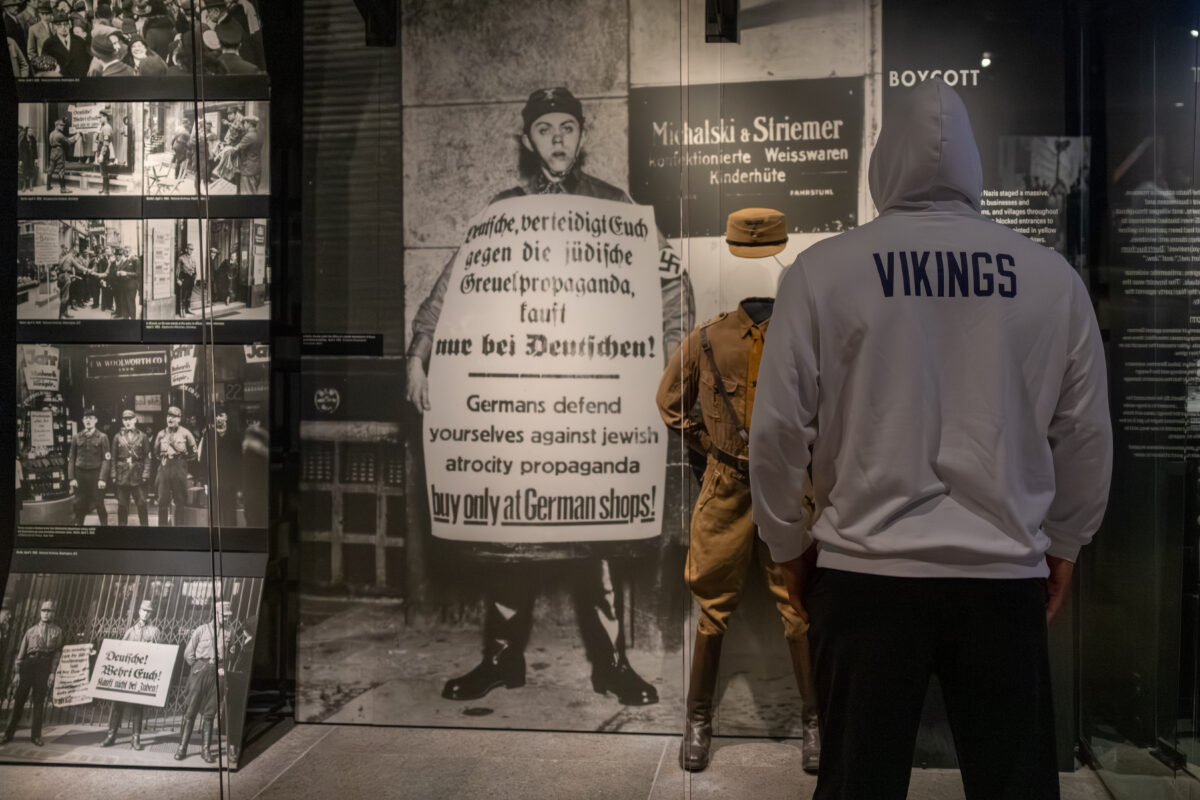
Beyond exposing students to Holocaust history, Wilf said it was also important for Vikings players to join the tour — both to help guide the students and to experience the history themselves.
“Our Vikings players are so appreciative of representing the Vikings and being here,” Wilf said. “People look up to professional athletes like the Minnesota Vikings. We’re appreciative that they’re great ambassadors for our organization, and they’re learning as well at the same time.”
Rouse, an offensive tackle who was selected in the sixth round of the 2024 NFL Draft, told JI that it was his first time on the trip and that he would not hesitate to do it again. He said the experience was especially enlightening for him based on “how little I learned in high school on what happened in the Holocaust.”
“The main thing I knew was about Anne Frank and Auschwitz,” Rouse said. “It’s important that everyone at least understands and gets a glimpse of what happened with the Holocaust, especially with the state of the world today.”
“The fact that you had people [Wilf’s parents] that were able to survive the Holocaust and still persevere through to have raised someone like Mark and have that strength to move forward and to get through that evil — it’s just important,” he added. “It’s a disgusting part of the history of the world, but I think it’s important that everyone knows about that.”
Rouse said that having the students in attendance was especially important:
“A few of them [the students] talked about how they didn’t even know a lot about the Holocaust, they only learned a couple things,” Rouse said. “They may have known a lot about slavery, but they didn’t know about the Holocaust. Being able to see that perspective actually brings us closer together because we have more things in common with one another. I think that’s one thing that we can connect and share and come together that can just help bring us forward.”
Rouse said the effort is something that more NFL teams and players should emulate. “I think there are players in every single team that do want to get involved, do want to help,” he said. “And there are students across the country in each and every state that would not hesitate to say yes and come to something like this and be part of the experience. I think we should do this for as many people as we can.”
Williams, a defensive end who signed with the Vikings in 2025, said the most important part of the experience was “understanding history.” Echoing Rouse, Williams said the museum tour offered a closer look at a subject he felt was not taught in enough depth in school.
“In school, you don’t really get too in-depth of all the atrocities. But when you get into these museums, you really get the unfiltered truth. That’s what we need in society — unfiltered truth so we don’t sugarcoat the atrocities of the past,” Williams said. “We tend to repeat it [history], and this is just another example of the hatred in the world and how we need to avoid it.”
But while the players had their own takeaways from the experience, Williams similarly emphasized that “the kids being here was way more important than us [the players] being here.”
“The younger generation is always going to be the future, even though we’re not that many years apart,” Williams said. “I feel like them being here is just going to help bring more change into this world, more than the previous generations could bring.”
Rodriguez, a defensive tackle and seventh-round selection in the 2024 NFL Draft for the Vikings, said the experience was important in bringing the history “to light.”
“I think it just brings to light the history that is brutal, heartbreaking and gut-wrenching, and shows how we could seek a change in our lives and get more knowledge from that,” Rodriguez said. “Just how many souls had to fight day in and day out. You can’t even put into words, honestly, the [amount of] mass casualties that took place. And for what? Someone’s race, skin color or ethnicity? It’s insane.”
Agustina Cruz was the first recipient of an award promoted by the U.S. Embassy in Buenos Aires and the city’s Holocaust museum that is named after a group of Germans who openly protested Hitler

Dina Brookmyer
Inside the Shapell Center of the U.S. Holocaust Memorial Museum
Until this month, 21-year-old Agustina Cruz had never left Argentina. Before this year, she had never even been to Buenos Aires, which is more than 900 miles southeast of her hometown of Palpalá, a small city of 60,000 people located in Jujuy, a region known for soaring rock formations.
That all changed earlier this year when she became the inaugural recipient of the White Rose Award, a prize administered by the U.S. Embassy in Argentina and the Buenos Aires Holocaust Museum. The award was named for a group of Germans who openly protested Adolf Hitler and the Nazis’ extermination of Jews.
Cruz won the award for advocating for the Romani, a community so marginalized in Argentina that people accused her of “getting into the mouth of the devil” — a Spanish expression — simply for publicly supporting a Roma family in the face of taunting from her classmates.
But her planned trip this month to Washington, where she was slated to visit the U.S. Holocaust Memorial Museum and tour the city, almost fell apart due to ignorance and hate.
One of Cruz’s university professors had initially told her that she would get an excused absence for missing class. But once that professor found out that Cruz would be on a trip to learn about the Holocaust, the professor said Cruz could not miss class, because the trip was sponsored by a Jewish organization.
“She shouldn’t be discriminated against for doing the right thing herself,” said Marc Stanley, who served as U.S. ambassador to Argentina from 2022 until January of this year. He worked with the Holocaust Museum of Buenos Aires on the award, and accompanied Cruz to Washington earlier this month after she decided to make the trip and risk a failing grade in her course.
“In my community, there’s lots of ignorance. They do not respect the Roma community,” Cruz told Jewish Insider via a translator at the end of an eventful day at the Holocaust Museum in Washington, which included a two-hour private tour and a meeting with a Holocaust survivor. As she described the bullying she faced for standing up for embattled members of the Roma community, Cruz began to cry.
She had learned about the White Rose Award from her teacher, Lorena Rosa Blanca, who accompanied her on the trip to Washington. Cruz was selected as the winner by a panel in Buenos Aires that included Stanley and Jewish, Christian and Muslim leaders.
“She’s a very strong girl who suffered discrimination at school,” Rosa Blanca told JI.
As Cruz walked through the museum, she recorded video of nearly everything her Spanish-speaking tour guide said, including when he told her that her work is important “for humankind.” She paused at a panel about the Roma, which explained that “long-held prejudices were fueled by Nazi racism.” Between 250,000 and 500,000 members of the Roma community were killed by the Nazis. Cruz took in the exhibits with awe and horror, including a section about the Nazis who hid out in Argentina after the end of the war.
“I feel so enriched by all of this information,” Cruz said afterward. “I’m thinking of using social media, perhaps TikTok or some other social media [platform], to reach out to teenagers and open their eyes to the history, to all the suffering, and to the fact that we are all human beings, and we all deserve to enjoy human rights.”
The project had a diplomatic goal, in addition to the educational goal for the recipient. Educating about the Holocaust — and about tolerance — is an American value that U.S. emissaries abroad have a duty to promote, Stanley explained.
“I think human rights is certainly a U.S. value,” Stanley said. “Making known that we both [the U.S. and Argentina] have museums like this, that we both constantly battle against discrimination against marginalized communities, is something that I worked on as U.S. ambassador. Showing that we’re in the same fights with Argentina, that we’re all in the same boat, I think is important.”
Cruz, now studying social work as a university student, said she plans to let her peers know “that they should not be afraid to speak up to defend other people, other people who may be different.”
Suzanna Tarica, an 85-year-old Holocaust survivor who was born in France in 1940, listened intently as Cruz shared her story.
“What you’re doing is what I want to do also,” Tarica told Cruz. “We are looking at accomplishing the same goal, which is tolerance, understanding and peace — and to get rid of ignorance.”
The former New York governor said about his rival’s comments, ‘We know all too well that words matter. They fuel hate. They fuel murder’

Jose Perez/Bauer-Griffin/GC Images
New York mayoral candidate, Andrew Cuomo attends a labor union rally in Union Square on June 17, 2025 in New York City.
Former New York Gov. Andrew Cuomo spoke out against Zohran Mamdani, his top rival in New York City’s Democratic mayoral primary on Tuesday, for defending calls to “globalize the intifada” in a widely criticized podcast appearance this week.
“Yesterday when Zohran Mamdani was asked a direct question about what he thought of the phrase ‘globalize the intifada,’ he dismissed it as ‘language that is subject to interpretation,’” Cuomo said in a social media post on Wednesday. “That is not only wrong — it is dangerous. At a time when we are seeing antisemitism on the rise and in fact witnessing once again violence against Jews resulting in their deaths in Washington, D.C., or their burning in Denver — we know all too well that words matter. They fuel hate. They fuel murder.”
Mamdani, a far-left state assemblyman from Queens who is polling in second place behind Cuomo, has faced backlash over his comments in an interview with The Bulwark, where he characterized the slogan heard frequently at anti-Israel protests as an expression of Palestinian rights and invoked a prominent act of Jewish resistance to Nazi Germany to justify its usage, even as the phrase has been criticized as a call to violence against Jews.
“I think what’s difficult also is that the very word has been used by the Holocaust Museum when translating the Warsaw Ghetto Uprising into Arabic, because it’s a word that means struggle,” Mamdani said on the podcast, in an apparent reference to the U.S. Holocaust Memorial Museum in Washington.
For its part, the museum, which rarely weighs in on domestic politics, dismissed Mamdani’s comments in a sharply worded social media post on Wednesday that did not mention him by name.
“Exploiting the Museum and the Warsaw Ghetto Uprising to sanitize ‘globalize the intifada’ is outrageous and especially offensive to survivors,” the museum said. “Since 1987 Jews have been attacked and murdered under its banner. All leaders must condemn its use and the abuse of history.”
Pressed to respond to the outage over his comments, Mamdani said in an emotional press conference on Wednesday that he is frequently targeted for his Muslim faith. “I try not to talk about it,” he said, choking up. “My focus has always been on making this a city that’s affordable, on making this a city that every New Yorker sees themself in,” he added, “and it takes a toll.”
“The thing that’s made me proudest in this campaign is that the strength of our movement is built on our ability to have built something across Jewish and Muslim New Yorkers,” he said, adding that “antisemitism is such a real issue in this city, and it has been hard to see it weaponized by candidates who do not seem to have any sincere interest in tackling it but rather in using it as a pretext to make political points.”
Ted Deutch, the CEO of the American Jewish Committee, also took offense at Mamdani’s framing, saying his invocation of the Holocaust Museum “is as offensive as it is outrageous” in comments posted to social media on Wednesday.
“I don’t know this candidate, but I know a lot of fine elected officials in the city he wants to run,” Deutch added. “ALL OF THEM should condemn the use of ‘globalize the intifada’ as the call to violence that it is. And they should tell Mr. Mamdani that if he really wants to keep Jews safe, he must do the same.”
Cuomo, who along with his allies has accused Mamdani of espousing anti-Israel rhetoric amid a recent surge of antisemitic incidents, likewise called on his opponents in the primary “to join together to denounce Mr. Mamdani’s comments because hate has no place in New York.”
“There are no two sides here,” Cuomo wrote. “There is nothing complicated about what this means.”
Whitney Tilson, a former hedge fund executive seeking the Democratic nomination who has been highly critical of Mamdani’s anti-Israel views, also took aim at the state assemblyman in a statement on Wednesday.
“Mamdani’s refusal to disavow terrorism against Jews is utterly disqualifying,” Tilson argued. “His assurances that he will protect Jewish New Yorkers ring hollow.”
A spokesperson for Mamdani did not immediately respond to a request for comment.
Brad Lander, the Jewish city comptroller who is polling in third place and recently cross-endorsed with Mamdani, said at a town hall hosted by the UJA-Federation of New York earlier this month that he does not immediately view calls to “globalize the intifada” as antisemitic, arguing the phrase is “really complicated” and that such judgements depend on context.
“The First Intifada was relatively nonviolent, and the Second Intifada was quite violent,” Lander said of the Palestinian uprisings that began in 1987 and ended in the early 2000s, killing more than 1,000 Israelis in a series of attacks targeting civilians and soldiers alike. “So if you say ‘globalize the intifada,’ you are at very least, at the very least, playing with vague language.”
The phrase has also stirred controversy further down the ballot. Shahana Hanif, a far-left city councilwoman in Brooklyn who has clinched endorsements from Lander and Mamdani as she faces a primary challenge, has also drawn scrutiny for amplifying a call to “globalize the intifada” on social media before she took office.
While she had initially dismissed complaints from Jewish leaders who took issue with her decision to endorse the phrase, Hanif, an outspoken critic of Israel, ultimately relented — deleting the post and expressing regret for boosting a message that many voters had found concerning.
“I unequivocally apologize for this,” Hanif wrote in a letter to Jewish community members last fall. “I understand now that the phrase can invoke feelings of hostility, discrimination and fear for Jewish people. It was never my intention to promote such messaging, and I removed the post as soon as I recognized its harmful implications.”
Please log in if you already have a subscription, or subscribe to access the latest updates.
 Continue with Google
 Continue with Apple