









































The agency said state administrative agencies and the extended DHS shutdown caused the lengthy delay in issuing the grants
Brandon Bell/Getty Images
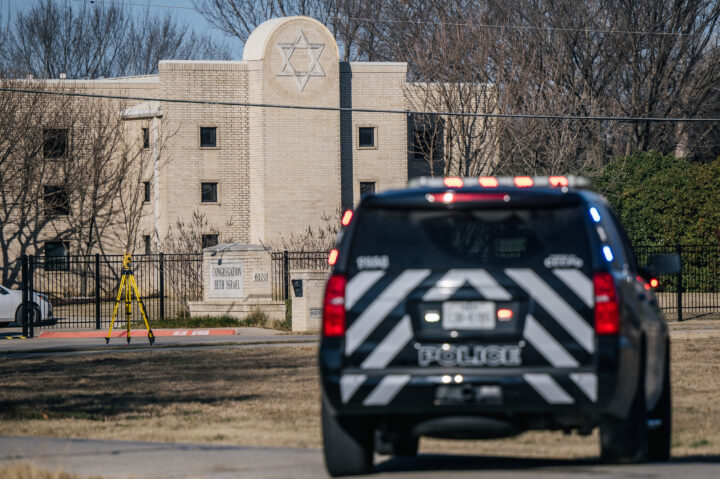
A law enforcement vehicle sits near the Congregation Beth Israel synagogue on January 16, 2022 in Colleyville, Texas.


 Add JewishInsider on Google
The Federal Emergency Management Agency announced on Wednesday that 1,600 out of 6,000 applications received for the long-delayed 2025 Nonprofit Security Grant Program cycle were approved, meaning that under 27% of organizations that applied received any funding — a significant dip from previous years.
The grants were approved nearly a year after applications opened for the 2025 cycle on Aug. 13, 2025, and after applications for 2026 NSGP funding were already due last week. FEMA indicated that state agencies responsible for administering the grants on the state level and repeated Department of Homeland Security shutdowns relating to immigration enforcement disputes were responsible for the delays.
FEMA said it had provided initial allocations to state agencies in September of last year and subsequently received the applications from individual nonprofits from the state agencies, which the agency did not finish reviewing until earlier this month.
FEMA said that more than 60% of the grant funding had been provided to houses of worship, including Christian, Muslim, Hindu, Buddhist, Sikh and Jewish institutions.
The program was funded at $274.5 million in 2025, with $266 million of that being provided to nonprofit institutions. The grant awards represent a significant drop in application acceptances, as well as a moderate dip in applications received as compared to 2024. In 2024, 3,288 applications were approved, around 40% of the 7,584 applications received, with $454.5 million made available overall.
More applications were also approved in 2023 and 2022 than in this grant cycle. In 2023, with $305 million available, FEMA approved 2,201 applications out of 5,257, and in 2022, FEMA approved 1,821 applications out of 3,470, with $250 million available.
The administration distributed an additional $220 million in supplemental funding in two tranches last year, from emergency funding passed by Congress in 2024.
FEMA did not respond to a request for comment on how much total funding had been requested in 2025, nor how many Jewish institutions had received funding.
Lauren Wolman, senior director of government relations and strategy for the Anti-Defamation League, expressed gratitude that the grants had been released but emphasized that “many vulnerable organizations remain without the support they need.”
“Congress must pass the Jewish American Security Act, which would authorize $1 billion annually for this critical program,” Wolman continued. “We also hope future application timelines provide organizations with the opportunity to incorporate prior award decisions into their planning.”
The application period for 2026 grants closed before the administration announced the 2025 awards, which lawmakers and advocates said complicated the 2026 application process for institutions that did not yet know if they would be receiving funding under the previous year’s program.
“It was troubling that government disputes that led to shutdowns of DHS delayed the 2025 NSGP grants,” Nathan Diament, the executive director of the Orthodox Union Advocacy Center said. “We are thankful for [Homeland Security] Sec. [Markwayne] Mullin and his team at DHS — as well as the White House Faith Office — working to get these funds finally awarded. “
Eric Fingerhut, the CEO of the Jewish Federations of North America, said JFNA is “relieved and grateful” that the grants have been finalized.
“These grants will allow synagogues and Jewish institutions to get the vital security upgrades necessary to protect our community and support flourishing Jewish life,” Fingerhut said. “We also know the need continues to outpace the availability, which is why we continue to call on Congress to increase funding for this vital program and [pass] the Jewish American Security Act.”
Rabbi A.D. Motzen, national director of government affairs for Agudath Israel of America, also expressed thanks for the grant announcement, while noting the significant shortfall in funding.
“Every grant means another institution and community that is better prepared to prevent a terror attack,” Motzen said in a statement. “The fact that nearly three quarters of grant applicants were turned away due to lack of funds, however, highlights the need for additional funding, especially with the terror attack at a West Bloomfield [Mich.] synagogue still fresh in our minds.”
Jewish groups praised the move for allowing law enforcement to increase its security presence at religious institutions, which is often paid for by the houses of worship themselves
Brandon Bell/Getty Images
A law enforcement vehicle sits near the Congregation Beth Israel synagogue on January 16, 2022 in Colleyville, Texas.
The House and Senate’s negotiated 2026 funding package for the Department of Justice includes funding for state and local law enforcement specifically allocated for protecting religious institutions.
The explanatory report accompanying the bill, released Monday, instructs the Department of Justice to allocate at least $5 million in DOJ law enforcement grant funding to agencies “seeking to enhance security measures for at-risk religious institutions and to address the precipitous increases in hate crimes targeting individuals on the basis of religion.”
Such funding, aimed at providing law enforcement with additional resources to step up their security presence at synagogues and other houses of worship, has been pursued by Jewish community groups particularly amid rising antisemitic attacks in the wake of the Oct. 7, 2023, attacks in Israel.
Nathan Diament, the executive director of the Orthodox Union Advocacy Center, told Jewish Insider the issue is one that the OU has been working on for some time, noting that many police seen stationed outside synagogues are often off-duty and being paid by the synagogues themselves, not their municipalities.
“It always struck us as a little crazy that communities have to pay out of pocket” to ensure police protection, Diament said, while noting that local law enforcement are often low on funding and cannot always spare the personnel. By dedicating some of the pool of federal funds that the Department of Justice provides annually to local law enforcement, police would be able to deploy on regular duty or on overtime, Diament said.
He said that OU had worked with the Justice Department under the Biden administration to issue guidance to police instructing them that they can, but were not required to, use the grant funding to deploy officers to protect religious institutions. He said he’d had discussions with Trump administration DOJ personnel about specifically allocating existing grant funding to that purpose earlier this year, but the officials said that congressional authorization would be needed.
Diament described this language in the report as a first step forward. He said that OU is hoping to see the language incorporated into the bill text itself before passage.
He said that the program could grow in the future depending on needs and the political debates on police funding, and emphasized that — if the bill passes — OU will urge the DOJ to allocate more than the allotted minimum of $5 million.
Diament also noted that providing police protection at no cost to Jewish institutions can help other security funding provided through the Nonprofit Security Grant Program “go further” and be applied to other security needs.
Diament credited Sen. Jerry Moran (R-KS), the chair of the Senate Appropriations Committee subcommittee responsible for Justice Department funding, and Rep. Grace Meng (D-NY), the ranking member of the corresponding House committee, as key champions of the new provision.
Moran cited the killing of Sarah Milgrim, an Israeli Embassy employee and Kansas resident shot and killed at the Capital Jewish Museum last year, in a statement on the effort.
“In the months since then, the Jewish community has been rocked by numerous attacks that have prompted increased police presence at synagogues and houses of worship across the country,” he continued. “The freedom to worship is one of the most fundamental rights enshrined in our Constitution. While it is disheartening that places of worship and faith-based organizations are coming under attack, we have a responsibility to protect these institutions and in doing so, protect the rights of Americans of all faiths.”
“In recent years, there has been a significant rise in attacks on houses of worship of Americans of many faiths, including the Jewish community,” Meng said in a statement to JI. “As Ranking Member of the House Appropriations Subcommittee on Commerce, Justice, Science, and Related Agencies, public safety is a top priority for me. That’s why I was proud to work across the aisle to secure millions in federal funds to make it easier for houses of worship to hire security personnel. This bipartisan win will help stop incidents before they occur and builds on existing programs that help at-risk institutions enhance their physical security.”
The six-point security plan spearheaded by the Jewish Federations of North America and a coalition of more than 40 Jewish groups in response to the Capital Jewish Museum shooting also called for the government to “increase funding for local police and law enforcement to create capacity for both monitoring and protecting Jewish institutions” because “[t]he demands on local and state law enforcement far outpace their capacity to meet the need, which disproportionately affects targeted communities like the American Jewish community.”
“At a time when antisemitic threats are growing more frequent and more dangerous, federal funding to protect at-risk institutions, prevent hate crimes and support Holocaust education are essential,” Lauren Wolman, the Anti-Defamation League’s senior director of government relations and strategy, said in a statement. “ADL welcomes language in the FY2026 Conferenced CJS, E&W, and Interior funding bill that dedicates resources to help law enforcement enhance security for at-risk religious institutions and respond to the sharp rise in religion-based hate crimes.”
“We are pleased to see continued support for key programs that strengthen law enforcement, prevention and education,” Wolman continued. “The reality is that the need far outpaces current investment. Combating antisemitism requires sustained resources, coordination, and accountability across the federal government.”
Eric Fingerhut, the CEO of JFNA, also praised the new funding.
“It is critical that local law enforcement agencies have the resources to protect the Jewish communities they serve. Given the rising threats of violence to Jewish events and institutions, local law enforcement definitely needs federal help,” Fingerhut said. “This appropriation is an important recognition of that need and we look forward to working with Congress to develop the most effective and expansive assistance to local law enforcement possible.”
The negotiated bill also preserves funding for a series of hate crimes prevention grant programs supported by major Jewish community groups, providing $35 million under a series of programs, for which the original House version of the bill had not allocated any funding and which the Trump administration had aimed to slash. The Senate proposal included the $35 million in funding.
It also provides $20 million for the Department of Justice’s Community Relations Service — a cut of $4 million from 2025 funding levels. The House version of the bill and the administration had aimed to shutter the CRS, which is charged with helping to mediate communal conflicts based on various forms of hatred and discrimination, completely.
The legislation would implement new transparency measures and consistent standards for how DHS allocates grant funding
Nathan Posner/Anadolu via Getty Images
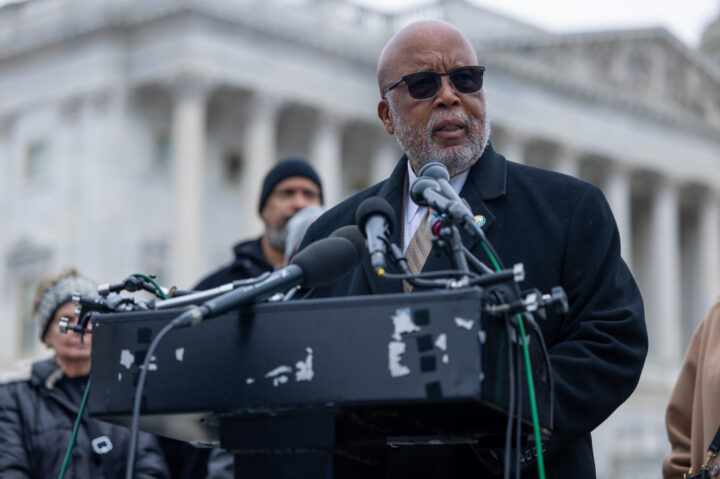
Rep. Bennie Thompson (D-MI) speaks at a press conference on the introduction of a House Resolution condemning January 6th pardons and the firing of DOJ prosecutors, in Washington, DC on February 5, 2025.
After repeatedly raising concerns about slow progress, a lack of transparency and a lack of accountability for Department of Homeland Security grant programs this year, including the Nonprofit Security Grant Program, Democrats on the House Homeland Security Committee introduced legislation on Tuesday that aims to put in place stricter guidelines for the management of such programs.
Reps. Tim Kennedy (D-NY) and Bennie Thompson (D-MS) are leading the DHS Grants Accountability Act, which — according to an information sheet from its sponsors — would implement new transparency measures and consistent standards for how DHS allocates grant funding, require FEMA to allow applicants at least 30 days to prepare and submit their applications and to open applications within 60 days of when funding is appropriated and mandate that FEMA award grants annually.
The legislation comes after lawmakers raised concerns about the Trump administration’s management of various DHS grant programs, including the NSGP. The application process for the 2026 NSGP allocations opened months late and on a significantly reduced timeline, and lawmakers have raised concerns about a lack of transparency from DHS and other issues with NSGP’s management this year.
“I am proud to lead legislation that makes commonsense, necessary reforms to restore fairness and predictability to FEMA’s suite of preparedness grant programs,” Kennedy said in a statement. “When local needs are placed at the forefront of these funding decisions, communities can focus on what matters most: keeping people safe.”
Thompson, the ranking member of the House Homeland Security Committee, said the bill would “clarify congressional intent and ensure that FEMA awards grants based on need and in a timely and reliable manner” and “keep our preparedness grants consistent and transparent, giving States and local partners the stability they need to keep our communities safe.”
Without Republican support, the legislation is unlikely to move forward in the current Congress.
Please log in if you already have a subscription, or subscribe to access the latest updates.
 Continue with Google
 Continue with Apple